
The Right Circular Cone: Radius, Height and Slant Height
A right circular cone stands on a circular base, with its vertex directly above the centre of the base. Three lengths describe it: the radius r of the base, the height h (from the vertex straight down to the centre), and the slant height l (from the vertex to any point on the edge of the base).
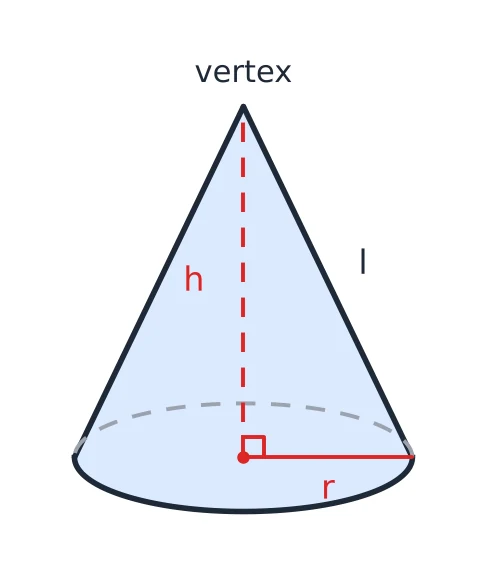
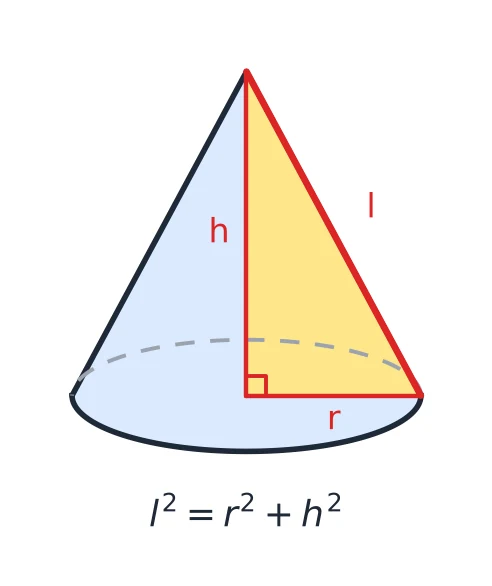
The height and the radius meet at right angles at the centre, and the slant height joins their ends. So h, r and l form a right triangle with l as the hypotenuse:
Question setters build cones on Pythagorean triplets so that l comes out whole:
| Triplet | Cones built on it (r, h, l) |
|---|---|
| 3, 4, 5 | 6, 8, 10 and 9, 12, 15 |
| 5, 12, 13 | 5, 12, 13 |
| 7, 24, 25 | 7, 24, 25 |
| 8, 15, 17 | 8, 15, 17 and 16, 30, 34 |
| 20, 21, 29 | 21, 20, 29 or 20, 21, 29 |
Either of the two shorter numbers can be the radius. A cone with r = 12 cm and h = 5 cm also has l = 13 cm; it is just wide and flat instead of tall.
Diameter given. A cone of base diameter 14 cm and height 24 cm has r = 7 cm and l = 25 cm. Using 14 in the formula gives , not a whole number, which is a good sign that the diameter went in by mistake.
Not every cone is a triplet. With r = 4 cm and h = 6 cm, cm; the options will then carry the root.
The slant height is always the longest of the three: l is more than h and more than r. If your working gives a height bigger than the slant, a radius and a diameter have been mixed up somewhere.
Curved Surface and Total Surface of a Cone
Cut the curved surface along one slant line and open it out flat. You get a sector of a circle. Its radius is the slant height l, and its arc is the edge that went round the base, so the arc is .
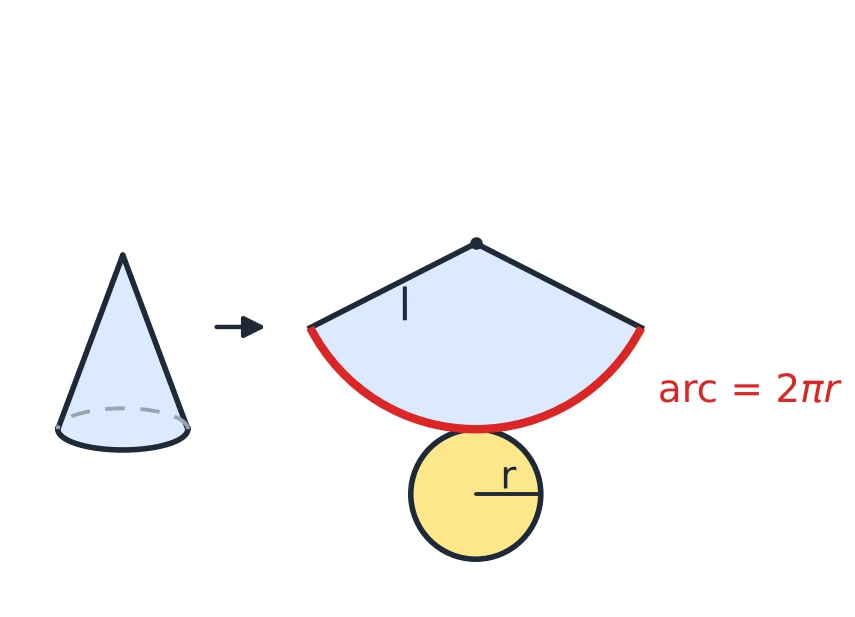
The area of a sector is × arc × radius (see Chapter 13), so
A solid cone also has its circular base:
For r = 7 cm and h = 24 cm, the slant is 25 cm. Then CSA = cm², the base is 154 cm², and TSA = 704 cm². The factored form gives the same: cm².
With kept in the options: r = 8 cm and h = 6 cm give l = 10 cm, so CSA = cm² and TSA = cm².
Which surface?
| Object | Surface to use |
|---|---|
| Tent, funnel, joker's cap, conical roof, ice-cream cone | only (no base) |
| Solid cone of wood or metal, a toy top |
[SSC Tip] The curved surface needs the slant height, not the height. When a question gives r and h, find l first. Here cm² is the wrong answer you are most likely to see next to 550 cm².
Volume of a Cone: One Third of the Cylinder
Take a cone and a cylinder with the same base and the same height. Fill the cone with water and pour it into the cylinder: it takes exactly three cones to fill the cylinder. So
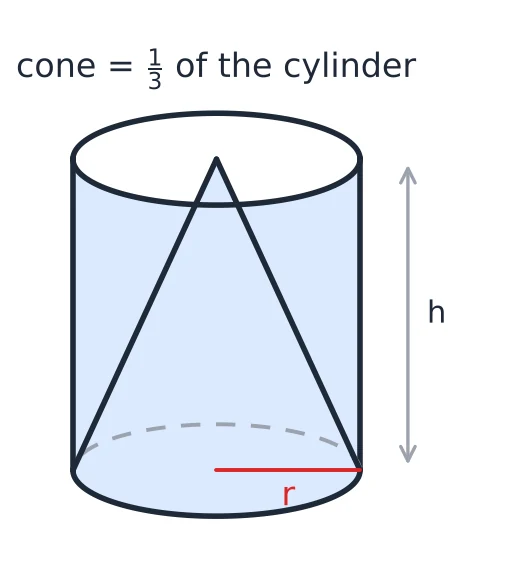
For r = 7 cm and h = 24 cm, cm³. The cylinder on the same base with the same height holds 3 × 1232 = 3696 cm³.
The volume uses the height h, not the slant l. Putting l = 25 cm in place of h gives about 1283 cm³, close enough to 1232 cm³ to look right, so check which length you used.
Cone and cylinder together.
- Same base and same height: volumes 1 : 3. If the two together hold 1848 cm³, that is 4 equal parts, so the cone holds cm³ and the cylinder 1386 cm³.
- Same radius and equal volumes: gives H = 3h, so the cone is three times as tall.
- Same height and equal volumes: gives , so the cone's radius is times the cylinder's.
Capacity in litres. Divide cm³ by 1000. A conical flask of radius 10.5 cm and height 18 cm holds cm³, which is 2.079 litres.
Quick check on any answer: a cone's volume must be less than half of . If your answer is not, the has gone missing.
Finding the Missing Measurement
Two facts about a cone are enough to find everything else. Most of the time the route goes through the right triangle of h, r and l.
- Height from the volume and the radius. . A cone of volume 1848 cm³ and radius 7 cm has cm.
- Radius from the volume and the height. . Volume 2464 cm³ and height 12 cm: , so r = 14 cm.
- Radius from the curved surface and the slant. . CSA 550 cm² and l = 25 cm give r = 7 cm, and then h = 24 cm from the triplet.
- Volume from the slant and the height. l = 26 cm and h = 24 cm give r = 10 cm, so cm³.
- Radius from the total surface and the slant. with l = 10 cm means r(10 + r) = 144. Try the factor pairs of 144: 8 × 18 works, so r = 8 cm.
Radius and height in a ratio. With r : h = 3 : 4, the slant is 5 parts. If l = 20 cm, one part is 4 cm, so r = 12 cm, h = 16 cm and cm³.
Surface ratios in words. CSA : base area = = l : r. So 'the curved surface is twice the base area' means l = 2r, and then . 'The total surface is three times the base area' means l + r = 3r, which again gives l = 2r.
Write down which of r, h, l you already have before choosing a formula. The surfaces need l, the volume needs h, and the triangle links the two.
Comparing Two Cones
The and the cancel in a ratio, so two cones compare just like two cylinders:
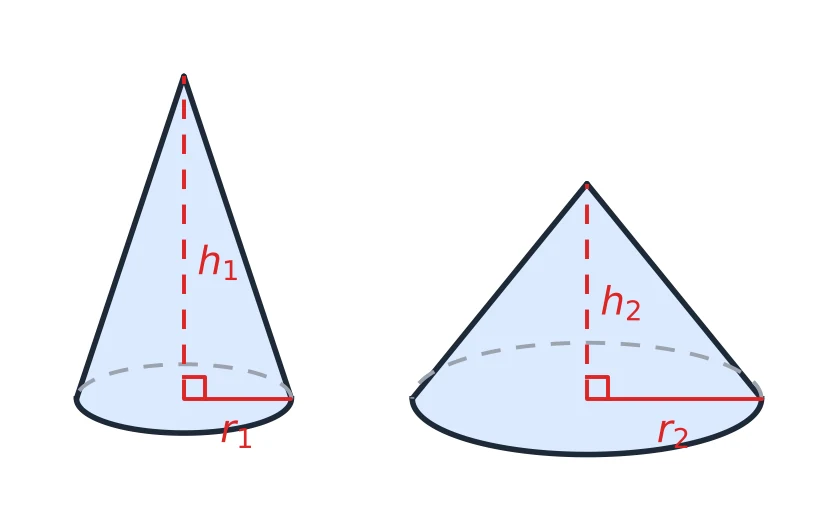
- Radii 3 : 4 and heights 2 : 3 give volumes .
- Equal volumes: the heights go the opposite way to the squares of the radii. Radii 2 : 3 give heights 9 : 4.
- Same height: volumes are as the squares of the radii. Same radius: volumes are as the heights.
Curved surfaces need the slants. A ratio of radii and a ratio of heights do not give the ratio of slant heights unless the cones have the same shape. Work out each l. Cones with r = 5, h = 12 (l = 13) and r = 8, h = 15 (l = 17) have curved surfaces .
Cones of the same shape. If one cone is an enlargement of the other (radius and height both multiplied by the same k), then
| Lengths (r, h, l) | Surfaces | Volumes |
|---|---|---|
| k |
Heights 2 : 3 give curved surfaces 4 : 9 and volumes 8 : 27. Going back, volumes 27 : 64 mean heights 3 : 4.
Percentage change. It works as for the cylinder (see Cylinders and Hollow Cylinders): the radius counts twice in the volume and the height once. Radius up 10% with the height fixed: volume up 21%. Radius and height both up 10%: volume up 33.1%.
A Cone Made from a Sector, and Back
Cut a sector out of a sheet and bring its two straight edges together. It curls into the curved surface of a cone with no base. Three things carry over:
- the sector's radius becomes the slant height of the cone: l = L;
- the sector's arc becomes the circumference of the base: , so ;
- the sector's area becomes the curved surface of the cone.
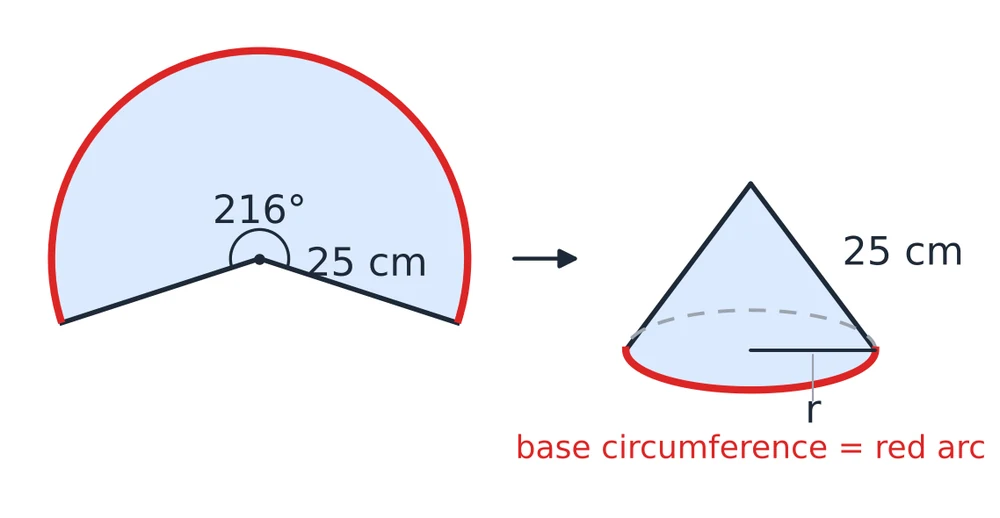
A sector of angle 216° is cut from a circle of radius 25 cm. Then l = 25 cm and cm, so cm and the volume is cm³. As a check, the curved surface cm² equals the sector's area, cm².
Shapes that come up.
- A semicircle (180°) gives . From a semicircle of radius 14 cm: l = 14 cm, r = 7 cm and cm.
- A quadrant (90°) gives .
- A circle with a sector cut away: use the angle that is left, 360° minus the part removed.
Going back: cone to sector. Cut a cone's curved surface along a slant and lay it flat. The sector angle is
A cone with r = 9 cm and l = 24 cm opens into a sector of .
Compare with rolling a sheet into a cylinder, where a side of the sheet became the circumference. Here the radius of the sheet becomes the slant, never the radius of the cone.
Conical Tents: Canvas, Cost and Air Space
A conical tent is a cone with no canvas on the floor, so the canvas needed is the curved surface . Find the slant height first.
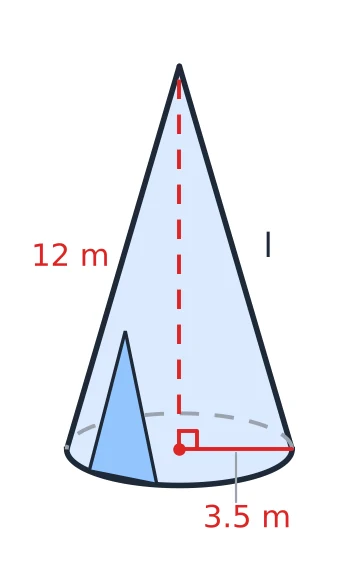
A tent has radius 3.5 m and height 12 m. Then m, and the canvas is m².
Length of canvas. Canvas is sold in rolls of a fixed width, and the rate may be per metre of length. Since area = length × width,
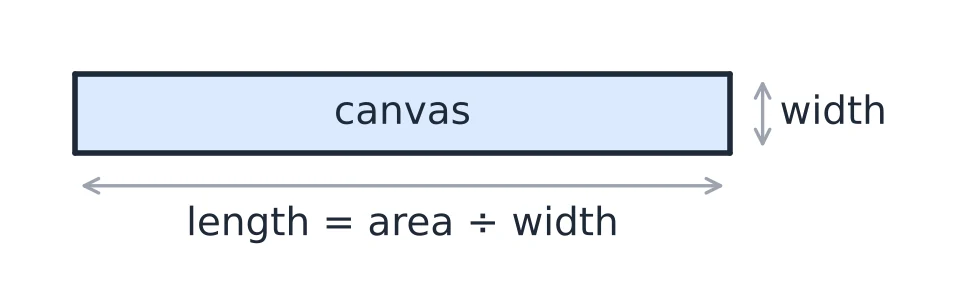
With canvas 1.25 m wide, the tent needs m. At ₹80 per metre the canvas costs ₹8,800. If the rate is per m², multiply the area by it directly. If some canvas is wasted in cutting and stitching, add that extra area (or length) before working out the cost.
Air space and floor space.
- Air inside = volume = m³.
- Floor = base area = m².
- For 11 people, each gets m² of floor and m³ of air.
Height from the needs of each person. If each person needs a m² of floor and b m³ of air, then for n people and . Dividing, , so
whatever the number of people. With 3 m² of floor and 12 m³ of air each, the tent must be 12 m high.
[SSC Tip] Two different rates appear in tent questions: per metre of canvas (divide the area by the width first) and per m² (use the area as it is). Read the unit of the rate before you multiply.
Heaps of Grain or Sand
Grain, sand or gravel poured on level ground settles into a cone. The amount in the heap is its volume, , and the sheet needed to cover it is its curved surface, . The base lies on the ground, so it is never covered.
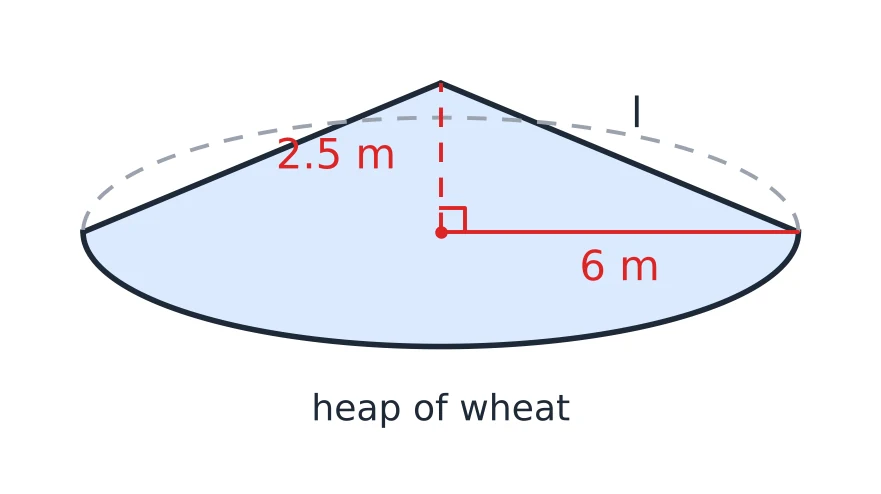
A heap of wheat has radius 6 m and height 2.5 m. The slant is m (the 5, 12, 13 triplet halved). With = 3.14:
- volume = m³;
- canvas to cover it = 3.14 × 6 × 6.5 = 122.46 m².
In terms of these are m³ and m².
Base circumference given. Some questions describe a heap by the distance round its bottom. A heap with base circumference 44 m has m. If it is 3 m high, it holds m³.
Bags and containers. The number of bags is the volume of the heap divided by the volume of one bag. If each bag holds 0.11 m³, the 154 m³ heap fills bags. When a heap is shifted into a tank or a pit, its volume stays the same; that idea is worked out fully in Combined Solids, Melting and Recasting.
Heaps are wide and low, so r is usually much bigger than h. If your slant comes out shorter than the radius, check the arithmetic: l must be the longest of the three.
A Cone Cut Parallel to Its Base
A plane parallel to the base cuts a cone into two pieces: a small cone on top and a frustum below. The small cone has exactly the same shape as the whole cone, because the cross-section shows two similar right triangles.
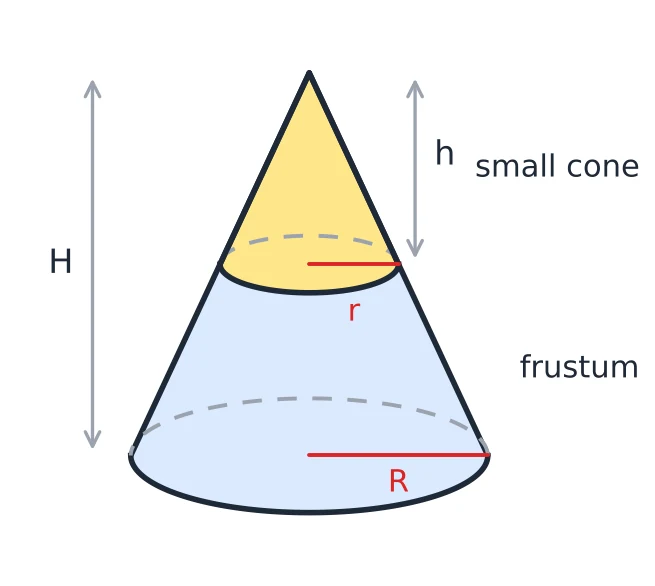
If the small cone's height is k times the whole height, then its radius and slant are also k times, so
Cut through the middle of the height. Here k = . The small cone is of the volume, and the frustum is the other . So
- small cone : frustum (volume) = 1 : 7;
- small cone : whole cone (volume) = 1 : 8;
- small cone : frustum (curved surface) = 1 : 3, since the small cone has of the curved surface.
Cut at one third of the height from the vertex. k = , so the small cone is of the volume and the two parts are 1 : 26.
Where to cut. A cone is 30 cm high, and the small cone cut off the top must have of the volume. Then , k = , and the small cone is 7.5 cm high. So the cut is 7.5 cm below the vertex, which is 22.5 cm above the base. Read whether the question measures from the vertex or from the base.
Two parts of equal volume. Then and ; the cut is not at the middle of the height.
[SSC Tip] 'Cut through the middle' halves the height, not the volume. The pieces are 1 : 7 by volume, and the options usually also offer 1 : 1, 1 : 3 and 1 : 8. Decide whether the question compares the small cone with the frustum or with the whole cone.
The Frustum: Volume
A frustum is what is left of a cone after a small cone has been cut off the top. Buckets, tumblers, lampshades and flower pots are frustums. It has two circular ends, of radii R (the larger) and r (the smaller), and a height h between them.
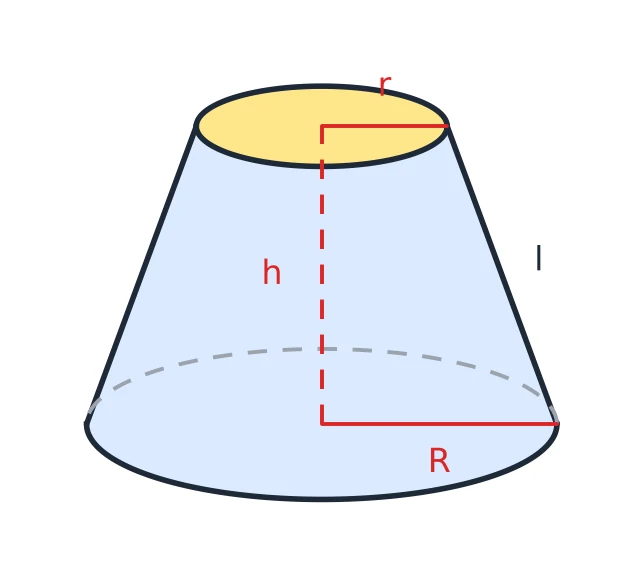
Its volume is the big cone minus the small cone. Working that out with similar triangles gives
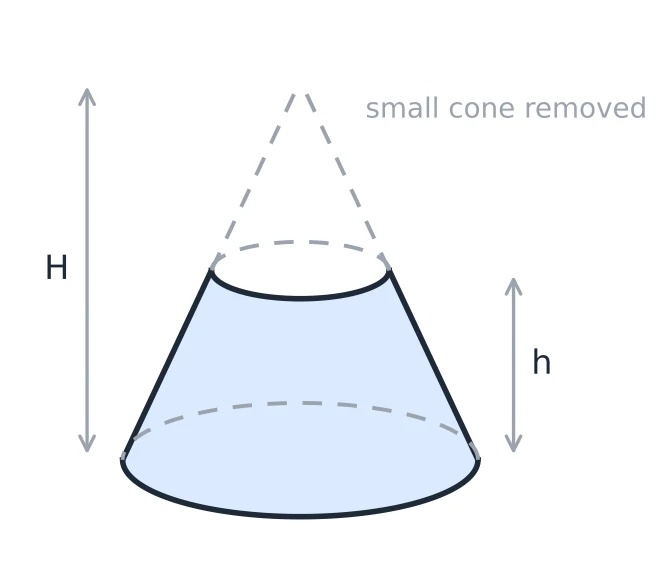
Check it once by subtraction. Take R = 6 cm, r = 3 cm, h = 7 cm. Since r is half of R, the small cone is half as tall as the big one, so the big cone is 14 cm high and the small one 7 cm.
- Big cone: .
- Small cone: .
- Frustum: cm³.
The formula gives cm³, the same.
With . R = 10.5 cm, r = 7 cm, h = 6 cm: cm³, which is 1.463 litres.
Two shortcuts that do not work.
- A cylinder with the average radius, . Here that is 1443.75 cm³, too small.
- , which drops the middle term Rr.
The middle term is the product of the two radii, not their sum, and the whole bracket is multiplied by , a third of the height.
Slant Height and Surfaces of a Frustum; Buckets
Cut a frustum down the middle and you see a trapezium. Drop a perpendicular from the edge of the top to the base: it makes a right triangle whose legs are the height h and the difference of the radii, R − r.
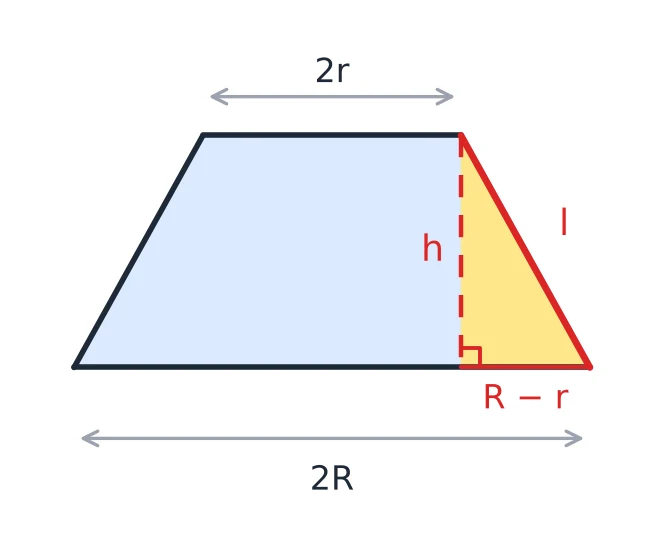
Then
The curved surface is the average of the two circumferences times the slant, much like the area of a trapezium.
Take R = 10.5 cm, r = 3.5 cm and h = 24 cm. Then cm (the 7, 24, 25 triplet with R − r = 7). CSA = cm². The two ends add 346.5 + 38.5 = 385 cm², so the total surface is 1485 cm².
Buckets. A bucket is a frustum standing on its smaller end, open at the wide top and closed at the bottom.
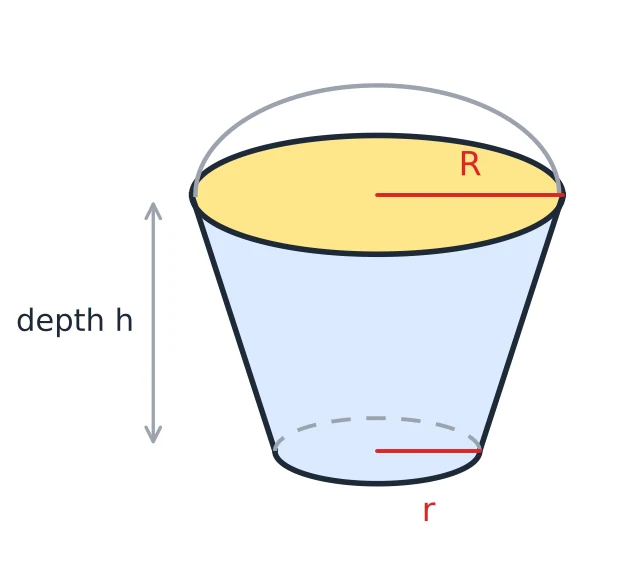
- Metal sheet for the bucket = (the small circle at the bottom only).
- Capacity = the frustum's volume, usually wanted in litres.
A bucket 24 cm deep with top radius 10.5 cm and bottom radius 3.5 cm needs 1100 + 38.5 = 1138.5 cm² of sheet and holds cm³, that is 4.004 litres.
The slips to watch: using h where l is needed, using R + r instead of R − r inside the root, and adding the open top of the bucket to the sheet.
Solved Examples
Question 1
A cone has base radius 16 cm and height 30 cm. What is its curved surface area? (a) cm² (b) cm² (c) cm² (d) cm²
Answer. First the slant: cm (the 8, 15, 17 triplet doubled). Curved surface = = (a) cm². I nearly wrote , but the height is not the slant.
Question 2
Find the total surface area of a solid cone of radius 21 cm and height 20 cm. (Take .) (a) 1914 cm² (b) 2706 cm² (c) 3300 cm² (d) 4686 cm²
Answer. Slant = cm (20, 21, 29). TSA = = (c) 3300 cm². A cone has only one base, so I add once.
Question 3
What is the volume of a cone whose base radius is 3.5 cm and height is 12 cm? (Take .) (a) 462 cm³ (b) 154 cm³ (c) 616 cm³ (d) 77 cm³
Answer. . The base is 38.5 cm², and a third of 12 is 4, so V = 38.5 × 4 = (b) 154 cm³. Without the you get 462 cm³, which is the cylinder.
Question 4
The volume of a cone is 2156 cm³ and the radius of its base is 7 cm. What is its height? (Take .) (a) 14 cm (b) 21 cm (c) 84 cm (d) 42 cm
Answer. . The base area is cm², so = (d) 42 cm. Dividing 2156 by 154 alone gives 14 cm, the height of a cylinder with the same volume.
Question 5
The curved surface area of a cone is 2200 cm² and the radius of its base is 14 cm. What is its volume? (Take .) (a) 9856 cm³ (b) 29568 cm³ (c) 4928 cm³ (d) 19712 cm³
Answer. gives cm. Then cm (7, 24, 25 doubled). Volume = = (a) 9856 cm³.
Question 6
The slant height of a cone is 29 cm and its curved surface area is cm². What is its volume? (a) cm³ (b) cm³ (c) cm³ (d) cm³
Answer. , so r = 20 cm. Then cm. Volume = = (c) cm³.
Question 7
The radii of two cones are in the ratio 2 : 3 and their heights are in the ratio 9 : 8. What is the ratio of their volumes? (a) 3 : 4 (b) 1 : 2 (c) 2 : 3 (d) 4 : 9
Answer. Volume goes with . So the ratio is = (b) 1 : 2.
Question 8
Two cones have equal volumes. Their radii are in the ratio 4 : 5. What is the ratio of their heights? (a) 5 : 4 (b) 16 : 25 (c) 4 : 5 (d) 25 : 16
Answer. Equal volumes means , so . The answer is (d) 25 : 16. The narrower cone has to be the taller one, which matches.
Question 9
A cone and a cylinder have the same base radius and the same volume. The height of the cylinder is 9 cm. What is the height of the cone? (a) 27 cm (b) 3 cm (c) 9 cm (d) 18 cm
Answer. . The cancels, so and H = (a) 27 cm. A cone holds a third of the cylinder on the same base, so it must be three times as tall to hold the same amount.
Question 10
Two cones have the same shape. Their heights are 6 cm and 9 cm, and the volume of the larger cone is 540 cm³. What is the volume of the smaller cone? (a) 360 cm³ (b) 240 cm³ (c) 160 cm³ (d) 120 cm³
Answer. Same shape means every length is in the ratio 6 : 9 = 2 : 3, so the volumes are in the ratio . Smaller volume = = (c) 160 cm³. Multiplying by only (360 cm³) treats volume like a length.
Question 11
A sector of angle 288° is cut from a circle of radius 15 cm and folded into a cone. What is the volume of the cone? (a) cm³ (b) cm³ (c) cm³ (d) cm³
Answer. The radius of the sheet becomes the slant, so l = 15 cm. The arc becomes the base circumference: cm. Then cm, and = (b) cm³. Using 15 cm as the height gives cm³, but 15 is the slant.
Question 12
The curved surface of a cone of base radius 7 cm and slant height 18 cm is cut along a slant line and laid flat. What is the angle of the sector formed? (a) 70° (b) 280° (c) 160° (d) 140°
Answer. The sector's radius is the slant, 18 cm, and its arc is the base circumference, . So , which gives = (d) 140°.
Question 13
A semicircular sheet of radius 14 cm is bent into a cone. What is the volume of the cone? (Take .) (a) cm³ (b) cm³ (c) cm³ (d) cm³
Answer. The slant is the sheet's radius, 14 cm. The arc of a semicircle is half the circle, so and r = 7 cm. Then cm. Volume = , which is (a) cm³.
Question 14
A conical tent has a base radius of 10.5 m and a height of 14 m. Canvas 2.5 m wide costs ₹50 per metre. What is the cost of the canvas for the tent? (Take .) (a) ₹28,875 (b) ₹9,240 (c) ₹11,550 (d) ₹5,775
Answer. Slant: m (3, 4, 5 times 3.5). Canvas area = m². The canvas is 2.5 m wide, so the length is m, and the cost is 231 × 50 = (c) ₹11,550. The rate is per metre, so multiplying the area by ₹50 (₹28,875) is wrong.
Question 15
A conical tent is to be put up for a group of people. Each person needs 3.5 m² of floor and 21 m³ of air. What must the height of the tent be? (a) 6 m (b) 18 m (c) 9 m (d) 12 m
Answer. For n people, the floor is and the air is . Putting the first into the second: , so = (b) 18 m. The number of people cancels out, which is why it is not given.
Question 16
A conical heap of rice has a base circumference of 31.4 m and a height of 1.8 m. What is the volume of the heap? (Take = 3.14.) (a) 141.3 m³ (b) 188.4 m³ (c) 15.7 m³ (d) 47.1 m³
Answer. From , r = m. Volume = = (d) 47.1 m³.
Question 17
A conical heap of sand is 1.2 m high and its base radius is 3.5 m. How much canvas is needed to cover it? (Take .) (a) 40.7 m² (b) 13.2 m² (c) 79.2 m² (d) 81.4 m²
Answer. The base is on the ground, so only the curved surface is covered. Slant = m (the 12, 35, 37 triplet divided by 10). Canvas = = (a) 40.7 m². Adding the base (79.2 m²) would put canvas under the sand.
Question 18
A cone is cut by a plane parallel to its base, through the midpoint of its height. What is the ratio of the volume of the small cone to the volume of the frustum? (a) 1 : 8 (b) 1 : 3 (c) 1 : 7 (d) 1 : 1
Answer. The small cone has half the height and half the radius, so its volume is of the whole. The frustum is the remaining . Small cone : frustum = = (c) 1 : 7. The 1 : 8 compares the small cone with the whole cone, which is not what was asked.
Question 19
A cone is 24 cm high. A plane parallel to its base cuts off a small cone whose volume is of the whole cone. At what height above the base is the cut made? (a) 8 cm (b) 16 cm (c) 12 cm (d) 18 cm
Answer. Volumes go as , so and k = . The small cone is cm high, measured down from the vertex. So the cut is 24 − 8 = (b) 16 cm above the base.
Question 20
The curved surface area of a cone is twice the area of its base, and its base radius is 6 cm. What is its volume? (a) cm³ (b) cm³ (c) cm³ (d) cm³
Answer. gives l = 2r = 12 cm. Then cm. Volume = = (d) cm³.
Question 21
A frustum of a cone has end radii 9 cm and 3 cm and a height of 5 cm. What is its volume? (a) cm³ (b) cm³ (c) cm³ (d) cm³
Answer. = (a) cm³. I keep the middle term Rr = 27; dropping it gives cm³.
Question 22
A frustum has end radii 13 cm and 7 cm and a height of 8 cm. What is its curved surface area? (a) cm² (b) cm² (c) cm² (d) cm²
Answer. The slant uses the difference of the radii: cm. CSA = = (c) cm². With the height in place of the slant you would get cm².
Question 23
A bucket is 12 cm deep. The radius of its top is 14 cm and the radius of its bottom is 3.5 cm. How many litres of water can it hold? (Take .) (a) 9.702 litres (b) 3.234 litres (c) 2.8875 litres (d) 32.34 litres
Answer. Capacity = cm³. Dividing by 1000 gives (b) 3.234 litres. A cylinder with the average radius 8.75 cm would give about 2.89 litres, which is too small.
Question 24
An open bucket is 8 cm deep, with a top radius of 16 cm and a bottom radius of 10 cm. How much metal sheet is needed to make it? (Take = 3.14.) (a) 816.4 cm² (b) 1934.24 cm² (c) 653.12 cm² (d) 1130.4 cm²
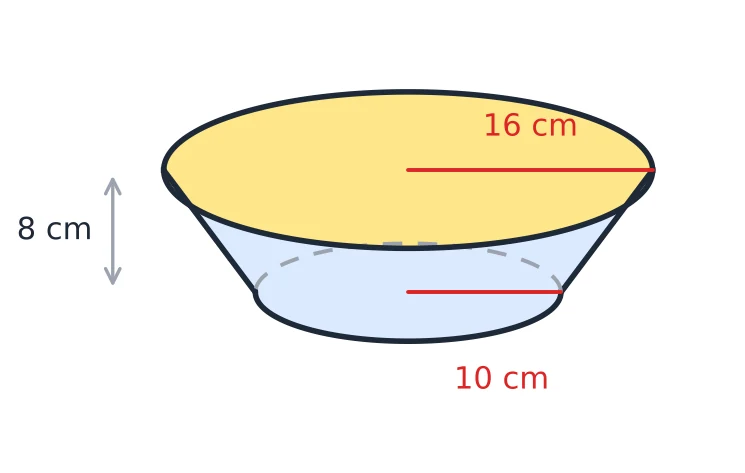
Answer. Slant = cm. Curved surface = 3.14 × (16 + 10) × 10 = 816.4 cm². The bucket is open at the top, so only the bottom circle is added: 3.14 × 100 = 314 cm². Sheet = 816.4 + 314 = (d) 1130.4 cm².