
Right Prisms: Base Area × Height
A prism is a solid with two equal, parallel ends (the bases) joined by flat side faces. In a right prism the side edges stand at right angles to the bases, so every side face is a rectangle. A prism takes its name from its base: triangular, square, pentagonal, hexagonal and so on. A cuboid is simply a right prism on a rectangle.
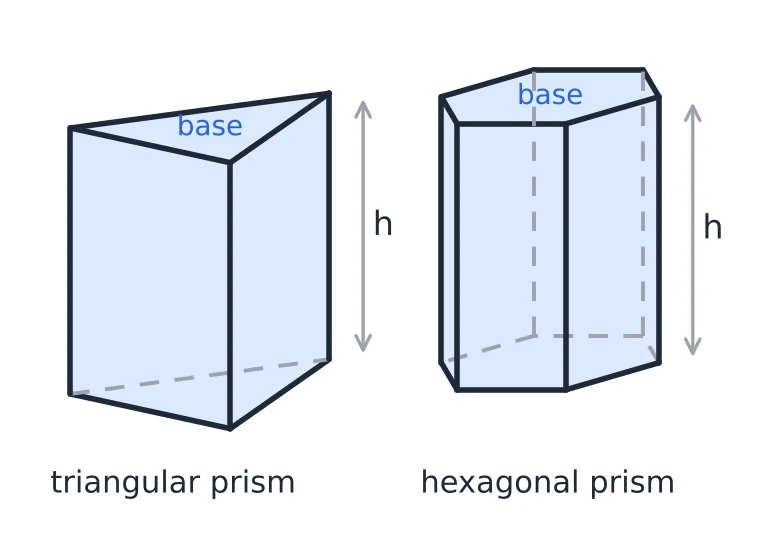
Every slice parallel to the base is a copy of the base, and the side faces are rectangles of height h whose widths are the sides of the base. That gives three formulas:
A prism whose base has area 24 cm² and perimeter 20 cm, standing 10 cm high, has volume 240 cm³, lateral surface 200 cm² and total surface 200 + 48 = 248 cm².
So the volume needs the area of the base and the lateral surface needs its perimeter. The base is a plane figure from Chapter 13; these are the ones that appear in prism questions:
| Base | Area | Perimeter |
|---|---|---|
| Equilateral triangle, side a | 3a | |
| Right triangle, legs p and q | ||
| Square, side a | 4a | |
| Rhombus, diagonals and | ||
| Trapezium, parallel sides a and b, gap d | sum of the four sides | |
| Regular hexagon, side a | 6a |
The same three formulas give the cylinder as well, with a circle as the base (Cylinders and Hollow Cylinders).
Triangular Prisms: Right-Angled and Equilateral Bases
Right-angled base. Take a prism 10 cm high whose base is a right triangle with legs 9 cm and 12 cm. The hypotenuse is cm.
- Base area = cm², and base perimeter = 9 + 12 + 15 = 36 cm.
- Volume = 54 × 10 = 540 cm³.
- Lateral surface = 36 × 10 = 360 cm².
- Total surface = 360 + 2 × 54 = 468 cm².
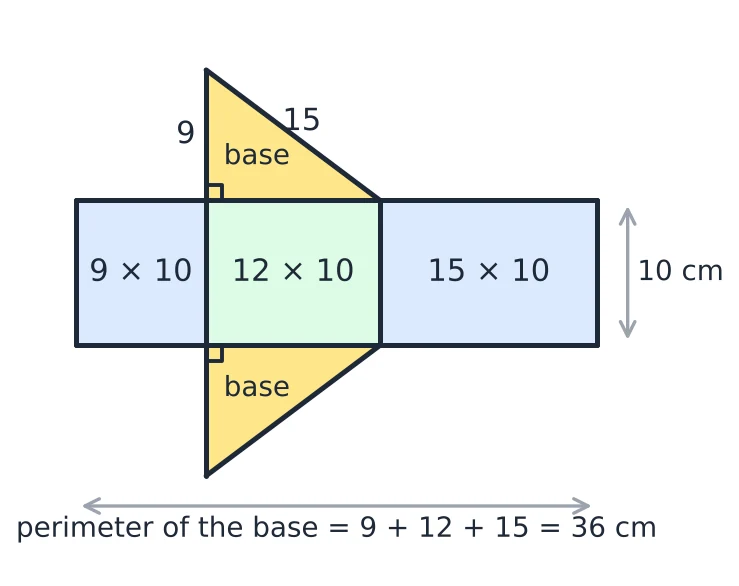
The net shows why. The three side faces, 9 × 10, 12 × 10 and 15 × 10, sit in one strip 36 cm long, and the two triangles at the ends are the bases.
Equilateral base. A prism 10 cm high on an equilateral triangle of side 8 cm:
- Base area = cm², and base perimeter = 24 cm.
- Volume = cm³, about 277 cm³.
- Lateral surface = 24 × 10 = 240 cm².
- Total surface = cm².
Any other triangle. Find the base area first, by half of base times height or by Heron's formula (Chapter 13). An isosceles base with sides 13, 13 and 10 cm has height cm and area 60 cm². On a prism 7 cm high the volume is 420 cm³ and the lateral surface is 36 × 7 = 252 cm².
[SSC Tip] The hypotenuse does not enter the base area, but it does enter the perimeter. In the first prism above, leaving the 15 cm side out of the perimeter gives a lateral surface of 21 × 10 = 210 cm² instead of 360 cm².
Prisms on Square, Rhombus and Trapezium Bases
Square base. Side a and height h: volume , lateral surface 4ah, total surface . This is just a cuboid a × a × h. With a = 5 cm and h = 12 cm: volume 300 cm³, lateral surface 240 cm², total surface 290 cm².
Rhombus base. The area comes from the diagonals, but the perimeter needs the side, and the side is found from the half-diagonals, because the diagonals of a rhombus bisect each other at right angles.
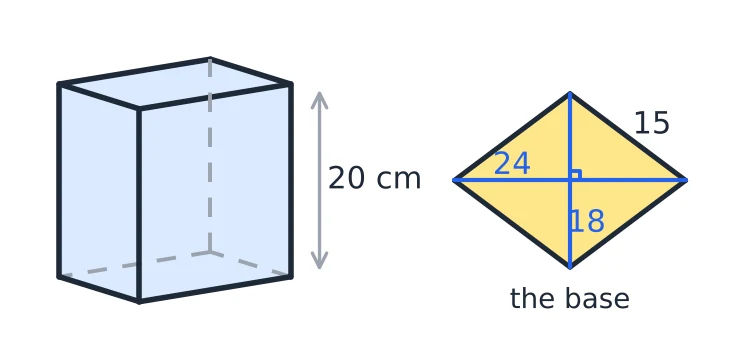
A prism 20 cm high on a rhombus with diagonals 24 cm and 18 cm:
- Base area = cm².
- Side = cm, so the perimeter is 60 cm.
- Volume = 216 × 20 = 4320 cm³, lateral surface = 60 × 20 = 1200 cm², total surface = 1200 + 432 = 1632 cm².
Trapezium base: troughs and channels. A prism can lie on its side. A trough or a canal with a trapezium-shaped cross-section is a prism lying down, and its length plays the part of the height.
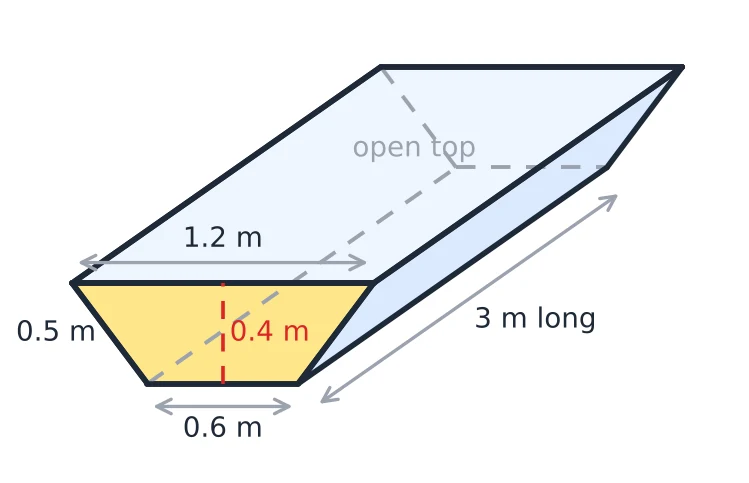
The trough in the figure is 1.2 m wide at the top, 0.6 m at the bottom, 0.4 m deep and 3 m long. Each sloping side overhangs by m, so it is m wide.
- Cross-section = m².
- Volume = 0.36 × 3 = 1.08 m³, so the trough holds 1080 litres.
- Metal needed (no top): the bottom and the two slopes are rectangles 3 m long, (0.6 + 0.5 + 0.5) × 3 = 4.8 m², and the two trapezium ends add 2 × 0.36 = 0.72 m². In all, 5.52 m².
Regular Hexagonal Prisms
Lines from the centre to the six corners cut a regular hexagon of side a into six equilateral triangles of side a. So
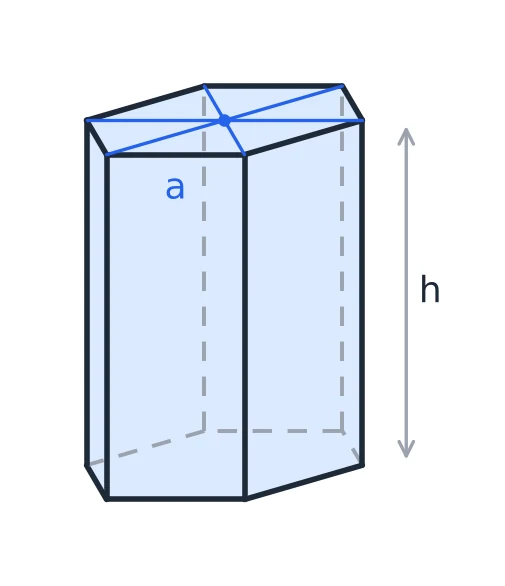
A hexagonal prism with side 4 cm and height 10 cm:
- Base area = cm².
- Volume = cm³, about 415.7 cm³.
- Lateral surface = 6 × 4 × 10 = 240 cm².
- Total surface = cm².
Two widths of a hexagon. Across two opposite corners a regular hexagon measures 2a. Across two opposite flat sides it measures (twice the height of one of the six triangles). A hexagonal rod that measures 12 cm across the flats has side cm, so its cross-section is cm².
Backwards. A hexagonal prism 5 cm high has volume cm³. Its base is cm², so , and the side is 4 cm.
Painting a pillar. Only the side faces of a pillar are painted. A hexagonal pillar with side 0.5 m and height 4 m has 6 × 0.5 × 4 = 12 m² of side surface, so painting it at ₹40 per m² costs ₹480.
When a question puts a pentagon or an octagon at the base, it normally states the base area. Then only the general rule, base area × height, is needed.
Working Backwards: Height, Side or Base from the Volume
Each prism formula can be turned round.
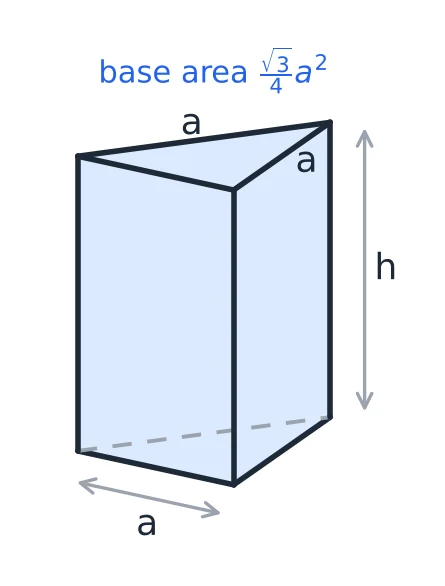
Height from the volume. An equilateral prism with side 6 cm has base area cm². If its volume is cm³, its height is cm. The cancels, so there is no need for 1.732.
Side of the base from the volume. An equilateral prism 10 cm high has volume cm³. The base area is , so , and a = 8 cm.
Height from the lateral surface. A prism on an equilateral triangle of side 12 cm has lateral surface 360 cm². The perimeter is 36 cm, so h = 360 ÷ 36 = 10 cm.
Side from the lateral surface. A prism 8 cm high on a square base has lateral surface 384 cm². The perimeter is 384 ÷ 8 = 48 cm, the side is 12 cm and the volume is 144 × 8 = 1152 cm³.
Comparing two prisms. If two prisms have equal bases, their volumes are in the ratio of their heights. If they have equal heights, their volumes are in the ratio of their base areas.
Faces, Edges and Vertices of Prisms and Pyramids
A prism on an n-sided base has n rectangles plus 2 bases, n edges on each base plus n side edges, and n corners on each base. A pyramid on an n-sided base has n triangles plus 1 base, n base edges plus n edges up to the apex, and n corners plus the apex.
| Solid | Faces | Edges | Vertices |
|---|---|---|---|
| Prism, n-sided base | n + 2 | 3n | 2n |
| Pyramid, n-sided base | n + 1 | 2n | n + 1 |
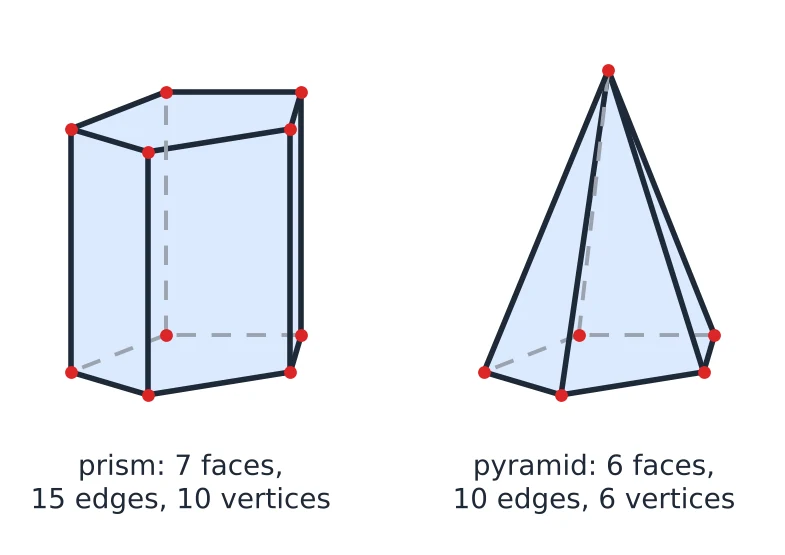
| Base | Prism (F, E, V) | Pyramid (F, E, V) |
|---|---|---|
| Triangle | 5, 9, 6 | 4, 6, 4 |
| Square | 6, 12, 8 | 5, 8, 5 |
| Pentagon | 7, 15, 10 | 6, 10, 6 |
| Hexagon | 8, 18, 12 | 7, 12, 7 |
Euler's formula. For every such solid (and any solid with flat faces and no holes through it),
The pentagonal prism in the figure: 7 + 10 − 15 = 2. The pentagonal pyramid: 6 + 6 − 10 = 2.
Using it. Find n first, then the rest.
- A prism with 24 edges: 3n = 24, so n = 8. It has 10 faces and 16 vertices.
- A pyramid with 9 faces: n + 1 = 9, so n = 8. It has 16 edges and 9 vertices.
- A solid with 12 faces and 30 edges: V = 2 − 12 + 30 = 20.
A pyramid on a pentagon has as many faces as vertices (6 each); that is true of every pyramid, since both are n + 1.
Right Pyramids: Height, Slant Height and Lateral Edge
A pyramid has a polygon for its base and triangular side faces that meet at one point, the apex V. In a right pyramid the apex is straight above the centre O of the base. In most questions the base is a regular polygon (an equilateral triangle, a square or a regular hexagon), so all the side faces are equal. Three lengths are used:
- the height h = VO, straight down to the centre of the base;
- the slant height l = VM, down the middle of a side face to the midpoint M of a base edge;
- the lateral edge e = VB, from the apex to a corner of the base.
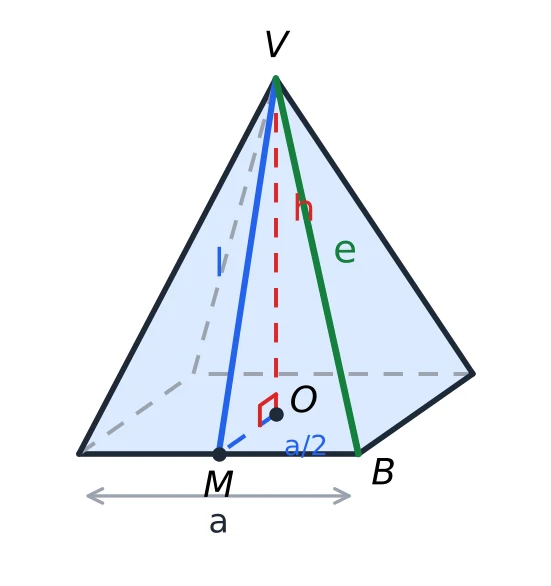
For a square base of side a, OM is half the side and OB is half the diagonal, . The right triangles VOM and VOB give
With a = 20 cm and h = 24 cm: cm, and cm, about 27.86 cm. The slant height always lies between the height and the lateral edge.
One from the others. Slant height 26 cm and base 20 cm give cm. Slant height 29 cm and height 21 cm give , so the base is 40 cm.
[SSC Tip] The slant height ends at the middle of a base edge, so it uses half the side. Putting the whole side into Pythagoras for a = 20, h = 24 gives cm, a wrong value that looks perfectly reasonable.
Volume of a Pyramid: One Third of the Prism
A pyramid holds exactly one third of the prism that has the same base and the same height.
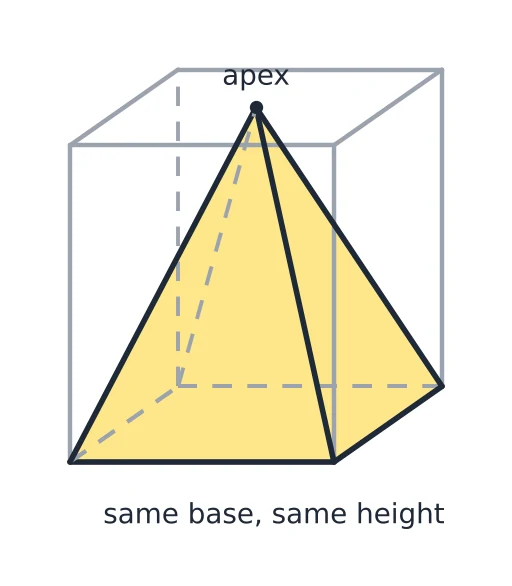
Why one third. Join the centre of a cube of edge a to its eight corners. This cuts the cube into 6 equal pyramids, one standing on each face, each with height . Each one is therefore , and the formula agrees: .
For example, a square pyramid with base 20 cm and height 24 cm has volume cm³. A prism on the same base with the same height holds 9600 cm³.
Height from the volume. A square pyramid with base 9 m has volume 486 m³. Then , so h = 18 m. Multiply the volume by 3 before dividing by the base area.
Comparing with a prism.
- Same base and same height: pyramid : prism = 1 : 3.
- Same base and same volume: the pyramid is 3 times as tall.
The h in the formula is the vertical height. If a question gives the slant height, find h from it first, as in the previous part.
Lateral and Total Surface Area of a Pyramid
Each side face of a right pyramid is a triangle. Its base is one side of the base polygon and its height is the slant height l. Adding all of them:
There is only one base here, unlike a prism. For a square base of side a the lateral surface is .
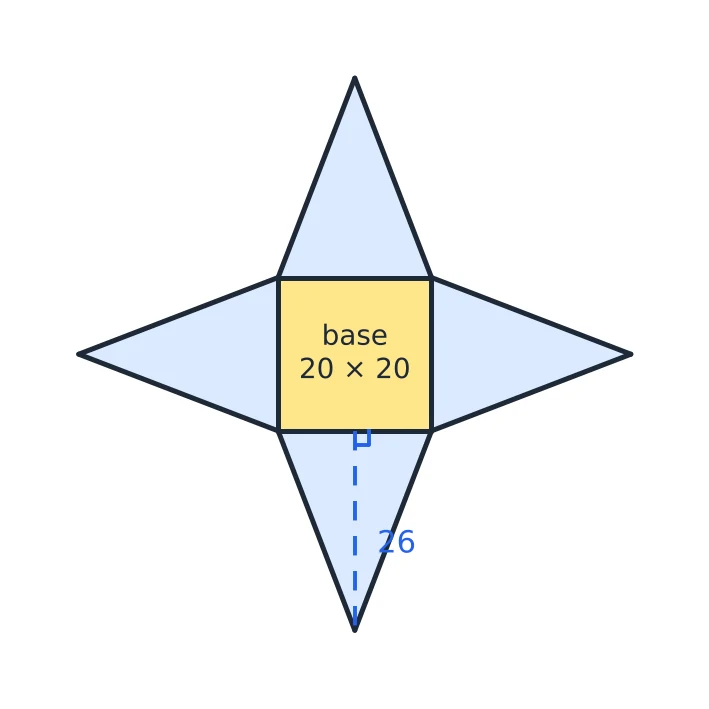
The net shows a square base of side 20 cm and four triangles of height 26 cm: lateral surface = cm² and total surface = 1040 + 400 = 1440 cm².
From the height to the surface. A square pyramid has base 16 cm and height 6 cm. The slant height is cm, so the lateral surface is cm² and the total surface 320 + 256 = 576 cm². Its volume is cm³.
Backwards. Lateral surface 1040 cm² on a 20 cm square base: 2 × 20 × l = 1040, so l = 26 cm and then h = 24 cm.
A pyramid-shaped tent. A tent on a square base of 6 m with height 4 m has slant height m. The canvas covers only the four sides: m². At ₹50 per m² it costs ₹3,000.
[SSC Tip] Surface uses the slant height; volume uses the vertical height. For the 16 cm pyramid above, putting h = 6 into the surface formula gives 192 cm² instead of 320 cm².
Pyramids on Rectangular and Hexagonal Bases
Rectangular base. A rectangle is not a regular polygon, so its pyramid has two slant heights. With base L × B and height h, the centre is from each long side and from each short side:
- on the two faces standing on the sides of length L, ;
- on the two faces standing on the sides of length B, .
Two triangles of each kind give lateral surface = .
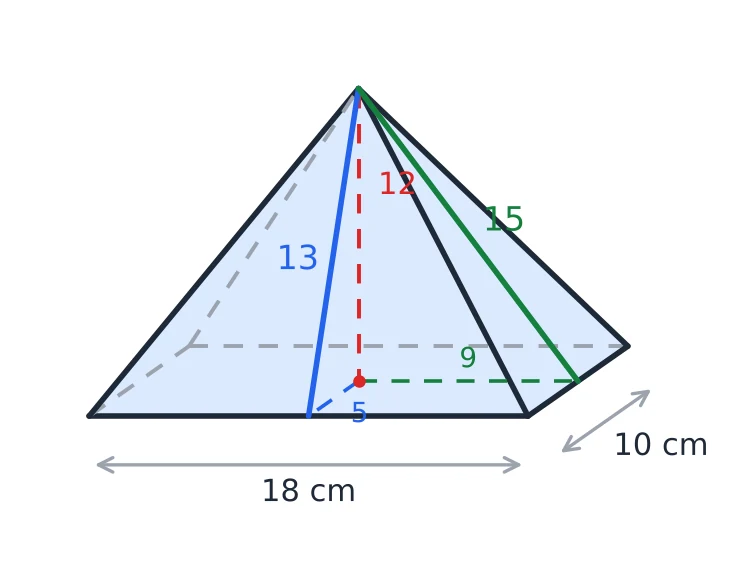
Base 18 cm × 10 cm and height 12 cm: cm on the 18 cm sides and cm on the 10 cm sides. Lateral surface = 18 × 13 + 10 × 15 = 234 + 150 = 384 cm², total surface = 384 + 180 = 564 cm², and volume = cm³. The longer side of the base gets the shorter slant height.
Hexagonal base. In a regular hexagon of side a, the centre is a from each corner and from each side (the height of one of the six equilateral triangles). So
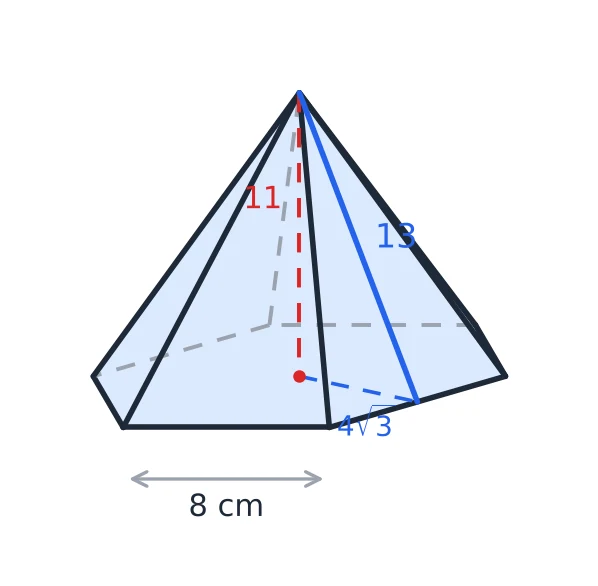
Side 8 cm and height 11 cm: the centre is cm from each side, so cm. Lateral surface = cm². The base is cm², and the volume is cm³. Each lateral edge is cm.
[Tier 2] Pyramid on an Equilateral Triangle
Here the base is an equilateral triangle of side a, and the apex stands above its centroid G (which is also its incentre and circumcentre). The median of the base is , and G divides it in the ratio 2 : 1, so
GM is the distance from G to a side (the inradius) and GA the distance to a corner (the circumradius).
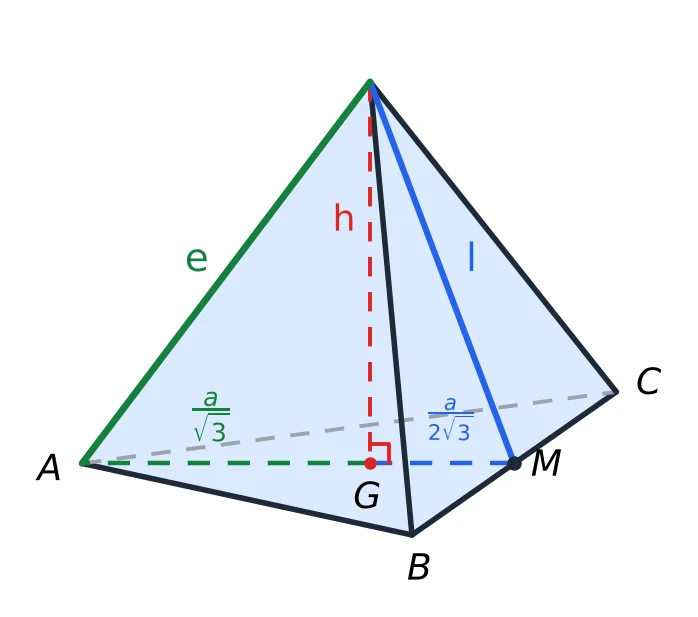
Right triangles VGM and VGA then give the slant height and the lateral edge:
For example, take a base side of cm and a height of 12 cm. Then GM = 5 cm and GA = 10 cm.
- Slant height cm, lateral edge cm.
- Base area = cm², so the volume is cm³.
- Lateral surface = cm², total surface = cm².
Backwards. On the same base, a lateral edge of 26 cm means cm.
Use GM with the slant height and GA with the lateral edge, and keep in mind that GA is twice GM.
[Tier 2] The Regular Tetrahedron
A regular tetrahedron is a triangular pyramid whose four faces are all equilateral triangles of side a. It has 4 faces, 6 edges and 4 vertices, every edge is a, and any face can serve as the base.
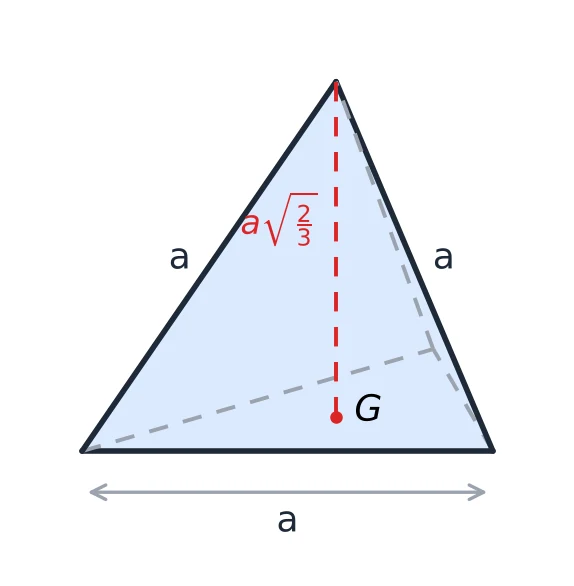
Its formulas all follow from the previous part, with the lateral edge e = a:
| Measure | Formula |
|---|---|
| Total surface (4 faces) | |
| Lateral surface (3 faces) | |
| Slant height (height of a face) | |
| Height | |
| Volume |
Where the height comes from. GA = and the lateral edge is a, so . The volume is then , which simplifies to .
For an edge of 6 cm: total surface cm², height cm, volume cm³.
Height of the solid or height of a face. Each face is an equilateral triangle, so the slant height is simply the height of a face, . For a = 6 that is cm (about 5.2 cm), while the height of the solid is cm (about 4.9 cm). The three side faces cover cm².
Backwards. Total surface cm² means , so a = 8 cm and the volume is cm³.
Solved Examples
Question 1
The base of a right prism is a right-angled triangle whose sides containing the right angle are 8 cm and 15 cm. The height of the prism is 12 cm. What is its volume? (a) 1,440 cm³ (b) 480 cm³ (c) 720 cm³ (d) 240 cm³
Answer. Base area = cm². Volume = base area × height = 60 × 12 = (c) 720 cm³. If you got 1,440 cm³, you multiplied 8 × 15 without the half.
Question 2
A right prism 10 cm high stands on a triangle with sides 7 cm, 24 cm and 25 cm. What is its total surface area? (a) 560 cm² (b) 728 cm² (c) 644 cm² (d) 896 cm²
Answer. , so the base is a right triangle with area cm². The perimeter is 56 cm, so the lateral surface is 56 × 10 = 560 cm². A prism has two bases: total = 560 + 2 × 84 = (b) 728 cm².
Question 3
The base of a prism is an equilateral triangle of side 6 cm and the prism is 9 cm high. What is its volume? (a) cm³ (b) cm³ (c) cm³ (d) cm³
Answer. Base area = cm². Volume = = (a) cm³. The belongs to a pyramid, not a prism, so is out.
Question 4
A prism 15 cm high has an equilateral triangle of side 10 cm as its base. What is its total surface area? (a) cm² (b) 450 cm² (c) cm² (d) cm²
Answer. Lateral surface = perimeter × height = 30 × 15 = 450 cm². Each base is cm², and there are two of them. Total = (d) cm². Adding only one base gives .
Question 5
A right prism has a rhombus as its base, with diagonals 24 cm and 10 cm. The prism is 20 cm high. What is its lateral surface area? (a) 2,080 cm² (b) 1,040 cm² (c) 2,400 cm² (d) 1,280 cm²
Answer. The diagonals cut each other in half at right angles, so each side of the rhombus is cm. Perimeter = 52 cm, and the lateral surface = 52 × 20 = (b) 1,040 cm². I used the half-diagonals 12 and 5; the whole diagonals would give a side of 26 cm and 2,080 cm², twice too much.
Question 6
A water channel 5 m long has a trapezium-shaped cross-section, 2 m wide at the top, 1.2 m wide at the bottom and 0.8 m deep. How many litres of water does it hold when full? (a) 12,800 litres (b) 8,000 litres (c) 6,400 litres (d) 640 litres
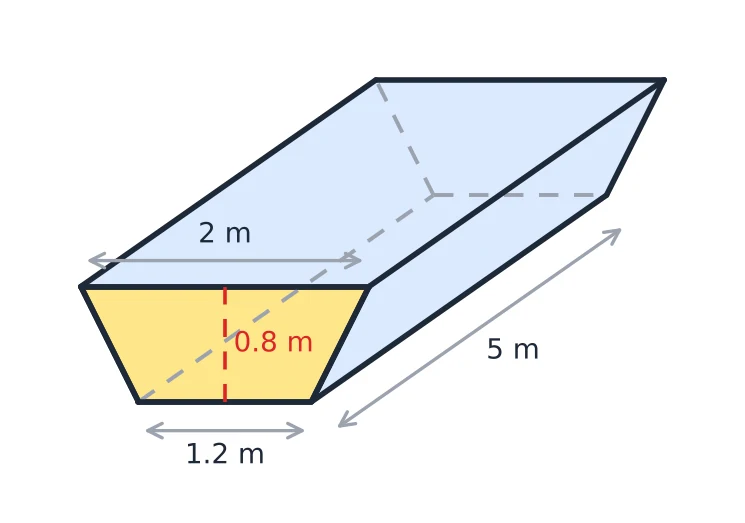
Answer. The channel is a prism lying on its side, and its length plays the part of the height. Cross-section = m². Volume = 1.28 × 5 = 6.4 m³, and 1 m³ = 1000 litres, so it holds (c) 6,400 litres.
Question 7
A prism 7 cm high has a regular hexagon of side 6 cm as its base. What is its volume? (a) cm³ (b) cm³ (c) cm³ (d) cm³
Answer. The hexagon is six equilateral triangles of side 6 cm, each cm². So the base is cm² and the volume is = (d) cm³. counts only one of the six triangles.
Question 8
The volume of a prism whose base is an equilateral triangle of side 8 cm is cm³. What is its height? (a) 30 cm (b) 10 cm (c) 90 cm (d) 7.5 cm
Answer. Base area = cm². Height = = (a) 30 cm. The roots cancel, so no decimals are needed.
Question 9
A right prism on a square base has a lateral surface area of 480 cm² and a height of 12 cm. What is its volume? (a) 480 cm³ (b) 1,200 cm³ (c) 1,440 cm³ (d) 4,800 cm³
Answer. Lateral surface = perimeter × height, so the perimeter is 480 ÷ 12 = 40 cm and each side of the square is 10 cm. Volume = = (b) 1,200 cm³.
Question 10
A prism has 12 vertices. How many edges does it have? (a) 12 (b) 24 (c) 18 (d) 8
Answer. A prism on an n-sided base has 2n vertices, so 2n = 12 and n = 6: it is a hexagonal prism. Its edges are 3n = (c) 18: six on the top, six on the bottom and six standing up.
Question 11
A pyramid has 20 edges. How many faces does it have? (a) 11 (b) 10 (c) 12 (d) 22
Answer. A pyramid on an n-sided base has 2n edges, so n = 10. It has 10 triangular faces and 1 base, that is (a) 11 faces. Euler agrees: 11 faces + 11 vertices − 20 edges = 2.
Question 12
A solid with flat faces has 14 faces and 24 vertices. How many edges does it have? (a) 38 (b) 40 (c) 12 (d) 36
Answer. Euler's formula: F + V − E = 2, so E = F + V − 2 = 14 + 24 − 2 = (d) 36. (It could be a prism on a 12-sided base: 14 faces, 24 vertices, 36 edges.)
Question 13
A right pyramid on a square base of side 16 cm is 15 cm high. What is its slant height? (a) cm (b) 17 cm (c) 31 cm (d) cm
Answer. The slant height runs down the middle of a side face to the midpoint of a base edge, which is 8 cm from the centre. So = (b) 17 cm. Using the full side 16 gives , and is the lateral edge, which goes to a corner.
Question 14
A right pyramid has a square base of side 9 cm and a height of 14 cm. What is its volume? (a) 378 cm³ (b) 1,134 cm³ (c) 189 cm³ (d) 756 cm³
Answer. Volume = = (a) 378 cm³. Without the one third you get 1,134 cm³, which is the prism on the same base.
Question 15
A square pyramid has a base of side 12 cm and a height of 8 cm. What is its total surface area? (a) 240 cm² (b) 336 cm² (c) 384 cm² (d) 528 cm²
Answer. First the slant height: half the side is 6, so cm. Lateral surface = cm². Add the base, 144 cm²: total = (c) 384 cm².
Question 16
The slant height of a square pyramid is 25 cm and the side of its base is 14 cm. What is its volume? (a) 4,704 cm³ (b) cm³ (c) 784 cm³ (d) 1,568 cm³
Answer. The volume needs the vertical height. Half the side is 7, so cm. Volume = = (d) 1,568 cm³. Putting the slant height 25 in place of h gives cm³.
Question 17
A pyramid on a square base of side 15 m has a volume of 1,500 m³. What is its height? (a) 20 m (b) m (c) 60 m (d) 10 m
Answer. , so 75h = 1500 and h = (a) 20 m. Dividing 1500 by 225 without the 3 gives m.
Question 18
A square pyramid has a base of side cm and a height of 16 cm. What is the length of each lateral edge? (a) cm (b) 20 cm (c) 28 cm (d) cm
Answer. A lateral edge runs from the apex to a corner. The corner is half a diagonal from the centre, and the diagonal is cm, so that distance is 12 cm. Edge = = (b) 20 cm.
Question 19
A pyramid 24 cm high stands on a rectangular base 20 cm × 14 cm. What is its lateral surface area? (a) 850 cm² (b) 884 cm² (c) 864 cm² (d) 816 cm²
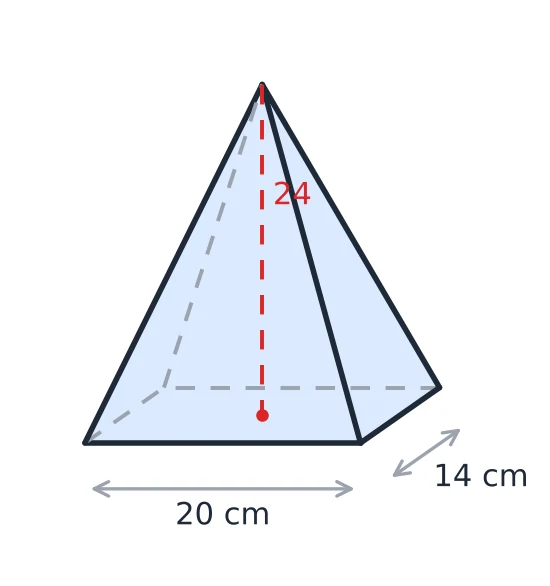
Answer. A rectangle gives two slant heights. The faces on the 20 cm sides are 7 cm from the centre at the base, so their slant height is cm. The faces on the 14 cm sides are 10 cm away, so theirs is cm. Lateral surface = 2 × × 20 × 25 + 2 × × 14 × 26 = 500 + 364 = (c) 864 cm². Using 25 cm for all four faces gives 850 cm².
Question 20
A pyramid 9 cm high has a regular hexagon of side 4 cm as its base. What is its volume? (a) cm³ (b) cm³ (c) cm³ (d) cm³
Answer. Base = six equilateral triangles of side 4 cm = cm². Volume = = (d) cm³.
Question 21
[Tier 2] A right pyramid 8 cm high stands on an equilateral triangle of side cm. What is its lateral surface area? (a) cm² (b) cm² (c) cm² (d) cm²
Answer. The apex is above the centroid, which is cm from each side. Slant height = cm. Lateral surface = = (b) cm². With the height 8 in place of the slant height you would get .
Question 22
[Tier 2] A right pyramid stands on an equilateral triangle of side cm, and each of its lateral edges is 15 cm. What is its volume? (a) cm³ (b) cm³ (c) cm³ (d) cm³
Answer. A lateral edge goes to a corner, and a corner is cm from the centroid. So cm. Base area = cm². Volume = = (a) cm³.
Question 23
[Tier 2] Each edge of a regular tetrahedron is cm. What is its volume? (a) cm³ (b) cm³ (c) 72 cm³ (d) 144 cm³
Answer. Volume = . Here , so the volume is = (c) 72 cm³. Dividing by 6 alone and forgetting the gives .
Question 24
[Tier 2] What is the height of a regular tetrahedron whose edges are 9 cm long? (a) cm (b) cm (c) cm (d) cm
Answer. The apex is above the centroid of the base, which is cm from each corner. The lateral edge is 9 cm, so = (d) cm. The formula gives the same. cm is the slant height of a face, not the height of the solid.