
Cuboid and Cube
- Cuboid: volume , total surface , four walls , diagonal .
- ; the 12 edges add up to .
- Faces , , at a corner: volume .
- Cube: , , four walls , diagonal , face diagonal .
- Cut into cubes of edge : pieces, surface × . cubes in a row: .
- A cube's surface needs the full diagonal .
Rooms, Boxes and Tanks
- Four walls = perimeter of the floor × height, less doors and windows.
- Paper or carpet of width : length = area ÷ .
- Squares of side cut from an sheet: box .
- Wood thick: a closed box loses from each outside measure; an open box loses only from its height.
- Bricks = wall volume (less mortar) ÷ one brick.
- 1 m³ = 1000 litres and 1 litre = 1000 cm³. Rain = area × depth in metres.
Right Prisms
- Volume = base area × height.
- Lateral surface = perimeter of the base × height; total = lateral + 2 × base.
- Bases you will meet (see Chapter 13): equilateral triangle , right triangle , rhombus , trapezium, regular hexagon .
- Rhombus side from the half-diagonals: .
- An -sided base: faces, edges, vertices. Euler: .
- A prism has two bases, and both belong in the total surface.
Pyramids
- Volume .
- Lateral surface ; total = lateral + one base.
- Square base of side : slant height with ; edge to a corner with .
- An -sided base: faces, edges, vertices.
- [Tier 2] Equilateral base: the centre is from each side and from each corner.
- [Tier 2] Regular tetrahedron: surface , height , volume .
Cylinders
- Volume , curved surface , total .
- Volume ÷ curved surface , a quick way to the radius.
- Two cylinders: volumes go as , curved surfaces as .
- A sheet rolled up: the side that goes round is , the other side is the height.
- Roller: area pressed = curved surface × number of turns.
- Tank open at the top: .
- Before squaring anything, check whether the question gave the radius or the diameter.
Hollow Cylinders and Pipes
- Metal ; the thickness is .
- Outer surface , inner , each rim ; all of them together .
- Flow through a pipe each second speed; km/h × gives m per second.
- [Tier 2] Well and embankment: , with + width.
- is a thin rod, not the pipe.
Cones
- Slant height . Triplets: 3-4-5, 5-12-13, 8-15-17, 7-24-25, 20-21-29.
- Curved surface , total , volume .
- On the same base and height as a cylinder, a cone holds one third as much.
- Sector into cone: the sector's radius is and its arc is , so .
- Tent or heap: canvas = curved surface only; length of canvas = area ÷ width.
- Volume takes the height, surface the slant: mark and on your sketch.
Frustums
- Cut parallel to the base: the top cone has lengths , surfaces , volume .
- Halfway cut: top : frustum = 1 : 7. Three equal heights: 1 : 7 : 19.
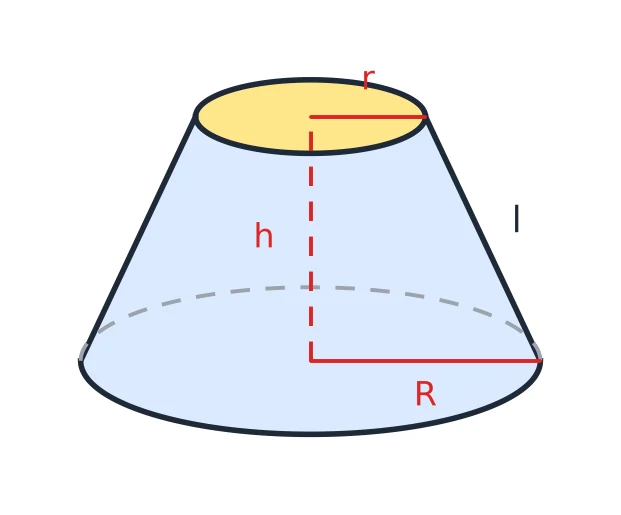
- Volume ; slant .
- Curved surface ; the total adds , an open bucket only .
- The slant uses , never .
Spheres and Hemispheres
- Sphere: volume , surface .
- Hemisphere: volume , curved surface , solid total .
- Two spheres: surfaces as , volumes as .
- Shell: . Bowl: holds ; inside surface .
- Sphere in a cube: . Cube in a sphere: .
- In a cylinder of height : volumes 2 : 3, and the sphere's surface equals the cylinder's curved surface.
- Cone, hemisphere and cylinder of radius and height : 1 : 2 : 3.
Combined Solids
- Add only the surfaces you could touch. The joint circle is hidden.
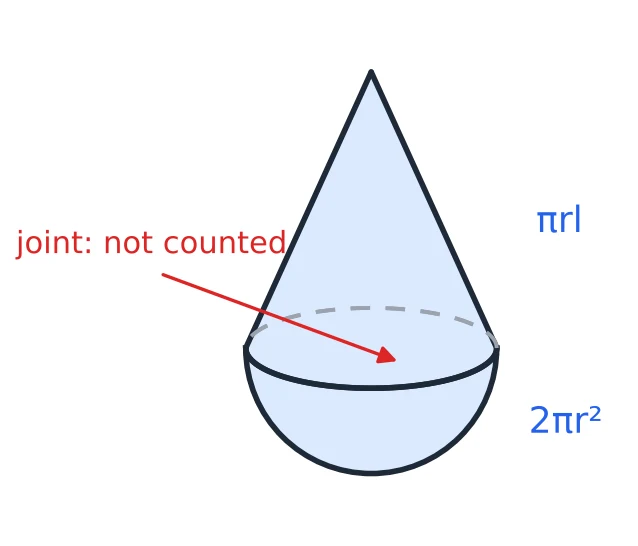
- Toy: . Tent: .
- Capsule: , which is width × full length.
- Hemisphere scooped from a cube: (the bowl adds , the hole removes ).
- Volumes add, or subtract what is cut out.
- A tent has no floor; a solid toy does.
Melting and Recasting
- Volume before = volume after. Surface area is not kept.
- Number of pieces = big volume ÷ volume of one piece. Cancel and the thirds first.
- Spheres into spheres: . Several spheres into one: .
- Sphere into a wire: length .
- Rise in water = volume put in ÷ base area of the vessel.
- A hollow solid gives only its metal, .
- If 10% is wasted, recast the 90% that is left.
Change in Volume and Surface Area
- Every length × : surfaces × , volume × .
- Every length up 10%: surfaces up 21%, volume up 33.1%. Up 20%: 44% and 72.8%. Down 20%: down 36% and 48.8%.
- Different changes: multiply. Radius up 10%, height down 10%: , so a cylinder's volume goes up 8.9%.
- Same volume with the radius × : the height is divided by .
- Backwards, take the cube root: volume × 1.331 means lengths × 1.1, which is 10%, not .
Before the Exam
- Put every length in one unit. For litres: m³ × 1000, or cm³ ÷ 1000.
- Ask three questions: radius or diameter, height or slant, curved or total surface.
- Pick from the options: multiples of 11 or 22 mean .
- Size checks: a cone is a third of its cylinder, and a sphere fills about half of the cube around it.
- For a combined solid, sketch it and tick each visible surface once.
- Then work through the PYQ Practice Sets of this chapter, keeping each solids question under a minute.