
The Sphere: Surface Area and Volume
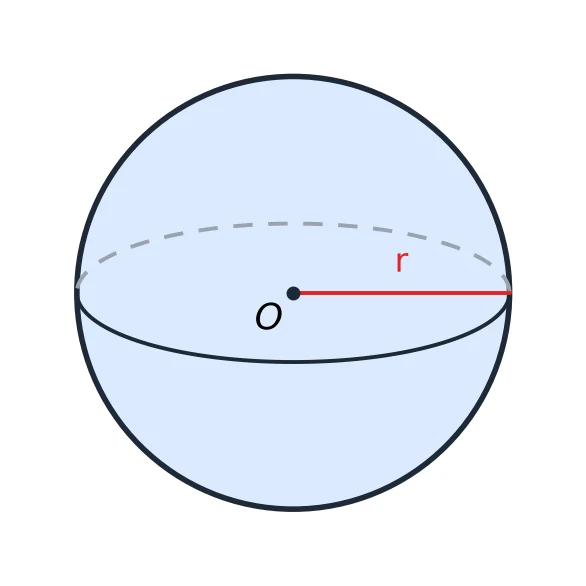
A sphere is the shape of a ball. Every point on its surface is the same distance r from the centre O, so r is the radius and 2r is the diameter. A sphere has no flat face and no edge, so it has only one surface: for a sphere, "curved surface area" and "total surface area" are the same number.
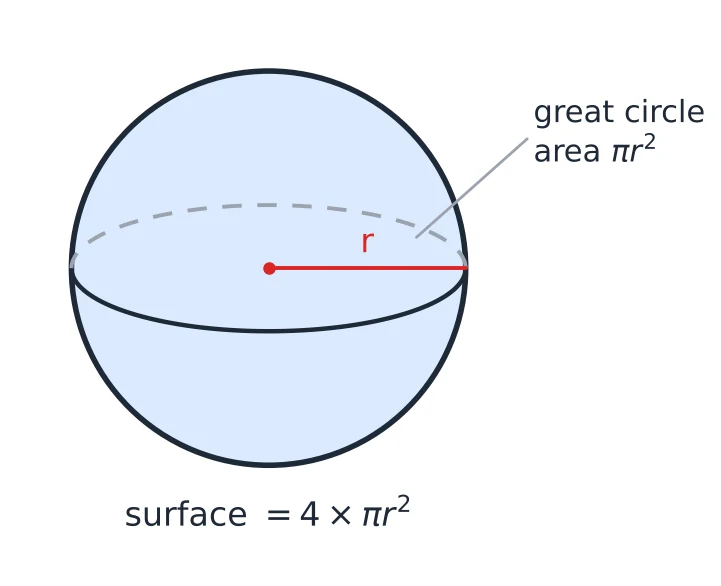
Where the 4 comes from. Cut a sphere through its centre and the cut face is the biggest circle the sphere holds, called a great circle (the equator on a globe). Its area is , and the surface of the sphere is exactly four of these circles. Peel an orange carefully and the peel will cover about four circles of the orange's own size.
- r = 21 cm: surface cm², volume cm³.
- Diameter 21 cm, so r = 10.5 cm: surface cm², volume 4851 cm³.
- r = 6 cm, answer in terms of : surface cm², volume cm³.
Quick arithmetic. With the volume is . Cancel the 21 against before you multiply: for r = 21 it is .
| Radius | Surface area | Volume |
|---|---|---|
| 3.5 cm | 154 cm² | cm³ |
| 7 cm | 616 cm² | cm³ |
| 10.5 cm | 1386 cm² | 4851 cm³ |
| 14 cm | 2464 cm² | cm³ |
| 21 cm | 5544 cm² | 38,808 cm³ |
Read the question for the word "diameter". A ball of diameter 14 cm has r = 7 cm. Putting 14 into the formulas makes the surface 4 times and the volume 8 times too big.
Finding the Radius from the Surface Area or the Volume
Most sphere questions give one measure and ask for another. Go through the radius every time.
From the surface area: . For a surface of 2464 cm², , so r = 14 cm, and the volume is cm³.
From the volume: . For a volume of 4851 cm³, . A decimal cube looks awkward, so multiply it by 8: . Since , that 21 is the diameter, and r = 10.5 cm.
With left in the answer the work is shorter. Volume cm³: , so , r = 9 cm and the surface is cm².
| n | 3 | 4 | 5 | 6 | 7 | 8 | 9 | 10 | 11 | 12 | 14 | 21 |
|---|---|---|---|---|---|---|---|---|---|---|---|---|
| 27 | 64 | 125 | 216 | 343 | 512 | 729 | 1000 | 1331 | 1728 | 2744 | 9261 |
Volume straight from the surface. Since ,
A surface of 616 cm² gives r = 7 cm, and then cm³.
Surface and volume equal in number. Then , which gives r = 3 units. Only the numbers match: one is in square units and the other in cubic units.
[Tier 2] For every sphere, . Cube the surface and you get ; square the volume, multiply by , and you get as well. It appears as one of the statements in "which of the following is true" questions.
Hemispheres: Curved Surface, Total Surface and Volume
Cut a sphere through its centre and you get two hemispheres. A solid hemisphere has two surfaces: the curved part, which is half the sphere's surface, and a flat circular face of radius r.
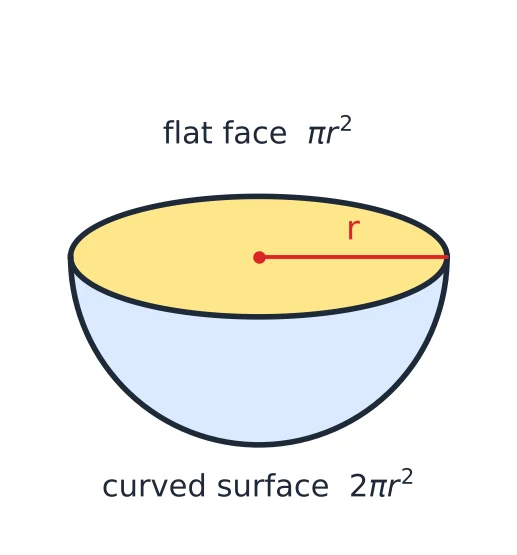
- r = 21 cm: curved surface 2772 cm², total surface 4158 cm², volume 19,404 cm³.
- r = 7 cm: curved surface 308 cm², total surface 462 cm², volume cm³.
Which surface?
- A solid hemisphere (a paperweight, the base of a toy) with nothing stuck on the flat face: total surface, .
- A dome, a hemispherical roof or the inside of a bowl: curved surface only, . There is no flat face to paint.
Working back. A total surface of 1848 cm² means , so and r = 14 cm. The volume is then cm³.
For the same radius, a hemisphere has half the volume of the sphere, but its total surface () is three quarters of the sphere's surface (), not half. Its curved and total surfaces are in the ratio 2 : 3.
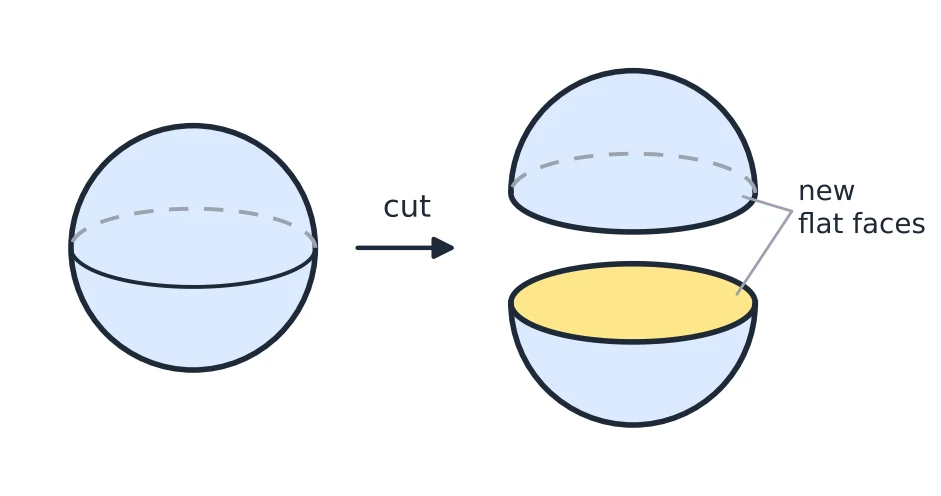
Cutting a sphere in two. A sphere of radius 7 cm has a surface of 616 cm². Cut it into two hemispheres and each has a total surface of 462 cm², so the two together have 924 cm². The cut made two new flat faces of 154 cm² each: an increase of 308 cm², which is 50%. The volume does not change.
[SSC Tip] Decide whether the flat face counts before you calculate. "Total surface" or "solid hemisphere" means ; "curved surface", "dome" or "inside of a bowl" means .
Comparing Two Spheres, and Blowing Up a Balloon
For two spheres with radii in the ratio a : b:
- the diameters (and the circumferences of their great circles) are in the ratio a : b;
- the surface areas are in the ratio ;
- the volumes are in the ratio .
The same is true for two hemispheres. Whatever ratio is given, come back to the radii first.
- Volumes 64 : 125 give radii 4 : 5 (cube roots), so the surfaces are 16 : 25.
- Surfaces 9 : 49 give radii 3 : 7 (square roots), so the volumes are 27 : 343.
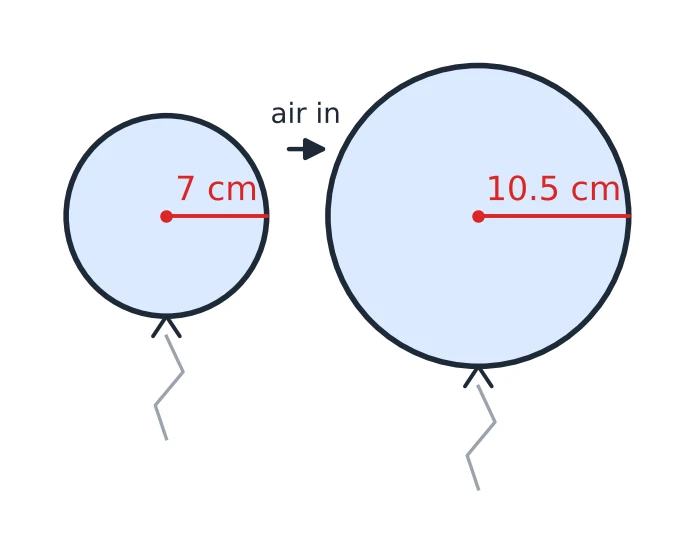
A balloon. A balloon stays a sphere as it fills, so only its radius changes. Blown up from radius 7 cm to 10.5 cm, the radii are 2 : 3, the surfaces 4 : 9 and the volumes 8 : 27. The air pumped in is the difference of the two volumes: cm³.
Read it the other way round too. If the surface becomes 4 times, the radius has doubled and the volume is 8 times. If the volume becomes 27 times, the radius is 3 times and the surface 9 times.
A percentage change behaves the same way: a radius 10% longer makes the surface times and the volume times (the general rule is in Combined Solids, Melting and Recasting).
Hollow Spheres (Spherical Shells)
A hollow metal ball is a sphere with a smaller sphere taken out of its middle. Call the outer radius R and the inner radius r. The thickness of the metal is R − r.
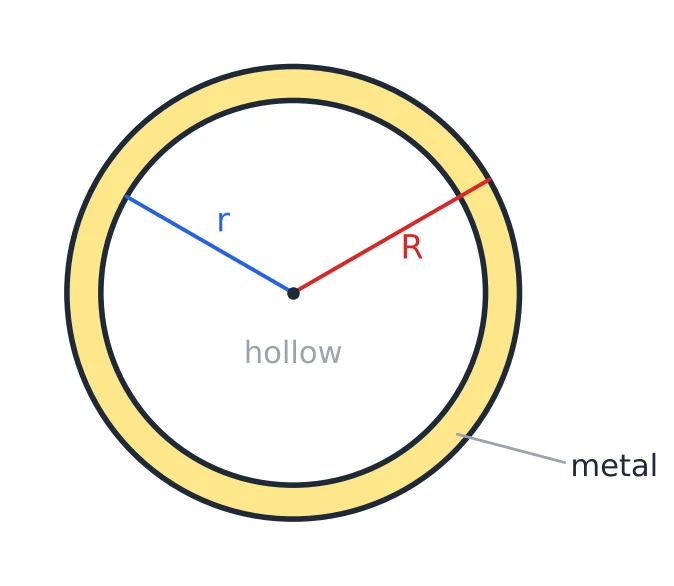
The outer surface is and the inner surface .
Outer radius 10 cm and inner radius 8.5 cm (thickness 1.5 cm): metal cm³. If 1 cm³ of the metal weighs 8 g, the ball weighs 1617 × 8 = 12,936 g, that is 12.936 kg.
Do not cube the thickness. has nothing to do with .
Inner radius from the metal. Outer radius 6.5 cm and 627 cm³ of metal: . Since , we get , so r = 5 cm and the metal is 1.5 cm thick.
If the outer and inner diameters are given, halve both before cubing.
Hemispherical Bowls: Capacity, Inside, Outside and the Rim
A bowl is a hollow hemisphere. What it holds depends only on the inner radius; the metal and the outer surface need the outer radius as well.
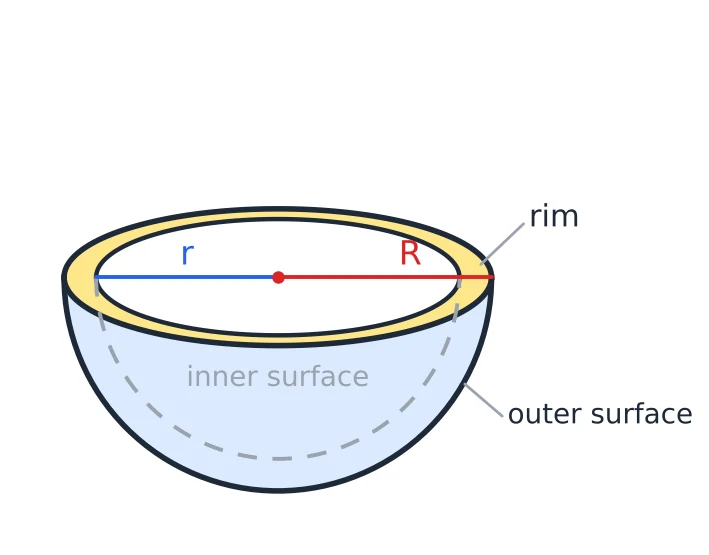
With inner radius r and outer radius R (thickness R − r):
- capacity ;
- inner curved surface (for polishing, tin-plating or painting the inside);
- outer curved surface ;
- the rim is a flat ring, ;
- metal used ;
- whole surface (inside, outside and rim) .
Capacity in litres. Inner diameter 21 cm, so r = 10.5 cm: capacity cm³. One litre is 1000 cm³, so the bowl holds 2.4255 litres.
A bowl with thickness. Inner radius 9 cm and outer radius 10 cm: inside cm², outside cm², rim cm², so the whole surface is cm². The metal is cm³.
Cost. To tin-plate the inside of a bowl of inner radius 10.5 cm at ₹16 per 100 cm², find the inner surface, cm². The cost is = ₹110.88.
[SSC Tip] If the inner diameter and the thickness are given, the outer radius is the inner radius plus the thickness. Adding the thickness to the diameter is the usual slip. And a bowl has no flat face, so never applies to it.
Units, Weight and Cost
Tank, ball and dome questions add one more step after the formula.
- Capacity: 1 litre = 1000 cm³, and 1 m³ = 1000 litres.
- Weight: weight = volume × the weight of 1 cm³ of the material.
- Cost: painting, polishing and gilding go with the surface; filling, or the price of the metal, goes with the volume.
A few lines of each:
- A spherical tank of inner radius 2.1 m holds m³, which is 38,808 litres.
- A solid metal ball of diameter 7 cm, with 1 cm³ of the metal weighing 6 g: the volume is cm³, so it weighs g, or 1.078 kg.
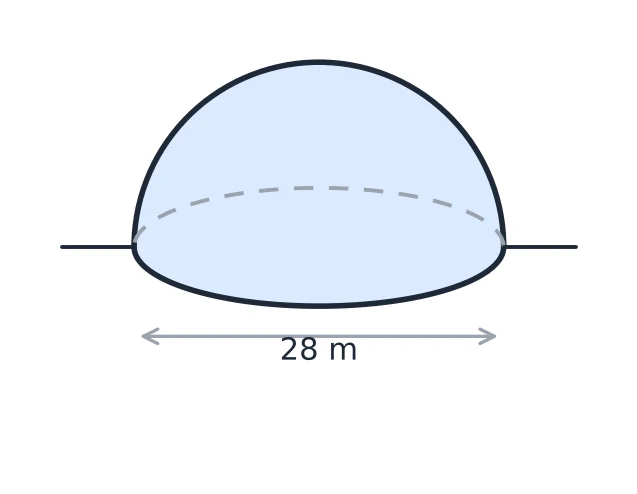
- The inside of a hemispherical dome of diameter 28 m is painted at ₹12 per m². Only the curved surface is painted: m², and the cost is 1232 × 12 = ₹14,784.
Watch the rate. "₹5 per 100 cm²" means you divide the area by 100 before multiplying by 5. A radius in cm with a rate per m² needs the area turned into m² first (1 m² = 10,000 cm²).
A Sphere in a Cube, and a Cube in a Sphere
The largest sphere inside a cube touches all six faces, so its diameter equals the edge of the cube: .
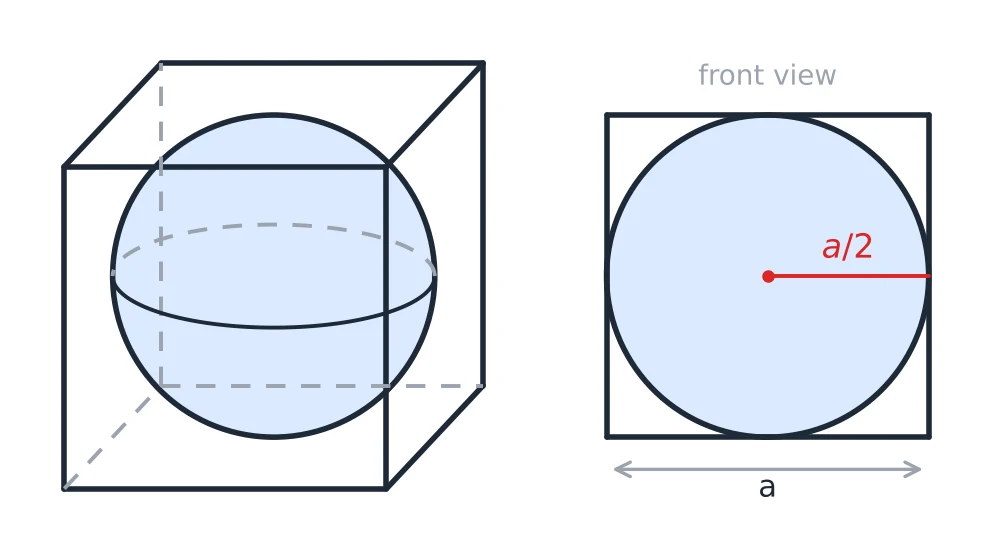
In a cube of edge 14 cm the sphere has r = 7 cm and volume cm³, while the cube is 2744 cm³. In general
which is with . So of the cube is empty space (or wood cut away, if the sphere is carved from the cube): here cm³. The surfaces are in the same ratio, 616 cm² against 1176 cm².
A cube inside a sphere (all eight corners on the sphere): the long diagonal of the cube runs from one corner, through the centre, to the opposite corner, so it is a diameter of the sphere.
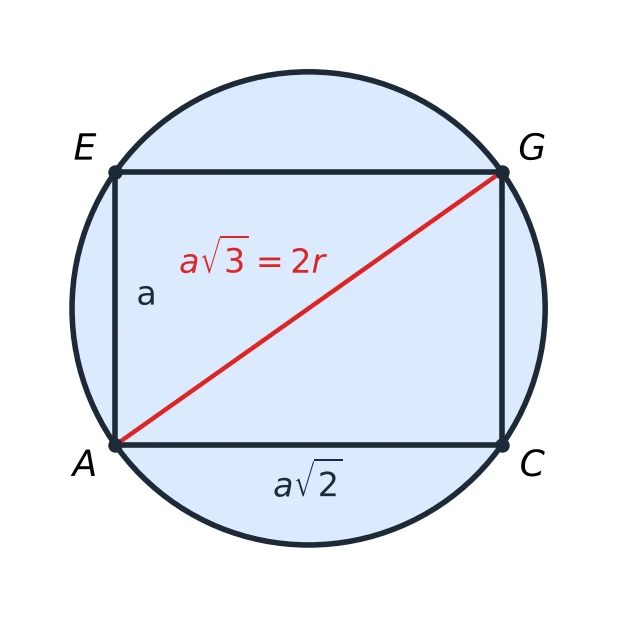
A sphere of diameter cm holds a cube of edge 10 cm, with volume 1000 cm³ and surface 600 cm². Use the long diagonal , not the face diagonal . The figure shows the cut through A, C, G and E: the face diagonal AC is only one side of that rectangle, and the diameter is AG.
A Sphere in a Cylinder: Volumes 2 : 3
A sphere of radius r fits exactly inside a cylinder of radius r and height 2r, touching the curved side, the top and the bottom. Archimedes was proud enough of the results below to want this figure on his tomb.
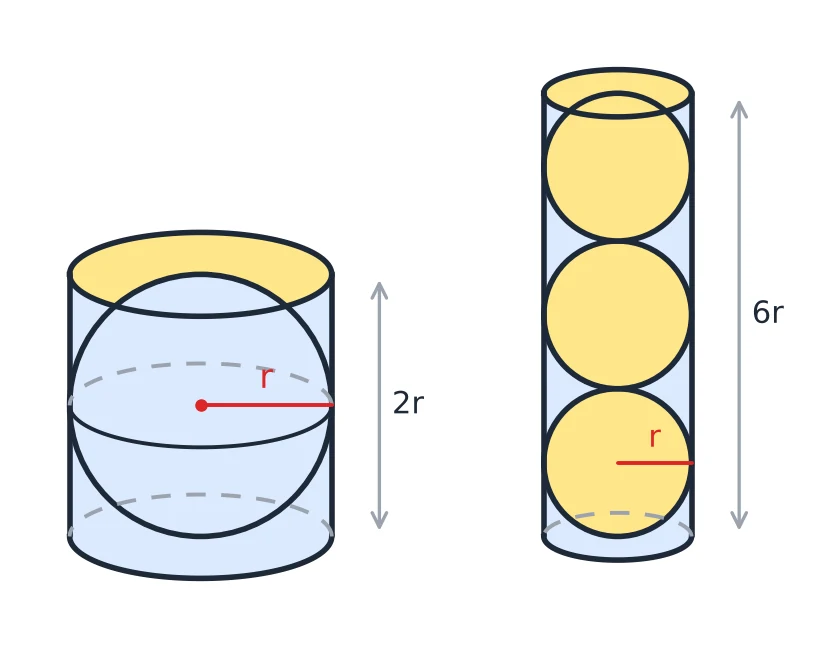
- Volumes: the cylinder is and the sphere , so sphere : cylinder = .
- The curved surface of the cylinder is , exactly the surface of the sphere.
- The total surface of the cylinder is , so sphere : cylinder total is 2 : 3 again.
With r = 7 cm the cylinder holds 2156 cm³ and the sphere is cm³, so cm³, one-third of the cylinder, is left around the sphere. If the cylinder was full of water, two-thirds of the water spills out when the sphere is pushed in.
Balls in a can. Three balls of radius r packed in a can of radius r need a height of 6r. The balls take of the can's , two-thirds again, so one-third of the can is air. For tennis balls of diameter 7 cm in a can 21 cm tall: the can holds 808.5 cm³, the balls fill 539 cm³, and 269.5 cm³ is empty.
Hemisphere, Cone and Cylinder on the Same Base
Take a hemisphere, a cone and a cylinder with the same radius r and the same height. A hemisphere's height is its radius, so the cone and the cylinder are r high as well.
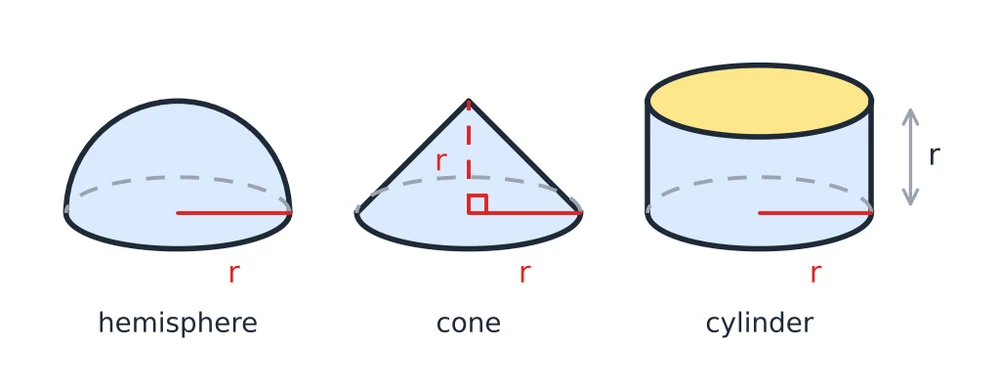
The hemisphere holds two cones, and the cylinder holds the cone and the hemisphere together (1 + 2 = 3). With r = 7 cm the three volumes are cm³, cm³ and 1078 cm³.
The same 2 : 1 : 3 appears for a sphere, a cone and a cylinder of radius r and height 2r: .
The surfaces do not follow 2 : 1 : 3. The cone's slant is , so
- curved surfaces: , which is ;
- total surfaces: , which is .
[SSC Tip] Keep the order of the solids in the question. If it asks for cylinder : hemisphere : cone, the answer is 3 : 2 : 1, and 2 : 1 : 3 is wrong there.
Solved Examples
Question 1
What is the surface area of a sphere of diameter 21 cm? (Take .) (a) 5544 cm² (b) 1386 cm² (c) 346.5 cm² (d) 4851 cm²
Answer. The diameter is 21 cm, so the radius is 10.5 cm. Surface . I cancel the 7 into one 10.5 to get , so the answer is (b) 1386 cm². Taking 21 as the radius gives 5544 cm², four times too much.
Question 2
The volume of a sphere is 38,808 cm³. What is its surface area? (Take .) (a) 1386 cm² (b) 2772 cm² (c) 4158 cm² (d) 5544 cm²
Answer. First the radius. , so and r = 21 cm. Then the surface is = (d) 5544 cm².
Question 3
The surface area of a sphere is 616 cm². What is its volume? (Take .) (a) cm³ (b) cm³ (c) 4312 cm³ (d) cm³
Answer. gives , so r = 7 cm. Now I use : , which is (a) cm³.
Question 4
The volume of a sphere is cm³. What is its surface area? (a) cm² (b) cm² (c) cm² (d) cm²
Answer. , so and r = 12 cm. Surface = (c) cm².
Question 5
A solid hemisphere has radius 10.5 cm. What is its total surface area? (Take .) (a) 693 cm² (b) 1039.5 cm² (c) 1386 cm² (d) 2425.5 cm²
Answer. It is solid, so the flat face counts too. Total = (b) 1039.5 cm². The curved part alone would be 693 cm².
Question 6
The curved surface area of a hemisphere is 2772 cm². What is its volume? (Take .) (a) 4158 cm³ (b) 38,808 cm³ (c) 9702 cm³ (d) 19,404 cm³
Answer. , so and r = 21 cm. Volume = (d) 19,404 cm³.
Question 7
The total surface area of a solid hemisphere is cm². What is its volume? (a) cm³ (b) cm³ (c) cm³ (d) cm³
Answer. The question says total surface, so I use . That gives and r = 6 cm. Volume = (a) cm³.
Question 8
The volumes of two spheres are in the ratio 8 : 125. What is the ratio of their surface areas? (a) 2 : 5 (b) 8 : 125 (c) 4 : 25 (d) 16 : 25
Answer. Volumes go with , so the radii are . Surfaces go with , so the answer is (c) 4 : 25.
Question 9
A spherical balloon is blown up so that its radius increases from 10 cm to 15 cm. What is the ratio of its surface area before and after? (a) 2 : 3 (b) 4 : 9 (c) 8 : 27 (d) 9 : 4
Answer. Only the radius changes, 10 : 15 = 2 : 3. The surface goes with the square of the radius, so it is (b) 4 : 9. 8 : 27 would be the ratio of the volumes, the air inside.
Question 10
A balloon is inflated until its surface area is 9 times what it was. How many times its old volume is its new volume? (a) 3 times (b) 9 times (c) 18 times (d) 27 times
Answer. Surface 9 times means the radius is times. Volume goes with the cube, , so (d) 27 times.
Question 11
A hollow metal ball has an outer diameter of 13 cm and an inner diameter of 10 cm. What volume of metal is in it? (Take .) (a) 627 cm³ (b) 313.5 cm³ (c) 5016 cm³ (d) 1254 cm³
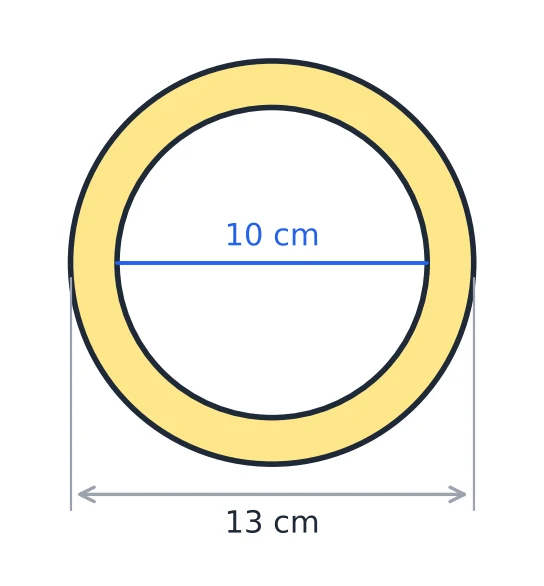
Answer. Halve the diameters first: R = 6.5 cm and r = 5 cm. Metal . As 149.625 ÷ 21 = 7.125, this is 88 × 7.125 = (a) 627 cm³. Cubing the diameters instead gives 5016 cm³, eight times too much.
Question 12
A hollow spherical ball has an outer radius of 5.5 cm, and its metal is 1.5 cm thick. If 1 cm³ of the metal weighs 10 g, what does the ball weigh? (Take .) (a) 6.97 kg (b) 6.32 kg (c) 4.29 kg (d) 2.68 kg
Answer. The inner radius is 5.5 − 1.5 = 4 cm. Metal cm³. Weight = 429 × 10 = 4290 g, which is (c) 4.29 kg.
Question 13
A hemispherical tank has an inner radius of 2.1 m. How many litres of water can it hold? (Take .) (a) 38,808 litres (b) 19,404 litres (c) 1940.4 litres (d) 9702 litres
Answer. Capacity . Since 9.261 ÷ 21 = 0.441, this is 44 × 0.441 = 19.404 m³. One m³ holds 1000 litres, so the tank holds (b) 19,404 litres. 38,808 litres would be a full sphere of that radius.
Question 14
The inner diameter of a hemispherical bowl is 28 cm. What does it cost to polish the inside at ₹25 per 100 cm²? (Take .) (a) ₹308 (b) ₹462 (c) ₹616 (d) ₹77
Answer. Only the curved inner surface is polished. With r = 14 cm that is cm². At ₹25 for every 100 cm², the cost is = (a) ₹308.
Question 15
[Tier 2] A hemispherical bowl has an inner radius of 6 cm and is 1 cm thick. What is the total area of its surface: inside, outside and the rim together? (a) cm² (b) cm² (c) cm² (d) cm²
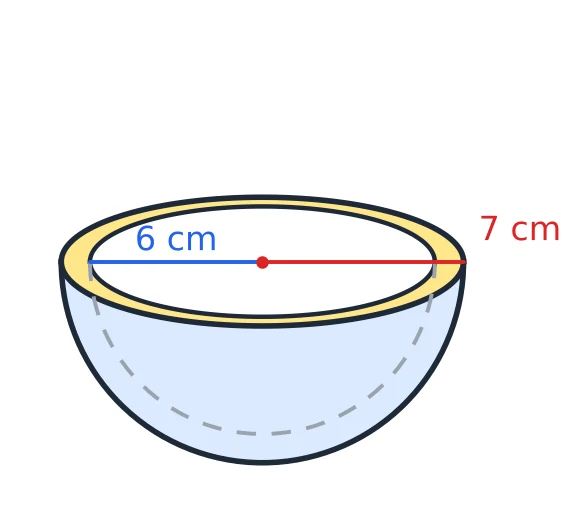
Answer. The outer radius is 6 + 1 = 7 cm. Inside: . Outside: . The rim is a flat ring: . Adding the three gives (c) cm². I can check with .
Question 16
A solid metal ball has a diameter of 14 cm, and 1 cm³ of the metal weighs 7.5 g. What does the ball weigh? (Take .) (a) 86.24 kg (b) 5.39 kg (c) 4.62 kg (d) 10.78 kg
Answer. The radius is 7 cm, so the volume is cm³. Weight g, that is (d) 10.78 kg.
Question 17
The outer surface of a hemispherical dome of radius 10.5 m is to be painted at ₹20 per m². What will it cost? (Take .) (a) ₹20,790 (b) ₹13,860 (c) ₹27,720 (d) ₹6,930
Answer. A dome has no flat face to paint, only the curved surface: m². Cost = 693 × 20 = (b) ₹13,860.
Question 18
What is the volume of the largest sphere that can be cut from a cube of edge 21 cm? (Take .) (a) 38,808 cm³ (b) 9261 cm³ (c) 4851 cm³ (d) 1386 cm³
Answer. The largest sphere touches all six faces, so its diameter is the edge, 21 cm, and r = 10.5 cm. Volume = (c) 4851 cm³. With r = 21 the sphere would not even fit inside the cube.
Question 19
A cube is placed inside a sphere of radius cm so that all its corners touch the sphere. What is the volume of the cube? (a) 512 cm³ (b) cm³ (c) cm³ (d) 64 cm³
Answer. All eight corners are on the sphere, so the long diagonal of the cube is a diameter: . So a = 8 cm and the volume is = (a) 512 cm³. Using the face diagonal by mistake would give an edge of cm.
Question 20
A solid sphere fits exactly inside a closed cylindrical box, touching the top, the bottom and the curved side. The box has a volume of 2156 cm³. What volume of the box is empty? (Take .) (a) cm³ (b) 1078 cm³ (c) cm³ (d) cm³
Answer. A sphere that just fits a cylinder is of the cylinder, so the empty part is , which is (d) cm³. I never needed the radius (it is 7 cm).
Question 21
Three tennis balls, each of diameter 6 cm, are packed in a cylindrical can that just holds them. What volume of the can is not filled by the balls? (a) cm³ (b) cm³ (c) cm³ (d) cm³
Answer. Each ball has radius 3 cm. The can has the same radius and is 3 × 6 = 18 cm tall, so it holds cm³. The balls fill cm³. The empty part is the difference, (b) cm³, one-third of the can as expected.
Question 22
A cone, a hemisphere and a cylinder stand on equal bases and have the same height. The cone has a volume of 120 cm³. What is the total volume of the three solids? (a) 360 cm³ (b) 600 cm³ (c) 720 cm³ (d) 480 cm³
Answer. Same base and same height means all three are r high, and their volumes are cone : hemisphere : cylinder = 1 : 2 : 3. So the hemisphere is 240 cm³ and the cylinder 360 cm³. Total = 120 + 240 + 360 = (c) 720 cm³.
Question 23
A solid sphere of radius 10.5 cm is cut into two equal hemispheres. By how much does the total surface area increase? (Take .) (a) 693 cm² (b) 346.5 cm² (c) 1386 cm² (d) 1039.5 cm²
Answer. The cut makes a new flat circle on each half. Each circle is cm², and there are two of them, so the increase is (a) 693 cm².
Question 24
A solid hemisphere and a solid sphere have equal total surface areas. What is the ratio of the radius of the hemisphere to the radius of the sphere? (a) 4 : 3 (b) (c) 3 : 4 (d)
Answer. The hemisphere's total surface is and the sphere's is . Setting them equal gives , so , that is (d) . The hemisphere needs the bigger radius, which makes sense: it has less curved surface to work with.