
Choose Radii That Cancel 22/7
Questions on solids look long on paper: a cone melted into balls, a tank filled through a pipe, a room to be papered, a cube cut into small cubes. Underneath, most of them are one ratio or one formula with numbers that have been picked to cancel. The methods below show how to use that, and each one says where it stops working. Before you start, write the radius (not the diameter) on a rough sketch, and look at the unit the options are in: cm³, m³ or litres.
When to use it: a cylinder, cone or sphere question where the value of is not given.
Fast way: look at the options first.
- Multiples of 11 or 22 (154, 616, 1232, 4851), or a 7 under a fraction: take . The radius will be a multiple of 7 or 3.5, so cancel the 7 before you multiply anything else.
- Decimals like 314, 942 or 2512: take . The radius is then usually 5, 10 or 20.
- Options written with in them, like cm³: keep as a letter till the end.
Worth knowing by heart, with :
| Radius | |||
|---|---|---|---|
| 3.5 | 38.5 | 154 | |
| 7 | 154 | 616 | |
| 10.5 | 346.5 | 1386 | 4851 |
| 14 | 616 | 2464 | |
| 21 | 1386 | 5544 | 38808 |
The first column is the base of a cylinder or a cone, the second is the surface of a sphere and the third its volume. Halve the last two for a hemisphere's curved surface and volume. A sphere's volume is , so it comes out whole only when takes care of the 21: radii 10.5, 21 and 31.5 work, while 7 and 14 leave thirds.
For example: a cone of radius 14 cm and height 15 cm has volume cm³. The 3 goes into 15 before you touch 616.
Where it fails:
- If the question gives , use it even when the numbers turn untidy.
- The table is by radius. A ball of diameter 21 cm has radius 10.5 cm, so its volume is 4851 cm³, not 38808 cm³.
Scale Factor for Lengths, Surfaces and Volumes
When to use it: two solids of the same shape, where every length of one is times the matching length of the other. Two spheres, two cubes, a cone and the small cone cut off its top, a balloon as it is blown up.
Fast way: multiply every length by , and every area (curved, total or base) is multiplied by , while the volume is multiplied by . So always pass through the lengths:
- volumes to surfaces: take the cube root, then square;
- surfaces to volumes: take the square root, then cube.
| Lengths | Surfaces | Volumes |
|---|---|---|
| 1 : 2 | 1 : 4 | 1 : 8 |
| 2 : 3 | 4 : 9 | 8 : 27 |
| 3 : 4 | 9 : 16 | 27 : 64 |
| 4 : 5 | 16 : 25 | 64 : 125 |
For example: two spheres have volumes in the ratio 64 : 343. Their radii are 4 : 7, so their surfaces are 16 : 49.
Where it fails:
- Every length must change by the same factor. Two cylinders with radii 1 : 2 and equal heights are not the same shape: their volumes are 1 : 4, not 1 : 8. Use the next method for them.
- If a volume ratio is not a perfect cube, say 1 : 2, the lengths are . Leave the root as it is.
[SSC Tip] In a balloon question the air pumped in is the difference of the two volumes. The ratio of the volumes answers a different question, so read which one is asked.
Two Cylinders or Cones: Multiply the Ratios
When to use it: two cylinders (or two cones) with the radii in one ratio and the heights in another, and the ratio of volumes or curved surfaces is asked, or worked backwards.
Fast way: drop the constants and put the ratios into what is left.
- The volume of a cylinder or a cone goes with . Radii and heights give volumes .
- The curved surface of a cylinder goes with , so the same pair gives .
- Equal volumes: the heights are in the inverse ratio of . Equal curved surfaces: the heights are in the inverse ratio of .
For example: radii 3 : 4 and heights 8 : 9. Volumes , and curved surfaces .
A cone against a cylinder needs the put back. A cone with twice the radius of a cylinder and the same height holds times as much.
Where it fails:
- The curved surface of a cone is , so it goes with , not . Find the ratio of the slant heights first.
- The total surface is a sum, so ratios cannot go straight in. Work out each total and then compare.
Percentage Change in Volume
When to use it: the radius, height or edges change by given percentages, and the change in volume or surface is asked.
Fast way: a volume is a product of lengths: for a cylinder or a cone, for a cube, for a sphere. Multiply the multipliers, or use the successive-change rule once for every extra factor (see Chapter 3).
| Every length | Every surface | Volume |
|---|---|---|
| up 10% | up 21% | up 33.1% |
| up 20% | up 44% | up 72.8% |
| up 50% | up 125% | up 237.5% |
| down 10% | down 19% | down 27.1% |
| down 20% | down 36% | down 48.8% |
For example: the radius of a cylinder goes up 50% and its height is halved. Volume: , so it goes up 12.5%. The curved surface has only two factors: , so it goes down 25%. One goes up while the other comes down.
Where it fails:
- A change by a fixed amount (the radius up by 2 cm) needs the actual numbers.
- Backwards, take the cube root of the volume multiplier. Volume up 72.8% means lengths up by , which is 20%; dividing 72.8 by 3 gives a wrong 24.3%.
- The total surface is not a product, so when and change by different percentages, work it out with numbers.
Cuboid from Its Three Face Areas
Take the three faces that meet at one corner: the top, the front and one side. If their areas are , and , then , so
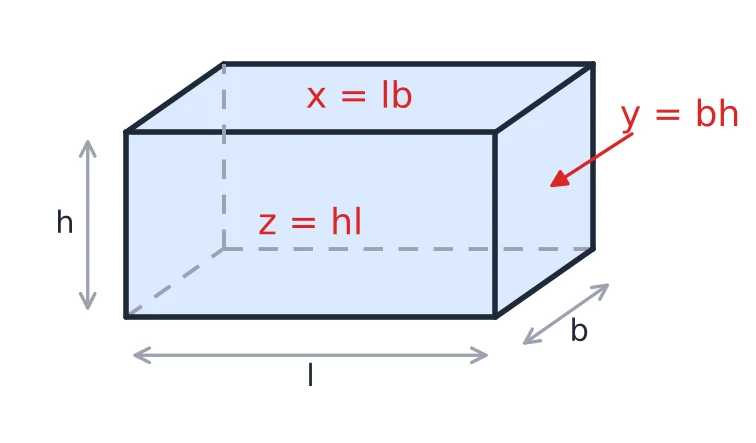
Each edge is the volume divided by the face that does not contain it: , , .
For example: faces of 54 cm², 72 cm² and 48 cm². Factorise before you multiply: , whose square root is . So the volume is 432 cm³, and the edges are , and cm.
For a cube one face is enough: a face of 36 cm² means an edge of 6 cm and a volume of 216 cm³.
Where it fails:
- The three faces must meet at one corner. Two opposite faces have the same area and tell you nothing new.
- The total surface alone cannot give the volume.
Edges, Diagonal and Surface in One Identity
When to use it: two of these three are given for a cuboid: the sum of the edges (or ), the diagonal, the total surface.
Fast way:
The 12 edges add up to , so divide by 4 first.
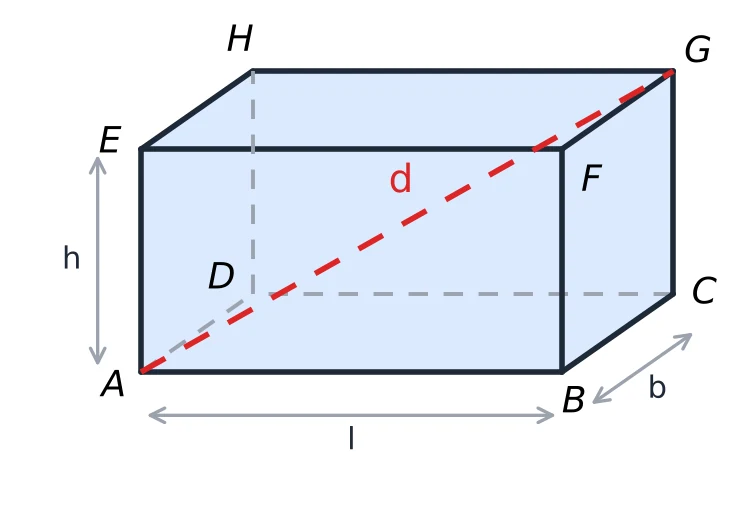
For example: the edges of a cuboid add up to 124 cm and its diagonal is 19 cm. Then , and the total surface is cm². (The cuboid is 6 cm by 10 cm by 15 cm.)
For a cube, , so the total surface is just . A cube with diagonal cm has a surface of 150 cm².
Where it fails:
- It gives the surface, not the volume. Two cuboids with the same edge sum and the same diagonal can hold different amounts.
- A face diagonal is . Check that the question gives the diagonal of the whole cuboid.
Walls and Side Faces: Base Perimeter × Height
When to use it: the four walls of a room, the side faces of a prism, the curved surface of a cylinder.
Fast way: open the side faces out into one long strip. Its length is the perimeter of the base and its width is the height, so
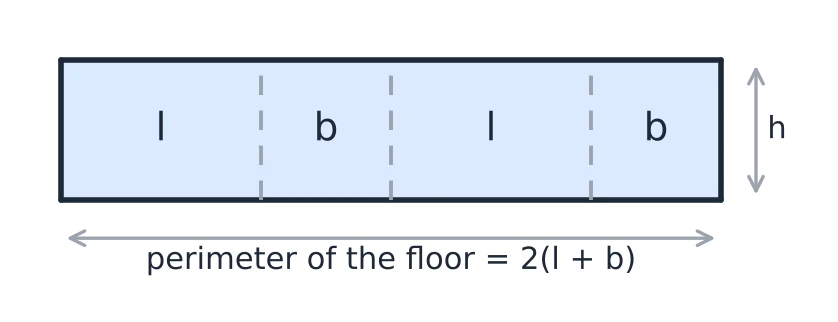
- Room: four walls . Take off the doors and windows, then multiply by the rate.
- Cylinder: . Prism on a regular hexagon of side : .
- Paper or cloth of width : the length needed is the area ÷ .
For example: a hall 16 m by 11 m and 4.5 m high has walls of m². Painting them at ₹40 per m² costs ₹9,720.
Where it fails:
- The floor and ceiling are not in it. An open box (no lid) needs the walls plus one base, and a closed box the walls plus two.
- Pyramids and cones have sloping faces: their lateral surface is , and the height will not do.
Cutting and Joining Cubes
Fast way:
- A cube of edge cut into cubes of edge gives cubes, and their total surface is times the old surface. Each cut opens up new faces, while the volume stays the same.
- cubes of edge in a row make an cuboid with surface . Each joint hides two faces, and . Two cubes give , three give .
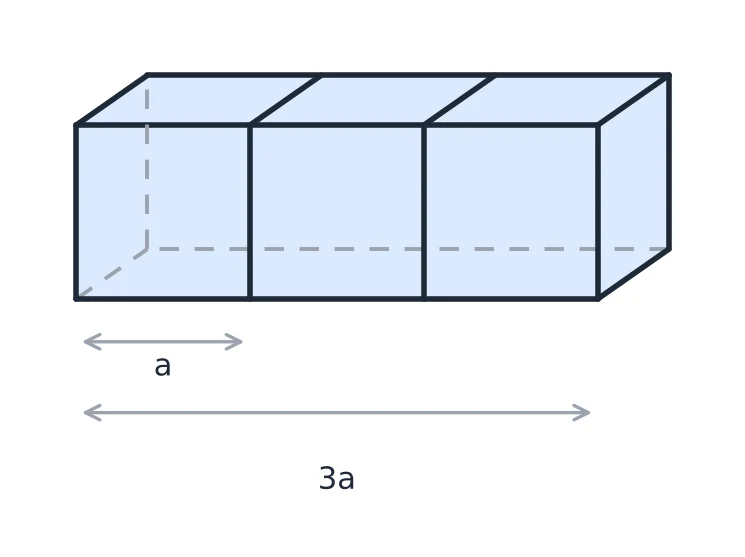
For example: a 12 cm cube cut into 3 cm cubes gives cubes. The surface goes from cm² to cm², which matches .
Where it fails:
- Cubes joined in an L or in a square: count the joints, as each one hides . Four cubes in a 2 by 2 square have 4 joints, so the surface is .
- must be a whole number, or the pieces cannot all be cubes.
Slant Heights from Pythagorean Triplets
When to use it: a cone, a square pyramid or a frustum with the height or the slant height missing.
Fast way: the height, the radius and the slant height make a right triangle with the slant height as its longest side, . If the three numbers form a triplet, you can write the slant height down without any square root.
- 3-4-5, 5-12-13, 8-15-17, 7-24-25, 20-21-29, 12-35-37 and 9-40-41, and their multiples. A radius of 10.5 with a height of 14 gives a slant of 17.5, which is 3-4-5 times 3.5.
- Square pyramid of side : the two short sides are the height and half the side, .
- Frustum: they are the height and .
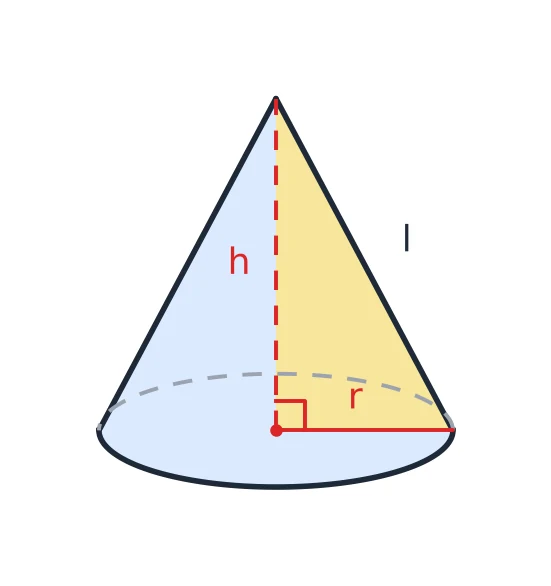
For example: a cone of radius 14 cm and height 48 cm has a slant height of 50 cm (7-24-25 doubled), so its curved surface is cm².
Where it fails:
- Check which two lengths are given. A slant of 25 and a radius of 7 give a height of 24; if you added the squares and got , you treated the slant as a short side.
- Volume uses the height and the curved surface uses the slant height. Keep the two apart on your sketch.
- In a pyramid the slant height runs to the middle of a base edge. The edge from the apex to a corner is longer, and needs half the diagonal of the base.
Cone, Hemisphere and Cylinder on One Base: 1 : 2 : 3
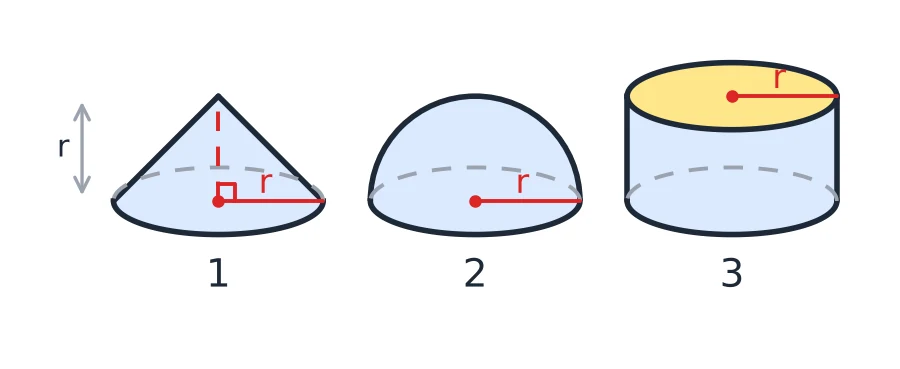
When to use it: a cone, a hemisphere and a cylinder on the same base of radius , each of height ; or a sphere that just fits inside a cylinder.
Fast way:
- Cone , hemisphere , cylinder : the volumes are 1 : 2 : 3.
- A sphere that just fits a cylinder (height ): volumes . The sphere's surface equals the cylinder's curved surface , and with the two ends the cylinder's total is , so the total surfaces are 2 : 3 as well.
- A cone and a cylinder on the same base with the same height, whatever the height: 1 : 3. Three conefuls fill the cylinder.
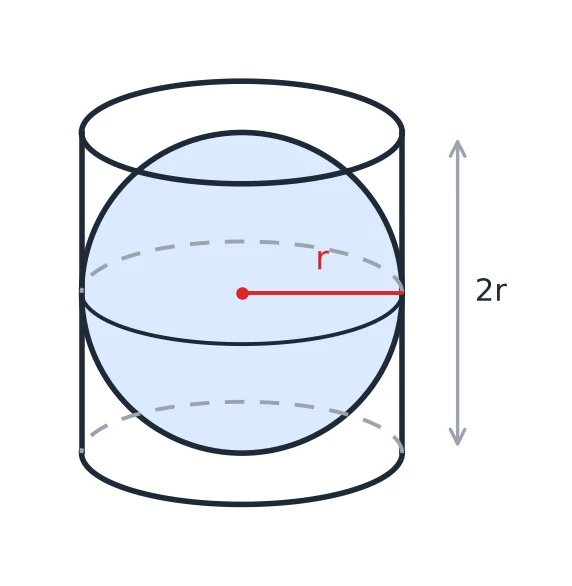
For example: a sphere of volume 38808 cm³ fits exactly in a closed cylinder. The cylinder holds cm³, so the space around the sphere is 19404 cm³, half the sphere.
Where it fails:
- 1 : 2 : 3 needs every height equal to . A cone of height holds as much as the hemisphere.
- The curved surfaces do not follow it. They are , and .
- The 2 : 3 is for the cylinder that just fits. A taller cylinder holds more.
Melting and Recasting as a Ratio of Cubes
When to use it: a solid is melted and made into others (balls, coins, wire, a cone), and the number of pieces or a new length is asked.
Fast way: the volume does not change. Write volume before = volume after, cancel and the common fractions, and only then multiply.
- A sphere into small spheres: the number is .
- Several spheres into one: . Radii 1, 6 and 8 make a sphere of radius 9, since .
- A sphere drawn into a wire of radius : the length is .
- A sphere into a cone of the same radius: , so . A cylinder into a cone of the same radius: the cone is 3 times as tall.
For example: a cylinder of radius 9 cm and height 16 cm is melted into spheres of radius 3 cm. Number .
Where it fails:
- Surface area is not kept. A ball melted into 8 equal balls gives balls of half the radius, with twice the total surface ().
- A hollow solid gives only its metal, , not its outer volume.
- If some metal is lost, say 10%, use the 90% that is left.
Litres, Cubic Metres and Rainfall
When to use it: a capacity in litres, water flowing through a pipe, rain collected from a roof or a field.
| This | equals |
|---|---|
| 1 m³ | 1000 litres |
| 1 litre | 1000 cm³ |
| 1 cm³ | 1 ml |
| 1 m³ | 1000000 cm³ |
| 1 hectare | 10000 m² |
- A cube of edge 10 cm holds exactly 1 litre.
- Rain of depth on an area gives a volume , with in metres. 1 cm of rain on a hectare is m³, which is 100000 litres.
- Water through a pipe: the volume each second is the area of the cross-section × the speed. Change km/h to m per minute by , or to m per second by (see Chapter 10).
For example: a tank 3.5 m by 2 m by 1.5 m holds 10.5 m³, which is 10500 litres.
Where it fails:
- A tank measured in cm gives cm³. 50 cm by 40 cm by 30 cm is 60000 cm³, which is 60 litres, not 60000.
- Area units square the factor: 1 m² is 10000 cm², not 100.
[SSC Tip] With the sizes in metres, multiply by 1000 at the very end to get litres. With the sizes in cm, divide by 1000.
Rise in Water Level
When solids are dropped into a vessel of water, or water is poured from one vessel into another, the water rises by the volume put in divided by the base area of the vessel:
- spheres of radius dropped into a cylinder of radius : rise , as the cancels.
- Number of marbles needed to raise the level by : .
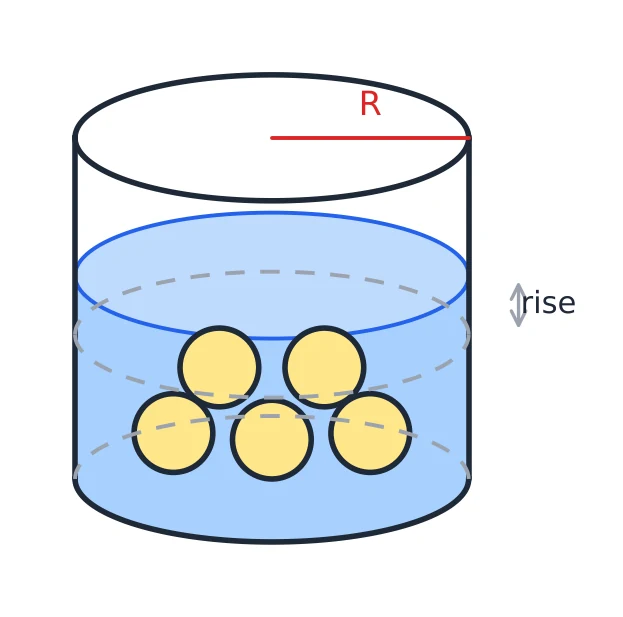
For example: 8 balls of radius 3 cm go into a cylinder of radius 12 cm. Each ball is (times ), so the rise is cm.
Where it fails:
- The solid must be fully under water. A tall rod standing in shallow water pushes up only the part below the surface.
- If the vessel overflows, the rise stops at the brim.
- Divide by the area of the base, not by the volume of the vessel.
[SSC Tip] How deep the water was at the start does not matter, as long as the solids end up fully covered.
Hollow Pipes and Shells: Factor Before You Multiply
When to use it: the metal in a pipe, a tube or a hollow sphere, with the inner and outer radii.
Fast way:
- Pipe of length : metal , where is the thickness.
- Pipe open at both ends, every surface (outside, inside and the two rings): .
- Hollow sphere: metal . Here there is no short cut with .
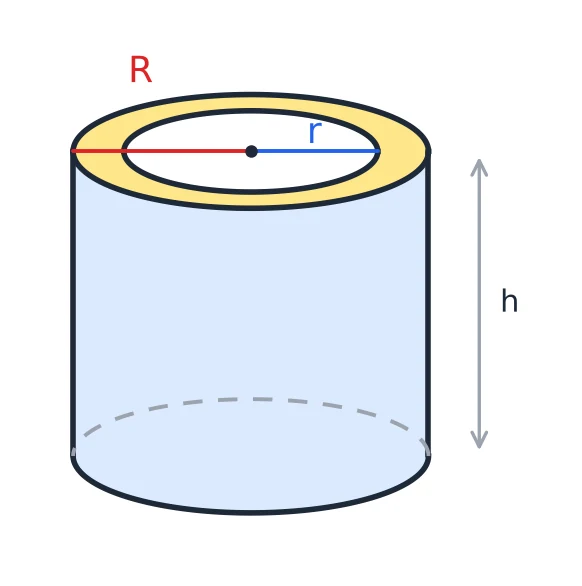
For example: a pipe 21 cm long with outer radius 8 cm and inner radius 6 cm has cm³ of metal. Its whole surface is cm².
Where it fails:
- is a thin rod whose radius is the thickness. It is not the pipe.
- Read whether the thickness or the inner radius is given. An outer diameter of 16 cm with a thickness of 2 cm means and .
Cone Cut Parallel to Its Base: 1 : 7 : 19
When to use it: a cone is cut by planes parallel to its base, and the volumes or curved surfaces of the pieces are compared.
Fast way: the piece on top is a small cone of the same shape, so use and , with measured from the apex.
- Cut halfway up: the top cone is of the volume, so top : frustum = 1 : 7.
- Two cuts at equal heights: the cones from the apex are 1 : 8 : 27, so the three pieces are 1 : 7 : 19 by volume, and 1 : 3 : 5 by curved surface.
- Frustum the whole cone, where .
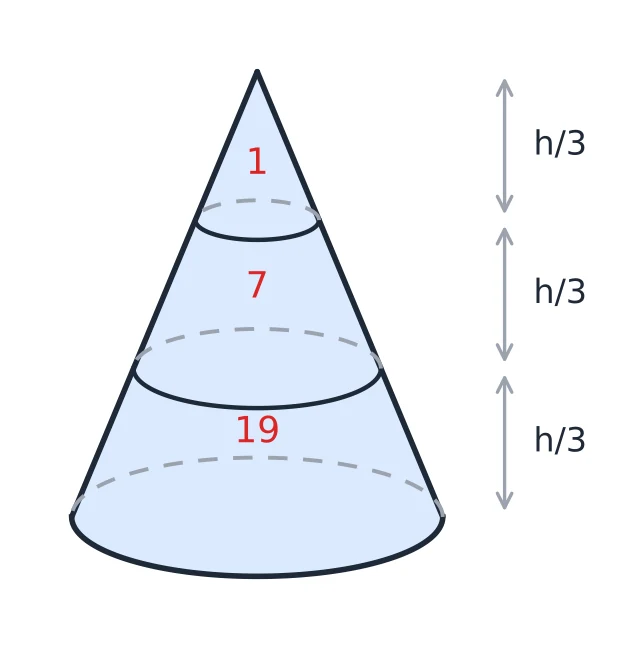
For example: a cone of volume 1600 cm³ is cut halfway up its height. The frustum holds cm³.
Where it fails:
- Measure from the apex. A cut one third of the way up from the base leaves a top cone with , which is of the volume.
- The 1 : 3 : 5 is for the curved surfaces only. A frustum's total surface also has its two circular faces.
Sector into Cone in One Ratio
When a sector of a circle is bent into a cone (or a cone's curved surface is cut along a slant and opened flat), the radius of the sector becomes the slant height , and its arc becomes the rim of the base. So
- The curved surface of the cone equals the area of the sector.
- A semicircle makes a cone with ; a quarter circle gives .
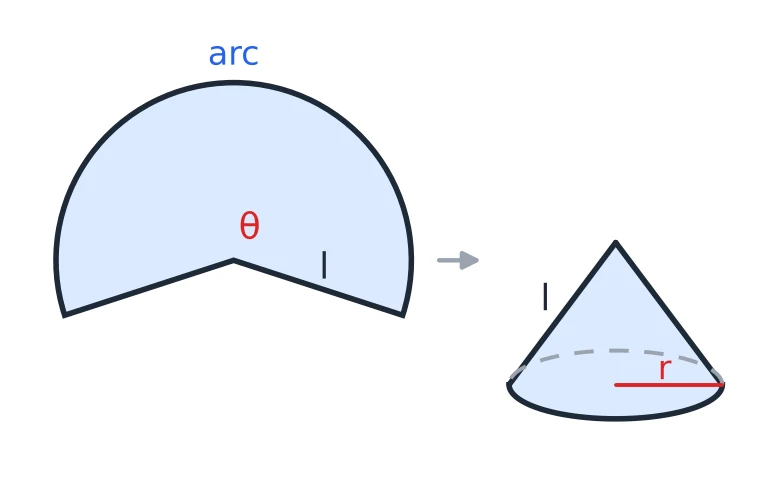
For example: a sector of radius 20 cm and angle gives cm. The height is 16 cm (12-16-20), and the volume is cm³.
Where it fails:
- The sector's radius is the slant height, not the height. Use Pythagoras for .
- If the two edges overlap when the cone is made, take the overlap off the arc first.
Largest Solid Inside a Cube or Cuboid
Fast way: in a cube of edge ,
| Largest | Radius | Height | Volume | Share of the cube |
|---|---|---|---|---|
| Sphere | none | about 52% | ||
| Cylinder | about 79% | |||
| Cone | about 26% |
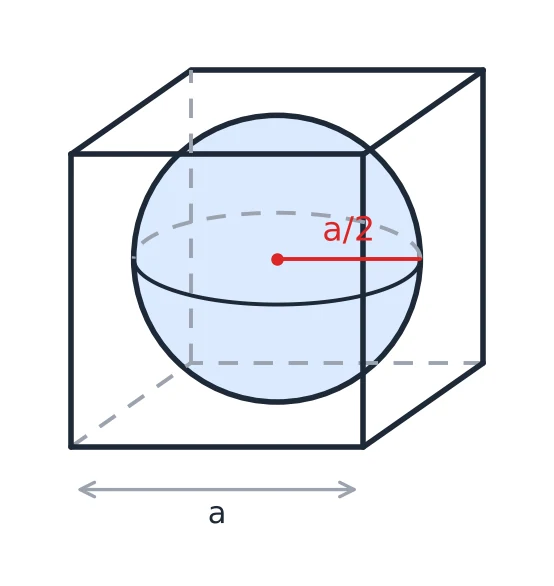
- A cube inside a sphere of radius : the diagonal of the cube is the diameter, .
- A cuboid: the largest sphere has a diameter equal to the shortest edge. For a cylinder or a cone, try each face as the base (radius = half the shorter side of that face, height = the third edge) and compare .
For example: the largest sphere cut from a cube of edge 42 cm has radius 21 cm and volume 38808 cm³. The cube is 74088 cm³, so 35280 cm³, a little under half, is wasted.
Where it fails:
- A sphere around a cube touches its corners, so it needs the cube's diagonal , not a face diagonal.
- The best cylinder in a cuboid does not always stand on the largest face. In a 10 × 6 × 6 box, the one on a 6 × 6 end (, ) beats the one on a 10 × 6 face (, ).
Quick Option Checks: Divisibility and Size
When to use it: before a long calculation, to see which options are even possible, and at the end as a check.
Fast way:
- With and a radius that is a multiple of 7 (or of 3.5), every volume and surface is a multiple of 11. An option that 11 does not divide is out.
- Sizes: a cone is a third of the cylinder on the same base and height, and a sphere fills about half of the cube around it.
- Wrong options are made from a short list of slips: curved surface for total surface, the diameter used as the radius (which makes a cylinder's volume 4 times and a sphere's 8 times too big), the of a cone left out, used for a volume, and litres mixed up with cm³.
For example: the volume of a cone of radius 14 cm and height 9 cm is one of (a) 1848 cm³ (b) 5544 cm³ (c) 1846 cm³ (d) 7392 cm³. 1846 is not a multiple of 11. 5544 is three times 1848 (the left out) and 7392 is four times 1848 (diameter used as the radius). That leaves 1848 cm³, and confirms it.
Where it fails:
- Two close options that both pass the test: work it out in full.
- With the test with 11 tells you nothing.
Solved Examples
Each question below uses one of the methods above. Try it with a timer first, then compare your time with the time check under the answer.
Question 1
A hemispherical bowl has an inner radius of 10.5 cm. How many litres of soup can it hold?
Answer. A full sphere of radius 10.5 is 4851 cm³ (from the table), so the bowl is half of it, 2425.5 cm³. Divide by 1000 for litres: about 2.43 litres.
Time check: about 15 seconds.
Question 2
The curved surfaces of two cones of the same shape are in the ratio 16 : 25. The smaller cone holds 320 cm³. How much does the bigger one hold?
Answer. Surfaces 16 : 25 means lengths 4 : 5, so volumes 64 : 125. The bigger cone holds = 625 cm³.
Time check: about 15 seconds.
Question 3
The radii of two cylinders are in the ratio 2 : 3 and their heights in the ratio 9 : 5. The first holds 1232 cm³. Find the volume of the second and the ratio of their curved surfaces.
Answer. Volumes go with : . So the second holds = 1540 cm³. Curved surfaces go with : = 6 : 5.
Time check: about 20 seconds.
Question 4
The radius of a cone is increased by 20% and its height is decreased by 30%. Find the percentage change in its volume.
Answer. Radius twice: . Then the height: . The volume goes up by 0.8%. With multipliers, .
Time check: about 15 seconds.
Question 5
Three faces of a cuboid that meet at a corner have areas 120 cm², 72 cm² and 60 cm². Find its volume and its total surface.
Answer. = 720 cm³. The total surface is just twice the three faces: = 504 cm². The edges come out as , and cm, if they are asked.
Time check: about 20 seconds.
Question 6
The length, breadth and height of a cuboid add up to 25 cm, and its total surface is 400 cm². Find its diagonal.
Answer. , so the diagonal is 15 cm. (A 10 cm by 10 cm by 5 cm box fits these numbers.)
Time check: about 10 seconds.
Question 7
A room is 12 m long, 8 m wide and 4 m high. It has one door 2 m by 1.25 m and two windows 1.5 m by 1 m each. Its walls are to be covered with paper 75 cm wide that costs ₹15 per metre. Find the cost.
Answer. Walls m². The door and windows take m², leaving 154.5 m². Paper 0.75 m wide needs m, which costs = ₹3,090.
Time check: about 30 seconds.
Question 8
Three cubes of edge 5 cm are joined end to end. Find the surface of the cuboid formed, and how much less it is than the total surface of the three cubes.
Answer. = 350 cm². The three cubes had cm², so the surface is 100 cm² less: the two joints hide four faces.
Time check: about 10 seconds.
Question 9
A cone has a slant height of 37 cm and a base radius of 12 cm. Find its volume.
Answer. 12-35-37 is a triplet, so the height is 35 cm. = 5280 cm³.
Time check: about 15 seconds.
Question 10
A cone, a hemisphere and a cylinder stand on equal bases, and the cone and the cylinder are as tall as the radius. Together the three hold 58212 cm³. Find the radius.
Answer. In thirds of the three are 1, 2 and 3, which add up to 6 thirds, so the total is . Then , and the radius is 21 cm.
Time check: about 20 seconds.
Question 11
A solid metal cone of radius 6 cm and height 24 cm is melted and made into spheres of radius 1.5 cm. How many spheres are made?
Answer. The cone is , and each sphere is . Number = 64.
Time check: about 15 seconds.
Question 12
A copper sphere of diameter 9 cm is drawn into a wire of diameter 3 mm. How long is the wire?
Answer. cm and the wire's radius is 0.15 cm. Length cm, which is 54 m.
Time check: about 20 seconds.
Question 13
Rain 5 cm deep falls on a flat roof 22 m by 14 m, and all of it runs into a cylindrical tank of diameter 2.8 m. By how much does the water in the tank rise?
Answer. Water from the roof m³. The tank's base is m², so the rise is = 2.5 m.
Time check: about 20 seconds.
Question 14
Water flows at 5 km/h through a pipe of inner diameter 14 cm into a tank 50 m long and 44 m wide. How long will it take for the water in the tank to rise by 7 cm?
Answer. In one hour the pipe delivers a cylinder of radius 0.07 m and length 5000 m: m³. The tank needs m³. Time = 2 hours.
Time check: about 25 seconds.
Question 15
How many marbles of diameter 3 cm must be dropped into a cylindrical beaker of diameter 6 cm, partly filled with water, to raise the water by 4 cm?
Answer. = 8 marbles.
Time check: about 15 seconds.
Question 16
An iron pipe 42 cm long has an outer diameter of 16 cm and is 1 cm thick. If 1 cm³ of iron weighs 8 g, find the weight of the pipe.
Answer. and . Metal cm³. Weight g = 15.84 kg.
Time check: about 20 seconds.
Question 17
A cone of volume 5400 cm³ is cut into three pieces of equal height by two planes parallel to its base. Find the volume of the middle piece.
Answer. The pieces are 1 : 7 : 19, which is 27 parts in all. The middle piece is = 1400 cm³.
Time check: about 10 seconds.
Question 18
A sector of angle is cut from a circle of radius 35 cm and bent into a cone. Find the radius of the cone and its curved surface.
Answer. = 14 cm. The curved surface is the sector's area, = 1540 cm². Check: .
Time check: about 10 seconds.
Question 19
Find the volume of the largest sphere that can be cut from a wooden cuboid 21 cm by 28 cm by 35 cm.
Answer. The sphere is limited by the shortest edge, 21 cm, so its radius is 10.5 cm and its volume is 4851 cm³. A radius of 17.5 cm would need the sphere to be 35 cm across in every direction, which the 21 cm side does not allow.
Time check: about 10 seconds.