
Before You Start: How to Use These 40 Problems
Sections 1 to 7 taught you the physics. This section is where you find out whether you actually own it. Every problem here is new — new numbers, new framings, and combinations that no single earlier section could set up on its own. Nothing repeats an in-section example you have already worked.
Here is the thing about this chapter: it is not conceptually hard, but it is geometrically unforgiving. Almost every mark lost in Motion in a Plane goes to one of five places — adding magnitudes instead of components, trusting a bare and landing in the wrong quadrant, mixing up which subscript is the observer in , forgetting that at the top of a projectile but is not, or thinking that constant speed means zero acceleration. So work these with a pen, and draw the diagram before you write the first equation. Every single time.
The order they come in
| Examples | What they drill | Feels like |
|---|---|---|
| 1-6 | Scalars vs vectors, meaningful operations, displacement vs path length | Warm-up |
| 7-13 | Resultants and directions, components, the quadrant trap, vector inequalities, closure | Warm-up to medium |
| 14-19 | Differentiating , constant acceleration in a plane, the angle between and | Medium |
| 20-27 | Projectiles: full anatomy, complementary angles, horizontal projection, finding from and , clearing an obstacle | Medium, exam bread-and-butter |
| 28-32 | Circular motion: from , from , from ; period and frequency; comparisons | Medium |
| 33-37 | Relative velocity in a plane: rain, both river routes, aircraft in wind, a two-car collision | Medium to hard |
| 38-40 | Multi-concept chains — two or three skills locked together | Hard, JEE Advanced flavour |
Key Point: Throughout this section, and mean the launch speed and launch angle of a projectile. Every problem states the value of it uses, because this chapter mixes 9.8 m/s^2 with 10 m/s^2 (used wherever a question is built on round numbers). Never carry one over into the other.
[Board Important] In Board physics the setup carries as many marks as the answer: axes stated, components written, formula named, substitution shown. Every solution below is written the way yours should look.
Solved Examples
Example 1: Which of these operations even make sense?
State with reasons whether each of the following algebraic operations with scalar and vector physical quantities is meaningful: (a) adding any two scalars, (b) adding a scalar to a vector of the same dimensions, (c) multiplying any vector by any scalar, (d) multiplying any two scalars, (e) adding any two vectors, (f) adding a component of a vector to the same vector.
Solution:
- (a) Adding any two scalars — meaningful only if they are of the same dimension. You may add 5 kg to 3 kg. You may not add 5 kg to 3 s. "Any two" is too generous, so the honest answer is: meaningful only for like quantities.
- (b) Adding a scalar to a vector — never meaningful, even when the dimensions match. A vector carries direction; a scalar does not. There is no rule that tells you which way the sum points. Force 5 N added to work 5 J is nonsense twice over; even "5 N of force plus 5 N of some scalar" has no defined direction.
- (c) Multiplying a vector by a scalar — always meaningful. This is Section 2's . The scalar may even carry its own units: velocity (a vector) times mass (a scalar) gives momentum (a vector).
- (d) Multiplying any two scalars — always meaningful. Mass times specific heat, density times volume, current times time. The product simply carries the product of the units.
- (e) Adding any two vectors — meaningful only if they are of the same dimension. You may add two forces by the triangle law; you may not add a force to a velocity.
- (f) Adding a component of a vector to the same vector — meaningful. A component of a vector is a vector of the same kind, with the same dimensions. So is a perfectly legal vector sum. It is unusual, but it is legal.
Final Answer: (a) meaningful only for same-dimension scalars; (b) never meaningful; (c) always meaningful; (d) always meaningful; (e) meaningful only for same-dimension vectors; (f) meaningful.
Takeaway: Two separate filters are running here. Dimensions decide whether an addition is allowed at all; type (scalar vs vector) decides whether the operation itself exists. Multiplication is the relaxed one — you can multiply almost anything by almost anything, because the units simply combine. Addition is the strict one.
Example 2: Five statements, true or false
State with reasons whether each is true or false: (a) the magnitude of a vector is always a scalar, (b) each component of a vector is always a scalar, (c) the total path length is always equal to the magnitude of the displacement vector, (d) the average speed of a particle is greater than or equal to the magnitude of its average velocity over the same interval, (e) three vectors not lying in a plane can never add up to give a null vector.
Solution:
- (a) TRUE. Magnitude is a single non-negative number with units and no direction. That is the definition of a scalar.
- (b) FALSE — and this is the one most students get wrong. A component of a vector is itself a vector: is a vector pointing along . What is scalar is the coefficient . Careful writing distinguishes "the component " from "the number ", and this statement fails on the first reading.
- (c) FALSE. They are equal only when the particle moves in a straight line without reversing. In every other case the path is longer than the straight-line gap between the ends. A full circle is the extreme case: path length , displacement zero.
- (d) TRUE. Average speed is and the magnitude of average velocity is . Since path length always, and both carry the same , the inequality follows immediately.
- (e) TRUE. Adding three vectors head to tail gives a closed triangle only if the three of them are coplanar — a triangle is a plane figure. If the third vector sticks out of the plane of the first two, the tail-to-head chain cannot close. You need at least four non-coplanar vectors to sum to zero in three dimensions.
Final Answer: (a) T, (b) F, (c) F, (d) T, (e) T.
Takeaway: Statement (b) is the trap and statement (d) is the one worth remembering as a principle: average speed magnitude of average velocity, always, with equality only for straight-line one-way motion. It follows from nothing more than "path length is never shorter than the shortcut".
Example 3: What actually makes a quantity a scalar?
Read each statement and state, with reasons and examples, whether it is true or false. A scalar quantity is one that (a) is conserved in a process, (b) can never take negative values, (c) must be dimensionless, (d) does not vary from one point to another in space, (e) has the same value for observers with different orientations of axes.
Solution:
- (a) FALSE. Conservation has nothing to do with being a scalar. Energy is a conserved scalar, but kinetic energy alone is a scalar that is not conserved in an inelastic collision. Meanwhile momentum is conserved and is a vector. The two ideas are independent.
- (b) FALSE. Temperature on the Celsius scale is a scalar and reads °C on a cold morning. Potential energy, electric potential and charge are all scalars that go negative freely.
- (c) FALSE. Mass is a scalar with dimension ; speed is a scalar with dimension . Most scalars in physics carry units. (Refractive index and strain are the dimensionless ones — but that is a coincidence, not a requirement.)
- (d) FALSE. Temperature varies from point to point in a room, gravitational potential varies with height, and density varies through the atmosphere. All three are scalars. Varying in space is perfectly normal.
- (e) TRUE — and this is the real definition. A scalar is exactly the thing that is invariant under rotation of the coordinate axes. Rotate your axes and and both change, but does not. Mass, temperature and speed are the same for every observer no matter how his axes are tilted.
Final Answer: (a) F, (b) F, (c) F, (d) F, (e) T.
Takeaway: Four tempting definitions of "scalar" are all wrong and only the fifth survives. A scalar is a quantity that does not change when you rotate the axes. Everything else — conservation, sign, dimensions, uniformity in space — is a separate property that some scalars happen to have and others do not.
Example 4: Three skaters, one displacement
Three girls skating on a circular ice ground of radius 200 m start from a point P on the edge and reach the diametrically opposite point Q, each following a different path — one along the diameter, one along a curved path bowing to one side, one along a semicircular arc. What is the magnitude of the displacement vector for each? For which girl is this equal to the actual length of path skated?
Solution:
- Set coordinates. Put the centre at the origin, so P is at m and Q at m.
- Displacement is end minus start, and nothing else about the path enters:
- So the magnitude is 400 m for all three girls, directed from P to Q. The three paths are different; the three displacements are identical.
- Now the path lengths. The straight diameter is 400 m. The semicircular arc is m. The bowed curve is somewhere in between, but certainly more than 400 m.
- The match. Path length equals displacement magnitude only for the girl who skated along the straight diameter, because she never changed direction.
Final Answer: All three have displacement of magnitude 400 m directed from P to Q. Only the girl who skates along the diameter has path length equal to it (400 m).
Takeaway: Displacement is blind to the route. Three completely different journeys with the same endpoints give one identical displacement vector, and the straight-line path is the only one whose length matches it — which is another way of saying a straight line is the shortest distance between two points.
Example 5: The cyclist in the park
A cyclist starts from the centre O of a circular park of radius 1 km, rides out to the edge at P, then cycles along the circumference through a quarter of the circle to Q, and returns to the centre along QO. The round trip takes 10 minutes. Find (a) the net displacement, (b) the average velocity, and (c) the average speed.
Solution:
- Recognise the shape of the journey. He starts at O and finishes at O. Everything else is decoration.
- (a) Net displacement. Initial and final position vectors are the same point, so The net displacement is the null vector — zero magnitude, no direction to speak of.
- (b) Average velocity . Zero, without computing anything.
- (c) Average speed needs the path length, and here the route matters completely:
- O to P along a radius: 1 km
- P to Q along a quarter of the circumference: km
- Q back to O along a radius: 1 km
- Convert the time and divide. min h, so
Final Answer: (a) zero, (b) zero, (c) 21.4 km/h.
Takeaway: For any closed journey the average velocity is zero before you compute anything — so if a question asks for it, write zero and move on. The average speed is the quantity that carries information, and it is the only one of the two that needs you to look at the actual route.
Example 6: The dishonest cabman
A passenger wants to go from the station to a hotel 10 km away on a straight road. A dishonest cabman takes him along a circuitous 23 km route and reaches the hotel in 28 minutes. Find (a) the average speed of the taxi and (b) the magnitude of the average velocity. Are the two equal?
Solution:
- Sort the two lengths. Path length is what the meter records: 23 km. Displacement is what the map shows: 10 km, straight from station to hotel.
- Time in hours. min h.
- (a) Average speed km/h.
- (b) Magnitude of average velocity km/h.
- (c) Not equal, and they could not be: the route was not straight. Their ratio is which is exactly the ratio of path length to displacement — the times cancel.
Final Answer: (a) 49.3 km/h, (b) 21.4 km/h, (c) no, they are not equal; the speed is 2.3 times the velocity magnitude.
Takeaway: Notice you never needed the shape of the circuitous route. The ratio of average speed to the magnitude of average velocity is always just the ratio of path length to displacement magnitude, because the same divides both. That single sentence answers a whole family of questions in one line.
Example 7: Two forces at an angle — magnitude and direction
Two forces of magnitude 12 N and 16 N act at a point with an angle of between them. Find the magnitude of the resultant and the angle it makes with the 12 N force. Solve it twice: once with the resultant formula and once by components.
Solution:
- Route 1 — the resultant formula from Section 3. With N, N, :
- Its direction from the 12 N force:
- Route 2 — components, as a check. Put along :
- Add componentwise:
- Direction from components: , giving above the 12 N force. Both components are positive, so the resultant is in the first quadrant and the plain is safe here.
Final Answer: N at from the 12 N force, on the side of the 16 N force.
Takeaway: The two routes are the same algebra wearing different clothes — expand in components and the falls out. Use the formula when only two vectors are involved; switch to components the moment there are three or more, because the formula does not extend and components do.
Example 8: Four vectors, and the quadrant that catches everyone
Find the resultant of the four displacement vectors all in metres. Give its magnitude and its true direction. What does a calculator's give, and why is that wrong? What single vector would have to be added to make the resultant zero?
Solution:
- Add the -components and the -components separately. This is the only way to add more than two vectors — the formula handles exactly two and does not extend.
- Magnitude:
- Direction — and here is the trap. Both components are negative, so the resultant lies in the third quadrant. The reference angle from the magnitudes alone is so the true direction is (equivalently , or " below the negative -axis").
- What the calculator says. Fed , it returns — pointing into the first quadrant, exactly from the truth. The two minus signs cancelled inside the ratio and the calculator lost the information forever.
- A sanity check on the answer. The four vectors have magnitudes 10, 5.39, 11.40 and 9.22 m, summing to 36.0 m. The resultant is 11.3 m — comfortably below that ceiling, as the triangle inequality demands. And a resultant pointing down and to the left is what you would expect from vectors and , which are the two big ones and both point that way.
- The vector that cancels it. To make the total zero we need with : which has the same magnitude 11.3 m but points at — the exact opposite direction.
Final Answer: m, of magnitude 11.3 m at from the axis. The calculator's is wrong by . Adding m makes the resultant zero.
Takeaway: Two habits, both non-negotiable. Add components, never magnitudes — and for three or more vectors that is the only method available. Then fix the quadrant from the signs, because can only ever return an answer between and and physically half of all directions live outside that window. [JEE/NEET] A resultant with two negative components is always in the third quadrant, whatever your calculator insists.
Example 9: The four inequalities, established and tested
Establish the inequalities (a) , (b) , (c) , (d) . When does the equality sign apply? Then test all four with , at .
Solution:
- The geometry behind (a) and (b). Draw and head to tail; closes the triangle. In any triangle no side can exceed the sum of the other two and no side can be less than their difference. Those two facts are inequalities (a) and (b).
- Equality in (a) needs the triangle to collapse into a straight line with and pointing the same way (). Equality in (b) needs them antiparallel ().
- (c) and (d) come free. Write . Since , apply (a) and (b) to the pair and . The bounds are unchanged; only the equality conditions swap over, because reversing swaps "parallel" and "antiparallel". So (c) is an equality when and are antiparallel and (d) when they are parallel.
- The algebraic check. For any angle , Since can only run from to , both expressions are trapped between and . That is all four inequalities in one line.
- The numbers. With , , the bounds are and . At : Both sit comfortably inside .
Final Answer: All four follow from the triangle inequality; equality in (a) and (d) when the vectors are parallel, in (b) and (c) when they are antiparallel. At the sum is 7.00 and the difference 4.36, both inside the bounds 2 to 8.
Takeaway: Memorise the band, not the four separate statements: both and live between and . Any exam option outside that band is wrong on sight, and this kills a surprising number of multiple-choice questions in ten seconds.
Example 10: Four vectors that sum to zero
Given , which of the following are correct? (a) must each be a null vector. (b) The magnitude of equals the magnitude of . (c) The magnitude of can never be greater than the sum of the magnitudes of and . (d) must lie in the plane of and if and are not collinear, and in the line of and if they are collinear.
Solution:
- (a) INCORRECT. Four non-zero vectors placed head to tail around a closed quadrilateral sum to zero. A concrete counterexample settles it: take The four components add to , yet not one of them is null.
- (b) CORRECT. Rearranging the given equation, Two vectors that are exact negatives have equal magnitudes (and opposite directions). Check on the numbers above: and , both of magnitude .
- (c) CORRECT. From the same equation, , so by the triangle inequality applied twice. So can equal that sum (if the three are all parallel) but never exceed it.
- (d) CORRECT. Write . The vector is a combination of and , so it must lie in the plane those two define. If and happen to be collinear they define no plane, only a line — and then , and hence , lies along that line.
Final Answer: (a) incorrect; (b), (c) and (d) are all correct.
Takeaway: Every part here was solved by the same move — rearrange the zero-sum equation so the thing you are asked about sits alone on one side. Once is on the page, part (b) is obvious. Do not try to visualise four vectors at once; do the algebra first.
Example 11: The motorist who turns left every 500 m
On open ground a motorist follows a track that turns left by after every 500 m. Starting from a given turn, find the displacement at the third, sixth and eighth turn, and compare each with the total path length.
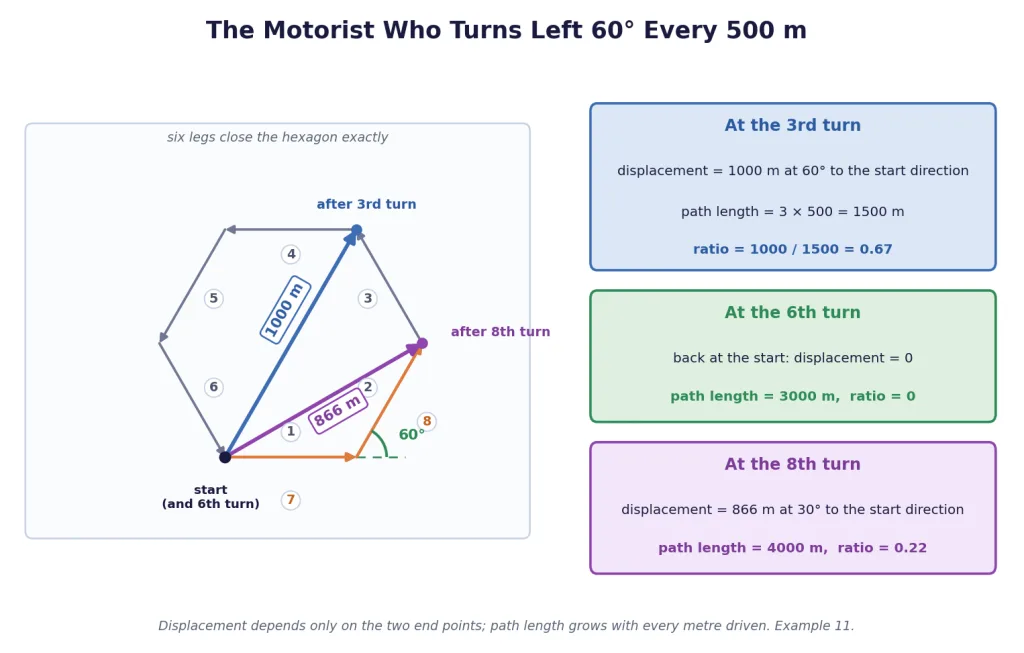
Solution:
- Recognise the figure. A turn of repeated after equal legs is the exterior angle of a regular hexagon: legs close the loop exactly. Draw it before computing anything.
- Set up components. Take the first leg along . The -th leg is m in the direction , so its components are and .
- At the third turn — add the first three legs: Direction: to the initial direction (both components positive, first quadrant, so this is safe). Path length m.
- At the sixth turn — the hexagon has closed. He is back where he started:
- At the eighth turn — legs 7 and 8 simply retrace legs 1 and 2, so his position is the same as after two legs: Path length m.
- The comparison.
| Turn | Displacement magnitude | Path length | Ratio |
|---|---|---|---|
| 3rd | 1000 m at | 1500 m | 0.67 |
| 6th | 0 | 3000 m | 0 |
| 8th | 866 m at | 4000 m | 0.22 |
Final Answer: 1000 m at (path 1500 m); zero (path 3000 m); 866 m at (path 4000 m).
Takeaway: Look down the last column. The path length climbs steadily while the displacement falls to zero and then climbs back. That is the whole lesson of displacement versus distance in one table: the longer a closed-ish journey runs, the more brutally the two diverge. Also note the shortcut — once you spot the hexagon, the 6th, 12th and 18th turns are all zero without any arithmetic at all.
Example 12: Components along a rotated pair of axes
and are unit vectors along the - and -axes. What are the magnitude and direction of the vectors and ? What are the components of along the directions of and ?
Solution:
- The vector . Components , so Both components positive first quadrant direction from the -axis.
- The vector . Components , so the magnitude is again . Now , fourth quadrant direction (that is, below the -axis, or ).
- These two are perpendicular to each other ( and are apart), so they are a perfectly good pair of axes — just the usual axes rotated by . Their unit vectors are
- Resolve onto the new axes. has magnitude and direction . The component of a vector along any direction is :
- Cross-check by projecting components directly. Along the projection is ; along it is .
- Final check on the pair. Rotating axes must not change the length:
Final Answer: Both and have magnitude , directed at and . The components of are along and along .
Takeaway: Axes are a choice, not a fact. Resolve the same vector onto a rotated pair and both numbers change — but does not, because the length of a vector is a scalar and scalars are exactly the things that survive a rotation of axes (which is precisely what Example 3(e) said). The negative sign on is real information: leans to the side of the line.
Example 13: Can these close? Resultant bounds in action
(a) Can three forces of 5 N, 9 N and 17 N acting at a point give zero resultant? (b) Can 3 N, 6 N and 8 N? (c) Two vectors of magnitude 8 and 5 units are added. Which of 2, 3, 9, 13 and 14 units are possible resultants? (d) Show that three forces of 7 N each can give zero resultant, and say how.
Solution:
- The closure rule. Vectors sum to zero exactly when, drawn head to tail, they close a polygon. For three vectors that polygon is a triangle, so zero resultant is possible if and only if no one magnitude exceeds the sum of the other two.
- (a) 5, 9 and 17. The two smaller ones give , which is less than 17. The 17 N side is too long for the other two to reach across. Not possible. Equivalently: the resultant of 5 and 9 lies between 4 and 14, and 17 is outside that band, so nothing can cancel it.
- (b) 3, 6 and 8. Check the longest: . The triangle closes. Possible.
- (c) 8 and 5 together. The band of achievable resultants is So 3 is possible (antiparallel), 9 is possible (at some intermediate angle), 13 is possible (parallel). 2 is impossible (below the floor) and 14 is impossible (above the ceiling).
- (d) Three forces of 7 N. Three equal magnitudes always close — into an equilateral triangle. Drawn head to tail that means each successive force is turned from the previous one. Check by components with the three at , , :
Final Answer: (a) no; (b) yes; (c) 3, 9 and 13 are possible, 2 and 14 are not; (d) yes — with the three forces at to one another.
Takeaway: Two rules cover this entire family. Two vectors: the resultant lives in the band to . Three vectors: they can cancel exactly when the largest is not bigger than the sum of the other two. Neither needs a single trigonometric function, and between them they answer most "is this possible" questions in the exam in under ten seconds.
Example 14: Differentiating a position vector
The position of a particle is given by metres, where is in seconds. (a) Find and . (b) What are the magnitude and direction of the velocity at s?
Solution:
- Differentiate component by component. This is the whole method — the , , are constant vectors, so they just sit there while the coefficients get differentiated:
- Differentiate once more: The acceleration is constant: 4.0 m/s^2 directed along , for all time.
- Read what each term is telling you. The -motion is uniform (3.0 m/s forever), the -coordinate never changes (the particle stays in the plane m), and only accelerates. This is a projectile in disguise.
- (b) Velocity at s. Substitute:
- Magnitude:
- Direction. and puts it in the fourth quadrant of the x-y plane: that is, measured anticlockwise from .
Final Answer: (a) m/s and m/s^2. (b) At s the speed is 8.54 m/s directed below the -axis.
Takeaway: Differentiating a vector is not a new operation — it is ordinary differentiation done once per component. And notice the constant vanished in the very first derivative, taking the entire -motion with it: a constant term in shifts where the motion happens, never how it happens.
Example 15: Constant acceleration from the origin
A particle starts from the origin at with velocity m/s and moves in the x-y plane with constant acceleration m/s^2. (a) At what time is the -coordinate 16 m, and what is the -coordinate then? (b) What is the speed at that time?
Solution:
- Split into two independent one-dimensional problems. This is the whole point of Section 4. Write the two columns side by side:
| -motion | -motion | |
|---|---|---|
| initial position | 0 | 0 |
| initial velocity | 0 | 10.0 m/s |
| acceleration | 8.0 m/s^2 | 2.0 m/s^2 |
- (a) Use the -column alone to find the time. With and : (The root s is before the motion started, so it is rejected.)
- Now hand that time to the -column — the clock is the only thing the two motions share:
- (b) Velocity at s, from :
- Speed:
Final Answer: (a) s, at which m. (b) The speed is 21.3 m/s.
Takeaway: The whole solution is two separate 1D problems that talk to each other through one shared quantity — the time. Solve for in whichever direction the question gives you enough information, then carry that across. This is exactly the machinery that makes projectile motion work, and it is worth recognising it here in its pure form.
Example 16: Which relations survive for arbitrary motion?
For any arbitrary motion in space, which of the following are true? (a) , (b) , (c) , (d) , (e) .
Solution:
- Sort the list into two kinds of statement. Some of these are definitions (true always, by construction); the rest are results derived under an assumption (true only when the assumption holds).
- (b) TRUE — it is the definition of average velocity. Displacement divided by the time interval. Nothing was assumed about how the particle got from one place to the other.
- (e) TRUE — it is the definition of average acceleration. Change in velocity divided by the time interval. Again, no assumption.
- (c) FALSE in general. This came from integrating and pulling out of the integral because it was constant. If changes with time you cannot pull it out and the result collapses.
- (d) FALSE in general, for exactly the same reason — it is the second integration of the same constant- assumption. Also note the symbol in (c) and (d) has no time label, which is itself the giveaway.
- (a) FALSE in general. Averaging the two end velocities ignores everything in between. It happens to be correct when is constant, because then changes linearly in time and the average of a linear function over an interval is the mean of its endpoint values. Any other motion and it fails. A particle that shoots out and comes straight back to its start has in some cases, giving zero on the right when the true average velocity is genuinely zero — but change the story slightly and the agreement disappears.
Final Answer: Only (b) and (e) are true for arbitrary motion. (a), (c) and (d) require constant acceleration.
Takeaway: Definitions survive everything; derived formulas carry their assumptions with them. Whenever a formula in kinematics contains a bare with no time-dependence written on it, ask immediately: was this derived assuming is constant? For (a), (c) and (d) the answer is yes, which is exactly why they fail here.
Example 17: How fast is that aircraft?
An aircraft flies at a height of 3400 m above the ground. The angle subtended at a ground observation point by the aircraft's positions 10.0 s apart is . What is the speed of the aircraft?
Solution:
- Draw the geometry. The observer is at O on the ground. The aircraft is at A at the first instant and at B ten seconds later, both at height 3400 m. The angle .
- Use the symmetry. Drop a perpendicular from O to the flight line; call its foot M, at the midpoint of AB. This perpendicular is the height, m, and it bisects the angle, so .
- Solve one right triangle. In triangle OMA, right-angled at M:
- Double it to get the whole path flown:
- Divide by the time. The aircraft flew 1822 m in 10.0 s:
- Sanity check in familiar units. km/h. That is a perfectly ordinary cruising speed for a passenger jet, so the answer is believable.
Final Answer: About 182 m/s (roughly 656 km/h).
Takeaway: The single move that makes this easy is bisecting the angle with the perpendicular from the observer, which turns one awkward isosceles triangle into two clean right-angled ones. Also note the classic trap: it is , not — if you use the full angle you get 1961 m/s and an aircraft flying at Mach 6.
Example 18: A full workup with constant acceleration in a plane
A particle is at m at , moving with velocity m/s, and has constant acceleration m/s^2. Find (a) its velocity and position at s, (b) the displacement over those 4 s and its direction, (c) the average velocity, and (d) the instant at which it is moving parallel to the -axis, and its speed then.
Solution:
- (a) Velocity, from , applied to each component: Both components positive, so the direction is from — almost straight up the -axis.
- Position, from :
- (b) Displacement is final minus initial position: Both components positive first quadrant direction from .
- (c) Average velocity: with magnitude m/s, also at — necessarily the same direction as the displacement, since dividing by a positive scalar cannot turn a vector.
- Notice what the average velocity is not. It is not the velocity at any of the instants we have computed: at the speed was m/s in a quite different direction, and at s it was 20.1 m/s. Average velocity is a displacement-per-time bookkeeping number, not a snapshot.
- (d) Moving parallel to the -axis means : At that instant m/s, so the particle is moving at 26 m/s straight along .
- A cross-check on step 4. Since is constant, must equal :
Final Answer: (a) m/s and m; (b) displacement 40 m at ; (c) average velocity 10 m/s at ; (d) at s, moving at 26 m/s.
Takeaway: The vector equations of motion are used exactly as you used the scalar ones in Chapter 2 — once for , once for , never mixing the two. And step 7 is the check worth building into your habits: with constant acceleration only, , and it catches arithmetic slips instantly. (Example 16 has just shown you it is only valid for constant .)
Example 19: Reading "speeding up" and "slowing down" off the vectors
A particle moves in the x-y plane with metres. (a) Find and . (b) Find the angle between and at and at s, and say in each case whether the particle is speeding up or slowing down. (c) At what instant are and perpendicular, and what is the speed then?
Solution:
- (a) Differentiate once, then again: The acceleration is constant and points along at all times. (This particle is a projectile launched with under m/s^2.)
- (b) At : , so m/s in the direction . The acceleration points at . The angle between them is Obtuse, so has a component opposing : the particle is slowing down.
- At s: , so m/s in the direction (fourth quadrant, since and ). The angle to at is Acute, so the particle is speeding up. Confirm it against the speeds themselves: 10 m/s at , then 6.32 m/s at s — so it slowed down first and is now on the way back up.
- (c) Perpendicular means the angle is exactly . With pointing straight down, must be exactly horizontal, i.e. :
- The speed there is whatever is left, namely the horizontal part on its own:
- Recognise the instant. with downward is the top of the trajectory, and 6.0 m/s is the minimum speed of the entire motion — the smallest it ever gets, because never changes and is at its least possible value, zero. Everything in step 3 falls into place: before s the speed is falling, after it the speed is rising.
Final Answer: (a) m/s, m/s^2. (b) at (slowing down); at s (speeding up). (c) At s, speed 6.0 m/s.
Takeaway: The angle between and is a speedometer needle: acute means speeding up, obtuse means slowing down, and exactly means the speed is momentarily neither — a turning point of speed, the minimum here. [JEE Tip] That condition locates the top of any projectile without ever writing , and it is the same condition that lets uniform circular motion run at constant speed forever (Example 32).
Example 20: One throw, every number in it
A ball is projected from level ground with speed m/s at above the horizontal. Take m/s^2 and neglect air resistance. Find (a) the components of the initial velocity, (b) the time of flight, (c) the maximum height, (d) the horizontal range, and (e) the velocity 1.0 s after launch.
Solution:
- (a) Resolve the launch velocity. Always the first line of a projectile solution: From here on, never changes and only feels gravity.
- (b) Time of flight. The ball returns to the launch height, so the -displacement over the whole flight is zero:
- (c) Maximum height, reached at s when :
- (d) Horizontal range — the horizontal motion is uniform, so it is just speed times time: Check against the formula: m.
- (e) Velocity at s. The horizontal part is untouched; the vertical part has lost : Direction: above the horizontal (both components positive, so it is still rising).
Final Answer: (a) 27.6 m/s and 23.1 m/s; (b) s; (c) m; (d) m; (e) 30.6 m/s at above the horizontal.
Takeaway: Every projectile problem starts with the same two lines — resolve into and — and then becomes bookkeeping. Note how the launch angle of had already fallen to after just one second: the direction of motion changes continuously even though the acceleration never does.
Example 21: The complementary pair, from a measured range
A ball thrown at to the horizontal lands 90 m away on level ground. Take m/s^2. Find (a) the launch speed, (b) the other launch angle that gives the same 90 m range, (c) the maximum height for each of the two throws, and (d) verify the two neat relations and .
Solution:
- (a) Work backwards from the range formula.
- (b) The complementary angle. Range depends on , and , so , giving
- (c) Maximum heights. With m, The steeper throw goes 2.37 times higher for the identical range.
- (d) First relation. Since , which is the maximum height a vertical throw at the same speed would reach.
- Second relation:
- A bonus difference. The two flight times are s and s. Their ratio is .
Final Answer: (a) 31.1 m/s; (b) ; (c) 14.6 m and 34.6 m; (d) both relations check out, with m and m.
Takeaway: Equal ranges do not mean equal flights. The complementary pair share only ; the steeper one goes much higher and stays up times longer. [JEE Tip] Remember and — either one lets you jump straight from two heights to a speed or a range with no angle in sight.
Example 22: Thrown horizontally off a cliff
A stone is thrown horizontally at 12 m/s from the top of a cliff 80 m high. Take m/s^2. Find (a) the time it takes to reach the ground, (b) how far from the foot of the cliff it lands, (c) its speed and direction on landing, and (d) the instant at which its velocity makes with the horizontal.
Solution:
- Set the axes and split the motion. Origin at the launch point, horizontal in the direction of throw, downwards (convenient here, so nothing carries a minus sign). Then
- horizontally: m/s,
- vertically: , m/s^2 The initial vertical velocity is zero — that is the entire meaning of "thrown horizontally".
- (a) The vertical motion alone gives the time. The horizontal throw does not delay the fall by a single instant:
- (b) Hand that time to the horizontal motion:
- (c) Velocity on landing. The horizontal part is unchanged; the vertical part has been building for 4 s: Direction: below the horizontal — very steep, because 80 m is a long drop compared with a modest 12 m/s throw.
- (d) At the two components are equal in magnitude, so m/s: By then it has fallen m, so it is still 72.8 m above the ground — the moment happens very early in the fall, and the path steepens rapidly after it.
Final Answer: (a) 4.0 s; (b) 48 m from the foot; (c) 41.8 m/s at below the horizontal; (d) at s.
Takeaway: A horizontally thrown stone and a stone simply dropped from the same cliff hit the ground at the same instant — the horizontal throw buys distance, never time. That is the independence of and made physical, and it is one of the most heavily tested single facts in this chapter.
Example 23: Recovering the launch from and
A projectile on level ground reaches a maximum height of 25 m and lands 80 m from its launch point. Take m/s^2. Find the launch angle, the launch speed, and the time of flight.
Solution:
- Use the ratio that eliminates the speed. Divide the height formula by the range formula: The launch speed has cancelled completely — this gives you the angle on its own, which is why it is the single most useful derived relation in the topic.
- Substitute the given numbers:
- Now find the speed from the range formula, with and :
- Check with the height formula — an independent equation, so this is a real test:
- Time of flight:
- A second, independent route to . Time of flight depends only on the height reached, since : This one never used the range or the angle at all.
Final Answer: , m/s, s.
Takeaway: gives you the angle without the speed — memorise it in exactly that form. Two special cases fall straight out and are worth knowing: means , and means (which is Example 27). Step 6 is the other keeper: the time of flight is fixed by the maximum height alone, through .
Example 24: Does the ball clear the wall?
A ball is kicked from the ground at 20 m/s at towards a wall 3.0 m high standing 25 m away. Take m/s^2. (a) Does it clear the wall, and by how much? (b) Is it rising or falling as it passes? (c) What is its speed at that moment?
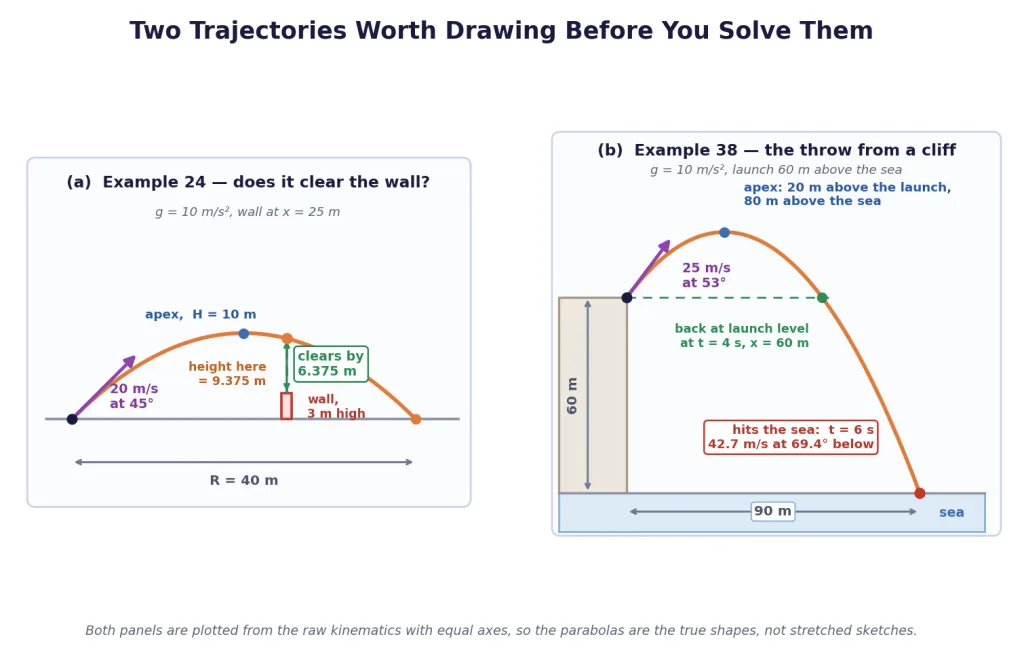
Solution:
- First check the range — could it even get there? The wall at 25 m is inside the range, so the ball does reach it. Good.
- Resolve the launch:
- (a) Find the time to reach the wall from the horizontal motion, which is uniform:
- Find the height at that instant: The wall is 3.0 m tall, so the ball clears it by m.
- (b) Rising or falling? Check the vertical velocity there: Negative, so it is already falling. That makes sense: the apex sits at m, and the wall is at 25 m, past it.
- (c) Speed at the wall: at below the horizontal.
Final Answer: (a) Yes, it clears the wall with 6.375 m to spare; (b) it is falling; (c) 14.6 m/s, angled below the horizontal.
Takeaway: Obstacle problems are one question in disguise: what is when equals the obstacle's distance? Get the time from the horizontal motion, feed it into the vertical. Checking the range first is worth ten seconds — if the wall were 45 m away, the ball would land before reaching it and the whole calculation would be meaningless.
Example 25: Velocity at chosen instants
A stone is projected at 25 m/s at to the horizontal from level ground. Take m/s^2. Find (a) its velocity 1.5 s after launch, (b) the two instants at which it is moving at to the horizontal, and (c) its speed at half the maximum height.
Solution:
- Resolve, and note the two standard results:
- (a) At s: at above the horizontal — still rising, since .
- (b) Moving at to the horizontal means , so Two different velocities produce that magnitude, so expect two answers.
- Rising, with m/s: Falling, with m/s: The two straddle the apex at s symmetrically: .
- (c) At half the maximum height, m. Use on the vertical motion alone:
- Combine with the untouched horizontal part:
Final Answer: (a) 13.1 m/s at ; (b) at s (rising) and s (falling); (c) 19.2 m/s.
Takeaway: Two habits here. First, any question about the angle of motion has two answers unless the problem says rising or falling — the parabola makes every slope twice, once on the way up and once on the way down. Second, notice that at half the height the speed is 19.2 m/s, which is not halfway between 25 m/s (launch) and 10.6 m/s (apex): speed does not vary linearly with height, does.
Example 26: The relief package dropped from an aircraft
An aircraft flying horizontally at 720 km/h at a height of 1500 m releases a relief package. Take m/s^2 and ignore air resistance. Find (a) the time the package takes to reach the ground, (b) the horizontal distance it travels, (c) how far ahead of the drop zone the pilot must release it, expressed as the angle of the line of sight from the vertical, and (d) the speed at which the package lands.
Solution:
- Convert the speed first. km/h m/s.
- Set up. At release the package has the aircraft's velocity: m/s horizontal, . This is a horizontal projection from 1500 m.
- (a) The vertical motion gives the time, taking downwards as positive:
- (b) Horizontal distance covered in that time: The package lands 3.5 km beyond the point of release — it keeps pace with the aircraft the whole way down, so it lands directly below the aircraft, not behind it.
- (c) The angle of sight. At release, the target is 1500 m below and 3499 m ahead, so the line of sight from the aircraft makes an angle with the vertical of The pilot must release when the drop zone appears from straight down, i.e. only below the horizon ahead.
- (d) Landing velocity. The horizontal component is untouched; the vertical has been growing for 17.5 s: at below the horizontal.
Final Answer: (a) 17.5 s; (b) 3.5 km; (c) the line of sight is from the vertical at release; (d) 263 m/s at below the horizontal.
Takeaway: The package is not dropped over the target — it is dropped 3.5 km short of it. And through the whole fall it stays directly beneath the aircraft, because nothing horizontal ever acts on it. [JEE/NEET] That "stays below the plane" result is a standard one-line question; the moment the plane accelerates or turns, of course, it stops being true.
Example 27: When the range is three times the height
For a projectile on level ground the horizontal range is three times the maximum height. Find the launch angle, and find what fraction of the maximum possible range (for the same launch speed) this represents. Then check the whole thing with m/s and m/s^2.
Solution:
- Start from the relation established in Example 23:
- Substitute the condition : (This is the familiar 3-4-5 angle, with and .)
- Compare with the maximum range. For a given , the largest possible range is , at . Here So this throw achieves 96% of the best possible range despite being off the optimal angle.
- Now verify with real numbers. Take m/s, m/s^2, :
- Check the condition: . And m, so .
Final Answer: , achieving 96% of the maximum possible range.
Takeaway: The range curve is flat near its peak. Being away from costs you only 4% of the range — which is why real throwers and kickers get away with imprecise angles, and why questions that ask for "the angle for maximum range" are testing a much sharper idea than questions that ask for the range itself. [NEET Important] The pairs worth knowing cold: at , at , at .
Example 28: The hands of a clock
A wall clock has a second hand 8.0 cm long and a minute hand 10.0 cm long. For the tip of each hand find the angular speed, the linear speed and the centripetal acceleration. Then find the ratio of the two angular speeds and the ratio of the two centripetal accelerations.
Solution:
- Start from the periods, which are what a clock actually gives you: the second hand takes s per revolution, the minute hand s.
- Angular speed is :
- Linear speed of the tip is , with the radii in metres ( m, m):
- Centripetal acceleration — use , which is the convenient form when is what you have:
- The angular-speed ratio is set purely by the periods; the lengths are irrelevant:
- The acceleration ratio brings the lengths back in:
Final Answer: Second hand: rad/s, mm/s, m/s^2. Minute hand: rad/s, mm/s, m/s^2. Ratios: 60:1, 2880:1.
Takeaway: The minute hand is longer than the second hand and still has a far smaller acceleration, because depends on — and squaring a factor of 60 buries a factor of 0.8 completely. [NEET Important] When comparing circular motions, always ask which quantity is held fixed: at the same , longer radius wins; at the same , shorter radius wins.
Example 29: The Moon in its orbit
The Moon orbits the Earth in a nearly circular path of radius m with a period of 27.3 days. Find (a) its orbital speed, (b) its centripetal acceleration, and (c) how that acceleration compares with m/s^2 at the Earth's surface.
Solution:
- Convert the period to SI, because every formula wants seconds:
- (a) Orbital speed. In one period the Moon covers one circumference: About 1.02 km/s, or 3680 km/h.
- (b) Centripetal acceleration, from :
- Cross-check with the period form , which avoids using the speed we just computed:
- (c) The comparison:
Final Answer: (a) m/s; (b) m/s^2, directed towards the Earth; (c) about of surface gravity.
Takeaway: That factor of 3600 is not a coincidence — the Moon sits about 60 Earth-radii away, and . Newton did exactly this calculation and recognised it as the inverse-square law, which is how the Moon ended up in Chapter 7. For now the physics lesson is narrower: the Moon is in free fall towards the Earth at every instant, and m/s^2 is how hard.
Example 30: Which car is turning harder?
Car A goes round a circular track of radius 100 m at a steady 20 m/s. Car B goes round a track of radius 50 m at a steady 15 m/s. (a) Which car has the larger centripetal acceleration? (b) At what speed must B travel for the two accelerations to be equal? (c) Find each car's period.
Solution:
- (a) Compute both accelerations — do not guess from the speeds: Car B has the larger centripetal acceleration, even though it is the slower car — its much tighter turn more than makes up for it.
- (b) Set m/s^2 and solve for the required speed: which is 50.9 km/h. So B must slow from 15 m/s to 14.1 m/s.
- (c) Periods — the time for one lap, :
- A consistency check on B. Using with s:
Final Answer: (a) Car B, at 4.5 m/s^2 against A's 4.0 m/s^2; (b) 14.1 m/s (50.9 km/h); (c) s and s.
Takeaway: Speed alone tells you nothing about how hard a body is accelerating in a circle — it is always , and the radius is doing half the work. This is why a slow, tight hairpin bend throws you sideways harder than a fast, gentle motorway curve, and it is the single most common comparison question in this topic.
Example 31: Designing a fairground rotor
A fairground rotor is a cylindrical room of radius 4.0 m that spins about its vertical axis. It is to be run so that riders against the wall experience a centripetal acceleration of . Take m/s^2. Find the required linear speed of a rider, the period of rotation, the angular speed, and the number of revolutions per minute.
Solution:
- Write down the target acceleration:
- Get the speed from :
- Get the period from :
- Angular speed:
- Revolutions per minute is the frequency in the units the engineer actually uses:
- Check by going backwards through the other formula, which uses rather than :
Final Answer: m/s, s, rad/s, and about 25.9 revolutions per minute.
Takeaway: Notice the chain: , each step one formula. Quoting an acceleration "in units of " is standard engineering practice — it tells a rider they will feel three times their own weight pressed against the wall. [JEE Tip] 26 rpm sounds gentle and produces ; centripetal acceleration climbs fast because it goes as .
Example 32: Uniform circular motion written as a vector
A particle moves so that its position vector is metres, with in seconds. (a) Show that it moves in a circle at constant speed and find the radius, angular speed, speed and period. (b) Find and at s and show they are perpendicular. (c) Show that always points at the centre.
Solution:
- (a) Identify the circle. The magnitude of is Constant distance from the origin means a circle of radius m centred at the origin. Comparing with gives rad/s.
- Differentiate for the velocity: Check against m/s. Period s.
- Differentiate again for the acceleration: Check against m/s^2.
- (b) At s the phase is :
- Directions, read off the signs. has , , so second quadrant: . has both components negative, so third quadrant: . The gap is
- (c) The general result. Compare the acceleration with the position: The minus sign says points exactly opposite to — that is, from the particle straight back to the centre — at every instant. Hence "centripetal", meaning centre-seeking.
Final Answer: (a) m, rad/s, m/s, s. (b) At s, m/s at and m/s^2 at — exactly apart. (c) , always towards the centre.
Takeaway: This is Section 6 derived rather than asserted. contains the entire content of uniform circular motion — the magnitude , the centre-seeking direction, and the perpendicularity to all fall out of that one line. And the perpendicularity is precisely Example 19's condition for the speed not to change, which is why a body can accelerate forever in a circle and never speed up.
Example 33: The cyclist and the vertical rain
Rain is falling vertically at 12 m/s. A cyclist rides due north at 5.0 m/s. (a) At what angle to the vertical, and in which direction, must she tilt her umbrella? (b) At what speed does the rain appear to strike her? (c) If she doubles her speed to 10 m/s, what happens to the angle?
Solution:
- Set axes and write both velocities in the ground frame. Take north and vertically upwards:
- (a) Subtract to get the rain as she sees it. She wants the velocity of the rain relative to herself: Both components negative: the rain appears to come at her from the front and above, which is exactly what you feel on a bicycle.
- The tilt angle from the vertical: She tilts the umbrella from the vertical, towards the north — that is, forwards, into her own direction of travel.
- (b) The apparent speed is the magnitude of that relative velocity: (A 5-12-13 triangle.) Faster than the 12 m/s the rain actually falls at — moving through rain always makes it seem to come harder.
- (c) Doubling her speed to 10 m/s: and the apparent speed becomes m/s. The angle did not double — it went from to , not to , because it is the tangent that is proportional to her speed, not the angle itself.
Final Answer: (a) from the vertical, tilted forward (north); (b) 13.0 m/s; (c) the angle becomes , not .
Takeaway: Two things students get wrong here. The umbrella tilts forwards, into the motion — the instinct to lean it backwards is wrong. And angles do not scale linearly: doubling a velocity component doubles a tangent, and only for small angles does that approximately double the angle itself.
Example 34: One river, two routes
A river 120 m wide flows at 3.0 m/s. A boat can move at 5.0 m/s in still water. Find, for each of the two standard routes: (a) the shortest-time crossing — its time, the drift, the resultant speed, and the actual path length; and (b) the crossing that lands directly opposite — the heading required and the time taken.
Solution:
- Set axes once and keep them. Let point downstream and straight across, from the near bank to the far bank. Then m/s and the boat's velocity relative to the water has magnitude 5.0 m/s in whatever direction the boatman chooses.
- (a) Shortest time. Only the -component of the boat's velocity carries it across, so the crossing is quickest when the entire 5.0 m/s is spent on — that is, when the boat is headed straight across, perpendicular to the bank:
- The drift — how far downstream the current carries her in that time:
- The resultant speed and the actual path. The boat's ground speed is at off the straight-across direction. The path she actually traces is which also equals m.
- (b) Landing directly opposite. Now the downstream component of the resultant must be zero, so the boat must be headed upstream by an angle that exactly cancels the current:
- What is left for the crossing: The path here is exactly the 120 m width, and the crossing takes 25% longer than the shortest-time route.
Final Answer: (a) 24 s, drift 72 m, ground speed 5.83 m/s, path 140 m. (b) Head upstream; crossing takes 30 s.
Takeaway: The two routes optimise different things and you can never have both. Shortest time means pointing straight across and accepting the drift; shortest path means sacrificing part of your speed to fight the current. The 3-4-5 triangle appearing in step 6 is not luck — with the across-component is always the 4.
Example 35: The aircraft and the crosswind
An aircraft has an airspeed of 240 km/h. A wind of 45 km/h blows from the west. (a) If the pilot points the nose due north, what are the aircraft's ground speed and its actual track? (b) What heading must he take so that the aircraft actually travels due north, and what is the ground speed then? (c) How long would a 500 km northward journey take on that heading?
Solution:
- Fix the axes and translate the wind. Take east and north. A wind from the west blows towards the east, so Get this convention backwards and every answer lands on the wrong side of the compass.
- (a) Nose due north. The aircraft's velocity relative to the air is , and the ground velocity is the vector sum:
- The track (the direction actually travelled over the ground). Both components positive, so it is east of north by He is going faster than 240 km/h but drifting steadily off course.
- (b) To actually fly due north, the east-west components must cancel, so he must aim into the wind, west of north by an angle :
- The ground speed on that heading is whatever is left in the northward direction: or directly, km/h.
- (c) Time for 500 km:
Final Answer: (a) 244 km/h on a track east of north; (b) head west of north, ground speed 236 km/h; (c) about 2 h 7 min.
Takeaway: Compare the two parts. Pointing north gains speed (244 km/h) but goes the wrong way; correcting the heading loses speed (236 km/h) but arrives. A crosswind always costs you something — there is no heading that both cancels the drift and keeps the full 240 km/h. [JEE/NEET] And remember the three words: a wind is named for where it comes from, a heading for where the nose points, a track for where the aircraft actually goes.
Example 36: Two cars approaching a junction
Two straight roads cross at right angles. Car A is 40 m south of the junction, travelling north at 10 m/s. Car B is 60 m west of the junction, travelling east at 15 m/s. (a) Do they collide? (b) If instead B travels at 12 m/s, find the time of closest approach and the minimum separation.
Solution:
- Set coordinates with the junction at the origin, east and north:
- Go into A's frame. Everything about a collision is decided by the relative position and the relative velocity:
- (a) The collision test. A sees B as moving in a straight line at constant . They collide only if that line runs straight at A — which means must be antiparallel to . Compare the components: The same negative multiple in both, so — B is heading straight at A. They collide, at s.
- Verify directly. At s, A is at , and B is at . Both are exactly at the junction.
- (b) B slowed to 12 m/s. Now
- Minimise the separation. Work with the square, which is easier to differentiate: Set it to zero: s.
- Substitute back: They miss by 7.7 m — and note that B is now south-west of A at that moment, so B has crossed the junction first.
Final Answer: (a) Yes — they collide at the junction 4.0 s later; (b) with B at 12 m/s the closest approach is 7.68 m, occurring at s.
Takeaway: The collision condition is a direction condition, not a distance condition: two bodies collide exactly when the relative velocity points along the line joining them. Ride on one body, watch the other travel in a straight line, and ask whether that line passes through you. Everything else — closest approach, time of it — is then one minimisation.
Example 37: Two ships leaving the same port
Two ships leave a port at the same moment. Ship A sails due north at 25 km/h; ship B sails at 40 km/h in a direction east of north. Find (a) the velocity of B relative to A, giving both magnitude and direction, and (b) how far apart they are after 2.0 hours.
Solution:
- Axes: east, north. Resolve both velocities in the ground frame.
- Ship A heads due north, so it is all :
- Ship B is east of north, so the angle is measured from the north axis. That means the sine goes with east and the cosine with north — the opposite of the usual habit, so be careful:
- (a) Subtract:
- Magnitude and direction: Both components positive, so first quadrant: north of east. To someone standing on A's deck, B drifts away roughly east-north-east at 22.2 km/h.
- (b) Separation after 2.0 h. In A's frame B moves in a straight line at constant velocity, so
- Ground-frame check. After 2 h, A is at km and B is at km. The gap is
Final Answer: (a) 22.2 km/h directed north of east; (b) 44.4 km apart.
Takeaway: Neither nor is anywhere near 22.2 — in a plane the relative speed is never a simple difference of speeds. And watch step 3: when a bearing is given as "east of north", the angle is measured from the north axis, so takes the east component. Reading that convention backwards is the most common single error in bearing problems.
Example 38: The throw from the cliff (hard)
A ball is thrown from the top of a 60 m cliff overlooking the sea, with speed 25 m/s at above the horizontal. Take m/s^2, and . Find (a) the greatest height it reaches above the sea, (b) the time it takes to hit the sea, (c) how far from the base of the cliff it lands, (d) its speed and direction on impact, and (e) the instant and place at which it passes the launch height on the way down. The trajectory is drawn in panel (b) of the figure above Example 24.
Solution:
- Set the origin at the launch point, horizontal out to sea, upwards. The sea surface is then at m. Resolve:
- (a) The rise above the launch point comes from the vertical motion alone, with at the top: So the greatest height above the sea is m. (This happens at s.)
- (b) Time to hit the sea. Use the vertical equation all the way down to m: Reject the negative root — it is the fictitious earlier time at which a ball following the same parabola would have been at sea level. Physically, s.
- (c) Horizontal distance, from the uniform horizontal motion:
- (d) Impact velocity. Horizontal unchanged; vertical after 6 s: Direction: , , so fourth quadrant, below the horizontal.
- An independent check on that speed. Energy-style reasoning gives for a drop of m: Note this cross-check knows nothing about the angle — the impact speed is independent of the launch direction, though the impact direction is not.
- (e) Back at launch height means again: At s it is at m, moving with m/s and m/s, i.e. at 25 m/s, the launch speed, but now below the horizontal — the parabola is symmetric about its apex.
Final Answer: (a) 80 m above the sea; (b) 6.0 s; (c) 90 m from the base; (d) 42.7 m/s at below the horizontal; (e) at s and m, moving at 25 m/s directed below the horizontal.
Takeaway: Three things to carry away. A projectile launched from a height has an unsymmetrical flight — 4.0 s above the launch level and only 2.0 s below it, but the extra 60 m of drop is where most of the speed is gained. The quadratic always has a root to reject, and it is always the one that lies before the motion started. And step 6's cross-check is worth building in: impact speed depends only on launch speed and drop height, never on launch angle.
Example 39: Crossing to a chosen landing point (hard)
A river 400 m wide flows at 2.0 m/s. A boat moves at 4.0 m/s relative to the water. The boatman must land at a jetty that is 300 m downstream of his starting point on the opposite bank. In what direction must he head, and how long does the crossing take?
Solution:
- Axes: downstream, across. He must achieve a displacement of metres, which has magnitude m — the straight line to the jetty.
- Let be the heading, measured from the straight-across direction and taken positive downstream. Then the boat's velocity relative to the water is downstream and across, and the ground velocity is
- Impose the condition. Because both velocity components are constant, the boat travels in a straight line, so the velocity must point at the jetty just as the displacement does:
- Solve with the standard -method. Since and gives :
- Pick the physical root. The first gives . The second gives , for which — the boat would be heading backwards, away from the far bank, and would never cross. Reject it. So
- Now the velocities and the time:
- Check the landing point: m. And the ground speed is m/s, so the 500 m straight-line path takes s.
Final Answer: He must head downstream of straight across, and the crossing takes about 103 s.
Takeaway: Compare with Example 34. Landing straight across needed an upstream heading; landing downstream needs a downstream one, but only — much less than the line to the jetty, because the current is already doing part of the downstream work for him. [JEE Tip] The condition that unlocks this whole family is step 3: with constant velocities the path is straight, so the velocity vector must point at the destination. And as always with a trigonometric equation, there are two roots and one of them is physical nonsense.
Example 40: The stone that breaks free (hard)
A stone is whirled in a horizontal circle of radius 1.0 m at the end of a string, making 2.0 revolutions per second, with the circle 5.0 m above the ground. The string suddenly snaps. Take m/s^2. Find (a) the speed of the stone at the instant the string breaks, (b) its centripetal acceleration just before, expressed also in units of , (c) how far it lands from the point directly below where the string snapped, and (d) its speed on landing.
Solution:
- (a) Speed on the circle. With frequency rev/s, the angular speed is rad/s, so (Equivalently: it covers m per revolution, twice a second.)
- (b) Centripetal acceleration just before the break: In units of (taking m/s^2 for this comparison), that is — the string was pulling sixteen times harder than gravity.
- The moment of release — this is the conceptual heart of the problem. Once the string snaps there is no centripetal force, so the stone does not fly outwards along the radius. It leaves along the tangent, carrying the velocity it had at that instant: 12.6 m/s horizontally, perpendicular to the radius. From then on it is a horizontal projectile.
- (c) The fall. Horizontally launched means : In that second it travels horizontally measured from the point directly below the break, along the tangential direction.
- A subtlety worth noticing. Since the tangent is perpendicular to the radius, the distance from the point directly below the centre of the circle is not 12.6 m but — barely different here, because 1.0 m is small beside 12.6 m, but the reasoning matters if the radius is comparable to the throw.
- (d) Landing speed. The horizontal component is untouched and the vertical has been building for 1.0 s: at below the horizontal.
Final Answer: (a) 12.6 m/s; (b) 158 m/s^2, about ; (c) 12.6 m from the point directly below the break; (d) 16.1 m/s at below the horizontal.
Takeaway: Three topics locked together in one problem. When the string snaps the stone flies off along the tangent, never along the radius — that is Section 6's "velocity is tangent to the path" being cashed in, and it is the single most-asked conceptual point about circular motion. From that instant onward the centripetal acceleration is gone; the only acceleration is , and the problem becomes Section 5's horizontal projection. Nothing about the 158 m/s^2 survives the break.