
A Projectile Is Free Fall With a Head Start Sideways
Section 4 ended with a promise. It said that motion in a plane is two independent one-dimensional motions sharing one clock, and that if you set and you get projectile motion for free. Time to collect.
Here is the thing about a thrown ball that surprises people the first time they meet it properly: nothing pushes it forward. Once it leaves your hand there is no engine, no forward force, nothing. The only thing acting on it is gravity, and gravity points straight down. So the sideways motion has no reason to change, and the vertical motion is plain free fall. That is the whole of this section, and everything below is bookkeeping.
Key Point: An object that is in flight after being thrown or projected is called a projectile. A football, a cricket ball, a javelin, a bullet, a jet of water, a package released from an aircraft — all projectiles. In our treatment we assume air resistance has a negligible effect, so after launch the only acceleration is that due to gravity, directed vertically downward.
Setting up the axes — do this first, every single time
Take the launch point as the origin, the x-axis horizontal in the direction the object is thrown, and the y-axis vertically upward. Let the object be launched with speed at an angle above the horizontal.
Now resolve, using Section 3:
And the acceleration, which is the whole reason this problem is easy:
That minus sign is not optional. You chose "up" as positive, gravity points down, so where is the positive number 9.8 m/s^2 (or 10 m/s^2 when a problem says so). Half the sign errors in this chapter come from writing and hoping.
Feed the six numbers into Section 4's equations
With , the component equations and collapse to something almost embarrassingly simple:
Four equations. Learn them and you can rebuild every other formula in this section from scratch in about ninety seconds — which is exactly what you should do in an exam if a formula deserts you.
The two motions, side by side
| Horizontal (x) | Vertical (y) | |
|---|---|---|
| Initial velocity | ||
| Acceleration | ||
| Velocity at time | , constant | |
| Position at time | ||
| What kind of motion is it | uniform velocity | uniform acceleration: free fall |
| Chapter 2 analogy | a car on cruise control | a ball thrown straight up |
The one sentence that matters: The horizontal motion and the vertical motion are completely independent. The ONLY thing that links the two columns is the shared time . Nothing in the x-column ever appears in the y-column, and nothing in the y-column ever appears in the x-column.
[JEE/NEET] Nearly every projectile question is solved by finding from one column and spending it on the other. "When does it land?" is a y-question. "How far did it go?" is an x-question that needs the answer to the y-question. Train yourself to sort the given data into two columns before you write a single equation.
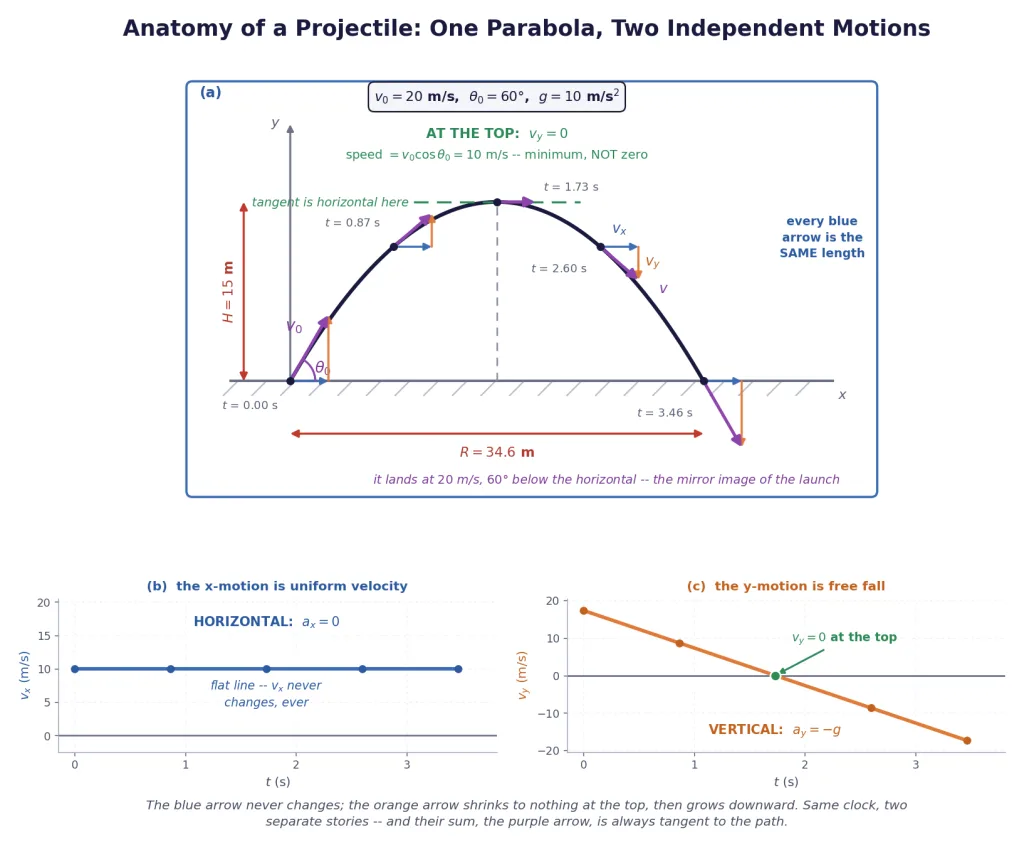
Read the figure slowly, because it contains most of this section. The blue arrow is and it is the same length at every single instant — that is made visible. The orange arrow is : long and upward at launch, shorter, shorter, gone at the top, then growing downward. The purple arrow is the actual velocity, the vector sum of the two, and notice that it always lies along the tangent to the path, exactly as Section 4 insisted it must.
Galileo was the first person to state this independence, in his Dialogue Concerning the Two Chief World Systems (1632). It is not an obvious idea — for two thousand years people believed a cannonball flew forward until its "impetus" ran out and only then fell. Galileo's claim was that it was falling the whole time.
The Path Is a Parabola: Eliminating the Clock
We have and . Both mention . But a path is a relationship between and alone — where the object is, not when it was there. So kill the .
The derivation, in two lines
From the horizontal equation,
Substitute that into the vertical equation:
The cancels in the first term and , so
Key Point — the equation of the trajectory:
Why that is a parabola
Look at what is actually variable in that expression. is a constant. and were fixed the moment the object left your hand, so is a constant and is a constant. Call them and :
That is a quadratic in with a negative coefficient — a parabola opening downward. This is Galileo's celebrated result, and it drops out of two lines of substitution.
Key Point: The trajectory of a projectile (air resistance neglected) is a parabola. Since always, it always opens downward.
Reading a trajectory backwards
Examiners love handing you a trajectory like and asking for and . You never need a new formula — just match coefficients:
- From : .
- From : .
And two bonuses that fall straight out of the algebra, no physics required:
- Range (where the path returns to ): set , so , giving (the launch) or
- Maximum height (the vertex, at ):
[JEE Tip] Those last two are worth memorising in exactly that form. A question that gives you and asks for the range or the maximum height is then a five-second question, and it comes up often.
A sanity check you can run on any trajectory
The parabola must be symmetric about the vertical line through its apex. So the apex sits at , the object spends half its flight going up and half coming down, and the two halves are mirror images. If a calculation ever gives you an apex that is not at half the range (for level ground), something is wrong.
Time of Flight, Maximum Height and Range
Three numbers describe almost every projectile question. All three come from the four equations of Block 1, and all three assume the projectile lands back at the height it was launched from — level ground. Keep that condition in the front of your mind; it is the single most common source of wrong answers.
Time to reach maximum height,
At the top of the path the object is momentarily moving horizontally, so its vertical velocity is zero. Set :
Time of flight,
The object is back at launch level when again:
is the launch itself; the useful root is
— the trip up takes exactly as long as the trip down. That is the symmetry of the parabola showing up as a statement about time.
Maximum height,
Put into the equation:
Which is just the Chapter 2 result applied to the vertical column with and . Nothing new.
Horizontal range,
The horizontal motion is uniform, so distance is simply speed multiplied by the whole flight time:
and , so
Maximum range — and why
and are fixed, so is largest when is largest. The sine of anything never exceeds 1, and it equals 1 when the angle is :
Key Point: For a given launch speed the range is maximum at , and that maximum range is . Two useful corollaries: , and the maximum height reached on that throw is .
The complementary-angle result
Galileo, in Two New Sciences, wrote that "for elevations which exceed or fall short of by equal amounts, the ranges are equal". Here is the proof, which is three lines.
Take the two angles and . Then
But and as well. The two values of are identical, so the two ranges are identical.
Notice that , so the pair are complementary angles. Stating it the way exams state it:
Key Point — complementary angles: and give the same horizontal range for the same launch speed. So and land in the same place; so do and ; so do and .
But their times of flight and maximum heights are completely different. The steeper throw takes longer and climbs higher.
[NEET Important] "Same range, different time and height" is one of the most reliably examined single facts in this whole chapter. If a question says two projectiles thrown at the same speed land at the same point, the angles are complementary and you can write immediately.
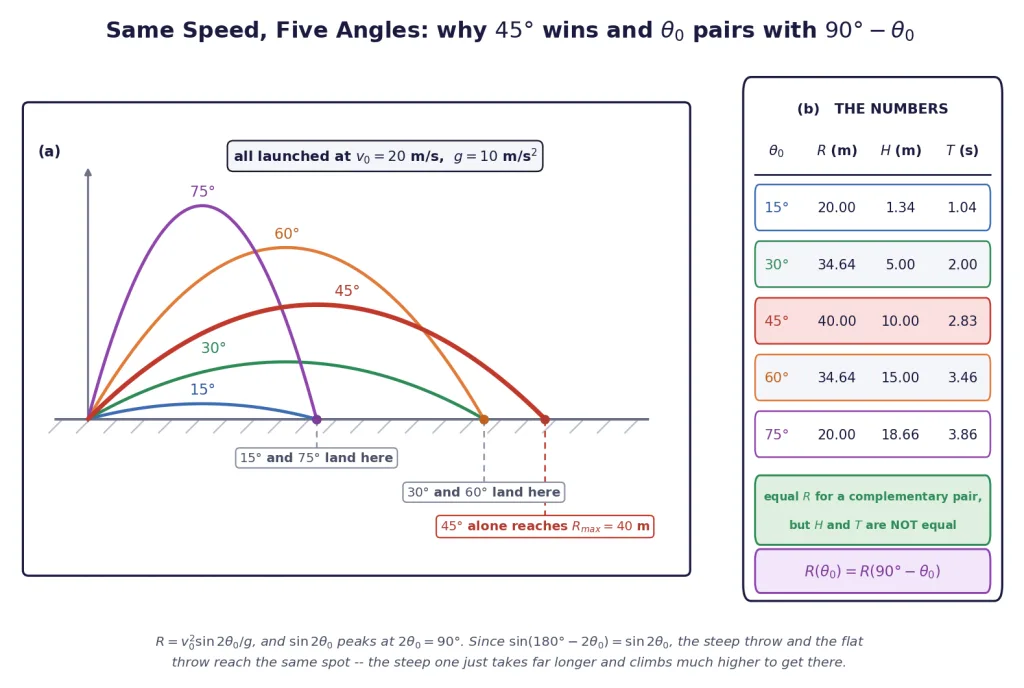
The link between and
Divide by and watch things cancel:
Beautifully, and have both vanished. Give a projectile's range and maximum height and this hands you the launch angle instantly, with no other information at all. At , , so — a fact worth carrying around on its own.
Reference table (same , level ground)
| as a fraction of | as a fraction of | ||
|---|---|---|---|
| 0.500 | 0.500 | 0.033 | |
| 0.866 | 0.866 | 0.125 | |
| 1.000 | 1.000 | 0.250 | |
| 0.866 | 0.866 | 0.375 | |
| 0.500 | 0.500 | 0.466 | |
| 0.000 | 0.000 | 0.500 |
Read the last row: throw it straight up and the range is zero, but the height is the biggest it can ever be, . That row is a standard exam question in disguise.
Velocity at Any Instant — and the Trap at the Top
So far we have talked about where the projectile is. Now, how fast is it going, and in what direction?
You already have the components. Recombine them the Section 3 way:
where is the angle the velocity makes with the horizontal at that instant. While the object is rising and is positive; after the top and is negative, meaning the velocity points below the horizontal.
The trap at the top
At the highest point . Students then write "so the velocity is zero at the top". It is not.
Key Point — a guaranteed exam trap: At the highest point of a projectile's path, only the vertical component of velocity is zero. The horizontal component is still , exactly what it was at launch. So at the top: The velocity there is purely horizontal, which is why the tangent to the parabola is horizontal at the apex.
The only way the speed at the top is zero is if — a straight vertical throw, which is not really a projectile problem at all.
[NEET Important] And while the speed is at a minimum at the top, the acceleration at the top is still downward. It never changes, not for one instant of the flight, not at the apex, not on landing. "Acceleration is zero at the highest point" is wrong; the velocity's rate of change is what gravity fixes, and gravity does not take a break.
The symmetry of the flight
Because the up-half and the down-half of a parabola are mirror images, everything pairs up:
| Quantity | On the way up, at height | On the way down, at the same height |
|---|---|---|
| Speed | the same | |
| Angle with the horizontal | above | below |
| Time from launch |
In particular, at landing ():
Key Point: For level ground, a projectile lands with the same speed it was launched with, and its velocity makes the same angle with the horizontal — but below it instead of above. Launch and landing are mirror images.
That gives you a beautiful shortcut for the speed at any height : use the Chapter 2 equation on the vertical column only,
The angle has vanished completely. The speed of a projectile at a given height depends only on the launch speed and the height, never on the launch angle. (If that feels familiar, it should — it is conservation of energy, which you will meet properly in Chapter 5.)
Worth noticing
- is largest at launch and at landing, smallest at the top. It never passes through zero.
- never changes, so the projectile's horizontal shadow moves at a perfectly constant speed for the whole flight.
- and are at an obtuse angle while rising (the object is slowing), exactly at the top, and at an acute angle while falling (speeding up). That is Section 4's angle table playing out in a single throw.
Horizontal Projection From a Height
This is a different animal from everything above, and it deserves its own treatment because it is its own question archetype: a ball rolled off a table, a package released from a level-flying aircraft, a stone thrown horizontally off a cliff, a marble shot off the edge of a bench.
The set-up
The object is launched horizontally from a height above the ground, with speed . So , and therefore
Put the origin at the launch point with upward, so the ground is at . The two columns:
Time of fall — and the result that startles everyone
The object reaches the ground when :
Key Point: Look at what is not in that formula: . The time taken to fall is decided entirely by the height, and is completely independent of the horizontal speed. A ball rolled gently off a table and a ball fired horizontally off the same table at 100 m/s hit the floor at the same instant.
This is the classic demonstration of the independence of the two motions, and it is worth doing at home with two coins and a ruler. It sounds wrong. It is not wrong. The vertical column contains no anywhere, so the vertical motion cannot possibly know how fast the object is moving sideways.
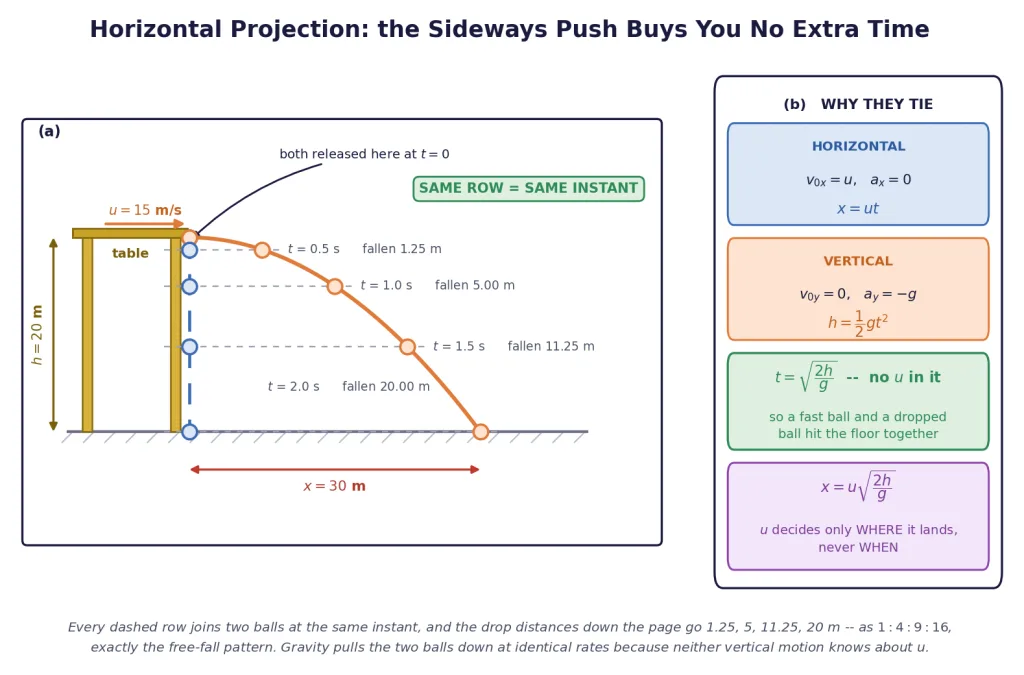
Each dashed row in the figure joins the two balls at the same instant, and the rows are always level. The projected ball travels further and further sideways per row (equal steps, because is constant) while dropping 1.25, 5, 11.25 and 20 m — the ratio , the signature of free fall from rest.
Horizontal distance, and the landing velocity
The horizontal range from the base of the launch point follows immediately:
Here does matter — it decides where the object lands, never when. At the moment of landing:
The trajectory here
Substituting into :
Still a parabola — but only the descending half of one. The full parabola's apex sits at the launch point itself, since that is where .
The recipe
| Step | What to do |
|---|---|
| 1 | Write the height and the horizontal speed in separate columns |
| 2 | Get from the height alone: |
| 3 | Spend that on the horizontal column: |
| 4 | For the landing velocity, combine with by Pythagoras |
[Board Important] Do not use or here. Both are zero when , and both were derived for a projectile that returns to its launch height. This one never does. Go back to the columns.
What We Threw Away, and the Whole Section on One Card
The thing we neglected: air resistance
Every result above rests on one assumption stated once and then quietly used forty times: air resistance is negligible. In real life it is not, and it is honest to know what changes.
The drag force on a moving object points opposite to its velocity, and its magnitude grows with speed. Because it acts along the velocity — which is constantly changing direction — it messes with both columns at once, and the beautiful independence of and is destroyed. Consequences, qualitatively:
| With drag | What actually happens |
|---|---|
| The path | No longer a parabola. It becomes an unsymmetrical curve, sometimes called a ballistic curve |
| Horizontal velocity | No longer constant — it decreases steadily throughout the flight |
| The range | Shorter than , and for a fast projectile dramatically shorter |
| The descent | Steeper than the ascent, because the object has lost horizontal speed but is still falling |
| Landing speed | Less than the launch speed; energy has been given to the air |
| The best angle | Slightly less than for maximum range |
Key Point: Air resistance makes the real path unsymmetrical: the ascending half is longer and flatter, the descending half shorter and steeper, and the whole range is reduced. That is why a cricket ball's flight looks lopsided against the parabola you would draw for it, and why a badminton shuttle — very light, very draggy — falls almost vertically at the end of its flight.
None of this is examinable arithmetic at Class 11 level, but the qualitative statements above are asked as one-liners in both Boards and NEET, and "the path with air resistance is not a parabola" is worth knowing cold.
The formula card
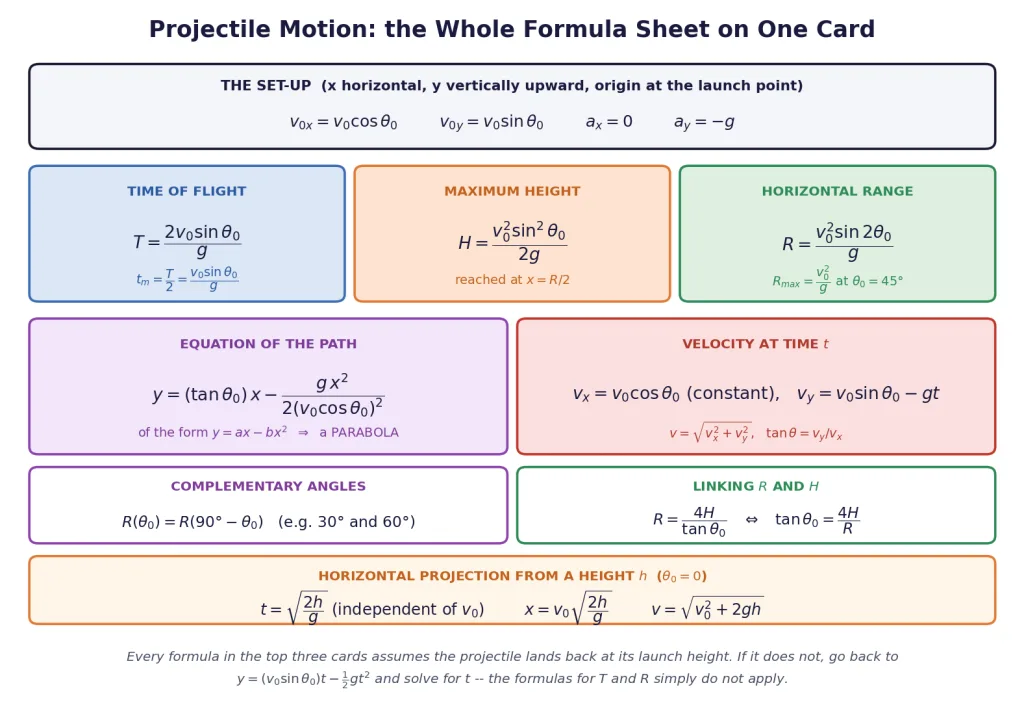
Mistake checklist
| Mistake | Fix |
|---|---|
| "Velocity is zero at the top" | Only is zero. The speed there is , the minimum of the flight |
| "Acceleration is zero at the top" | for every instant of the flight, apex included |
| Using , , when the landing height differs from the launch height | Those three assume level ground. Otherwise solve for directly |
| Writing with the y-axis upward | Sign error. Up positive means |
| Using for a horizontal projection | makes it zero. Use |
| Thinking a faster horizontal throw stays in the air longer | has no in it |
| Mixing with | takes ; takes . Different creatures |
| Forgetting to double to get | on level ground only |
| Reporting a landing angle as positive | Below the horizontal is negative; state the direction in words |
| Using when the problem said 10 | Read the question. Both values are in circulation, and the marks follow the stated value |
| Assuming the maximum range angle is from a height | It is only for level ground; from a cliff the best angle is smaller |
Where this goes next
Section 6 takes a different special case — acceleration always perpendicular to velocity — and gets uniform circular motion out of it. Section 7 adds a second observer with relative velocity. Section 8 works dozens more projectile problems, and Section 9 pushes projectiles onto inclined planes and moving platforms for JEE Advanced.
Before you move on, close the book and rebuild , and from and . If you can do that, you own this section.
Solved Examples
A note on : some problems use m/s^2 and others use m/s^2. Each example below states which value it uses, and it always follows the value the question itself states. Never mix them inside one question.
Example 1: The cricket ball thrown at
A cricket ball is thrown at a speed of 28 m/s in a direction above the horizontal. Calculate (a) the maximum height, (b) the time taken by the ball to return to the same level, and (c) the distance from the thrower to the point where the ball returns to the same level. Take m/s^2.
Solution:
- Sort the data into columns first. m/s, , so
- (a) Maximum height — a pure y-question:
- (b) Time of flight:
- (c) Range — the horizontal column, spending the time from (b): or straight from the formula, m, which rounds to 69 m.
Final Answer: (a) m; (b) s; (c) m.
Takeaway: Three questions, three formulas, and every one of them was reachable from the four basic equations. Note the cross-check built into step 4: computing two different ways and getting the same number costs ten seconds and catches almost every slip.
Example 2: The complete anatomy of one throw
A ball is projected from the ground with speed 20 m/s at to the horizontal. Take m/s^2. Find (a) the components of the initial velocity, (b) the time to reach the top and the total time of flight, (c) the maximum height and the range, (d) the position and velocity at s, and (e) the speed and direction on landing.
Solution:
- (a)
- (b)
- (c)
- (d) At s, run both columns: Both components positive, so it is genuinely above the horizontal, still climbing.
- (e) By symmetry it lands at 20 m/s, at below the horizontal. Check it the long way: m/s, m/s, so m/s and gives . Confirmed.
Final Answer: (a) 10.0 and 17.32 m/s; (b) 1.73 s and 3.46 s; (c) 15.0 m and 34.6 m; (d) at (10.0 m, 12.32 m) moving at 12.39 m/s at ; (e) 20 m/s at below the horizontal.
Takeaway: This is the template. If you can do all five parts of this without looking anything up, you can do any level-ground projectile question in the syllabus. Notice how part (d) never mixed the two columns, and how part (e) was answerable in one line by symmetry.
Example 3: Reading a projectile out of its trajectory
The path of a projectile launched from the origin is , with and in metres. Taking m/s^2, find (a) the launch angle, (b) the launch speed, (c) the horizontal range and (d) the maximum height.
Solution:
- Compare with the standard form , so and .
- (a)
- (b) (That is m/s, and note .)
- (c) Set : , giving or m. Cross-check with the formula: m. Same.
- (d) The vertex sits at m: Cross-check with m, and with m. All consistent.
Final Answer: (a) ; (b) 14.14 m/s; (c) 20 m; (d) 5 m.
Takeaway: You did not need to remember or — but having them turned a four-part question into a thirty-second question. And every single answer was cross-checked against a second route, which is how you should work when a question hands you this much redundancy.
Example 4: The complementary pair, made concrete
Two balls are thrown from the same point with the same speed 20 m/s, one at and the other at to the horizontal. Take m/s^2. (a) Show that they land at the same point. (b) Find the ratio of their times of flight and the ratio of their maximum heights. (c) Which ball is in the air longer, and by how much?
Solution:
- (a) For : For : Equal, because . The two angles add to , which is the whole reason.
- (b) Times of flight: Maximum heights:
- (c) The ball, by s — it is in the air about 73% longer, and climbs three times as high, to arrive at exactly the same spot.
Final Answer: (a) both 34.64 m; (b) and ; (c) the ball, by 1.46 s.
Takeaway: Same landing point, wildly different journeys. In cricket terms, that is the difference between a flat throw from the boundary and a lazy lob — both reach the keeper, but one gets there while the batter is still running. Remember the ratios: for times, for heights.
Example 5: The cricketer — from maximum range to maximum height
A cricketer can throw a ball to a maximum horizontal distance of 100 m. How high above the ground can the cricketer throw the same ball? Take m/s^2.
Solution:
- "Maximum horizontal distance" means he threw it at the best possible angle, , and got the maximum range. So (That is m/s, but you will not even need the square root.)
- To go as high as possible with the same throwing ability, he throws it straight up, . Then
- Notice the shortcut hiding in there. Since ,
Final Answer: 50 m.
Takeaway: — the greatest height you can throw something is exactly half the greatest distance you can throw it. Memorise that; it converts this whole question into one division. And do not confuse it with the other half-relation: on a throw the height reached is , not , because a throw is not a vertical one.
Example 6: The ball and the ceiling
The ceiling of a long hall is 25 m high. What is the maximum horizontal distance that a ball thrown with a speed of 40 m/s can go without hitting the ceiling of the hall? Take m/s^2.
Solution:
- Throwing at would give the biggest range in an open field, but here it would send the ball to m — straight into the ceiling. So the ceiling, not the rule, sets the angle.
- The best we can do is just graze the ceiling, i.e. make the maximum height exactly 25 m:
- Then , and
- Sanity check with : , so m. Agreed. (The time of flight, if you want it, is s.)
Final Answer: 150.5 m, thrown at to the horizontal.
Takeaway: The trap here is answering ", so m" on autopilot. A constraint was imposed — the ceiling — and once a constraint bites, the unconstrained optimum is not available. Always test whether the throw is actually allowed before you use it.
Example 7: The hiker on the cliff
A hiker stands on the edge of a cliff 490 m above the ground and throws a stone horizontally with an initial speed of 15 m/s. Neglecting air resistance, find the time taken by the stone to reach the ground, and the speed with which it hits the ground. Take m/s^2.
Solution:
- Origin at the edge of the cliff, y upward. Then , m/s, , , m/s^2, and the ground is at m.
- Time — a pure y-question, and the horizontal speed plays no part:
- Velocity components at landing:
- Speed:
- Two extras worth having. Horizontal distance from the base of the cliff: m. Landing direction: , so below the horizontal — very nearly straight down, because after 10 s of falling the vertical speed dwarfs the horizontal one.
Final Answer: s and m/s (landing 150 m from the base, at below the horizontal).
Takeaway: The 15 m/s never touched the time calculation. It only decided where the stone landed, and it contributed a modest 15 to a velocity whose other component was 98. In horizontal-projection problems, always compute from the height first and let everything else follow.
Example 8: The ball rolling off the table
A ball rolls off the edge of a table 1.25 m high with a horizontal speed of 2.0 m/s. Take m/s^2. Find (a) the time it takes to reach the floor, (b) how far from the foot of the table it lands, (c) its speed on landing and (d) the angle at which it strikes the floor.
Solution:
- (a) From the height alone:
- (b)
- (c) Cross-check with m/s. Same.
- (d)
Final Answer: (a) 0.5 s; (b) 1.0 m; (c) 5.39 m/s; (d) below the horizontal.
Takeaway: If the ball had rolled off at 8.0 m/s instead of 2.0, part (a) would still be 0.5 s — only parts (b), (c) and (d) would change. That is the independence result, in a form you can test with a coin and a table edge tonight.
Example 9: The dropped ball and the fired ball
From the top of a tower 20 m high, ball A is dropped from rest at the same instant that ball B is projected horizontally with speed 15 m/s. Take m/s^2. (a) Which ball reaches the ground first? (b) How far apart are they when they land? (c) With what speed does each land?
Solution:
- (a) Both fall the same height under the same , with the same . Their vertical columns are letter for letter identical: Neither ball reaches the ground first. They land simultaneously.
- (b) Ball A lands at the foot of the tower. Ball B lands at so they land 30 m apart. (Indeed, at every instant of the fall they are at the same height, separated horizontally by metres.)
- (c) Ball A: purely vertical, m/s straight down. Ball B: m/s and m/s, so at below the horizontal.
Final Answer: (a) neither — they land together at s; (b) 30 m apart; (c) A at 20 m/s vertically, B at 25 m/s at below the horizontal.
Takeaway: Same time, different speeds. Ball B is faster on landing because it kept the 15 m/s it started with — but that horizontal speed bought it no extra hang time whatsoever. Separating "how long" from "how fast" is the entire skill being tested here.
Example 10: Given and , find the launch
A projectile has a horizontal range of 40 m and a maximum height of 10 m. Take m/s^2. Find (a) the angle of projection, (b) the speed of projection, and (c) the time of flight.
Solution:
- (a) Use the relation that needs nothing else:
- (b) Now that is known, use the range formula: Check against the height: m. Correct.
- (c)
Final Answer: (a) ; (b) 20 m/s; (c) 2.83 s.
Takeaway: is the single highest-yield derived formula in this section, because it isolates the angle from the speed. Spot the pattern: always means , whatever the numbers are.
Example 11: The velocity at chosen instants, and the top
A body is projected with a speed of 40 m/s at to the horizontal. Take m/s^2. Find (a) the time of flight, the maximum height and the range, (b) its velocity at s, (c) its velocity at s, and (d) its speed when it is at half its maximum height, on the way up.
Solution:
- (a) m/s, m/s.
- (b) At s: . So this is — the ball is at the top. Not zero. It is the minimum speed of the flight, and it equals , as it must.
- (c) At s: m/s (descending).
- (d) At m, use : (Component check: , so . Same.)
Final Answer: (a) 4.0 s, 20.0 m, 138.6 m; (b) 34.64 m/s horizontally — at the top; (c) 36.06 m/s at below the horizontal; (d) 37.42 m/s.
Takeaway: Part (b) is the trap of this section, laid deliberately: a question that hands you the exact instant of the apex and waits to see whether you write "zero". Part (d) shows off , which needs no angle at all — the speed at a given height is decided by the launch speed and the height, and nothing else.
Example 12: Projected at an angle from a height
A ball is thrown from the top of a 25 m high building with a speed of 20 m/s at above the horizontal. Take m/s^2. Find (a) the time it takes to reach the ground, (b) the horizontal distance from the foot of the building where it lands, (c) the maximum height it reaches above the ground, and (d) its speed on hitting the ground.
Solution:
- Origin at the throwing point, y upward. m/s, m/s, and the ground is at m. Warning: does NOT apply here — the ball does not come back to its launch height.
- (a) Solve the y-equation for the instant m: The negative root is before the throw, so s.
- (b)
- (c) Above the roof the ball rises m, so above the ground it reaches (This peak happens at s, comfortably before it lands.)
- (d) Fastest route is the energy-style relation with m: Component check: m/s, m/s, so m/s, at below the horizontal.
Final Answer: (a) 3.45 s; (b) 59.7 m; (c) 30.0 m above the ground; (d) 30.0 m/s at below the horizontal.
Takeaway: The moment the landing height differs from the launch height, the three memorised formulas go back in the drawer and you solve the quadratic. Note also the two-step reading of part (c): "maximum height" from a building means above the ground, so add the building. And handled part (d) without a single component — just remember that is negative when the landing point is below the launch.