
Letting the Clock Run: Position and Displacement in a Plane
Sections 1 to 3 built you a complete algebra of vectors. You can scale them, add them head to tail, subtract them, resolve them into components and get an exact number out at the end. But every vector so far has been frozen — an arrow sitting still on the page.
Now we let the clock run. The particle moves, so its position vector changes with time, and once a vector is allowed to change with time, two brand-new vectors are born from it: velocity and acceleration. That is the whole of this section.
The position vector, again — but now it depends on
A particle P sits somewhere in the x-y plane. Section 1 told you to point an arrow at it from the origin; Section 3 told you to write that arrow in components. Put those together:
Key Point: The position vector of a particle P in the x-y plane, measured from the origin O of the reference frame, is where and are the components of along the x- and y-axes — which is to say, they are simply the coordinates of the particle.
That last clause is worth pausing on. In a plane, "the coordinates of a point" and "the components of its position vector" are the same two numbers. That is not a coincidence, it is the whole reason the coordinate system is useful.
As the particle moves, and become functions of time, so becomes a function of time:
A single vector equation, but it carries two independent pieces of information. Hold on to that — it comes back at the end of the section as the most important idea in the chapter.
Displacement along a curved path
Let the particle move along the curve shown in the figure below. At time it is at P, with position vector . At a later time it is at P, with position vector . The displacement over that interval is
and it is directed from P to P — the straight arrow that closes the gap, exactly as Section 1 defined it and Section 2 taught you to construct by subtraction.
Now put it in components, which is where all the power is:
Key Point: . The change in the position vector is the vector built out of the changes in the coordinates. You never subtract magnitudes; you subtract coordinates, one axis at a time.
[Board Important] Look at the figure again: the curve between P and P may be long and loopy, but is a straight arrow from start to finish. Displacement does not care about the path — only about where you began and where you ended. Section 1 hammered this; it stays true when the path curves in a plane, and it is the reason a runner who completes one lap of a track has zero displacement and several hundred metres of path length.
Average velocity — a vector, and it lies along
The definition is the one you already know from Chapter 2, promoted to vectors:
Key Point: The average velocity of an object over a time interval is the displacement divided by that interval: so that .
Here is the geometric fact that makes the next block work. Dividing a vector by a scalar is multiplication by — Section 2's operation. And is always positive (time runs forward), so is positive, so:
Key Point: has exactly the same direction as . It is the chord from P to P, rescaled. Nothing else.
Average velocity versus average speed
These two are different animals and examiners love the difference.
| Quantity | Definition | Type | Notes |
|---|---|---|---|
| Average velocity | displacement time | Vector | direction is that of |
| Average speed | path length time | Scalar | never negative, never zero unless the body never moved |
Because the path length is always at least as long as the straight-line displacement, the average speed is always greater than or equal to the magnitude of the average velocity. They are equal only when the motion is along a straight line without reversing. On a curve they are genuinely different numbers — Example 4 works one out.
[NEET Important] A very common one-liner: can the average speed be zero if the average velocity is zero? No. The reverse — average velocity zero while average speed is not — happens every time a body returns to where it started.
Instantaneous Velocity: Why the Chord Becomes the Tangent
Average velocity tells you about a whole interval. It cannot tell you how fast the particle is going right now, at this instant, at this point of the curve. For that we do what Chapter 2 did in one dimension: shrink the interval to nothing.
This is called the instantaneous velocity, or usually just "the velocity". Everything else in this section leans on it.
Doing the limit in components
The limit of a vector is taken component by component, because the unit vectors and are fixed — they do not change with time, so they come straight out of the limit:
Key Point — the whole toolkit in one place: and going the other way, and .
So if you are handed and , you differentiate each one separately and you are done. No geometry, no protractor. That is the payoff of Section 3.
The magnitude is the speed — a scalar, never negative. The angle is measured from the positive x-axis, and Section 3's warning still applies in full force:
[JEE Tip] on a calculator returns an angle between and only. Always look at the signs of and and fix the quadrant. A particle with and (m/s) is moving into the third quadrant at , not at , even though the calculator says .
And now the single most examined idea in this section
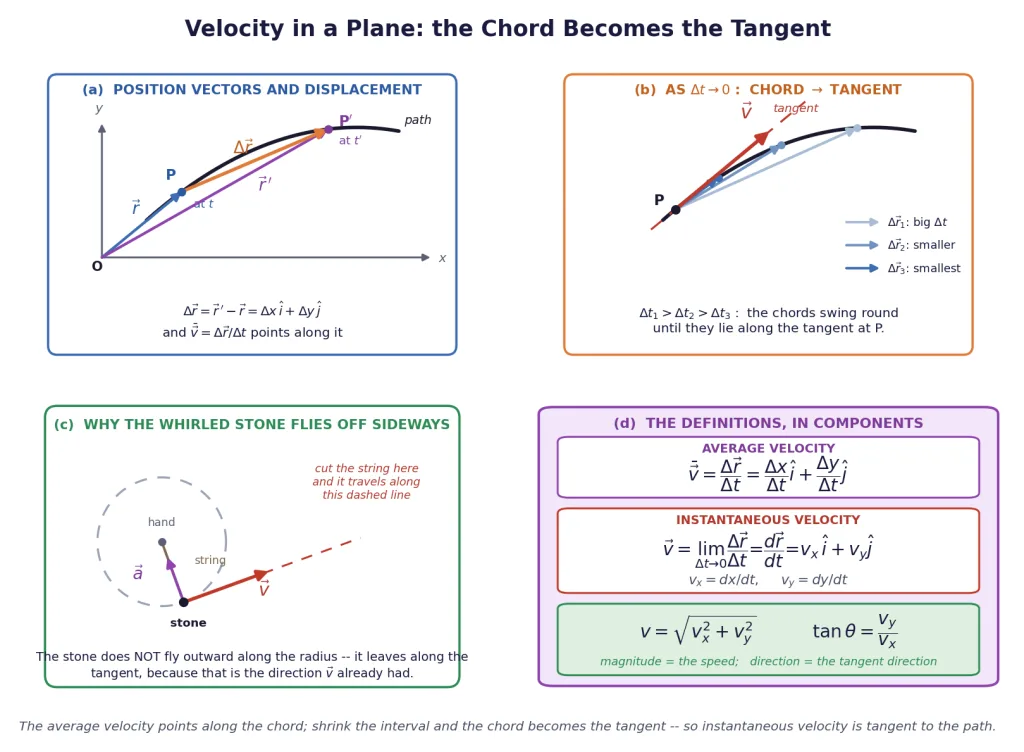
Look at panel (b). The particle is at P. Take a big interval and the displacement is a long chord, cutting well across the curve — the average velocity along it is a poor description of what is happening at P. Take a smaller interval : shorter chord, and it has swung round a little. Smaller still, : shorter again, swung round further.
The chords keep swinging in the same direction and they stop swinging at exactly one line — the tangent to the path at P.
Key Point (learn the sentence): As , becomes vanishingly small and lies along the tangent to the path. Therefore the direction of the velocity at any point on the path of an object is tangential to the path at that point, and is in the direction of motion.
Two words in there are load-bearing. Tangential fixes the line. In the direction of motion fixes which way along that line — a tangent line has two directions and the velocity picks the one the particle is actually heading.
Why this is not just geometry
A stone tied to a string is whirled in a horizontal circle. Cut the string. Which way does the stone go?
Almost everyone's first instinct is "outward, along the radius" — because that is where you feel the pull. It is wrong. Panel (c) has the answer: the stone leaves along the tangent, because at the instant the string snapped, the tangent was the direction the stone's velocity already had, and with no force to bend it any more, it simply keeps that velocity.
Once you see it, you see it everywhere:
- Sparks fly off a grinding wheel along tangents, in straight lines.
- Mud flies off a bicycle tyre tangentially — which is exactly where the mudguard is placed.
- A hammer thrower releases at a carefully chosen point of the circle, because release point sets the tangent, and the tangent sets the direction of flight.
[NEET Important] This appears as a one-line recall question almost every year, usually as "a stone whirled in a circle is released; it moves along _". The answer is the tangent at the point of release.
A cross-check that costs five seconds
If you also know the equation of the path in the form , then the slope of the tangent at any point is . But the tangent direction is the velocity direction, whose slope is . So:
[JEE Tip] Whenever a problem gives you and , eliminate to get the trajectory , then check that at your point equals . If they agree, your differentiation was right. Example 3 runs the check explicitly. It is the cheapest verification in the chapter.
One more distinction, because it gets confused
is the speed. Speed is about how fast; direction is about which way. In a plane those two can change completely independently:
- speed changing, direction fixed — a car accelerating down a straight road;
- speed fixed, direction changing — a car going round a roundabout at a steady 30 km/h;
- both changing — almost everything else.
The velocity vector has changed in all three cases. Which brings us to acceleration.
Acceleration in a Plane — and Why It Need Not Point Where You Are Going
Velocity is a vector. If it changes — in size, or in direction, or in both — there is an acceleration. The definitions run exactly parallel to the previous block.
Average acceleration
Since , the average acceleration points the same way as , the change in velocity — and is a vector subtraction, which you carry out by the triangle law of Section 2 or by components. Getting right is where most of the marks are won or lost.
Instantaneous acceleration
And since , the components can be written straight in terms of the coordinates:
So the full chain is: differentiate and once to get velocity, twice to get acceleration. Two separate one-dimensional differentiations, never mixed.
Now the sentence that separates a plane from a line
In Chapter 2 the acceleration had nowhere to go. Motion was along a line, so was either along (speeding up) or exactly opposite to it (slowing down). Plus or minus. Two options.
Key Point (examined almost verbatim): In one dimension, the velocity and the acceleration of an object are always along the same straight line — either in the same direction or in the opposite direction. However, for motion in two or three dimensions, the velocity and acceleration vectors may have any angle between and between them.
Read that twice. It is the licence that makes projectiles and circles possible, and it is the single fact most often thrown away by students who carry one-dimensional habits into a plane.
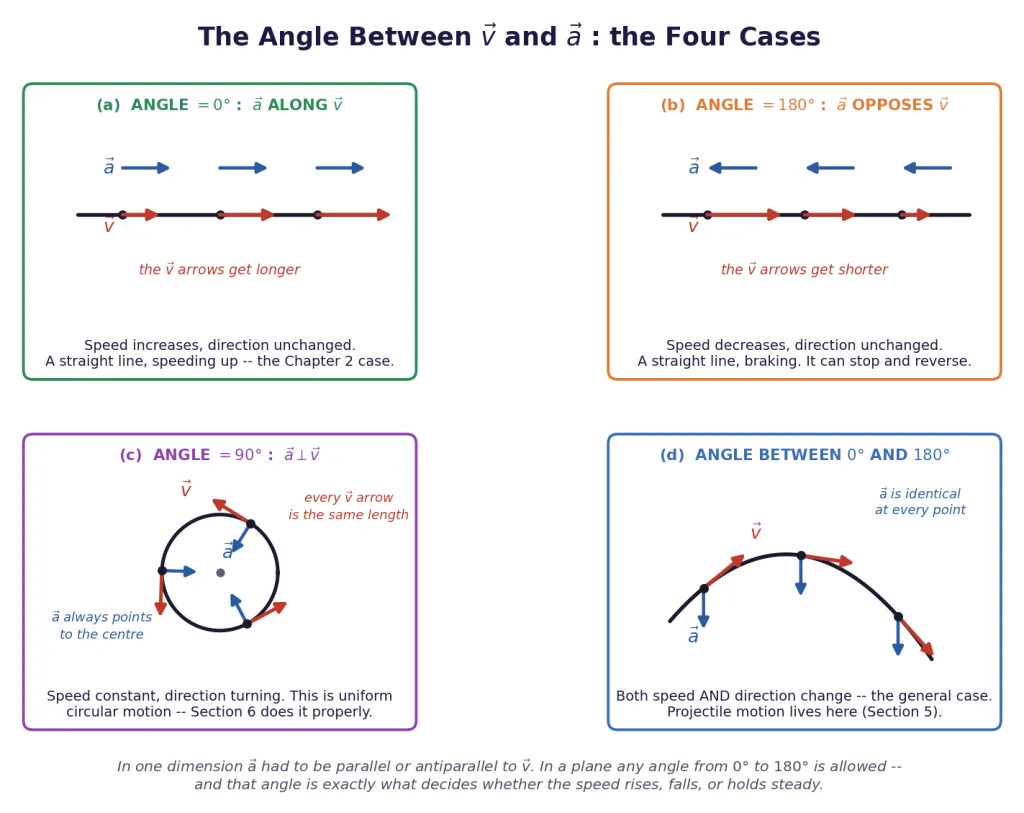
What each case means, physically
| Angle between and | Speed | Direction of motion | This is |
|---|---|---|---|
| ( along ) | increases | unchanged | straight line, speeding up |
| ( opposite ) | decreases | unchanged | straight line, slowing down (can stop and reverse) |
| ( perpendicular to ) | constant | turning | uniform circular motion (Section 6) |
| acute, between and | increases | turning | a curved path, gaining speed |
| obtuse, between and | decreases | turning | a curved path, losing speed |
Everything in this table follows from one idea, so learn the idea rather than the five rows:
Key Point: Split into a piece along and a piece perpendicular to .
- The parallel piece changes the speed — forward if it points along , backward if against.
- The perpendicular piece changes only the direction — it turns the velocity without touching its length.
So the angle between and is not a decoration. It is the whole story of what the motion is about to do.
That is why the case is so remarkable: the acceleration is not zero, it is doing real work every instant, yet the speed never changes by so much as a millimetre per second. Section 6 builds uniform circular motion on exactly this. And the general in-between case is projectile motion, where points straight down while swings from up-and-forward to down-and-forward — Section 5's territory.
Three traps, in the order they cost marks
[JEE Tip] Trap 1: . The magnitude of the acceleration is not the rate of change of speed. Only the component of along the direction of motion is. In uniform circular motion , a perfectly respectable non-zero number, while . Confusing the two is probably the most expensive single mistake in this chapter.
Trap 2: zero speed does not mean zero acceleration. A ball thrown vertically upward has at the top of its flight, and downward the entire time, including at that instant. In a plane the same thing happens whenever a particle's velocity passes through zero.
Trap 3: constant speed does not mean zero acceleration. Constant speed only kills the parallel part of . The perpendicular part is free to be as large as it likes. "Uniform speed" and "uniform velocity" are not the same phrase, and only the second one forces .
Key Point: if and only if both the speed and the direction of are constant — that is, only for uniform velocity, motion in a straight line at a steady speed.
Motion in a Plane with Constant Acceleration
Here is the case that matters most, because it covers a projectile, a charged particle in a uniform electric field, a puck sliding on a tilted air table, and every "constant force" problem you will meet next year.
Constant acceleration means is a constant vector — fixed in magnitude and fixed in direction. Not "constant speed", not "constant magnitude of acceleration". A constant vector.
Deriving the velocity equation
If is constant over an interval, then the average acceleration over that interval simply is that constant value. Let the velocity be at and at time . By definition,
One vector equation. Now resolve it — a vector equation is true if and only if it is true in each component separately (Section 3):
Deriving the position equation
For constant acceleration the velocity changes at a steady rate, so over the interval from to the average velocity is the plain arithmetic mean of the endpoints:
and the displacement is the average velocity multiplied by the time interval:
Two quick sanity checks, both worth making. Put : you get , correct. Differentiate with respect to : you get , which is Equation 1, also correct. A formula that survives both checks is almost certainly the right one.
In components:
Key Point — the constant-acceleration equations for motion in a plane:
The caution Chapter 2 already gave you, restated for vectors
That last relation is a shortcut, not a definition, and it comes with a fence around it.
Key Point: holds only when the acceleration is constant. The definition of average velocity, , is always true, for any motion whatsoever. If the acceleration varies, the two disagree — sometimes wildly.
[JEE Tip] Because is a vector, "constant acceleration" can fail in a way that has no one-dimensional analogue: the magnitude can stay fixed while the direction rotates. That is exactly what happens in uniform circular motion, where never changes but always points to the centre and therefore swings all the way round. Uniform circular motion is NOT constant-acceleration motion, and none of the boxed equations above may be used on it. Example 10 makes this concrete, and Section 6 handles it properly.
What about ?
Chapter 2's third equation has no direct vector version at this level, because writing it down needs a way of multiplying two vectors together — the scalar product. Section 9 (JEE Corner) sets that up and produces . For Boards and NEET, work in components: apply along each axis separately, which is perfectly legal because each axis carries a genuine one-dimensional motion.
The picture
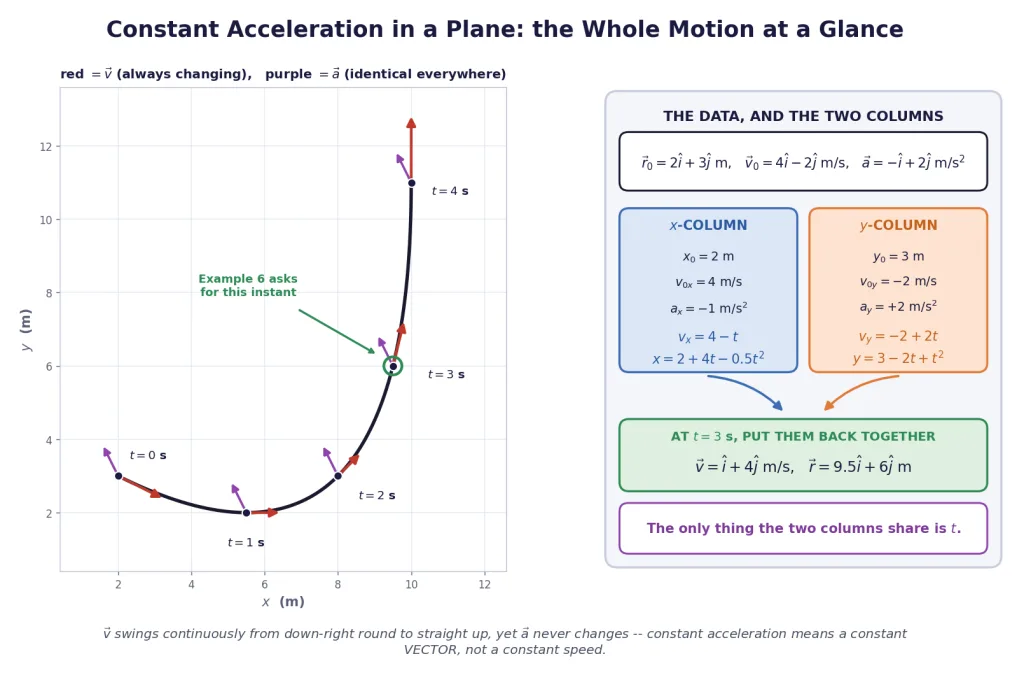
Read the left half of that figure slowly, because it contains a genuine surprise. Every purple arrow is identical — same length, same direction, at every instant. That is what "constant acceleration" means. And yet the red velocity arrows are all different: at the particle is heading down and to the right, by s it is moving horizontally, and by s it is heading straight up. The path curves the whole way.
A constant acceleration produces a curved path and a continuously changing velocity. If that feels contradictory, you are still thinking of acceleration as "getting faster" rather than as "the rate at which the velocity vector changes".
The Central Idea: Two One-Dimensional Motions Sharing One Clock
Everything in this section has been building to a single sentence. Here it is.
The central idea: Motion in a plane is TWO INDEPENDENT ONE-DIMENSIONAL MOTIONS running side by side, sharing only the clock. The x-motion knows nothing about the y-motion. Neither one can affect the other. The only thing they have in common is that they happen at the same time.
Stated plainly: the motions in the x- and y-directions can be treated independently of each other. That is, motion in a plane (two dimensions) can be treated as two separate simultaneous one-dimensional motions with constant acceleration along two perpendicular directions.
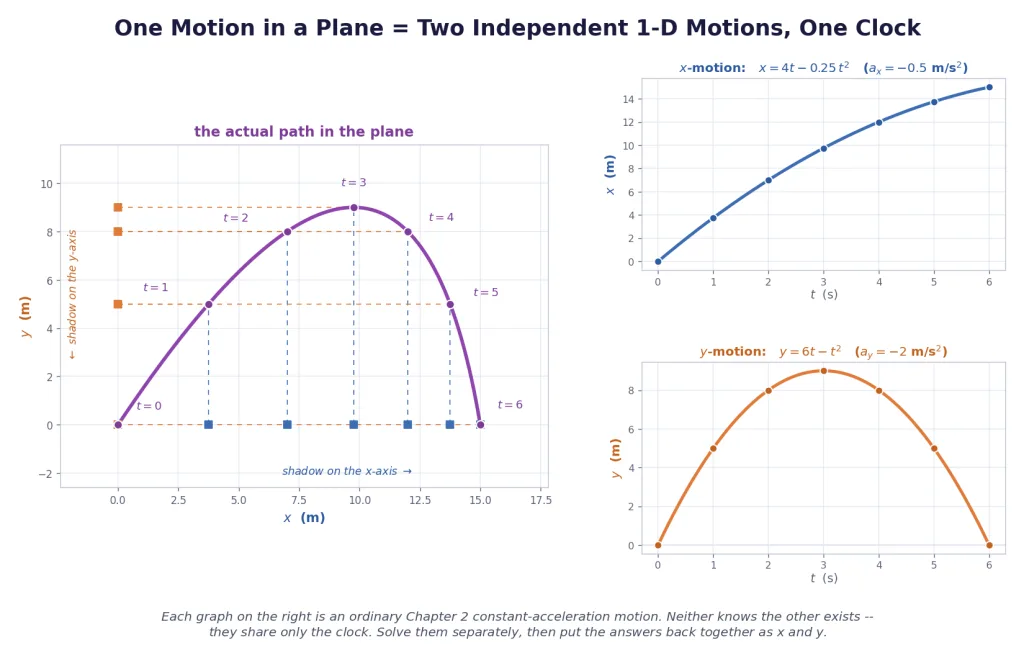
Read the figure like this
On the left is a real curved path in the plane. It looks like one complicated motion. Now watch the two shadows. Drop a perpendicular from the particle to the x-axis and follow that shadow: it slides right, gradually slowing. Drop a perpendicular to the y-axis and follow that shadow: it climbs, stops, and comes back down.
Each shadow, plotted against time, is on the right — and each is nothing more exotic than an ordinary Chapter 2 constant-acceleration motion. The x-shadow is a body decelerating gently. The y-shadow is a body thrown up and falling back. Neither graph contains a single symbol belonging to the other. Put the two shadows back together at any instant and you have recovered the full plane motion.
Why it is true, in one line
Because and are independent directions, a vector equation such as is satisfied if and only if the parts match each other and the parts match each other. Section 3 established that fact for static vectors; here it is doing real work. One vector equation is a pair of scalar equations, and the pair does not talk.
The recipe — four steps, and they never change
- Set up axes and write down , , , , , as six plain signed numbers. Resolve anything that arrives as "speed at an angle" using Section 3.
- Run the x-motion on its own with the Chapter 2 equations. Run the y-motion on its own with the Chapter 2 equations. Two separate columns on your page — literally draw the line between them.
- The clock is the only bridge. Whatever appears in one column is the same in the other. If a question fixes through one motion (say, "when does it hit the ground?" — a y-question), you carry that across and feed it into the other column.
- Recombine into or , and then get magnitude and direction with and , quadrant checked.
[Board Important] Step 3 is where nearly every plane-motion problem is actually decided. Ask yourself: which motion does the question pin down? Find from that one, then spend it on the other. Examples 7 and 8 both turn on exactly this move.
What this idea buys you
Everything. Section 5's projectile is just this recipe with the two simplest possible columns: (so the x-motion is uniform velocity) and (so the y-motion is free fall). The parabola that comes out is not a new law of physics — it is two very old laws, running at once.
Galileo was the first to state this independence, in his Dialogue Concerning the Two Chief World Systems (1632), and it was a genuinely revolutionary claim at the time. Four centuries later it is four lines of algebra in your notebook.
Mistake checklist
| Mistake | Fix |
|---|---|
| Mixing x and y inside one equation | Six numbers, two columns, never a term from the wrong column |
| Using on circular motion | Only for constant ; in circular motion rotates |
| Writing | Only the component of along changes the speed |
| Saying "constant speed, so no acceleration" | Perpendicular acceleration keeps the speed and turns the direction |
| Quoting straight off the calculator | Check the signs of and , fix the quadrant |
| Using with varying acceleration | Only for constant acceleration; otherwise go back to |
| Thinking points along | is tangent to the path; points from the origin. Unrelated in general |
| Treating displacement as path length on a curve | path length, with equality only for straight-line motion |
| Forgetting and | The particle need not start at the origin |
Where this goes next
You now have the complete kinematics of a plane. Section 5 takes the constant-acceleration equations and sets , , and out falls projectile motion — trajectory, time of flight, maximum height, range, the result and the complementary-angle pair. Section 6 takes the case from the angle table and builds uniform circular motion out of it. Section 7 puts two moving observers into the picture with relative velocity. All three are this section, applied.
Solved Examples
Example 1: Displacement and average velocity on a curved path
A particle moving in the x-y plane is at the point (3.0 m, 4.0 m) at s and at the point (9.0 m, 12.0 m) at s. Find (a) its displacement over that interval, (b) the magnitude and direction of the displacement, and (c) its average velocity.
Solution:
- (a) Write both positions as vectors and subtract, coordinate by coordinate: So m and m.
- (b) Magnitude and direction, by Section 3's formulas: Both components are positive, so the point lies in the first quadrant and needs no correction.
- (c) s, so
Final Answer: (a) m; (b) 10.0 m at ; (c) m/s, magnitude 3.33 m/s at .
Takeaway: Notice that came out at the same angle as — it had to, because dividing by the positive number rescales a vector without turning it. Also notice what we were never told and never needed: the shape of the path between the two points.
Example 2: Differentiating a position vector
The position of a particle is given by where is in seconds and the coefficients have the proper units for to be in metres. (a) Find and of the particle. (b) Find the magnitude and direction of at s.
Solution:
- (a) Differentiate term by term. The unit vectors are constants, so they just come along for the ride: The term was a constant 5.0 m, so it differentiates to zero — the particle stays in the plane m the whole time.
- Differentiate again: so m/s^2, directed along the +y direction and constant — it does not depend on .
- (b) At s,
- Direction, from the positive x-axis:
Final Answer: (a) m/s, m/s^2; (b) speed 5.0 m/s at about with the x-axis.
Takeaway: Three separate lessons in one small problem. One: came out constant (3.0 m/s) because was linear in — that is a uniform-velocity motion along x. Two: grows linearly, so the y-motion is uniformly accelerated. Three: at s the velocity is at but the acceleration is at — they are apart, and the angle is closing. This is the general case of the angle table, seen live.
Example 3: Proving the velocity is tangent to the path
A particle moves in the x-y plane with and , where and are in metres and in seconds. (a) Find the equation of its trajectory. (b) Find its velocity at s. (c) Show explicitly that this velocity is tangent to the trajectory. (d) At what instant is the velocity horizontal, and how high is the particle then?
Solution:
- (a) Eliminate . From the first equation . Substituting into the second: A parabola opening downward.
- (b) Differentiate the given functions: At s: m/s and m/s, so
- (c) The tangent test. At s the particle is at m. The slope of the trajectory there is and the slope of the velocity vector is The two slopes agree, so lies along the tangent. That is exactly the statement "velocity is tangent to the path", verified by arithmetic rather than by picture.
- (d) The velocity is horizontal when : Then m, and m. Cross-check from the trajectory: gives m, and m. Same point.
Final Answer: (a) ; (b) m/s, 2.83 m/s at ; (c) both slopes equal 1; (d) at s, at the highest point, m.
Takeaway: Part (c) is the five-second verification worth building into every problem of this type. And part (d) shows the useful reading of : the particle is momentarily moving horizontally, which on a downward-opening path means it is at the top. The x-motion never noticed — stayed 2.0 m/s throughout.
Example 4: Average velocity versus average speed on a curve
A particle travels along a quarter circle of radius 5.0 m, from the point (5.0 m, 0) to the point (0, 5.0 m), with the centre of the circle at the origin. It takes 4.0 s at constant speed. Find (a) the displacement, (b) the average velocity, (c) the average speed, and (d) the ratio of the magnitude of the average velocity to the average speed.
Solution:
- (a) Displacement depends only on the endpoints: Direction: and puts in the second quadrant, so the angle is from the positive x-axis. (A calculator fed would have said — the quadrant check is not optional.)
- (b) with magnitude m/s at .
- (c) The path length is a quarter of the circumference:
- (d) Notice the radius cancels: the ratio is for any quarter circle.
Final Answer: (a) m, i.e. 7.07 m at ; (b) 1.77 m/s at ; (c) 1.96 m/s; (d) 0.900.
Takeaway: Two different numbers for two different questions. Note also that "constant speed" did not mean zero acceleration: the direction of turned through during the trip, so there was an acceleration the whole way — perpendicular to , pointing at the centre. That is the row of the angle table, and Section 6 will give it a name.
Example 5: What the angle between and is telling you
A particle moves in the x-y plane with velocity m/s. (a) Find its acceleration. (b) Find the speed and the angle between and at , at s and at s, and say in each case whether the particle is speeding up, slowing down, or neither. (c) What is the minimum speed it ever reaches?
Solution:
- (a) Constant, of magnitude 2.0 m/s^2, pointing along the negative x-axis, i.e. at .
- (b) At : , so m/s and . The acceleration is at , so the angle between them is Obtuse means has a component against , so the particle is slowing down.
- At s: , so m/s straight up the y-axis, . The angle to (at ) is Perpendicular means no component along the motion, so at this instant the speed is neither increasing nor decreasing — the acceleration is purely turning the velocity.
- At s: , so m/s again, and with , we are in the second quadrant: . The angle to is Acute means has a component along , so the particle is speeding up.
- (c) This is smallest when the first bracket vanishes, i.e. at s, giving m/s. Which is precisely the instant the angle was — as it must be, because that is the moment the speed stops falling and starts rising.
Final Answer: (a) m/s^2; (b) and slowing at ; and momentarily steady at s; and speeding up at s; (c) 3.0 m/s.
Takeaway: One motion, and the angle between and sweeps from obtuse through to acute, with the speed falling, levelling and rising in exact step. The angle is a speedometer needle. Also note the counter-intuitive middle instant: m/s^2 there, yet the rate of change of speed is zero — the classic trap, caught in the act.
Example 6: The constant-acceleration equations, worked in full
A particle is at m at , moving with velocity m/s, and it has a constant acceleration m/s^2. Find, at s, (a) its velocity, (b) its position, (c) its displacement from the start and (d) its average velocity over the three seconds. Verify (d) two independent ways.
Solution:
- Set up the two columns first — six signed numbers, and never a term from the wrong column:
| -column | -column | |
|---|---|---|
| initial position | m | m |
| initial velocity | m/s | m/s |
| acceleration | m/s^2 | m/s^2 |
- (a) , component by component: Direction: , first quadrant, no correction needed.
- (b) , again one axis at a time:
- (c)
- (d) Route 1, from the definition: Route 2, from the constant-acceleration shortcut: The two agree, as they must — because the acceleration here really is constant.
Final Answer: (a) m/s (4.12 m/s at ); (b) m; (c) m, 8.08 m at ; (d) m/s, confirmed twice.
Takeaway: This is the figure at the top of the previous block, in numbers. The velocity went from pointing down-and-right (, at ) to pointing steeply up () — a swing of over — while never budged. Two routes to the average velocity, and when they agree you have almost certainly not made an arithmetic slip. Get into the habit.
Example 7: The clock is the bridge
A particle starts from the origin at with a velocity 5.0 m/s and moves in the x-y plane under the action of a force which produces a constant acceleration of m/s^2. (a) What is the y-coordinate of the particle at the instant its x-coordinate is 84 m? (b) What is the speed of the particle at this time?
Solution:
- Since , the position is so
- (a) The question pins down the x-motion, so get from there: The physical root is s (the other root is negative, so it is before the motion began).
- Now spend that on the y-column:
- (b) Differentiate the position: At s, (Its direction, if you want it, is above the x-axis.)
Final Answer: (a) m; (b) speed m/s.
Takeaway: Look at the structure, not the algebra. The x-column had all the information needed to find the time; the y-column then did as it was told. That is step 3 of the recipe, and this example exists precisely to drill it. Also: the particle starts moving purely along x, yet ends up 36 m along y, because has been quietly working the whole time.
Example 8: Reading a plane motion as two separate columns
A particle starts from the origin with velocity m/s and moves with constant acceleration m/s^2. Find (a) the instant at which its y-coordinate is maximum, (b) that maximum y, (c) the x-coordinate at that instant and (d) the velocity there.
Solution:
- The two columns: Read them as physics: the x-motion is a body speeding up along a line; the y-motion is a body thrown upward and falling back. Two familiar Chapter 2 problems, side by side.
- (a) The y-coordinate is maximum when the y-motion momentarily stops, i.e. when :
- (b)
- (c) Carry s across to the x-column:
- (d)
Final Answer: (a) s; (b) m; (c) m; (d) m/s, i.e. 11 m/s horizontally.
Takeaway: Part (a) is a pure y-question and part (c) is a pure x-question, connected by nothing but the shared value s. That is the independence principle earning its keep. And note part (d): at the highest point the velocity is not zero — only its y-component is. Students who write " at the top" are importing a one-dimensional habit into a plane and losing the whole question.
Example 9: Two velocities, one acceleration
A body moving in a plane has velocity m/s at and m/s at s. Assuming the acceleration is constant, find (a) the acceleration with its magnitude and direction, (b) the average velocity over the interval and (c) the displacement in those 3 seconds.
Solution:
- (a) From , Direction: , puts it in the fourth quadrant, so , i.e. below the positive x-axis.
- (b) Constant acceleration, so the shortcut is legal:
- (c) Cross-check with the full equation, : Agrees.
Final Answer: (a) m/s^2, 2.83 m/s^2 at ; (b) m/s; (c) m, i.e. 18.2 m at above the x-axis.
Takeaway: Notice that the speed was m/s at the start and m/s at the end, but the acceleration is not m/s^2. You cannot get acceleration by subtracting speeds. Subtract the velocity vectors, component by component, then divide.
Example 10: The case — and why the boxed equations do not apply
A particle moves with velocity m/s, with in seconds. (a) Show that its speed is constant. (b) Find its acceleration and its magnitude. (c) Find the angle between and . (d) Is this constant-acceleration motion?
Solution:
- (a) for every . The speed never changes.
- (b) Differentiate, remembering the chain rule brings out a factor 2: also constant in magnitude.
- (c) Take a convenient instant, say the one where : The angle between them is . In general is at angle and is at angle , so the two are perpendicular at every instant — which is exactly why the speed came out constant in part (a).
- (d) No. The magnitude of is fixed at 10.0 m/s^2, but its direction rotates steadily (it is at ). Constant acceleration means a constant vector, so and are illegal here.
Final Answer: (a) m/s always; (b) m/s^2; (c) at every instant; (d) no — the direction of changes.
Takeaway: This is uniform circular motion in disguise. If you look ahead to Section 6 you can even read off the radius: with m/s and m/s^2, the relation gives m. But the point for this section is part (d). Constant is not constant , and the difference is worth several marks a year.
Example 11: Where the average-velocity shortcut breaks
A particle moves in the x-y plane with velocity m/s. Find its displacement between and s (a) correctly, and (b) by wrongly applying . Explain the discrepancy.
Solution:
- First, is the acceleration constant? It depends on , so no. That already tells you which method is allowed.
- (a) The definition always holds, so integrate it component by component:
- (b) The (illegal) shortcut. Here and , so
- Compare. The y-components agree exactly (12 m both ways), because is trivially constant and never changes. The x-components differ by 9 m — the shortcut overestimates by 50%, because spends most of the interval well below the average of its endpoints, and only shoots up near the end.
Final Answer: (a) m; (b) the shortcut gives m, wrong in x by 9 m (50%).
Takeaway: is a definition and never fails. is a theorem about constant acceleration and fails the moment that hypothesis does. This example also shows something subtler: the shortcut can be right along one axis and wrong along the other, because the two motions are independent — so the "constant acceleration" test must be applied to each component separately.
Example 12: Trajectory, and is it speeding up?
A puck is launched across a frictionless table that is very slightly tilted sideways. It starts at the origin with m/s and experiences a constant acceleration m/s^2. Find (a) the equation of its path, (b) its position and velocity at s, (c) the angle between and then, and whether it is speeding up, and (d) the rate at which its speed is changing at that instant.
Solution:
- (a) The two columns: Eliminate : from the first, , so A parabola, opening downward from the origin.
- (b) At s: Check the trajectory at this point: m. Matches .
- (c) has , , so it is in the fourth quadrant at . The acceleration points along , i.e. at . The angle between them is Acute, so the puck is speeding up — and since the angle is not , it is also turning. Both at once: the general case.
- (d) Only the component of along changes the speed: Note this is well below m/s^2; the remaining m/s^2 is doing nothing but bending the path.
Final Answer: (a) ; (b) m, m/s (11.3 m/s at ); (c) , speeding up; (d) 2.83 m/s^2.
Takeaway: Part (d) is the single most useful habit in this whole section: resolve along and perpendicular to . The parallel piece is the rate of change of speed; the perpendicular piece is pure turning. Here they happen to be equal, so half the acceleration is going into "faster" and half into "sideways". Replace by and you have a projectile — which is Section 5, and now you know in advance exactly why its path is a parabola.