
Stretching, Shrinking and Flipping:
Section 1 gave you the language. You can now say what a vector is, draw one to scale, and tell a position vector from a displacement vector. What you still cannot do is combine two of them. This section fixes that, and it starts with the easiest operation of all: multiplying one vector by an ordinary number.
Call the number (Greek "lambda"). It is a real number — a plain scalar, not a vector.
Key Point: Multiplying a vector by a real number gives a new vector whose magnitude is times the magnitude of : Its direction is the same as if , and exactly opposite to if .
Notice the modulus bars around on the right. They are not decoration. A magnitude can never be negative, so even when the magnitude of is , not . The minus sign has already done its job — it flipped the arrow around. It does not get to make the length negative as well.
What the operation does, and what it never does
Here is the thing worth internalising: scaling does not tilt the arrow. Whatever you choose, lies along the same straight line as . It may get longer, it may get shorter, it may point backwards — but it stays on that line.
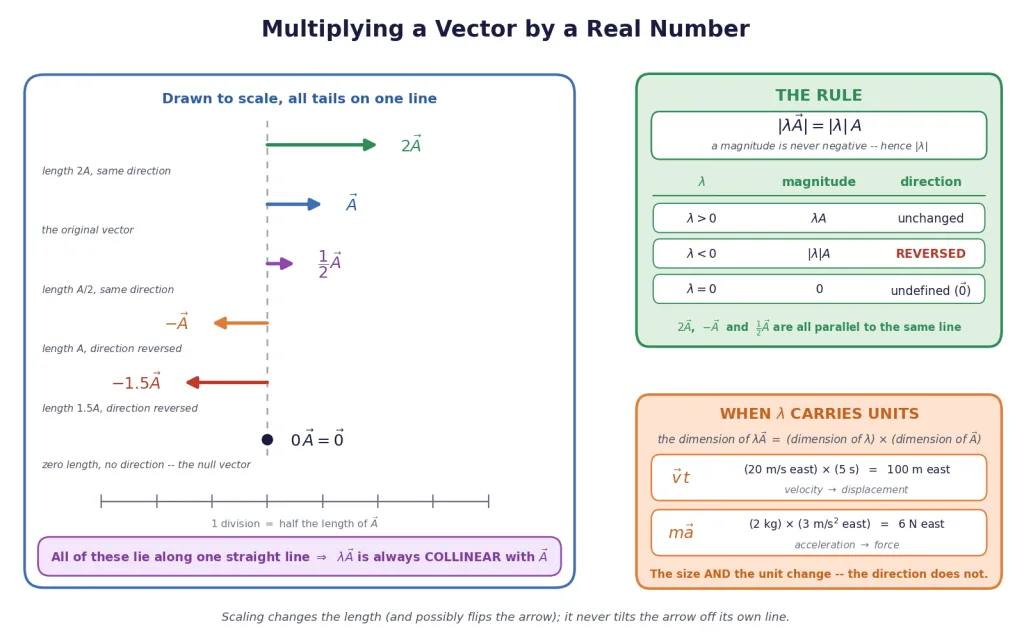
Read the figure carefully and you have the whole rule:
| example | magnitude | direction | |
|---|---|---|---|
| (longer) | unchanged | ||
| (shorter) | unchanged | ||
| unchanged — it is | |||
| (same length) | reversed | ||
| reversed | |||
| undefined |
Key Point: , and are all collinear with — they are parallel to one and the same line. In fact this is the cleanest test for collinearity there is: two non-zero vectors are collinear if and only if one is a real multiple of the other.
Section 1 introduced collinear vectors as a name in a gallery. Now you know where they come from: every collinear partner of is just for some .
The case
Multiplying by zero gives a vector of zero length. That is the null vector from Section 1, and it deserves its own line because examiners test it:
[Board Important] Write the answer as , with the arrow, not as the number 0. A vector operation cannot produce a scalar. This costs marks every single year.
When the multiplier carries units
So far has been a bare number. But there is a point here that most students skim past:
Key Point: The factor by which a vector is multiplied could be a scalar having its own physical dimension. Then the dimension of is the product of the dimensions of and .
In other words, can be a mass, a time, a charge — any scalar quantity. When it is, the product is a different physical quantity altogether, with a different unit:
Multiply a constant velocity of 20 m/s due east by a duration of 5 s and you get a displacement of 100 m due east. The number changed from 20 to 100, the unit changed from m/s to m, and the physical meaning changed from "how fast" to "how far". The one thing that did not change is the direction — still due east, because 5 s is a positive scalar.
This is the reason works at all. Mass is a positive scalar, so the force vector always points along the acceleration, never at an angle to it. Half of Chapter 5 rests on that single sentence.
[JEE/NEET] Watch for the sign. In for a spring, the scalar multiplier is negative, so the force points opposite to the displacement. Same rule, applied honestly.
Common slips
| Slip | Correct version |
|---|---|
| "" | ; magnitudes are never negative |
| "" | , a vector |
| " points somewhere new" | It is collinear with |
| " has the unit of acceleration" | It has the unit of force, kg m/s^2 N |
| " must be dimensionless" | It may carry units, and then the product is a new quantity |
The Triangle Law — Adding Vectors Head to Tail
Now the real business of the chapter. Two displacements, two forces, two velocities: how do you combine them into one?
Not by adding the numbers. Walk 4 km east and then 3 km north and you have covered 7 km of road, but you are only 5 km from where you started. The 7 is the path length; the 5 is the magnitude of the resultant displacement. Adding vectors is not arithmetic — it is a construction.
Section 1 said that a quantity only counts as a vector if it obeys the triangle law of addition. Here is that law, in full.
The construction, step by step
Key Point (the triangle law, or head-to-tail method): To find :
- Draw to a stated scale.
- Place the tail of at the head of , keeping 's direction unchanged.
- The resultant is the arrow drawn from the tail of to the head of .
The two vectors and their resultant form the three sides of a triangle — hence the name. Because the vectors are laid head to tail, it is also called the head-to-tail method.
Two details decide whether you get the marks:
- You are allowed to move . Section 1 established that a vector is unchanged by parallel shifting; that is exactly the permission you are using when you pick up and drop its tail onto 's head. You may slide it, but you may never rotate it or resize it.
- The resultant is not the third side "taken in order". and go round the triangle one way; goes from the very start to the very end, i.e. against the direction of the loop. If all three arrows chased each other round the triangle, the sum would be zero, not . More on that shortly.
It is a drawing, so draw it properly
This is a graphical method, and in a board exam it is marked as one:
Key Point: State a scale ("1 cm 2 N"), draw the vectors with a ruler and protractor at that scale, measure the resultant's length and its angle, then convert the length back using the same scale. The scale statement is part of the answer.
The lengths of the line segments must be proportional to the magnitudes. A 6 N force drawn the same length as a 3 N force is not a sloppy diagram — it is a wrong one.
The parallelogram law — the same thing, seen differently
There is a second construction, and both are worth knowing because different problems make one or the other more natural.
Key Point (the parallelogram law): Bring the tails of and to a common point O. Complete the parallelogram OPSQ by drawing a line from the head of parallel to , and a line from the head of parallel to . Then the diagonal drawn from O is the resultant .
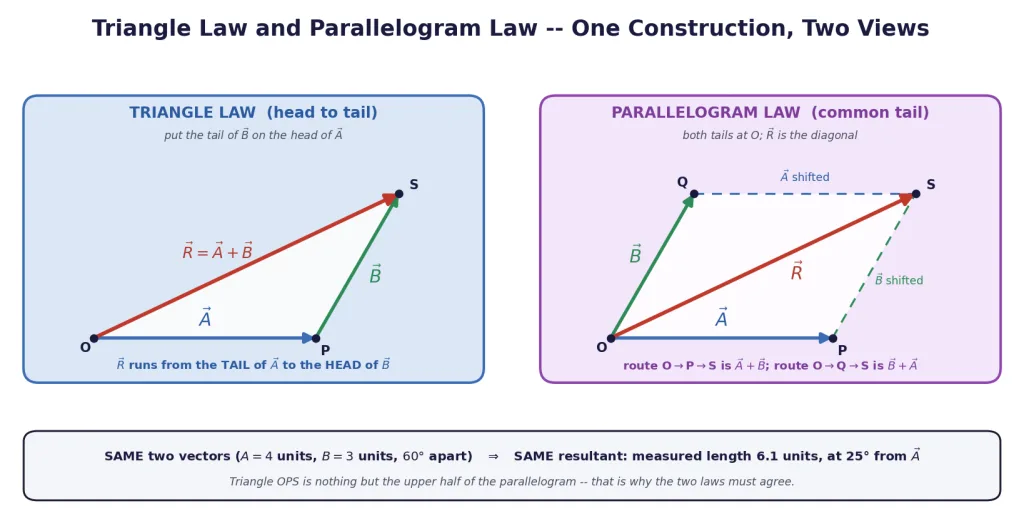
Both halves of that figure use the same two vectors: units, units, with between them. Both give a resultant of 6.1 units at from . That is not a coincidence, and you should be able to say why in one sentence:
Key Point: The two laws are equivalent. In the parallelogram OPSQ, the side PS is just shifted parallel to itself. So the triangle OPS — go along to P, then along to S — is the triangle-law construction, sitting inside the parallelogram as its upper half. The parallelogram simply draws it with both tails at O instead.
Commutativity falls straight out of the picture
Look at the parallelogram again. There are two ways to walk from O to S:
- O P S: along , then along . That is .
- O Q S: along , then along . That is .
Both routes end at the same corner S, so both sums are the same arrow OS.
Key Point: Vector addition is commutative:
[Board Important] "Show that vector addition is commutative" is a standard 2-mark question. The parallelogram picture with the two routes marked is the proof — draw it, label O, P, Q, S, and write the two routes. Do not try to prove it with numbers.
[JEE Tip] Commutativity is exactly what finite rotations fail (Section 1 flagged them as "neither scalar nor vector"). Rotate a book about the x-axis then about the y-axis, then swap the order: the book ends up in two different orientations. Because the order matters, finite rotations are not vectors, however much they look like they have magnitude and direction.
Three or More Vectors: The Polygon Law and the Closure Rule
Nothing about the head-to-tail idea stops at two vectors. Keep chaining.
Key Point (the polygon law): To add , place the tail of each vector at the head of the previous one, in any order. The resultant runs from the tail of the first vector to the head of the last.
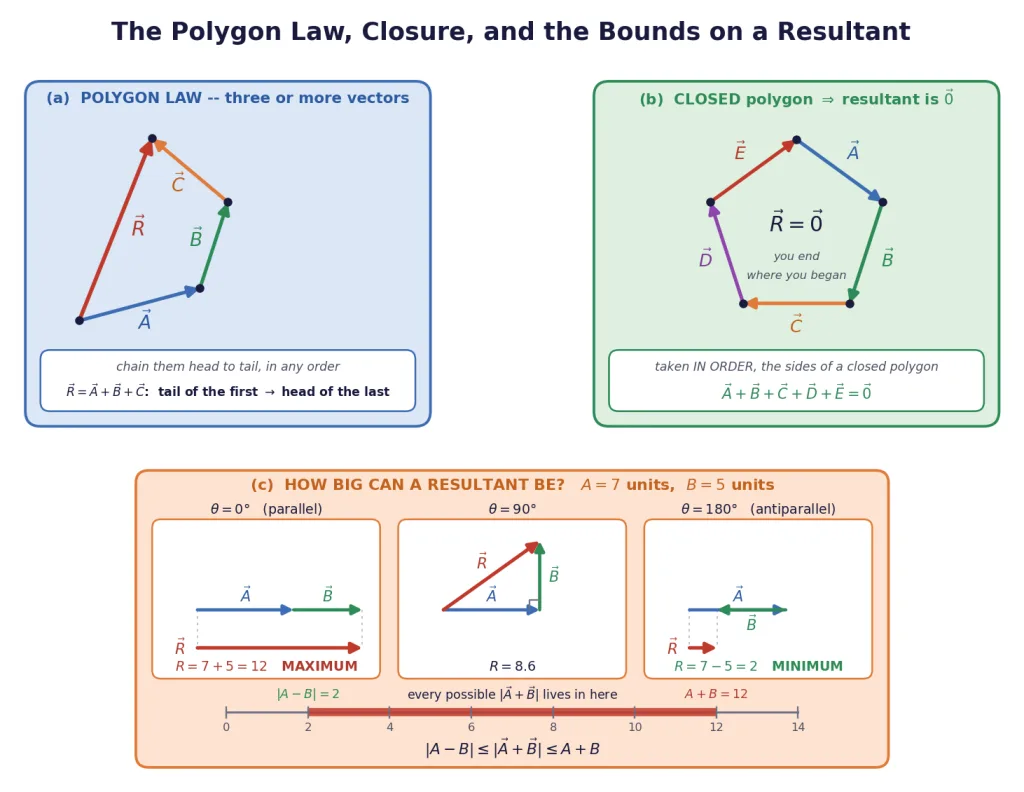
Panel (a) of that figure is the polygon law for three vectors. Panel (b) is the result that examiners cannot resist, and panel (c) is the subject of the last block of this section.
The closure rule — guaranteed exam material
Suppose the chain of vectors comes back to where it started, so that the head of the last vector lands exactly on the tail of the first. The figure is then a closed polygon.
Key Point: If a set of vectors, taken in order, forms a closed polygon, their resultant is the null vector:
The reason is almost embarrassingly simple. The resultant is the arrow from the tail of the first to the head of the last — and if the polygon closes, those two points are the same point. An arrow of zero length is the null vector.
You already met this idea physically in Section 1: a closed journey has zero displacement, however long the route was. Closure is the same statement, drawn instead of described.
Three cautions, because this is where marks are lost:
- "In order" is essential. The arrows must chase each other round the loop, head to tail all the way. If one of them is reversed, the polygon still looks closed but the sum is not zero.
- The polygon need not be regular, and the vectors need not be equal. Any closed shape works.
- If the vectors are the sides of a closed polygon taken in order, the sum is zero. If instead they run from the centre to the vertices of a regular polygon, the sum is also zero — but for a different reason (symmetry), and only when the polygon is regular. Do not mix the two statements up.
[JEE/NEET] The most common version of this question removes one side: "Five forces act along five sides of a regular hexagon taken in order. What is their resultant?" Since all six would sum to zero, the five must sum to the negative of the missing one — same magnitude, opposite direction. Example 10 works this through.
The algebra of vector addition
Three properties, all provable by drawing.
1. Commutative (proved in the last block from the parallelogram):
2. Associative. It does not matter which pair you add first:
The proof is the polygon itself. Chain , , head to tail. Whether you first join the tail of to the head of and then add , or first join the tail of to the head of and then hang that off , the start point and the end point of the chain never move. Same start, same end, same resultant.
Together, commutativity and associativity say something worth stating plainly: you may add any number of vectors in any order and any grouping, and the answer is the same. That freedom is what makes the polygon law legal.
3. The null vector is the identity. Three statements go together:
Adding changes nothing — geometrically you are told to walk a distance of zero, so you stay put.
And one more, which is really the definition of the negative vector from Section 1:
Two vectors of equal magnitude pointing in opposite directions cancel exactly. Head-to-tail, you walk out along and straight back along , landing where you began.
Key Point: and . Since a null vector has zero magnitude, its direction cannot be specified — it is not "zero direction", it is no direction. This is a favourite one-marker.
Subtraction, and the Two Diagonals of One Parallelogram
There is no separate "subtraction law" for vectors. There does not need to be one.
Key Point: The difference of two vectors is defined as the sum of the first and the negative of the second:
That is the entire definition. Reverse , then run the ordinary triangle law. Every rule you have already learned applies unchanged.
The figure that answers half the questions
Draw and from a common point and complete the parallelogram. It has two diagonals, and both of them mean something.
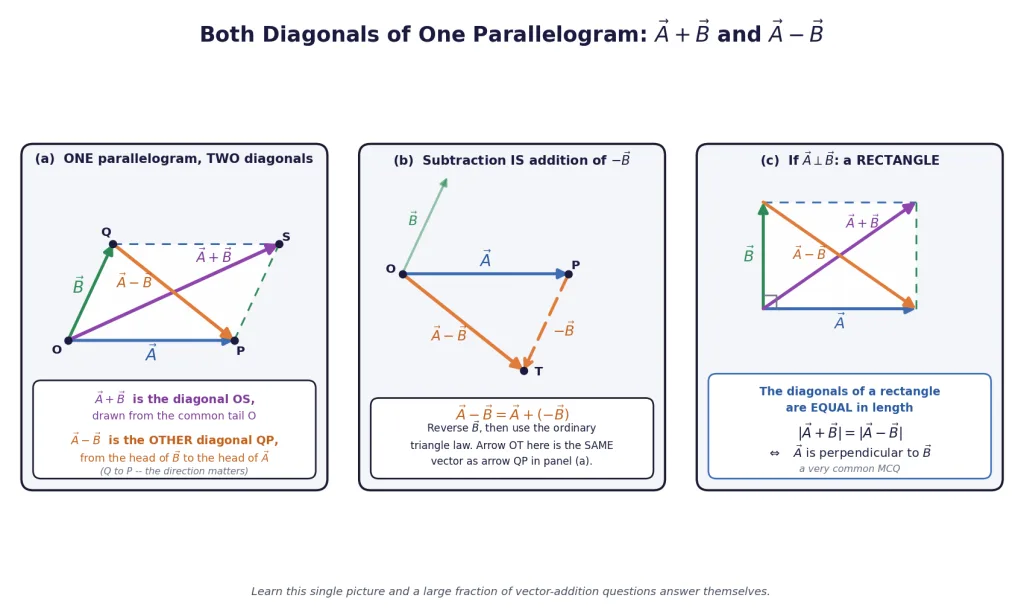
Key Point — memorise this one picture:
- The diagonal from the common tail O to the far corner S is .
- The other diagonal, drawn from the head of to the head of , is .
Panel (b) of the figure shows why the second one is right: shift that arrow QP back to the common origin and it is exactly the arrow you get by laying head-to-tail after .
The direction of the difference diagonal matters enormously. From the head of to the head of gives . Run it the other way and you have , which is the same length but points the opposite way:
Key Point: Vector subtraction is not commutative: (unless both are the null vector). It is not associative either. Only addition enjoys those properties.
Where subtraction actually shows up
Almost every time you see a in this book, a vector subtraction is hiding behind it:
Displacement (Section 1) is a subtraction of position vectors. Change in velocity is a subtraction of velocities, and it drives the whole of acceleration in Section 4 and circular motion in Section 6. Relative velocity (Section 7) is a subtraction too.
[NEET Important] The classic: a car rounds a corner at a steady 20 m/s, turning from due east to due north. Its speed never changes, yet has magnitude m/s. Constant speed does not mean zero change in velocity. Example 8 does this properly.
The equal-diagonals trick
Here is a small result that shows up as an MCQ far more often than its size deserves. Look at panel (c) of the figure. If and are perpendicular, the parallelogram becomes a rectangle — and the diagonals of a rectangle are equal.
Key Point:
The sum and the difference have equal magnitudes if and only if the two vectors are at right angles.
It works in both directions, and that is the point. If a question tells you , you may immediately write "the angle between them is " and move on.
[JEE Tip] Two companion facts from the same rectangle, both worth knowing on sight:
- If , the angle between them is acute (less than ).
- If , the angle is obtuse (more than ).
Think of it as a stretching parallelogram: as the angle opens from to , the sum-diagonal shrinks and the difference-diagonal grows, and they cross over exactly at .
How Big Can a Resultant Be? The Bounds, and When It Vanishes
You now have the constructions. This last block extracts from them the single most examined inequality in the chapter.
Go back to panel (c) of the polygon figure. Two vectors, units and units, and we swing the angle between them from to .
- At the vectors are parallel. Head to tail they lie on one straight line pointing the same way, so the lengths simply add: . Nothing can beat this.
- At they are antiparallel. Now the second arrow doubles back along the first, and the resultant is what is left over: . Nothing can be smaller.
- Every other angle lands somewhere in between.
Key Point — the bounds on a resultant: Maximum when the vectors are parallel (); minimum when they are antiparallel (). The resultant takes every value in between exactly once as goes from to .
This is the triangle inequality of school geometry wearing a physics hat: in any triangle, one side can never exceed the sum of the other two, nor fall short of their difference.
Why the modulus on ? Because a magnitude cannot be negative. If and , the minimum resultant is 3, not .
[NEET Important] This turns into a one-line filter. Two forces of 12 N and 5 N act at a point. Their resultant must lie between 7 N and 17 N. So a resultant of 4 N is impossible, 10 N is fine, and 17 N is possible only if the forces are parallel. You do not need any formula to say that.
When can the resultant be zero?
Set the minimum to zero and read off the condition.
Key Point: The resultant of two vectors is zero if and only if they have equal magnitudes and opposite directions — that is, .
Consequently, two vectors of unequal magnitude can NEVER give a zero resultant, at any angle. The best they can do is , which is not zero.
Three vectors, and the closure test
With three vectors there is more freedom, and a very clean criterion.
Key Point: Three vectors can have a zero resultant if and only if they are coplanar and can be arranged head to tail to form a closed triangle. In magnitude terms, that means the largest of the three must be less than or equal to the sum of the other two.
Both halves matter. The vectors must lie in one plane — three non-coplanar vectors can never cancel, because the third one always has a component sticking out of the plane of the first two. And the magnitudes must be able to close a triangle.
The classic question: Can three vectors of magnitudes 3, 4 and 8 give a zero resultant?
No. Even with the 3 and the 4 lined up perfectly nose to tail, they reach only units, and 7 units cannot get you back along an 8-unit arrow. There is always a gap of at least 1 unit. Try 3, 4 and 6 instead and the answer flips to yes, because .
Key Point: The minimum number of coplanar vectors of unequal magnitude needed for a zero resultant is three. (With equal magnitudes, two are enough — and .)
Two vectors of equal magnitude: a result worth memorising
One special case comes up so often that it is worth having on the tip of your tongue. Take two vectors of the same magnitude , with angle between them. The parallelogram becomes a rhombus, and the diagonals of a rhombus bisect its angles. Geometry then gives:
Key Point: For two vectors of equal magnitude separated by angle : and the resultant bisects the angle between them, i.e. it makes an angle with each.
Check it against the bounds. At : , the maximum, correct. At : , the minimum, correct.
| worth remembering as | ||
|---|---|---|
| maximum | ||
| resultant equals each vector | ||
| minimum |
[JEE/NEET] The row is asked relentlessly, in both directions: "two equal forces have a resultant equal in magnitude to either one — find the angle" (), and "three equal forces are in equilibrium — find the angle between any two" (also , since each pair must balance the third).
Where this section stops
Everything above is geometry — constructions, triangles, bounds. What we have deliberately not done is turn the general case into a formula. For two vectors at an arbitrary angle with unequal magnitudes, you still have to draw and measure.
Section 3 removes that limitation. It splits every vector into perpendicular components, which converts the drawing into arithmetic and produces the general expression for and for its direction. Read this section for the why; read Section 3 for the fast machinery.
Mistake checklist
| Mistake | Fix |
|---|---|
| Adding magnitudes: | Only when ; in general it is smaller |
| "The minimum resultant is " | It is — never negative |
| Thinking two unequal vectors can cancel | Impossible at any angle |
| Reading the third side of a triangle as the resultant | The resultant runs from the first tail to the last head, against the loop |
| drawn from head of to head of | Backwards — that arrow is |
| Constant speed | Direction can change; then |
| Writing | , a vector |
Solved Examples
Example 1: Scaling a vector, four ways
A vector has magnitude 6 units and points due east. Describe fully (magnitude and direction) the vectors (a) , (b) , (c) , (d) . (e) Which of these are collinear with ?
Solution:
Use , with the direction unchanged for and reversed for .
- (a) : magnitude units, direction due east (unchanged).
- (b) : magnitude units, direction due west (reversed). Note the magnitude is , not .
- (c) : magnitude units, direction due east.
- (d) : magnitude 0. This is the null vector , and its direction cannot be specified.
- (e) All of (a), (b) and (c) are real multiples of , so all three are collinear with — they lie along the same east-west line. (b) happens to point the opposite way along that line, which does not stop it being collinear. The null vector is conventionally taken to be collinear with every vector.
Final Answer: (a) 18 units east; (b) 12 units west; (c) 2 units east; (d) ; (e) all of (a), (b), (c).
Takeaway: Scaling only ever does two things — change the length, and possibly flip the arrow. It never produces a new direction. If your answer to a question contains an angle that was not in the question, you have made an error.
Example 2: When the multiplier carries units
(a) A drone flies with a constant velocity of 15 m/s due north for 8.0 s. Find its displacement. (b) A body of mass 2.5 kg has an acceleration of 4.0 m/s^2 directed north of east. Find the net force on it. (c) A 2.0 kg ball moves at 5.0 m/s due west. Find its momentum.
Solution:
Each part is a vector multiplied by a positive scalar that carries units. The direction survives untouched; the magnitude and the unit both change.
- (a) . Magnitude ; unit .
- (b) . Magnitude ; unit .
- (c) . Magnitude ; unit .
Final Answer: (a) 120 m due north; (b) 10 N at north of east; (c) 10 kg m/s due west.
Takeaway: Three different physical quantities came out of one operation. The point is that may have its own dimension, so the product has the product of the dimensions. Since mass and time are always positive, is always along and is always along — never at an angle.
Example 3: The triangle law, drawn to scale
A cyclist rides 4.0 km due east, then turns and rides 3.0 km due north. Using the triangle law, find (a) the total path length and (b) the magnitude and direction of the resultant displacement. State your scale.
Solution:
- Scale. Take 1 cm 1 km. So is drawn 4.0 cm long pointing east, and is 3.0 cm long pointing north.
- Construction. Draw from O to P. Place the tail of at P and draw it to S. Join O to S — that arrow is the resultant .
- (a) Path length is measured along the route, so it is a plain scalar sum:
- (b) Measured with a ruler, OS comes out 5.0 cm long, which at our scale is 5.0 km. Since the turn was through a right angle, the triangle OPS is right-angled at P, and the measurement checks against the 3-4-5 triangle: .
- Measured with a protractor, OS makes with the east direction (exactly, ).
Final Answer: (a) 7.0 km; (b) 5.0 km directed north of east.
Takeaway: Path length 7.0 km, displacement 5.0 km — the two are different quantities and the question asked for both. And notice what the triangle law bought you: the direction, which no amount of adding numbers would have given.
Example 4: The parallelogram law with equal forces
Two forces, each of magnitude 8.0 N, act at a point with an angle of between them. Find the magnitude and direction of the resultant.
Solution:
- Construction. Bring both tails to O. Draw along a chosen direction and at to it, both 8.0 cm long on a scale of 1 cm 1 N. Complete the parallelogram and draw the diagonal from O.
- Because the two magnitudes are equal, the parallelogram is a rhombus, and the diagonal of a rhombus bisects the angle. So the resultant makes with each force.
- The rhombus splits into two congruent right triangles along that diagonal, giving the equal-magnitude result:
- Check against the bounds. With N, any resultant must satisfy N. Our 13.86 N sits comfortably inside, and closer to the maximum than the minimum — which is right, because is closer to than to .
Final Answer: 13.9 N, directed along the bisector, i.e. at to each force.
Takeaway: For equal magnitudes, two facts come free: the resultant is and it bisects the angle. The bisecting is often the part the question actually wants, and it is pure geometry — a rhombus, not a formula.
Example 5: The equal-magnitude table, and a reverse question
Two vectors each of magnitude 10 units are separated by an angle . (a) Find the magnitude of their resultant for , , , and . (b) For what value of is the resultant equal in magnitude to either vector? (c) For what is the resultant zero?
Solution:
Use with .
- (a) Working through the angles:
| units | |||
| units | |||
| units | |||
| units | |||
- (b) We want , i.e. : The table confirms it: the row gives exactly 10.0 units.
- (c) needs , so and — the vectors are antiparallel. With equal magnitudes and opposite directions they are and , which cancel exactly.
Final Answer: (a) 20.0, 17.3, 14.1, 10.0, 0 units; (b) ; (c) .
Takeaway: Notice the resultant falls steadily as opens out — from down to zero. The row is the one to memorise: two equal vectors at have a resultant equal to either one of them. That single fact answers a startling number of MCQs.
Example 6: What resultants are even possible?
Two forces of magnitudes 12 N and 5 N act at a point. (a) What are the largest and smallest possible magnitudes of their resultant, and at what angles? (b) Which of the following are possible resultants: 4 N, 7 N, 10 N, 17 N, 18 N? (c) At what angle is the resultant 13 N?
Solution:
- (a) Apply the bounds with , :
- (b) Every achievable resultant must lie in the closed interval from 7 N to 17 N:
- 4 N — impossible, below the minimum.
- 7 N — possible, exactly the minimum ().
- 10 N — possible, some angle between and .
- 17 N — possible, exactly the maximum ().
- 18 N — impossible, above the maximum.
- (c) Try a right angle. Laid head to tail with , the two forces and their resultant form a right triangle with legs 12 and 5, so the resultant is the hypotenuse: So gives exactly 13 N.
Final Answer: (a) 17 N at , 7 N at ; (b) 7 N, 10 N and 17 N are possible, 4 N and 18 N are not; (c) .
Takeaway: Part (b) took no calculation at all — just the interval. Get into the habit of writing down the moment you see two magnitudes; it disposes of a whole class of MCQs in about five seconds, and it is a free sanity check on any answer you compute the long way.
Example 7: Can these three cancel?
(a) Can three vectors of magnitudes 3, 4 and 8 units have a zero resultant? (b) What about 3, 4 and 6 units? (c) Can two vectors of magnitudes 5 and 9 units have a zero resultant? (d) State the general condition for three vectors to sum to the null vector.
Solution:
- (a) For three vectors to sum to they must form a closed triangle head to tail. Take the two smaller ones first: even placed nose to tail in perfect alignment, 3 and 4 reach only The 8-unit vector is too long to be closed off by the other two — there is always a gap of at least unit. No, it is impossible.
- (b) Now the largest is 6, and . A triangle with sides 3, 4 and 6 exists, so yes, a suitable arrangement gives zero. (Equivalently: the resultant of the 3 and the 4 can be anything from 1 to 7 units, and 6 lies in that range, so it can be cancelled by the 6-unit vector pointing the opposite way.)
- (c) Two vectors cancel only if they are equal in magnitude and opposite in direction. Here , and the smallest resultant they can manage is units. No.
- (d) Three vectors have a zero resultant if and only if they are coplanar and can be arranged head to tail into a closed triangle — equivalently, the largest magnitude does not exceed the sum of the other two.
Final Answer: (a) No; (b) Yes; (c) No; (d) coplanar, with the largest the sum of the other two.
Takeaway: The whole test is one comparison: largest versus the sum of the other two. And note (c): two vectors of unequal magnitude can never cancel, which is why the minimum number of coplanar vectors of different magnitudes needed for a zero resultant is three.
Example 8: Change in velocity — subtraction in disguise
(a) A car rounds a bend at a constant speed of 20 m/s, its velocity turning from due east to due north. Find the magnitude and direction of the change in velocity. (b) A ball strikes a wall head-on at 10 m/s and rebounds along the same line at 10 m/s. Find the change in velocity.
Solution:
Change in velocity means — a subtraction, so reverse the initial velocity and add.
- (a) is 20 m/s east; is 20 m/s north. Reverse to get , which is 20 m/s west. Now add (north) and (west) head to tail. They are perpendicular and equal in magnitude, so the triangle is right-angled and isosceles: pointing exactly midway between north and west, i.e. north-west.
- Cross-check with the equal-magnitude difference formula. The angle between and is , so m/s. Agrees.
- (b) Take "towards the wall" as the direction of , magnitude 10 m/s. Then is 10 m/s away from the wall, so and
Final Answer: (a) 28.3 m/s towards the north-west; (b) 20 m/s directed away from the wall.
Takeaway: In both parts the speed never changed and yet is large. Velocity is a vector; changing only its direction is still a change. Part (b) is the standard first step of every impulse problem in Chapter 5 — the answer is , not zero.
Example 9: The equal-diagonals condition
For two vectors and of magnitudes 5 units and 3 units it is found that . (a) What is the angle between and ? (b) Find the common value of the two magnitudes. (c) If instead , what can you say about the angle?
Solution:
- (a) Draw both vectors from a common point and complete the parallelogram. is one diagonal and is the other. The diagonals of a parallelogram are equal only when it is a rectangle, and the parallelogram is a rectangle exactly when its adjacent sides are perpendicular. Therefore
- (b) With the vectors at right angles, both diagonals are the hypotenuse of a 5-by-3 right triangle:
- (c) Picture the parallelogram closing up as decreases. The sum-diagonal grows and the difference-diagonal shrinks, and they are equal only at . So means the angle is acute, .
Final Answer: (a) ; (b) units each; (c) the angle is acute.
Takeaway: is an if and only if, so it reads in both directions. Spot that equality in a question stem and write "perpendicular" immediately — no algebra needed.
Example 10: Forces round a hexagon
Six forces, each of magnitude 10 N, act along the six sides of a regular hexagon taken in order. (a) Find their resultant. (b) If the force along the last side is now removed, what is the resultant of the remaining five? (c) Six vectors of equal magnitude are drawn from the centre of a regular hexagon to its six vertices. What is their sum?
Solution:
- (a) "Taken in order" means the forces are laid head to tail all the way round — the head of each sits on the tail of the next, and the last one closes back onto the start. That is precisely a closed polygon, so the resultant runs from a point to itself:
- (b) Since all six sum to , the first five must sum to the negative of the sixth: So the resultant has magnitude 10 N, equal to the removed force, and points in the direction opposite to it. Geometrically it is the arrow that closes the open gap — from the tail of the first side to the head of the fifth.
- (c) This is a different configuration: six co-initial vectors from the centre, spaced apart. They pair up — each vector has another pointing exactly opposite to it ( round the circle) and equal in magnitude. Each pair cancels, so the three pairs give
Final Answer: (a) ; (b) 10 N, opposite in direction to the removed force; (c) .
Takeaway: Two different reasons for the same answer, and examiners exploit the confusion. Sides of a closed polygon taken in order sum to zero for any polygon. Spokes from the centre sum to zero only because the polygon is regular (symmetry). Part (b) is the standard "remove one side" twist: the answer is always the missing vector, reversed.
Example 11: Order and grouping do not matter
A hiker walks 4.0 km due east, then 3.0 km due north, then 2.0 km due west. (a) Find the magnitude and direction of the resultant displacement using the polygon law. (b) Show that adding the three legs in a different order gives the same result. (c) Compare the resultant with the total distance walked.
Solution:
- (a) Chain the three displacements head to tail. Starting at O, the east leg takes you 4.0 km right; the north leg 3.0 km up; the west leg 2.0 km back left. The end point is therefore km east of O and 3.0 km north of O. The resultant is the arrow from O to that end point: Its direction: , so north of east.
- (b) Reorder the walk as west first, then east, then north. The east and west legs partly cancel ( east west east), and the north leg is unchanged, so you again finish 2.0 km east and 3.0 km north of O — the same point, hence the same resultant 3.6 km at north of east. This is commutativity and associativity at work:
- (c) Distance walked is the path length, a scalar sum: km, against a displacement magnitude of 3.6 km.
Final Answer: (a) 3.6 km at north of east; (b) same resultant, as it must be; (c) path 9.0 km, displacement 3.6 km.
Takeaway: The polygon's start and end points are all that matter — the shape of the chain in between is irrelevant. That is the geometric content of "vector addition is commutative and associative", and it is why path length always.
Example 12: Both diagonals at once
and each have magnitude 6.0 units, with at to . Find (a) and its direction, (b) and its direction, and (c) the angle between and .
Solution:
Measure all directions from , taking anticlockwise as positive. Since the magnitudes are equal, the parallelogram is a rhombus and both diagonals bisect its angles.
- (a) The angle between the two vectors is : It bisects the angle, so it lies at from . (Here is the special case again — the sum has the same magnitude as each vector.)
- (b) For the difference, reverse . The vector sits at , so the angle between and is . These two also have equal magnitudes, so bisecting that gap, i.e. at from (thirty degrees on the other side of from ). Equivalently, using the companion formula directly: units. Same answer.
- (c) The two diagonals lie at and , so the angle between them is
Final Answer: (a) 6.0 units at from ; (b) 10.39 units at on the far side of ; (c) .
Takeaway: Part (c) is not a fluke. When the parallelogram is a rhombus, and the diagonals of a rhombus are always perpendicular — so is always at right angles to for equal-magnitude vectors, whatever the angle between them. Worth carrying into the JEE hall.