
Same Chapter, Half the Clock
Section 9 just took this chapter apart the JEE way — dot and cross products, projectiles fired up hillsides, radius of curvature, non-uniform circular motion. If you have read it, you already know more than this section is going to ask of you.
So why a separate NEET Corner? Because NEET does not test the same skill.
JEE gives you a hard question and enough time to think. NEET gives you a manageable question and almost no time at all. Physics is 45 questions, and inside a 180-minute paper shared with Chemistry and Biology those 45 deserve roughly 45 minutes. One minute each — and mechanics, thermodynamics and electricity will eat far more than their share. So the three or four questions from this chapter have to be finished in well under a minute each, correctly, so the time is banked for the ones that genuinely need it.
Key Point: NEET's version of this chapter never leaves the core syllabus. No inclined-plane projectiles. No radius of curvature. No cross products beyond a bare mention. No calculus. Everything on the paper is a definition you recall, one formula you substitute into, a standard set-up you have already drilled, or a format you have practised.
The four types, and what each should cost you
| Type | What it looks like | Your budget | The right instinct |
|---|---|---|---|
| 1. Direct recall | "Which of these is a scalar?" "Two vectors are equal when…" "In uniform circular motion the acceleration is…" | 15-20 s | You either know it or you don't. Never derive a definition. |
| 2. One-step plug-in | Time of flight, maximum height, range, , a resultant | 25-35 s | Spot the word, pick the formula, substitute once. |
| 3. Standard set-up | Rain and umbrella, river crossing, a stone on a string, a ball off a table | 25-40 s | Recognise the template. Draw the one triangle. |
| 4. Assertion-Reason / Column matching | Two NEET-only formats, both drilled below | 35-45 s | Judge each statement alone; anchor and kill codes. |
[Important] A diagnostic worth internalising: if a question from this chapter needs a third line of working, you have misread it. NEET gives you two of the quantities and asks for a third. If you find yourself resolving gravity along a slope, you have wandered into the Section 9 version of the question.
The / arithmetic
Four marks for a right answer, minus one for a wrong one, zero for a blank. So on a doubtful item the real question is not "can I get this?" but "can I get this in 40 seconds?" If two options survive elimination and 40 seconds have gone, take the better one and move — a 50-50 guess is worth marks on average. What you must never do is spend three minutes rescuing one mark's worth of doubt.
What this section does and does not repeat
We will not re-derive the parallelogram law (Section 2 does that), rebuild the component method (Section 3), re-derive the projectile formulas (Section 5), or re-derive (Section 6). What you get instead is the same material reorganised for recognition speed: the sentences NEET asks almost word for word, a projectile card with a chooser, the resultants you should never compute, the circular and relative-velocity templates with clean numbers, and the two NEET-only formats drilled properly.
The One-Liners NEET Asks Word for Word
This block is pure recall ammunition. Read it as flashcards, not as prose. Every item here has appeared as a complete question by itself, and the wording stays close to the standard phrasing because that is how it gets asked.
What actually makes a quantity a vector
Almost everyone can recite "a vector has magnitude and direction". That answer is incomplete, and NEET knows it.
Key Point: A vector is a quantity that has magnitude, has direction, and obeys the triangle law (equivalently the parallelogram law) of vector addition. All three conditions. A scalar is specified completely by a number with a unit, and combines by ordinary algebra.
The third condition is the whole question. Two famous quantities pass the first two tests and fail the third:
- Electric current. It has a magnitude in amperes and we happily speak of its direction along a wire. But currents meeting at a junction add algebraically, not by the parallelogram law. Current is a scalar.
- Finite rotation. A rotation has a size (the angle) and a direction (the axis). But rotate a book about one axis and then about another, then do the same two in the reverse order — you get different final orientations. Vector addition is commutative; finite rotations are not. A finite rotation is not a vector. (Very small rotations are, which is why angular velocity is a genuine vector.)
[Important] The scalar list that keeps coming back: mass, time, distance, speed, work, energy, power, pressure, density, temperature, charge, electric current, frequency, volume, potential. The vector list: displacement, velocity, acceleration, force, momentum, impulse, torque, weight, electric field, angular velocity.
The rest of the one-liners
Key Point:
- Two vectors are equal only if they have the same magnitude and the same direction. Equal magnitudes alone are not enough.
- A vector may be displaced parallel to itself without changing it. Where you draw it does not matter, only how long and which way.
- A unit vector has magnitude 1 and no dimensions and no units — it only carries direction.
- The null vector has zero magnitude and an arbitrary (indeterminate) direction.
- Displacement depends only on the initial and final positions, never on the path; its magnitude is never greater than the path length.
- The resultant of two vectors always satisfies .
- Instantaneous velocity is always tangent to the path.
The three sentences NEET asks about projectiles
1. Why is the horizontal velocity constant? Because gravity acts vertically only, so the horizontal acceleration is zero (air resistance being neglected). Nothing pushes or pulls the projectile sideways, so from launch to landing.
2. What is the velocity at the highest point? Horizontal, and equal to — not zero. Only the vertical component vanishes there. The acceleration at that point is still downwards.
3. What is the path? A parabola, because is linear in plus a term while is linear in ; eliminating gives as a quadratic in .
The two sentences NEET asks about circular motion
1. Why is uniform circular motion accelerated even though the speed is constant? Because velocity is a vector, and its direction changes at every instant. A changing velocity means a non-zero acceleration, whatever the speed is doing.
2. Which way does the acceleration point? Towards the centre — hence centripetal, meaning "centre-seeking" — with magnitude . And since the speed never changes, is perpendicular to at every instant.
The always-true / never-true table
Speed comes from knowing which sentences are safe.
| Statement | Verdict |
|---|---|
| Path length magnitude of displacement | Always true |
| Two vectors of equal magnitude are equal vectors | Never safe |
| A vector can be added to a scalar | Impossible |
| The resultant of two vectors can be smaller than either of them | True (e.g. equal vectors at ) |
| The resultant of two unequal vectors can be zero | Never |
| Three vectors can add to zero | True, if they close a triangle |
| A projectile's speed is minimum at the highest point | True on level ground |
| A projectile's acceleration is zero at the highest point | Never — it is throughout |
| In uniform circular motion the acceleration is constant | False — its magnitude is constant, its direction is not |
| In uniform circular motion and are perpendicular | Always true |
| Electric current is a vector | False |
| A finite rotation is a vector | False |
[Important] The most reused distractor pair in this chapter is "acceleration is zero at the top" versus the truth that it is . Right behind it sits "the acceleration is constant in uniform circular motion" — its magnitude is constant, the vector is not. Read whether the option says "acceleration" or "magnitude of acceleration".
The Projectile Card, and the 10-Second Chooser
Section 5 derived all of this. Here it becomes a lookup table you use without thinking.
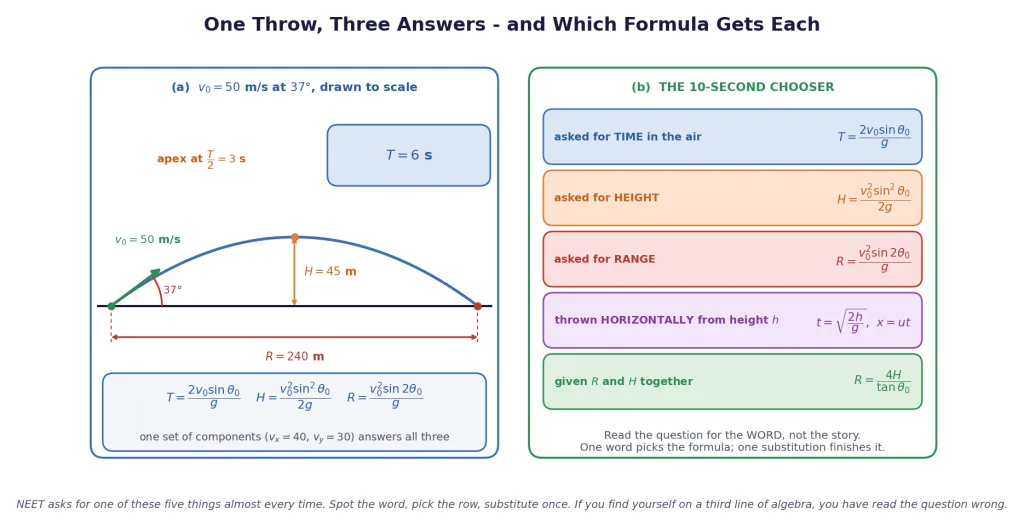
The card (level ground, launch speed at angle , air resistance neglected)
| Quantity | Formula | Note |
|---|---|---|
| Horizontal velocity | constant for the whole flight | |
| Time to the top | half the flight | |
| Time of flight | ||
| Maximum height | speed there is | |
| Horizontal range | ||
| Maximum range | at | |
| Range and height together | so exactly at | |
| Trajectory | a parabola | |
| Horizontal projection from height | , | does not depend on |
The chooser: given what, use which
Key Point: Read the question for the word, not the story.
- the word is "time" / "how long"
- the word is "height" / "how high"
- the word is "range" / "how far"
- the words are "thrown horizontally from a height" first, then
- you are handed and together
The complementary-angle result
Because . So and share a range; so do and , and and . The two flights are not identical, though — the steeper one goes higher and stays up longer:
Two more results from the pair, both directly asked: and .
The five ratios worth carrying in your head
With m/s^2 and the standard / pair (, ), the arithmetic almost always lands clean. A launch of 50 m/s gives and at , and s, m, m. Swap to and , , giving s, m, and the same m.
[Important] Three traps that account for most of the lost marks here.
- Time of flight versus time to the top. is the whole flight; is half of it. Read which one is wanted.
- Speed at the top. It is , not zero — and the acceleration there is , not zero.
- "Thrown horizontally" from a height. The time of fall is and is completely independent of the launch speed. A ball rolled off a table fast and one simply dropped hit the floor together.
Horizontal projection, in three lines
Thrown horizontally with speed from height :
and the landing direction is below the horizontal. That is the entire topic.
Rapid Resultants and Components
Nobody has time to run on the clock. Almost every resultant NEET asks for is one of a handful of shapes you can recognise.
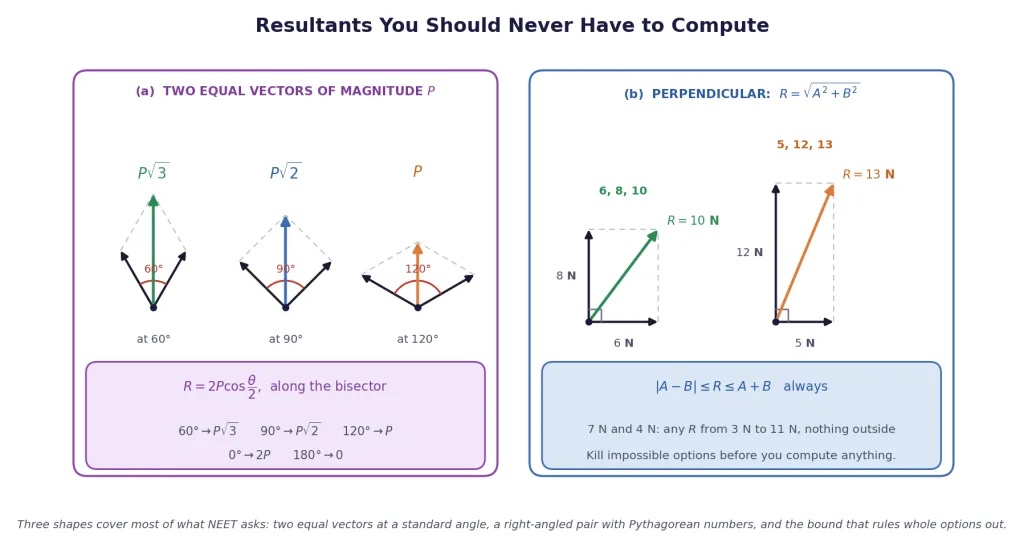
Shape 1: the perpendicular case
Learn the Pythagorean triples by sight, because examiners choose them precisely so the arithmetic is clean:
| Angle with | |||
|---|---|---|---|
| 3 | 4 | 5 | |
| 6 | 8 | 10 | |
| 5 | 12 | 13 | |
| 8 | 15 | 17 | |
| 9 | 12 | 15 |
If you see 6 and 8 at right angles and the options contain a 10, you are done in three seconds.
Shape 2: two EQUAL vectors at an angle
If both have magnitude and the angle between them is , the parallelogram is a rhombus, so the resultant bisects the angle and
| Resultant | |
|---|---|
The row is the one that surprises people and therefore the one that gets asked: two equal vectors at have a resultant equal in magnitude to each of them. (It is also why three equal vectors at to one another add to zero.)
Shape 3: the bound, used as a weapon
Key Point: Before computing anything, work out the two bounds. Any option outside is impossible and can be struck out without a single line of algebra. For 7 N and 4 N, the resultant must lie between 3 N and 11 N — so an option offering 2 N or 12 N is dead on sight.
The bound also answers a whole family of questions on its own:
- Two forces have a resultant of zero they must be equal in magnitude and opposite in direction.
- Two unequal vectors can never give a zero resultant.
- Three vectors can give zero only if they can be arranged head to tail into a closed triangle.
Components, at speed
The angles you should never have to compute:
| 0 | 1 | |
| 0.5 | 0.866 | |
| 0.6 | 0.8 | |
| 0.707 | 0.707 | |
| 0.8 | 0.6 | |
| 0.866 | 0.5 | |
| 1 | 0 |
[Important] The single commonest slip in this whole topic is adding magnitudes. is almost never — it is that only when the two point the same way. If a question gives 3 N and 4 N at and an option says 7 N, that option is there to catch exactly this reflex. The answer is 5 N.
Circular Motion and Relative Velocity, as Templates
The circular-motion card
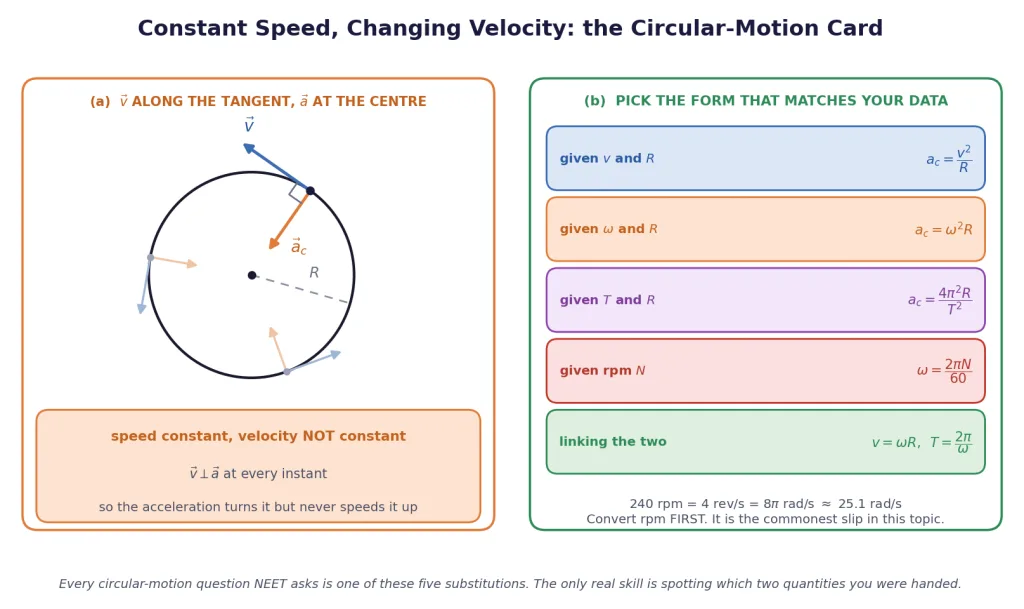
Everything NEET asks about circular motion is one of five substitutions. The only real skill is spotting which two quantities you were handed.
| You are given | Use |
|---|---|
| and | |
| and | , and |
| and | , then |
| frequency and | , then |
| revolutions per minute | first, then anything |
Key Point: Convert rpm to rad/s before you substitute. This is the commonest arithmetic slip in the topic. 240 rpm is 4 revolutions per second, which is rad/s, about 25.1 rad/s. Number of revolutions is , never itself.
Two comparison rules that answer questions on their own:
- Same (two points on the same rotating disc, two hands of a clock at the same instant): and . The outer point moves faster and accelerates harder.
- Same (two cars on different tracks at the same speed): . The tighter turn has the larger acceleration.
Relative velocity: two templates, one triangle each
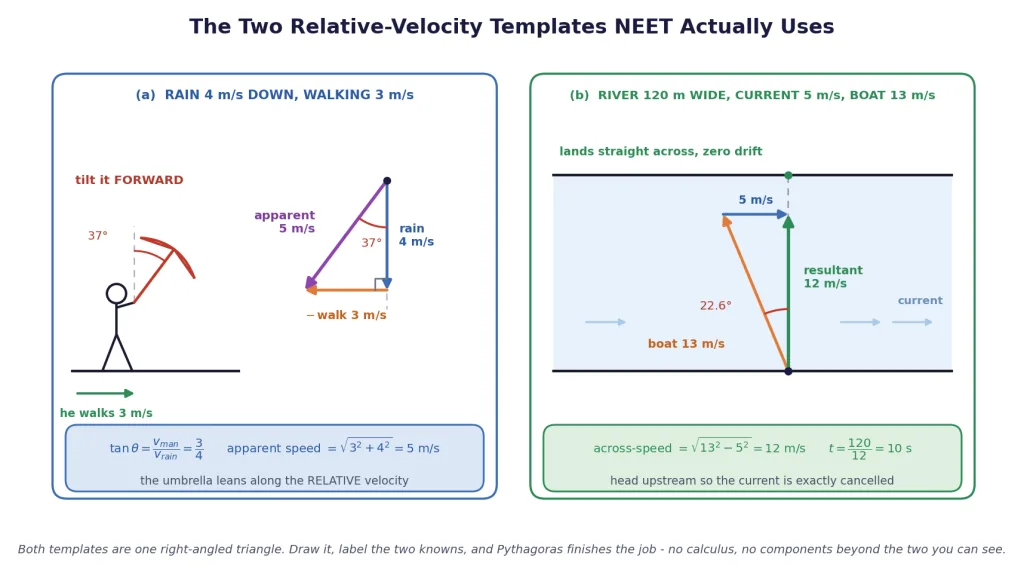
Template 1 — rain and the umbrella. Rain falls vertically at ; you walk horizontally at . The rain you feel is , so
and you tilt the umbrella forward, into your direction of motion, by that angle. Rain at 4 m/s with a 3 m/s walk gives , so and the apparent speed is 5 m/s.
Template 2 — crossing a river straight across. The river flows at , the boat does in still water (). To land directly opposite, the upstream component of the boat's velocity must exactly cancel the current:
The other route, for contrast: if he simply points straight across, the crossing takes the shortest possible time , but he is carried downstream by a drift of .
| Shortest TIME | Shortest PATH (zero drift) | |
|---|---|---|
| Heading | straight across | upstream |
| Time | (smaller) | (larger) |
| Drift | zero |
[Important] Read which route the question wants. "Shortest time" and "shortest path" are different headings, different times, and different answers — and the question will use one of those two phrases deliberately. Note also that landing straight across is only possible when .
Assertion-Reason: the Format, Then the Drill
Here is a format a Board-trained student has often never practised, and NEET uses it every year. You are given two statements — an Assertion (A) and a Reason (R) — and asked how they relate.
The four option codes
Key Point:
(a) Both A and R are true, and R is the correct explanation of A.
(b) Both A and R are true, but R is NOT the correct explanation of A.
(c) A is true but R is false.
(d) A is false but R is true.(Some papers replace (d) with "both A and R are false". Read the instruction line once at the start of the paper, then never again.)
The three-step attack
The whole format collapses if you do this in order and refuse to shortcut it.
- Judge A on its own. Physically cover R with a finger. Is the assertion, as a standalone sentence, true? Decide before you have read a word of R — otherwise R's confident tone will talk you into agreeing with a false assertion.
- Judge R on its own. Is the reason a true statement of physics? Not "does it support A" — just, is it true?
- Only if both are true, ask the third question: does R actually supply the cause of A? Not "are they about the same topic" — does it explain it?
Steps 1 and 2 alone settle two of the four options. Step 3 only ever separates (a) from (b).
Why this chapter is a favourite for the format
Because it is full of sentences that are true but sound wrong, and sentences that sound right but are false. Circular motion alone supplies four of them. Expect these to recur:
- a body moving at constant speed can still be accelerating (true)
- the acceleration at the top of a projectile's flight (it is , not zero)
- equal magnitudes versus equal vectors
- the resultant being smaller than either vector
- electric current having a direction yet being a scalar
The traps, in order of how often they work
- The true-but-irrelevant reason. R is a perfectly correct sentence of physics with nothing to do with A. Both read as familiar and true, so the hand reaches for (a). The answer is (b). This is the commonest way marks are lost in this format.
- The over-general assertion. A contains "always" or "never" and is therefore false, while R is the true general statement that shows why. That construction gives (d) almost every time.
- The swapped definition. A says "a vector is any quantity with magnitude and direction" — which is incomplete; the triangle law is part of the definition.
- The converse. R states the reverse implication of A: a true sentence, pointing the wrong way.
Drill: five items, decide before you read the verdict
1. A: A body moving in a circle at constant speed is accelerating. R: Velocity is a vector, so a change in its direction alone is enough to produce an acceleration.
2. A: Two vectors having equal magnitudes are always equal vectors. R: Two vectors are equal only when they have the same magnitude and the same direction.
3. A: The horizontal component of a projectile's velocity stays constant throughout its flight. R: The acceleration due to gravity acts vertically downwards and has no horizontal component.
4. A: At the highest point of its flight, a projectile has zero acceleration. R: At the highest point the vertical component of the velocity is zero.
5. A: Electric current has both magnitude and direction, yet it is a scalar quantity. R: Currents meeting at a junction add algebraically and not by the triangle law of vector addition.
| # | A | R | Does R explain A? | Answer |
|---|---|---|---|---|
| 1 | true | true | yes — that is exactly the cause | (a) |
| 2 | false — direction must match too | true | — | (d) |
| 3 | true | true | yes — no horizontal force means no horizontal acceleration | (a) |
| 4 | false — the acceleration is there | true — the vertical velocity really is zero | — | (d) |
| 5 | true | true | yes — failing the triangle law is precisely why it is a scalar | (a) |
Item 4 is the classic of this chapter: the reason is a perfectly true sentence, and it is exactly the sentence that tempts you into believing the false assertion. Judge A first, alone, and you never fall for it.
[Important] When you genuinely cannot separate (a) from (b), pick (a) only if you can say out loud, in one sentence, why R causes A. If the best you can manage is "they are both true and both about projectiles", the answer is (b).
Column Matching, Elimination Habits, and the 45-Second Finish
Column matching: anchor, eliminate, confirm
Column I gives four items, Column II gives four or five, and the options are codes like "A-iii, B-i, C-iv, D-ii". The trap is built into the shape: it looks like four questions for the price of one, so students dutifully work out all four pairings and burn two minutes.
Key Point: You are not matching four items. You are eliminating four codes. One pairing you are certain of usually kills two or three of them outright.
- Find your anchor — the entry you are surest about, or the one that is structurally unique (the only angle among speeds, the only one with a square root, the only zero).
- Kill every code that contradicts it.
- Apply your second-surest pairing to whatever survives.
- Only if two codes still stand, check a third pairing. You will rarely get that far.
Worked demonstration.
| Column I | Column II |
|---|---|
| (A) Two equal vectors of magnitude at | (i) |
| (B) Two equal vectors of magnitude at | (ii) |
| (C) Two equal vectors of magnitude at | (iii) |
| (D) Two equal vectors of magnitude at | (iv) zero |
Codes: (1) A-iii, B-ii, C-i, D-iv (2) A-i, B-ii, C-iii, D-iv (3) A-iii, B-i, C-ii, D-iv (4) A-ii, B-iii, C-i, D-iv
The 20-second run. Anchor on C: two vectors pointing the same way simply add, so C-i. Codes (2) and (3) die at once. Between (1) and (4) the only difference is A and B: two equal vectors at give , so A-iii. Code (4) dies. Answer: code (1) — and you never checked B or D at all.
Killing options without solving
These four habits routinely turn a 90-second question into a 20-second one.
1. Kill by dimensions. An answer for a time must look like or ; an answer for a length like ; an answer for an acceleration like or . If a question asks for the time of flight and an option reads , that option is a length. It is gone without a second's thought.
2. Kill by direction and sign. In uniform circular motion the acceleration must point at the centre — an option saying "along the tangent" or "along the velocity" is dead. A resultant must lie between the two vectors, never outside the angle they enclose.
3. Kill by limiting case. Push a formula-answer to an extreme:
| Push | What must happen |
|---|---|
| and must go to zero, must go to zero | |
| must go to zero, must be maximum | |
| must be maximum, and must equal | |
| in a river problem | the required heading must go to straight across |
| in circular motion | must go to zero (a straight line) |
An option that misbehaves in any of these limits is wrong, whatever the algebra says.
4. Kill by rough magnitude. With , a ball thrown at 20 m/s cannot go higher than m or further than m, whatever the angle. If your working produced 200 m, you have slipped a factor of ten and the correct option is usually still visible in the list.
The 45-second checklist
- Classify in 3 seconds. Recall, one-step plug-in, standard set-up, or format drill?
- If recall: answer or move on. Never reason your way to a definition.
- If numeric: underline the two given quantities, circle the wanted one, pick the row of the card, substitute once. Convert rpm and km/h first.
- If a standard set-up: name the template (rain, river, table-top, string) and draw its one triangle.
- If assertion-reason: judge A alone, then R alone, and only then the link.
- If column matching: anchor on the surest or structurally unique pairing and kill codes.
- At 45 seconds, stop. Two survivors and no clarity means guess between them and move on. The clock is worth more than the mark.
Key Point: Everything NEET asks from this chapter is one recall or one substitution. If you are on your third line of algebra, or you have started resolving gravity along a slope, you have wandered into the Section 9 version of the question. Go back and read it again — NEET almost certainly asked something simpler.
Solved Examples
Twelve problems at exactly NEET's level and pace. Time yourself: aim for under 45 seconds each, and treat anything that takes you past 90 seconds as a signal that you reached for the wrong tool.
Example 1: The chooser, run three times on one throw
A ball is projected at 50 m/s at to the horizontal (, , m/s^2). Find (a) the time of flight, (b) the maximum height, (c) the horizontal range, and (d) the speed at the highest point.
Solution:
Components once, and then never again.
(a) Time of flight — the word is time:
(b) Maximum height — the word is height:
(c) Range — the word is range:
(d) Speed at the top is the horizontal component, unchanged: 40 m/s. Not zero.
Two five-second checks. m. And the largest range this launcher could ever manage is m, so 240 m is sensible for an angle near but not at .
Final Answer: (a) 6.0 s (b) 45 m (c) 240 m (d) 40 m/s.
Takeaway: One line of components answered all four parts. Note that step 4 used rather than the formula — with the components already on the page, that is faster and there is no double-angle to get wrong.
Example 2: The complementary partner
The same launcher fires at 50 m/s but now at . Find its time of flight, maximum height and range, and compare all three with Example 1.
Solution:
Swap the components — that is the whole trick, since :
The three answers:
The comparison. The range is identical at 240 m, because and are complementary. But this steeper throw goes nearly twice as high (80 m against 45 m) and stays up a third longer (8.0 s against 6.0 s).
The two pair-results, verified:
And the ratios: , and .
Final Answer: s, m, m — same range, greater height, longer flight.
Takeaway: "Same range" never means "same flight". If a question says two angles give the same range and then asks about heights or times, it is testing precisely this. The ratios for heights and for times are worth memorising outright.
Example 3: Rolled off a table
A ball rolls off a table 20 m high with a horizontal speed of 15 m/s. Take m/s^2. Find (a) the time it takes to hit the floor, (b) how far from the table it lands, (c) the speed with which it lands, and (d) how the time would change if it left the table at 30 m/s instead.
Solution:
Recognise the template. "Horizontally from a height" means and the two motions are independent.
(a) The time comes from the vertical motion alone:
(b) Horizontal distance, at the unchanged horizontal speed:
(c) Landing speed. The vertical component has grown to m/s, so at below the horizontal.
(d) The time would not change at all. contains no . At 30 m/s the ball still lands after 2.0 s — it simply lands twice as far away, 60 m out.
Final Answer: (a) 2.0 s (b) 30 m (c) 25 m/s at below the horizontal (d) unchanged at 2.0 s.
Takeaway: Part (d) is the whole point, and it is asked constantly in the form "a ball rolled off a table and a ball dropped from the same table — which lands first?" Together. Horizontal motion cannot affect vertical motion.
Example 4: Three resultants, none of them computed
Find the resultant of (a) forces of 6 N and 8 N acting at right angles, (b) two forces of 10 N each at , and (c) two forces of 10 N each at .
Solution:
(a) Perpendicular — recognise the triple. 6, 8 and 10 is the 3-4-5 triangle doubled: directed at from the 6 N force.
(b) Two equal vectors — use : along the bisector, so from each force.
(c) Same rule, different angle: Again along the bisector, from each.
Sanity-check (c), because it is the counter-intuitive one. Two 10 N forces have combined to give… 10 N. That is correct: at they partly cancel. Push the angle further, to , and the resultant would be zero. Push it back to and it would be 20 N. Ten sits comfortably in between.
Final Answer: (a) 10 N at from the 6 N force (b) 17.3 N along the bisector (c) 10 N along the bisector.
Takeaway: Not one of the three needed . Two shapes — the Pythagorean right angle and two equal vectors — cover the overwhelming majority of what NEET asks, and both are recognitions rather than calculations.
Example 5: Killing options with the bound
Two forces of 7 N and 4 N act at a point. (a) Between what limits must their resultant lie? (b) Which of 2 N, 5 N, 8 N and 12 N are possible resultants? (c) At what angle would they give a resultant of 5 N?
Solution:
(a) Write the bounds first — always.
(b) Test each option against the bound.
- 2 N: impossible, below the lower bound of 3 N.
- 5 N: possible.
- 8 N: possible (and close to the perpendicular case, N).
- 12 N: impossible, above the upper bound of 11 N.
- (c) Only now do any algebra, and only because the question forced it: The obtuse angle is exactly what we should expect: to get a resultant smaller than the larger force, the two must be pulling substantially against each other.
Final Answer: (a) from 3 N to 11 N (b) 5 N and 8 N are possible; 2 N and 12 N are not (c) about .
Takeaway: Part (b) took five seconds and needed no formula. On a real paper, the bound alone often leaves exactly one surviving option, and you never have to reach step 3 at all.
Example 6: A car on a circular track
A car goes round a circular track of radius 40 m at a steady 20 m/s. Find (a) its centripetal acceleration, (b) its angular speed, (c) the time for one lap, and (d) what happens to the acceleration if the same car takes a track of half the radius at the same speed.
Solution:
(a) You were handed and , so pick that row of the card:
(b) Angular speed: Cross-check: m/s^2. Agrees.
(c) Period:
(d) Halve the radius at the same speed. With fixed, , so halving doubles the acceleration to 20 m/s^2. The tighter turn is the harder one, which is why a small roundabout feels sharper than a motorway curve at the same speed.
Final Answer: (a) 10 m/s^2 (b) 0.5 rad/s (c) 12.6 s (d) it doubles, to 20 m/s^2.
Takeaway: Part (d) is a proportional-reasoning question dressed up as a numerical one. Spot "same speed" or "same " in a comparison and answer by proportion — at fixed , and at fixed . No numbers required.
Example 7: A fan, and the rpm conversion
A ceiling fan rotates at 240 rpm. Its blade tip is 0.30 m from the axis. Find (a) the angular speed in rad/s, (b) the period, (c) the speed of the blade tip, and (d) the centripetal acceleration of the tip, and of a point halfway along the blade.
Solution:
(a) Convert first. Always. (240 rpm is 4 revolutions per second, and each revolution is rad — the same answer, arrived at without a formula.)
(b) Period:
(c) Tip speed:
(d) Tip acceleration: That is about 19 times . Halfway along the blade, is halved but is the same for every point of a rigid body, so
which is exactly half.
Final Answer: (a) 25.1 rad/s (b) 0.25 s (c) 7.54 m/s (d) 190 m/s^2 at the tip, 95 m/s^2 halfway.
Takeaway: Every point of a rigid rotating body shares the same but has a different and . At fixed , both and scale directly with — so the mid-blade point has half the speed and half the acceleration, not a quarter.
Example 8: Rain and the umbrella
Rain is falling vertically at 4 m/s. A man walks along a straight road at 3 m/s. (a) At what angle to the vertical must he hold his umbrella, and in which direction? (b) How fast does the rain appear to strike him? (c) What changes if he doubles his walking speed?
Solution:
(a) Use the template. The rain he feels is , which is 4 m/s downward plus 3 m/s backwards (opposite to his walk). So it appears to come from in front of him, and He tilts the umbrella from the vertical, forward, in the direction he is walking.
(b) Apparent speed — the hypotenuse of the same right triangle:
(c) Walking at 6 m/s instead: He must lean the umbrella much further forward, and the rain hits him harder.
Final Answer: (a) from the vertical, tilted forward (b) 5 m/s (c) and 7.2 m/s.
Takeaway: Two habits settle every rain question. Forward, always — you tilt into your direction of motion, never backwards. And the tangent takes on top when the angle is measured from the vertical; if a question asks for the angle from the horizontal instead, it is the complement. Read which one it wants.
Example 9: Crossing a river straight across
A river 120 m wide flows at 5 m/s. A boat can do 13 m/s in still water. The boatman wants to land at the point directly opposite his start. (a) In what direction must he head? (b) What is his speed relative to the bank? (c) How long does the crossing take? (d) How long would it take if he simply pointed straight across, and how far downstream would he land?
Solution:
(a) The zero-drift condition: the upstream component of his velocity must cancel the current.
(b) What is left over is the across-component — and 5, 12, 13 is a Pythagorean triple:
(c) Time to cross:
(d) The other route. Pointing straight across gives the full 13 m/s across the stream:
Final Answer: (a) upstream of straight across (b) 12 m/s (c) 10 s (d) 9.2 s, landing 46.2 m downstream.
Takeaway: The two routes are genuinely different questions with different answers. Shortest time means point straight across and accept the drift; shortest path means head upstream and accept the longer crossing. The question always names one of them — underline the phrase before you compute.
Example 10: An assertion-reason item, run properly
Assertion (A): A particle moving along a circular path with constant speed has zero acceleration. Reason (R): The magnitude of the velocity of the particle does not change.
Options: (a) both true, R explains A (b) both true, R does not explain A (c) A true, R false (d) A false, R true.
Solution:
Step 1 — judge A alone. Cover R. Is it true that a particle on a circle at constant speed has zero acceleration? No. Velocity is a vector, and its direction is changing continuously, so the velocity is changing, so there is an acceleration — the centripetal acceleration , directed at the centre. A is false.
Step 2 — judge R alone. Is it true that the magnitude of the velocity does not change? Yes — that is exactly what "constant speed" means. R is true.
Step 3 — not needed. A false and R true settles it immediately.
Final Answer: (d) — A is false, R is true.
Takeaway: Notice how the item is engineered. R is a true, comfortable, familiar sentence, and it is precisely the sentence that makes the false assertion sound reasonable. That is why step 1 must happen with R physically covered. Had you read R first, you would very likely have chosen (a).
Example 11: A column-matching item, run properly
A particle moves in a circle. Match the given data in Column I with the centripetal acceleration in Column II.
| Column I | Column II |
|---|---|
| (A) m/s, m | (i) 2 m/s^2 |
| (B) m/s, m | (ii) 12 m/s^2 |
| (C) m/s, m | (iii) 16 m/s^2 |
| (D) m/s, m | (iv) 24 m/s^2 |
Codes: (1) A-ii, B-iii, C-i, D-iv (2) A-iii, B-ii, C-iv, D-i (3) A-ii, B-i, C-iii, D-iv (4) A-i, B-iii, C-ii, D-iv
Solution:
Find the structural anchor. Entry (C) is the only one where the radius exceeds the speed, so it is the only one that can give a small acceleration. Compute just that one:
Kill the codes that disagree. Codes (2), (3) and (4) all assign C to something other than (i). All three die. Only code (1) survives.
One confirmation, then stop. Check the entry you are next surest about:
Final Answer: Code (1) — A-ii, B-iii, C-i, D-iv.
Takeaway: Two divisions, and the item was finished. The temptation is to compute all four accelerations, which takes four times as long and gives no extra marks. Anchor on the entry that is easiest or most distinctive, kill codes, and confirm once.
Example 12: Four questions, none of them calculated
Answer each of these by elimination alone, without computing a final number.
(a) A projectile is launched with speed . Which of these could be its time of flight: , , , ?
(b) Two forces of 5 N and 9 N act at a point. Can their resultant be 3 N?
(c) A stone is whirled on a string in a horizontal circle at constant speed. In which direction is its acceleration?
(d) A ball is thrown at 20 m/s at . A student's working gives a maximum height of 50 m. Is that plausible?
Solution:
(a) Kill by dimensions. A time must be built like . Three of the four options are , which is a length. Only has the dimensions of time. Answer: the second option, and no physics was needed.
(b) Kill by the bound. , so . A resultant of 3 N is below the lower bound and therefore impossible. Five seconds.
(c) Kill by direction. In uniform circular motion the acceleration is centripetal — directed towards the centre of the circle, perpendicular to the velocity. Any option saying "along the velocity", "along the tangent" or "outward" is wrong by definition. (There is no outward force on the stone; the string pulls it inward.)
(d) Kill by rough magnitude. The greatest height any 20 m/s throw can reach is the straight-up value m. At only the actual height is m. 50 m is impossible — the student has slipped by a factor of ten somewhere.
Final Answer: (a) (b) no, 3 N is below the lower bound of 4 N (c) towards the centre (d) no — the ceiling for a 20 m/s throw is 20 m.
Takeaway: Four questions, no calculation, well under a minute in total. Dimensions, bounds, direction and rough magnitude are not just checking tools — on a timed paper they are often the fastest route to the answer itself. Build the habit of asking "what can I rule out?" before asking "what is the answer?"