
Why Resolve at All? Because a Ruler Is Not a Formula
Section 2 handed you three constructions — the triangle law, the parallelogram law, the polygon law — and every one of them is a drawing. You pick a scale, you sharpen a pencil, you lay one arrow's tail on another's head, and then you measure the answer off the page.
That works. It is also the problem.
Key Point: The graphical method is exact in principle and approximate in practice. The accuracy of your resultant is the accuracy of your ruler and your protractor — nothing more. Put plainly: the graphical method is sometimes tedious and has limited accuracy.
Think about what an exam actually asks. Two forces of 17.3 N and 25.0 N act at to each other; find the resultant to three significant figures. You cannot draw that. Half a degree of protractor error moves the answer by more than the tolerance you are being marked against. And in three dimensions you cannot draw it at all.
So we need a way to turn the geometry into arithmetic — into numbers you add, square and square-root, with no drawing anywhere in sight. That method is called resolution, and the whole of this section is built on one simple reversal of direction:
- Addition takes two vectors and produces one.
- Resolution takes one vector and produces two.
They are inverse operations, and the second one is the useful one, because the two vectors you break a vector into can be chosen to be as convenient as you like.
Resolving along any two directions
Here is the general statement.
Let and be any two non-zero vectors in a plane that are not parallel to each other, and let be another vector in that same plane. Then can always be written as a sum of a multiple of and a multiple of .
The construction is a two-line piece of geometry:
- Let O be the tail and P the head of .
- Through O draw a straight line parallel to ; through P draw a straight line parallel to . Because and are not parallel, these two lines must meet — call the meeting point Q.
- By the triangle law, .
- But lies along and lies along , so each is just a real multiple of its direction: and .
Key Point: Any vector in a plane can be resolved along any two non-zero, non-parallel vectors and in that plane: where and are real numbers. The vectors and are called the component vectors of along and .
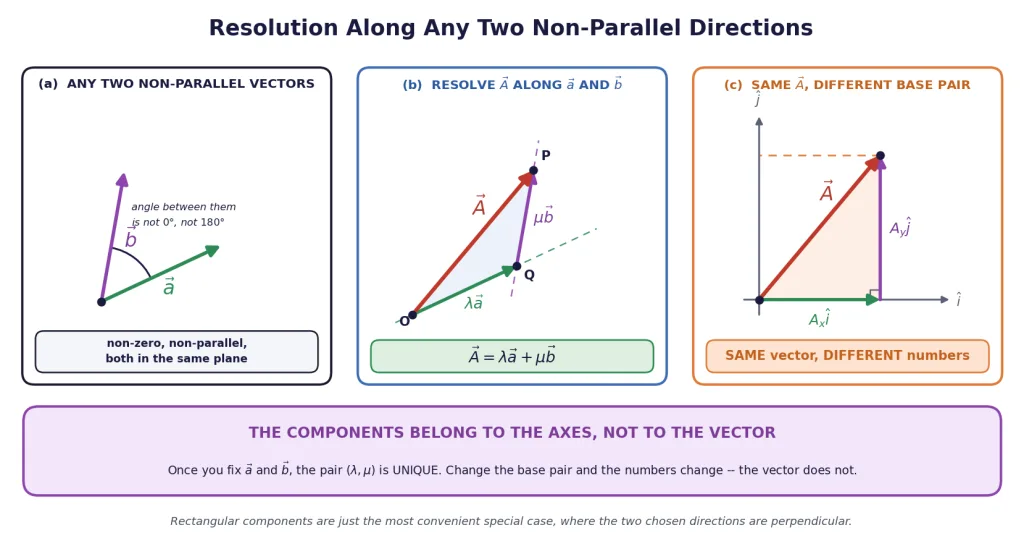
Notice that this uses nothing you have not already met: Section 2's multiplication by a real number supplies , and Section 2's triangle law glues the two pieces back together.
Two things students get wrong about this
First: the resolution is unique — once you have chosen and . There is exactly one line through O parallel to and exactly one line through P parallel to , so Q is pinned down, and with it and . You cannot get two different answers for the same pair of base directions.
Second: change the base pair and the numbers change. Panels (b) and (c) of the figure show the same vector resolved twice, along two different pairs of directions, and the two answers look nothing like each other. Both are correct.
Key Point: The components belong to the axes, not to the vector. itself never changes; only the numbers you describe it with do. This is why a question must always tell you the directions you are resolving along, and why your answer must always say which ones you used.
[JEE Tip] The non-parallel condition is not a technicality. If and were parallel, every combination would lie along that one line, and you could never reach a vector pointing anywhere else. Two parallel directions carry only one direction's worth of information.
Why we almost always choose perpendicular directions
Nothing in the construction demands a right angle. But if you pick and perpendicular to each other, three lovely things happen at once:
- Each component can be read off with a single sine or cosine.
- The magnitude comes back by Pythagoras, with no cross term.
- The two components are completely independent — pushing along has no effect on whatsoever.
That special case is called rectangular or orthogonal resolution, and it is what the rest of this section — and honestly, the rest of this chapter — actually uses.
Rectangular Components and the Unit Vectors , ,
To resolve along perpendicular directions we need a name for "one unit that way". Section 1 introduced the general unit vector . Now we fix three of them permanently, one per coordinate axis.
Key Point: , and are the unit vectors along the , and axes of a rectangular coordinate system. They satisfy They are mutually perpendicular, and they are dimensionless and carry no unit — their only job is to point.
That last property is worth a sentence of its own, because it is a one-mark question in disguise. A unit vector is a vector divided by its own magnitude, so the units cancel. If m/s, the "m/s" belongs to the numbers 3 and 4, not to and . Writing " metres" is meaningless.
Multiplying a unit vector by a scalar gives a vector of magnitude along that direction, so any vector splits into "how much" times "which way": where is the unit vector along .
Resolving into and
Take a vector lying in the - plane, with its tail at the origin, making an angle with the positive -axis. Drop a perpendicular from its head onto each axis. You get two vectors and along the axes with and since is parallel to and is parallel to , we can write and .
Key Point: and are the - and -components of . They are ordinary real numbers — scalars, which may be positive, negative or zero.
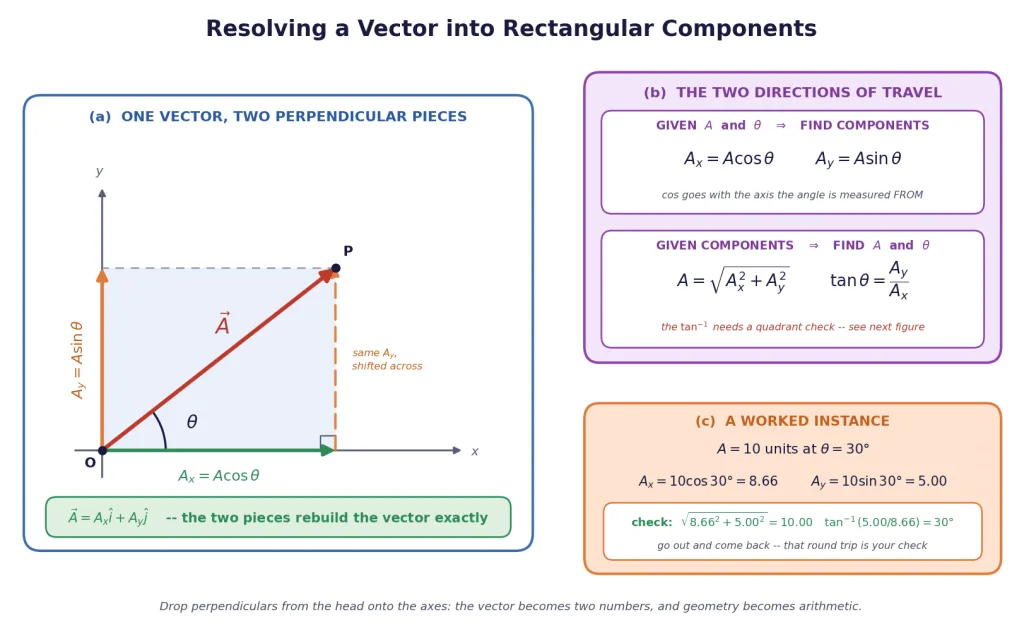
[Board Important] The wording here matters and examiners follow it closely: is not a vector, but is. The number is called the component; the arrow is called the component vector. Say and you have said something perfectly sensible — a component is allowed to be negative. Say "the magnitude is " and you have said something impossible.
Going backwards: from components to magnitude and direction
The forward direction is trigonometry. The reverse direction is Pythagoras.
Key Point:
So a vector in a plane can be specified in exactly two equivalent ways, and you must be fluent in translating between them:
| Specification | Data | Convert with |
|---|---|---|
| Polar form | magnitude and angle | , |
| Component form | the pair , | , |
The angles you should be able to write down instantly
[NEET Important] The and rows are not exact — the exact angles are and — but they come from the 3-4-5 triangle and problem setters use them constantly precisely because they give clean answers. Recognising "3-4-5" on sight saves fifteen seconds every time.
The one trap in
The formula is not a law of nature that says " gets the cosine". It says something better:
Key Point: The cosine goes with the axis you measured the angle FROM; the sine goes with the other one.
Measure the angle from the -axis and . Measure the very same vector's angle from the -axis — call it , with — and now while . Both descriptions are right, and they agree, because .
This matters far more than it looks. A projectile launched at " above the horizontal" and a projectile launched at " to the vertical" are two completely different problems, and thousands of marks a year are lost by students who reach for cosine on autopilot. Draw the angle before you write the formula.
The Quadrant Trap: Why Alone Is Not an Answer
Here is a question that has cost more marks than almost anything else in this chapter.
A vector has components and . Find its direction.
You do the obvious thing: , so . And that is wrong. A vector with a negative -component and a positive -component points up and to the left — it is in the second quadrant, somewhere between and . It cannot possibly be at , which points down and to the right.
The calculator is not broken. It is doing exactly what it is designed to do, and the design has a limitation you have to know about.
Key Point: The key on a calculator always returns an angle in the range to — the first and fourth quadrants only. It sees only the ratio , and one ratio corresponds to two opposite directions, apart. It cannot tell them apart, so you must.
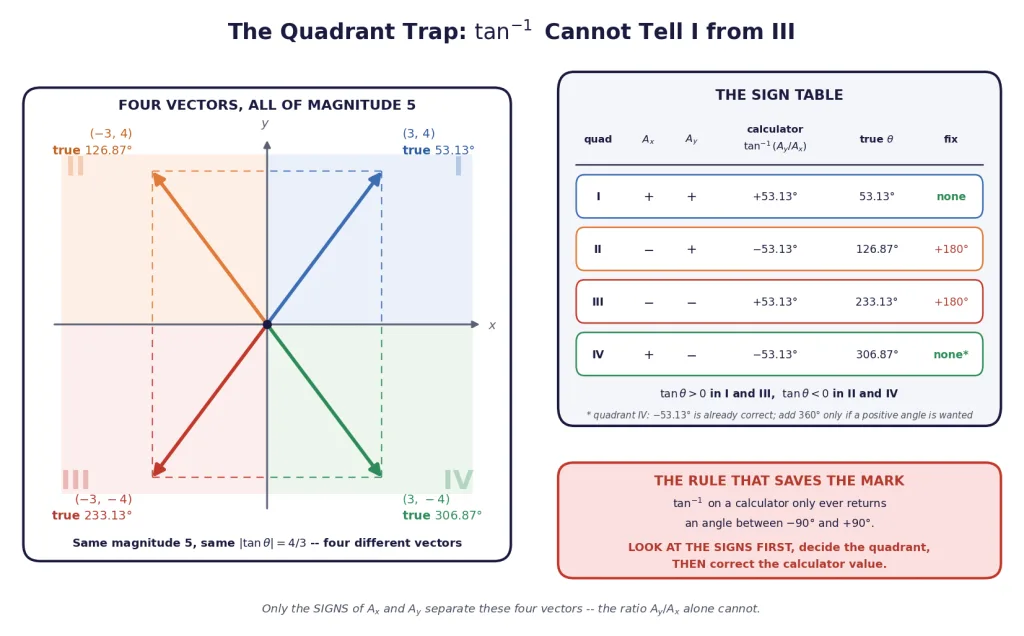
The sign table — learn this, it is free marks
| Quadrant | True lies in | Calculator gives | Your fix | ||
|---|---|---|---|---|---|
| First | to | the correct angle | none | ||
| Second | to | a negative angle | add | ||
| Third | to | a positive angle | add | ||
| Fourth | to | the correct negative angle | none (or add ) |
The pattern is easy to remember once you see where it comes from: whenever is negative, add . That is the whole rule. A negative -component means the vector points into the left half-plane, and the calculator has quietly given you the arrow pointing the opposite way.
The same drill on all four quadrants
Take the four vectors in the figure. Every one has magnitude and every one has , so a calculator gives for all four. Only the signs separate them:
| Components | Quadrant | Calculator | True direction |
|---|---|---|---|
| First | |||
| Second | |||
| Third | |||
| Fourth | , i.e. |
[JEE/NEET] In multiple-choice papers this is a favourite distractor: the "wrong" option is exactly the calculator value, sitting there waiting for anyone who did not check the signs. Before you press , write down the two signs and say out loud which quadrant you are in.
The habit that never fails
There is a cleaner way to think about it that works every single time, without memorising a table:
- Compute the acute reference angle from magnitudes only: .
- Sketch the vector using the signs — a five-second sketch, no scale needed.
- Read the true angle off the sketch: first quadrant ; second ; third ; fourth .
[Board Important] In board answers you are usually allowed — often preferred — to describe the direction in words rather than as an angle from the -axis: " units directed north of west" is completely unambiguous and cannot be marked wrong for a quadrant error. Use that phrasing whenever the problem is set in compass directions.
One last reassurance: components carry signs, magnitudes never do. is fine. is not, ever.
Stepping Out of the Plane: Three Dimensions and Direction Cosines
Everything so far has lived in a plane, because that is what this chapter is about. But the machinery does not care how many axes you have, and JEE does ask, so here is the extension in one short block.
Resolve along all three axes and you get three components instead of two:
Key Point:
The magnitude formula is just Pythagoras applied twice — once in the - plane to get , and once more with perpendicular to that.
A position vector in space is written the same way:
Direction cosines
In a plane, one angle fixes a direction. In space you need more, and the tidiest way to give it is with the angles , and that makes with the , and axes.
Key Point: The three quantities , , are called the direction cosines of .
Notice that all three use a cosine. That is the same rule as before — each angle is measured from the axis whose component you are computing, so each axis gets the cosine.
Substituting into and dividing through by gives an identity that examiners love:
Key Point: Equivalently, in terms of the angles themselves, .
[JEE Tip] This identity is a ready-made filter. If a question offers you three direction cosines and asks whether they are possible, square them and add: unless you get exactly 1, no such direction exists. And if two are given, the third follows immediately up to a sign.
The direction cosines are also just the components of the unit vector along , since and a unit vector must have magnitude 1 — which is the identity above, wearing different clothes.
One subtlety most students skip: , and are angles in space, between pairs of lines that are generally not coplanar. They are not three angles you can draw in one flat picture and add up.
The Analytical Method: Add Components, Never Magnitudes
Now we cash in. This is the payoff for all the resolving.
Take two vectors in the - plane, already written in component form:
Their sum is
Vector addition is commutative and associative (Section 2 established both), so we are free to shuffle and regroup the four pieces, collecting the terms together and the terms together:
Comparing with gives the result the whole section has been driving at.
Key Point — the analytical method: Each component of the resultant is the sum of the corresponding components of the vectors being added. No drawing, no protractor — just ordinary arithmetic, done twice.
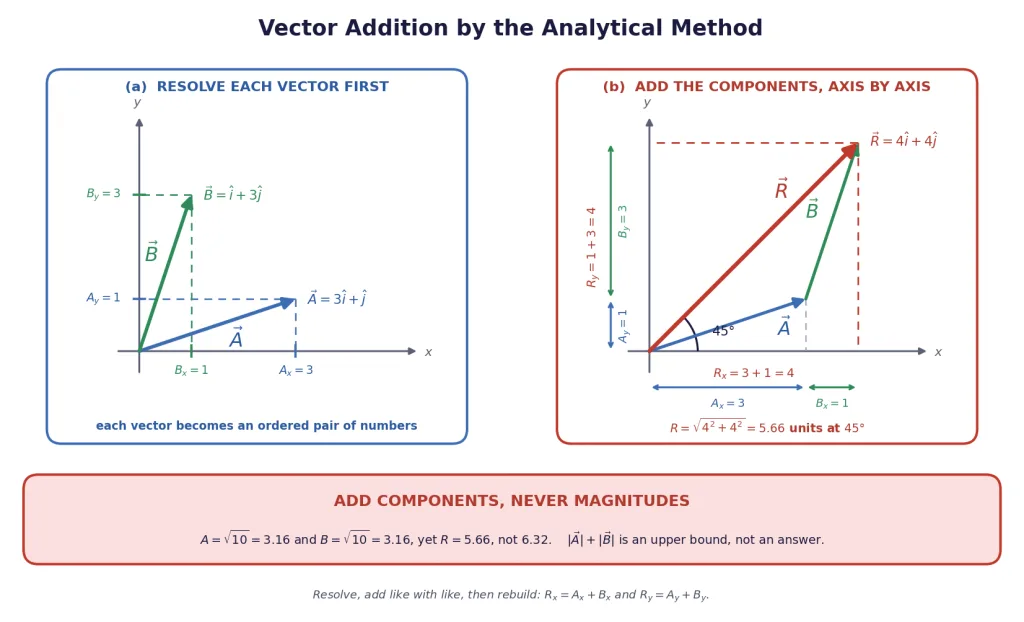
Why this is legal, in one sentence
Because and are perpendicular, motion along can never contribute anything along . The two axes are watertight compartments. That is exactly why we chose perpendicular directions back in the first block, and it is the same idea that will later let us treat a projectile as two independent one-dimensional motions.
The rule to shout at yourself
Key Point: Add components, never magnitudes. is almost never — that happens only when the two vectors are parallel.
In the figure, and each have magnitude . Add the magnitudes and you would predict 6.32. The true resultant is , of magnitude . Section 2's bound was telling you this all along: , and the gap is the price of the vectors not being parallel.
More than two vectors, and subtraction
Nothing changes. Add a third vector and you get a third term in each bracket; the components just keep piling up.
Key Point — for any number of vectors: and in three dimensions the same again with
Subtraction is just addition with a minus sign in front of the components: for ,
This is the moment the polygon law becomes obsolete for calculation. Five vectors, ten vectors, any number — the work grows by one line of addition per vector, not by one more careful drawing.
The four-step recipe
Use this every single time, in this order:
- Choose axes and draw a rough sketch. Take east as and north as unless the problem suggests something better. The sketch is for signs, not for measurement.
- Resolve every vector into and , being careful about which axis the angle was measured from, and attach the correct signs from the sketch.
- Add all the -components; add all the -components. Keep the two columns physically separate on the page — mixing them is the single most common slip.
- Rebuild: and , then fix the quadrant using the signs of and .
[JEE Tip] Step 3 is where a table beats prose. Rule two columns headed and , write one row per vector, and sum each column. It takes ten seconds longer and eliminates the whole family of "lost a sign" errors.
A quick sanity check before you move on: whatever you get for must satisfy Section 2's bounds. If you have added a 5 and a 3 and produced 9.4, something is wrong — no arrangement of those two can beat 8.
The Resultant of Two Vectors at an Angle
Section 2 could tell you that the resultant of two vectors lies between and , and it could tell you the answer exactly when the vectors were parallel, antiparallel, perpendicular or equal in magnitude. What it could not do was give you the general answer. Components can. This derivation is a standard one, and it is examinable in its own right.
Setting it up
Let and have magnitudes and with an angle between them. We are free to choose our axes, so choose them to make life easy: put the -axis along . Then
Now just add the components:
The magnitude
The last two terms collapse, since :
Key Point — the law of cosines for vectors: where is the angle between and when they are drawn from a common tail.
The direction
The resultant makes an angle with , and since we put the -axis along , that angle is just the direction of in our chosen frame:
Key Point: is measured from , towards . The angle from is then .
The same two results can be reached by pure geometry, dropping a perpendicular SN from the tip of the resultant onto the line of — and it is worth seeing that the two routes give identical formulas, because and are precisely our and . The component method just gets there without any construction.
The same figure also gives the sine rule for the triangle, which is occasionally quicker:
Does it agree with Section 2? Check the corners
A formula you cannot check is a formula you will misremember. Feed the special cases in:
| becomes | Section 2 said | ||
|---|---|---|---|
| the maximum | |||
| between the bounds | |||
| the Pythagoras case | |||
| between the bounds | |||
| the minimum |
Every row matches. The directions check out too: at , , so the resultant lies along — of course it does, the vectors are parallel. At , , the familiar right-triangle answer.
And the equal-magnitude shortcut from Section 2 falls straight out. Put : using . One formula, and Section 2's whole table is contained in it.
Subtraction
is , and reversing turns the angle between them from into . Since , the middle sign simply flips:
Key Point: Same — still the angle between the original and — just a minus sign.
Two formulas, one character apart. Read the question twice before you choose. A useful memory hook: the plus sign goes with the sum, and a plus sign makes things bigger; the minus goes with the difference.
[JEE/NEET] Combining the two gives a favourite identity: The cross terms cancel. This is the parallelogram law of geometry — the sum of the squares of the diagonals equals the sum of the squares of the four sides — and it turns several nasty-looking problems into one line.
Mistake checklist
| Mistake | Fix |
|---|---|
| Using the angle one vector makes with the horizontal as | is the angle between the two vectors, tails together |
| Writing | Only when |
| Quoting straight off the calculator | Check the signs of , and fix the quadrant |
| when the angle was given from the -axis | Cosine belongs to the axis the angle was measured from |
| Calling a vector | is a scalar; is the component vector |
| Writing a negative magnitude | Components may be negative; magnitudes never |
| Attaching a unit to | Unit vectors are dimensionless |
| Forgetting is measured from | Swap and in the formula if you want the angle from |
| Adding a 5 and a 3 to get 9 | Check against the bound |
Where this goes next
You now have a complete algebra of vectors: scale them, add them, subtract them, resolve them, and get exact numbers out at the end. Section 4 stops treating vectors as static arrows and lets them change with time — position, velocity and acceleration become vectors, and the fact that and components add independently becomes the fact that and motions run independently. That single idea is the whole of projectile motion.
Solved Examples
Example 1: Resolving a force
A force of 50 N acts at above the horizontal. (a) Find its horizontal and vertical components. (b) Write the force in , notation. (c) Verify your components by rebuilding the magnitude and direction.
Solution:
- (a) Take horizontal and vertical, with measured from the -axis:
- (b)
- (c) Rebuild the magnitude: Rebuild the direction: , so . Both components are positive, so we are in the first quadrant and no correction is needed.
Final Answer: (a) 43.3 N horizontal, 25.0 N vertical; (b) N.
Takeaway: Always do part (c). Squaring and adding the components must give back the original magnitude — it is a ten-second check that catches a swapped sine and cosine every time.
Example 2: From components back to magnitude and direction
A displacement vector is metres. Find (a) its magnitude, (b) its direction, (c) the unit vector along it, and (d) the vector of magnitude 26 m pointing the same way.
Solution:
- (a) Note the square kills the minus sign — the magnitude is , never .
- (b) , and the calculator returns Check the signs: and , so the vector points right and down — the fourth quadrant, where angles run from to . The calculator's negative answer is already a fourth-quadrant direction, so it is correct as it stands; expressed as a positive angle it is .
- (c) Check: , and it carries no unit — the metres cancelled.
- (d) Multiply the unit vector by the required magnitude: Check: m
Final Answer: (a) 13 m; (b) below the axis, i.e. ; (c) ; (d) m.
Takeaway: is a Pythagorean triple worth knowing alongside . And note how part (d) works: magnitude times unit vector rebuilds any vector you like along a known direction.
Example 3: The four-quadrant drill
Four vectors have components , , and . For each, find the magnitude and the true direction measured anticlockwise from the axis.
Solution:
- Magnitudes. Every one of them squares to the same thing: All four have magnitude 5. The signs vanish under the square.
- Reference angle. Using magnitudes only, This same reference angle serves all four.
- Now place each one by its signs:
| Components | Quadrant | True direction |
|---|---|---|
| First (, ) | ||
| Second (, ) | ||
| Third (, ) | ||
| Fourth (, ) |
- A calculator fed directly would have returned for both the first and the third rows, and for both the second and the fourth. Two pairs, indistinguishable by ratio alone.
Final Answer: All four have magnitude 5 units; directions , , and .
Takeaway: One value of always corresponds to two directions apart. The signs of the components — not the ratio — are what pick the right one.
Example 4: Resolving along two non-perpendicular directions
Express the vector in the form , where and . (a) Find and . (b) Verify your answer. (c) What are the components of the same along and , and what does the comparison tell you?
Solution:
- (a) Write out the requirement and compare coefficients: Because and are independent directions, the coefficients must match separately: Adding: , so . Subtracting: , so .
- (b) Check by substitution:
- (c) Along and the components are simply and . So the same vector is described by the pair on one base pair and by on another. Neither is more correct than the other. The vector's own magnitude is unaffected:
- Note also that and here happen to be perpendicular to each other (at and ), but they are not unit vectors — each has magnitude — which is exactly why the numbers 4 and 2 are not the same as 6 and 2.
Final Answer: (a) , ; (c) , — same vector, different numbers.
Takeaway: "Comparing coefficients" works because a resolution along a fixed pair of non-parallel directions is unique. Change the pair and the numbers change; the arrow does not.
Example 5: Three forces, one resultant
Three forces act at a point: 10 N along the direction, 20 N at to the direction, and 15 N along the direction. Find the magnitude and direction of the resultant.
Solution:
- Resolve each force. Set out a two-column table — this is the habit that prevents lost signs.
| Force | -component (N) | -component (N) |
|---|---|---|
| 10 N at | ||
| 20 N at | ||
| 15 N at | ||
| Sum |
- Magnitude:
- Direction: , so . Both and are positive, so we are in the first quadrant and the calculator value stands.
- Sanity check: the three magnitudes are 10, 20 and 15, so the largest conceivable resultant is 45 N and 18.03 N sits comfortably below it.
Final Answer: N at from the direction.
Takeaway: Notice that the 15 N force did not need any special treatment — pointing it along was handled automatically by . Let the trigonometry supply the signs; do not add them by hand as well, or you will apply them twice.
Example 6: The general resultant of two vectors at an angle
Find the magnitude and direction of the resultant of two vectors and in terms of their magnitudes and the angle between them. Then apply your result to units, units, .
Solution:
- Choose convenient axes. The answer cannot depend on our choice, so take the -axis along . Then
- Add components:
- Magnitude:
- Direction. With the -axis along , the angle of the resultant from is
- Apply the numbers. With , , (, ):
- Check against the bounds. and , and indeed . Check the direction too: is less than , so the resultant lies between the two vectors and closer to the longer one, exactly as it must.
Final Answer: at from ; for the numbers given, units at from .
Takeaway: The trick that makes this derivation short is choosing the -axis along . You are always allowed to do that, and it kills half the algebra before it starts.
Example 7: The motorboat and the current
A motorboat is racing towards north at 25 km/h and the water current in that region is 10 km/h in the direction east of south. Find the resultant velocity of the boat.
Solution:
- Set up axes. Take = east and = north.
- Resolve the boat's velocity. It points due north, so
- Resolve the current. " east of south" means: start pointing south, then swing towards east. Its southward part uses the cosine of (measured from south) and its eastward part the sine:
- Add components:
- Magnitude:
- Direction. Both components are positive, so the resultant points into the north-east quadrant. Measuring from north (the natural reference for a navigation problem): so the boat actually travels at about east of north. Measured anticlockwise from east instead, that is .
- Cross-check with the formula of Example 6. The angle between (due north) and ( east of south) is :
Final Answer: About 22 km/h, directed east of north.
Takeaway: The boat is pointed due north but travels east of north — the current takes it sideways. Resolving compass directions is the whole difficulty here: read " east of south" as "from south, turn towards east", and let the sketch tell you that the north component must come out negative.
Example 8: Working backwards to the angle
The resultant of two forces of 10 N and 6 N has magnitude 14 N. (a) Find the angle between the two forces. (b) Find the angle the resultant makes with the 10 N force. (c) Check that 14 N is a possible resultant at all.
Solution:
- (c) first — always check feasibility. By Section 2's bounds the resultant must lie between N and N. Since , the value is possible and a solution exists.
- (a) Put the numbers into :
- (b) With (the reference vector), and :
- Verify by going forward. With : N
Final Answer: (a) ; (b) from the 10 N force; (c) yes, since .
Takeaway: When a question gives you the resultant and asks for the angle, the cosine formula is just a linear equation in . And check the bounds first — if the given resultant lay outside them, the correct answer would be "no such angle exists".
Example 9: When the resultant is perpendicular to one of the vectors
Two vectors and have magnitudes 5 units and 10 units. Their resultant is perpendicular to . Find (a) the angle between and and (b) the magnitude of the resultant.
Solution:
- Set up. Put the -axis along , so and . Then
- (a) Impose the condition. " perpendicular to " means has no component along , i.e. : The general condition is worth remembering: .
- (b) The resultant is then purely the -part: which is . Cross-check with the cosine formula:
- Note : the resultant is shorter than the longer vector, which is perfectly normal at an obtuse angle.
Final Answer: (a) ; (b) 8.66 units.
Takeaway: "Perpendicular to " translates instantly into "" once you have put the -axis along . Two standard results fall out: , and . Note that this needs — you cannot cancel a long vector's contribution with a short one.
Example 10: Change in velocity — the subtraction formula
A particle's speed stays at 30 m/s along one direction, then becomes 40 m/s along a direction making with the first. Find (a) the magnitude of the change in velocity and (b) the magnitude of for comparison. (c) Verify the parallelogram identity.
Solution:
- (a) The change in velocity is a difference of vectors, so use the minus form with , the angle between the two velocities:
- (b) The sum uses the plus sign:
- (c) The parallelogram identity says the two squares should add to twice the sum of the squares of the sides:
- Component cross-check for (a). With and :
Final Answer: (a) 36.06 m/s; (b) 60.83 m/s; (c) both sides equal 5000.
Takeaway: The change in a vector quantity is , final minus initial — get that order backwards and the direction of your answer reverses. Note the speed only rose from 30 to 40 m/s, a change of 10, yet the velocity changed by 36.06 m/s, because the direction changed too.
Example 11: The block on an incline
A block of weight 100 N rests on a frictionless incline that makes with the horizontal. Resolve the weight into components (a) parallel to the incline surface and (b) perpendicular to it. (c) Why is this resolution more useful than the horizontal-vertical one?
Solution:
- Choose smart axes. Nothing forces you to use horizontal and vertical. Take the -axis down the slope and the -axis perpendicular to the slope. This is exactly the freedom the first block of this section established.
- Find the angle. The weight points vertically down. The perpendicular to the incline is tilted from the vertical by the same as the incline is from the horizontal (their arms are mutually perpendicular). So the weight makes an angle of with the perpendicular direction.
- (b) The angle is measured from the perpendicular axis, so that axis gets the cosine:
- (a) The along-the-slope component gets the sine:
- Check: N
- (c) Because in these axes the physics separates cleanly. The normal reaction from the surface is entirely along and balances , so the block does not sink into the incline. Nothing balances , so that component alone drives the block down the slope. In horizontal-vertical axes, both the weight and the normal force would have two components each and nothing would cancel neatly.
Final Answer: (a) 50.0 N down the slope; (b) 86.6 N into the slope.
Takeaway: Choose your axes to suit the problem, not the page. Tilting the axes to line up with the incline is not a trick — it is the general resolution theorem being used exactly as intended, and it is the standard opening move for every inclined-plane question you will meet in Class 11 and 12.
Example 12: A vector in three dimensions
For , find (a) its magnitude, (b) the unit vector along it, (c) its direction cosines and the angles , , , and (d) verify that .
Solution:
- (a)
- (b)
- (c) The direction cosines are the components of :
- (d) This is no accident — the numerator is and the denominator is , so it is 1 for every vector.
- Notice , which is not and has no reason to be. These are angles in space between non-coplanar lines; they do not add to anything memorable.
Final Answer: (a) 7 units; (b) ; (c) , , giving , , ; (d) the sum is exactly 1.
Takeaway: is the 3D cousin of the 3-4-5 triangle and appears constantly in JEE problems. The identity is really just the statement that has magnitude 1 — and it gives you the third angle free whenever two are known.