
How to Use This Section
This is the last section of the chapter, and it is built for one job: to be read the night before the paper, and again in the queue outside the hall.
Nothing new is taught here. Every card below is a compression of something Sections 1 to 12 worked through properly, in the same notation and with the same worked numbers. So if a line here surprises you, that is not a line to memorise — it is a signal to go back and reread the section that owns it.
Six formula cards, one mistake checklist, one 60-second panic list. Screenshot the three figures.
Unless a card says otherwise, everything below uses m/s^2, because that is what makes the arithmetic land on clean numbers — Board-level worked examples mostly use 9.8 m/s^2, and the difference is about 2%.
Card 1 — The Vector Toolkit
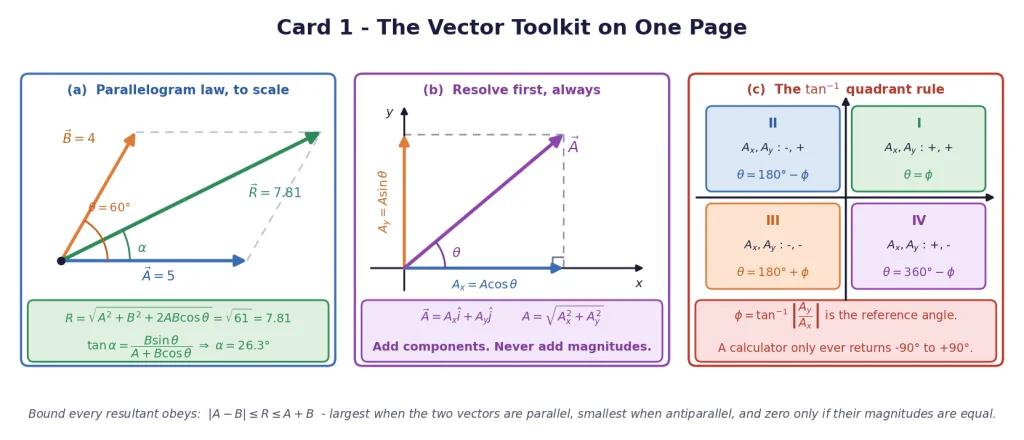
Scalar or vector? The three-part test
Key Point: A scalar is specified completely by a number with a unit. A vector needs a magnitude, a direction, and it must obey the triangle law of vector addition. All three conditions, not just the first two.
| Examples | |
|---|---|
| Scalars | distance, speed, mass, time, temperature, work, energy, pressure, density |
| Vectors | displacement, velocity, acceleration, force, momentum, angular velocity |
| The trap cases | electric current and pressure have a magnitude and a direction and are still scalars, because they do not add by the triangle law. Finite rotation is not a vector either, because two finite rotations give a different result if you swap their order |
Notation: for the vector, or for its magnitude, which is never negative. A unit vector has magnitude 1 and carries direction only. The null vector has zero magnitude and an indeterminate direction.
The three graphical laws
- Triangle law. Draw from the head of . The resultant runs from the tail of to the head of .
- Parallelogram law. Draw both from a common point, complete the parallelogram; the resultant is the diagonal through that common point. The other diagonal is .
- Polygon law. For several vectors, chain them head to tail; the closing side taken in the reverse sense is the resultant. If the polygon closes on its own, the resultant is .
Addition is commutative, , and associative, . Subtraction is addition in disguise: .
Multiplication by a real number
Multiplying by a real number gives , of magnitude . If the direction is unchanged; if it is reversed; if you get the null vector. If carries units, the product is a different physical quantity — turns an acceleration into a force.
The resultant of two vectors
Key Point: For and at an angle measured between them when drawn from a common point: where is the angle the resultant makes with .
The worked case on the figure: , , gives and , so .
Three special cases fall straight out: gives ; gives ; gives .
The bound every resultant obeys
Key Point: Largest when the two vectors are parallel, smallest when antiparallel, and every value in between is reached at exactly one angle. The resultant can be zero only if .
This one line answers every "which value is impossible" question in about eight seconds. With magnitudes 6 and 10, the resultant is confined to .
Components, and the quadrant rule
Key Point: For a vector at angle to the x-axis: The component along the line the angle is measured from takes the cosine; the perpendicular one takes the sine.
And then the analytical method, which is the only reliable way to add vectors: resolve everything, add the components, reassemble. , , then . Never add magnitudes.
Key Point (the quadrant rule): A calculator's only ever returns an angle between and , so it cannot tell a first-quadrant vector from a third-quadrant one. Find the reference angle from the magnitudes, then fix the quadrant by the signs.
| Signs of | Quadrant | Direction from the axis |
|---|---|---|
| I | ||
| II | ||
| III | ||
| IV |
All four of , , and have , and they point at , , and respectively. A two-second sketch settles the quadrant with no thought at all.
Card 2 — Motion in a Plane
Once direction can no longer be carried by a plus or a minus sign, every kinematic quantity becomes a vector. Nothing about the definitions changes; they simply grow arrows.
The four definitions
Key Point:
Two facts that get asked on their own, over and over:
- The instantaneous velocity is always tangent to the path. As shrinks, the chord pivots until it lies along the tangent. That is why a stone released from a whirling string flies off along the tangent, not along the radius.
- The average velocity points along the chord, from the start point to the end point — not along the path, and generally not along the tangent anywhere.
Speed is ; average speed is (path length)/(time), which is not the magnitude of the average velocity unless the motion is in a straight line without reversal.
The angle between and , which decides everything
Key Point: In a plane, need not be along — and the angle between them is the whole story.
| Angle between and | What happens | Example |
|---|---|---|
| straight line, speeding up | free fall from rest | |
| straight line, slowing down | a ball thrown straight up | |
| speed constant, direction turning | uniform circular motion | |
| between and | curved path, speeding up | a projectile after the apex |
| between and | curved path, slowing down | a projectile before the apex |
The fast test: the sign of tells you about the speed — positive means speeding up, negative means slowing down, zero means the speed is momentarily unchanging. Whether is parallel to tells you about the path — parallel or antiparallel means straight, anything else means curved.
Constant acceleration, in vector form
Key Point: If is constant in both magnitude and direction: and the average velocity is , valid only for constant .
The one idea the whole chapter rests on
Key Point (independence of x and y): Each vector equation above splits into two independent scalar equations: The x-motion and the y-motion do not talk to each other. The only thing they share is the clock .
Plane motion is therefore just two one-dimensional motions running side by side, and every technique from Chapter 2 transfers unchanged to each column. Change as much as you like and does not move a millimetre. Set and and you have projectile motion, which is Card 3.
[Board Important] Write the two columns out explicitly in your answer. Examiners award marks for the split itself, and it is also the single best defence against mixing an quantity into a equation.
Card 3 — The Complete Projectile Formula Sheet
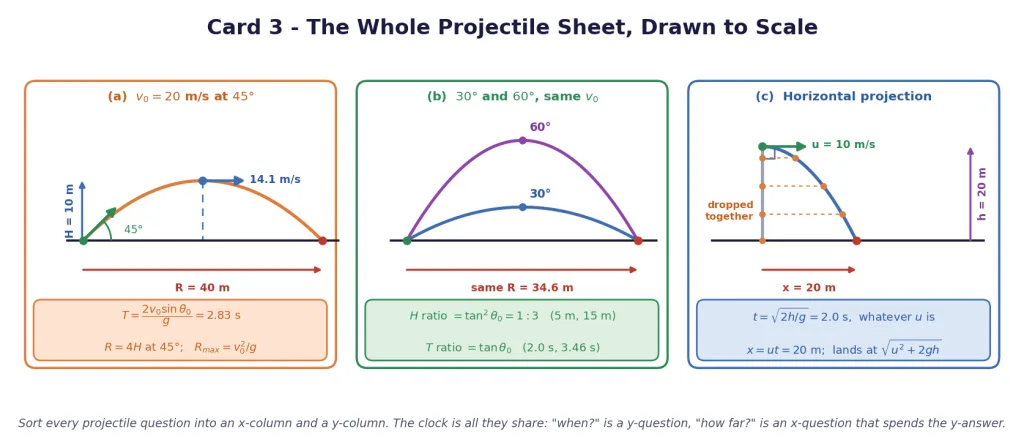
Launch from level ground with speed at angle above the horizontal, origin at the launch point, upward. Then and , and everything below follows from Card 2's two columns.
The four starting equations — learn these, rebuild the rest
Given ninety seconds and these four lines you can derive every result in the table below, which is exactly what to do if a formula deserts you in the hall.
The trajectory
Key Point: Eliminating gives a downward-opening parabola. Written as , the range is and the maximum height is , with .
The results table
| Quantity | Formula | Worth noticing |
|---|---|---|
| Time to the top | exactly half the flight | |
| Time of flight | up-time equals down-time | |
| Maximum height | ||
| Horizontal range | ||
| Maximum range | at | and then |
| Range from height | recovers from a measured and | |
| Speed at the top | never zero | |
| Speed at height | same speed going up and coming down | |
| Acceleration anywhere | vertically downward | including at the very top |
The worked case on the figure: m/s at with m/s^2 gives s, m, m and a speed at the apex of 14.1 m/s. Note , as it must be at .
Complementary angles — and what they do NOT share
Key Point: and launched at the same speed give equal ranges. That is all they share.
| Quantity | Ratio for against |
|---|---|
| Range | — equal |
| Time of flight | |
| Maximum height |
At 20 m/s the and shots both carry 34.6 m, but the heights are 5 m against 15 m (ratio ) and the flight times 2.0 s against 3.46 s (ratio ). "Complementary means the same range" is true; "complementary means the same everything" costs marks every year.
The symmetry, and horizontal projection
The parabola is symmetric about the vertical through its apex, so the apex sits at , the time up equals the time down, and the projectile passes any given height with equal speeds on the way up and on the way down — returning to the launch level at exactly , at below the horizontal.
Key Point (horizontal projection from a height ): With , The fall time does not contain . A ball rolled off a table at 2 m/s and one at 20 m/s hit the floor at the same instant, and both at the same instant as one simply dropped.
Worked case on the figure: m with m/s gives s, m and a landing speed of 22.4 m/s. And that is the landing speed for any launch angle from that height — up, down or horizontal.
Card 4 — Uniform Circular Motion
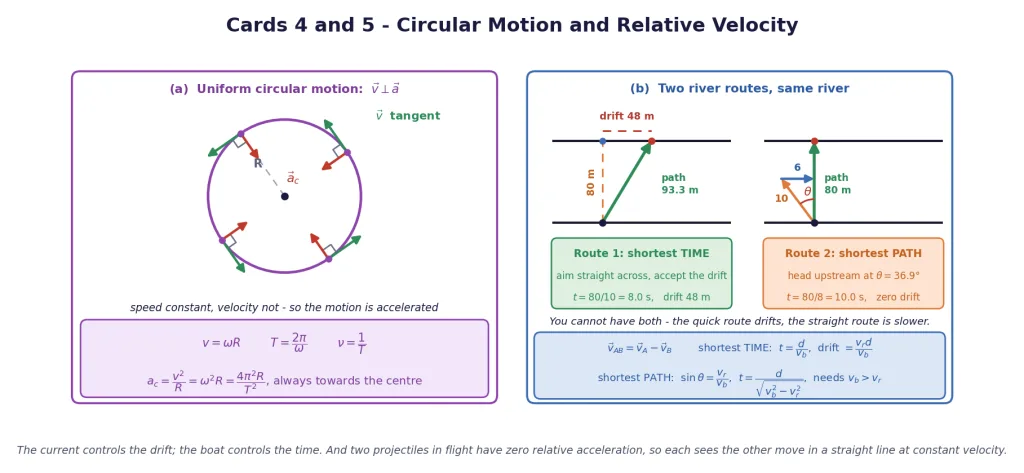
A particle goes round a circle of radius at constant speed . Its speed never changes, its velocity changes every instant, and that is the whole point of the topic.
The relations
Key Point: and the acceleration directed towards the centre at every instant. Hence the name: centripetal means centre-seeking.
is in radians and in rad/s, always. Convert before you substitute: revolutions per minute is rad/s, so 60 rpm is rad/s, 120 rpm is rad/s and 300 rpm is rad/s.
Worked case: m at m/s gives rad/s, s, Hz and m/s^2.
What is constant and what is not
| Quantity | Constant? | Why |
|---|---|---|
| Speed | yes | that is what "uniform" means |
| Velocity | no | its direction turns continuously |
| Magnitude of the acceleration | yes | and are both fixed |
| Acceleration vector | no | it always points at the centre, so it rotates too |
| Angular speed , period | yes | properties of the rotation itself |
Key Point: is along the tangent and is along the radius, inward, so at every instant of uniform circular motion. That perpendicularity is exactly why the speed stays constant while the direction keeps changing — an acceleration at right angles to the velocity can only turn it, never lengthen it.
Two consequences that get asked directly: over one complete revolution the displacement is zero, so the average velocity is zero while the average speed is ; and the average acceleration over a complete revolution is zero, while is non-zero at every instant.
The non-uniform extension
Let the speed change as well. Then the acceleration has two perpendicular pieces:
Key Point: Uniform circular motion is simply the case . With and m/s^2 the total is 5 m/s^2, tilted away from the radius.
[NEET Important] For NEET, uniform circular motion is the whole story — , towards the centre, , and the rpm conversion. The non-uniform paragraph and Card 6 are JEE territory.
Card 5 — Relative Velocity in Two Dimensions
This topic sits outside the rationalised syllabus — the body text was cut, and only a passing mention survives — yet the rain-and-umbrella problem is a standard worked example, the exercises need it, and JEE Main and NEET ask it every year. Section 7 teaches it properly; here is all of it compressed.
The definition
Key Point: If A and B have velocities and measured in the same frame (normally the ground), then Read the subscripts in order: the first is the object described, the second is the observer. So and are equal in magnitude and exactly opposite in direction.
The same subtraction runs through position and acceleration: and .
The method, every time, without exception: fix axes, write every velocity in components in the same frame, subtract componentwise, then convert back to magnitude and direction with the quadrant check from Card 1. Your intuition about "add the speeds" or "subtract the speeds" does not survive two dimensions.
The commonest error in the whole topic is mixing frames. A boat's speed "in still water" is relative to the water; a swimmer's speed is relative to the water; an aircraft's airspeed is relative to the air. None of those are ground velocities until you add the carrier's velocity.
Rain and the umbrella
Key Point: Hold the umbrella along , not along . For vertical rain of speed and a man walking at :
Rain at 6 m/s with a cyclist at 8 m/s: the apparent speed is 10 m/s and the tilt is forward. Walk faster and the rain seems to come at you more horizontally, and to fall faster than it really does. Two more standard readings: if the rain appears vertical to a moving observer, its true horizontal component equals that observer's velocity; and rain appearing vertical does not mean it is falling vertically.
Crossing a river — the table to burn into memory
A river of width flows at ; the boat does in still water. Same river, same boat, two completely different answers.
| Route 1: shortest TIME | Route 2: shortest PATH | |
|---|---|---|
| Aim the boat | perpendicular to the bank | upstream at , with |
| Across-component | ||
| Crossing time | (the minimum) | (longer) |
| Drift downstream | zero | |
| Speed over the ground | ||
| Path length | (the minimum) | |
| Always possible? | yes | only if |
The worked case on the Card 4 figure: m, m/s, m/s. Route 1 takes 8.0 s, drifts 48 m and covers a slanted path of 93.3 m. Route 2 needs a heading of upstream, crosses at 8 m/s, takes 10.0 s and covers exactly 80 m.
Key Point: PLUS for the quick one, MINUS for the straight one. And the crossing time of Route 1 contains no at all — the current controls the drift, the boat controls the time. You cannot have both routes at once, so read which one the question wants: "heads straight across" is Route 1, "lands directly opposite" is Route 2.
Two projectiles at once
Key Point: Both projectiles have , so Relative to either one, the other moves in a straight line at constant velocity. Gravity leaves the problem entirely and no term ever appears in the relative motion.
That single line collapses a whole family of horrible-looking questions into one division. Two bodies collide in mid-air if the relative velocity points from one straight at the other, and the time is then the initial separation divided by the relative speed. It is also the reason a projectile aimed directly at a target that starts falling at the same instant always hits it, whatever the launch speed.
Card 6 — The JEE Extension
Everything up to Card 5 is Board and NEET material in full. This card is Section 9 in one page, and NEET candidates can skip it without losing a single mark — none of it is on the NEET syllabus for this chapter.
The two products
Key Point:
The dot product does four jobs: the angle between two vectors, ; the perpendicularity test, ; the component of one vector along another, ; and the "is it speeding up" test of Card 2. It is commutative. The cross product gives a vector perpendicular to both, by the right-hand rule, of magnitude equal to the area of the parallelogram they span — so the triangle area is . It is anti-commutative, , and it vanishes for parallel vectors.
Projectile on an inclined plane
Tilt the axes: along the slope, perpendicular to it. Then the flight starts and ends at exactly as on flat ground, with replaced by . With the plane at and the launch at measured from the slope:
is the same whether you fire up the slope or down it. The range up the slope is maximum at , and down the slope at . Read whether the given angle is measured from the slope or from the horizontal — that single reading decides the whole answer.
Moving platforms, curvature and angular kinematics
Launched from something already moving? Add the platform's velocity to the launch velocity before doing any projectile work, then proceed normally. The ball inherits the carrier's velocity, never its acceleration.
Key Point (radius of curvature): where is the component of the acceleration perpendicular to the velocity. Only that part bends the path; the parallel part merely changes the speed. For a projectile, where is the angle of the velocity to the horizontal — so the curvature is sharpest at the apex, where .
Angular kinematics, for constant angular acceleration , is Chapter 2's algebra symbol for symbol:
with the bridges , and , and . is a genuine vector along the axis (by the right-hand rule) even though a finite rotation is not, because infinitesimal rotations do commute.
Card 7 — The Twelve Mistakes That Cost the Most Marks
Every one of these was flagged somewhere in Sections 1 to 12. They are ordered roughly by how often they actually turn up in answer scripts.
1. Adding magnitudes instead of adding components. unless the two vectors are parallel. Take and : each has magnitude 10, but their sum is , of magnitude 12, not 20. Resolve, add the components, then take the square root. Every single time.
2. Reading off the calculator without the quadrant correction. The calculator returns only to , so it cannot distinguish quadrant I from quadrant III or II from IV — the signs cancel inside the ratio and take the direction information with them. Components give , and the true direction is . Find the reference angle from the magnitudes, then fix the quadrant from the signs (Card 1's table), or just sketch the two components first.
3. Thinking the speed is zero at the top of a projectile's flight. Only the vertical component vanishes there. The speed at the apex is , and it is zero only for a shot fired straight up. For m/s at the apex speed is 14.1 m/s, and the projectile is still travelling horizontally at full pace. Its acceleration at the top is downward, unchanged — a second favourite in the same sentence.
4. Forgetting that the horizontal velocity of a projectile never changes. , so from launch to landing. Nothing pushes a projectile forward and nothing slows it down horizontally. Every question that asks for the velocity at some instant is really asking you to combine this unchanged with the current .
5. Mixing up the two river-crossing routes. "Heads straight across" is Route 1 — minimum time , and you accept a drift of . "Lands directly opposite" is Route 2 — zero drift, heading upstream, and a longer time . Note the sign under the root: PLUS for the quick one, MINUS for the straight one. And Route 2 is impossible unless .
6. Thinking uniform circular motion is unaccelerated. Constant speed is not constant velocity. The direction turns continuously, so the velocity changes continuously, so there is an acceleration — , pointing at the centre, non-zero at every instant. "The speed is constant, therefore " is the most reliably punished sentence in this chapter.
7. Applying the constant-acceleration kinematic equations to circular motion. and require to be constant in both magnitude and direction. On a circle the acceleration vector rotates with the particle, so it is not constant even in uniform circular motion, and those equations are simply wrong there — not approximate. Use , , and the angular equations (and only if is constant).
8. Confusing centripetal acceleration with a force. is an acceleration, measured in m/s^2. It is what some real force — tension, friction, gravity, the normal reaction — produces. Writing "the centripetal force acts in addition to the tension" double-counts, and calling a force loses the mark outright. And there is no outward "centrifugal force" in a ground frame at all.
9. Using and inconsistently within one problem. Pick one value at the very start, write it at the top of your working, and use it everywhere. For m/s at the maximum height is 10.2 m with and 10.0 m with — about 2% apart, which is enough to send you to the wrong option in a multiple-choice paper. Mixing the two inside one question produces answers that do not even agree with each other.
10. Forgetting that a finite rotation is not a vector. It has a magnitude (the angle) and a direction (the axis), and it is still not a vector, because two finite rotations performed in the opposite order leave the body in a different orientation — vector addition must be commutative. Rotate a book about a horizontal axis and then about a vertical one, then repeat in the reverse order, and look at the two results. Infinitesimal rotations do commute, which is exactly why angular velocity is a vector.
11. Assuming complementary angles give equal times of flight. They give equal ranges, and nothing else. The times are in the ratio and the heights in the ratio . At 20 m/s the and shots both land 34.6 m away, but they are in the air for 2.0 s and 3.46 s and reach 5 m and 15 m. Equal range does not mean equal anything else.
12. Measuring an angle from the wrong reference line. From the horizontal, from the incline, from the vertical, from the perpendicular to the bank, from rather than from — the same picture yields four different numbers. On an incline the projectile formulas need measured from the slope; for a river crossing the heading is measured from the perpendicular to the bank, not from the bank; in the angle is measured from . Write down which line you are measuring from before you write the number.
Key Point: Two more that cost single marks each: quoting a bare number with no unit or no direction where a vector answer was asked for, and forgetting to convert rpm to rad/s () before substituting into or .
The 60-Second Revision
You are in the queue outside the hall. This is the irreducible minimum.
Vectors. Magnitude, direction, and the triangle law — current and pressure fail the third, and so does finite rotation. with ; the bound , zero only if . Components , ; . Add components, never magnitudes. Fix the quadrant from the signs.
Plane motion. , always tangent to the path. , need not be along . means speeding up. For constant : and , which split into independent x and y equations sharing only the clock.
Projectiles. , , constant. , , , , at , . Speed at the top is , never zero; acceleration there is still down. Complementary angles: same range, times in , heights in . Horizontal projection: with no in it, , landing speed .
Circular motion. , , , for rpm. , towards the centre, with throughout. Speed constant, velocity not — so the motion is accelerated, and the linear kinematic equations do not apply. Non-uniform: .
Relative velocity. , ; resolve, subtract componentwise, then reassemble. Umbrella along , tilt . River: straight across gives with drift ; zero drift needs and gives , possible only if . Two projectiles have zero relative acceleration.
Habits. Resolve before you think. Write which line every angle is measured from. Sort every projectile into an x-column and a y-column. Pick one value of and keep it.
That is the whole chapter. Go and get the marks.