
What JEE Adds to This Chapter
Sections 1 to 8 stayed inside the Board syllabus, and they covered it properly: vectors, components, the analytical method, projectiles, uniform circular motion, relative velocity. If the Board paper were the only thing on your calendar, you could stop there.
JEE will not let you. Not because the physics changes — it does not, there is no new law anywhere in this section — but because JEE asks the same laws through set-ups the earlier sections never draw. A projectile fired up a hillside. A ball thrown from a moving truck. A particle whose speed on a circle is itself changing. A question that asks not "how far did it go" but "how sharply is it turning right now".
Here is the thing: every one of those is solvable with what you already have, provided you also carry two pieces of vector algebra that the syllabus parks in later chapters. So we take them first.
The two tools we are borrowing early
| Tool | Where it is formally introduced | Why you need it now |
|---|---|---|
| Scalar (dot) product | Chapter 6, Work, Energy and Power | The angle between two vectors, perpendicularity tests, the component of one vector along another |
| Vector (cross) product | Chapter 7, System of Particles and Rotational Motion | Areas, the direction perpendicular to two vectors, and |
Borrowing them is not cheating. Every coaching sheet in the country introduces both in the vectors chapter, and half the JEE Main vector questions are unanswerable without them.
What this section covers, in order
- The scalar product — what it means, and the four things it computes for you.
- The vector product — the determinant, the right-hand rule, the area.
- Projectile motion on an inclined plane, up the slope and down it, with the maximum-range condition. This is the single biggest JEE-only topic in the chapter.
- Projectiles launched from something already moving — trucks, aircraft, trolleys.
- The radius of curvature of a trajectory, from .
- Non-uniform circular motion — tangential and radial acceleration together, plus the angular kinematic equations and as a vector.
- Two projectiles at once, optimisation problems, and the traps that cost the most marks.
Key Point: Nothing here replaces Sections 1 to 8. Every single one of these topics is built by taking a standard result you already own and asking it a harder question. If a step below feels unfamiliar, the fix is almost always to go back to the corresponding basic section, not to memorise a new formula.
[Exam Tip] Throughout this section, is the launch speed and the launch angle. Take m/s^2 unless a question says otherwise, because that is what makes JEE arithmetic land on clean numbers.
The Scalar Product: Two Vectors In, One Number Out
You already know how to add vectors. You have never been told what it would mean to multiply two of them. There are two useful answers, and this is the first.
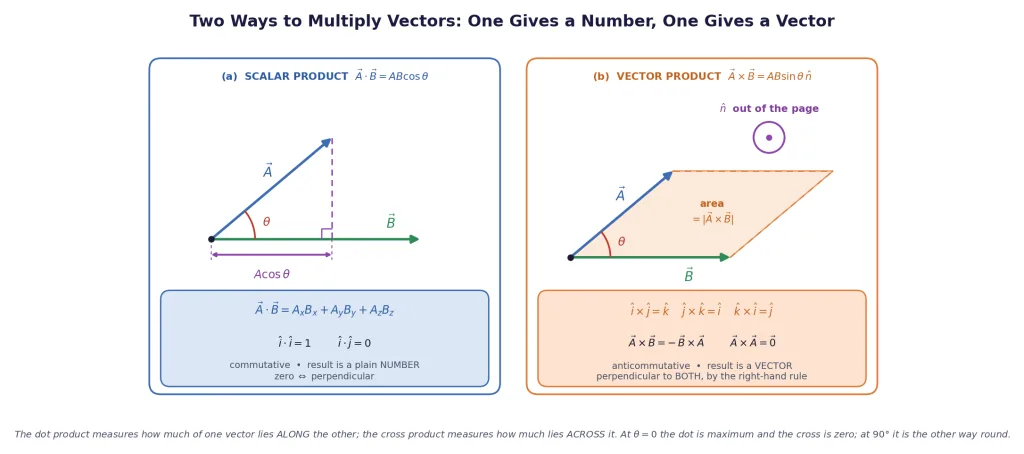
The definition
Key Point: The scalar product (or dot product) of and is where and are the magnitudes and is the angle between the two vectors when they are drawn from a common point. The result is a scalar — a plain number with no direction at all.
That last sentence is the whole reason for the name, and it is worth saying out loud: the dot product of two vectors is not a vector. Writing is not a small slip; it is a category error, and examiners build options around it.
The component form — the one you will actually use
Write both vectors in components. Because , , are mutually perpendicular unit vectors,
(each unit vector has magnitude 1 and ; any two different ones are at and ). Multiply out , throw away every cross term, and you are left with
Three multiplications and two additions. No angle needed.
Its properties
| Property | Statement | Comment |
|---|---|---|
| Commutative | does not care about order | |
| Distributive | so you may expand brackets normally | |
| Scalar factors | pull numbers out freely | |
| Self product | since ; this is how magnitudes get in | |
| Sign | positive if , zero at , negative if | the sign is a direction test |
The four jobs it does for you
Job 1 — the angle between two vectors. Equate the two forms and rearrange:
This is the only clean way to get the angle between two vectors given in component form. Do not try to do it by drawing.
Job 2 — the perpendicularity test. Since ,
One line of arithmetic settles a question that would otherwise need angles. It is also how you solve for an unknown: "find such that these two are perpendicular" means "set the dot product to zero and solve".
Job 3 — the component of one vector along another. The projection of on the direction of has length , and
If you want the projection as a vector rather than a length, multiply by the unit vector along :
Job 4 — magnitudes of sums. Dot a sum with itself and expand:
That is Section 3's resultant formula, derived in one line. The subtraction version follows the same way with a minus sign, giving .
Key Point: Four uses, one operation. Angle, perpendicularity, projection, magnitude of a sum. If a question mentions any of those four words, reach for the dot product before you reach for geometry.
[Exam Tip] A trick worth having: if and are perpendicular, then , so . The two diagonals of a parallelogram are perpendicular exactly when it is a rhombus — proved in one line, and asked most years.
The Vector Product: Two Vectors In, a Third Vector Out
The other way to multiply. This one keeps the direction information, and gives back a vector.
The definition
Key Point: The vector product (or cross product) of and is where is the angle between them (, so ) and is the unit vector perpendicular to the plane containing both, pointing in the sense given by the right-hand rule.
The right-hand rule. Point the fingers of your right hand along and curl them towards through the smaller angle. Your thumb now points along . (Equivalently: turn a right-handed screw from to and see which way it advances.)
It is NOT commutative
Curl from to instead and your thumb points the other way. So
This is called anticommutative, and it is the single most common source of sign errors in the whole topic. Order matters. Always.
Two immediate consequences:
- , because and . Note the zero on the right is the null vector, not the number zero.
- More generally, for non-zero vectors means they are parallel or antiparallel. Compare with the dot product, where zero meant perpendicular. The two tests are exact opposites.
The unit vectors
With , , forming a right-handed set:
Memorise the cycle : going forwards round the cycle gives a plus, going backwards gives a minus. That one picture generates all nine lines above.
The determinant form — the one you will use
Watch the minus sign on the middle term. It is part of the determinant expansion, not a typo, and forgetting it is worth a wrong answer roughly once per paper.
The magnitude is an area
Draw and from a common point and complete the parallelogram. Its base is and its height is , so
and therefore
This is asked directly, most often as "find the area of the triangle whose two sides are the vectors …".
The comparison table — learn this side by side
| Scalar product | Vector product | |
|---|---|---|
| Result | a scalar | a vector |
| Magnitude | ||
| Order | commutative | anticommutative |
| Zero when | (perpendicular) | or (parallel) |
| Maximum when | , value | , value |
| Direction of result | none | perpendicular to both, right-hand rule |
| Geometric meaning | projection of one on the other | area of the parallelogram |
| Unit vectors | , | , |
[Exam Tip] Two useful identities that fall straight out. First, and — the cross product is perpendicular to both parents, so its dot with either is zero. That is a free check on any cross product you compute. Second, , since . If a question gives you one product and asks for the other, that identity is the shortcut.
Key Point: The dot product measures how much of one vector lies along the other. The cross product measures how much lies across it. When they are parallel the dot is maximum and the cross vanishes; when perpendicular it is the other way round.
Projectile on an Inclined Plane
This is the biggest JEE-only topic in the chapter, and it has a reputation for being hard. It is not. It is Section 5 with the axes tilted.
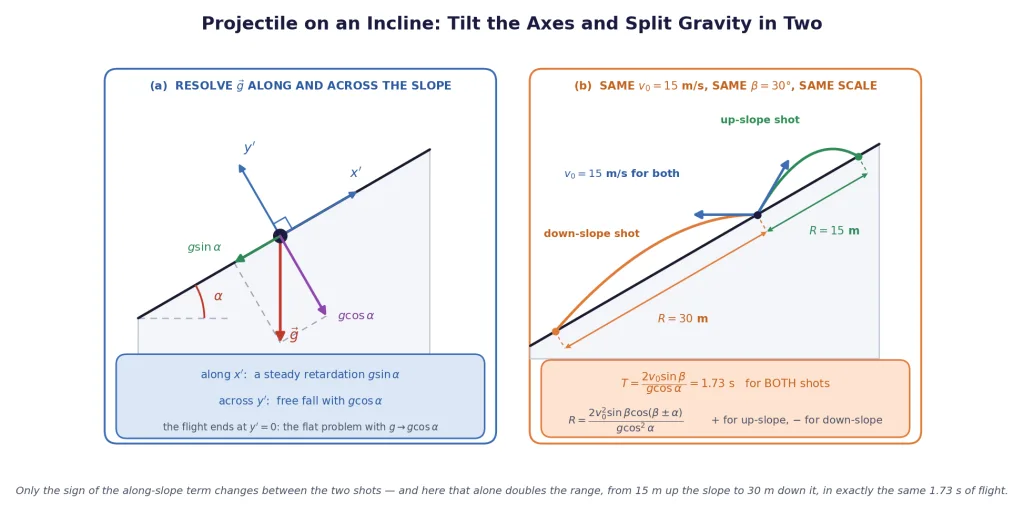
The set-up and the one decision that solves it
A plane is inclined at angle to the horizontal. A particle is projected from a point on the plane with speed , at angle measured from the inclined surface (not from the horizontal — read the question carefully, some papers give the angle from the horizontal instead). It lands back on the plane.
If you set up ordinary horizontal and vertical axes, the landing condition becomes "", which is a mess. So do the one thing that fixes everything:
Key Point: Take the axis along the incline and the axis perpendicular to it. Then the flight begins and ends at , exactly as on flat ground — and the whole problem becomes the familiar one with replaced by .
Gravity, which points straight down, now has a component along each of the new axes:
And the launch velocity splits as
Time of flight
The perpendicular motion is a complete round trip: it starts at with velocity and returns to under a constant . That is precisely the flat-ground time-of-flight problem, so
Notice what is not in it: does not depend on the sign of the along-slope acceleration at all. The time of flight is the same whether you fire up the slope or down it. That surprises everyone the first time.
The greatest distance from the surface, measured perpendicular to it, follows the same way:
Range along the incline, firing UP the slope
Along , the particle starts with and is retarded by for the whole flight:
Substitute :
The bracket is the compound-angle identity for , so
Firing DOWN the slope
Everything is identical except that gravity's along-slope component now helps instead of hindering, so the sign in front of flips and becomes :
The check that proves both formulas. Put (flat ground). Both collapse to , which is exactly Section 5's range formula. If a derived formula does not survive that check, you have made a mistake.
The maximum-range condition
Hold and fixed and vary . Rewrite the numerator of using the product-to-sum identity :
Only the first term contains , and it is largest when , that is :
For the down-slope shot, replace by everywhere:
Reading these results
| Feature | Up the slope | Down the slope |
|---|---|---|
| Optimum angle to the incline | ||
| Maximum range | ||
| Compared with flat ground | always less than | always more than |
| Optimum direction bisects | the incline and the vertical | the down-slope and the vertical |
Both optimum directions have the same elegant description: the launch direction bisects the angle between the slope you are firing along and the vertical. At both reduce to , as they must.
Key Point: The ratio of the two maximum ranges is . On a slope that is — you can throw three times as far downhill as uphill with the same effort.
[Advanced] Two variations worth knowing. (1) If the particle is projected horizontally from a point on a downward slope, that is just the down-slope case with . (2) If the question asks where the particle strikes the incline perpendicularly, set the along-slope velocity to zero at landing: , which combined with gives .
Two Twists on the Projectile: a Moving Launcher, and How Sharply It Turns
Part A: launching from something that is already moving
A ball thrown from a moving truck. A bomb released from a flying aircraft. A stone thrown by a running boy. In every case the rule is a single line of vector addition, and everything else follows from Section 5.
Key Point: The initial velocity of the projectile in the ground frame is the vector sum Add the two velocities first. Then run the ordinary projectile machinery on the result.
The classic result. A truck moves at a constant 15 m/s. A passenger throws a ball straight up at 20 m/s relative to the truck. Where does it land?
In the ground frame the ball leaves with , so it is an ordinary projectile of speed 25 m/s launched at . Its time of flight is s and in that time its horizontal displacement is m. The truck, moving uniformly, also covers m.
Same horizontal displacement. The ball lands back in the thrower's hand.
And there is a shorter way to see it: horizontally, ball and truck have the same constant velocity and no horizontal acceleration, so relative to the truck the ball has zero horizontal velocity throughout. In the truck's frame the ball simply goes straight up and straight back down.
Key Point: This works only because the truck moves uniformly. If the truck accelerates with after the throw, it gains an extra on the ball, and the ball lands that far behind the hand. If the truck brakes, the ball lands in front.
Aircraft dropping a package. Release means "let go with zero velocity relative to the aircraft", so in the ground frame the package starts with the aircraft's full horizontal velocity and zero vertical velocity — a horizontal projection from a height, exactly as in Section 5. Two consequences that get asked every year:
- The package stays directly below the aircraft for the whole fall (both keep the same horizontal velocity), so the pilot sees it fall vertically.
- To hit a target, the pilot must release when the target is at an angle ahead of the vertical, where .
Part B: the radius of curvature of a trajectory
Here is a question that never turns up at Board level and JEE Advanced loves: at this instant, how sharply is the path bending?
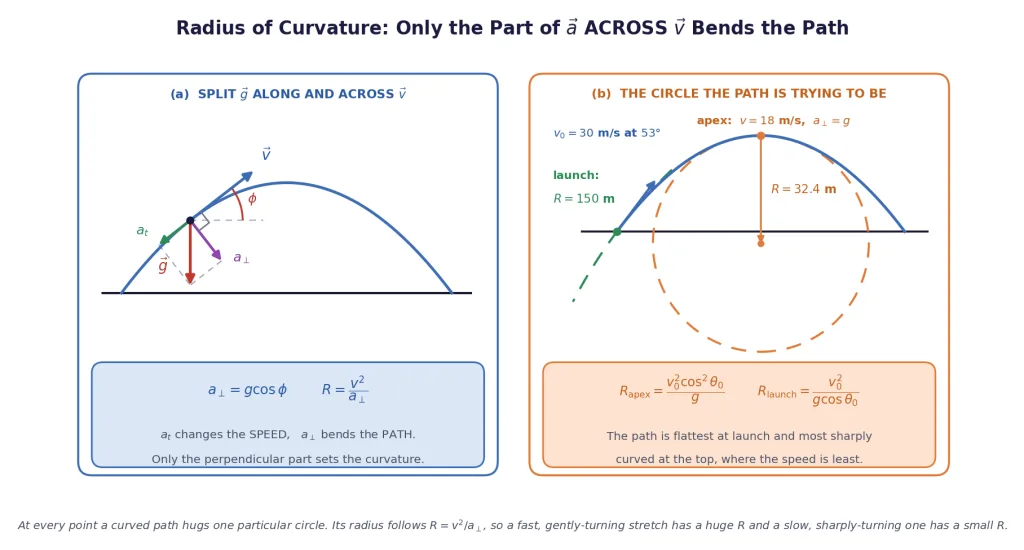
Take any point on any curved path. Over a short enough stretch, the path is indistinguishable from an arc of some circle — the circle that hugs it best at that point. The radius of that circle is the radius of curvature at that point.
Now split the acceleration at that instant into two pieces:
- , the component along — this changes the speed;
- , the component perpendicular to — this changes the direction.
Turning along a circle of radius at speed requires a centripetal acceleration (Section 6), and the only thing available to supply it is the perpendicular component. So , giving
Key Point: For a projectile the acceleration is always downwards, so if is the angle the velocity makes with the horizontal at that instant, and The whole calculation is: find at that instant, find the direction of , take the perpendicular component of , divide.
The two standard positions.
At launch, and , so
At the apex, the velocity is horizontal () and equal to , so the whole of is perpendicular to it:
Their ratio is , which is worth remembering as a one-line answer.
Does that make sense? At the apex the projectile is moving slowest and the entire is bending it, so the turn is at its tightest and is at its minimum. Near launch it is fast and only part of is bending it, so the path is at its flattest and is large. A projectile is a parabola, not a circle, so genuinely changes from point to point.
[Advanced] If you have met calculus curvature, gives the same answers from the trajectory equation. It is slower, and in an exam the route wins every time — but it is a good way to check yourself while practising.
Non-Uniform Circular Motion, and as a Vector
Section 6 kept the speed constant. Release that condition and circular motion becomes the richest set-up in the chapter.
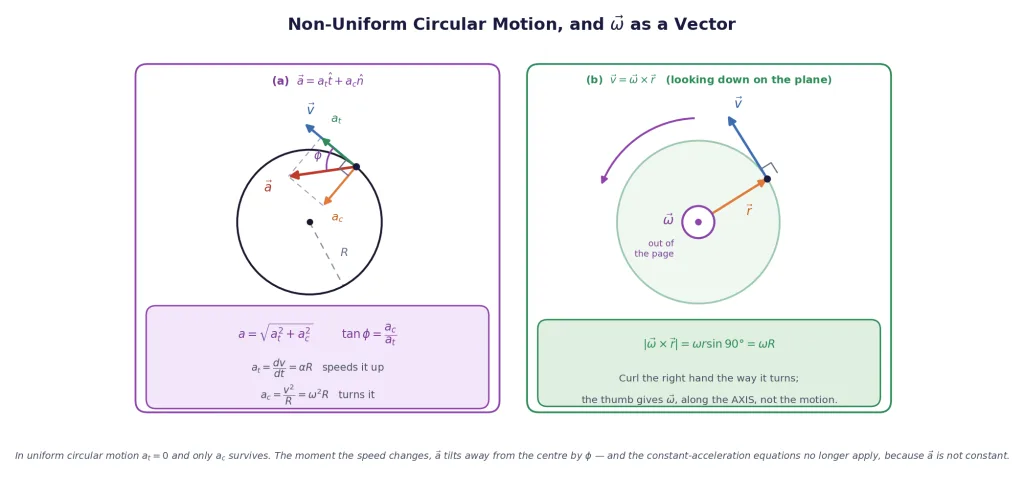
Two accelerations, doing two different jobs
A particle moves on a circle of radius with a speed that is itself changing. Its acceleration now has two components:
| Component | Symbol | Direction | Formula | What it does |
|---|---|---|---|---|
| Tangential | along the tangent, parallel to | changes the speed | ||
| Radial / centripetal | towards the centre | changes the direction |
They are perpendicular to each other, so the total acceleration is
where is the angle between the total acceleration and the tangent (it is sometimes measured from the radius instead — always state which convention you are using, and check the answer options).
Key Point: In uniform circular motion , the total acceleration is purely centripetal, and . The moment the speed changes, tilts away from the centre. It points inwards and forwards while speeding up, inwards and backwards while slowing down — but it always has an inward component as long as the particle is on the circle at all.
The angular kinematic equations
Define the angular acceleration
If is constant, the whole of Chapter 2's algebra transfers symbol for symbol:
and there is even an angular version of the th-second result. The correspondence is exact:
| Linear | Angular | Bridge |
|---|---|---|
| displacement | angular displacement | |
| velocity | angular velocity | |
| acceleration | angular acceleration | |
Key Point: in these equations is in radians and in rad/s. Convert rpm to rad/s before you substitute: for revolutions per minute. Number of revolutions .
The trap, and it is a serious one. These angular equations are legal for constant . The linear equations are not, because in circular motion the acceleration vector is constantly changing direction, so is not constant even when the speed is. Never write using .
Angular velocity as a vector
Angular velocity has a magnitude and a direction, and it adds like a vector, so it is one. But which way does it point? Not along the motion — the motion goes round in a circle and has no single direction.
Key Point: points along the axis of rotation, in the sense given by the right-hand rule: curl the fingers of your right hand the way the body turns, and the thumb gives . For anticlockwise rotation in the plane of this page, points out of the page.
With that convention, the velocity of any point of the rotating body is
where is the position vector of the point measured from any point on the axis. Check it: for a point in the plane of rotation, , so the magnitude is — Section 6's , recovered. And the direction comes out tangential and in the correct sense automatically, which is the real reason for using the cross product here.
The centripetal acceleration also has a compact vector form, , whose magnitude is and whose direction is straight at the axis.
[Exam Tip] Because lies along the axis and lies in the plane, they are always perpendicular in this simple case: . Likewise . Two free checks on any answer you produce.
Two Projectiles at Once, Optimisation, and the Traps
Two projectiles: the shortcut that removes gravity
Section 7 gave you the idea; here is how far it goes.
Two particles are in flight at the same time. Both have acceleration downwards. So the relative acceleration is
Key Point: Relative to each other, two projectiles move in a straight line at constant velocity. Gravity cancels completely. In the frame of one projectile, the other one does not fall at all — it drifts uniformly.
That converts a two-parabola problem into a one-line kinematics problem:
The collision condition. Two projectiles collide if and only if the relative velocity points along the initial separation vector . The time to collision is then simply
and you must always check that this is less than the time either particle spends in the air.
If they do not collide, the separation still grows linearly along a fixed direction, so "how far apart are they after 4 s" is a one-step multiplication, and the minimum separation is the perpendicular distance from the starting relative position to the line of .
One useful special case. Two particles launched from the same point at the same speed but different angles and have relative speed
because the two velocity vectors have equal magnitude, so their difference is a chord of a circle. The separation after time is that speed times — no parabolas anywhere.
Optimisation: three standard questions
1. Minimum speed to reach a given point . Fix the target and ask for the smallest that gets there. Starting from the trajectory equation and minimising gives the two results worth memorising:
Sanity check with : the target is on the ground at distance , giving and — exactly turned around. Good.
2. The safe parabola (the envelope). For a fixed launch speed , sweep the angle through every value and ask which points in the plane are reachable. The boundary is itself a parabola:
Everything inside it can be hit (by two different angles, in fact); everything outside is unreachable at that speed; points on it are reachable by exactly one angle. Its apex sits at the maximum height and it meets the ground at , the maximum range — which is exactly what it should do.
[Advanced] The two boxed results in part 1 and part 2 are the same statement seen from opposite sides. Asking "what is the least speed that reaches " is the same as asking "for which does sit exactly on the envelope". You can derive either from the other.
3. Clearing a wall. A wall of height stands a distance away. The condition is just " when " in the trajectory equation:
Two habits make these quick. First, check the range before anything else — if the ball never reaches the wall and there is nothing to compute. Second, if you are asked whether the ball is rising or falling as it passes, compare with : before the midpoint it is rising, after it, falling.
The traps, in the order they cost marks
Trap 1 — "equal in magnitude" is not "equal". Two vectors are equal only if they have the same magnitude and the same direction. A car going 20 m/s north and a car going 20 m/s east have equal speeds and unequal velocities. The version of this that catches people: a projectile's speed at the launch height on the way down equals its launch speed, but the velocities are not equal — the vertical component has reversed sign.
Trap 2 — assuming . That holds only when the two are parallel. In general Section 2's bound applies: . So can even be smaller than either vector. Two forces of 3 N and 4 N at right angles give 5 N, not 7 N.
Trap 3 — using the kinematic equations in circular motion. requires a constant acceleration vector. In circular motion swings round with the particle, so it is never constant, even at constant speed. Use the angular equations instead — those are the ones that are legal (for constant ).
Trap 4 — the cross product order. and differ by a sign. If an answer's direction is wrong but its magnitude is right, this is almost always why.
Trap 5 — does not mean one of them is zero. It means they are perpendicular. Likewise means parallel, not zero. Ordinary-number instincts do not transfer.
Trap 6 — the angle in the range formula. In the angle is measured from the incline. If a question gives the angle from the horizontal, call it and use first. More marks are lost here than to any algebra.
Key Point (the section on one card): Dot for angles and projections, cross for areas and perpendiculars. Tilt the axes on an incline. Add the platform's velocity before you start. for curvature. Split circular acceleration into and . Two projectiles see each other move in a straight line. And in every one of these, the physics is Section 1 to 8 — only the geometry has changed.
Solved Examples
Twelve problems at genuine JEE level. Work each one on paper before reading the solution — the value is entirely in the attempt.
Example 1: The dot product, doing all four of its jobs
Given and , find (a) , (b) the angle between them, (c) the component of along , and (d) the value of for which is perpendicular to .
Solution:
(a) Dot product, by components. A plain number. No , no .
Magnitudes first — both are Pythagorean triples, which is why these numbers were chosen:
(b) The angle. A small angle, which fits: points at and at , and the difference is . That independent check costs five seconds and is worth doing.
(c) Component of along : Compare with : almost all of lies along , as it must for a separation.
(d) Perpendicularity. Set the dot product to zero: Check: . Correct.
Final Answer: (a) 63 (b) (c) 4.85 (d) .
Takeaway: One operation answered four different questions. Note in particular that part (b) is not doable by drawing and part (d) is not doable by geometry at all — the dot product is the tool for both.
Example 2: The cross product, and an area
For and , find (a) , (b) the area of the triangle with and as two adjacent sides, (c) a unit vector perpendicular to both, and (d) the angle between them, using both products as a cross-check.
Solution:
(a) Set up the determinant.
Check it immediately by dotting with each parent: Perpendicular to both, as it must be. Five seconds, and it catches the middle-term sign error.
Magnitude:
(b) Area of the triangle is half the parallelogram:
(c) The unit normal: (and is equally valid — there are two perpendicular directions, and which one you get depends on the order of the product).
(d) The angle, two ways. With , , so : The two agree.
Final Answer: (a) (b) 4.56 square units (c) (d) .
Takeaway: Three habits shown here: watch the minus on the middle determinant term, dot the answer with both parents to check it, and when an angle is close to prefer the cosine route — changes fast near while is flat there, so the cosine gives the more reliable number.
Example 3: Firing up a slope [Advanced]
A ball is projected from a point on a plane inclined at to the horizontal, with speed 15 m/s at to the inclined surface, directed up the slope. Take m/s^2. Find (a) the time of flight, (b) the range along the incline, (c) the maximum distance from the incline surface, and (d) the coordinates of the landing point in ordinary horizontal and vertical axes.
Solution:
Choose the tilted axes. up the slope, perpendicular to it. Then
(a) Time of flight — from the perpendicular motion returning to : (exactly s).
(b) Range along the slope, from the along-slope motion: The closed form agrees:
(c) Maximum distance from the surface:
(d) Back to ordinary axes. The landing point is 15.0 m up the slope, so
Independent check in ordinary axes. The launch angle to the horizontal is , so m/s and m/s, and the trajectory is Setting gives , so m and m. Then m. Both routes land on the same point.
Final Answer: (a) 1.73 s (b) 15.0 m (c) 3.25 m (d) .
Takeaway: The tilted-axis route took four lines; the ordinary-axis route needed a quadratic. Both are correct, and on a slope the tilted axes will always be faster. Also notice that with , this happens to be exactly — so 15.0 m is not just a range here, it is the maximum possible range up this slope at this speed.
Example 4: The same shot, fired down the slope [Advanced]
Everything as in Example 3 — a incline, 15 m/s, to the surface — but now the ball is thrown down the slope. Find the time of flight and the range along the incline, and compare with the up-slope shot.
Solution:
What changes and what does not. The perpendicular motion is untouched: same m/s, same . So identical to the up-slope shot. Time of flight does not know which way you aimed along the slope.
What does change: gravity's along-slope component now points the same way as the motion, so it accelerates instead of retarding:
From the closed form, with :
Check by simulation in ordinary axes. The launch angle to the horizontal is : the ball is thrown horizontally at 15 m/s off the top of the slope. It falls while travelling horizontally, and the slope drops away as . Setting gives s, at which point m and the drop is 15.0 m, so
The comparison. Same speed, same angle to the surface, same 1.73 s in the air — and double the range, 30.0 m against 15.0 m.
Final Answer: s (unchanged), m — exactly twice the up-slope range.
Takeaway: The single sign change in the along-slope term is the whole story. And note the neat coincidence that made the check easy: when , the down-slope shot is a purely horizontal throw, which is why so many textbook problems phrase it that way.
Example 5: Maximum range on a slope, both ways [Advanced]
A projectile is launched at 20 m/s from a point on a plane inclined at (take , ), m/s^2. Find the maximum possible range (a) up the slope and (b) down the slope, with the launch angle in each case, and (c) compare both with the maximum range on level ground.
Solution:
(a) Up the slope. The optimum angle to the incline is
(b) Down the slope.
(c) On level ground the same launcher would manage So the slope costs you 37.5% of your range going uphill and gains you 150% going downhill.
The ratio, which is the quantity most often asked:
Check the up-slope answer by simulation. With the launch angle to the horizontal is , so m/s and m/s. The flight lasts s, landing at m, m — and m, on the slope (). Confirmed.
Final Answer: (a) 25.0 m at to the incline (b) 100.0 m at to the incline (c) 40.0 m on the level; the down-slope maximum is 4 times the up-slope maximum.
Takeaway: Both optimum directions bisect the angle between the slope you are firing along and the vertical, and both reduce to when . If you remember only one thing, remember with the plus sign for uphill.
Example 6: The ball thrown up from a moving truck
A truck moves along a straight road at a constant 15 m/s. A passenger throws a ball vertically upward at 20 m/s relative to the truck. Take m/s^2. Find (a) the ball's velocity in the ground frame at the moment of release, (b) its time of flight and maximum height above the throwing point, (c) the horizontal distance it covers, and (d) where it lands relative to the thrower — and how that answer changes if the truck accelerates at 2.0 m/s^2 from the instant of the throw.
Solution:
(a) Add the velocities. In the ground frame So a "vertical" throw from a moving truck is, to someone on the roadside, an ordinary projectile at 25 m/s.
(b) Only the vertical part decides these:
(c) Horizontal distance, at the unchanged horizontal velocity:
(d) Where does it land? In the same 4.0 s the truck covers m. Identical. The ball lands exactly back in the thrower's hand.
The clean way to see this: horizontally, ball and truck have the same constant velocity and neither has any horizontal acceleration, so their horizontal separation never changes. In the truck's frame the ball goes straight up and straight back down.
- If the truck accelerates at 2.0 m/s^2 from the moment of release, the ball is unaffected (it has left the truck) and still travels 60 m, while the truck now covers so the ball lands m behind the hand. That gap is exactly .
Final Answer: (a) m/s, i.e. 25 m/s at (b) 4.0 s, 20 m (c) 60 m (d) back in the hand; 16 m behind it if the truck accelerates at 2.0 m/s^2.
Takeaway: The whole problem is one vector addition at . Everything after that is Section 5. And the famous "it lands back in your hand" result is a statement about uniform motion — the moment the platform accelerates, it fails, and by a computable amount.
Example 7: The package released from an aircraft
An aircraft flying horizontally at 150 m/s releases a supply package from a height of 720 m. Take m/s^2 and ignore air resistance. Find (a) the time the package takes to reach the ground, (b) the horizontal distance it covers, (c) how far ahead of the drop zone, as an angle from the vertical, the pilot must release it, (d) the speed and direction with which it lands, and (e) where the aircraft is when the package lands.
Solution:
Set up. Releasing means "with zero velocity relative to the aircraft", so in the ground frame the package starts with This is a horizontal projection from a height — Section 5's second standard case.
(a) Time of fall, from the vertical motion alone:
(b) Horizontal distance:
(c) The release angle. The pilot must let go when the target is at
(d) Landing velocity. The horizontal component is unchanged and the vertical one has grown:
(e) Where is the aircraft? It flies on at 150 m/s and covers m in the same time — the same horizontal distance as the package. The aircraft is directly above the package when it lands, and to the pilot the package appeared to fall straight down.
Final Answer: (a) 12.0 s (b) 1800 m (c) from the vertical (d) 192.1 m/s at below the horizontal (e) directly overhead.
Takeaway: Part (e) is the one students get wrong, usually by assuming the aircraft "outruns" the package. It cannot: nothing acts horizontally on either of them, so their horizontal velocities stay equal forever. Air resistance is what breaks this in reality, and it is exactly what we agreed to ignore.
Example 8: How sharply is it turning? [Advanced]
A projectile is launched at 30 m/s at above the horizontal (take , ), with m/s^2. Find the radius of curvature of its path (a) at the launch point, (b) at the highest point, and (c) at s after launch.
Solution:
Components once, at the start:
(a) At launch. The velocity is at to the horizontal, so the component of perpendicular to it is
(b) At the apex. The velocity is horizontal and equal to m/s, and is entirely perpendicular to it, so m/s^2: The general form m agrees.
(c) At s. Update the velocity:
Independent check on (c) using calculus. The trajectory is , so and . At s, m, giving and
Final Answer: (a) 150 m (b) 32.4 m (c) 65.9 m.
Takeaway: The radius of curvature falls steadily from launch to apex — from 150 m to 32.4 m here, a factor of — because the projectile is losing speed while an ever-larger share of goes into bending it. The apex is always the sharpest turn of the flight.
Example 9: Circular motion with the speed changing
A particle moves along a circle of radius 4.0 m so that the distance covered along the arc gives it a speed m/s, with in seconds. At s find (a) the tangential acceleration, (b) the centripetal acceleration, (c) the magnitude and direction of the total acceleration, and (d) the total arc length covered and the angle swept in the first 2.0 s.
Solution:
(a) Tangential acceleration is the rate of change of speed:
The speed at that instant: m/s.
(b) Centripetal acceleration:
(c) Total acceleration. The two components are perpendicular: So leans strongly towards the centre but is tilted off the radius… check that: from the inward radius. Either statement is fine as long as you say which reference you used.
(d) Arc length is the integral of the speed:
Final Answer: (a) 8.0 m/s^2 (b) 16.0 m/s^2 (c) 17.9 m/s^2 at from the tangent (d) 5.33 m of arc, rad.
Takeaway: Two independent accelerations doing two independent jobs, combined by Pythagoras because they are perpendicular. Note that the angular acceleration here is not constant ( so ), which is exactly why part (d) needed an integral rather than .
Example 10: Angular kinematics, and as a vector
Part 1. A wheel of radius 0.50 m starts from rest and spins up with a constant angular acceleration of 8.0 rad/s^2. At s find its angular speed, the angle turned, and the tangential, centripetal and total acceleration of a point on its rim.
Part 2. A rigid body rotates with rad/s. Find the velocity of the particle at m, and verify it is perpendicular to both and .
Solution — Part 1:
Angular speed from :
Angle turned from : Cross-check with : . Consistent. That is of a revolution.
Rim accelerations: (The rim speed, if you want it, is m/s.)
Solution — Part 2:
Take the cross product:
Magnitude check: m/s, and m/s. Agrees with .
Perpendicularity checks:
Bonus — the centripetal acceleration as a vector: Its magnitude is m/s^2 , and it points exactly opposite to — that is, straight at the axis.
Final Answer: Part 1: rad/s, rad, m/s^2, m/s^2, m/s^2. Part 2: m/s, perpendicular to both.
Takeaway: The angular equations are legal here because is constant. The linear ones are not, because swings round with the particle. And delivers both the magnitude and the correct tangential direction in a single stroke — that is what earns the cross product its place.
Example 11: Two projectiles, and a mid-air collision [Advanced]
Part 1. From the top of a tower, one stone is thrown horizontally at 12 m/s and, at the same instant, a second is thrown vertically upward at 9.0 m/s. How far apart are they 4.0 s later, and along what direction?
Part 2. Particle A is projected from the origin at 30 m/s at above the horizontal. At the same instant particle B is projected from a point 75 m away on the same level, with a velocity of m/s. Show that they collide, and find when and where. Take m/s^2 and assume both stay in the air.
Solution — Part 1:
Use zero relative acceleration. Both stones have acceleration , so relative to each other they move in a straight line at constant velocity:
They start from the same point, so the separation is simply along a fixed direction below the horizontal, and it grows linearly with time — no anywhere, because gravity has cancelled.
Solution — Part 2:
Write both initial velocities.
Relative velocity of A with respect to B: It is purely horizontal, and B lies purely horizontally from A (75 m along ). The relative velocity therefore points exactly along the initial separation — the collision condition is satisfied.
Time to collide:
Where? Track A: Track B, starting at m: Same point. They meet at , 27 m above the ground.
Are they still airborne? Both have m/s, so both have a flight time of s. Since s, yes — the collision is real and not an artefact of the algebra.
Final Answer: Part 1: 60 m apart, along below the horizontal. Part 2: they collide after 3.0 s at the point .
Takeaway: Step 7 is not optional. Plenty of "collision" problems are designed so that the meeting point is below ground or after landing, and the correct answer is they do not collide. Also notice that both particles had the same vertical velocity of 24 m/s, which is what made horizontal — that is how these questions are constructed, and spotting it is faster than any algebra.
Example 12: The cheapest possible throw [Advanced]
A target sits at the point relative to a launcher at the origin. Take m/s^2. Find (a) the minimum speed with which a projectile can reach it and the angle required, (b) verify by tracing the trajectory, and (c) using that same speed, decide whether a second target at can be hit.
Solution:
(a) Use the minimum-speed result. With m and m, first the straight-line distance:
The angle: (so exactly).
(b) Trace it. With m/s at , Time to reach m: s. At that instant It passes exactly through the target.
(c) Use the safe-parabola envelope. At , At m this gives m — exactly our first target. The first target lies on the envelope, which is precisely why it needed the minimum speed and could be reached by only one angle.
The second target at has , so it lies outside the safe parabola. At 28.28 m/s it cannot be hit at any angle.
Final Answer: (a) 28.28 m/s at (b) confirmed — the path passes through (c) no, is outside the reachable region at that speed.
Takeaway: The minimum-speed condition and the safe-parabola envelope are two views of the same fact: the least speed that reaches a point is the speed for which that point sits exactly on the envelope. Once you see that, part (c) is a five-second check rather than a calculation, and any question of the form "can it be hit?" becomes one substitution.