
Two Observers, One Motion — Now in a Plane
Chapter 2 taught you relative velocity on a straight line, where the whole business was subtraction with signs. Everything in this section is that same idea with one upgrade: the subtraction becomes vector subtraction.
In the rationalised syllabus there is no numbered section on relative velocity in two dimensions — the body text was cut, and it survives only as a single line in the closing notes () and inside the problem sets. It is nonetheless required — the standard rain-and-umbrella problem cannot be solved without it, and river-boat problems appear in JEE Main and NEET essentially every year. So we teach it here from scratch, assuming nothing.
The definition, promoted to vectors
Key Point (Definition): If A and B have velocities and measured in the same frame (take it to be the ground), then the velocity of A relative to B is This is the velocity of A that an observer riding on B — who considers himself at rest — would measure.
Read the subscripts in order, exactly as in Chapter 2: the first subscript is the object being described, the second is the observer. And swapping them still flips the sign, now as a vector statement:
So and have the same magnitude and exactly opposite directions. The same subtraction works for position and acceleration too:
The method — and it is a method, not an instinct
Here is the thing about two dimensions: your intuition is not good enough. In 1D you could sometimes guess "add the speeds" or "subtract the speeds" and get away with it. In a plane, guessing fails, because the answer depends on an angle. So do this, every time, without exception:
Key Point — the four-step recipe:
- Fix axes and write them down. Usually east and north, or downstream and across.
- Write every velocity in components, , using Section 3's resolution. Everything must be in the same frame (the ground) before you subtract.
- Subtract componentwise: .
- Convert back to magnitude and direction: , and get the direction from the signs of the two components — not from a bare (Section 3's quadrant warning applies here in full).
The geometric picture
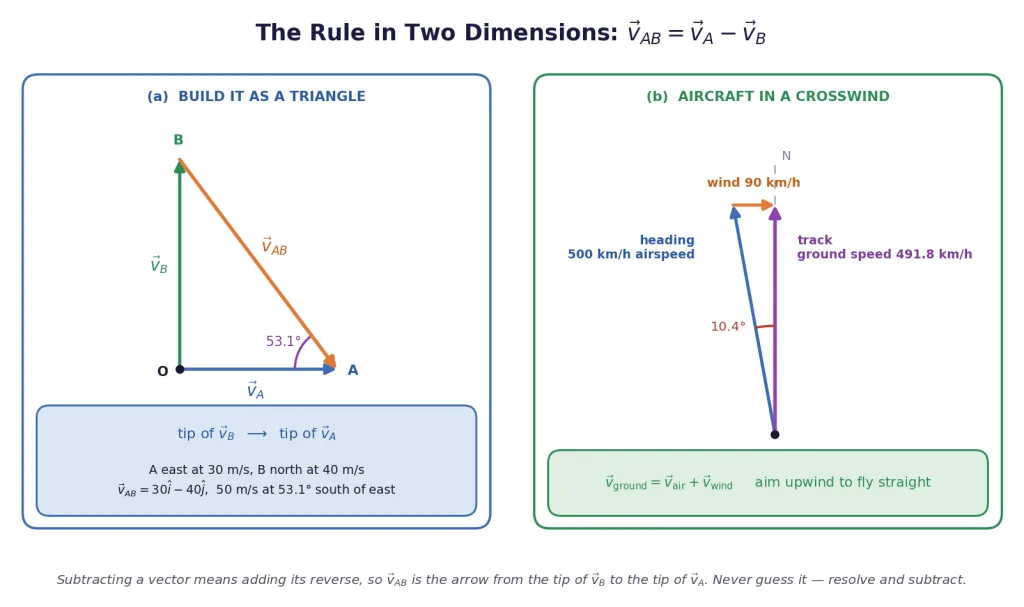
Subtracting a vector means adding its reverse, so . Draw and from a common point; then is the arrow running from the tip of to the tip of . That is Section 2's subtraction rule, unchanged.
Panel (a) makes it concrete. Car A drives east at 30 m/s, car B drives north at 40 m/s. Then , so A appears to B to be moving at 50 m/s in a direction south of east. Notice that neither 30, nor 40, nor , nor is the answer. Only the vector subtraction gives it.
Two special cases worth naming
| If | Then | Meaning |
|---|---|---|
| permanently at rest relative to each other; separation frozen | ||
| relative motion is uniform: straight line, constant speed |
That second row is a monster, and Block 6 cashes it in: two projectiles both have , so relative to one another they move in a straight line at constant velocity, and problems that look horrible become one division.
[JEE/NEET] The commonest error in this whole topic is mixing frames. A boat's speed "in still water" is measured relative to the water. A swimmer's speed is relative to the water. A plane's airspeed is relative to the air. A bullet's muzzle speed is relative to the gun. None of those are ground velocities until you add the carrier's velocity to them.
Rain and the Umbrella
You are standing in the rain. Which way do you tilt the umbrella? Straight up, if the rain falls vertically and you are standing still. Start walking and you have to lean it forward — everyone knows this from experience, and the reason is exactly .
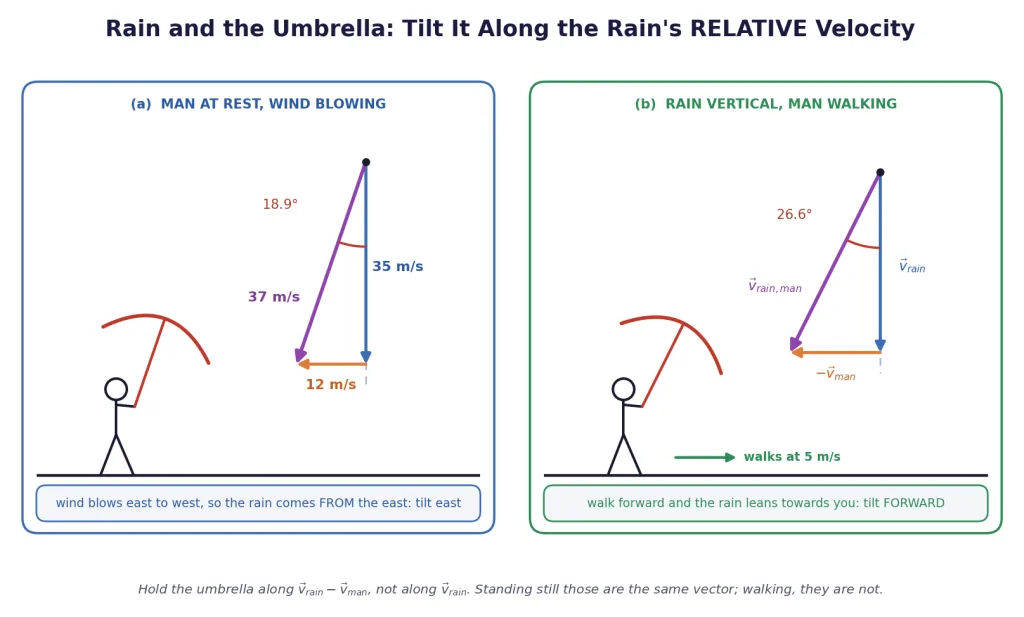
Key Point: You must hold the umbrella along the direction of the rain's velocity relative to you: Not along . Standing still, those two are the same vector; the moment you move, they are not.
Case 1: you are still, the wind is blowing
Rain falls vertically at 35 m/s. A wind then blows at 12 m/s from east to west. Because the wind carries the drops sideways, the rain's velocity in the ground frame is the vector sum of the two: 35 m/s downward plus 12 m/s westward.
Since the drops are travelling towards the west, they must be arriving from the east — so the umbrella tilts towards the east, at about to the vertical.
Case 2: the rain is vertical, you are walking
Now the wind is gone; the rain falls straight down at speed , and you walk east at speed . Take east, up:
There it is: a backward horizontal component appears, of size exactly your own walking speed. To you the rain seems to slant towards you from in front, so you tilt the umbrella forward, into your direction of motion, by
Key Point: Walk faster and grows: the rain appears to come at you more and more horizontally, and it also appears to fall faster than it really does.
Panel (b) is this case with m/s and m/s: , so , and the apparent speed is 11.18 m/s rather than 10.
Case 3: "at what speed must he walk for the rain to appear vertical?"
This one is asked constantly, and once you see it in components it takes five seconds. The rain appears vertical when the horizontal component of the relative velocity is zero:
Key Point: For the rain to appear to fall vertically, the man must match the rain's horizontal velocity — same size, same direction. He then sees only the vertical component, , which is less than the rain's actual speed.
The reverse problem: two observations, one rain
The hardest version hands you what the rain looks like at two different walking speeds and asks for the rain's true velocity. Treat the rain's velocity as two unknowns and write one equation per observation.
Let (with negative, since it falls).
- "Walking at the rain appears vertical" gives , so .
- "Walking at the rain appears at angle to the vertical" gives .
Two equations, two unknowns, done. Example 3 below runs this exact machinery.
[NEET Important] Watch the wording. "Rain appears to fall at with the vertical" is about . "Rain is falling at with the vertical" is about in the ground frame. Different vectors, different answers, one word between them.
Crossing a River, Route 1: Shortest TIME
This is the biggest family of problems in the topic, and almost all of the marks lost in it are lost by mixing up two routes that sound similar and are completely different. Let us set the stage very carefully.
The set-up and the notation
A river of width flows with speed . A boat can move at speed in still water — that is, is the speed of the boat relative to the water, and it is the only speed the boatman controls. The water itself moves at relative to the ground. So:
Key Point (the governing equation): The boatman chooses the direction of ; the river then adds its own contribution, and the sum is what actually happens.
Axes: let be downstream, be straight across towards the far bank. Then always, and only -motion gets you across.
Route 1: point the boat straight at the far bank
The boatman heads perpendicular to the bank, so and
Now use the independence of the two components — the same idea that made projectile motion easy in Section 5.
The crossing time comes only from the -column, and the -velocity is the full :
Key Point: This is the smallest possible crossing time, because is the largest across-stream velocity the boat can ever have. Turning the boat at all reduces the across-component and takes longer.
The drift comes only from the -column. During that time the current sweeps the boat downstream by
The resultant speed over the ground, and the actual path length:
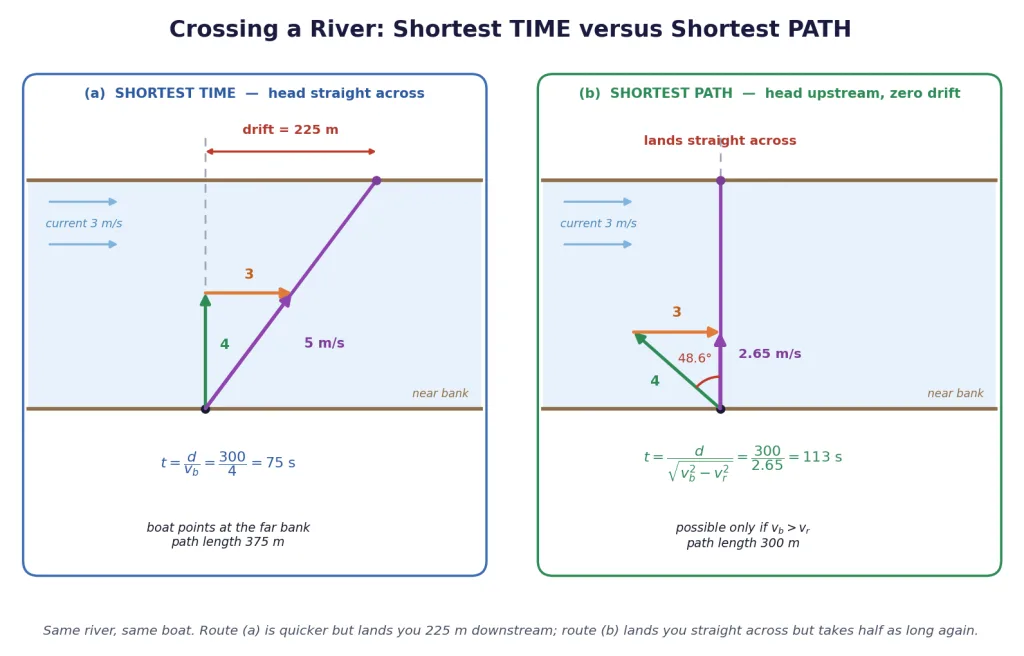
Read panel (a). The boat's nose points straight across the whole way, but the boat itself travels along the slanted purple line, because the current is quietly adding sideways motion the entire time. It arrives 225 m downstream of the point opposite its start.
Key Point — the fact that surprises everyone: The crossing time does not depend on the current at all. , with no in it. The current cannot help you across and cannot stop you; all it does is move you sideways while you cross. It changes where you land, never when.
[JEE Tip] That independence is worth stating as a slogan: the current controls the drift, the boat controls the time. A question that doubles the current and asks what happens to the crossing time is testing this one line — the answer is "nothing".
Reading the question correctly
| The question says | It means |
|---|---|
| "crosses in the shortest time" | head perpendicular to the bank; accept the drift |
| "heads directly across" / "points the boat towards the opposite bank" | the same thing |
| "the boat is rowed perpendicular to the current" | again the same thing |
| "reaches the point directly opposite" | that is Route 2, coming next — a different problem entirely |
Crossing a River, Route 2: Shortest PATH (Zero Drift)
Now the boatman wants to land at the point directly opposite his start. He must arrive with zero drift, which means his resultant velocity must point straight across, which means his -component must be exactly zero.
Getting the heading
He cannot switch the current off, so he must cancel it: he aims the boat upstream, at an angle to the straight-across line, so that the upstream component of his own velocity exactly kills the downstream current.
Add them and demand that the -component vanishes:
Key Point: where is measured from the line perpendicular to the bank, pointing upstream.
What is left over
The -motion is gone entirely, so the whole ground velocity is the surviving -component:
Key Point:
Notice the minus sign under that root, where Route 1 had a plus. That single sign is the whole difference between the two routes, and it is worth reading twice.
The condition everyone is examined on
That square root is only real if .
Key Point: Zero drift is possible only if — the boat must be faster than the current. If there is no heading that lands you straight across; the river will always win some sideways ground and you must land downstream.
[JEE Tip] When the sensible question becomes "which heading gives the least drift?" Minimising over gives (note: the ratio is now the other way up), and the minimum drift works out to . Example 6 does it with numbers.
The two routes side by side
This is the table to burn into memory. Same river, same boat, two completely different answers.
| Route 1: shortest TIME | Route 2: shortest PATH | |
|---|---|---|
| Boat is aimed | perpendicular to the bank | upstream at , with |
| Across-component of velocity | ||
| Crossing time | (the minimum) | (longer) |
| Drift downstream | zero | |
| Speed over the ground | ||
| Path length | (the minimum) | |
| Always possible? | yes | only if |
Key Point: You cannot have both. The route that minimises the time does not minimise the path, and the route that minimises the path does not minimise the time. Read the question, decide which one it wants, and then use the matching column.
[NEET Important] A mnemonic that survives exam pressure: PLUS for the quick one, MINUS for the straight one. belongs to the shortest-time crossing (the current helps you go faster over the ground, sideways); belongs to the zero-drift crossing (you spend part of your speed fighting the current).
Aircraft in a Wind: Heading versus Track
An aircraft in moving air is the river-boat problem with the labels changed, and once you see that, there is almost nothing new to learn.
| River-boat | Aircraft | Meaning |
|---|---|---|
| , the heading | where the nose points; the airspeed | |
| the wind's velocity over the ground | ||
| , the track | where the aircraft actually goes; the ground speed |
Key Point: The heading is the direction the aircraft is pointing. The track is the direction it is actually travelling over the ground. In a crosswind they are not the same, and the angle between them is called the drift angle.
The two questions that get asked
Question type A — "the wind is such-and-such, the pilot heads such-and-such; find the ground velocity." Pure addition. Resolve both vectors into components, add, convert back to magnitude and direction. Example 8 below.
Question type B — "the pilot must make good a track of due north; what heading does he need, and what is his ground speed?" This is the zero-drift river crossing wearing a uniform. The pilot must aim into the wind by just enough that the wind's sideways push is cancelled.
If the desired track is due north and the wind blows due east with speed , the pilot heads west of north by an angle with
and what is left to carry him north is
Both formulas are the shortest-path river results with and . Same physics, same square root, same minus sign.
Key Point: Crabbing into the wind always costs ground speed. You spend part of your airspeed cancelling the crosswind instead of moving forward, so whenever there is any crosswind at all. And a crosswind stronger than the airspeed makes the desired track impossible — exactly as made zero drift impossible.
Panel (b) of the first figure in this section is a worked instance: airspeed 500 km/h, a 90 km/h wind from the west, and a required track of due north. The pilot must head west of north and settles for a ground speed of 491.8 km/h instead of 500.
[JEE Tip] Watch the meteorological convention. A "wind from the west" (a westerly) blows towards the east. Exam problems often say "a wind blows from the north at 20 m/s", and that vector is , pointing south. Getting this backwards flips your answer to the wrong side of the compass, and it is a very expensive way to lose a question.
The same idea, three costumes
| Problem | Object's own velocity | Medium's velocity | What is asked |
|---|---|---|---|
| Boat on a river | boat in still water | current | drift, or the upstream heading |
| Aircraft in a wind | airspeed | wind | ground speed, or the heading |
| Swimmer in a river | swimmer in still water | current | where he lands, or the angle |
Three names, one triangle. If you can do the river, you can already do the other two.
Two Projectiles: Zero Relative Acceleration
Now the result that makes hard-looking problems collapse.
Take two objects, both moving under gravity alone. Whatever their masses, whatever their speeds, whatever directions they were thrown in, both have the same acceleration:
So their relative acceleration is
Key Point: Two projectiles have zero relative acceleration. Therefore, as seen from either one of them, the other moves with constant velocity — in a perfectly straight line, at a steady speed. Gravity vanishes from the relative problem completely.
This is the two-dimensional version of the Chapter 2 result that two freely falling bodies have zero relative acceleration, and it is far more powerful in a plane, because it turns a pair of parabolas into a single straight line.
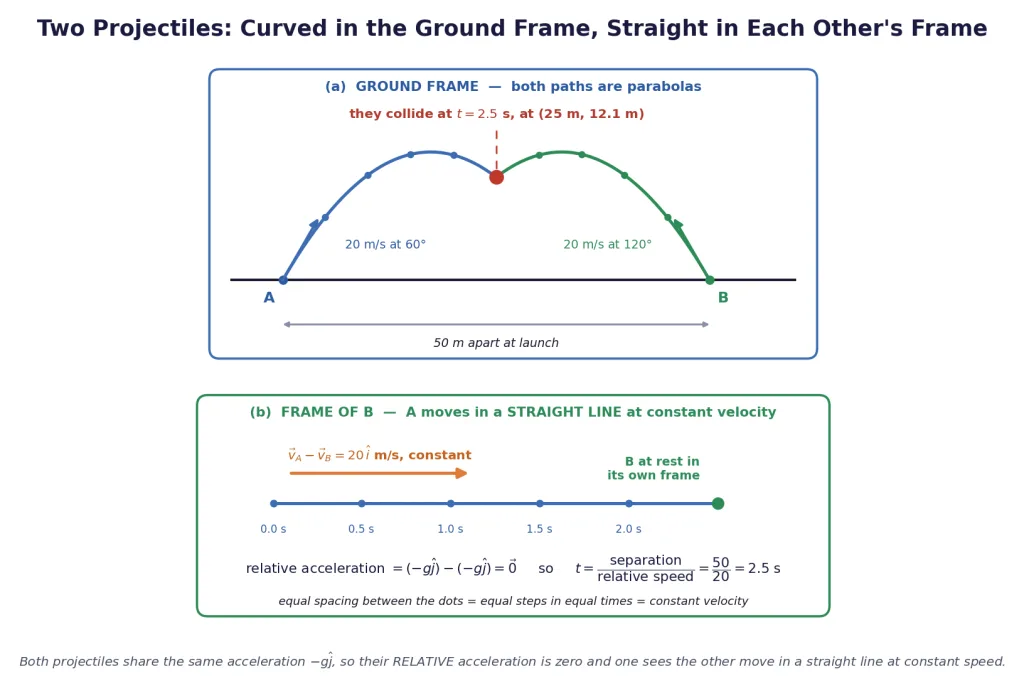
Look at the two panels. In the ground frame, two curved paths that happen to meet. In B's frame, A slides along a straight line at a constant 20 m/s and hits B — and the dots, drawn at equal time intervals, are equally spaced, which is what "constant velocity" looks like on a diagram.
The collision condition, in one line
If the two start at and , their separation vector evolves as
with no term, because the relative acceleration is zero. They collide when this is :
Key Point (collision condition): Two projectiles collide if and only if the relative velocity is directed along the line joining them (pointing from 1 towards 2). If it is, the time to collide is No quadratic, no , no trajectory equations. Just a division.
A famous corollary, sometimes called the monkey-and-hunter result: to hit a target that is released from rest at the same instant you fire, aim straight at where the target is now. In your relative frame the target does not fall at all, so aiming directly at it works. Example 9 does it with numbers.
Do check afterwards that the collision happens while both objects are still in the air (and above the ground). The relative-motion argument tells you when they would meet; it does not know about the ground.
And when they do not collide
If the relative velocity is not along the line joining them, the separation still changes linearly, so the distance between them is
For two objects launched from the same point at the same instant, and the separation is simply — it grows linearly with time, in a fixed direction, no matter how wildly the two parabolas curve. That is Example 11.
The whole section on one card
| Situation | The relation to use |
|---|---|
| Definition | , |
| Rain and umbrella | tilt along ; walking, from the vertical |
| Rain appears vertical | man's speed = rain's horizontal component |
| River, shortest time | , drift , ground speed |
| River, zero drift | upstream, , needs |
| Aircraft in wind | ; for a fixed track, |
| Two projectiles | : straight line, constant velocity; |
Where this goes next
Section 8 works dozens more problems of every type in this chapter. Section 9 (JEE Corner) pushes relative motion further — projectiles launched from moving platforms, where the launch velocity itself must be built by vector addition before you start. And in Chapter 5 the whole idea returns as the principle behind non-inertial frames.
Solved Examples
A standing instruction for all twelve: write the axes down first, then write every velocity in components. Do not try to see the answer. In two dimensions the answer is not visible; it is calculated.
Example 1: The boy at the bus stop
Rain is falling vertically with a speed of 35 m/s. Wind starts blowing after some time with a speed of 12 m/s in the east-to-west direction. In which direction should a boy waiting at a bus stop hold his umbrella?
Solution:
- Axes. Let point east and point vertically up. The boy is at rest, so and the rain's velocity relative to him is simply its ground velocity.
- Components. The rain falls at 35 m/s, so its vertical component is . The wind blows from east to west, i.e. towards , and it carries the drops with it, contributing :
- Magnitude:
- Direction. Measuring from the vertical,
- Which way? Both components are negative: the drops travel westward and downward. Something travelling west is arriving from the east, so the umbrella must be tilted towards the east.
Final Answer: The boy should hold his umbrella in the vertical plane at about with the vertical, tilted towards the east. The rain reaches him at 37 m/s.
Takeaway: Two traps hide in one small problem. First, "east to west" describes where the wind is going, so the vector is . Second, the umbrella tilts towards where the rain comes from, which is the opposite of where it is going. Getting either backwards puts the umbrella on the wrong side.
Example 2: Walking through vertical rain
Rain is falling vertically at 10 m/s. A man walks east at 5 m/s. Find the speed and direction of the rain as it appears to him.
Solution:
- Axes: east, up.
- Subtract:
- Magnitude:
- Direction from the vertical: The -component is negative (westward) while he walks east, so relative to him the rain slants towards him from the front.
Final Answer: The rain appears to fall at 11.18 m/s, at to the vertical, slanting from the front. He must tilt the umbrella forward by .
Takeaway: Walking never makes the rain look gentler. It adds a horizontal component of exactly your own speed, so the apparent speed is always greater than the true 10 m/s. And the tilt is always forward, into your motion — which matches what you actually do with an umbrella without ever having done the algebra.
Example 3: Two observations, one rain — finding the true velocity
A man walking east at 3 km/h finds that the rain appears to fall vertically. When he doubles his speed to 6 km/h, the rain appears to fall at to the vertical. Find the actual speed and direction of the rain.
Solution:
- Set up the unknown. Let with east, up. We expect .
- Observation 1, at : "Appears vertical" means the horizontal component is zero:
- Observation 2, at : The angle with the vertical is , so the horizontal and vertical parts must be equal in size:
- Assemble:
- Check both observations. At 3 km/h the relative velocity is : vertical, correct. At 6 km/h it is : equal components, so , correct.
Final Answer: The rain falls at km/h, at to the vertical, inclined towards the east.
Takeaway: The phrase "appears vertical" is not decoration — it is the equation , and it hands you one unknown immediately. Build the second observation on top of it and you have a two-equation system that never needs a diagram. Always substitute back at the end; it costs nothing and catches sign errors.
Example 4: Crossing a river in the shortest time
A river 300 m wide flows at 3 m/s. A boat can travel at 4 m/s in still water. The boatman heads the boat straight towards the opposite bank. Find (a) the time to cross, (b) the drift downstream, (c) his speed over the ground and (d) the length of the path he actually travels.
Solution:
- Axes: downstream, across. Heading straight across means
- (a) Time — a pure -question, and the -velocity is 4 m/s:
- (b) Drift — a pure -question, spending the time from (a):
- (c) Ground speed: at an angle from the straight-across direction, tilted downstream.
- (d) Path length: Cross-check: m. Agreed.
Final Answer: (a) 75 s; (b) 225 m downstream; (c) 5 m/s at to the straight-across line; (d) 375 m.
Takeaway: Note what the current did and did not do. It did not change the 75 s — that came from 4 m/s across 300 m and nothing else. It did add 225 m of drift and stretch the path from 300 m to 375 m. The current controls the drift; the boat controls the time.
Example 5: The same river, landing straight across
For the river of Example 4 (width 300 m, current 3 m/s, boat 4 m/s in still water), the boatman now wants to land at the point directly opposite his starting point. Find (a) the direction in which he must head, (b) his speed over the ground, and (c) the time to cross. Compare with Example 4.
Solution:
- The condition. He must have zero drift, so the -component of his ground velocity must vanish. Heading upstream at angle from the straight-across line:
- (a) measured from the perpendicular to the bank, tilted upstream. (Equivalently, from the bank itself — read the question's convention carefully.)
- (b) Ground speed. Only the across-component survives: Check directly: m/s. Agreed.
- (c) Time:
- Comparison. Route 1 took 75 s and landed 225 m downstream over a 375 m path. Route 2 takes 113.4 s — about 1.51 times as long, 38 s more — but lands exactly opposite over a 300 m path.
Final Answer: (a) upstream from the perpendicular; (b) 2.65 m/s; (c) 113.4 s, against 75 s for the shortest-time route.
Takeaway: Same river, same boat, two answers that differ by more than half a minute and 225 m. The mathematical marker is one sign: Route 1 has , Route 2 has . If you write the wrong sign you have not made an arithmetic slip; you have solved a different problem.
Example 6: When the river is faster than the boat
A river 200 m wide flows at 5 m/s. A boat can do only 3 m/s in still water. (a) Can the boatman land directly opposite? (b) At what angle should he head to make the drift as small as possible, and (c) what are that minimum drift and the corresponding crossing time?
Solution:
- (a) Zero drift needs , and no angle has a sine greater than 1. It is impossible. With the boat is simply carried downstream no matter which way it points.
- (b) Set up the drift. Heading upstream at angle from the perpendicular, the across-velocity is and the net downstream velocity is . So Differentiating with respect to and setting the result to zero gives , that is (Note the ratio is upside down compared with the zero-drift formula. That is not a typo, and examiners know it.)
- (c) With we get , so Cross-check with the compact formula: m. Agreed.
Final Answer: (a) No, since ; (b) upstream from the perpendicular; (c) minimum drift 266.7 m, crossing time 83.3 s.
Takeaway: Check before reaching for . If the check fails, the question is not "how do I land opposite" but "how little can I lose", and the answer flips the ratio to . Two formulas that look almost identical solve two genuinely different problems.
Example 7: An aircraft that must fly due north
An aircraft cruises at 500 km/h relative to the air. A wind of 90 km/h blows from the west. The pilot must make good a track of due north. Find (a) the heading he must fly, (b) his ground speed, and (c) the time to cover 1000 km northward.
Solution:
- Axes: east, north. A wind from the west blows towards the east, so
- (a) The heading. For the track to be due north, the east-west component of must be zero. So the pilot must point west of north by , with Heading: west of north.
- (b) Ground speed. What is left after cancelling the wind is the northward part: Cross-check by components: , and adding gives — due north, as required.
- (c)
Final Answer: (a) west of north; (b) 491.8 km/h; (c) 2.03 hours.
Takeaway: This is Example 5 in an aeroplane. is ; is . And note the price of the crosswind: 8.2 km/h of ground speed spent purely on not being blown sideways.
Example 8: Given the heading, find the track
An aircraft heads NE with an airspeed of 300 km/h. A wind of 60 km/h blows due east. Find the aircraft's ground velocity — magnitude and direction.
Solution:
- Axes: east, north. "NE" means east of north, so the components split as eastward and northward:
- The wind:
- Add:
- Magnitude:
- Direction. Both components are positive, so the vector is in the north-east quadrant:
Final Answer: 334.1 km/h along a track of NE.
Takeaway: The wind has done two things at once: pushed the ground speed up from 300 to 334 km/h, and swung the track from to east of north — a drift angle of . Note carefully that a bearing like NE resolves as for east and for north, the opposite of the usual habit, because the angle is measured from the north axis rather than from the east axis.
Example 9: Aim straight at it (the monkey-and-hunter result)
A ball is projected from the origin at 25 m/s, aimed directly at a second ball held at the point (30 m, 40 m). At the very instant of projection the second ball is released from rest and falls freely. Take m/s^2. Show that they collide, and find when and where.
Solution:
- Aim the first ball. The separation vector from origin to target is , whose magnitude is m. The unit vector towards the target is , so
- Go to the relative frame. The second ball starts from rest, so and Both are in free fall, so and this relative velocity never changes.
- Is it aimed correctly? points exactly along the line joining them. So in ball 2's frame, ball 1 comes straight at it in a straight line at 25 m/s. They must collide.
- When:
- Where — check both, in the ground frame. Ball 1: m, m. Ball 2: m (it never moves sideways), m. Both are at (30 m, 20 m). Confirmed.
- Sanity check on the ground. Ball 2 would reach the ground at s, comfortably after the collision at 2.0 s. So the collision is real, not hypothetical.
Final Answer: They collide 2.0 s after launch, at the point (30 m, 20 m).
Takeaway: Both balls fall exactly 20 m in those 2 seconds, so the fall cancels out completely and only the straight-line aim matters. This is why "aim directly at the target if it is released at the moment you fire" works, and it is why hunting a monkey that lets go of its branch is a fair test of your relative-motion algebra. Note how little work step 4 was compared with solving two trajectory equations simultaneously.
Example 10: Two projectiles thrown at each other
Two balls are thrown simultaneously from points A and B on level ground, 50 m apart. Ball A is thrown at 20 m/s at above the horizontal, towards B; ball B is thrown at 20 m/s at above the horizontal, towards A. Take m/s^2. Do they collide, and if so, when and where?
Solution:
- Axes and components. Put A at the origin and B at (50 m, 0), with from A towards B.
- Relative velocity: Purely horizontal — the vertical parts cancel exactly, because both were thrown at the same angle with the same speed.
- Is it along the line joining them? The line from A to B is , purely horizontal. is parallel to it and points from A towards B. So they collide.
- When:
- Where. Using ball A in the ground frame: Check with ball B: m, and the same by symmetry. Confirmed.
- Still airborne? Each has a time of flight s, which is greater than 2.5 s. Yes.
Final Answer: They collide 2.5 s after launch, at a point 25 m from A and 12.05 m above the ground.
Takeaway: The relative velocity came out horizontal because the two vertical components were identical — and that is the real content of the problem. Two projectiles thrown at the same speed and the same angle towards each other always collide, at the midpoint, whatever the numbers. Solving this by writing both trajectories and setting them equal would take five times as long.
Example 11: How fast do they separate?
Two balls are thrown from the same point at the same instant, both at 20 m/s, one at and the other at to the horizontal, in the same vertical plane. Find (a) the velocity of the first relative to the second, and (b) the distance between them 2.0 s after launch (assume both are still in the air).
Solution:
- Components.
- (a) Relative velocity: The components are equal and opposite in sign, so the direction is below the horizontal. (Neat check: for two equal speeds separated by an angle , the relative speed is m/s.)
- (b) Separation. Both are projectiles, so and the relative motion is uniform. They started from the same point, so the initial separation is zero and
Final Answer: (a) m/s, i.e. 10.35 m/s directed below the horizontal; (b) 20.7 m.
Takeaway: Two curved paths, and yet the gap between the two balls grows in a perfectly straight line at a perfectly constant rate. Gravity acts on both equally, so it cancels out of the relative problem and never appears in the answer — note that is not used anywhere in this solution.
Example 12: Making the rain look vertical
Rain falls at 20 m/s in a direction making with the vertical, tilted towards the east. (a) With what velocity must a man move for the rain to appear to fall vertically? (b) If instead he walks west at 10 m/s, at what angle to the vertical does the rain then appear to fall, and at what speed?
Solution:
- Resolve the rain. east, up. The angle is measured from the vertical, so the eastward part carries the sine and the downward part the cosine:
- (a) The rain appears vertical when the horizontal component of is zero: He then sees : vertical, at 17.32 m/s — noticeably slower than the rain's true 20 m/s.
- (b) Now (westward), so The relative velocity points east and down, so the rain appears to come from the west — from behind him, since he is walking west.
Final Answer: (a) 10 m/s due east, after which the rain appears vertical at 17.32 m/s; (b) 26.46 m/s at to the vertical, arriving from behind.
Takeaway: Two lessons in one problem. Match the rain's horizontal component and the rain looks vertical and slower; run against it and the apparent speed and tilt both grow sharply. And watch the resolution in step 1: when an angle is quoted from the vertical, sine goes with the horizontal component and cosine with the vertical, which is the reverse of the projectile habit.