
When a Plus Sign Stops Being Enough
The whole of Chapter 2 ran on nothing more exotic than a plus sign and a minus sign. That worked because of one lucky fact about a straight line: on a line there are only two directions. Pick one of them as positive, and every direction in the problem is now labelled. A velocity of m/s and a velocity of m/s are the same speed pointing opposite ways, and the algebra took care of itself.
Now step off the line. A cricket ball leaves the bat, a boat noses across a river, a stone whirls on a string. Here a velocity can point east, or north, or north of east, or in any of infinitely many directions in the plane. There is no way to label all of them with a handful of signs.
Key Point: In one dimension, a quantity's direction has only two possibilities, so a or sign carries it completely. In a plane there are infinitely many directions, so we need a new mathematical object that carries a direction inside it. That object is the vector.
What actually changes
Here is the thing: the physics of Chapter 2 does not change at all. Velocity is still "rate of change of position", acceleration is still "rate of change of velocity". What changes is the arithmetic.
For ordinary numbers, is and there is nothing more to say. But if a boat's engine drives it at 3 m/s and a current carries it at 4 m/s, the boat's actual speed could be 7 m/s, or 1 m/s, or 5 m/s, or anything in between — it depends entirely on the directions. A number system that gives one answer cannot describe that. A vector system can.
The plan for this section
Sections 2 and 3 will teach you how vectors add, subtract and split apart. This section teaches the language first — what a vector is, what it is not, how to write it, how to draw it, and the two vectors that motion in a plane is built from: the position vector and the displacement vector. Get this section right and the rest of the chapter is bookkeeping.
Scalars, Vectors, and the Third Test Almost Everyone Forgets
In physics, every quantity we meet is either a scalar or a vector. Let's break this down.
Scalars
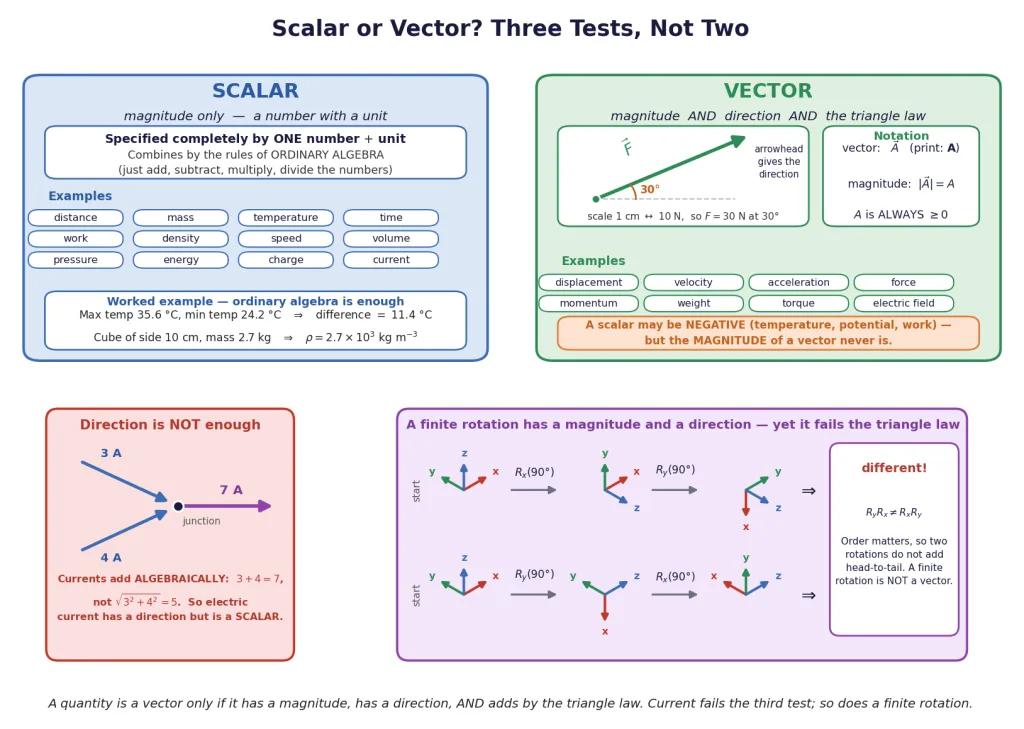
Key Point: A scalar quantity is a quantity with magnitude only. It is specified completely by a single number, along with the proper unit. The rules for combining scalars are the rules of ordinary algebra — scalars are added, subtracted, multiplied and divided just like ordinary numbers.
Common examples: distance, mass, temperature, time, work, density, speed, volume, pressure, and also energy, charge, power and electric current.
Two quick illustrations show how undramatic scalar arithmetic is:
- A rectangle 1.0 m by 0.5 m has perimeter m. Each side is a scalar, the perimeter is a scalar.
- The day's maximum and minimum temperatures are 35.6 °C and 24.2 °C, so the difference is simply 11.4 °C. A 10 cm aluminium cube of mass 2.7 kg has volume m^3 and density kg m^-3. All scalars, all plain arithmetic.
Key Point (a trap): "Magnitude only" does not mean "always positive". A scalar can be negative — a temperature of °C, a gravitational potential of J/kg, the work done by friction. The minus sign there is part of the value, not a direction. Contrast that with the magnitude of a vector, which is never negative.
Also worth noting: you may only add or subtract scalars that carry the same unit, but you may multiply or divide scalars of different units freely — that is exactly how mass divided by volume produces density.
Vectors — and the condition students skip
Key Point: A vector quantity is a quantity that has both a magnitude and a direction and obeys the triangle law of addition, or equivalently the parallelogram law of addition.
Read that definition again, because it has three conditions, not two. Almost every textbook summary in the market quotes only the first two, and almost every JEE and NEET conceptual question on this topic attacks the third.
Examples of vectors: displacement, velocity, acceleration, force, momentum, weight, torque, and electric field.
Two famous quantities that fail the third test
1. Electric current. Current in a wire clearly has a direction — we draw arrows for it on every circuit diagram. Yet current is a scalar. Why? Look at a junction where a 3 A wire and a 4 A wire meet at right angles and feed a third wire. The outgoing current is A. If current were a vector, the triangle law would demand A. Experiment says 7 A. Currents add algebraically, not by the triangle law, so current is a scalar.
2. Rotation through a finite angle. A rotation has an obvious magnitude (the angle) and an obvious direction (the axis). But take a physics textbook, rotate it about a horizontal axis and then about a vertical axis. Now start over and do the same two rotations in the opposite order. The book ends up in a different orientation. Vector addition is commutative — always — so anything whose "sum" depends on the order cannot be a vector. Finite rotations are not vectors. (Infinitesimally small rotations are, which is why angular velocity is a vector. That is a Class 11-12 rotational-motion story.)
[JEE Tip] If a question offers "has magnitude and direction, therefore it is a vector" as an option, treat it as wrong by default. The examiner is almost certainly holding electric current, finite rotation, or pressure behind their back.
The quick reference table
| Quantity | Scalar or vector | The reason in one line |
|---|---|---|
| Distance / path length | Scalar | A number of metres, no direction attached |
| Displacement | Vector | Needs "how far" and "which way"; adds head-to-tail |
| Speed | Scalar | Magnitude of velocity only |
| Velocity, acceleration | Vector | Direction is part of the physics |
| Mass, density, volume | Scalar | Pure amounts |
| Weight (the force ) | Vector | It is a force, directed downward |
| Time, temperature | Scalar | Temperature may be negative, but has no direction |
| Work, energy, power | Scalar | Products of vectors that come out directionless |
| Force, momentum, torque | Vector | All obey the triangle law |
| Pressure | Scalar | Defined as force per unit area, magnitude only |
| Electric current | Scalar | Has a direction but adds algebraically |
| Finite rotation | Neither | Has magnitude and direction but is not commutative |
| Number of moles | Scalar | A count |
| Angular frequency | Scalar | A rate, |
| Angular velocity | Vector | Direction along the axis, by the right-hand rule |
Writing a Vector Down, and Drawing It
Notation
Handwriting and printing disagree about vectors, and you need to read both.
Key Point: A vector is written with a small arrow over the letter, , , . Most printed books instead use bold face: , , . They mean exactly the same thing. Bold face is hard to produce by hand, so in your answer scripts always use the arrow.
The magnitude of a vector — also called its absolute value — is written , or more briefly as the same letter in ordinary (light) type, . So
Key Point: The magnitude of a vector is always a positive number or zero. It can never be negative. If a calculation ever hands you N, you have made a sign error, not a discovery.
[Board Important] Dropping the arrow is a real mark-loser. Writing "" when the question asked for the vector equation, or writing " m/s" with no direction, both get cut. Arrow on the vector, no arrow on the magnitude — be mechanical about it.
A vector is drawn as a directed line segment
This is the picture that the whole chapter runs on.
Key Point: A vector is represented by a directed line segment — an arrow. Its length, drawn to a chosen scale, is proportional to the magnitude of the vector, and the arrowhead shows its direction. The starting point is the tail (or origin) of the vector and the pointed end is its head (or tip).
Choosing a scale is the part students forget. If you decide that 1 cm represents 10 N, then:
- a 30 N force is drawn as a 3.0 cm arrow,
- a 45 N force is drawn as a 4.5 cm arrow,
- and an arrow you measure to be 2.2 cm long represents 22 N.
The direction is fixed by stating an angle from a reference direction — usually the -axis, or the east direction, or the horizontal. " above the horizontal", " north of east", " from the positive -axis" are all complete specifications.
Vectors are free — you may slide them
Here is a property that looks like a technicality and turns out to be the reason vector algebra works at all:
Key Point: In our study, vectors do not have fixed locations. Displacing a vector parallel to itself leaves the vector unchanged. Such vectors are called free vectors. (In some applications the line of action does matter — for example a force acting on a rigid body. Those are called localised vectors, and you will meet them in rotational motion.)
So the same arrow drawn in the top-left of your page and in the bottom-right of your page is the same vector, as long as its length and direction are unchanged. That is precisely what lets you pick up and place its tail on the head of when you add them in Section 2.
Position Vector and Displacement Vector
Now we use the language. These two vectors are how motion in a plane gets described at all, and the difference between them is examined every single year.
The position vector
To say where an object is in a plane, you must first choose a convenient point as the origin, call it O. Everything is then measured from there.
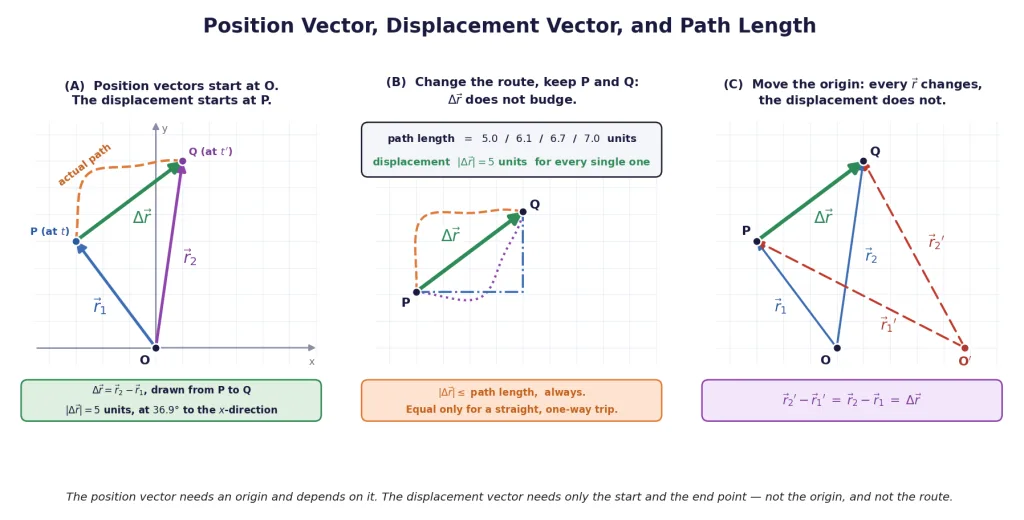
Key Point: If a particle is at the point P, the vector drawn from the origin O to P is its position vector, written (often written ). Its magnitude is the straight-line distance from O to P, and its direction is the direction in which P lies as seen from O.
The single most important thing to notice: the position vector depends on where you put the origin. Move the origin and every position vector in the problem changes. That is not a flaw — it just means the origin is a choice you make, and you must state it and then stick to it.
The displacement vector
Suppose the particle is at P at time (position vector ) and at Q at a later time (position vector ).
Key Point: The displacement vector is It is the vector drawn from the initial position P to the final position Q — tail at P, tip at Q. It is written as the vector .
The two independence properties
These are the exam-worthy facts, and they are what make displacement useful.
Key Point 1 — path independence. The displacement vector is the straight line joining the initial and final positions and does not depend on the actual path taken between them. A particle may crawl from P to Q along any winding route you like — there are infinitely many — and every one of them has the same displacement .
Key Point 2 — origin independence. Displacement does not depend on the choice of origin either. Shift the origin from O to O and both position vectors change, but the difference does not: where is the shift. The two terms cancel.
So: the position vector needs an origin and depends on it; the displacement vector needs neither an origin nor a route. All it needs is a start point and an end point.
Displacement versus path length, one more time
Chapter 2 established this for straight lines. In a plane the same statement holds, now as a statement about a vector:
Key Point: The magnitude of the displacement is less than or equal to the path length between the two points: The two are equal only when the object moves along a straight line in one direction, without turning back.
[NEET Important] Two instant consequences that NEET loves:
- Any closed path — a full lap of a circular track, a round trip home, a complete orbit — has zero displacement, however long the path length is. Therefore the average velocity is zero even though the average speed is not.
- Because path length and both are divided by the same time, average speed magnitude of average velocity, always.
Section 4 turns into velocity and acceleration. For now, make sure you can draw correctly: from the initial point, to the final point, in one straight arrow.
Equality of Vectors, and the Seven Special Vectors
When are two vectors equal?
Key Point: Two vectors and are said to be equal if, and only if, they have the same magnitude and the same direction.
Both conditions. Not one. There is a clean procedure for checking equality: shift parallel to itself until its tail coincides with the tail of . If their tips now coincide too, the vectors are equal. You are allowed to do that shifting precisely because vectors are free.
And the counterexample you must be able to quote: two vectors of the same length but different directions are not equal. Slide one onto the other's tail and the tips land in different places. A 5 N force pointing east and a 5 N force pointing north have equal magnitudes and are emphatically not the same force. In symbols, does not imply .
[JEE/NEET] Watch the reverse implication too: does imply . Equality of vectors is the stronger statement.
The gallery of special vectors
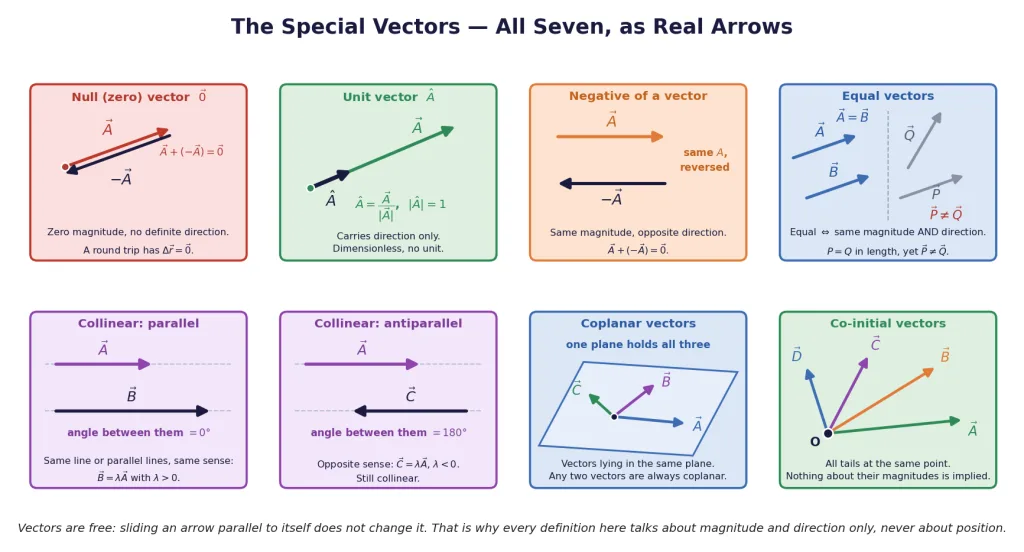
1. Null vector (zero vector), A vector of zero magnitude and no definite direction. Where it turns up: , and the displacement of any round trip (start and finish at the same point). Its properties: , , and . Note the arrow — the null vector is not the number .
2. Unit vector, A vector of magnitude exactly 1 drawn along a given direction: Its whole job is to carry direction and nothing else. Because you divide a quantity by its own magnitude, the units cancel: a unit vector is dimensionless and has no unit. Use: any vector splits neatly into "how much" times "which way", . The special unit vectors , , along the , and axes are the workhorses of Section 3.
3. Negative of a vector, Same magnitude, opposite direction. Use: it converts subtraction into addition, , which is exactly how Section 2 does subtraction. Also .
4. Equal vectors Same magnitude and same direction, as above. Use: it is what lets you slide a vector across the page during a construction without changing the physics.
5. Collinear vectors Vectors that act along the same line, or along parallel lines. Two sub-cases:
- Parallel: same sense, angle between them , so with .
- Antiparallel: opposite sense, angle between them , so with . Use: whenever for some real , the two are collinear, and their resultant is just an algebraic sum. These are the only two cases where vector addition collapses back to ordinary arithmetic.
6. Coplanar vectors Three or more vectors that all lie in the same plane. Use: this is the condition that lets us do the whole of this chapter in two dimensions. Note the small print — any two vectors are always coplanar, because two intersecting lines always define a plane. "Coplanar" only says something new from three vectors onward.
7. Co-initial vectors Vectors that all have the same initial point (their tails all sit at one point). Use: this is the natural arrangement for the parallelogram law, and for showing several forces acting at one point on a body. It says nothing at all about their magnitudes or directions.
The traps, collected
| The trap | The truth |
|---|---|
| "It has direction, so it is a vector" | Electric current has direction and is a scalar |
| "Magnitude and direction is enough" | Finite rotation has both and is still not a vector |
| "The magnitude of can be negative" | Never. A magnitude is |
| "Equal magnitudes means equal vectors" | Direction must match too |
| "Displacement depends on the route" | It depends only on the endpoints |
| "Displacement depends on the origin" | It does not; the position vector does |
| " has the unit of " | A unit vector is dimensionless |
| "The null vector is the number zero" | It is a vector, written |
| "Path length displacement" | Backwards: the displacement magnitude is the path length |
Solved Examples
Example 1: Sorting the list
State, for each of the following physical quantities, whether it is a scalar or a vector: volume, mass, speed, acceleration, density, number of moles, velocity, angular frequency, displacement, angular velocity.
Solution:
Apply the test in order: does it need a direction to be fully specified, and does it add by the triangle law?
| Quantity | Answer | Why |
|---|---|---|
| Volume | Scalar | A single number of cubic metres |
| Mass | Scalar | An amount of matter |
| Speed | Scalar | Magnitude of velocity, direction stripped off |
| Acceleration | Vector | Rate of change of a vector |
| Density | Scalar | Mass per unit volume, both scalars |
| Number of moles | Scalar | A count of particles |
| Velocity | Vector | Speed plus a direction |
| Angular frequency | Scalar | , a rate; no direction is specified here |
| Displacement | Vector | The straight arrow from start to finish |
| Angular velocity | Vector | Directed along the axis of rotation, by the right-hand rule |
Final Answer: Vectors — acceleration, velocity, displacement, angular velocity. Scalars — volume, mass, speed, density, number of moles, angular frequency.
Takeaway: Look at the pair angular frequency and angular velocity. They differ by one word and land on opposite sides of the table. Angular frequency is a rate of oscillation, a number; angular velocity has an axis and so a direction. Examiners plant this pair deliberately.
Example 2: Two more sorting drills
(a) Pick out the two scalar quantities from: force, angular momentum, work, current, linear momentum, electric field, average velocity, magnetic moment, relative velocity.
(b) Pick out the only vector quantity from: temperature, pressure, impulse, time, power, total path length, energy, gravitational potential, coefficient of friction, charge.
Solution:
- (a) Go through the list. Force, angular momentum, linear momentum, electric field, average velocity, magnetic moment and relative velocity all need a direction and all obey the triangle law. That leaves work and current.
- Work is a scalar: it is a product of two vectors (force and displacement) that yields a pure number of joules.
- Current is the classic trap. It has a direction, but currents meeting at a junction add algebraically, so it fails the triangle-law test and is a scalar.
- (b) Temperature, pressure, time, power, path length, energy, gravitational potential, coefficient of friction and charge are all specified by a number and a unit. Impulse is force multiplied by a time interval, — a vector times a scalar, therefore a vector, pointing along the force.
Final Answer: (a) work and current. (b) impulse.
Takeaway: Note why pressure is a scalar even though force is a vector. Pressure is force per unit area at a point, and it pushes equally in every direction — there is no one direction to quote. Anything of the form "vector scalar" (impulse, momentum , weight ) is a vector; anything of the form "vector vector" (work, power) comes out a scalar.
Example 3: Proving that a quantity with direction can still be a scalar
(a) At a junction in a circuit, a wire carrying 3 A and a wire carrying 4 A meet at right angles and feed a single outgoing wire. What is the outgoing current, and what would it be if current were a vector?
(b) A book lying flat is rotated about a horizontal axis and then about a vertical axis. Another identical book is given the same two rotations in the reverse order. Are the two books in the same final orientation? What does the answer prove?
Solution:
- (a) By charge conservation (Kirchhoff's junction rule), the current out equals the sum of the currents in, algebraically: If current obeyed the triangle law, two perpendicular "current vectors" would combine to Experiment gives 7 A, not 5 A. So current fails the triangle-law test.
- (b) The two books end up in different orientations. Track any corner of the book through both sequences and you will find it in two different places. In matrix language, — the two rotations do not commute.
- Now recall a property of vector addition that Section 2 will prove: it is commutative, , always. A finite rotation has a magnitude (the angle) and a direction (the axis), but combining two of them depends on the order. So a finite rotation cannot be a vector.
Final Answer: (a) 7 A; a vector treatment would wrongly predict 5 A, so current is a scalar. (b) No — the orders give different results, so finite rotation is not a vector.
Takeaway: These are the two standard counterexamples, and between them they justify the third clause of the definition. Having a direction is necessary for being a vector; it is nowhere near sufficient. Learn to say "it does not obey the triangle law" — that is the sentence that earns the mark.
Example 4: Drawing to scale, and reading a drawing back
(a) On a scale of 1 cm to 5 m/s, how long an arrow represents a velocity of 20 m/s directed north of east? (b) On the same scale, a student's arrow measures 2.4 cm. What velocity is it? (c) A force diagram uses 1 cm to 4 N and an arrow is 6.5 cm long. What force is that? (d) Can the same diagram represent m/s?
Solution:
- (a) Length required magnitude scale: Draw a 4.0 cm arrow at measured anticlockwise from the east direction, with the arrowhead at the far end.
- (b) Reading backwards, magnitude length scale m/s, along whatever direction the arrow points.
- (c) N.
- (d) No. A length on paper cannot be negative, and neither can the magnitude of a vector. m/s is meaningless. If a body moves at 20 m/s in the direction opposite to , you write , and its magnitude is still m/s.
Final Answer: (a) 4.0 cm; (b) 12 m/s; (c) 26 N; (d) no — a magnitude is never negative.
Takeaway: The scale statement is part of the answer, not decoration. In a board exam a graphical-method question that says "1 cm = 5 m/s" expects you to write the scale down, measure, and convert back. Marks are given for the scale line.
Example 5: Position vectors, displacement, and moving the origin
A particle is at the point P m at time and at Q m at time , coordinates measured from an origin O.
(a) Find the magnitudes of the two position vectors. (b) Find the displacement vector, its magnitude and its direction. (c) Repeat part (b) with the origin shifted to O m and comment.
Solution:
- (a) The position vectors are and :
- (b) Displacement is final minus initial: measured anticlockwise from the -direction (that is rad).
- (c) From the new origin, the coordinates of P and Q are and . The position vectors have changed: now m and m. But which is the same displacement, m at .
Final Answer: (a) 3.61 m and 8.49 m; (b) m at to the -axis; (c) the position vectors change to 3.16 m and 8.06 m, but the displacement is unchanged.
Takeaway: The shift was subtracted from both position vectors, so it cancelled in the difference. That single line is the whole proof of origin independence, and it is why physics problems let you put the origin wherever it is convenient.
Example 6: A semicircular track — displacement against path length
A jogger runs from A to B along a semicircular track of radius 35 m, A and B being the two ends of a diameter. (a) Find the path length and the displacement. (b) Find the ratio of the magnitude of the displacement to the path length. (c) What are they if she keeps going and completes the full circle back to A?
Solution:
- (a) The path length is the length of the semicircular arc: The displacement is the straight arrow from A to B, which is the diameter: directed from A towards B along the diameter.
- (b) Notice the radius cancelled — the ratio is for any semicircle.
- (c) For the full circle the path length doubles to m, but she finishes where she started, so
Final Answer: (a) path 110 m, displacement 70 m; (b) ; (c) path 219.9 m, displacement zero.
Takeaway: Two habits worth building. First, path length is measured along the curve; displacement is measured through the middle. Second, for any closed path the displacement is the null vector — so the average velocity of one complete lap is exactly zero, no matter how fast the lap was run.
Example 7: A two-leg journey
A cyclist rides 3 km due east and then 4 km due north. Find (a) the total path length, (b) the magnitude and direction of the displacement, and (c) the ratio of the two.
Solution:
- (a) Path length is just the sum of the distances covered along the route:
- (b) Put the origin at the start. The cyclist finishes 3 km east and 4 km north of it, so So the displacement is 5 km directed north of east (that is rad from the east direction).
- (c)
Final Answer: (a) 7 km; (b) 5 km at north of east; (c) .
Takeaway: The direction is half the answer. "5 km" alone is not a displacement — it is a magnitude. Always finish a displacement answer with the angle and the reference direction you measured it from. And note , as requires.
Example 8: A round trip and the null vector
A cyclist starts from a point O, rides 400 m due north, then 300 m due east, and then returns to O along the straight road joining his position to O. The whole trip takes 300 s. Find (a) the length of the last leg, (b) the total path length, (c) the net displacement, (d) the average speed, and (e) the magnitude of the average velocity.
Solution:
- (a) After two legs he is 400 m north and 300 m east of O, so his distance from O is The last leg is that straight 500 m road.
- (b)
- (c) He finishes exactly where he began, so the displacement is the null vector: You can see it in the legs too: .
- (d)
- (e)
Final Answer: (a) 500 m; (b) 1200 m; (c) ; (d) 4 m/s; (e) zero.
Takeaway: A moving body with zero average velocity is not a contradiction — it just means it came home. This is the cleanest illustration of the null vector in the whole chapter, and the "average speed is 4 m/s but average velocity is zero" contrast is a guaranteed one-marker.
Example 9: Unit vectors
A force is given by newton.
(a) Find its magnitude. (b) Find the unit vector along . (c) Verify that your unit vector has magnitude 1 and state its unit. (d) Write the vector of magnitude 24 m/s that points along the same direction.
Solution:
- (a)
- (b) By definition :
- (c) Its unit: we divided newtons by newtons, so the unit vector is dimensionless and carries no unit at all. Do not write " N".
- (d) Any vector is (magnitude) (unit vector along it): Check: m/s, and the direction, , matches . Same direction, new magnitude.
Final Answer: (a) 10 N; (b) ; (c) magnitude 1, dimensionless; (d) m/s.
Takeaway: Remember the two-way split . It says a vector is "how much" times "which way", and it is the fastest way to build a new vector of a stated size along a known direction — a construction you will use constantly in projectile and circular motion. (Components and , are set up properly in Section 3; here we only needed the definition of .)
Example 10: Are these two vectors equal?
(a) A particle moves from A to B. A second particle moves from C to D. Are the two displacement vectors equal? (b) Is the vector equal to ?
Solution:
- (a) Compute both displacements as (final initial): Magnitudes: both . Directions: both . Same magnitude and same direction, so They start from different points, but a vector is free — slide one until the tails coincide and the tips coincide too.
- (b) Magnitudes: and . Equal magnitudes. Directions: for but for . Different. Hence The angle between them is — small, but not zero, and that is enough.
Final Answer: (a) Yes, AB CD. (b) No — same magnitude, different directions.
Takeaway: Part (a) shows that equality has nothing to do with location; part (b) shows it has everything to do with direction. Together they are the whole content of "equal if and only if same magnitude and same direction". Swapping the components of a vector is the examiner's favourite way to build a wrong option that has the right magnitude.
Example 11: Collinear, coplanar, co-initial
Let .
(a) Is collinear with ? Find , the ratio , and the angle between them. (b) Three forces act at the same point on a body and all lie in the plane of the page. Which of the words collinear, coplanar, co-initial apply? (c) True or false: any two vectors are always coplanar.
Solution:
- (a) . Since with , a real number, the two are collinear. Magnitudes: Because is negative, points the opposite way: the angle between them is ( rad). They are collinear and antiparallel.
- (b) They are co-initial, because all three tails sit at the same point. They are coplanar, because all three lie in the plane of the page. They are not collinear unless they happen to lie along one line — three forces at a point generally do not.
- (c) True. Two vectors, drawn from a common point, define two intersecting lines, and two intersecting lines always determine exactly one plane. So the idea of coplanarity only becomes a real condition once you have three or more vectors.
Final Answer: (a) collinear and antiparallel; , ratio 2, angle . (b) co-initial and coplanar, not collinear. (c) True.
Takeaway: Multiplying by a real number never changes the line a vector lies along — it only stretches the arrow by and, if , flips it end for end. So "" and "collinear" are the same statement. Section 2 develops this properly.
Example 12: Position and displacement on a curved path
A particle moves along a quarter circle of radius 10 m centred at the origin, from the point m to the point m.
(a) What are the magnitudes of the position vectors at the start and at the end? (b) Find the displacement vector, its magnitude and its direction. (c) Find the path length and compare.
Solution:
- (a) Every point of the path is on a circle of radius 10 m centred at the origin, so The two position vectors have the same magnitude but different directions, so they are not equal vectors — a live example of Example 10's point.
- (b) The displacement points up and to the left; measuring anticlockwise from the direction, (that is rad), i.e. above the direction, which is north-west.
- (c) The path is a quarter of the circumference: So , and the ratio is , comfortably obeying .
Final Answer: (a) 10 m each; (b) m at from the axis; (c) path 15.71 m, ratio 0.900.
Takeaway: Three things in one problem: equal magnitudes do not make equal vectors, the displacement of a curved journey is still one straight arrow, and the angle must be quoted from a stated reference direction — writing "" here without saying from where would be ambiguous and would cost the mark.