
Constant Speed, and Yet Accelerating
Here is a sentence that sounds like nonsense the first time you read it:
A stone whirled on a string at a perfectly steady speed is accelerating the whole time.
Nothing about the stone is speeding up. Nothing is slowing down. Put a speedometer on it and the needle never moves. And still, every physicist in the world will tell you it is accelerating — hard.
The resolution is a single word you already know: velocity is a vector. Acceleration is the rate of change of velocity, not the rate of change of speed. A vector can change in two ways — its length can change, or its direction can change. The stone's velocity vector never changes length, but it is swinging round through a full every revolution. That is a change. So there is an acceleration.
Section 4 already laid the groundwork for this: it showed that when is perpendicular to , the speed stays constant while the direction turns. This section is that special case worked out completely.
Key Point: When an object follows a circular path at constant speed, the motion is called uniform circular motion. The word uniform refers to the speed — which is constant — and NOT to the velocity, which changes direction at every single instant.
Why the velocity is tangential
Section 4 proved that instantaneous velocity is always along the tangent to the path. Feed a circle into that result and you get a fact worth carrying everywhere: in circular motion points along the tangent, and since a tangent to a circle is always perpendicular to the radius at that point, is perpendicular to the radius at every instant.
That is not a bonus fact, it is the hinge of the entire derivation later in this section. Circle the sentence.
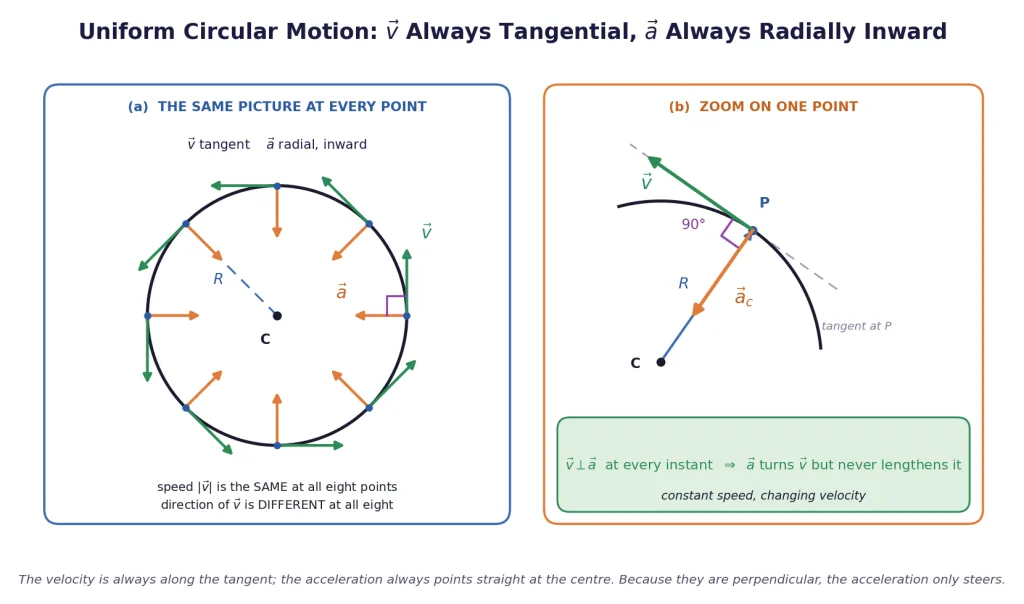
Look at panel (a). Eight points around one circle. At every one of them the green arrow has exactly the same length — that is "constant speed". At every one of them the green arrow points somewhere different — that is "changing velocity". Both statements are visible in the same picture, which is why the paradox at the top of this page is not really a paradox at all.
Two things this section will not do
- It will not explain what makes the object go round. That is a question about forces, and forces belong to Chapter 4. Here we only describe the motion.
- It will not cover motion where the speed also changes as the object goes round. That is called non-uniform circular motion, it needs a second component of acceleration, and Section 9 (JEE Corner) picks it up.
The quantities we are about to need
| Symbol | Name | SI unit | What it measures |
|---|---|---|---|
| radius | m | size of the circle | |
| linear (tangential) speed | m/s | how fast along the arc | |
| angular displacement | rad | how much angle was swept | |
| angular speed | rad/s | how fast the angle sweeps | |
| time period | s | time for one full revolution | |
| frequency | Hz | revolutions per second | |
| centripetal acceleration | m/s^2 | the inward acceleration |
Seven symbols, and by the end of this section every one of them will be expressible in terms of any other two. That is genuinely all uniform circular motion is.
The Angular Language: , and
Describing a circle with and is clumsy — both coordinates wobble up and down as you go round. There is a much better variable: the angle.
Angular displacement
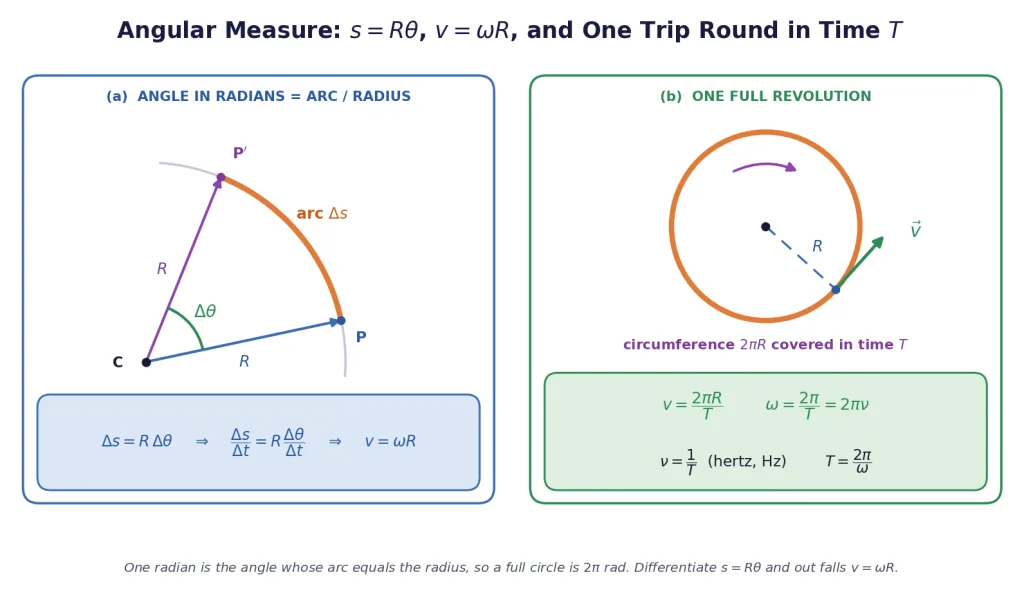
Put the centre of the circle at C. As the object moves from P to P, the line CP sweeps through an angle. That angle is the angular displacement , and in physics we measure it in radians, never in degrees, unless a question specifically asks for degrees at the end.
Key Point: One radian is the angle subtended at the centre by an arc equal in length to the radius. So by definition A full circle has arc length , so a full circle is radians. Hence rad , rad , and 1 rad .
Radians look like an odd choice until you notice what they buy you: is clean only in radians. In degrees you would have to write and drag that factor through every equation for the rest of your life. Note also that a radian is a pure number (a length divided by a length), which is why "rad" quietly appears and disappears in unit checks without breaking anything.
Angular speed
Angular speed is the rate at which the angle is being swept out:
Key Point: Its SI unit is the radian per second (rad/s), often written s since the radian is dimensionless.
For uniform circular motion is a constant, so the average and the instantaneous angular speed are the same number and you can use over any interval you like, big or small.
The bridge:
Now watch how one line of algebra connects the angular world to the linear world. Start with the arc length in a small time :
Divide both sides by :
The left side is the speed along the arc — which, as , is exactly the linear speed . The right side is . Therefore:
Key Point: The linear speed is the angular speed multiplied by the radius. is the exchange rate between "angle per second" and "metres per second".
The consequence students forget
Every point on a rigid rotating body — a fan blade, a wheel, a merry-go-round, a CD — shares the same . They all sweep the same angle in the same time; they have to, or the body would tear itself apart. But because , points further from the axis move faster.
Key Point: On one rigid rotating body, is common to all points and . The tip of a fan blade is doing several times the speed of a point halfway along it, even though both complete one turn in the same time.
[JEE/NEET] This is the standard trap in "two points on a rotating disc" questions. Read the question carefully: if the two points are on the same rotating body, equate the 's. If they are two separate objects on two different circles, you cannot assume anything is equal until the question tells you what is.
Units discipline
has to be in rad/s before you put it into any formula in this section. Questions love to hand you the rotation rate in some other unit:
| Given as | Convert with | Example |
|---|---|---|
| revolutions per second () | 5 rev/s gives rad/s | |
| revolutions per minute (rpm) | 300 rpm gives rad/s | |
| revolutions in seconds | 14 rev in 25 s gives rad/s | |
| degrees per second | multiply by | /s gives rad/s |
[NEET Important] rpm to rad/s is divide by 60, then multiply by . Doing only one of those two steps is the single most common arithmetic slip in this topic.
Time Period and Frequency
Circular motion repeats. That gives us two more quantities, and they are the ones the numerical questions usually hand you.
Key Point:
- The time period is the time taken for one complete revolution. SI unit: second.
- The frequency is the number of revolutions completed per second. SI unit: hertz (Hz), where 1 Hz = 1 revolution per second = 1 s.
- They are reciprocals:
(Frequency is written with the Greek letter nu, . Watch it — handwritten, and look alarmingly alike; is also used for frequency for exactly that reason.)
Everything in terms of and
In one full revolution the object travels the whole circumference, , and takes time . Speed is distance over time, so
And in one full revolution the angle swept is radians in time :
That last relation deserves its own line because it is used constantly:
Key Point:
Notice the factor is what converts "revolutions per second" into "radians per second" — because one revolution is radians.
Consistency check: substitute into and you get , exactly what we wrote from circumference-over-time. The two routes agree, as they must.
The conversion table you should be able to write from memory
| If you know | is | is | is |
|---|---|---|---|
| and | given | ||
| and | given | ||
| and | given | ||
| and | |||
| rev in time |
[Board Important] The last row is how almost every Board question is phrased — "makes 14 revolutions in 25 s", "completes 7 revolutions in 100 s". Read it as: and . Get those two out first, before you touch anything else, and the rest of the problem falls over on its own.
A worked feel for the numbers
An object on a circle of radius 2.0 m completing one revolution every 4.0 s:
- s, so Hz — a quarter of a revolution every second.
- rad/s.
- m/s. Check: m/s. Agreed.
Three numbers, thirty seconds, no formula sheet required.
Centripetal Acceleration: the Similar-Triangles Derivation
Time to find that acceleration. We know it exists (the direction of keeps changing). We now want two things about it: how big and which way.
The standard derivation is a small piece of geometry, and it is genuinely beautiful, so do not skip to the boxed formula.
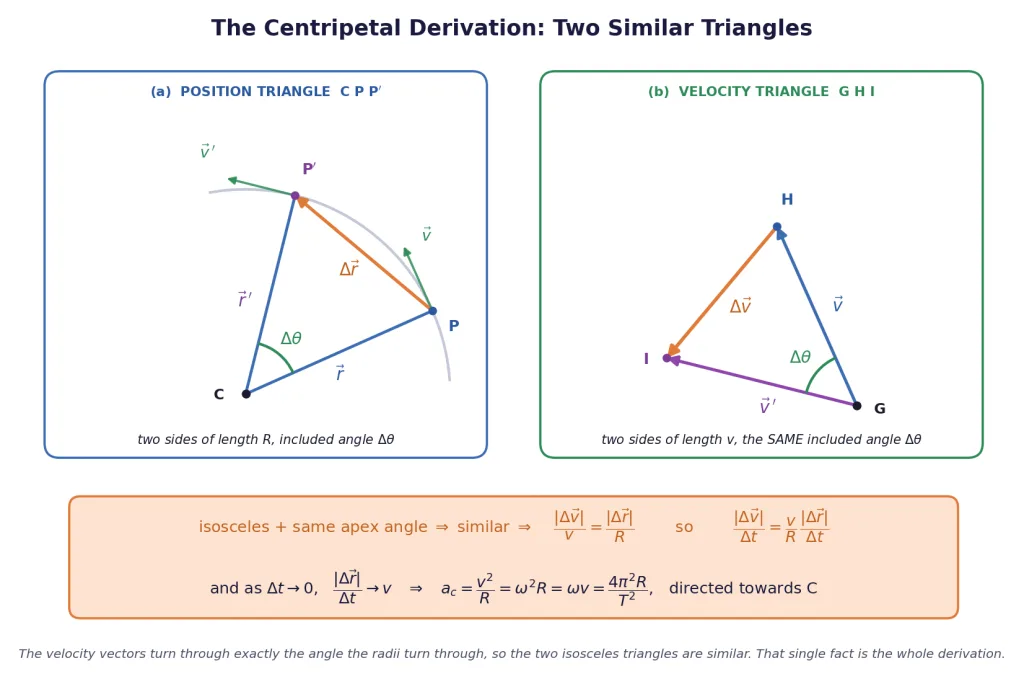
Set up the two triangles
Let the object be at P at time and at P at time .
- Its position vectors from the centre C are and . Both have length . The angle between them is the angle swept, . The third side of triangle CPP is the displacement .
- Its velocity vectors are and . Both have length (constant speed!). Draw them from a common point G; their heads are H and I. The third side of triangle GHI is .
Now the key observation, the one the whole derivation turns on:
Key Point: is perpendicular to , and is perpendicular to . If you rotate two perpendicular lines together, the angle between them is preserved — so the angle between and is also . The velocity vectors turn through exactly the angle the radii turn through.
Therefore the triangles are similar
Triangle CPP has two sides of length with included angle — isosceles. Triangle GHI has two sides of length with the same included angle — also isosceles. Two isosceles triangles with equal apex angles are similar. So the ratio of base to equal-side is the same in both:
Divide by and take the limit
Let . On the left, becomes the magnitude of the instantaneous acceleration, . On the right, becomes the magnitude of the instantaneous velocity — because as the interval shrinks, the chord PP and the arc PP become indistinguishable, and arc over time is the speed . (Stated explicitly: for small , .)
So the right-hand side becomes , and:
Key Point — centripetal acceleration:
The same formula, four ways
Substituting , and gives four interchangeable forms. Know all four; questions will hand you whichever variable is least convenient.
| Form | Use it when the question gives you |
|---|---|
| linear speed and radius | |
| angular speed and radius | |
| both speeds, or when you want to avoid | |
| period and radius | |
| frequency and radius |
And the direction: straight at the centre
The magnitude was the easy half. The direction is the half with the name in it.
Since and , the triangle GHI is just the triangle CPP rotated through and rescaled. So is perpendicular to . And , being the base of an isosceles triangle, lies along the bisector of the angle between and — which, when you place it on the arc, points inward.
Make smaller and the picture sharpens: makes an angle of with , and as that becomes exactly — perpendicular to the velocity, aimed dead at the centre.
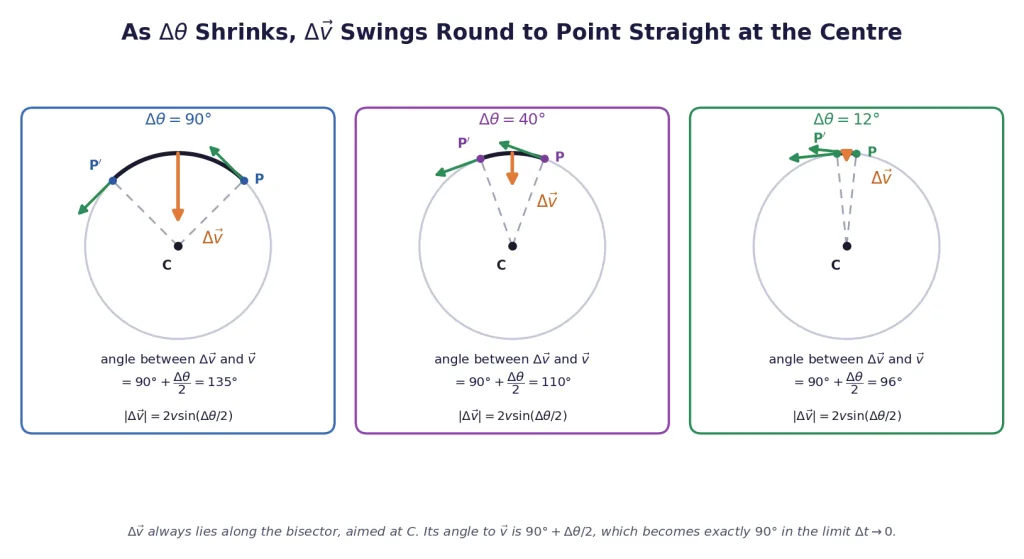
Key Point: The acceleration in uniform circular motion has magnitude and is directed radially inward, towards the centre of the circle, at every point of the path. Because of that direction it is called centripetal acceleration — from a Greek root meaning centre-seeking. The term is Newton's; the first thorough published analysis was by Christiaan Huygens in 1673.
A useful by-product
The similar-triangles ratio also hands you the exact size of the velocity change over a finite arc, which the limit throws away. Since the velocity triangle is isosceles with sides and apex angle :
Some quick values worth remembering: over a quarter circle (), ; over , exactly; over a half circle (), , because the velocity has simply reversed.
[JEE Tip] Do not confuse with . The first is the true magnitude of the vector change; the second would only be right if the acceleration vector held still, which it does not. Their ratio is the reason the average acceleration over an arc is always a bit smaller than the instantaneous .
Perpendicular Forever — and What Is Not
Why the speed cannot change
Put the two results side by side. is tangential. is radial and inward. A tangent is perpendicular to a radius. Therefore:
Key Point: In uniform circular motion, and are perpendicular at every instant.
Section 4 proved what that costs and what it buys: when , the component of acceleration along the motion is zero, so the rate of change of speed is zero, and the entire acceleration goes into turning. We do not need to redo that argument — we just collect it.
So the logic runs in a satisfying circle of its own: constant speed forces , and keeps the speed constant. Each is the reason for the other.
Centripetal acceleration is a requirement, not a cause
This is the single biggest conceptual confusion in the topic, so let us be blunt about it.
Key Point: "Centripetal acceleration" is a kinematic requirement, not a force. It is the answer to the question "what acceleration must a body have if it is to move in a circle of radius at speed ?" — and the answer is towards the centre. It says nothing about what supplies that acceleration.
What supplies it changes from problem to problem, and every one of them is Chapter 4's business, not ours:
| Situation | What actually provides the inward acceleration |
|---|---|
| Stone whirled on a string | tension in the string |
| Car turning on a flat road | friction between tyres and road |
| Moon orbiting the Earth | gravitational attraction |
| Ball rolling inside a bowl | the normal reaction from the surface |
| Electron in a magnetic field | the magnetic force |
There is no such thing as "centripetal force" as a separate new force of nature. The phrase is just a job title: whichever real force happens to be pointing at the centre gets to hold the job. In this chapter we describe the motion; in Chapter 4 you will find out who is paying for it.
[NEET Important] And there is no outward "centrifugal force" in an inertial frame. The outward shove you feel on a turning bus is your own inertia — your body's tendency to keep going straight while the bus turns under you. Do not put a centrifugal arrow on a free-body diagram in this course.
Three traps that are worth marks
[JEE/NEET] Trap 1 — average velocity over a full revolution is zero. After one complete revolution the object is back where it started, so the displacement is and
Path length and displacement are wildly different here — against . Over half a revolution the numbers are against , so the average speed exceeds the magnitude of the average velocity by exactly the factor . The same argument makes the average acceleration over a full revolution zero too, since returns to its starting value — while the instantaneous is nowhere near zero. Exactly this is asked constantly.
[JEE/NEET] Trap 2 — is not a constant vector. Its magnitude never changes. Its direction changes continuously, always pointing at the centre, sweeping through every revolution. A vector whose direction keeps changing is not a constant vector, no matter how steady its length.
Key Point: Constant magnitude constant vector. In uniform circular motion is constant but is not.
[JEE/NEET] Trap 3 — the kinematic equations do NOT apply. and from Section 4 were derived assuming is a constant vector. In circular motion it is not, so those equations are simply invalid here. Put plainly: the kinematic equations for uniform acceleration do not apply to uniform circular motion, because here the magnitude of the acceleration is constant but its direction is changing.
Writing "" on a circular-motion problem is not a small slip. It is applying a formula outside the conditions of its derivation, and it will be wrong.
The whole section on one card
| Quantity | Formula | Direction |
|---|---|---|
| Angular displacement | (radians) | along the axis (Section 9) |
| Angular speed | --- | |
| Linear speed | tangential | |
| Time period | --- | |
| Frequency | (Hz) | --- |
| Centripetal acceleration | radially inward | |
| Velocity change over angle | along the bisector, inward | |
| Angle between and | , always | --- |
Where this goes next
Section 7 puts a second observer into the picture and asks how motion looks from a moving frame. Section 9 (JEE Corner) takes the lid off: angular velocity as a genuine vector , non-uniform circular motion where a tangential acceleration sits alongside , and the radius of curvature of a general curved path — which turns out to be , this section's formula read backwards.
Solved Examples
Two habits before we begin. First: convert to rad/s immediately. Whatever unit the rotation rate arrives in, turn it into in rad/s on line one. Second: cross-check with a second formula. If and disagree, you have made an arithmetic slip and you have caught it in ten seconds.
Example 1: The insect in the groove
An insect trapped in a circular groove of radius 12 cm moves along the groove steadily and completes 7 revolutions in 100 s. (a) What is its angular speed, and its linear speed? (b) Is the acceleration vector a constant vector? What is its magnitude?
Solution:
- Get first. Seven revolutions in 100 s means one revolution takes
- (a) Angular speed:
- Linear speed, using with cm: Its direction is along the tangent to the groove at every point.
- (b) Magnitude of the acceleration: Cross-check with the other form: cm/s^2. Agreed.
- Is constant? No. It always points towards the centre of the groove, and since that direction changes continuously as the insect crawls round, the acceleration vector is continuously changing direction. Only its magnitude is constant.
Final Answer: (a) rad/s, cm/s, tangential; (b) not a constant vector — direction changes continuously — but its magnitude is constant at 2.3 cm/s^2.
Takeaway: Notice we never converted centimetres to metres. We did not need to: and give the answer in whatever length unit came in, as long as is in rad/s. Part (b) is the real physics of the question, and it is worth more marks than the arithmetic.
Example 2: The stone on a string
A stone tied to the end of a string 80 cm long is whirled in a horizontal circle with a constant speed. If the stone makes 14 revolutions in 25 s, what is the magnitude and direction of the acceleration of the stone?
Solution:
- Radius and frequency. The string is the radius, so cm m. Fourteen revolutions in 25 s means
- Angular speed:
- Acceleration:
- Cross-check two more ways. Linear speed m/s, so m/s^2. And m/s^2. Three routes, one answer.
- Direction: along the string, pointing from the stone towards the centre of the horizontal circle.
Final Answer: m/s^2, directed along the string towards the centre of the circle.
Takeaway: A famous coincidence lives in this answer: m/s^2 is almost exactly . It means nothing physically — it is just the numbers — but examiners like the problem for precisely that reason, so do not let the familiar-looking number talk you into writing "9.8".
Example 3: The aircraft loop
An aircraft executes a horizontal loop of radius 1.00 km with a steady speed of 900 km/h. Compare its centripetal acceleration with the acceleration due to gravity.
Solution:
- Convert to SI first.
- Centripetal acceleration:
- Compare with m/s^2:
Final Answer: m/s^2, which is about 6.4 times the acceleration due to gravity.
Takeaway: "Compare with " means take a ratio, not a difference — and the ratio is dimensionless, which is why it is a genuinely meaningful statement about how brutal the turn is. Pilots call this a 6.4 g turn, and it is close to the limit of what a trained human can take without blacking out. Note also how little work step 1 was, and how impossible the problem is without it.
Example 4: The full set of five numbers for a car on a track
A car goes round a circular track of radius 50 m at a constant speed of 72 km/h. Find (a) its speed in m/s, (b) its angular speed, (c) the time period, (d) the frequency and (e) the centripetal acceleration.
Solution:
- (a)
- (b) From :
- (c) Check the other way: s. Agreed.
- (d) So the car completes about one lap every sixteen seconds, or roughly 3.8 laps a minute.
- (e) Cross-check: m/s^2.
Final Answer: (a) 20 m/s; (b) 0.40 rad/s; (c) 15.71 s; (d) 0.0637 Hz; (e) 8.0 m/s^2 towards the centre.
Takeaway: Given any two of you can produce all the rest, and there is always a second route to check the answer. Build the habit of taking it — it costs seconds and saves marks.
Example 5: The ceiling fan
A ceiling fan blade is 60 cm long, measured from the axis to the tip, and the fan rotates at 300 rpm. Find (a) the angular speed, (b) the speed of the blade tip, (c) the centripetal acceleration of the tip, and express it as a multiple of . Take m/s^2.
Solution:
- (a) Convert rpm to rad/s. 300 revolutions per minute is revolutions per second, so Hz and
- (b) With m, That is about 68 km/h at the tip — worth respecting.
- (c) Cross-check: m/s^2.
Final Answer: (a) 31.42 rad/s; (b) 18.85 m/s; (c) 592.2 m/s^2, about 60 times .
Takeaway: Ordinary household objects produce enormous centripetal accelerations, because carries the square of the angular speed. Double the rpm and quadruples. That is why fan blades and grinding wheels are engineered so carefully — and why a loose blade becomes a projectile.
Example 6: Two points on the same disc
A disc rotates at a steady 120 rpm. Point A is 10 cm from the axis and point B is 25 cm from the axis. Find, for each point, the angular speed, the linear speed and the centripetal acceleration, and state the ratios and .
Solution:
- One angular speed for both. A and B are on the same rigid disc, so they share :
- Linear speeds:
- Accelerations:
- Ratios. Since is common, both and are directly proportional to :
Final Answer: rad/s for both; m/s, m/s; m/s^2, m/s^2; both ratios are .
Takeaway: Same body, same . Then and . Compare this with Example 11, where two objects share the same speed instead — and every proportionality flips over.
Example 7: A point on the Earth's equator
Treat the Earth as a sphere of radius m rotating once every 24 hours. For a person standing on the equator, find (a) the angular speed, (b) the linear speed, and (c) the centripetal acceleration, and express it as a percentage of m/s^2.
Solution:
- (a) One revolution in s, so
- (b) Cross-check: m/s. That is about 1670 km/h.
- (c)
Final Answer: (a) rad/s; (b) about 463 m/s; (c) 0.0337 m/s^2, roughly 0.34% of .
Takeaway: You are hurtling eastward faster than a passenger jet and you cannot feel a thing, because the acceleration it requires is a third of one percent of . That tiny number is also why the measured value of is very slightly smaller at the equator than at the poles — a real, measurable effect hiding inside a "negligible" quantity.
Example 8: Velocity change over a quarter circle
A particle moves in a circle of radius 5.0 m at a constant speed of 10 m/s. Between two points P and Q on the circle, the radius turns through . Find (a) the magnitude of the change in velocity, (b) the time taken, (c) the magnitude of the average acceleration over that interval, (d) the instantaneous centripetal acceleration, and (e) the displacement and the path length.
Solution:
- Angular speed: rad/s.
- (a) Change in velocity. The two velocity vectors have the same length 10 m/s and the angle between them is rad: (Or directly: the vectors are perpendicular and equal in length, so the difference has magnitude m/s.)
- (b) Time taken:
- (c) Average acceleration: Its direction is along the bisector, i.e. from the midpoint of the arc towards the centre.
- (d) Instantaneous centripetal acceleration: So the average is only of the instantaneous value.
- (e) The two radii are perpendicular, so the displacement is the chord m, while the path length is the quarter arc m.
Final Answer: (a) 14.14 m/s; (b) 0.785 s; (c) 18.0 m/s^2; (d) 20.0 m/s^2; (e) displacement 7.07 m, path length 7.85 m.
Takeaway: Three separate traps live in this one question. The average acceleration is not equal to — it is smaller, because the acceleration vector keeps rotating during the interval. Displacement is not path length. And m/s even though the speed never changed by a single m/s.
Example 9: One complete revolution
A particle completes one full revolution of a circle of radius 2.0 m in 4.0 s at constant speed. Find (a) its speed, (b) its centripetal acceleration, (c) its average speed over one revolution, (d) its average velocity over one revolution, (e) its average acceleration over one revolution, and (f) the magnitude of its average velocity over half a revolution.
Solution:
- (a)
- (b)
- (c) Average speed is total path over total time: — the same as the instantaneous speed, because the speed never varies.
- (d) After one revolution the particle is back at its starting point, so and
- (e) After one revolution the velocity vector is back to exactly what it was, so and the average acceleration is also — even though at every instant m/s^2.
- (f) Over half a revolution the particle ends up diametrically opposite, so the displacement is m in a time s: Meanwhile the average speed over that half is still 3.14 m/s. Their ratio is , exactly as predicted.
Final Answer: (a) 3.14 m/s; (b) 4.93 m/s^2; (c) 3.14 m/s; (d) zero; (e) zero; (f) 2.0 m/s.
Takeaway: Parts (d) and (e) are a favourite exam question in numerical clothing, and they are pure vector bookkeeping — a closed path has zero displacement, and a returning velocity has zero change. Part (f) gives you the factor that shows up again and again in half-revolution questions.
Example 10: Working backwards from the acceleration
A body moves in a circle of radius 0.25 m with a constant centripetal acceleration of 9.0 m/s^2. Find its speed, angular speed, time period and frequency.
Solution:
- Speed from :
- Angular speed from : Check with : m/s^2. Correct.
- Time period:
- Frequency:
Final Answer: m/s, rad/s, s, Hz.
Takeaway: Every relation in this section runs in both directions. Do not memorise "formulas for finding " — memorise the relationships, and then solve for whichever letter the question is missing.
Example 11: Same period, or same speed?
Two particles A and B move in horizontal circles of radii and . Compare their linear speeds and centripetal accelerations (a) if they have the same time period, and (b) if they have the same linear speed.
Solution:
- (a) Same time period . Same means the same . Then With a common , both and are directly proportional to . The outer particle is faster and more strongly accelerated.
- (b) Same linear speed . Now use the forms that contain : With a common , is inversely proportional to . The inner particle is now the more strongly accelerated one.
Final Answer: (a) and ; (b) , and .
Takeaway: The proportionality of with reverses depending on what is being held fixed. There is no such thing as " increases with radius" as a standalone fact. Always ask first: what is common between the two motions? Then pick the form of that contains that common quantity.
Example 12: The centrifuge
A laboratory centrifuge spins a sample at a radius of 15 cm at 3000 rpm. Find the angular speed, the linear speed of the sample and its centripetal acceleration, expressed as a multiple of m/s^2.
Solution:
- Angular speed. rpm rev/s, so Hz and
- Linear speed, with m:
- Centripetal acceleration:
Final Answer: rad/s, m/s, m/s^2, about 1510 times .
Takeaway: This is what centrifuges are for. Denser particles need an enormous inward acceleration to be carried round with the fluid; anything that cannot get it gets left behind at the outer wall, which is exactly how a centrifuge separates a mixture. Note again the : going from 3000 to 6000 rpm would not double this number, it would quadruple it.