
Velocity Changes Too — So Measure How Fast
Section 2 handed you a powerful tool: the velocity at any instant, , read off as the slope of the tangent to the x-t graph. But look at what that tool actually reports for real motion. A car pulling away from a red light has , then 3 m/s, then 8 m/s, then 14 m/s. A ball you throw up has m/s, then 20, then 10, then 0, then negative.
The velocity itself is changing. So the obvious next question is: how fast is the velocity changing?
Galileo got here first — and asked the right question
This is not a trivial question, and it stumped people for a long time. Change of velocity with respect to what? Two candidates:
- rate of change of velocity with distance, or
- rate of change of velocity with time.
Galileo tested both on freely falling bodies and on balls rolling down inclined planes, and found something decisive: the rate of change of velocity with time is a constant of motion for all objects in free fall, while the change of velocity with distance is not constant at all — it decreases as the object falls further. Time won. That is why acceleration is defined per unit time.
Key Point (Definition): The average acceleration over a time interval is the change of velocity divided by the time interval: where and are the instantaneous velocities at times and . It is the average change of velocity per unit time.
Units and dimensions — a guaranteed one-marker
Velocity divided by time means (m/s) divided by s:
| Quantity | Symbol | SI unit | Dimensional formula |
|---|---|---|---|
| Average acceleration | m/s^2 (written ) | ||
| Instantaneous acceleration | m/s^2 |
[Board Important] Write the dimensional formula as , not just , when the question says "dimensional formula" — the zero power of mass earns the mark.
A feel for the numbers helps:
| Situation | Rough acceleration |
|---|---|
| Free fall near the Earth's surface | 9.8 m/s^2 |
| A car doing 0 to 100 km/h in 10 s | 2.8 m/s^2 |
| A sprinter off the blocks | 4 to 5 m/s^2 |
| Hard braking on a dry road | 6 to 8 m/s^2 |
| A lift starting or stopping | 1 to 2 m/s^2 |
On a v-t graph, is the slope of a chord
This is the exact echo of Section 2. There, average velocity was the slope of the chord on the x-t graph. Here:
Key Point: On a plot of velocity versus time, the average acceleration is the slope of the straight line (chord) connecting the point to the point .
One warning before we go on
is a change in velocity, not a change in speed. If a ball moving at 12 m/s along bounces back at 8 m/s along , the speed changed by only 4 m/s, but the velocity changed by m/s. Get this wrong and every collision problem you ever meet goes wrong. Example 2 does it properly.
Acceleration at an Instant
You already know how this story goes, because you watched it happen to velocity in Section 2. Average acceleration describes a whole interval. Squeeze the interval to nothing and you get the value at an instant.
Key Point (Definition): Instantaneous acceleration is defined in exactly the same way as instantaneous velocity:
And since is itself , acceleration is what you get by differentiating position twice:
The two-step machine
Think of it this way — one function goes in, two derivatives come out:
A quick run of the machine on (SI units):
- m/s — the velocity grows with time.
- m/s^2 — constant, the same at every instant.
Notice that came out a pure number with no in it. That is the signature of uniformly accelerated motion, and it is the case the rest of this chapter lives in.
The graphical meaning — this is the sentence to memorise
Key Point: The acceleration at an instant is the slope of the tangent to the v-t curve at that instant.
Put the two slope rules side by side, because examiners love to swap them:
| Graph | What its slope gives you |
|---|---|
| x-t (position vs time) | velocity, |
| v-t (velocity vs time) | acceleration, |
(The matching area rules — area under v-t, area under a-t — get the full treatment in Section 5. All you need here is one fact about area, and it is at the end of this page.)
Acceleration is a vector — and in 1D that means a sign
Velocity has both magnitude and direction. So a change in velocity can come from:
- a change in magnitude only (a car speeding up in a straight line),
- a change in direction only (a car going round a circular track at a steady 40 km/h — its speed never changes but it is accelerating every second),
- a change in both.
Key Point: Acceleration may result from a change in speed (magnitude), a change in direction, or changes in both. Like velocity, acceleration can be positive, negative or zero.
In this chapter the motion is confined to a straight line, so "direction" has only two options and collapses into a sign: means the acceleration vector points along , means it points along . Case 2 above is impossible in strict 1D motion — but keep it in mind, because circular motion in Chapter 3 is built on it.
[JEE Tip] is always true, for any motion whatsoever. The friendly formulas and are not — they are true only when is constant. Section 4 derives them; Section 8 shows you what to do when is not constant.
Positive, Negative and Zero Acceleration — and What the x-t Graph Does
Once you have fixed a positive direction, is a signed number, and each sign leaves an unmistakable fingerprint on the shape of the position-time graph.
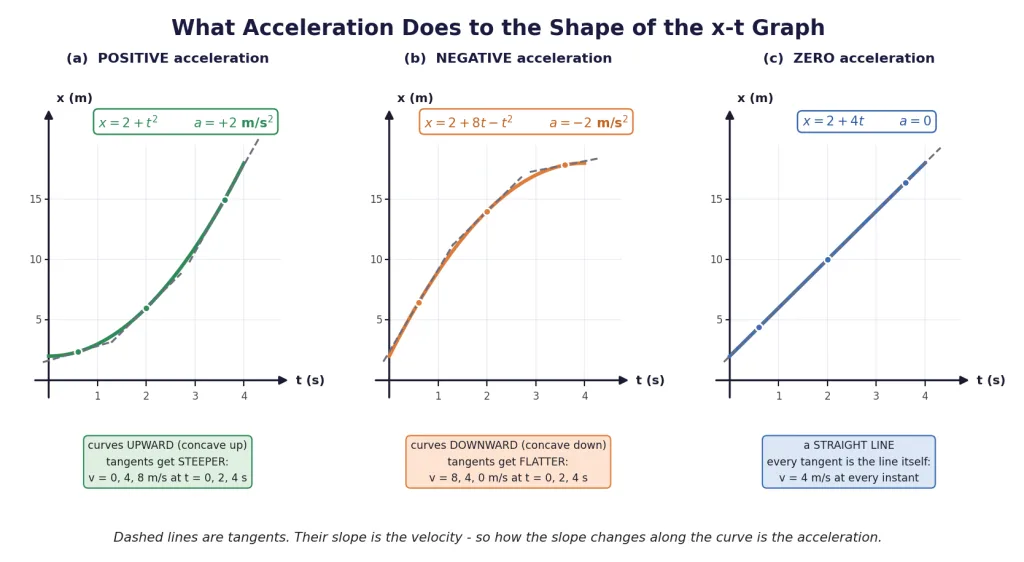
Key Point: The position-time graph curves upward for positive acceleration, curves downward for negative acceleration, and is a straight line for zero acceleration.
Why the curvature works out that way
Do not memorise this — derive it in two seconds, every time:
- The slope of the x-t graph is the velocity .
- The acceleration is how that slope changes as you move along the curve.
So:
- the slope keeps increasing the curve gets steeper and steeper going right it bends upward (concave up).
- the slope keeps decreasing the curve flattens, then tips over it bends downward (concave down).
- the slope never changes a straight line, which is uniform motion.
Check it against panel (a) of the figure: gives , so the velocity climbs 0, 4, 8 m/s at s. The three dashed tangents in that panel do exactly that — each one is steeper than the last. In panel (b), gives : 8, 4, 0 m/s. The tangents flatten out until the last one is horizontal.
The trap in the word "upward"
Curving upward is a statement about curvature, not about direction of travel. A body can be moving in the direction (position decreasing, graph heading down the page) and still have a graph that is concave up — that is exactly panel (b) of the v-t figure read the other way round. Look at how the graph bends, not at whether it rises.
Here is the summary table to carry into the exam:
| Sign of | Slope of the x-t graph | Shape of the x-t graph | Shape of the v-t graph |
|---|---|---|---|
| increasing | curves upward (concave up) | straight line sloping up | |
| decreasing | curves downward (concave down) | straight line sloping down | |
| constant | straight line | horizontal straight line |
[NEET Important] "The x-t graph of a body is a straight line. Its acceleration is _" is a standard one-liner. Answer: zero — a straight x-t graph means constant slope, means constant velocity, means no acceleration. Do not confuse it with a straight v-t graph, which means constant acceleration, not constant velocity.
The Four Standard v-t Graphs
For constant acceleration the v-t graph is always a straight line — because is its slope and a constant slope draws a straight line. What changes from case to case is where that line sits and which way it tilts. There are four cases, and between them they cover essentially every 1D constant-acceleration problem you will ever be given.
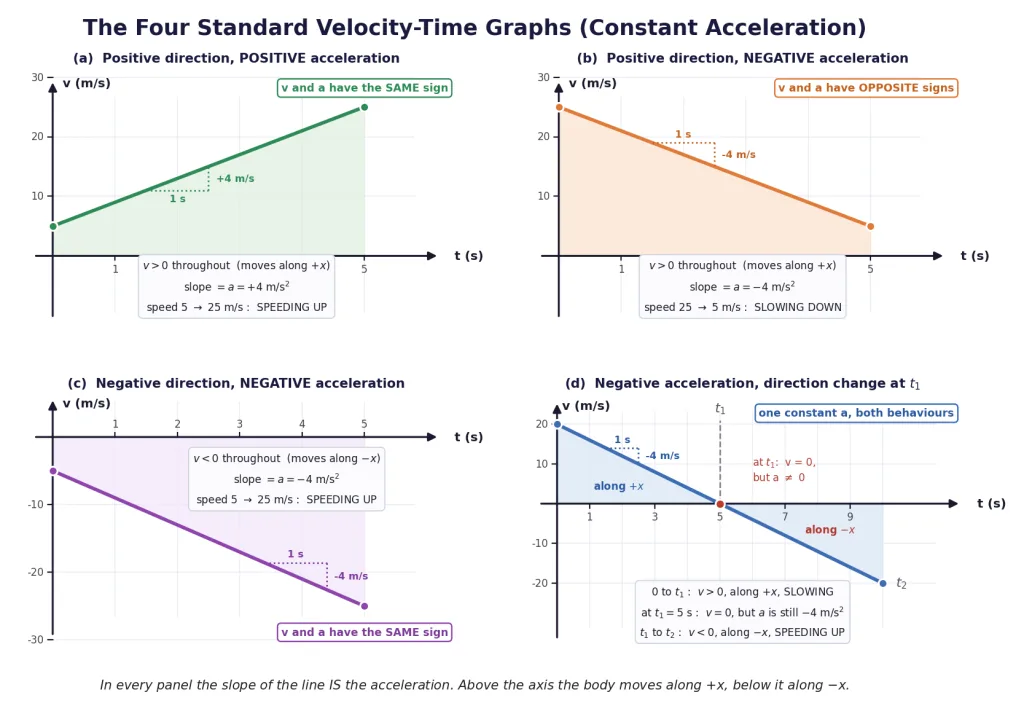
Key Point: In the graph above:
(a) An object moving in the positive direction with positive acceleration.
(b) An object moving in the positive direction with negative acceleration.
(c) An object moving in the negative direction with negative acceleration.
(d) An object with negative acceleration that changes direction at time — it moves in the direction between and , and in the opposite direction between and .
Read the four panels as a table:
| Case | Line sits | Line tilts | Sign of | Sign of | Speed is |
|---|---|---|---|---|---|
| (a) | above the t-axis | upward | increasing | ||
| (b) | above the t-axis | downward | decreasing | ||
| (c) | below the t-axis | downward | increasing | ||
| (d) | crosses the t-axis at | downward | then | throughout | decreasing, then increasing |
Two habits will get you full marks on any question about these:
- Above the axis or below it answers which way the object is moving.
- Tilting up or down answers what the acceleration is doing. Nothing else.
Case (d) deserves a paragraph of its own
Panel (d) is the one that shows up in exams disguised as a dozen different stories — a ball thrown up, a car braking and then reversing, a stone shot upward from a moving lift.
Across the whole interval the acceleration is one single unchanging value, m/s^2 in the figure. The line is perfectly straight; nothing happens to it at . And yet the motion changes character completely at :
- From to the object moves along and its speed falls to zero.
- At the velocity is exactly zero — but the acceleration is still m/s^2. The line crosses the axis; it does not stop there.
- From to the object moves along and its speed grows again.
One constant acceleration, two opposite behaviours. That single sentence is the heart of the next two pages.
One fact about area, and then we hand the topic over
There is one graph fact worth writing down now:
Key Point: The area under the v-t curve over a time interval equals the displacement in that interval.
Sanity-check it on the simplest case: an object with constant velocity has a v-t graph that is a horizontal line, so the area between and is the rectangle — which is exactly the displacement. And if you ever wonder how an area can be a distance, look at the units on the two axes: (m/s) multiplied by (s) is m. Areas on graphs always carry the product of the two axis units.
In case (d), the area above the axis counts as positive and the area below counts as negative — which is how a v-t graph tells displacement and distance apart. The full slope-and-area toolkit, in both directions between x-t, v-t and a-t, is Section 5's job.
The Big Trap: The Sign of Does Not Mean "Slowing Down"
Here is the single most misunderstood idea in this chapter, and it is important enough to be worth stating twice, in two different ways. Most students carry a rule in their heads that goes "negative acceleration means slowing down". It is wrong, and it costs marks every single year.
The statement that is always true
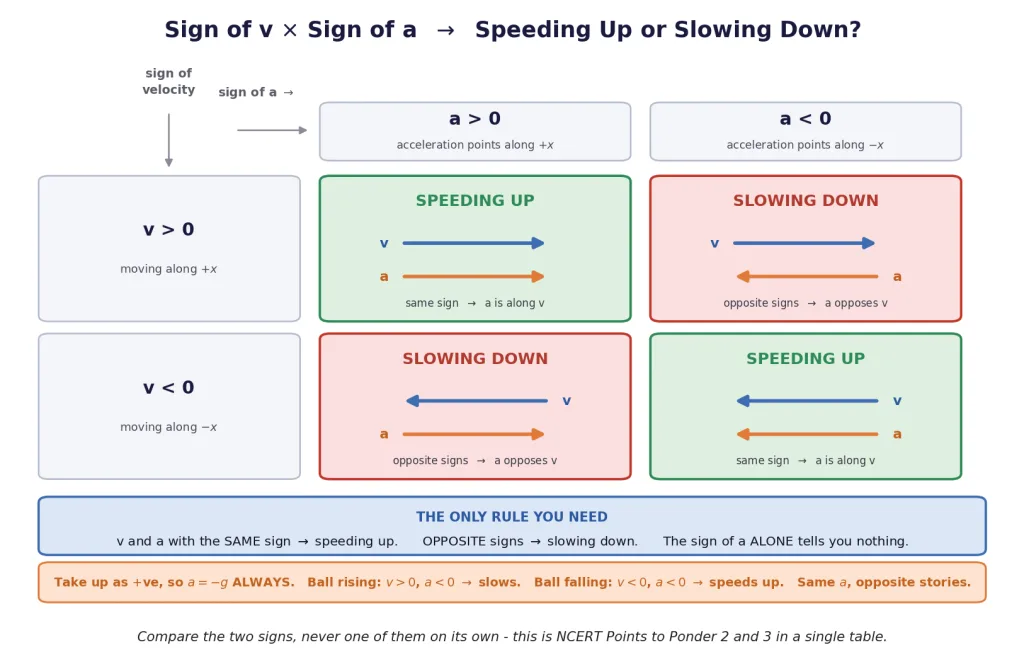
Key Point: If a particle is speeding up, the acceleration is in the direction of the velocity. If its speed is decreasing, the acceleration is in the direction opposite to the velocity. This statement is independent of the choice of the origin and the axis.
That last clause is the whole point. Nature does not know where you put your origin or which way you called positive. Whether a body is gaining or losing speed is a physical fact; it cannot depend on your bookkeeping.
The statement that is NOT true
Key Point: The sign of acceleration does not tell you whether the particle's speed is increasing or decreasing. The sign of acceleration depends on your choice of the positive direction of the axis.
Compare the two signs, never one of them alone:
| Sign of | Sign of | relative to | Result |
|---|---|---|---|
| same direction | speeding up | ||
| opposite | slowing down | ||
| same direction | speeding up | ||
| opposite | slowing down |
The pattern is worth one line of memory: same signs, speeding up; opposite signs, slowing down. Multiply the two signs — if the product is positive the body is gaining speed, if negative it is losing speed.
The standard illustration, worked out
Take the vertically upward direction as positive. Then the acceleration due to gravity is negative: , and it stays for the whole flight, going up, at the top, and coming down. Now watch the same negative acceleration produce two opposite stories.
A particle falling under gravity. It moves downward, so . And . Same signs, so the acceleration is along the velocity — the particle speeds up, exactly as your eyes tell you a falling stone does. Negative acceleration, increasing speed.
A particle thrown upward. It moves upward, so , while still. Opposite signs, so the acceleration opposes the velocity — the particle slows down. Same negative acceleration, decreasing speed.
One value of . Two different outcomes. The sign of decided nothing on its own; the comparison of the two signs decided everything.
And if you flip the convention — call downward positive — then for the same two motions, and every velocity sign flips too. The signs all change; the physics does not move a millimetre. Example 6 runs both conventions side by side so you can see the answers survive.
A word about "deceleration" and "retardation"
Textbooks and question papers use these words freely, and they mean speed is decreasing — the acceleration opposes the velocity. They do not mean " is negative". A body moving along with m/s^2 is decelerating, even though is positive.
[NEET Important] Assertion-reason questions attack this constantly. "Assertion: a body with negative acceleration must be slowing down." That assertion is false. Have the counter-example ready in one breath: a freely falling stone, with upward taken positive, has and is speeding up.
Zero Velocity Is Not Zero Acceleration — and Where We Go Next
The instant that breaks everyone's intuition
Key Point: The zero velocity of a particle at any instant does not necessarily imply zero acceleration at that instant. A particle may be momentarily at rest and yet have non-zero acceleration.
The standard example is the one from panel (d) of the v-t figure. Throw a ball straight up. At the highest point of its flight its velocity is exactly zero — and the acceleration at that instant is still downward, unchanged.
If that feels wrong, run the definition instead of your intuition. Take up as positive, throw at 30 m/s, use m/s^2, so and the top is at s. Now build the average acceleration on a small interval straddling the top:
for every value of , however small. Take and it is still m/s^2. The acceleration at the top is m/s^2, full stop. Physically: if the acceleration really did vanish at the top, the ball would have zero velocity and no reason to change it, so it would hang in the air forever.
And read the statement the other way too, because that is also examined:
- at an instant does not imply . Ball at the top of its flight.
- does not imply . A car cruising at a steady 60 km/h has zero acceleration and plenty of velocity.
- The only honest link is: means the velocity is not changing at that instant, whatever value it happens to have.
[JEE/NEET] Word the two quantities carefully in your answer: velocity is about where the object is going right now, acceleration is about how that is being changed right now. They are independent readings at a single instant.
Real graphs have no sharp corners
Several figures in this chapter show x-t, v-t and a-t graphs with sharp kinks — corners where the curve suddenly changes direction. A kink means the function is not differentiable there, so a tangent (and therefore a velocity, or an acceleration) cannot even be defined at that point.
Key Point: In any realistic situation the functions are differentiable at all points and the graphs are smooth. Physically this means acceleration and velocity cannot change values abruptly at an instant — changes are always continuous.
The kinks in such figures are an idealisation, drawn because they make the arithmetic clean. A real car does not go from to m/s^2 in zero time; the change takes a fraction of a second, and if you zoomed in you would find a smooth curve rounding off every corner.
The doorway into Section 4
Acceleration can vary with time in general, and Section 8 deals with that head on. But:
Key Point: From here to the end of the chapter, our study is restricted to motion with constant acceleration. In that case the average acceleration over any interval equals the constant value of the acceleration during that interval.
That one restriction is what makes everything downstream possible. Apply the definition of average acceleration over the interval from to , with the velocity being at and at time :
Rearrange, and out drops the first equation of motion:
That is the whole derivation — no calculus, no graph, just the definition of average acceleration plus the promise that is constant.
Where each piece goes from here:
| Topic | Section |
|---|---|
| Deriving and drilling , , , free fall | Section 4 |
| The full slope-and-area toolkit, converting between x-t, v-t and a-t graphs | Section 5 |
| Non-constant acceleration, integrating , , | Section 8 |
Everything below the line in this section — the sign rules, the four v-t shapes, "zero velocity is not zero acceleration" — stays true no matter which of those you are doing. Learn it here once and you never revisit it.
Solved Examples
Example 1: Average acceleration with a unit conversion
A car travelling along a straight road speeds up uniformly from 36 km/h to 72 km/h in 5.0 s. Take the direction of motion as positive. Find its average acceleration.
Solution:
- Convert to SI first. Multiply km/h by to get m/s:
- Apply the definition.
- Read the sign. is positive, and is positive, so the acceleration is along the motion and the car is speeding up. Consistent with the question.
Final Answer: m/s^2, directed along the motion.
Takeaway: Convert km/h to m/s before you do anything else — the factor is going in, coming out. An answer of "7.2" here means you divided km/h by seconds and produced a quantity in km/h/s, which is not an SI acceleration.
Example 2: A rebound — where change in velocity beats change in speed
A ball moving along the direction at 12 m/s strikes a wall and rebounds along the direction at 8 m/s. The contact lasts 0.05 s. Find the average acceleration during contact.
Solution:
- Fix the sign convention explicitly. Take as positive. Then m/s and m/s. The minus sign is doing real work here — it is what records the reversal.
- Change in velocity:
- Average acceleration:
- Interpret. The magnitude is 400 m/s^2 and the direction is along , i.e. away from the wall — which is exactly the direction the wall pushes the ball.
Final Answer: m/s^2, i.e. 400 m/s^2 directed along .
Takeaway: The speed only changed from 12 m/s to 8 m/s, a drop of 4 m/s. The velocity changed by 20 m/s. Acceleration is built from the change in velocity, so it is 20, never 4. Whenever a body reverses direction, write both velocities with their signs before subtracting — this is the most common single-line mistake in the whole chapter.
Example 3: From to — differentiate twice
A particle moves along the x-axis with , where is in metres and in seconds. Find (a) and , (b) the velocity and acceleration at s, (c) the instant at which the acceleration is zero, and (d) the average acceleration between and s.
Solution:
- (a) Run the two-step machine. Power rule term by term; constants differentiate to zero.
- (b) Substitute s. Both positive, so at that instant the particle is moving along and speeding up.
- (c) Set : s. At that instant m/s. So the particle is not at rest when its acceleration vanishes — it is momentarily moving at a steady 2.5 m/s, which happens to be its minimum speed.
- (d) Average acceleration needs two velocities, not a derivative.
Final Answer: , ; at s, m/s and m/s^2; at s; m/s^2 over the first 2 s.
Takeaway: Notice m/s^2 is not equal to or ; it equals at the midpoint s. That is a feature of an acceleration that is linear in , not a general rule. And part (c) is the first hint of the next big idea: says nothing at all about .
Example 4: Given directly
A particle's velocity is (SI units). Find (a) its acceleration at s, (b) its average acceleration between s and s, and (c) its acceleration at .
Solution:
- (a) One differentiation is enough — you were handed , not :
- (b) Average acceleration between the two instants.
- (c) . At the starting instant the particle has velocity 4 m/s but zero acceleration.
Final Answer: m/s^2; m/s^2 between 1 s and 3 s; .
Takeaway: Parts (a) and (b) coming out equal is a genuine coincidence of the numbers — for quadratic in , the average acceleration over an interval equals the instantaneous acceleration at the midpoint, and 2 s happens to be the midpoint of 1 s and 3 s. Change the interval to 0 s to 3 s and becomes m/s^2, which matches . Part (c) is the headline: zero acceleration with non-zero velocity is perfectly ordinary.
Example 5: Reading acceleration off a v-t graph
A bus starts from rest and its velocity rises uniformly to 20 m/s in 4.0 s. It then runs at a steady 20 m/s for the next 6.0 s, and finally slows uniformly to rest in a further 5.0 s. Find (a) the acceleration in each of the three stages, (b) the displacement of the bus, and (c) its average acceleration over the whole 15 s.
Solution:
- (a) The acceleration in each stage is the slope of that segment of the v-t graph.
- Stage 1 ( to 4.0 s): m/s^2
- Stage 2 (4.0 s to 10.0 s): — a horizontal line has zero slope
- Stage 3 (10.0 s to 15.0 s): m/s^2
- (b) Displacement is the area under the v-t graph — a triangle, a rectangle and a triangle:
- (c) Average acceleration over the whole trip uses only the endpoints:
Final Answer: m/s^2, , m/s^2; displacement 210 m; average acceleration over the whole trip is zero.
Takeaway: Part (c) is the one that catches people. The bus accelerated hard, cruised, then braked hard — and its average acceleration for the journey is exactly zero, because it started and finished at rest. Average acceleration only ever looks at the two endpoint velocities; everything in between is invisible to it. (Average velocity here is m/s, which is very much not zero.)
Example 6: The gravity illustration, both sign conventions
A ball is thrown vertically upward with a speed of 30 m/s. Take m/s^2 and neglect air resistance. Using upward as positive, state the velocity, the speed, the acceleration and whether the ball is speeding up or slowing down at s, 3 s and 5 s. Then repeat the whole analysis with downward as positive and compare.
Solution:
- Set up with up positive. The acceleration is due to gravity and points downward, so m/s^2 for the entire flight — going up, at the top and coming down. The initial velocity is m/s, so
- Evaluate at the three instants and apply the sign rule.
| (s) | (m/s) | speed (m/s) | (m/s^2) | signs of , | verdict |
|---|---|---|---|---|---|
| 1 | 20 | opposite | slowing down | ||
| 3 | 0 | at rest, | at the top | ||
| 5 | 20 | same | speeding up |
- Now flip the convention: downward positive. Every direction label reverses. Now m/s^2 and the initial velocity is m/s, so .
| (s) | (m/s) | speed (m/s) | (m/s^2) | signs of , | verdict |
|---|---|---|---|---|---|
| 1 | 20 | opposite | slowing down | ||
| 3 | 0 | at rest, | at the top | ||
| 5 | 20 | same | speeding up |
- Compare the two tables. Every sign flipped. Every speed is identical, and every verdict is identical.
Final Answer: Slowing down at 1 s, momentarily at rest at 3 s, speeding up at 5 s — in both conventions.
Takeaway: This is the sign rule in numbers: the sign of the acceleration depends on the direction you chose as positive, not on whether the body is speeding up. In the first table the acceleration is negative the whole way and the ball is slowing down at 1 s but speeding up at 5 s — the same negative producing opposite outcomes. Pick a convention, write it at the top of your answer, then never look at the sign of on its own again.
Example 7: At the top of the flight — but
For the same ball (thrown up at 30 m/s, m/s^2, up positive), find (a) the time it takes to reach the highest point, (b) the height of that point above the throwing point, (c) its velocity there, and (d) its acceleration there, working part (d) from the definition rather than by quoting .
Solution:
- (a) The ball is at the top when its velocity is zero: s.
- (b) With (upward positive), m.
- (c) . The ball really is momentarily at rest, not "nearly" at rest.
- (d) Now compute the acceleration at that instant honestly, from the limit. Take a small interval of half-width straddling s: This is m/s^2 for s, for s, for every . Taking changes nothing, so m/s^2 at the top.
Final Answer: 3.0 s; 45 m; ; m/s^2 (i.e. 10 m/s^2 directed downward).
Takeaway: Zero velocity at an instant does not mean zero acceleration at that instant, and this is the single most-asked assertion-reason question in kinematics. A body momentarily at rest still has an acceleration. Argue it physically if you like: if became zero at the top, the ball would have no velocity and nothing changing it, so it would simply hang there — which is not what balls do.
Example 8: Four particles, four sign combinations
Four particles move along the x-axis. At a certain instant their velocities and accelerations are: (i) m/s, m/s^2; (ii) m/s, m/s^2; (iii) m/s, m/s^2; (iv) m/s, m/s^2. For each, state whether the particle is speeding up or slowing down.
Solution:
Apply the one rule: compare the two signs. Same signs means is along and the speed grows; opposite signs means opposes and the speed falls. To make it concrete, here is the speed 0.1 s later in each case (assuming stays constant over that sliver of time), computed from :
| Case | signs | after 0.1 s | speed after 0.1 s | verdict | ||
|---|---|---|---|---|---|---|
| (i) | same | 6.2 m/s (up from 6) | speeding up | |||
| (ii) | opposite | 5.8 m/s (down from 6) | slowing down | |||
| (iii) | same | 6.2 m/s (up from 6) | speeding up | |||
| (iv) | opposite | 5.8 m/s (down from 6) | slowing down |
Final Answer: (i) speeding up, (ii) slowing down, (iii) speeding up, (iv) slowing down.
Takeaway: Cases (ii) and (iii) are the ones that pay. In (iii) the acceleration is negative and the particle is gaining speed; in (iv) it is positive and the particle is losing speed. Multiply the signs: positive product means speeding up. Never judge from the sign of alone.
Example 9: Identify the acceleration from the x-t equation
Three particles move with in metres and in seconds: (i) , (ii) , (iii) . For each, find the acceleration and say how the x-t graph is shaped. For (i), also find when the particle turns around.
Solution:
- Differentiate twice each time.
- (i) , m/s^2 — constant and negative, so the x-t graph curves downward.
- (ii) m/s, — the x-t graph is a straight line, uniform motion.
- (iii) , m/s^2 — constant and positive, so the x-t graph curves upward.
- (i) Turning point. The particle turns where : s. Its position then is m, and since the curve is concave down this is the maximum position it ever reaches. After 0.75 s it moves back along .
Final Answer: (i) m/s^2, concave down, turns at s at m; (ii) , straight line; (iii) m/s^2, concave up.
Takeaway: For any , the acceleration is simply — the coefficient of doubled — and the sign of tells you the curvature immediately. Spotting that in three seconds saves real time in a timed paper.
Example 10: The acceleration reverses but the particle never does
A particle moves with (SI units). Find (a) and , (b) whether the particle is ever momentarily at rest, (c) the instant at which the acceleration changes sign, and (d) describe the motion in the first 3 s.
Solution:
- (a)
- (b) Is ever zero? Solve . Discriminant , so there is no real root: is never zero. Since and is continuous, at all times — the particle always moves along and never turns back. Its slowest moment is at the vertex s, where m/s.
- (c) when s. Before that ; after it, .
- (d) Put the signs together.
- s: , — opposite signs, so the particle slows down (from 6 m/s to m/s) while still moving forward.
- s: , m/s — minimum speed, still moving.
- s: , — same signs, so it speeds up again. By s, m/s and m/s^2.
Final Answer: , ; never at rest; changes sign at s; the particle moves forward throughout, slowing to m/s and then speeding up.
Takeaway: Three separate traps handled in one problem. The particle decelerates without ever reversing; the acceleration is zero at an instant while the velocity is not; and the acceleration changes sign while the velocity never does. The discriminant test on is the fastest way to prove a particle never turns around.
Example 11: Constant negative acceleration with a direction change
A particle moves along the x-axis with velocity m/s and is at the origin at . Find (a) its acceleration, (b) the instant it reverses direction, (c) its velocity and speed at s and s with the verdict in each case, and (d) the displacement and the distance travelled in the first 5 s.
Solution:
- (a) m/s^2, constant. This is exactly panel (d) of the four-graph figure.
- (b) The direction reverses where : s. For s, (motion along ); for s, (motion along ).
- (c)
- At s: m/s, speed 8 m/s. Signs of and are opposite, so it is slowing down.
- At s: m/s, speed 8 m/s. Signs are now the same, so it is speeding up.
- (d) Displacement is the (signed) area under the v-t graph; distance is the total unsigned area. Split at s.
- to 3 s: a triangle above the axis, base 3.0 s, height 12 m/s, area m.
- s to 5 s: a triangle below the axis, base 2.0 s, height 8 m/s, area m, counted as m.
Final Answer: m/s^2; reverses at s; slowing at 1 s, speeding up at 5 s; displacement m, distance 26 m.
Takeaway: Same speed (8 m/s) at both instants, same constant acceleration, opposite verdicts — the sign rule doing its job. And note how displacement and distance part company the moment the velocity changes sign: always split the journey at the instant before computing distance. Average velocity here is m/s while average speed is m/s.
Example 12: The doorway — constant acceleration gives
(a) A train starting from rest accelerates uniformly and reaches 20 m/s in 8.0 s. Find its acceleration, its velocity at s, and the time it would need to reach 30 m/s. (b) A scooter moving at 15 m/s brakes with a constant acceleration of m/s^2. Find its velocity after 2.0 s and the time it takes to stop.
Solution:
- (a) Because is constant, the average acceleration equals that constant value, so Rearranged, that same relation is . Then:
- (b) Same equation, negative . Take the direction of motion as positive, so m/s and m/s^2. The scooter stops when :
Final Answer: (a) m/s^2, m/s at 5.0 s, 12 s to reach 30 m/s. (b) m/s after 2.0 s, stops after 6.0 s.
Takeaway: Both parts used nothing more than the definition of average acceleration plus " is constant". In (b), and have opposite signs throughout, so the scooter is slowing the whole time — and the equation handles it automatically once you put the minus sign in. Section 4 takes this single equation and builds the rest of the kinematic toolkit on top of it.