
One Assumption, and Three Equations Fall Out
Section 3 closed with a bargain. The price: from here to the end of the chapter, the acceleration is constant — fixed in size and fixed in direction. What you get in return is the most useful set of formulas in all of mechanics.
You already own the first one. Because is constant, the average acceleration over the interval from to is that constant value, so , and rearranging gives
Here is the velocity at and is the velocity at time .
That is one equation connecting , , and . What we do not yet have is any equation containing the displacement . For that we need the graph.
The graph does the work
For constant acceleration the v-t graph is a straight line — slope , intercept . And Section 3 handed you one more fact:
Key Point: The area under the velocity-time curve between times and is equal to the displacement of the object during that interval.
Put those two together and the derivation is basically geometry. The region under a straight line from to is a trapezium, and a trapezium splits into a rectangle plus a triangle.
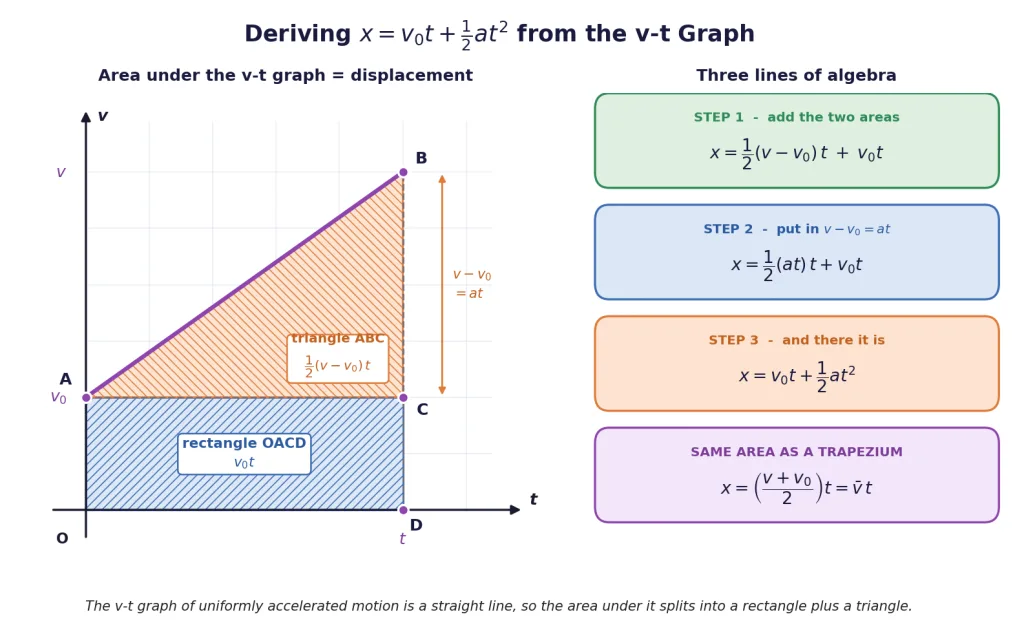
Label the corners as in the figure above: , , and . Then
That area is the displacement . Now spend Equation 1: . Substituting,
Read it as a sentence and it stops being a formula to memorise: the displacement is what you would have covered at the starting velocity, plus a bonus that the acceleration adds on. If is negative, that "bonus" is a subtraction.
The same trapezium, measured a second way
The area of a trapezium is also (average of the parallel sides) x (width):
In words: the object covers displacement with an average velocity equal to the arithmetic mean of the initial and final velocities. That is a genuinely useful shortcut — but the bracket after it is not decoration.
Key Point: holds only for constant acceleration. The definition of average velocity, , is always true; this particular value for it is not.
[JEE Tip] Here is a 10-second proof that it fails otherwise. Take (so the acceleration is , not constant) over to 4.0 s. The real displacement is m, so the true average velocity is m/s. But m/s. Off by 50%. Examiners love that trap.
The Third Equation — and All Three Again, by Calculus
Equations 1 and 2 both contain . Sometimes a problem tells you nothing about time and asks nothing about it — a car braking from 25 m/s in 40 m, say. Carrying through such a problem is wasted work, so we eliminate it.
From Equation 1, . Put that into the trapezium form :
Cross-multiply and you have the third equation:
Key Point — the kinematic equations of rectilinear motion for constant acceleration: connecting the five quantities , , , and . These assume the position at is .
If the object does not start at the origin
Nothing above required to be measured from the object's starting point — but Equation 2 as written does assume it. If the object is at when , replace every by :
[Board Important] For a ball thrown from the top of a 25 m tower with the ground as origin, m. Half the "impossible" tower problems are just students forgetting the .
Now the calculus route
The graph proof is beautiful but it leans on a picture. Calculus gets there with no picture at all, and — this matters — it keeps working when the acceleration is not constant.
Equation 1. By definition , so . Integrate both sides, velocity from to as time runs from to :
Equation 2. Further, , so . Integrate again, now substituting the we just found:
Equation 3. This one uses a chain-rule trick worth learning on its own:
Integrate both sides:
Key Point: The advantage of the calculus method is that it can be used for motion with non-uniform acceleration also. The form is the single most useful line in this section for JEE — it is how you handle acceleration given as a function of position.
The restriction, stated plainly
This is examined almost every year as a one-mark conceptual question, so learn the sentence:
Key Point: The definitions of instantaneous velocity and acceleration are exact and always correct, while the kinematic equations are true only for motion in which the magnitude and the direction of the acceleration are constant during the course of the motion.
So: a stone in free fall, a braking car with steady brakes, a trolley on a uniform slope — all fine. A car in city traffic, a ball bouncing, a particle with — not fine, and plugging into there is simply wrong, not merely approximate. Section 8 picks up variable acceleration with the integration methods above.
Which Equation Do I Pick? The 15-Second Decision
Most students who "cannot do kinematics" can actually do all the algebra fine. What they lack is a decision procedure. Here it is, and it never fails.
Every constant-acceleration problem is about five quantities: , , , and . A well-posed problem hands you three of them and asks for a fourth. Notice that the fifth quantity — the one that is neither given nor asked for — is the one you must avoid. So:
Key Point: Identify the quantity you neither know nor want. Choose the equation that does not contain it. One substitution, one answer, no simultaneous equations.
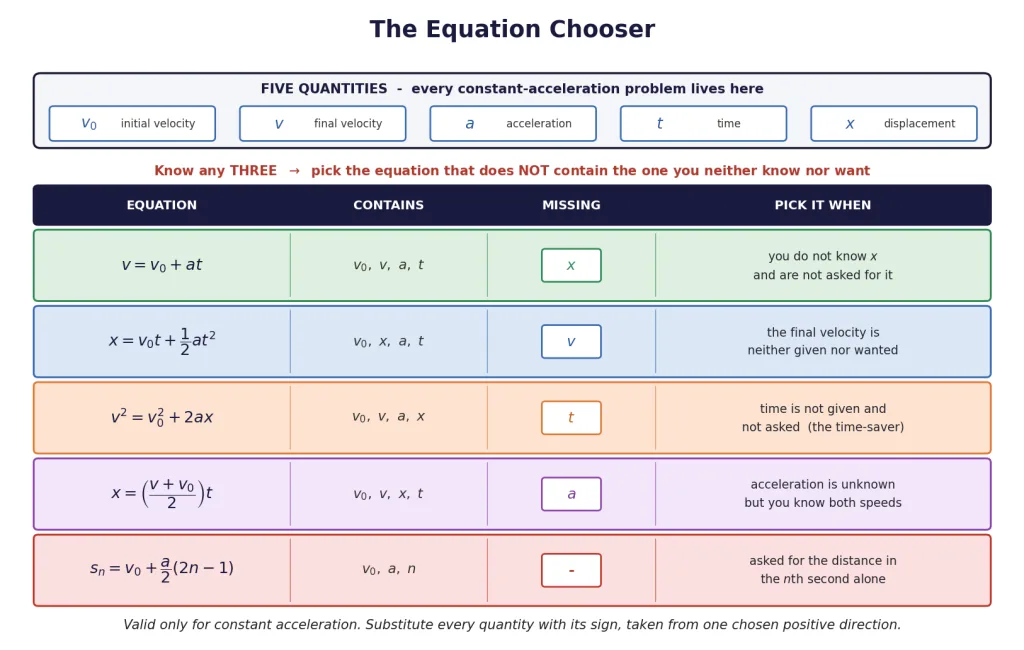
| Equation | Contains | Missing | Reach for it when |
|---|---|---|---|
| displacement is neither given nor asked | |||
| the final velocity is neither given nor asked | |||
| time is neither given nor asked | |||
| you know both velocities but not | |||
| -- | asked for the distance in the th second alone |
Three drills, five seconds each
- A car starts from rest at 2 m/s^2. How far in 6 s? Given ; want ; is the odd one out. Use .
- A train at 20 m/s stops in 200 m. Find the retardation. Given ; want ; is the odd one out. Use .
- A scooter slows from 15 m/s to 5 m/s in 4 s. How far did it go? Given ; want ; is the odd one out. Use . (You could find first — that is two steps instead of one.)
When the problem asks for two things
Find the "cheap" one first with a one-step equation, then you have four quantities and every remaining equation is open to you. If a problem seems to give you only two quantities, look again: "starts from rest" means , "comes to rest" means , "dropped" means , and "under gravity" means . Those phrases are data.
[NEET Important] In NEET you have roughly 45 seconds per question. The chooser is worth more marks per minute than any amount of algebra practice, because it removes the one thing that eats time — deciding what to do. Section 10 drills it further.
Signs: The Discipline That Makes Every Problem Routine
Here is the thing about the three equations — there is only one version of them. There is no separate formula for a body slowing down, no special formula for a body thrown up, no "downward" version. There is one set, and the signs do all the rest of the work.
Key Point: In the kinematic equations the various quantities are algebraic, i.e. they may be positive or negative. The equations are applicable in all situations (for one-dimensional motion with constant acceleration) provided the values of the different quantities are substituted in the equations with proper signs.
And the companion rule from Section 1: the origin and the positive direction are your choice, but you must make the choice first and then never change it inside a problem.
The recipe — five steps, every single time
- Draw the motion and mark an origin. Anywhere you like: the ground, the top of the tower, the point of release.
- Choose one positive direction and write it on the page ("taking upward as positive"). This is not a formality — it is the line that makes your answer markable.
- Convert every given quantity into a signed number. Anything pointing along your positive direction gets a ; anything opposite gets a . This applies to , , and alike.
- Substitute and solve. Do not "correct" a sign mid-calculation because the answer looks odd. The algebra knows what it is doing.
- Interpret the sign of the answer. A negative means the object ended up on the negative side of the origin; a negative means it is moving in the negative direction. That is information, not an error.
What the signs look like in practice
| Situation (taking up / forward as positive) | Watch out for | ||
|---|---|---|---|
| Car speeding up | nothing — the easy case | ||
| Car braking | the equations keep working past the stop; check time | ||
| Object dropped from rest | comes out negative — it fell below the origin | ||
| Object thrown up | is on the way up and on the way down | ||
| Object thrown down | both negative; speed grows, as it should |
Notice the fourth row. The acceleration of a body under gravity is at every instant of the flight, including the top. Students who "switch to on the way down" are secretly changing the positive direction halfway through, which breaks step 2.
[JEE/NEET] Choosing down as positive for a purely falling body is perfectly legal and often tidier: then , and the depth fallen comes out positive. What is illegal is choosing down as positive and then writing . Pick, declare, obey.
Two roots from a quadratic — which one is real?
is quadratic in , so it often gives two roots.
- A negative root describes where the object would have been before the clock started, if it had been moving this way all along. Discard it (state that you are discarding it).
- Two positive roots are usually both physical: the object passes the same height twice, once going up and once coming down.
Displacement out, distance by hand
The in these equations is always displacement, never path length. They part company the moment the velocity changes sign.
Key Point: If the velocity reverses inside the interval, split the journey at the instant , compute each part separately, then add magnitudes for distance and add signed values for displacement.
That single habit prevents the most common wrong answer in this entire chapter.
Distance Travelled in the nth Second
"How far does it go in the 5th second?" is not asking for at s. It is asking for the ground covered between s and s — one second of travel, the fifth one.
So build it exactly that way. Write for the displacement in the th second:
It really does give metres
This formula makes students uneasy, and they are right to notice: the right-hand side looks like a velocity plus an acceleration, which cannot be a distance. Here is the resolution.
Key Point: The interval is exactly 1 second, and that hidden factor is what fixes the units. In full, . Because the number 1 changes nothing numerically, we drop it — but the answer is a displacement in metres, not a velocity in m/s.
So write your answer as "18 m", never "18 m/s". Writing the unit as m/s in a Board answer is a guaranteed mark lost.
Two more cautions. is a displacement for that second, so it carries a sign; it equals the distance only if the body does not reverse during that particular second. And must be a whole number — "distance in the 2.5th second" is meaningless.
Galileo's law of odd numbers
Now set — a body falling from rest — and watch what the formula says:
The is common to every term and cancels out of the ratio. That is Galileo's result, stated in his own words:
Key Point: "The distances traversed, during equal intervals of time, by a body falling from rest, stand to one another in the same ratio as the odd numbers beginning with unity" — namely 1 : 3 : 5 : 7 : 9 : 11.
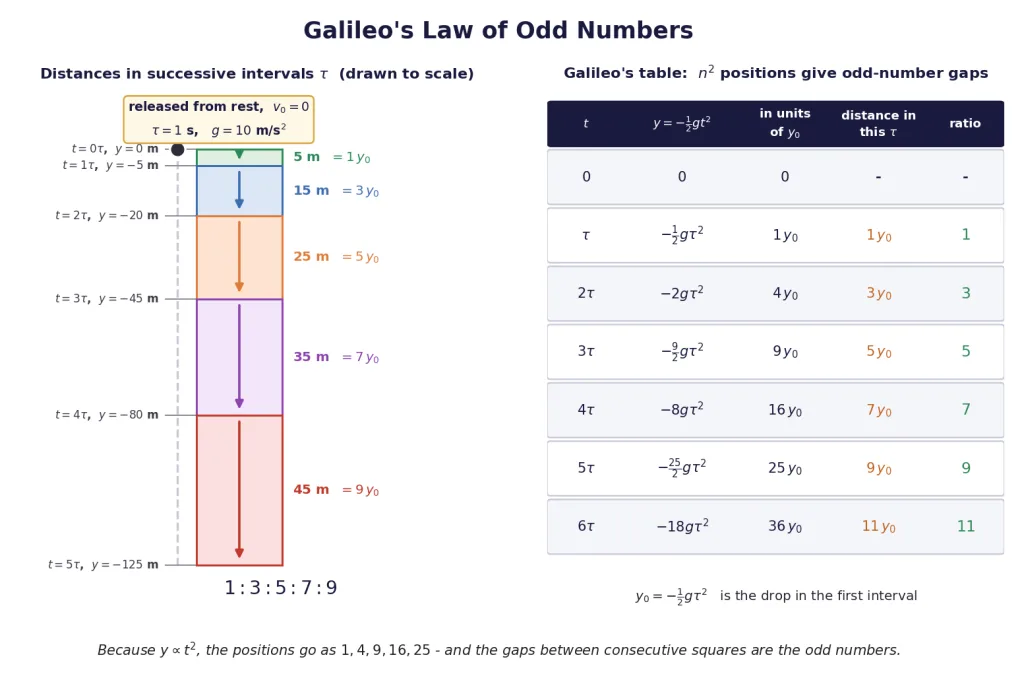
The same result can be built from the position rather than the gaps, and that view is worth having too. Take upward as positive and drop the object from , so and
Evaluate this at and the positions come out proportional to — the perfect squares — in units of , the drop in the very first interval. The distance in each successive interval is the gap between consecutive squares:
and the gaps between consecutive squares are exactly the odd numbers. Galileo Galilei (1564-1642), who was the first person to make quantitative studies of free fall, got there without algebra — by rolling balls down inclined planes and timing them with a water clock, because falling bodies were far too quick for the clocks of his day.
[JEE/NEET] The ratio needs . If the body starts with a velocity, the ratio is not odd numbers — go back to and compute. A question that quietly gives a non-zero and offers "1 : 3 : 5" as an option is fishing, and plenty of students bite.
The Classic Applications: Free Fall, Vertical Throw, Braking and Reaction Time
Free fall
An object released near the Earth's surface accelerates downward under gravity. If air resistance is neglected, the object is said to be in free fall. Provided the fall is small compared with the Earth's radius, can be taken as constant at 9.8 m/s^2 — so free fall is just a case of motion with uniform acceleration, and our three equations apply unchanged.
Take the motion along , with upward as positive. Gravity points down, so
Release the object from rest at , so , and the three equations collapse to:
Every one of those minus signs is doing a job. is negative because the object moves downward; is negative because it is below the origin; and in the third, is negative so comes out positive, as must.
What the three graphs look like:
- a-t graph: a horizontal line at m/s^2. Constant, throughout.
- v-t graph: a straight line through the origin sloping downward, slope . The speed grows steadily; the velocity becomes more and more negative.
- y-t graph: a downward-opening parabola through the origin, getting steeper and steeper.
And note what is not in these equations: mass. A heavy stone and a light one, released together with air resistance neglected, fall identically.
A body thrown vertically upward — and its symmetry
Same acceleration, non-zero starting velocity. Take up as positive: , for the whole flight — rise, top and fall.
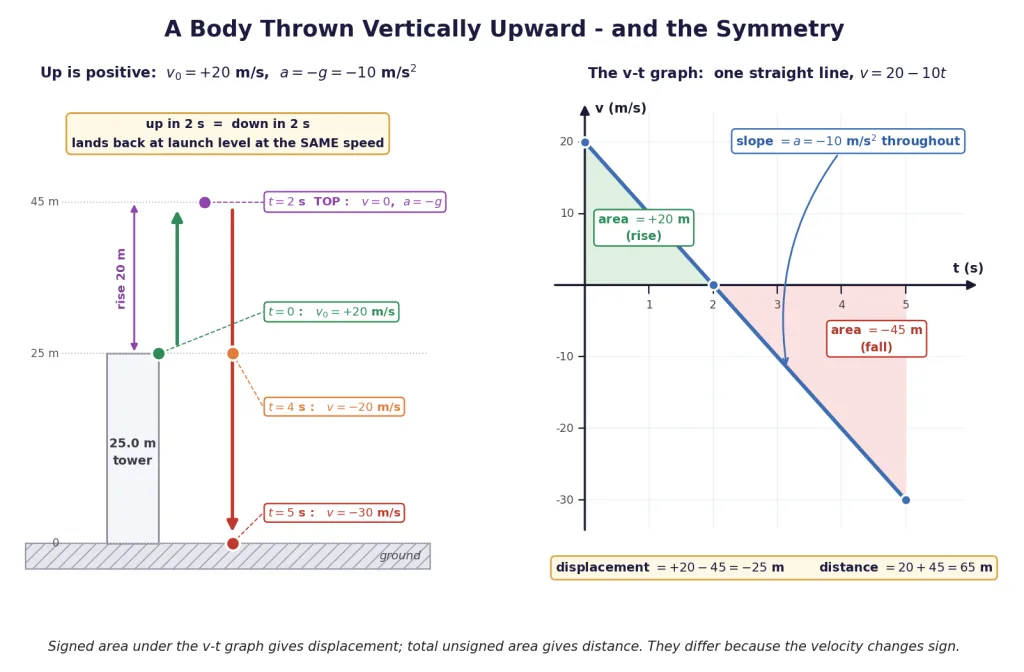
Working from the launch level, three results are worth having at your fingertips:
| Quantity | Result | From |
|---|---|---|
| Time to reach the top | ||
| Maximum rise above launch | ||
| Time to return to launch level |
Key Point — the symmetry results. For flight between the same two levels: the time up equals the time down, and the object passes any given height with equal speeds going up and coming down (velocities equal in magnitude, opposite in sign). In particular it returns to the launch level with exactly the speed of projection.
Two warnings that cost marks:
- At the highest point but is still . (Section 3 laboured this; it shows up here.)
- The symmetry is about the launch level, not the ground. Throw a ball up from a tower and it is not symmetric about the ground — the downward journey is longer, and it lands faster than it left.
Stopping distance
When brakes are applied, the distance the vehicle travels before stopping is the stopping distance. It depends on the initial velocity and on the braking deceleration. Time is neither given nor wanted, so the chooser sends us straight to Equation 3 with :
The minus sign is not a typo — is negative during braking, so comes out positive. The physics is in the exponent:
Key Point: The stopping distance is proportional to the square of the initial velocity. Doubling the initial velocity increases the stopping distance by a factor of 4 (for the same deceleration).
Real measurements on one make of car bear this out: braking distances of 10 m, 20 m, 34 m and 50 m at 11, 15, 20 and 25 m/s. Those imply decelerations of about 6.1, 5.6, 5.9 and 6.3 m/s^2 — near enough one constant value, which is exactly what the formula predicts. And this is why stopping distance is an important factor in setting speed limits, for example in school zones: halving the limit outside a school does not halve the braking distance, it quarters it.
Reaction time
Reaction time is the time a person takes to observe, think and act. If a boy suddenly steps onto the road, the time that elapses before the driver even slams the brakes is reaction time — and the car covers metres in it, before the braking distance above begins.
You can measure your own with a ruler. A friend holds a ruler vertically and drops it through the gap between your thumb and forefinger; you catch it as fast as you can and read off the distance it fell. The ruler is in free fall, so and , giving , or
For a typical measured value of cm with m/s^2, this gives s — worked out in full in Example 10 below. Typical human reaction times run 0.2 s to 0.3 s, and a car at 25 m/s covers about 5 m in that time without the brakes having touched.
Solved Examples
Example 1: The straight plug-in
A motorcycle starts from rest and accelerates uniformly at 2.5 m/s^2 along a straight road. Find (a) its velocity after 8.0 s, (b) the distance covered in those 8.0 s, (c) the distance covered in the first 4.0 s, and (d) its average velocity over the 8.0 s.
Solution:
Take the direction of motion as positive. Then , m/s^2.
- (a) Given , want — is the odd one out, so use Equation 1:
- (b) Given , want — use Equation 2:
- (c) Same equation, s:
- (d) m/s. Cross-check with the constant-acceleration shortcut: m/s. They agree, as they must.
Final Answer: (a) 20 m/s, (b) 80 m, (c) 20 m, (d) 10 m/s.
Takeaway: Look at (b) and (c): half the time did not give half the distance — it gave a quarter of it, because when you start from rest. That single fact is behind Galileo's odd numbers, the stopping-distance rule and about a third of the questions in this chapter.
Example 2: No time anywhere in sight
A car moving at 15 m/s accelerates uniformly and reaches 25 m/s after covering 100 m. Find (a) its acceleration and (b) the time taken.
Solution:
Direction of motion positive: m/s, m/s, m.
- (a) Given , want — is neither given nor asked, so Equation 3 is the one-step route:
- (b) Now that is known, the cheapest route to is Equation 1:
- Check with a third equation. m. Matches the given data.
Final Answer: (a) m/s^2, (b) s.
Takeaway: Part (a) in one line because we refused to introduce . Then note the checking habit: once you have all five quantities, any unused equation is a free verification. It costs ten seconds and catches almost every arithmetic slip.
Example 3: Braking, and a distance inside the journey
A train travelling at 72 km/h is brought to rest in 20 s by uniform braking. Find (a) the retardation, (b) the distance travelled before stopping, and (c) the distance covered in the first 5.0 s of braking.
Solution:
- Convert first. m/s. Take the direction of motion as positive: m/s, , s.
- (a) Given , want ; use Equation 1: The minus sign says the acceleration opposes the motion. The retardation is 1.0 m/s^2.
- (b) Equation 2 with the signed : Cross-check with Equation 3: m. Agreed.
- (c) Same equation, s:
Final Answer: (a) 1.0 m/s^2 retardation, (b) 200 m, (c) 87.5 m.
Takeaway: The train covers 87.5 m in the first quarter of the braking time but only 200 m in total — the early seconds of braking eat up most of the distance, because that is when the vehicle is still fast. Also note the discipline: went into the equation as , not , every single time.
Example 4: The sign recipe, run twice
A stone is thrown vertically downward with a speed of 5.0 m/s from the top of a 60 m tower. Take m/s^2 and find (a) the time it takes to reach the ground and (b) its velocity on landing. Then redo it with the opposite sign convention to prove the answer does not care.
Solution:
Convention A — origin at the ground, upward positive.
- Signed data: m, m/s (thrown downward), m/s^2, and landing means .
- Use :
- The roots are s and s. Discard the negative root — it refers to a time before the stone was thrown. So s.
- Landing velocity, Equation 1: m/s. Negative, i.e. 35 m/s directed downward. Sensible.
Convention B — origin at the top of the tower, downward positive.
- Signed data: , m/s, m/s^2, landing at m.
- m/s — positive, and positive now means downward. Same physical answer.
Final Answer: s; the stone lands at 35 m/s directed downward.
Takeaway: Two conventions, identical physics. What you may never do is mix them — writing (down positive) alongside (up positive) gives s, which is wrong and looks perfectly plausible on the page. Declare the direction in words at the top of your answer; markers give credit for it.
Example 5: The full vertical throw
A ball is thrown vertically upward with a velocity of 20 m/s from the top of a multistorey building. The height of the point from which the ball is thrown is 25.0 m from the ground. Take m/s^2 and find (a) how high the ball will rise, (b) how long it takes before hitting the ground, (c) its velocity on landing, (d) the total distance travelled and the displacement, and (e) the time and velocity when it passes the launch level on the way down.
Solution:
Take the y-axis vertically upward with zero at the ground. Then m, m/s, m/s^2.
- (a) At the highest point . Time is not wanted, so use : The ball rises 20 m above the launch point, reaching m above the ground.
- (b) One equation, whole journey. This is the method to prefer, because you never have to think about the path. Put into : Split-journey check: going up, s. Falling from rest at 45 m, s. Total s. Agreed.
- (c) m/s, i.e. 30 m/s downward. Check: , so m/s.
- (d) Up 20 m, then down m:
- (e) Back at the launch level, : s. Then m/s.
Final Answer: (a) rises 20 m (to 45 m above the ground), (b) 5.0 s, (c) 30 m/s downward, (d) distance 65 m, displacement 25 m downward, (e) at s with velocity 20 m/s downward.
Takeaway: Part (e) is the symmetry theorem in numbers — it left the roof at m/s and passes the roof at m/s, taking 2 s up and 2 s back. But it hits the ground at 30 m/s, not 20, because the ground is not the launch level. And look at (d): distance 65 m against a displacement of 25 m. One equation gives you displacement; distance is your own job.
Example 6: Free fall, tabulated
An object is released from rest and falls freely. Taking upward as positive, m/s^2 and the release point as the origin, find its velocity and position at , 2.0 and 3.0 s, and verify at s.
Solution:
- Set up. , m/s^2, . The equations become
- Tabulate.
| (s) | (m/s) | (m) | speed (m/s) | depth fallen (m) |
|---|---|---|---|---|
| 1.0 | 9.8 | 4.9 | ||
| 2.0 | 19.6 | 19.6 | ||
| 3.0 | 29.4 | 44.1 |
- Verify the third equation at s. m^2/s^2, and m^2/s^2. Identical.
Final Answer: , , m/s and , , m at 1.0, 2.0 and 3.0 s; the relation checks out.
Takeaway: The velocity grows linearly with time (double the time, double the speed) but the distance grows as (double the time, four times the depth). The coincidence at s, where the numbers appear in both columns, is pure numerology from — do not read anything into it. Notice also that is positive because itself is negative: the signs are self-consistent.
Example 7: Distance in the nth second, both ways
(a) A body starts from rest with a constant acceleration of 4.0 m/s^2. Find the distance it covers in the 5th second. (b) A body moving at 3.0 m/s accelerates uniformly at 2.0 m/s^2; find the distance covered in the 3rd second. (c) For the body in (a), find the distances in the 1st, 2nd and 3rd seconds and their ratio.
Solution:
- (a) By the formula. , m/s^2, : By first principles, to prove the formula is not magic:
- (b) m/s, m/s^2, : Check: m and m, difference 8.0 m.
- (c) With and m/s^2: m, m, m.
Final Answer: (a) 18 m, (b) 8.0 m, (c) 2 m, 6 m, 10 m, in the ratio 1 : 3 : 5.
Takeaway: Three things to carry away. The formula is just , so you can always rebuild it if you forget. The answers are in metres, not m/s, however velocity-like the formula looks. And in (c) the odd-number ratio appears without any mention of gravity — it is a property of starting from rest with constant acceleration, not a property of falling.
Example 8: Galileo's law of odd numbers in numbers
A body is released from rest and falls freely with m/s^2. Taking s, find the distances it falls in each of the first five 1-second intervals, show they are in the ratio 1 : 3 : 5 : 7 : 9, and confirm the total against .
Solution:
- Positions first (upward positive, released from , so ):
| (m) | in units of | fall in this interval | ratio | |
|---|---|---|---|---|
| 0 | 0 | -- | -- | |
| 5 m | 1 | |||
| 15 m | 3 | |||
| 25 m | 5 | |||
| 35 m | 7 | |||
| 45 m | 9 |
where m is the drop in the first interval.
- The ratio. . The positions went as the perfect squares , and the gaps between consecutive squares are the odd numbers.
- Cross-check with the nth-second formula: , giving 5, 15, 25, 35, 45 m directly.
- Total check. m, and m. Agreed.
Final Answer: 5, 15, 25, 35 and 45 m, in the ratio 1 : 3 : 5 : 7 : 9; total 125 m in 5.0 s.
Takeaway: With m/s^2 instead the distances are 4.9, 14.7, 24.5 m and so on — the numbers change, the ratio does not. That is why the law is stated as a ratio: it is independent of , of the units and of the length of . Galileo could therefore test it on an inclined plane, where the effective acceleration is smaller and the timing possible with the water clocks of 1604.
Example 9: Stopping distance and why school zones have speed limits
A car travelling at 20 m/s brakes with a constant deceleration of 5.0 m/s^2. (a) Find its stopping distance. (b) Repeat for 40 m/s. (c) If the driver's reaction time is 0.50 s, find the total distance from the moment the hazard appears, at both speeds.
Solution:
Take the direction of motion as positive, so m/s^2 and at the end.
- (a) Time is neither given nor asked, so Equation 3:
- (b) Doubling the speed multiplied the braking distance by 4, exactly as demands.
- (c) Reaction distance is travelled at constant speed, before any braking:
- At 20 m/s: m, so the total is m.
- At 40 m/s: m, so the total is m.
Final Answer: (a) 40 m, (b) 160 m, (c) 50 m at 20 m/s and 180 m at 40 m/s.
Takeaway: The two pieces scale differently — reaction distance grows linearly with speed, braking distance grows as the square — so total distance goes up faster than speed does. Driving twice as fast needs 3.6 times the room. That is precisely the argument for low speed limits outside schools, where a child may step out with only a few metres of warning.
Example 10: Measuring your reaction time with a ruler
A ruler is dropped vertically through the gap between a person's thumb and forefinger, and the person catches it after it has fallen cm. Taking m/s^2, estimate the reaction time. Then find how far a car at 25 m/s would travel in that time.
Solution:
- Set up. The ruler is in free fall from rest: , , and the fall distance is m. Taking magnitudes,
- Substitute.
- The driving consequence. m travelled before the brake pedal is even touched.
Final Answer: s; the car covers about 5.2 m during it.
Takeaway: Because , a friend who catches the ruler at 10 cm has a reaction time of 0.14 s, not half of 0.21 s — and you need four times the fall distance to double the time. Reaction time is also why the total stopping distance in Example 9 never drops to zero however good the brakes are.
Example 11: Displacement, distance, and a body that turns around
A particle starts at the origin with a velocity of 18 m/s and has a constant acceleration of m/s^2. For the first 5.0 s, find (a) the time and position at which it reverses, (b) its displacement, (c) the distance it travels, and (d) its average velocity and average speed.
Solution:
- (a) It reverses where . So it moves forward for 3.0 s, gets 27 m from the origin, then comes back.
- (b) Displacement over the whole 5.0 s — one equation, no case-splitting needed:
- (c) Distance needs the split at s.
- Leg 1 (0 to 3.0 s): m forward.
- Leg 2 (3.0 s to 5.0 s): m, i.e. 12 m backward. Graphical check: the v-t line runs from to m/s. Triangle above the axis m; triangle below m. Signed sum m, unsigned sum 39 m. Agreed.
- (d)
Final Answer: (a) reverses at s, 27 m from the origin; (b) displacement m; (c) distance 39 m; (d) average velocity 3.0 m/s, average speed 7.8 m/s.
Takeaway: The equation gave 15 m without complaint — and 15 m is the right displacement and the wrong distance. This is the single most common source of a lost mark in the chapter. Any time and have opposite signs, ask yourself whether falls inside your interval; if it does, split there.
Example 12: Two roots, both real
A ball is thrown vertically upward from the ground with a speed of 25 m/s. Taking m/s^2, find (a) the times at which it is 20 m above the ground, (b) its total time of flight, (c) the maximum height, and (d) explain the relation between your answers to (a) and (b).
Solution:
Upward positive, origin at the ground: m/s, m/s^2, .
- (a) Put m into : Both roots are physical: the ball is at 20 m at 1.0 s on the way up, and again at 4.0 s on the way down.
- (b) Landing means : , so (the throw) or s (the landing). Time of flight is 5.0 s.
- (c) At the top , and time is not wanted:
- (d) Notice s — the two times are symmetric about the top of the flight at s, each 1.5 s from it. Velocities: m/s and m/s. Equal speeds, opposite directions, exactly as the symmetry result promised.
Final Answer: (a) s and s, (b) 5.0 s, (c) 31.25 m, (d) the two times are symmetric about s and the speeds there are equal and opposite.
Takeaway: When a vertical-motion problem gives you a quadratic, do not throw away the second positive root — ask what it means. A single negative root gets discarded; two positive roots almost always mean "on the way up" and "on the way down". Also worth storing: total distance here is m while the displacement is zero.