
Before You Start: How to Use These 37 Problems
Sections 1 to 6 taught you the physics. This section is where you find out whether you actually own it. Every problem here is new — new numbers, new framings, and combinations that no single earlier section could set up on its own. Nothing is repeated from the in-section examples you have already worked.
Here is the thing about kinematics: it is not a hard topic, but it is an unforgiving one. Almost every mark lost in this chapter comes from one of four places — a sign, a unit, forgetting that distance and displacement are different animals, or quoting an algebraic root the physics has already ruled out. So work these with a pen, and set up a sign convention in writing before you touch a formula.
The order they come in
| Examples | What they drill | Feels like |
|---|---|---|
| 1-5 | Distance vs displacement, average speed vs average velocity, multi-leg journeys | Warm-up |
| 6-10 | Differentiating , reading velocity off an x-t curve | Warm-up to medium |
| 11-18 | The kinematic equations in every direction, nth second, two-stage motion, quadratics with a root to reject | Medium, exam bread-and-butter |
| 19-24 | Free fall and vertical motion: dropped, thrown, meeting mid-air, released from a moving balloon | Medium |
| 25-29 | Graphs: pulling numbers out of x-t, v-t and a-t plots; area as displacement | Medium |
| 30-34 | Relative velocity: overtaking, trains with length, relative motion under gravity | Medium to hard |
| 35-37 | Multi-concept chains — two or three skills in one problem | Hard, JEE Advanced flavour |
Key Point: Throughout this section, means initial velocity. Unless a problem says otherwise, is taken as 9.8 m/s^2; where a question is built on round numbers, the problem says "take m/s^2" explicitly.
[Board Important] Marks in Board physics are given for the setup as much as the answer: sign convention stated, correct equation named, substitution shown. Every solution below is written the way you should write yours.
Solved Examples
Example 1: Three legs, one straight road
A student walks 600 m east from her house to a bus stop, taking 8 minutes. She waits there 4 minutes, then realises she has forgotten her ID card and walks 200 m back west in 3 minutes before giving up. Taking east as positive, find (a) the total path length, (b) the displacement, (c) the average speed and (d) the average velocity for the whole 15 minutes.
Solution:
- Set the convention. East is . The three legs are m, m (waiting), and m.
- (a) Path length adds magnitudes and ignores direction:
- (b) Displacement adds signed changes:
- Total time. minutes s. The waiting time counts — the clock does not stop when she does.
- (c) Average speed m/s.
- (d) Average velocity m/s, that is 0.44 m/s east.
Final Answer: (a) 800 m, (b) 400 m east, (c) 0.89 m/s, (d) 0.44 m/s east.
Takeaway: Two traps in one small problem. The 4-minute wait belongs in for both averages, and the 200 m walked back adds to distance while subtracting from displacement. Average speed came out exactly twice the magnitude of average velocity here, which is the ratio — never a coincidence, always the ratio of path length to .
Example 2: A train journey with a station halt
A train covers 90 km at a steady 60 km/h, halts at a station for 20 minutes, then covers a further 60 km at a steady 90 km/h, all in the same direction along a straight track. Find (a) the total journey time, (b) the average speed for the whole journey, and (c) what the average speed would have been without the halt.
Solution:
- Leg 1 time: h.
- Halt: min h h.
- Leg 2 time: h h.
- (a) Total time h.
- (b) Total path length is km and the motion never reverses, so
- (c) Without the halt the time is h, giving km/h.
Final Answer: (a) 2.5 h, (b) 60 km/h, (c) 69.2 km/h.
Takeaway: Notice that the average speed for the whole trip, 60 km/h, happens to equal the speed of the first leg — pure coincidence, and exactly the sort of coincidence that tempts you into thinking averages of speeds work like averages of numbers. They do not. Also note (c) is not the mean of 60 and 90 (which would be 75); it is pulled down towards 60 because more time was spent at 60 km/h.
Example 3: A particle that doubles back
A particle moves along the x-axis. It is at m at , at m at s, and at m at s. It moves in one direction only during each of the two intervals. Find (a) the average velocity in each interval, (b) the total distance, (c) the total displacement, and (d) the average speed and average velocity over the whole 9 s.
Solution:
- (a) Interval 1 ( to s): m/s. Interval 2 ( to s): m/s. The sign flip is the particle turning round.
- (b) Distance. Because the motion is one-way inside each interval, path length is the sum of the magnitudes:
- (c) Displacement is end minus start, and only the endpoints matter:
- (d) Average speed m/s; average velocity m/s.
Final Answer: (a) m/s and m/s, (b) 52 m, (c) m, (d) 5.8 m/s and m/s.
Takeaway: The particle ends up 20 m to the left of where it started even though it first moved right — because the second leg was longer than the first. Whenever a sign flips between two legs, compute distance and displacement as two separate sums. Doing them in one pass is how published answers go wrong.
Example 4: Split the distance, not the time
A bus covers the first 40% of a straight route at 30 km/h and the remaining 60% at 45 km/h. Find its average speed for the whole route.
Solution:
- Choose a convenient total. Let the route be km (the answer cannot depend on , so pick the easiest number).
- Leg 1: 40 km at 30 km/h takes h.
- Leg 2: 60 km at 45 km/h takes h.
- Total time h h.
Final Answer: 37.5 km/h.
Takeaway: Look at steps 2 and 3 — the two legs took exactly the same time. That is why the answer is the plain arithmetic mean km/h. The general rule stands: average speed is the arithmetic mean of the speeds when the times are equal, and the harmonic mean when the distances are equal. This problem is a rigged case where a distance split happens to produce equal times. Always compute the times; never assume.
Example 5: Out, wait, and back at a different speed
A man drives 45 km along a straight road to a town at 90 km/h, spends 30 minutes there, and returns along the same road at 60 km/h. Find (a) the total distance, (b) the displacement, (c) the average speed for the whole trip, (d) the average velocity, and (e) the average speed for the driving only.
Solution:
- Times. Out: h. Stop: 0.5 h. Back: h. Total h.
- (a) Distance km.
- (b) Displacement. He finishes where he began, so .
- (c) Average speed km/h.
- (d) Average velocity .
- (e) Driving only: h, so the average is km/h. Cross-check with the equal-distance (harmonic mean) formula:
Final Answer: (a) 90 km, (b) zero, (c) 51.4 km/h, (d) zero, (e) 72 km/h.
Takeaway: This is the classic complaint, in numbers: telling the driver his average velocity was zero is technically true and completely useless. [NEET Important] For a closed round trip, average velocity is always zero, whatever the speeds — if a question asks for it, the answer is zero before you compute anything. Average speed is the quantity that carries information.
Example 6: A cubic that stops twice
A particle moves along the x-axis with , where is in metres and in seconds. Find (a) and , (b) the instants at which the particle is momentarily at rest, (c) the instant at which the acceleration is zero, (d) its velocity and acceleration at s and whether it is speeding up or slowing down there, and (e) its displacement and distance travelled in the first 5 s.
Solution:
- (a) Differentiate:
- (b) At rest means :
- (c) when , i.e. s — exactly midway between the two rest instants, as it must be for a quadratic .
- (d) m/s and m/s^2. Both are negative, so and point the same way and the particle is speeding up while moving in the direction.
- (e) The particle turns at s and s, so evaluate at all four boundaries: Displacement: m. Distance: m.
Final Answer: (a) , ; (b) 1 s and 4 s; (c) 2.5 s; (d) m/s, m/s^2, speeding up; (e) displacement m, distance 49 m.
Takeaway: 49 m of travel to end up 5 m behind the start. You cannot get the distance without first finding where — that is the whole reason part (b) comes before part (e). Note also part (d): negative acceleration did not mean slowing down. It meant speeding up, because the velocity was negative too.
Example 7: Two tangents, one curve
The x-t graph of a body is a smooth curve. A tangent drawn to it at the point s passes through the points and . A tangent drawn at s passes through and . Find (a) the velocity at each of those two instants, (b) the average acceleration between them, and (c) state what must have happened somewhere between s and s.
Solution:
- (a) Velocity is the slope of the tangent — two points on the tangent line are all you need.
- (b) Average acceleration over that interval:
- (c) The velocity went from negative to positive, and (for a smooth curve) it cannot jump. So must have passed through zero at some instant between 2 s and 6 s: the body turned around, and its x-t graph has a minimum there.
Final Answer: (a) m/s and m/s, (b) m/s^2, (c) the body reversed direction; the x-t curve has a minimum between 2 s and 6 s.
Takeaway: The two given points on each tangent are not points on the motion — they are just two convenient points on the straight line you drew. That is the whole skill: do not read the curve, read the tangent. And a sign change in is always a direction reversal, which always means distance and displacement are about to disagree.
Example 8: Read the constants straight off the polynomial
A particle moves with (SI units). Find (a) its initial position and initial velocity, (b) its acceleration, (c) when and where it turns around, and (d) its displacement, distance, average velocity and average speed over the first 5.0 s.
Solution:
- (a) Compare with the standard form : Check by differentiating: , so m/s.
- (b) m/s^2, constant — so the three kinematic equations are legal here.
- (c) when , i.e. s. Then It starts at m moving in the direction, is dragged to a halt at m, and comes back.
- (d) m. Displacement m. Distance m. Average velocity m/s; average speed m/s.
Final Answer: (a) m, m/s; (b) m/s^2; (c) at s, at m; (d) m, 39 m, m/s, 7.8 m/s.
Takeaway: Any that is a quadratic in is uniformly accelerated motion in disguise, and you can read , and off it by inspection without differentiating anything. Spot that, and half these problems collapse to a one-line substitution.
Example 9: Where instantaneous velocity equals the average
A particle moves with (SI units). For the interval to s find (a) the average velocity, (b) the instant at which the instantaneous velocity equals that average, (c) the instant at which the particle is at rest and its position then, and (d) the distance travelled and the average speed.
Solution:
- (a) and m, so
- (b) . Set : (The negative root is outside the interval, so discard it.)
- (c) At rest: s. Then
- (d) The particle reverses at s, so split the interval: Average speed m/s.
Final Answer: (a) m/s, (b) s, (c) s at m, (d) 21.2 m and 7.05 m/s.
Takeaway: For any smooth motion there is at least one instant where the instantaneous velocity equals the average velocity over the interval — that is the mean value theorem doing physics, and graphically it is the instant where the tangent is parallel to the chord. Note too that 7.05 m/s (average speed) comfortably exceeds 5.0 m/s (magnitude of average velocity), as it must whenever the particle turns round.
Example 10: Four statements to judge
Read each statement carefully and state, with a reason and an example, whether it is true or false. A particle in one-dimensional motion: (a) with zero speed at an instant may have non-zero acceleration at that instant; (b) with zero speed may have non-zero velocity; (c) with constant speed must have zero acceleration; (d) with a positive value of acceleration must be speeding up.
Solution:
- (a) TRUE. Speed and acceleration are independent at an instant — acceleration tells you how velocity is changing, not how big it is. Example: a ball thrown vertically upward at the very top of its flight has , yet m/s^2 downward the whole time. If were zero there, the ball would hang in the air forever.
- (b) FALSE. Speed is defined as the magnitude of velocity, . If then . There is no vector of zero magnitude and non-zero value. (Careful: this is about instantaneous quantities. Average speed and the magnitude of average velocity genuinely can differ — see Example 5, where the average velocity was zero but the average speed was 51.4 km/h.)
- (c) FALSE in general — true only in one dimension with no reversal. In one dimension, constant speed still allows the velocity to flip sign, and at the flip the acceleration is non-zero. And in two dimensions the counterexample is immediate: a particle in uniform circular motion has constant speed and a non-zero centripetal acceleration at every instant. So the statement is true only if the particle moves along a straight line without reversing.
- (d) FALSE. Speeding up requires and to have the same sign, not to be positive. Example: a car reversing along the direction at m/s with m/s^2. The acceleration is positive, yet the speed falls 20, 16, 12 m/s over successive seconds — it is slowing down. A second example is a ball thrown upward with downward taken as positive: throughout, but the ball is clearly decelerating on the way up.
Final Answer: (a) True, (b) False, (c) False (true only for straight-line motion in a fixed direction), (d) False.
Takeaway: [NEET Important] These four statements are asked almost verbatim, year after year, sometimes as assertion-reason pairs. Memorise the two counterexamples that kill (c) and (d): uniform circular motion and negative velocity with positive acceleration. And keep (a) and (b) apart in your head — an instant of zero speed says nothing about acceleration, but it does force the velocity to be zero.
Example 11: Two unknowns, one straight run
A train starting from rest accelerates uniformly along a straight track and reaches a speed of 72 km/h after covering 800 m. Find (a) its acceleration and (b) the time taken.
Solution:
- Convert first. m/s. Take the direction of motion as positive, so , m/s, m.
- (a) Time is neither given nor asked, so use the third equation:
- (b) Now the first equation is the cheapest route:
- Free check with the unused equation: m.
Final Answer: (a) 0.25 m/s^2, (b) 80 s.
Takeaway: Convert to SI before you write a single equation, not after. And the checking habit is worth ten seconds every time: once you know all five of , any equation you have not used yet is free verification.
Example 12: Stopping the car
A car moving along a straight highway at 126 km/h is brought to a stop within a distance of 200 m. Find (a) the retardation of the car, assumed uniform, and (b) the time it takes to stop.
Solution:
- Convert and set signs. m/s. Take the direction of motion as positive:
- (a) Use : The minus sign says the acceleration opposes the motion. Retardation m/s^2.
- (b) From :
- Alternative one-liner for (b). With constant acceleration the average velocity is m/s, so s.
Final Answer: (a) retardation m/s^2, (b) s.
Takeaway: [Board Important] Write m/s^2 in the working and then say "retardation = 3.06 m/s^2" in the answer. The equation needs the sign; the English word "retardation" already carries it, so writing "retardation m/s^2" is a double negative and loses marks. The step-4 shortcut is worth memorising for MCQs.
Example 13: Distance in the nth second, three ways
(a) A body starts from rest with a uniform acceleration of 4.0 m/s^2. How far does it travel during the 5th second? (b) A body moving at 5.0 m/s accelerates uniformly at 2.0 m/s^2. How far does it travel during the 4th second? (c) For the body in part (a), verify Galileo's law of odd numbers for the first three seconds.
Solution:
- The formula. Distance in the th second is the displacement between and : Note the units: is a distance in metres even though the formula looks like a velocity. That is because the interval is exactly 1 s.
- (a) , , : Cross-check the long way: m and m, so m.
- (b) , , :
- (c) For the body in (a): m, m, m. The ratio is which is Galileo's law of odd numbers. Their sum m equals m.
Final Answer: (a) 18 m, (b) 12 m, (c) .
Takeaway: "In the 5th second" means between s and s, not "in the first 5 seconds". Getting that reading right is most of the battle. And the odd-number ratio only holds when the body starts from rest — in part (b), with m/s, the successive-second distances are 6, 8, 10, 12 m, an arithmetic progression with common difference , but not .
Example 14: Accelerate, cruise, brake
A car starts from rest and accelerates uniformly at 2.0 m/s^2 for 10 s. It then travels at constant speed for 20 s, and finally decelerates uniformly at 4.0 m/s^2 until it stops. Find (a) the maximum speed reached, (b) the distance covered in each of the three stages, (c) the total distance and total time, and (d) the average speed for the whole journey.
Solution:
- (a) End of stage 1: m/s. This is the cruising speed, and the top speed of the trip.
- (b) Stage 1: m. Stage 2: constant speed, so m. Stage 3: , m/s, m/s^2. Time: s. Distance:
- (c) Total distance m. Total time s.
- (d) Average speed m/s.
Final Answer: (a) 20 m/s, (b) 100 m, 400 m, 50 m, (c) 550 m in 35 s, (d) 15.7 m/s.
Takeaway: Never apply one kinematic equation across a change in acceleration. Break the journey at every point where changes, carry the final velocity of one stage in as the initial velocity of the next, and the problem becomes three easy problems. Sanity check on (d): 15.7 m/s sits between 0 and 20 m/s, and closer to 20 because most of the time was spent cruising.
Example 15: Total time given, both stages unknown
A body starts from rest, accelerates uniformly at until it reaches its maximum speed, then immediately decelerates uniformly at until it comes to rest. The whole journey takes time . (a) Derive expressions for the maximum speed and the total distance. (b) Evaluate them for m/s^2, m/s^2 and s, and find the duration of each stage.
Solution:
- (a) Set up. Let the stages last and with , and let the peak speed be . The peak speed is reached from both sides:
- So and . Adding,
- Total distance is the area of the velocity-time triangle with base and height :
- (b) Numbers.
- Sanity check on the shape. The stronger deceleration () takes less time, so , exactly as found.
Final Answer: (a) , ; (b) m/s, m, with s and s.
Takeaway: [JEE Tip] This result appears in JEE Main almost every other year, usually with the answer options written in terms of , and . Memorise the shape: the peak speed is times the harmonic-type combination , and the distance is just the triangle . Also note that the average speed is m/s — half the peak, for any triangle starting and ending at rest.
Example 16: The quadratic root physics throws away
A car moving at 30 m/s begins to decelerate uniformly at 5.0 m/s^2. (a) At what instant has it covered 80 m? (b) Solve the same equation for 90 m and interpret the answer. (c) What does the algebra say about s, and why is it wrong?
Solution:
- Set up. Direction of motion positive: m/s, m/s^2, so
- First, find when the car stops — this is the step everybody skips: The equation is only valid for s. After that the car sits still.
- (a) Put : so s or s. Since , reject it. Answer: s. (Velocity then: m/s.)
- (b) Put : , a repeated root at s. A double root is the algebra telling you the car only just reaches 90 m — that is its stopping distance.
- (c) The ghost root s is the answer to a different question: "if the car kept accelerating at m/s^2 forever, when would it be back at m?" It would have reversed at s and driven backwards. Real cars do not do this — braking stops at .
Final Answer: (a) 4.0 s (reject 8.0 s), (b) s, a repeated root marking the stopping distance of 90 m, (c) it corresponds to a car that reverses after stopping, which does not happen.
Takeaway: [JEE Tip] In every decelerating-body problem, compute first and use it as a filter on your roots. If the quadratic has two positive roots and the body stops in between, exactly one of them is physical. This single habit is worth more marks in kinematics than any formula.
Example 17: Mid-time versus mid-distance
A train decelerates uniformly from 40 m/s to 10 m/s over a distance of 375 m. Find (a) its acceleration, (b) the time taken, (c) its speed when it has covered half the distance, and (d) its speed at half the time. Compare (c) and (d).
Solution:
- (a) m/s, m/s, m. Use :
- (b) : s.
- (c) Half the distance is 187.5 m from the start:
- (d) Half the time is 7.5 s:
- Compare. The mid-distance speed 29.2 m/s is greater than the mid-time speed 25 m/s. That makes sense: the train is fast at the start, so it eats the first half of the distance in less than half the time — at the half-distance mark the clock has not yet reached 7.5 s, so it is still moving quickly.
Final Answer: (a) m/s^2, (b) 15 s, (c) 29.2 m/s, (d) 25 m/s; mid-distance speed is the larger.
Takeaway: Two results worth carrying into an exam. The mid-time speed is the plain average m/s — it always equals the average velocity for uniform acceleration. The mid-distance speed is the root-mean-square m/s. And RMS is always arithmetic mean, so mid-distance speed mid-time speed, always, whether the body is speeding up or slowing down.
Example 18: Reaction time, braking, and a wall
A driver's reaction time is 0.60 s and his brakes produce a uniform retardation of 5.0 m/s^2. (a) Find his total stopping distance at 20 m/s. (b) Repeat at 30 m/s. (c) He is travelling at 25 m/s when an obstacle appears 60 m ahead. Does he stop in time? If not, at what speed does he hit it?
Solution:
- The two-part structure. Total stopping distance = reaction distance (constant speed, brakes not yet on) + braking distance:
- (a) At 20 m/s: reaction m; braking m; total m.
- (b) At 30 m/s: reaction m; braking m; total m. Speed went up by a factor 1.5, but stopping distance went up by a factor — because the braking term goes as .
- (c) At 25 m/s: reaction distance m. That leaves only m of braking room, but he needs m. He hits it.
- Impact speed after braking through 45 m:
Final Answer: (a) 52 m, (b) 108 m, (c) no — he collides at 13.2 m/s (about 48 km/h).
Takeaway: [Board Important] Reaction distance is linear in speed; braking distance is quadratic. That is why a 50% increase in speed roughly doubles the stopping distance, and why 13.2 m/s of impact speed survives even though he was "only" 17.5 m short of stopping. Never subtract the reaction distance from the braking distance — they add.
Example 19: The ball thrown up at 29.4 m/s
A player throws a ball vertically upwards with an initial speed of 29.4 m/s. Take m/s^2 and neglect air resistance. (a) What is the direction of the acceleration during the upward motion? (b) What are the velocity and acceleration of the ball at the highest point? (c) Choose and at the highest point, with the vertically downward direction as positive . Give the signs of position, velocity and acceleration during the upward and the downward motion. (d) To what height does the ball rise, and after how long does it return to the player's hands?
Solution:
- (a) The acceleration is that due to gravity: vertically downward, magnitude 9.8 m/s^2, during the upward motion, at the top, and during the downward motion alike. Gravity does not care which way the ball is going.
- (b) At the highest point the ball is momentarily at rest, so . But the acceleration is still m/s^2 downward. This is the classic "zero velocity, non-zero acceleration" instant.
- (c) Set up the unusual convention carefully. Origin at the highest point, downward positive, at the highest point.
Upward motion (this happens before ): the ball is below the top, and "below" is the positive direction, so . It is moving upward, against the positive direction, so . Gravity acts downward, along positive , so .
Downward motion (): still below the top, so ; now moving downward, so ; and .
position velocity acceleration Upward motion positive negative positive Downward motion positive positive positive
- (d) Go back to the ordinary convention (origin at the hand, upward positive): m/s, m/s^2. At the highest point : Time to rise: s. By the up-down symmetry of free fall, the fall back takes another 3.0 s, so the total time is 6.0 s.
Final Answer: (a) vertically downward; (b) , m/s^2 downward; (c) up: , down: ; (d) 44.1 m, returns after 6.0 s.
Takeaway: Part (c) is the whole reason this exercise exists: the signs of , and are properties of your chosen axis, not of the ball. Reverse the axis and every sign flips, but the physics — rises 44.1 m, back in 6.0 s — does not change by a hair. Also note the acceleration keeps the same sign throughout, whichever convention you pick: gravity never reverses.
Example 20: Height, landing speed, and the last second
A stone is dropped from the top of a tower and reaches the ground after 5.0 s. Take m/s^2 and neglect air resistance. Find (a) the height of the tower, (b) the speed with which it hits the ground, and (c) the distance it falls during the last second of its flight.
Solution:
- Set the convention. Take downward as positive with the origin at the top: , m/s^2.
- (a)
- (b) Cross-check: m/s.
- (c) "The last second" is the interval from s to s. Distance fallen in 4.0 s: Or straight from the nth-second formula with , :
Final Answer: (a) 122.5 m, (b) 49 m/s, (c) 44.1 m.
Takeaway: In that last single second the stone covers 44.1 m — more than a third of the entire 122.5 m tower. That is the law made visible, and it is why falls from height are so dangerous: almost all the distance (and all the speed) is picked up at the end.
Example 21: Two balls thrown up, two seconds apart
A ball is thrown vertically upward from the ground with a speed of 25 m/s. Exactly 2.0 s later a second ball is thrown up from the same point with the same speed of 25 m/s. Take m/s^2. Find (a) the time after the first throw at which they are at the same height, (b) that height, and (c) the velocity of each ball at that moment.
Solution:
- One clock, upward positive, origin at the ground. Let be measured from the first throw. The first ball lands at s, so we are looking for a meeting before then.
- (a) Set them equal. The terms cancel — they always do, because both balls share the same acceleration:
- (b) Height: m. Check with ball 2, which has been flying for 1.5 s: m.
- (c) Ball 1: m/s — coming down at 10 m/s. Ball 2: m/s — going up at 10 m/s.
- The elegant route (relative velocity). At s, ball 1 is at m moving at m/s. Ball 2 starts at 0 m at m/s. Both have the same acceleration, so the relative acceleration is zero and ball 2 gains on ball 1 at a steady m/s. Closing 30 m takes s, i.e. at s.
Final Answer: (a) s after the first throw, (b) 26.25 m, (c) ball 1 at 10 m/s downward, ball 2 at 10 m/s upward.
Takeaway: They meet with equal speeds in opposite directions — a symmetry you can see coming: the meeting point must be at the same height for both, and free fall gives equal speeds at equal heights. Note step 5: whenever two bodies are in free fall together, gravity cancels out of the relative motion and the chase becomes a constant-velocity problem.
Example 22: One thrown from a tower, one from the ground
From the top of a 60 m tower a ball A is thrown vertically upward with speed 10 m/s. At the same instant a ball B is thrown vertically upward from the foot of the tower with speed 30 m/s. Take m/s^2. Find (a) when they are at the same height, (b) that height, and (c) the velocity of each at that moment. (d) Confirm that ball A is still in the air.
Solution:
- Common origin at the ground, upward positive.
- (a) Set . The terms cancel:
- (b) m. Check: m.
- (c) m/s (falling at 20 m/s). — ball B is exactly at the top of its flight when they meet.
- (d) Ball A reaches the ground when , i.e. , giving s (rejecting the negative root). Since , A is still airborne at the meeting.
- Relative-velocity shortcut. Relative acceleration is zero, so B approaches A at a constant m/s and must close the initial 60 m gap: s. One line.
Final Answer: (a) 3.0 s, (b) 45 m above the ground, (c) A at 20 m/s downward, B momentarily at rest, (d) yes — A lands only at 4.61 s.
Takeaway: [JEE Tip] In any two-body free-fall problem, subtract the two position equations before substituting numbers. The terms cancel and you are left with a linear equation — which is why these problems have exactly one meeting time and never need the quadratic formula. Then always check the meeting happens before either body lands.
Example 23: A stone released from a descending balloon
A balloon is descending vertically at a steady 5.0 m/s. When it is 60 m above the ground a stone is released from it. Take m/s^2 and neglect air resistance. Find (a) the time the stone takes to reach the ground, (b) its speed on landing, (c) how high the balloon is when the stone lands, and (d) the separation between the stone and the balloon at that instant, computed two different ways.
Solution:
- The key idea. "Released" means the stone starts with exactly the velocity of the balloon — here 5.0 m/s downward, not zero. This is the step that decides the whole problem.
- Convention: upward positive, origin at the ground. So m, m/s, m/s^2.
- (a) Set : s (rejecting s, which is before the release).
- (b) m/s, so it lands at a speed of 35 m/s downward.
- (c) The balloon keeps descending at a steady 5.0 m/s, so in 3.0 s it drops 15 m: it is at m.
- (d) Separation, method 1: the balloon is at 45 m and the stone at 0 m, so they are 45 m apart. Method 2 (relative motion): in the balloon's frame the stone starts at rest (same initial velocity) and has relative acceleration downward. So
Final Answer: (a) 3.0 s, (b) 35 m/s, (c) 45 m above the ground, (d) 45 m.
Takeaway: Compare this, number for number, with the rising-balloon version worked in Section 6 (same 5.0 m/s, same 60 m): there the stone first goes up, and the fall takes longer. Here, released from a descending balloon, it never rises at all — its maximum height is the release point. The single sentence that decides which case you are in is "the released body inherits the carrier's velocity". Part (d) also shows off the cleanest use of relative motion: relative to any freely-falling-or-not carrier moving at constant velocity, the separation grows as .
Example 24: How long is it above a given height?
A ball is thrown vertically upward from the ground with a speed of 40 m/s. Take m/s^2. Find (a) the maximum height and total time of flight, (b) the two instants at which it is 60 m above the ground, (c) the length of time it spends above 60 m, and (d) its speed at 60 m.
Solution:
- Upward positive, origin at the ground: m/s, m/s^2, so .
- (a) Max height: m. Total flight: s.
- (b) Put : Both roots are physical this time. The ball passes 60 m on the way up at 2.0 s, and again on the way down at 6.0 s.
- (c) Time above 60 m s. Neat cross-check: it is above 60 m exactly while it covers the last m up and the first 20 m down, so
- (d) m/s at s and m/s at s: same speed, opposite directions, at the same height.
Final Answer: (a) 80 m and 8.0 s, (b) 2.0 s and 6.0 s, (c) 4.0 s, (d) 20 m/s (up then down).
Takeaway: Put this next to Example 16. There, the second root was unphysical and had to be thrown away; here both roots are real events because nothing stops the ball at the top. The test is always the same: does the motion described by your equation actually continue past that instant? Also note the symmetry pair — equal speeds at equal heights, and equal times either side of the peak.
Example 25: Three equal intervals on an x-t plot
The figure shows the x-t plot of a particle in one-dimensional motion, with three equal intervals of time marked. The curve passes through , rises to 6 m at the end of interval 1, creeps up to 7 m at the end of interval 2, and then falls steeply to m at the end of interval 3. Within each interval the particle moves in one direction only. In which interval is the average speed greatest, and in which is it least? Give the sign of the average velocity in each interval.
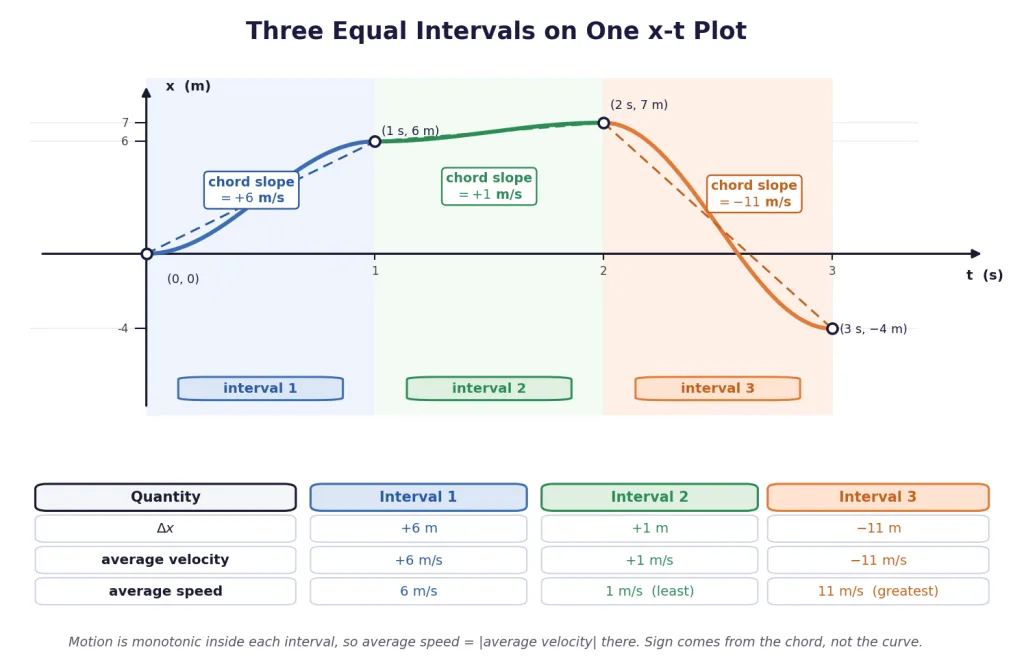
Solution:
- What "average" means on an x-t graph. Average velocity over an interval is the slope of the chord joining the two endpoints — you do not need the shape of the curve in between, only where it starts and ends.
- Read off the three values. Each interval lasts the same time, call it 1 unit:
- Interval 1: m
- Interval 2: m
- Interval 3: m
- Average velocities: , and (metres per unit time). Signs: positive, positive, negative.
- Average speeds. Since the particle does not reverse inside any interval, path length equals there, so the average speeds are 6, 1 and 11.
- Greatest average speed: interval 3 (the steepest chord).
- Least average speed: interval 2 (the flattest chord).
- Read it physically. In interval 2 the particle has almost stopped — the curve is nearly horizontal. In interval 3 it turns round and races back past its starting point.
Final Answer: Average speed is greatest in interval 3 and least in interval 2. Average velocity is positive in intervals 1 and 2 and negative in interval 3.
Takeaway: [NEET Important] Two separate readings from the same picture. Steepness (magnitude of slope) answers "how fast?"; tilt direction (sign of slope) answers "which way?". A chord going down-right is negative velocity no matter how the curve wiggles in between. And here average speed equals only because the motion is one-way inside each interval — if the curve had turned around mid-interval, you would have had to add path lengths instead.
Example 26: Displacement and distance from a v-t graph
The velocity-time graph of a particle moving along the x-axis is a straight line from down to , after which the velocity stays constant at m/s until s. Find (a) the acceleration in each phase, (b) the instant the particle reverses direction, (c) the displacement in the 12 s, (d) the distance travelled, and (e) the average velocity and the average speed.
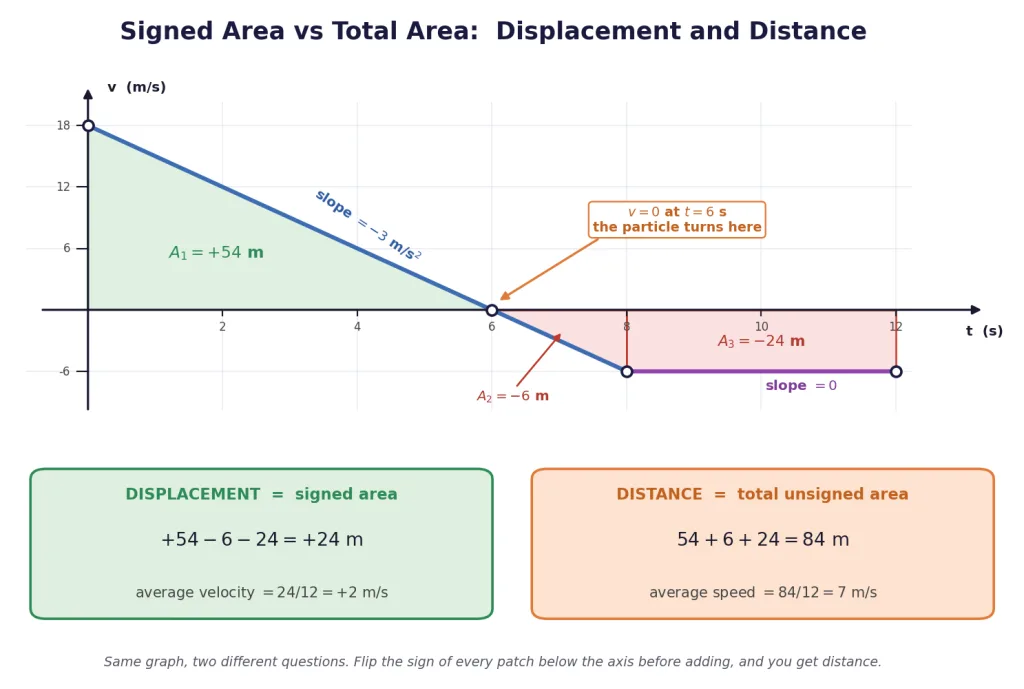
Solution:
- (a) Acceleration is the slope. Phase 1 ( to s): m/s^2. Phase 2 ( to s): the line is horizontal, so .
- (b) Reversal happens where crosses zero. On the first line , so
- (c) Displacement is the signed area. Break it at s and s:
- (triangle, to s, above the axis): m
- (triangle, to s, below the axis): m
- (rectangle, to s, below the axis): m
- (d) Distance is the total unsigned area:
- (e) Average velocity m/s. Average speed m/s.
Final Answer: (a) m/s^2 then 0, (b) s, (c) m, (d) 84 m, (e) m/s and 7.0 m/s.
Takeaway: One graph, two questions, two different answers — and the only difference is whether you keep the minus signs. Displacement adds signed areas; distance flips every below-axis patch positive first. The particle got as far as m at s and then walked 30 m back, finishing at m. If a question asks "how far from the start is it now", that is displacement; "how much ground did it cover" is distance.
Example 27: Climbing from an a-t graph
A particle starts from rest at the origin. Its acceleration-time graph is: m/s^2 from to s, from 4.0 s to 10 s, and m/s^2 from 10 s to 13 s. Find (a) the velocity at s, 10 s and 13 s, (b) the instant the particle reverses, (c) the maximum distance from the origin, (d) the displacement over the 13 s, and (e) the total distance travelled.
Solution:
- The rule going up the chain: area under an a-t graph gives ; area under the resulting v-t graph gives .
- (a) Velocities. m/s. m/s (zero acceleration means the velocity holds). m/s.
- (b) During the last phase , which is zero when , i.e. s.
- (c) Positions from the v-t areas:
- to s (triangle): m
- to s (rectangle): m, running total 96 m
- to s (triangle): m, running total 108 m — this is the farthest point, reached at s
- (d) From 12 s to 13 s the particle moves backwards: m. So
- (e) Distance m.
Final Answer: (a) , , m/s; (b) s; (c) 108 m; (d) 105 m; (e) 111 m.
Takeaway: The a-t graph is the top of the chain and it is the least informative — it can never tell you where the particle is until you supply the initial velocity and position. Notice that the a-t graph jumps discontinuously at 4.0 s and 10 s, which is fine, but the v-t graph built from it has kinks and no jumps, and the x-t graph has no kinks at all. Each integration smooths the picture by one step.
Example 28: The arithmetic behind the bouncing ball
A ball is dropped from a height of 90 m onto a floor. At each collision with the floor it loses one tenth of its speed. Take m/s^2. Find (a) the speed and the time of the first impact, (b) the rebound speed and the height of the first bounce, (c) the instant of the second impact, (d) the total distance travelled and the displacement up to s, and (e) the average speed over those 12 s.
Solution:
- (a) First impact. Dropped from rest through 90 m:
- (b) Rebound. It loses one tenth of its speed, so it leaves the floor at
- (c) Second impact. The rise takes s and the fall back takes the same, so That is exactly the right-hand end of the window asked about — the 0 to 12 s interval covers precisely one drop and one complete bounce.
- (d) Path length (down) (up) (down) m. Displacement m downward — the ball is back on the floor, 90 m below where it started.
- (e) Average speed m/s. Average velocity m/s downward.
Final Answer: (a) 42 m/s at s, (b) 37.8 m/s rising to 72.9 m, (c) s, (d) 235.8 m of path, 90 m of displacement, (e) 19.65 m/s.
Takeaway: Section 5 plotted this speed-time graph; here are the numbers that put the corners in the right places. Two things worth storing: losing one tenth of the speed costs you of the height (90 m becomes 72.9 m, not 81 m), and the average speed 19.65 m/s is more than twice the average velocity 7.5 m/s because most of the path cancelled itself out.
Example 29: Cruise, brake, reverse — from a v-t description
A particle moves along the x-axis at a constant m/s for the first 2.5 s. From then on it has a constant acceleration of m/s^2. Find (a) when and where it comes momentarily to rest, (b) when it returns to its starting point, (c) its speed at that moment, and (d) the total distance it has travelled by then.
Solution:
- Phase 1 ( to 2.5 s): m, and it is still moving at m/s.
- (a) Phase 2 starts at m with m/s and m/s^2. Time to stop: s, so at s. Extra distance: m, so it stops at m.
- (b) Coming back. From rest at m, with the same m/s^2 still acting, it accelerates back towards the origin. Let be the time since s: So it is back at at s.
- (c) m/s, i.e. a speed of 30 m/s, moving in the direction.
- (d) Distance m out m back m, while the displacement is zero. Average speed m/s; average velocity .
Final Answer: (a) at s, at m; (b) s; (c) 30 m/s; (d) 180 m.
Takeaway: Note the contrast with Example 16. There the negative acceleration was a brake and it switched off at ; here it is a permanent, physically real acceleration (think of a ball rolled up a ramp) and it keeps acting, so the particle really does come back. The words in the problem decide which situation you are in — read them. Also worth noticing: it returns at 30 m/s, faster than the 20 m/s it set out with, because it had 90 m to accelerate over instead of 40 m.
Example 30: The bullet and the thief's car, pushed further
A police van moving along a highway at 30 km/h fires a bullet at a thief's car speeding away in the same direction at 192 km/h. The muzzle speed of the bullet is 150 m/s. (a) Working entirely in the thief's frame, find the speed with which the bullet hits the car. (b) If the bullet is fired when the car is 100 m ahead, how long does it take to hit? (c) What is the smallest muzzle speed for which the bullet could reach the car at all? (d) What would the impact speed be if the thief were driving towards the van instead?
Solution:
- Convert everything to m/s and take the direction of travel as positive:
- The muzzle speed is relative to the gun, i.e. to the van. So in the ground frame
- (a) Go to the thief's frame. In a frame moving with the car, the car is at rest and the bullet approaches at This is the speed that matters for damage: the car "sees" the bullet arrive at 105 m/s, not 158 m/s.
- (b) In that same frame the car is stationary 100 m away and the bullet closes at a constant 105 m/s: (In the ground frame the bullet travels m in that time, while the car moves 51 m — the difference is exactly the 100 m gap.)
- (c) The bullet reaches the car only if it is faster than the car in the ground frame: Below a muzzle speed of about 45 m/s the car simply outruns the bullet.
- (d) Head-on. Now the car's ground velocity is m/s, so
Final Answer: (a) 105 m/s, (b) 0.95 s, (c) about 45 m/s, (d) 211.7 m/s.
Takeaway: [JEE/NEET] Everything here follows from one line, , applied in the right frame. Part (c) is the physically interesting one: relative velocity is not just a shortcut, it decides whether an interaction happens at all. And part (d) shows why head-on collisions are so much worse than rear-end ones at the same road speeds — the closing speed adds instead of subtracting.
Example 31: An express overtaking a goods train
A goods train 400 m long is moving at 36 km/h. An express train 200 m long, travelling at 72 km/h on a parallel track, overtakes it. (a) How long does the express take to overtake the goods train completely? (b) How far does the express travel along the ground during that time? (c) How long would the two take to cross each other if the goods train were moving in the opposite direction instead?
Solution:
- Convert: m/s, m/s. Take the express's direction as positive.
- (a) Same direction. In the goods train's frame, the express approaches at "Completely overtaken" means the express's nose starts level with the goods train's tail and finishes when the express's tail clears the goods train's nose — so the relative displacement is the sum of the lengths:
- (b) In the ground frame the express covers m and the goods train covers m. The difference, 600 m, is the relative displacement.
- (c) Opposite directions. Now m/s, and the relative displacement is still 600 m:
Final Answer: (a) 60 s, (b) 1200 m, (c) 20 s.
Takeaway: Two rules to lock in. The relative distance for one body to cross another is the sum of their lengths (use one length only when the other object is a point — a pole, a signal, a man on the platform). And relative speeds subtract for same-direction motion, add for opposite. Same trains, same speeds, three times faster to pass head-on.
Example 32: The fly between two cyclists
Two cyclists are 300 m apart on a straight road and ride towards each other, one at 5.0 m/s and the other at 7.0 m/s. At the instant they set off, a fly leaves the first cyclist's handlebar, flies at a constant 15 m/s to the second cyclist, turns instantly, flies back to the first, and keeps shuttling until the two cyclists meet and it is squashed between them. Find (a) how long the fly is in the air, (b) the total distance it flies, and (c) its displacement.
Solution:
- Do not try to add up the shuttle legs. There are infinitely many of them. Ask a different question first: how long does the fly have?
- (a) The cyclists' meeting. Their relative speed of approach is m/s and they must close 300 m:
- (b) The fly flies at a constant speed of 15 m/s for the whole 25 s, no matter how many times it turns:
- (c) Displacement is start point to end point. The fly starts at cyclist 1 and ends where they meet, which is from cyclist 1's starting position. So the displacement is 125 m, against 375 m of path.
Final Answer: (a) 25 s, (b) 375 m, (c) 125 m.
Takeaway: The trick is refusing to solve the problem you were shown. Distance = constant speed total time works for any zigzag one-dimensional path, however complicated, as long as the speed is constant. And parts (b) and (c) are a beautiful last reminder of Section 1: 375 m travelled, 125 m of displacement, and both are correct answers to different questions.
Example 33: The bottle that fell overboard
A man is rowing a boat upstream on a river that flows at a steady speed. As he passes a certain point a bottle falls overboard and floats away. He rows on for 15 minutes before noticing, then immediately turns and rows back downstream at the same effort, catching up with the bottle at a point 1.0 km downstream of where it fell in. Find the speed of the river.
Solution:
- Switch to the water's frame. In that frame the bottle is at rest (it floats, so it just moves with the water), and the boat moves at its speed relative to the water — which is the same going up as coming down, because "same effort" means the same speed relative to the water.
- So the journey is symmetric in the water frame: the boat spends 15 minutes moving away from the bottle and must therefore spend 15 minutes coming back to it.
- Now return to the ground frame. In those 30 minutes the bottle has drifted 1.0 km downstream, purely with the current. So
Final Answer: 2.0 km/h.
Takeaway: [JEE Tip] Notice what was never needed: the boat's own speed. Choosing the right frame deleted it from the problem entirely. Whenever a problem involves a current, a walkway or a conveyor, ask what the situation looks like from the moving medium — it is often the difference between three lines and three pages.
Example 34: A dropped stone chased by a thrown one
From the top of a 100 m tower a stone A is dropped from rest. Exactly 2.0 s later a stone B is thrown vertically downward from the same point with an initial speed of 30 m/s. Take m/s^2. (a) Do they meet before A lands? (b) When and where do they meet? (c) What are their speeds then? (d) Confirm using relative velocity.
Solution:
- Measure depth downward from the top, with from A's release:
- (b) Set them equal. Expand : . So Depth: m — that is 80 m below the top, 20 m above the ground. Check B: m.
- (a) Is A still falling at s? A lands when , i.e. s. Since , yes — they meet in mid-air, with 20 m to spare. (B lands at s, also after the meeting.)
- (c) Speeds at the meeting. both downward. B is 10 m/s faster, which is why it caught up.
- (d) Relative-velocity route. At the instant B is released ( s), A is already 20 m down and moving at 20 m/s. The two share the same acceleration, so relative acceleration is zero and B closes on A at a constant m/s:
Final Answer: (a) Yes; (b) at s, 80 m below the top; (c) A at 40 m/s, B at 50 m/s, both downward; (d) confirmed.
Takeaway: Two bodies in free fall have zero relative acceleration — always, regardless of when or how they were released. So relative to each other they move with constant velocity, and every "when do they meet" question becomes a one-line division. The only real work left is checking the meeting happens before either body reaches the ground, which is exactly what part (a) is for.
Example 35: A train between two stations
Two stations are 3.6 km apart on a straight track. A train starts from rest at one, accelerates uniformly at 1.0 m/s^2 up to its maximum permitted speed of 30 m/s, runs at that speed, and finally decelerates uniformly at 1.5 m/s^2 to come to rest at the other station. Find (a) the time and distance of each of the three stages, (b) the total journey time, (c) the average speed. (d) If the speed limit were removed, so the train accelerated at 1.0 m/s^2 and then immediately decelerated at 1.5 m/s^2, what would the peak speed and the total time be?
Solution:
- (a) Stage 1 (accelerating). Stage 3 (decelerating). Stage 2 (cruising). What is left over: (The stage-2 distance came out positive, which confirms the train really does reach the speed limit; if it had come out negative, part (d)'s situation would apply instead.)
- (b) s.
- (c) Average speed m/s. Sensibly below the 30 m/s peak.
- (d) No speed limit. Now the train accelerates over and decelerates over , reaching a peak that satisfies both Dividing, , and with m:
Final Answer: (a) 30 s / 450 m, 95 s / 2850 m, 20 s / 300 m; (b) 145 s; (c) 24.8 m/s; (d) peak 65.7 m/s, total 109.5 s.
Takeaway: [JEE Tip] Part (d) is Example 15's formula in a different disguise, and the distance split is worth remembering — the stage with the gentler acceleration gets the longer stretch. Also note the honest engineering conclusion: dropping the speed limit would cut the journey from 145 s to 110 s but demand 65.7 m/s (237 km/h) on a 3.6 km hop. That is why real timetables are built on stage-1/stage-3 arithmetic exactly like part (a).
Example 36: Does the following car crash?
Car A is travelling at 30 m/s, 120 m behind car B which is travelling at 20 m/s in the same direction on a straight road. B's driver suddenly brakes at a uniform 5.0 m/s^2 and comes to rest. A's driver takes 1.0 s to react and then brakes at a uniform 4.0 m/s^2. Does A hit B? If not, what is the closest they come?
Solution:
- Set up one axis along the road, origin at A's initial position, direction of travel positive. So B starts at m.
- What B does. It stops after s, having covered m. Its final resting position is
- What A does. For the first 1.0 s it holds 30 m/s and covers 30 m. Then it brakes: A stops at s at
- Compare. , so A never reaches B — it stops 17.5 m short.
- Is 17.5 m really the minimum gap? The gap shrinks whenever . Here is 30 m/s while is already falling, and even at s (when B has stopped) A is still doing m/s. So at every instant until A itself stops. The gap therefore decreases monotonically and its minimum is its final value, 17.5 m, reached at s.
Final Answer: No collision. The closest approach is 17.5 m, at s.
Takeaway: Two habits on display. First, the reaction time is a separate constant-velocity stage — A gives away 30 m before its brakes do anything, which is most of the margin. Second, comparing only the final positions is not enough in general: you must argue that the gap never dipped below that value earlier. Here it did not, because A stayed faster than B throughout. If the two had swapped speeds you would have had to minimise the gap function properly.
Example 37: The lift, and the bolt that falls upward
A lift starts from rest at the ground floor, accelerates upward at 1.2 m/s^2 for 5.0 s, travels at constant speed for 8.0 s, then decelerates at 1.5 m/s^2 to rest. (a) Find the maximum speed, the height gained in each stage, and the total height and time. (b) At the instant the lift reaches its maximum speed, a bolt comes loose from the ceiling, 2.45 m above the lift floor. Taking m/s^2, how long does the bolt take to hit the floor? (c) How far does the bolt move relative to the ground in that time, and in which direction? (d) With what speed does it strike the floor, as measured by a passenger?
Solution:
- (a) Stage 1: m/s and m. Stage 2: m. Stage 3: s and m. Total: m in s.
- (b) Choose the lift's frame — and check it is legal. The bolt comes loose during stage 2, when the lift moves at constant velocity. A constant-velocity frame is an inertial frame, so inside it the bolt simply falls from rest with :
- (c) Now switch to the ground frame. The bolt does not start at rest there — it inherits the lift's velocity, m/s upward. With upward positive: The bolt rises 1.79 m while "falling" 2.45 m to the floor. There is no contradiction: the floor rose m in the same time, and m. (In fact the bolt climbs to m at s and has begun to come back down when the floor catches it.)
- (d) In the lift frame the bolt lands at That is what the passenger measures. (In the ground frame the bolt is moving at m/s, i.e. gently downward — and m/s relative to the floor, the same answer.)
Final Answer: (a) 6.0 m/s; 15 m, 48 m, 12 m; 75 m in 17 s. (b) 0.71 s. (c) It moves upward 1.79 m. (d) 6.93 m/s.
Takeaway: This is the chapter in one problem: staged constant-acceleration motion, a frame change, and the reminder that a released object keeps the velocity it had. The headline result is worth carrying around — a bolt dropped inside a rising lift travels upwards in the ground frame while falling to the floor. Both descriptions are complete and correct; they are simply answers measured in different frames. [JEE Tip] Had the bolt come loose during stage 1 or stage 3, the lift frame would be accelerating and non-inertial, and you could not use in it — you would need instead. Always check which stage you are in before switching frames.