
Stop Reading. Start Scoring.
Sections 1 to 8 taught you this chapter — position and displacement, the derivative and the integral of motion, the kinematic equations, free fall, graphs, relative velocity, and the variable-acceleration machinery in Section 8. This section finds out whether you can use any of it with a clock running, which is a completely different skill.
There is no new theory below. There are 30 questions built to the JEE Main pattern, and a marking scheme that punishes the thing students do most: guessing.
The rules of engagement
Key Point: Do not treat this as a reading exercise. Sit down with a blank sheet, a pen and a timer, and attempt all 30 questions in one unbroken sitting before you look at a single explanation.
| The setup | What it is |
|---|---|
| Number of questions | 30 |
| Marking scheme | correct, incorrect, unattempted |
| Maximum score | marks |
| Minimum possible score | marks |
| Suggested time limit | 35 minutes (JEE Main pace is about 1 minute per question) |
| Take as | 10 m/s^2 unless a question says otherwise |
| Allowed | rough sheet, your own brain |
| Not allowed | calculator, formula sheet, looking back at Sections 1 to 8 |
[Exam Tip] That is not decoration. Four wild guesses that produce one lucky hit earn you mark for four minutes of work — a terrible trade. But a question you have narrowed to two options is worth attempting: on average that returns marks. Narrow first, then commit. Leave blank only what you could not narrow at all.
What this set covers
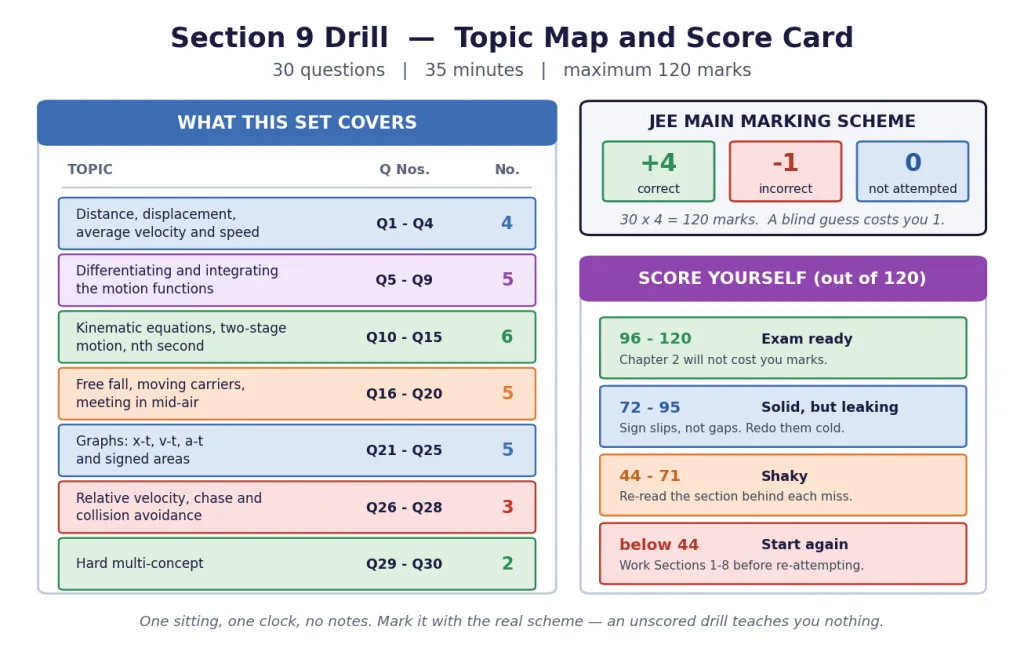
| Topic | Questions | How many |
|---|---|---|
| Distance vs displacement, average velocity vs average speed | Q1 to Q4 | 4 |
| Differentiating and integrating the motion functions, variable acceleration | Q5 to Q9 | 5 |
| Kinematic equations, two-stage motion, nth second, quadratic in | Q10 to Q15 | 6 |
| Free fall and vertical motion, moving carriers, meeting in mid-air | Q16 to Q20 | 5 |
| Graph interpretation: x-t, v-t, a-t, signed areas | Q21 to Q25 | 5 |
| Relative velocity, chase and collision avoidance | Q26 to Q28 | 3 |
| Hard multi-concept | Q29 to Q30 | 2 |
That spread is deliberate — it mirrors how JEE Main actually samples Motion in a Straight Line. The kinematic equations and free fall together account for 11 of the 30, because in the real paper they account for most of what gets asked here. Graphs and calculus take another 10, and they are where the marks are won, because most candidates rush them.
The difficulty mix is roughly 25% easy, 45% medium and 30% hard, so do not panic if a handful feel brutal. They are meant to.
[Exam Tip] Before you start, write your sign convention at the top of the sheet — up positive, or the initial direction of motion positive — and do not change it mid-question. More marks are lost in this chapter to a flipped sign than to a forgotten formula.
Scoring Yourself Honestly
Mark your sheet with the real scheme — , , — and total it. No half marks for "I knew that one really". The number you get is the number that matters.
The bands
| Your score (out of 120) | Verdict | What to do next |
|---|---|---|
| 96 to 120 | Exam ready. 80% or more on a hard set, inside the time. | Move on. This chapter will not cost you marks. Revisit only the specific items you missed. |
| 72 to 95 | Solid, but leaking marks. | These are almost always slips, not gaps — a dropped sign, a distance reported where a displacement was asked. Redo every wrong question without the explanation first. |
| 44 to 71 | Shaky. The ideas are there; the execution is not. | For each wrong answer, go back to the section it came from (use the topic map above) and rework its solved examples before re-attempting. |
| Below 44 | Start again. | Work Sections 1 to 8 properly, then Section 7's solved examples, then come back. Re-attempting this set now teaches you nothing. |
Read your own answer sheet
Before you touch the explanations, sort your mistakes into three piles. This is the most valuable ten minutes in the whole section.
- Concept errors — you did not know that a negative acceleration can mean speeding up, or that the nth-second formula dies once the body has stopped. Fixable by revision, and quickly.
- Execution errors — right method, wrong arithmetic, or you kept the wrong root of a quadratic. Fixable by slowing down for four seconds at the last line.
- Reading errors — you found the displacement when the question asked for the distance, or gave the height above the throwing point when it asked for the height above the ground. These are the cheapest marks in the paper to win back, and the ones students refuse to take seriously.
Key Point: In this chapter specifically, pile 3 is dominated by four traps: distance vs displacement when the body reverses, speed vs velocity when the sign flips, height above the ground vs height above the release point, and time measured from your clock vs time measured from the other body's release. Check which of the four caught you, every single time.
The five habits this set is drilling
- Fix the origin and the positive direction before writing anything. Then every , and carries its own sign automatically.
- Where a body reverses, split the interval at the turning instant. Displacement adds signed; distance adds unsigned. There is no formula that does both at once.
- On a v-t graph, area below the axis is negative displacement but positive distance. That one sentence answers a whole family of questions.
- In a chase or collision problem, sit in the other body's frame. A two-body problem becomes a one-body problem with and .
- When acceleration is not constant, do not reach for . Ask what the acceleration is a function of — , or — and pick the matching route from Section 8.
[Exam Tip] Every explanation below is a full step-by-step solution, so this set doubles as revision material. Read the explanation even for the questions you got right — sometimes you got there the slow way, and the fast way is what you will need in the hall.