
What "Motion" Actually Means
Motion is everywhere. You walk, you run, you ride a bicycle. Even asleep, air moves in and out of your lungs and blood flows through your arteries. Leaves fall, water pours down a dam, the Earth spins once a day and goes round the Sun once a year — and the Sun itself is drifting through the Milky Way.
Physics has to turn all of that into something you can calculate with. So it starts with the plainest possible definition.
Key Point (Definition): An object is said to be in motion if its position changes with time. Motion is change in position of an object with time.
That is the whole idea. No forces, no pushes, no causes — just position, and how it changes. This branch of physics has a name.
Key Point: Kinematics is the study of ways to describe motion without going into the causes of motion. What causes motion is the subject of Chapter 4 (Laws of Motion).
In this chapter we stay in the simplest possible arena: motion along a single straight line, called rectilinear motion. One direction, one axis, one number to keep track of.
Rest and motion are relative — always
Here is the thing that trips up most students on day one. Ask "is that book on the table at rest?" and the honest answer is: at rest with respect to what?
Think about a passenger sitting in a moving train:
- With respect to the train, the passenger's position never changes. She is at rest.
- With respect to the platform, her position changes every second. She is in motion at, say, 80 km/h.
Both statements are completely correct at the same time. They are not in conflict, because they are answers to two different questions.
Key Point: Rest and motion are relative terms. An object can be at rest with respect to one body and in motion with respect to another at the very same instant. There is no experiment that can label an object "absolutely at rest".
And that book on the table? The table sits on the floor, the floor sits on the Earth, and the Earth is spinning at roughly 1670 km/h at the equator while orbiting the Sun at about 30 km/s. So:
Key Point: Nothing in the universe is absolutely at rest. Every statement about rest or motion is a statement made with respect to some chosen body.
[Board Important] "Rest and motion are relative — explain with an example" is a standard 2-mark question. The train-passenger example, written out in both frames, gets full marks.
[JEE/NEET] Because motion is relative, "what is the velocity of A as seen by B?" is a legitimate and very common question. That question has a whole section of its own — Section 6, Relative Velocity — so we will not open it here. For now, just absorb the principle: you must say with respect to what.
Frame of Reference: Where You Stand Before You Measure
If every measurement of motion is "with respect to something", then before you write down a single number you must fix what that something is. That fixture is called a frame of reference.
Key Point (Definition): A frame of reference consists of three things:
- an origin O — the point you agree to call ;
- a set of axes through it — for rectilinear motion, a single axis, with a chosen positive direction;
- a clock — so you can say not just where the object was, but when.
Drop any one of the three and you cannot describe motion. Without an origin, "x = 7 m" means nothing. Without a positive direction, you cannot tell m from m. Without a clock, you have a photograph, not a motion.
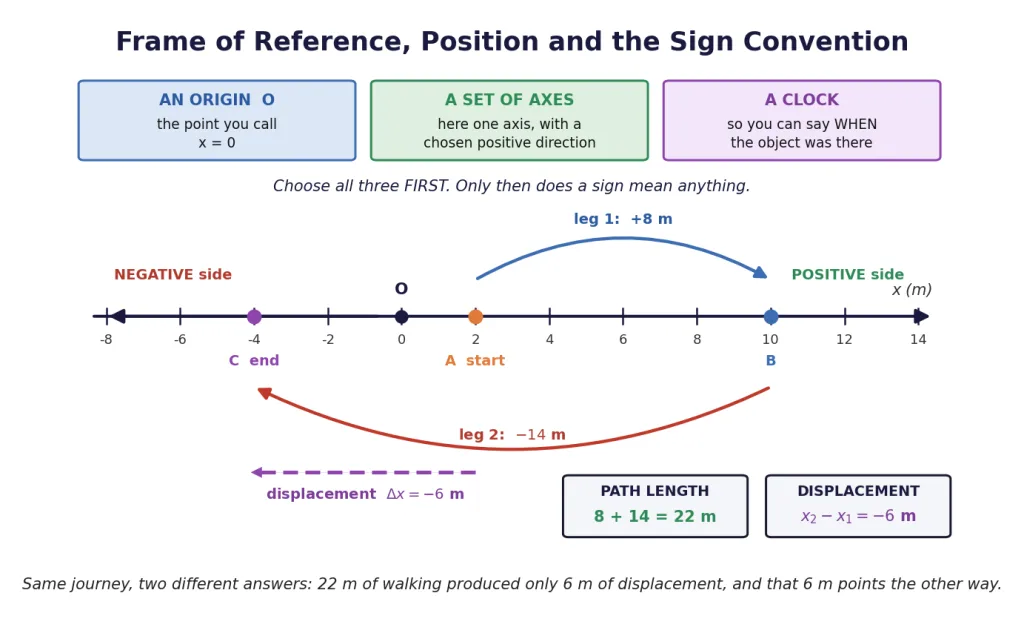
The sign convention for a straight line
Once the axis is drawn, the standard convention is fixed, and it is worth memorising word for word:
Key Point: The position of the object can be specified with reference to a conveniently chosen origin. For motion in a straight line, position to the right of the origin is taken as positive and to the left as negative.
So in the figure above, a point 4 m to the left of O has position m, and a point 10 m to the right has m. The minus sign is not saying "less than nothing" — it is saying which side.
[Board Important] And here is the warning that must go with it: the origin and the positive direction of an axis are a matter of choice. You should first specify this choice before you assign signs to quantities like displacement, velocity and acceleration.
Two consequences you will use all chapter long:
- The choice is yours. You may put the origin anywhere and point the positive direction either way. Nothing physical depends on your choice.
- But once made, you are stuck with it. Every position, every displacement, every velocity in that problem must use that same convention. Switching halfway is the single most reliable way to get a sign wrong.
[JEE Tip] In a vertical-motion problem you get to decide whether "up" is or . Pick one, write it down at the top of your rough work, and never revisit it. Section 4 leans on this constantly.
The point object approximation
Real objects have size. A train is 400 m long; which part of it is "at position x"?
Physics dodges this with an approximation stated right at the very start of the subject:
Key Point (Definition): We treat objects in motion as point objects. This approximation is valid so far as the size of the object is much smaller than the distance it moves in a reasonable duration of time.
That single sentence is the whole test. Apply it literally:
| Situation | Size of object | Distance moved | Point object? |
|---|---|---|---|
| Train between Delhi and Agra | ~0.4 km | ~200 km | Yes — size is negligible |
| Earth going round the Sun | km | km | Yes |
| A spinning ball turning sharply on pitching | ~7 cm | ~10 cm of turn | No — comparable |
| A beaker tumbling off a table | ~15 cm | ~75 cm fall | No — and it rotates |
Notice the second failure mode hiding in the last two rows: if the object is rotating or tumbling, different parts of it move differently, so no single point can stand in for the whole thing.
[NEET Important] Exactly this judgement is asked constantly, and appears in NEET-style papers almost verbatim. It is worked out as Example 1 below.
Position, Displacement and Path Length
With the frame fixed, everything else follows quickly.
Position
The position of a point object is simply its coordinate on the chosen axis at a given instant. It carries a sign, and it changes with time — so we often write .
Displacement
Suppose the object is at at time and at at a later time . The change in its position is its displacement.
Key Point (Definition): Displacement is the change in position: It is a vector in one dimension — its sign carries the direction. The symbol ("delta") always means "final minus initial", never the other way round.
Everything about displacement flows from that subtraction:
- It carries a sign. Positive means the object ended up further along the positive direction; negative means it ended up back along the negative direction.
- It is path-independent. Only the two end points appear in . What the object did in between is invisible to it.
- It can be zero even when the object moved, as long as it comes back to where it started.
- Its SI unit is the metre (m), and its dimensional formula is .
Path length (distance)
Key Point (Definition): The path length, or distance travelled, is the total length of the path actually traversed by the object between the two instants. It is a scalar: it has magnitude only, is always positive (or zero), and it never decreases as time goes on.
The word "actually" is doing all the work. Every metre the object physically covers gets added, whichever way it was heading at the time.
Putting them side by side
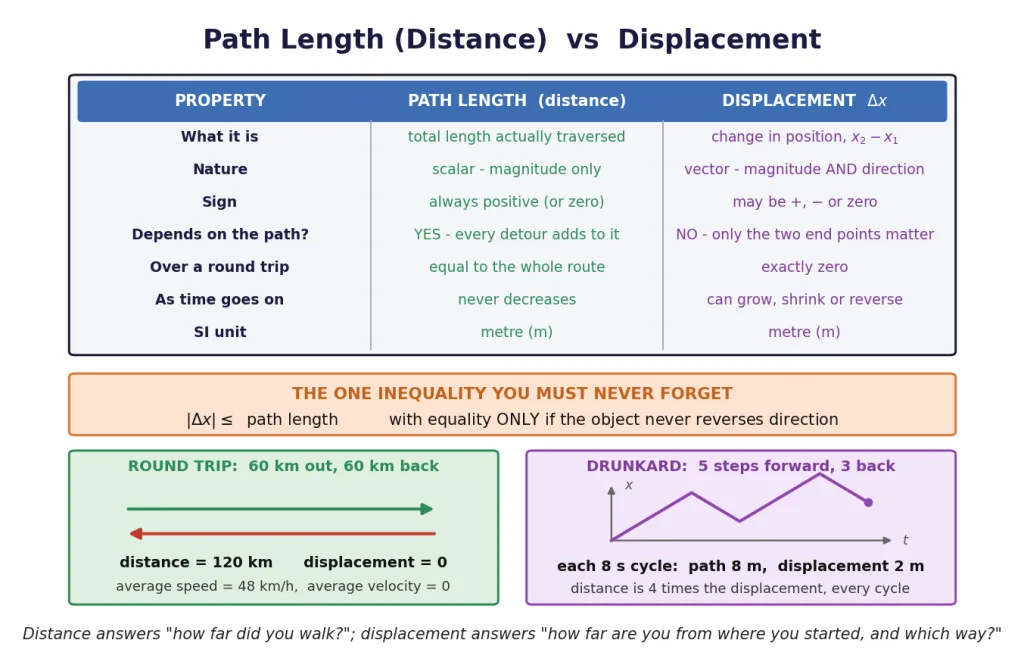
| Path length (distance) | Displacement | |
|---|---|---|
| Meaning | total length actually traversed | change in position, |
| Nature | scalar | vector (sign gives direction in 1D) |
| Sign | always positive or zero | may be positive, negative or zero |
| Depends on the path taken? | Yes | No — only the end points |
| Zero when? | only if the object never moved | whenever it returns to the start |
| With increasing time | never decreases | can increase, decrease or reverse |
| SI unit | metre (m) | metre (m) |
And the relationship that ties them together — commit this one to memory:
Key Point:
The magnitude of the displacement can never exceed the path length. They are equal only if the object moves in one direction along a straight line without ever reversing.
Why? Because path length adds up , while displacement adds up the bits with their signs, so opposite bits cancel. Cancellation can only shrink the total, never grow it.
The classic cases
A round trip. A car drives 60 km east and returns 60 km west to the same spot. Path length km. Displacement . Its odometer read 120 km, and yet its change in position was nothing at all.
The drunkard. A man in a narrow lane takes 5 steps forward and 3 steps backward, over and over, each step 1 m long. In each 8-step cycle he walks 8 m but advances only 2 m. Distance is four times displacement, cycle after cycle. This is worked out fully in Example 6.
[JEE/NEET] The reliable trap: a question gives you a journey with a reversal in it and then asks for "the distance". Students who quietly compute lose the mark. Whenever the direction changes, split the journey at the turning point and add the legs separately.
Average Velocity and Average Speed
Position tells you where. Now we ask how fast. And because this section deals only with whole intervals, there are exactly two quantities to define — one built from displacement, one built from path length.
Average velocity
Key Point (Definition): Average velocity is the displacement divided by the time interval in which the displacement occurs: SI unit: m/s; also written . Dimensional formula .
Since is always positive, the sign of is exactly the sign of . A negative average velocity simply means the object finished up on the negative side of where it started.
Average velocity is the slope of a chord
Draw the position-time graph. Mark the point and the point and join them with a straight line. That straight line is a chord of the curve, and
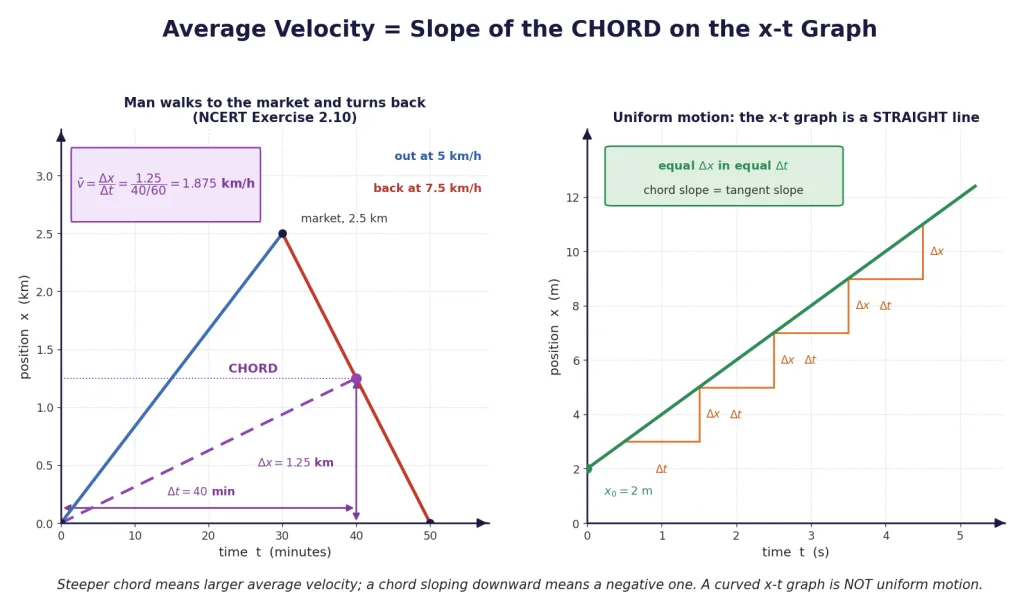
Read the left panel carefully. The man's actual journey is the blue-and-red bent path; the chord is the dashed purple line. Average velocity does not care about the bend at all — it only knows the two end points. That is displacement's path-independence showing up graphically.
Key Point: On an x-t graph, average velocity over an interval = the slope of the chord joining the two end points of that interval. A steeper chord means a larger magnitude; a chord sloping downward means a negative average velocity.
Average speed
Key Point (Definition): Average speed is the total path length divided by the total time interval: Being a path length over a positive time, it is always positive (or zero). It carries no direction.
There is a good reason why speed is defined this way rather than as the magnitude of average velocity: a man who walks to the market and back has zero average velocity, and "you would not like to tell the tired man on his return home that his average speed was zero."
The one-line summary
| Average velocity | Average speed | |
|---|---|---|
| Built from | displacement | total path length |
| Nature | vector — carries a sign | scalar — always positive |
| Zero when? | the object returns to its start | only if the object never moved |
| On the x-t graph | slope of the chord | not a slope — needs the whole path |
[Board Important] Distinguishing these two, with an example, is a guaranteed 3-mark question. Example 12 works it out in full.
A note on what comes next. Everything on this page is an average — it describes a whole interval, and says nothing about any single moment inside it. The velocity at an instant, and the acceleration at an instant, are Section 2's and Section 3's jobs respectively. Do not go looking for them here.
Why Average Speed Is Never Less Than the Magnitude of Average Velocity
This is asked somewhere in almost every Board paper. It is also a two-line proof, so there is no excuse for losing the mark.
The proof
Over the same time interval :
where is the path length. We already know from the previous block that
Now divide both sides by the same positive number . Dividing an inequality by a positive number preserves it, so
Key Point:
The equality holds if and only if the object moves in a single direction along a straight line, without ever reversing. In that case, and only in that case, .
That is the entire argument: the inequality between speeds is inherited, unchanged, from the inequality between distance and displacement.
[NEET Important] Two rapid-fire corollaries that get asked directly:
- If a body's average speed over some interval equals the magnitude of its average velocity, the body did not turn back during that interval.
- Average speed can be non-zero while average velocity is zero (any round trip). The reverse is impossible — average velocity can never be non-zero while average speed is zero.
The two-leg journey: the trap that catches everyone
Now the single most examined mistake in this whole section.
Case A — equal DISTANCES. A body covers the first half of a journey at speed and the second half at . What is the average speed for the whole trip?
Let each half be of length , so the total path length is . Time for the first half is , for the second . Therefore
This is the harmonic mean of and . Notice that the distance cancelled completely — the answer does not depend on how long the journey was.
Case B — equal TIMES. Now suppose the body travels at for a time and then at for the same time . The path lengths are and , and the total time is :
This one is the ordinary arithmetic mean.
Key Point: Equal distances give the harmonic mean . Equal times give the arithmetic mean . They are not the same number, and mixing them up is the classic silly loss of marks.
See the difference on real numbers
Take km/h and km/h.
| Journey split | Formula | Average speed |
|---|---|---|
| Equal distances | 48 km/h | |
| Equal times | 50 km/h |
The equal-distance answer is always the smaller of the two. That makes physical sense: covering equal distances means you spend more time at the slower speed, so the slow leg gets more weight.
[JEE Tip] For equal distances at speeds the same derivation gives
Memorise the shape, not the two-term special case, and you can never be caught out by a three-leg problem.
[JEE Tip] A sanity check that takes one second: the average speed must always lie between the smallest and the largest of the individual speeds. If you compute 55 km/h for a trip made at 40 and 60, you are fine; if you compute 105 km/h, you have added instead of averaged.
Uniform Motion
There is one special case so clean that the whole chapter uses it as a reference point.
Key Point (Definition): An object is in uniform motion along a straight line if it covers equal displacements in equal intervals of time, however small those intervals are chosen.
Equal displacements in equal times means the velocity never changes — neither in magnitude nor in direction. So:
- The velocity is constant, say .
- The acceleration is zero (acceleration is Section 3's topic; here just note that nothing is changing).
- The position obeys , where is the position at .
The graph is the giveaway
is the equation of a straight line, so:
Key Point: For uniform motion, the x-t graph is a straight line inclined to the time axis, whose slope is the velocity , and whose intercept on the x-axis is the starting position .
That is the right-hand panel of the figure in the previous block. Every step of equal width produces a rise of exactly the same — the picture of the definition.
And here is the payoff:
Key Point: In uniform motion the average velocity over every interval is the same, and equal to the velocity at every instant. The chord and the tangent coincide, because a straight line is its own chord.
This is the only kind of motion for which "the velocity" needs no qualification. For every other kind, you must specify average over what interval, or instantaneous at what moment.
Three cautions worth marks
- Uniform motion does not mean "constant speed". It means constant velocity. A car going round a circular track at a steady 40 km/h has uniform speed but not uniform velocity, because its direction keeps changing — so it is not uniform motion.
- A straight-line x-t graph means uniform motion. A curved one does not. If the x-t graph bends, the slope is changing, so the velocity is changing.
- The line need not pass through the origin, and it may slope downward. A downward-sloping straight line is still uniform motion — with a negative constant velocity, meaning the object moves steadily in the negative direction.
[NEET Important] In uniform motion, distance displacement over any interval in which the object does not reverse — and a uniformly moving object never reverses. Hence for uniform motion, average speed average velocity exactly. This is the cleanest illustration of the equality condition from the previous block.
Where this section ends
You can now set up a frame, assign signs, separate distance from displacement, and compute both averages over any interval. What you cannot yet do is say how fast something is moving at one particular instant — the chord gives you an interval, not a moment. Shrinking that interval to nothing is precisely the idea of instantaneous velocity, and it is the first thing Section 2 does.
Solved Examples
Example 1: Which bodies can be treated as point objects?
In which of the following examples of motion can the body be considered approximately a point object? (a) a railway carriage moving without jerks between two stations; (b) a monkey sitting on top of a man cycling smoothly on a circular track; (c) a spinning cricket ball that turns sharply on hitting the ground; (d) a tumbling beaker that has slipped off the edge of a table.
Solution:
- State the test: an object may be treated as a point object if its size is much smaller than the distance it moves in a reasonable duration of time — and if it is not tumbling or spinning in a way that matters.
- (a) Railway carriage. A carriage is a few tens of metres long; the distance between two stations is several kilometres. Size distance moved. → Yes, a point object.
- (b) Monkey on a cyclist. The monkey is under a metre across; the circular track is hundreds of metres around. Size distance moved. → Yes, a point object.
- (c) Spinning cricket ball turning sharply. The ball is about 7 cm across, and the sharp turn happens over a distance comparable to that. The spin also means different parts of the ball move differently. → No.
- (d) Tumbling beaker. The beaker's size is comparable to the height it falls through, and it is tumbling, so no single point represents it. → No.
Final Answer: (a) and (b) can be treated as point objects; (c) and (d) cannot.
Takeaway: Always compare size against distance moved, and then check for rotation or tumbling. Those two checks settle every question of this type.
Example 2: Signs depend on your convention; magnitudes do not
On a straight highway, a car is at the 12 km milestone and a truck at the 4 km milestone. Take the origin at the 8 km milestone. (a) Give the positions of the car and the truck if the positive x-direction is that of increasing milestones. (b) Give them if the positive x-direction is reversed. (c) The car now drives to the 4 km milestone. Find its displacement in each convention.
Solution:
- (a) Positive towards increasing milestones. The car is 4 km on the positive side of the origin, the truck 4 km on the negative side:
- (b) Positive direction reversed. Every sign flips:
- (c) Displacement in convention (a): the car goes from km to km, so
- Displacement in convention (b): now km and km, so
Final Answer: The signs are opposite in the two conventions, but the magnitude is 8 km either way, and in both cases the car ends up at the 4 km milestone.
Takeaway: Physics never depends on your choice of axis; only the bookkeeping does. Declare your convention once, at the top of the page, and stay with it.
Example 3: Position, displacement and average velocity — the basics
A particle moving along the x-axis is at m when and at m when s. Find (a) its displacement and (b) its average velocity.
Solution:
- Displacement is always final minus initial: Watch the double negative — subtracting adds 4.
- Time interval: s.
- Average velocity:
Final Answer: Displacement m; average velocity m/s, directed along the positive x-axis.
Takeaway: The commonest arithmetic slip in this whole chapter is mishandling when is negative. Write the subtraction with the brackets in place, every single time.
Example 4: One journey, two very different answers
A boy starts at m, walks to m, then turns around and walks to m. The whole trip takes 11 s. Find (a) the path length, (b) the displacement, (c) the average speed and (d) the average velocity.
Solution:
- Split the journey at the turning point — this is the whole trick.
- Leg 1: from m to m. Length m.
- Leg 2: from m to m. Length m.
- (a) Path length adds the magnitudes:
- (b) Displacement uses only the end points:
- (c) Average speed:
- (d) Average velocity:
Final Answer: m, m, average speed m/s, average velocity m/s.
Check: , so average speed average velocity as it must be. The inequality is strict here because the boy reversed direction.
Takeaway: 22 m of walking, 6 m of displacement, and the displacement points the opposite way to the first leg. When direction changes, distance and displacement stop resembling each other.
Example 5: The round trip — where average velocity dies
A car travels 60 km due east at 60 km/h, then immediately returns along the same road to the starting point at 40 km/h. Find (a) the total distance, (b) the displacement, (c) the average speed and (d) the average velocity for the whole trip.
Solution:
- Time for each leg using time distance / speed: Total time h.
- (a) Total distance — every kilometre counts:
- (b) Displacement — the car ends exactly where it began:
- (c) Average speed:
- (d) Average velocity:
Final Answer: distance 120 km, displacement 0, average speed 48 km/h, average velocity 0.
Takeaway: Notice that 48 km/h is not km/h — the two legs were equal in distance, not in time, so the answer is the harmonic mean km/h. And notice the whole point of defining average speed by path length: the driver certainly did not average zero.
Example 6: The drunkard in the lane
A drunkard walking in a narrow lane takes 5 steps forward and 3 steps backward, then again 5 forward and 3 backward, and so on. Each step is 1 m long and takes 1 s. How long does he take to fall into a pit 13 m away from the start? Also find his average velocity and average speed over that period.
Solution:
- Analyse one cycle. In 5 forward and 3 backward steps he takes steps, so one cycle lasts 8 s, during which:
- path length covered m,
- net displacement m.
- Do not just divide 13 by 2. That would give 6.5 cycles, but the pit is reached during a forward run, not at the end of a cycle. Track the position at the end of each cycle instead:
| Cycles completed | Time (s) | Position (m) |
|---|---|---|
| 1 | 8 | 2 |
| 2 | 16 | 4 |
| 3 | 24 | 6 |
| 4 | 32 | 8 |
- After 4 complete cycles he is at m at s. He now begins the next set of 5 forward steps:
- He reaches 13 m on the 5th step of that run, i.e. at s — and falls in. (He never gets to take the backward steps.)
- Average velocity: m/s.
- Average speed: he took 37 steps of 1 m in 37 s, so path length m and average speed m/s.
Final Answer: He falls into the pit after 37 s, having walked 37 m to achieve a displacement of 13 m. Average speed 1 m/s, average velocity m/s.
Takeaway: The trap is stopping at "5 cycles gets him to 10 m, so…". Always check whether the target is crossed mid-cycle — here he arrives 3 s into the 5th forward run. Note also that his average speed is nearly three times his average velocity.
Example 7: The market trip, three intervals
A man walks on a straight road from his home to a market 2.5 km away with a speed of 5 km/h. Finding the market closed, he instantly turns and walks back home with a speed of 7.5 km/h. What are the magnitude of average velocity and the average speed of the man over the intervals (i) 0 to 30 min, (ii) 0 to 50 min, (iii) 0 to 40 min?
Solution:
- First build the timetable. Take home as the origin and the direction home market as positive.
- Outward: h min. So he reaches the market at min.
- Return: h min. So he is home again at min.
- (i) Interval 0 to 30 min ( h). He has only walked outward, no reversal yet.
- Displacement km; path length km.
- km/h; average speed km/h.
- They are equal — exactly as the equality condition predicts, since he never turned back.
- (ii) Interval 0 to 50 min ( h). He is back home.
- Displacement ; path length km.
- ; average speed km/h.
- (iii) Interval 0 to 40 min ( h). He reached the market at 30 min and has been returning for 10 min h.
- Distance covered on the way back km, so he is at km.
- Displacement km; path length km.
- km/h; average speed km/h.
Final Answer:
| Interval | Magnitude of average velocity | Average speed |
|---|---|---|
| 0 to 30 min | 5 km/h | 5 km/h |
| 0 to 50 min | 0 | 6 km/h |
| 0 to 40 min | 1.875 km/h | 5.625 km/h |
Takeaway: This one problem contains the entire section. Interval (i) shows the equality case; interval (ii) shows average velocity collapsing to zero while average speed stays healthy; interval (iii) shows the general strict inequality. And it shows why average speed is defined by path length in the first place: you would not want to tell the tired man that his average speed on returning home was zero.
Example 8: Equal distances — the harmonic mean
A car covers the first half of the distance between two towns at 40 km/h and the second half at 60 km/h. Find its average speed for the whole journey.
Solution:
- Do not average the speeds. The two halves are equal in distance, so they take different times, and the slower leg occupies more of the journey.
- Let each half be . Total path length .
- Times for the two halves:
- Average speed:
- Or straight from the formula:
Final Answer: 48 km/h.
Takeaway: cancels — the answer never depends on how far the towns are. And 48 is less than the naive 50, because the car spent more time crawling at 40 than it did cruising at 60.
Example 9: Equal times — now it IS the arithmetic mean
A car travels at 40 km/h for the first half of the time of its journey and at 60 km/h for the second half of the time. Find the average speed. Compare with Example 8.
Solution:
- Let each half of the time be . Total time .
- Path lengths covered:
- Average speed:
- Or from the formula: km/h.
Final Answer: 50 km/h — compared with 48 km/h in Example 8, for the very same two speeds.
Takeaway: Same speeds, different split, different answer. Read the question for the word distance or the word time before you pick a formula. Equal distance harmonic mean; equal time arithmetic mean; and the harmonic mean is always the smaller of the two.
Example 10: Three equal stretches
A cyclist covers three equal stretches of a straight road at 20 km/h, 30 km/h and 60 km/h respectively. Find the average speed for the whole ride.
Solution:
- Use the general equal-distance result for legs:
- Add the reciprocals with LCM 60:
- Substitute:
- Sanity check: 30 lies between the slowest (20) and the fastest (60), so the answer is plausible. The naive arithmetic mean would have been km/h — too high, as always.
Final Answer: 30 km/h.
Takeaway: Learn the -leg form. Two-leg problems are then just , and a three-leg problem cannot ambush you.
Example 11: Uniform motion, read off two data points
A particle in uniform motion along the x-axis is at m at and at m at s. Find (a) its velocity, (b) its position at s, (c) the instant at which it crosses the origin, and (d) the distance it travels in the 8 s.
Solution:
- (a) In uniform motion the velocity is constant and equals the average velocity over any interval: The minus sign says it moves steadily in the negative x-direction.
- (b) Uniform motion obeys with m:
- (c) At the origin, :
- (d) Distance. The particle never reverses (uniform motion never does), so the distance equals the magnitude of the displacement:
Final Answer: m/s; m; it crosses the origin at s; distance m.
Takeaway: Because the motion is uniform, average speed average velocity m/s — the equality case in action. Also note the graph: is a straight line sloping downwards, which is still uniform motion.
Example 12: State and prove the two distinctions
Explain clearly, with examples, the distinction between (a) the magnitude of displacement over an interval and the total path length over the same interval, and (b) the magnitude of average velocity over an interval and the average speed over the same interval. Show that in both cases the second quantity is greater than or equal to the first, and state when equality holds.
Solution:
- (a) The definitions.
- Magnitude of displacement : the straight-line gap between the starting and finishing positions. It ignores the path.
- Total path length : the sum of the lengths of every stretch actually covered, regardless of direction.
- (a) The example. An athlete runs one complete lap of a 400 m circular track in 50 s.
- Path length m.
- Magnitude of displacement , because she finishes where she started. So 400 m of running produced zero displacement.
- (a) The inequality. Path length adds the magnitude of each stretch; displacement adds the stretches with their signs, so opposite stretches partly cancel. Cancellation can only reduce a total. Hence
- (b) The definitions. Divide both of the above by the same time interval :
- (b) The example. For the same athlete: average speed m/s, while the magnitude of average velocity .
- (b) The inequality. Dividing by the positive number preserves the inequality:
- When does equality hold? Only when , i.e. when the particle moves along a straight line in one fixed direction, without ever reversing, during the whole interval. A particle in uniform motion, or any body moving steadily one way, satisfies this.
Final Answer: In both parts, the second quantity is the first, with equality if and only if the motion is unidirectional (no reversal) throughout the interval.
Takeaway: This is the highest-frequency 3-mark question in the section. The full-mark answer is: two definitions, one example where they differ sharply (the closed lap), the one-line proof by dividing by , and the equality condition stated explicitly.