
The Three Equations You Trust Have a Hidden Assumption
Everything in Sections 1 to 6 was built on one sentence that is stated plainly and then quietly relied on for the rest of the chapter: the acceleration is constant. Under that assumption you got
and they carried you through free fall, braking, and the law of odd numbers.
Now here is the thing JEE knows and the Board paper mostly does not test: almost nothing in the real world has constant acceleration. A parachutist, a boat coasting with its engine cut, a charged particle drifting into a field, a block on a spring - in every one of them changes from instant to instant. And the moment changes, those three equations are not "approximately right". They are wrong.
Why they fail, precisely
Look at where came from. It came from , and that step pulled outside the integral because it was a constant. If depends on , or on , or on , you cannot pull it out, and the whole chain collapses.
Key Point: The kinematic equations are not laws of nature. They are the solutions of the differential equations of motion for the single special case constant. Change that case and you must go back and solve the differential equations again.
The three relations that never fail
These are definitions, not results, so no assumption about can break them:
The first two you met in Sections 2 and 3. The third one is new, and it is the single most useful tool in this entire section.
Deriving by the chain rule
Velocity is a function of time. But if the particle keeps moving in one direction, position is also a function of time, so velocity can equally be thought of as a function of position. Apply the chain rule to , routing it through :
and since is just ,
Two other ways of writing the same thing, both of which you will need:
That last form is worth a second look. It says acceleration is the rate of change of with respect to distance. If that reminds you of work and kinetic energy, good - it is exactly the kinematic skeleton of the work-energy theorem, which you will meet in Chapter 5.
When do I reach for it?
Key Point: Use whenever acceleration is given as a function of position, and whenever a question asks for velocity at a given position without mentioning time. It converts a problem about and into one clean integral with no anywhere in it.
[Exam Tip] Notice that is just this relation with constant: gives . So you are not learning a different physics. You are learning the version that works before the constant- shortcut is taken.
A sanity check you should run
If you ever apply to a problem where is written as or , stop. Those symbols in the acceleration are a signal, and the signal says: set up an integral.
The Three Integration Routes
Every variable-acceleration problem in JEE reduces to one question: what is a function of? Answer that and the route is fixed.
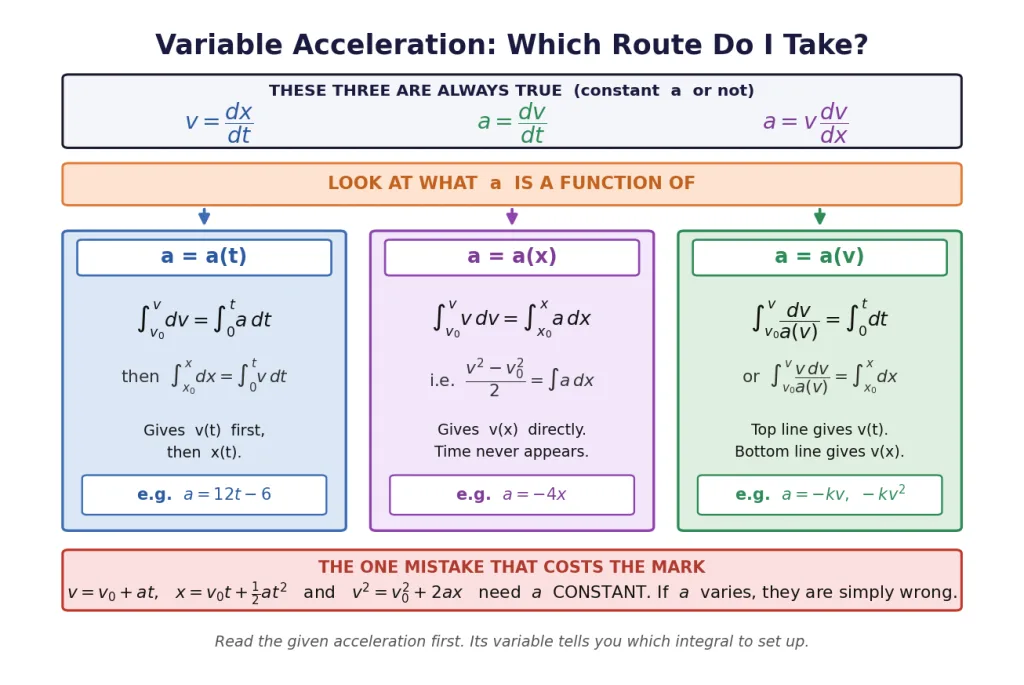
The decision table - memorise this one
| You are given | Use | Integrate | You get |
|---|---|---|---|
| , then gives | |||
| directly - no time involved | |||
| , want | as a function of , then invert | ||
| , want | as a function of , then invert |
Route 1: - two integrations, in order
Start from the definition and separate the variables - all the on one side, all the on the other:
Then do it again with the velocity you just found:
Key Point: Use definite integrals with the limits written in, not indefinite integrals with a you have to chase later. The lower limits are the initial conditions ( at , at ); the upper limits are the general values. Half the marks lost in this topic are lost to a forgotten constant of integration.
Route 2: - one integration, and time disappears
If the given acceleration mentions , then is useless to you: the left side is about time, the right side about position, and you cannot separate them. This is exactly the hole fills:
You get as a function of in one step, with no time anywhere. If the question then asks for time, you go on to solve - but usually it does not.
Route 3: - pick the half you need
Here you have a genuine choice, and choosing wrong doubles the work.
Want as a function of ? Separate from :
Want as a function of ? Separate from :
Key Point: Read the question before you integrate. "How long until the speed halves?" is a question. "How far does it travel before the speed halves?" is a question. Same physics, different integral, and the two answers are genuinely different numbers.
The three habits that make this routine
- Write down what is a function of before anything else. That single line picks your route.
- Separate variables completely before integrating. Nothing involving may remain on the side.
- Put the limits in immediately. Lower limits describe the start, upper limits the general instant.
[Advanced] A question can chain the routes. If depends on both and , you usually still separate - for example handled as a function of gives , and depending on only gives too. If genuinely nothing separates, JEE will not ask it in Class 11 kinematics.
Retarding Motion: versus
This is the most heavily tested single idea in JEE-level 1D kinematics, and it is genuinely beautiful, so it is worth doing slowly.
A body moving through a fluid feels a resistive force opposing its motion. At low speeds that force is proportional to the speed; at higher speeds it is proportional to the square of the speed. Since force gives acceleration, the two cases are
The minus sign says "opposes the motion". Both look almost the same. They behave completely differently.
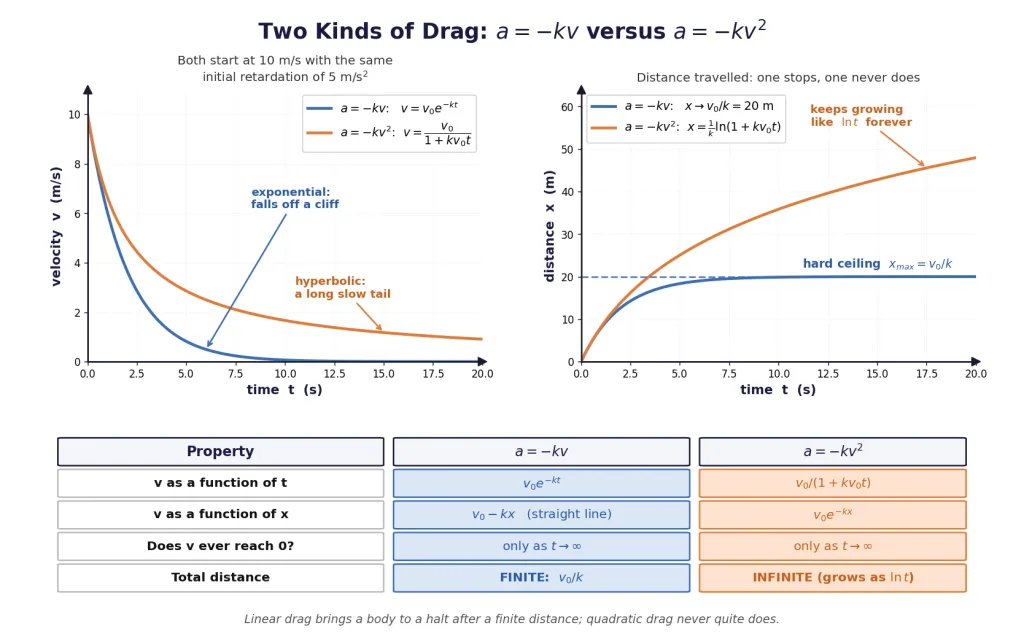
Case A:
Velocity as a function of time. This is , and we want , so use :
Exponential decay. The speed halves in a fixed time , halves again in the same time, and so on. It never actually reaches zero - only in the limit .
Velocity as a function of position. Now use the other half of Route 3, . The cancels:
That is a startlingly simple result: under linear drag, velocity falls off linearly with distance, so the v-x graph is a straight line.
Total distance. Put in :
Key Point: With the body takes infinite time to stop but covers only a finite distance . Never confuse the two - "it never stops" and "it travels forever" are different statements, and here the first is true and the second is false.
Case B:
Velocity as a function of time. , so
Not exponential - hyperbolic. It falls fast at first and then drags out a long, slow tail.
Velocity as a function of position. , and one power of cancels:
The exponential has moved from the time equation to the position equation. That swap is the whole story of this comparison.
Total distance. is never zero for any finite . Integrating instead,
which grows without bound - slowly, logarithmically, but forever.
The comparison, side by side
| (a straight line) | ||
| Stops in finite time? | No | No |
| Total distance | finite, | infinite, grows like |
| Units of | s | m |
Key Point (the one-line summary): Under the exponential sits in time, and the distance is capped at . Under the exponential sits in position, and the distance is never capped.
[Exam Tip] Check the units of to spot which case you are in if the problem is stated sloppily. For , must be s. For , must be m. And note that in Case B has no seconds in it at all - a strong hint that the natural result there is about distance.
Piecewise Graphs: Adding Signed Areas Without Losing a Sign
Section 5 gave you the two rules: slope of v-t is acceleration, area under v-t is displacement. JEE gives you a graph made of five or six straight segments and asks for both the displacement and the distance - because the two answers differ, and the difference is the mark.
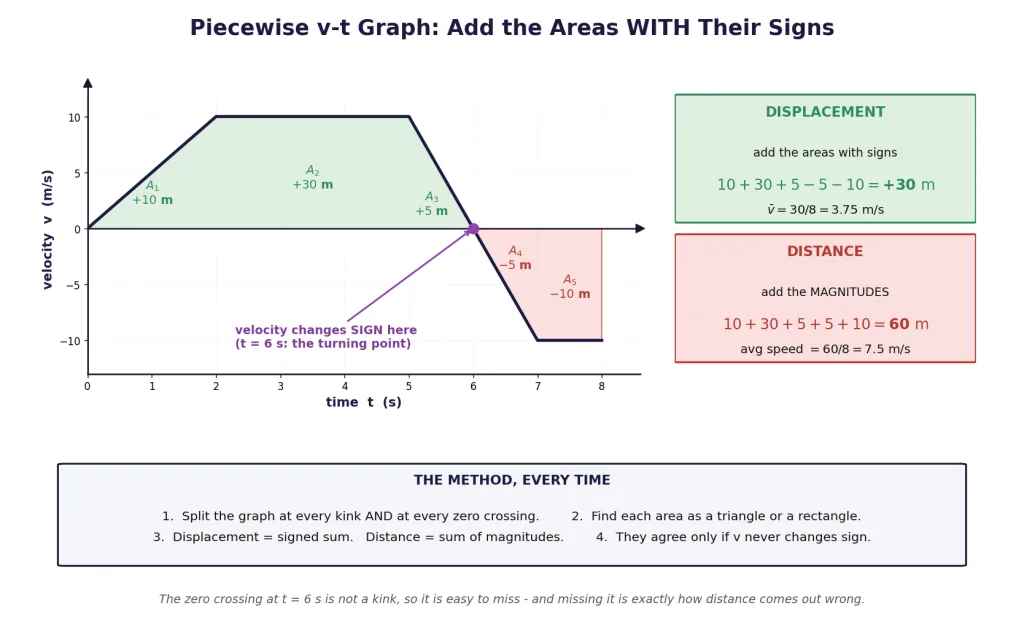
The method
- Split at every kink AND at every zero crossing. The kinks are obvious; the zero crossing is the one people miss, because nothing about the line looks special there.
- Compute each piece as a triangle or a rectangle - a trapezium counts as both, or use .
- Displacement = the signed sum. Areas below the time axis count as negative.
- Distance = the sum of the magnitudes.
- They agree if and only if the velocity never changes sign.
Key Point: Displacement (signed area). Distance (total unsigned area). The modulus is the entire difference between them.
Where the object is farthest out
A question that looks hard and is not: "at what time is the particle at its maximum distance from the start?" The position stops increasing exactly when crosses from positive to negative. So:
Key Point: The maximum (or minimum) of the x-t curve sits at the instant the v-t graph crosses the time axis, not where the v-t graph peaks. A peak in v-t is where the particle is fastest, not where it is farthest.
An a-t graph one level up
If they give you an a-t graph instead:
- Area under a-t between and = . Not the velocity itself - you need at the start to convert.
- Displacement then requires a second integration, i.e. the area under the v-t graph you just constructed.
[Exam Tip] With an a-t graph, always build the v-t graph as an explicit sketch first, marking at every corner. Trying to go from a-t straight to displacement in your head is how sign errors get in.
Curved segments
If a segment is a parabola rather than a straight line, the area is an integral, not a triangle. Two standard results save time:
- Area under from 0 to is - one third of the enclosing rectangle.
- Area under a straight line from to over a time is - the trapezium rule, and it is exact only because the line is straight.
That second point is the seed of a trap we will come back to: is a valid average only for a straight v-t segment, that is, only for constant acceleration.
Chase, Meeting and Minimum-Deceleration Problems
Section 6 set these up with constant velocities. Now at least one body accelerates, and the whole family becomes a JEE staple.
The master method
Key Point: Write and from the same origin, with the same positive direction, and with measured from the same instant. Then:
- they meet when ;
- the separation is ;
- the separation is maximum or minimum when , i.e. when their velocities are equal.
That last line is the one that unlocks most of these questions, and it is worth saying in words: the gap between two bodies stops changing at the instant they are moving at the same speed.
A car from rest overtaking a bus
A bus goes past at a steady just as a car, starting from rest, sets off with constant acceleration . Then
Setting them equal, , so (the start, which we knew) or
Two facts drop straight out and both get asked:
- At that instant the car's speed is - exactly twice the bus's speed. Always, whatever the numbers.
- The gap is largest when the speeds match, at , and there the gap is .
If the car starts a distance behind, the catch-up condition becomes , a quadratic. Solve it and keep the positive root.
Two particles under gravity: the relative-acceleration shortcut
Throw two objects at any speeds, in any directions, from any heights, at any times. Once both are in flight, both have acceleration downward. Therefore
Key Point: The relative acceleration of two freely falling bodies is zero. In the frame of one of them, the other moves with constant velocity - uniform motion in a straight line. So relative separation relative velocity time, and no term ever appears.
This turns most "two stones" problems into one line of arithmetic:
- A stone dropped from a tower of height , and another thrown up from the foot at , released together. Relative velocity of the thrown stone with respect to the dropped one is (upward), the gap is , so they meet at .
- Two stones released from the same point seconds apart. Once both are falling, their relative velocity is constant at and their separation grows linearly, at metres per second - it does not accelerate apart.
- One thrown down after another is released. Freeze the picture at the instant the second one leaves. Note the gap and the relative velocity then, and divide.
[Exam Tip] The shortcut only applies while both bodies are in free flight. Before the second is launched, or after one lands, the relative acceleration is not zero. Always check the window of validity.
The minimum deceleration to avoid a collision
Car A at is a distance behind car B, which is moving at a steady . A must brake. Work relative to B, in which B is at rest:
- initial relative velocity , closing;
- relative deceleration (B is unaccelerated);
- the near miss is the case where the relative velocity reaches zero exactly as the gap closes.
Key Point: Only the relative speed appears. Two cars at 100 and 90 m/s need exactly the same braking as two cars at 20 and 10 m/s from the same gap.
Reaction time changes everything. If the driver reacts for seconds before braking, the gap has already shrunk by . Use the reduced gap:
[Advanced] If B is braking too, the relative deceleration is - but only until B stops. After that B is stationary and the relative deceleration jumps to . Handle the two windows separately; a single formula through the whole motion is wrong.
Average Velocity in Parts - and the Four Standard Traps
The definition never changes
Everything below is a consequence of these two lines. If you are ever unsure, compute total displacement and total time from scratch and divide. That always works.
Equal times give the arithmetic mean; equal distances give the harmonic mean
Section 1 established this for legs at constant speed. It carries over unchanged to legs that are accelerating, as long as you use each leg's own average velocity and .
Two equal-time halves. Each leg lasts , so
Two equal-distance halves. Each leg covers , so the times are and and
Key Point: Equal times to arithmetic mean. Equal distances to harmonic mean. And since HM AM always, the equal-distance answer is always the smaller of the two - because you spend longer on the slow leg when the legs are equal in length.
For a leg with constant acceleration, that leg's average velocity really is . So a car accelerating uniformly from rest to 20 m/s has a leg-average of 10 m/s, and you feed 10 into the formulas above, not 20.
Trap 1: when the acceleration is not constant
This formula is a special case, and it is special because a straight-line v-t graph has its average at its midpoint height. Bend that line and the statement dies.
Take from rest. Then and . Over 0 to 2 s the particle covers 8 m in 2 s, so m/s. But m/s. Different, and the 6 is simply wrong.
Key Point: requires constant acceleration. With variable acceleration, go back to and integrate.
Trap 2: distance versus displacement when the velocity changes sign
If changes sign inside the interval, (which is what gives you) is the displacement, and the distance is larger. Find the times where , split the interval there, and add the magnitudes of the pieces.
A tell-tale: if a problem asks for distance and gives a velocity that is a quadratic in , it almost certainly has real roots inside the interval. Check them.
Trap 3: the quadratic root that physics throws away
A stone is thrown upward at 20 m/s from the top of a 25 m tower. With upward positive and m/s^2, the ground is at m:
Reject s: it is the instant the stone would have left the ground had it been in flight before the throw, which it was not.
Key Point: Reject a root only when it is genuinely unphysical - negative time, a negative mass, an imaginary speed. If both roots are positive, both usually mean something (a body passing a given height on the way up and again on the way down), and the question decides which one it wants.
Trap 4: is not
Acceleration is the rate of change of velocity. The rate of change of speed is a different quantity.
When the two agree. When they are negatives of each other: a particle with m/s and m/s is getting faster, at 2 metres per second per second, even though the acceleration is negative.
| Speed is | |||
|---|---|---|---|
| increasing | |||
| decreasing | (negative) | ||
| increasing | (positive) | ||
| decreasing | (negative) |
Key Point: The body speeds up when and have the same sign and slows down when they have opposite signs. This is one of the standard cautions, and JEE dresses it up as a question about .
[Exam Tip] In a graph question, "the particle's speed is increasing" means the v-t curve is moving away from the time axis, in either direction. It does not mean the curve is rising.
The Bouncing Ball with a Coefficient of Restitution
Section 5 drew the graphs for a ball that returns some fraction of its striking speed. Here we name that fraction, and squeeze the whole infinite sequence into two closed formulas.
Key Point (Definition): The coefficient of restitution of a collision between a ball and the floor is the ratio of the speed of separation to the speed of approach: is a perfectly elastic bounce (the ball returns to its original height forever); means it sticks.
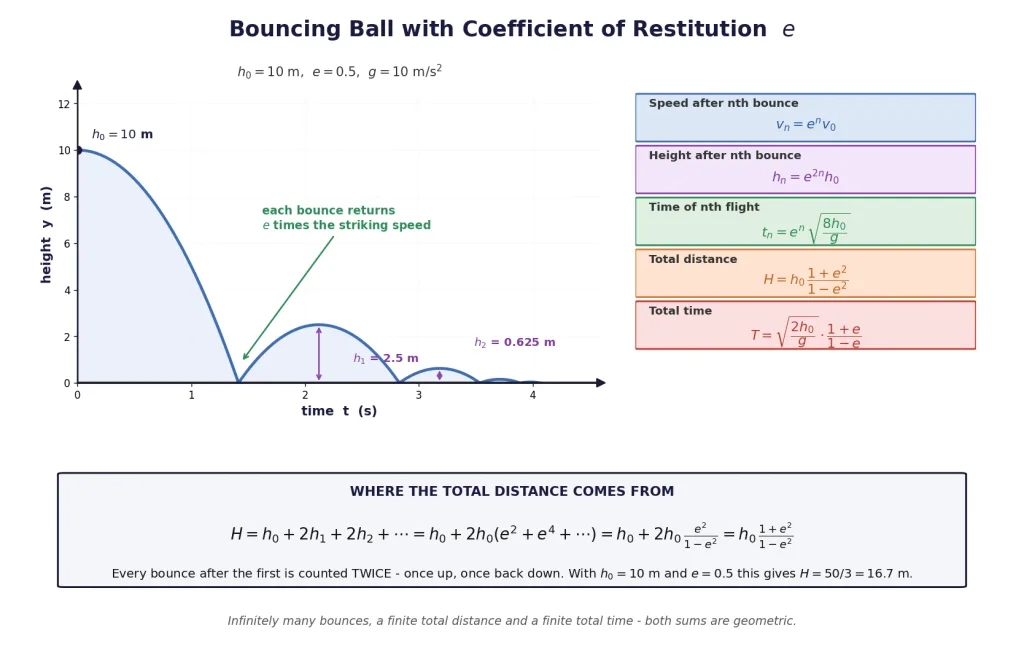
Building the ladder
Drop the ball from rest at height . It strikes the floor at
Speed after the nth bounce. Each impact multiplies the speed by , so
Height after the nth bounce. Rising with speed gives , and , so
Heights fall in a geometric progression with common ratio . [Exam Tip] , not - the single commonest slip in this topic.
Time of the nth flight. A body launched at is back down after , so
Total distance - summing the series
The ball falls once. Every later height is covered twice, up and down:
The bracket is an infinite GP with first term and ratio , so it sums to (valid because ):
Total time - a second series
The first drop takes . Then
Using , the second term is , so
Key Point: Infinitely many bounces, yet both the total distance and the total time are finite - the classic physical example of a convergent geometric series. Note the powers carefully: distance carries , time carries .
The formula card
| Quantity | Result |
|---|---|
| Striking speed of the first impact | |
| Speed after bounces | |
| Height after bounces | |
| Fraction of KE retained per bounce | |
| Total distance | |
| Total time |
[Advanced] If the ball is thrown down at from height instead of dropped, only the first line changes: , and the effective starting height for the series becomes . Rebuild from there rather than patching the final formulas.
Solved Examples
Example 1: The full route, with a direction reversal [Advanced]
A particle starts from rest at the origin. Its acceleration is m/s. For the interval to s find (a) the velocity at 2 s, (b) the displacement, (c) the distance travelled, and (d) the average velocity and average speed.
Solution:
Identify the route. is a function of alone, so Route 1: integrate to get , then to get .
First integration, with limits at :
(a) At s: m/s.
Second integration, with at :
(b) Displacement: m.
Does the velocity change sign? at and s. For , is negative (the particle initially moves backwards, because starts at m/s); for it is positive. So the interval must be split at s.
(c) Distance. Position at the turning point: m.
(d) Averages.
Final Answer: (a) 12 m/s (b) 4 m (c) 6 m (d) m/s, average speed 3 m/s.
Takeaway: Three separate traps in one question. The particle goes backwards first even though the final velocity is forward; distance (6 m) exceeds displacement (4 m); and the tempting m/s is not the average velocity, because the acceleration is not constant. The true answer is 2 m/s - a factor of three out.
Example 2: The route
A particle moves along the x-axis with acceleration (SI units). At its velocity is m/s. Find (a) its speed at m, (b) its speed at m, and (c) how far it gets before it momentarily stops.
Solution:
Identify the route. is a function of , so is no use. Use - Route 2.
Separate and integrate, with m/s at :
Solve for :
(a) At m: , so m/s.
(b) At m: , so m/s.
(c) It stops where : m (taking the positive root, since it started at the origin moving in the direction).
Final Answer: (a) 8 m/s (b) 6 m/s (c) it stops 5 m from the origin.
Takeaway: Time never entered the calculation once. That is the signature of the route - it answers "how fast is it here" without ever asking "when". (You may recognise with : this is simple harmonic motion, and with amplitude m. You will meet it properly in Class 11 Chapter 13.)
Example 3: The route, both halves [Advanced]
A body starts from rest and moves with acceleration m/s, where is in m/s. Find (a) as a function of , (b) the terminal (maximum) velocity, (c) the time taken to reach 4 m/s, and (d) the distance covered by the time it reaches 4 m/s.
Solution:
Identify the route. is a function of alone - Route 3. Parts (a) to (c) want ; part (d) wants . Different integrals.
(a) The half. Separate from :
(b) Terminal velocity. As , and m/s. Equivalently, set : gives m/s directly - the body stops accelerating once the resistance balances the drive.
(c) Time to reach 4 m/s. gives , so
(d) Distance by then - the other half of Route 3. Now separate from : Split the integrand by long division: . Then
Final Answer: (a) m/s (b) 5 m/s (c) 0.80 s (d) about 2.0 m.
Takeaway: One acceleration, two integrals, two genuinely different questions. Deciding which half of Route 3 you need before you start is the whole skill. And note the shortcut in (b): the terminal velocity is always the root of - you never need to integrate to find it.
Example 4: Linear drag - a boat with the engine cut
A motorboat moving at 10 m/s switches off its engine. The water resists it with a retardation , where is in m/s. Find (a) its speed after 4 s, (b) the time in which the speed falls to 2.5 m/s, (c) the distance covered in the first 4 s, and (d) the total distance it travels before coming to rest.
Solution:
Set up. with s and m/s. Use the standard results derived in the notes.
(a) . At s:
(b) Time to reach 2.5 m/s. gives , so
(c) Distance in 4 s. Integrate the velocity:
(d) Total distance. Use the form, , and set :
Final Answer: (a) 1.35 m/s (b) 2.77 s (c) 17.3 m (d) 20 m.
Takeaway: In the first 4 s the boat covers 17.3 m of its total 20 m - 86% of the whole journey - and then spends the rest of eternity creeping through the last 2.7 m. Infinite time, finite distance. And the quickest route to part (d) was the linear relation , not an integral over time.
Example 5: Quadratic drag - the same boat, the other law [Advanced]
The same boat, again cutting its engine at 10 m/s, but now the retardation is (SI units). Find (a) its speed after 4 s, (b) the time for the speed to halve, (c) the distance in which the speed halves, and (d) the distance covered in 4 s. Compare with Example 4.
Solution:
Set up. with m and m/s. Note s, the same initial retardation of 5 m/s as in Example 4 - so the two boats start out identically.
(a) . At s:
(b) Time to halve. Set m/s: , so s. (Generally - and unlike the exponential case, this halving time is not constant: the next halving takes 4 s, then 8 s.)
(c) Distance in which it halves. Use :
(d) Distance in 4 s. Integrate :
Final Answer: (a) 3.33 m/s (b) 2 s (c) 13.86 m (d) 21.97 m.
Takeaway: Compare with Example 4 line by line. After 4 s the linear-drag boat is down to 1.35 m/s having gone 17.3 m; this one is still doing 3.33 m/s and has already gone 22.0 m - past the 20 m that the other boat will never exceed. Same starting speed, same initial retardation, and one has a hard distance ceiling while the other does not.
Example 6: A five-segment v-t graph
A particle's velocity varies as follows: it rises uniformly from 0 to 10 m/s during 0 to 2 s; stays at 10 m/s from 2 to 5 s; falls uniformly from 10 m/s to m/s between 5 s and 7 s; and stays at m/s from 7 to 8 s. Find (a) the displacement, (b) the distance travelled, (c) the average velocity and average speed, and (d) the instant at which the particle is farthest from its start, and how far that is.
Solution:
Split the graph at every kink and at the zero crossing. During 5 to 7 s the velocity falls at m/s, so it passes through zero at s. That is the extra split point.
Area of each piece (area under v-t = displacement):
| Interval | Shape | Signed area |
|---|---|---|
| 0 to 2 s | triangle, | m |
| 2 to 5 s | rectangle, | m |
| 5 to 6 s | triangle, | m |
| 6 to 7 s | triangle, | m |
| 7 to 8 s | rectangle, | m |
(a) Displacement = signed sum m.
(b) Distance = sum of magnitudes m.
(c) Averages over the 8 s:
(d) Farthest point. The position keeps increasing while , i.e. up to s, and decreases afterwards. Position at 6 s m.
Final Answer: (a) m (b) 60 m (c) 3.75 m/s and 7.5 m/s (d) farthest at s, 45 m from the start.
Takeaway: The particle's maximum speed (10 m/s) occurs over 2 to 5 s, but its maximum distance from the start comes at s, where the speed is zero. Those are different questions with different answers, and the zero crossing at 6 s - which is not a kink and is easy to skate past - is what separates the 60 m from the 30 m.
Example 7: A car from rest overtaking a bus
A bus is moving at a constant 20 m/s. At the instant it passes a stationary car, the car starts from rest with a constant acceleration of 2 m/s in the same direction. Find (a) when the car catches the bus, (b) how far from the start that happens, (c) the car's speed then, and (d) the maximum distance by which the bus leads before being caught.
Solution:
Convention. Origin at the point where the bus passes the car, along the motion, at that instant. Then
(a) They meet when : is the start; the overtake is at s.
(b) Position: m. Check with the bus: m. They agree.
(c) Car's speed: m/s - exactly twice the bus's speed, as the general result predicts.
(d) Maximum lead. The gap stops growing when , i.e. at s - which is exactly when the speeds are equal ( m/s).
Final Answer: (a) after 20 s (b) 400 m from the start (c) 40 m/s (d) a maximum lead of 100 m at s.
Takeaway: Two results here are general, not accidental: the catching car is always doing twice the uniform speed at the moment it draws level, and the gap is always widest at the instant the speeds are equal, never before or after. Learn the "equal speeds" test - it answers every maximum-separation question in one line.
Example 8: Two particles under gravity - the zero relative acceleration trick [Advanced]
Take m/s. (a) A ball is released from rest at the top of a 100 m tower. One second later a second ball is thrown vertically downward from the same point at 20 m/s. Where and when do they meet? (b) A stone is dropped from the top of the same 100 m tower at the same instant that another is thrown vertically upward from the foot at 50 m/s. Where do they meet?
Solution (a):
Freeze the picture at the moment ball B is launched ( s after A). At that instant, ball A has fallen m and is moving at m/s downward.
Now use zero relative acceleration. From this moment both balls are in free fall, so and B moves relative to A at a constant The separation to be closed is 5 m.
Time to close the gap: s after B's launch, i.e. s after A was released.
Where. A has fallen m, so they meet 11.25 m below the top, i.e. 88.75 m above the ground. Check with B: m. They agree, and both are well above the ground, so the meeting is real.
Solution (b):
Relative motion again. Both are in free fall from , so the relative acceleration is zero and the upward stone approaches the dropped one at a constant m/s. The gap is 100 m, so
Where. Height of the thrown stone: m above the ground. The dropped stone has fallen m from 100 m, which is also 80 m. They agree.
Final Answer: (a) 1.5 s after the first release, 11.25 m below the top. (b) At s, 80 m above the ground.
Takeaway: In both parts the terms cancelled because both bodies have the same acceleration. Once you are in the frame of one falling body, the other moves in a straight line at constant speed and the problem is a division. The general result for part (b) is worth memorising: a stone dropped from height and one thrown up from the base at , released together, meet at .
Example 9: Minimum deceleration with a reaction time [Advanced]
Car A is travelling at 20 m/s, 25 m behind car B which is moving at a steady 10 m/s in the same direction. A's driver takes 0.5 s to react before applying the brakes. Find the least uniform deceleration A must then produce to avoid a collision. What if the reaction time were 1.0 s instead?
Solution:
Work in B's frame (B is unaccelerated, so this is legitimate). The relative velocity of A with respect to B is and the initial relative separation is 25 m.
The reaction phase. For 0.5 s nothing is braking, so the gap closes at the full 10 m/s:
The braking phase. In B's frame, A must lose all 10 m/s of relative velocity within 20 m. Apply to the relative motion (valid because the relative acceleration is the constant ):
Sanity check in the ground frame. Put the origin at A's initial position, so B starts at 25 m. During the 0.5 s reaction A moves m. Braking at 2.5 m/s, A falls from 20 to 10 m/s in s, covering m more. So at s, They are at the same point with the same speed - A just grazes B without impact, which is exactly what "minimum deceleration" means. Any smaller deceleration and A would still be gaining when it arrives.
With a 1.0 s reaction time. The gap closes by m first, leaving 15 m:
Final Answer: 2.5 m/s with a 0.5 s reaction time; 3.33 m/s with a 1.0 s reaction time.
Takeaway: Only the relative speed of 10 m/s enters, never the 20 and the 10 separately. And look at the sensitivity: half a second more of daydreaming demands 33% more braking. That is the physics behind every "maintain a safe following distance" sign you have ever ignored.
Example 10: Average velocity with an accelerated leg
A car covers a straight journey in two parts. In the first part it accelerates uniformly from rest to 20 m/s; in the second it travels at a constant 20 m/s. (a) If the two parts are equal in distance, find the average velocity for the whole journey. (b) If instead they are equal in time, find the average velocity. (c) Is m/s the answer to either?
Solution:
The leg averages first. The first leg has constant acceleration, so on that leg alone m/s. The second leg is uniform, so m/s. Now treat the journey as two legs with average velocities 10 and 20 m/s.
(a) Equal distances . Times are and : That is the harmonic mean of 10 and 20: .
Check with real numbers. Let each half be 100 m. Then the acceleration is m/s, so leg 1 takes s and covers m. Correct. Leg 2 takes s. Total: 200 m in 15 s, giving m/s. It agrees.
(b) Equal times . Distances are and : the arithmetic mean of 10 and 20.
(c) Neither. m/s would be the average only if the acceleration were constant for the whole journey, and it is not - it is 2 m/s on the first leg and zero on the second.
Final Answer: (a) 13.3 m/s (b) 15 m/s (c) no - 10 m/s is wrong for both.
Takeaway: Three different "averages" from one journey. Equal distances give the harmonic mean (13.3), equal times give the arithmetic mean (15), and the naive endpoint average (10) matches neither. Note also that the equal-distance answer is the smaller of the two, because equal halves make you spend proportionally longer in the slow leg.
Example 11: The bouncing ball, in full [Advanced]
A ball is dropped from rest at a height of 10 m onto a hard floor with coefficient of restitution . Take m/s. Find (a) the speed with which it first strikes the floor and the speed with which it rebounds, (b) the heights of the first three rebounds, (c) the total distance travelled before it stops bouncing, (d) the total time, and (e) the average speed over the whole motion.
Solution:
(a) First impact. Rebound speed m/s.
(b) Rebound heights from with : Each height is a quarter of the last - a GP with ratio .
(c) Total distance. The 10 m drop is covered once; every rebound height is covered twice:
(d) Total time. First drop: s. Then
(e) Average speed. (The average velocity is a different matter: the net displacement is 10 m downward, so m/s downward.)
Final Answer: (a) 14.14 m/s striking, 7.07 m/s rebounding (b) 2.5 m, 0.625 m, 0.156 m (c) 16.7 m (d) 4.24 s (e) 3.93 m/s.
Takeaway: Infinitely many bounces, and yet the ball travels a finite 16.7 m in a finite 4.24 s - both sums are geometric and both converge because . Keep the powers straight: speeds carry , heights carry , the total distance formula carries and the total time formula carries .
Example 12: Distance, displacement, and the rate of change of speed [Advanced]
A particle moves along a straight line with velocity m/s, starting from the origin at . For the interval 0 to 4 s find (a) the displacement, (b) the distance travelled, (c) the average velocity and average speed, and (d) at s, compare with the rate of change of speed.
Solution:
Find where changes sign. , which is zero at s and s. Between them, is negative; before s it is positive. So the interval splits at s.
Position function. Integrating with at :
(a) Displacement over 0 to 4 s:
(b) Distance. Position at the turning point: Forward leg: m. Backward leg: m.
(c) Averages:
(d) At s. The velocity is negative and the acceleration is negative, so is becoming more negative and the speed is increasing. Formally, since we have , so
Final Answer: (a) m (b) 8 m (c) 1.33 m/s and 2 m/s (d) m/s but the speed is increasing at 1 m/s.
Takeaway: A negative acceleration with a negative velocity means speeding up. The particle at s has m/s and is getting faster - if a question asks for "the rate at which the speed is changing", the answer is m/s, not . And note that the distance (8 m) beat the displacement (5.33 m) purely because of that reversal at s.