
The Question Average Velocity Cannot Answer
Section 1 left you with a good tool and a real gap. You can now take any two instants, subtract positions, divide by the elapsed time, and get
That number is honest, but it is a summary of a whole interval. It tells you how fast the object moved on the whole, and deliberately forgets everything that happened inside.
Here is the thing: that is almost never the question anyone actually asks.
Three situations that expose the gap
- The traffic policeman. A car covers 100 m of a road in 5 s, so its average velocity was 20 m/s. Was it speeding? You cannot say. It may have crawled at 5 m/s for four seconds and then bolted at 80 m/s. The average hides the crime.
- The speedometer. Your bike's speedometer needle is not averaging anything over the last minute. It is telling you how fast you are going right now — at this instant. That reading is a different physical quantity from average speed.
- The dropped ball. A ball falls from a roof and lands 2 s later, having covered 20 m. Average velocity 10 m/s downward. But the ball started at rest and hit the ground at 20 m/s. At not a single instant of the fall was it actually moving at 10 m/s… except one, and finding that one instant is a nice exercise later in this section.
Key Point: The average velocity tells us how fast an object has been moving over a given time interval, but it does not tell us how fast it moves at different instants of time during that interval. For that, we need a new quantity.
Why we cannot just "make the interval small"
The obvious repair is: to get the velocity at s, use a tiny interval around 4 s. And that instinct is exactly right — but there is a catch you must see clearly.
If you shrink , then shrinks too. Push it all the way to a single instant and you get
which is meaningless. A single instant has no duration, so it has no "distance covered" either. Velocity at an instant is not something you can get by arriving at .
What you can do is watch the ratio as gets smaller and smaller, and ask whether that ratio settles down on a definite number. It does. That settled-down number is what we will call the velocity at an instant, and the mathematical name for "the number a ratio settles on" is a limit.
[Board Important] The one-line version, worth memorising: average velocity belongs to an interval; instantaneous velocity belongs to an instant. Every confusion in this section comes from mixing those two up.
The Definition: Velocity as a Limit
Let's write the idea down properly.
Take the instant you care about, call it . Build a small interval of width around it, measure the displacement over that interval, and form the ratio . Now shrink towards zero and watch what the ratio does.
Key Point (Definition): The velocity at an instant is defined as the limit of the average velocity as the time interval becomes infinitesimally small: The symbol stands for the operation of taking the limit as of the quantity on its right.
Read Eq. (2.1a) out loud as a sentence: "the velocity at this instant is the value that the average velocity settles on, as the interval around this instant is squeezed to nothing."
What actually means
is not a fraction with on top and below that you can separate at will (not yet, anyway). It is a single symbol standing for the whole limiting process.
Key Point: In the language of calculus, the quantity on the right-hand side of Eq. (2.1a) is called the differential coefficient of with respect to , and is denoted . It is the rate of change of position with respect to time, at that instant.
One object, four names — get comfortable with all of them, because Boards, JEE and NEET each prefer a different one:
| Name | Where you will hear it |
|---|---|
| instantaneous velocity | standard physics prose |
| , the differential coefficient of w.r.t. | the calculus phrasing |
| the derivative of with respect to | your maths class |
| the rate of change of position at that instant | Board one-mark questions |
Notation and units
- SI unit: m/s, same as average velocity. Dimensional formula .
- In one dimension is a signed number: means moving along , means moving along , means momentarily at rest.
- From now on, when this chapter says just "velocity", it means instantaneous velocity. If an average is meant, it will say so, or wear a bar: .
- The velocity at is written ; the symbol is also used for it.
Two roads to the same number
There are two ways to actually evaluate that limit, and this section walks both:
- The graphical route — draw the position-time graph, draw chords, and watch them turn into a tangent. This is the route that shows you what velocity means.
- The numerical route — tabulate for smaller and smaller and watch the numbers converge. This is the route that shows you that the limit exists.
And then there is the shortcut both roads were secretly leading to: if you have a formula for , one line of differential calculus gives you for every instant at once.
The Graphical Route: From Chord to Tangent
It is easiest to work this through on one specific motion, so that is what we will do. A car moves so that its position is
with in metres and in seconds. We want the velocity at the instant s, which is the point marked on the graph.
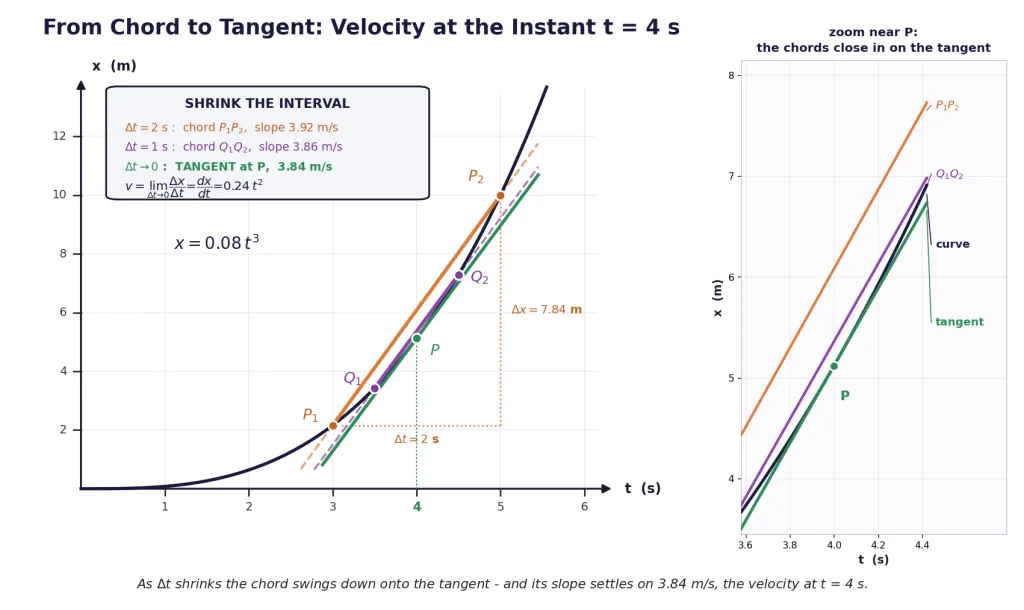
Step 1: take s, centred on s
"Centred" means you go half the interval back and half the interval forward:
Those two instants give the two points and on the curve. By the definition of average velocity, the slope of the straight line is the average velocity over the interval 3 s to 5 s. That line joining two points of a curve is called a chord.
Reading off the graph: m over s, so the slope of is 3.92 m/s.
Step 2: shrink to s
Now s and s. The chord becomes the shorter chord , and its slope gives the average velocity over the interval 3.5 s to 4.5 s — which comes out as 3.86 m/s.
Notice two things. The chord is shorter, it hugs the curve more closely, and its slope has moved.
Step 3: let
Keep going. Every time you halve , the two endpoints slide in towards and the chord pivots slightly. In the limit both endpoints merge into itself, and the chord stops being a chord: it becomes the straight line that just grazes the curve at , touching it there and nowhere nearby. That line is the tangent.
Key Point: In the limit , the line becomes tangent to the position-time curve at the point , and the velocity at s is given by the slope of the tangent at that point.
For this car, the tangent at has slope 3.84 m/s. That is the answer: the car's velocity at the instant s is 3.84 m/s.
The single most useful rule in this chapter
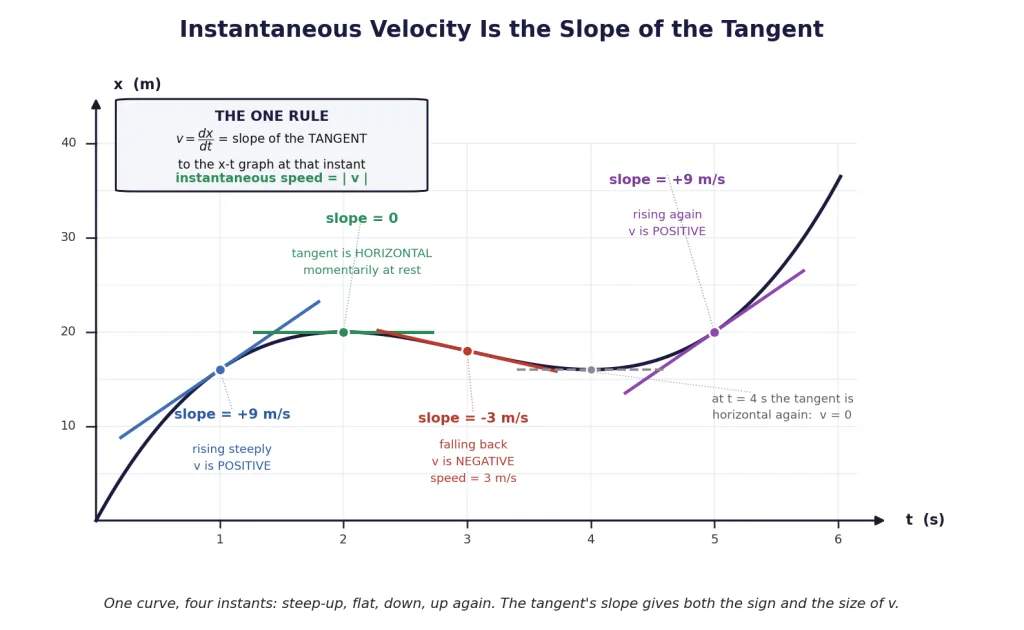
Because the tangent's slope is the velocity, an - graph tells you the velocity at a glance:
| Tangent at that instant | What the object is doing | Sign of |
|---|---|---|
| slopes up steeply | moving fast along | large positive |
| slopes up gently | moving slowly along | small positive |
| horizontal | momentarily at rest | |
| slopes down | moving along | negative |
| a straight line throughout | uniform motion, constant | constant |
[JEE/NEET] In a graph question, never estimate a velocity from a chord when the question asks for velocity at an instant — draw the tangent. Reading the chord is the single most common way marks are lost on x-t graph problems.
An honest warning
Key Point: The graphical method for the determination of instantaneous velocity is not always a convenient method. It needs a carefully plotted position-time graph, and drawing a tangent by hand is guesswork. It is far easier if you have either (i) position data at closely spaced instants, or (ii) an exact formula for .
Which is precisely why the next two blocks exist.
The Numerical Route: A Table of Values
The chord collapsing onto the tangent is difficult to show convincingly on a graph — so the honest thing to do is compute. Same car, , same target instant s. Shrink through 2.0, 1.0, 0.5, 0.1 and 0.01 s, always centred on 4.0 s, and watch the last column.
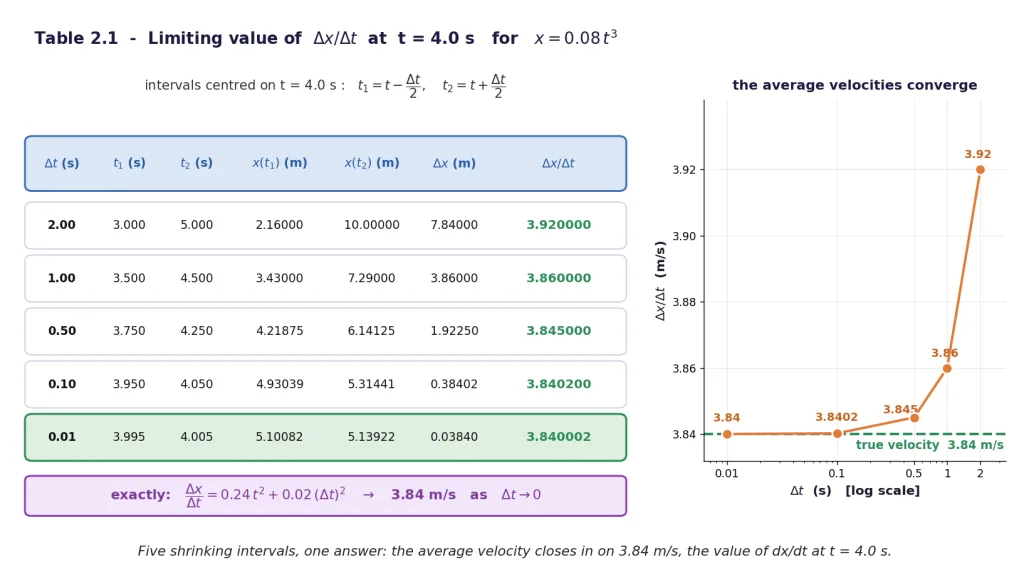
Table 2.1 — limiting value of at s
| (s) | (s) | (s) | (m) | (m) | (m) | (m/s) |
|---|---|---|---|---|---|---|
| 2.00 | 3.000 | 5.000 | 2.16000 | 10.00000 | 7.84000 | 3.920000 |
| 1.00 | 3.500 | 4.500 | 3.43000 | 7.29000 | 3.86000 | 3.860000 |
| 0.50 | 3.750 | 4.250 | 4.21875 | 6.14125 | 1.92250 | 3.845000 |
| 0.10 | 3.950 | 4.050 | 4.93039 | 5.31441 | 0.38402 | 3.840200 |
| 0.01 | 3.995 | 4.005 | 5.10082 | 5.13922 | 0.03840 | 3.840002 |
How each row is built
Take the s row and do it by hand, so you can reproduce any row in an exam:
- Endpoints: s and s.
- Positions: m and m.
- Displacement: m.
- Ratio: m/s.
What the table is telling you
Key Point: As is decreased from 2.0 s to 0.010 s, the value of the average velocity approaches the limiting value 3.84 m/s, which is the value of the velocity at s, i.e. the value of at s.
3.92, then 3.86, then 3.845, then 3.8402, then 3.840002. The numbers are not wandering; they are homing in. That convergence is what "the limit exists" means in practice, and it is why the definition is not empty.
A bonus you can actually prove
For this particular and a centred interval, the average velocity has an exact closed form. Using ,
At s this is
Check it against the table: gives ; gives ; gives . Every row, exactly.
And now the limit is obvious: the error term dies as , leaving 3.84 m/s. Notice also how fast it dies — halve and the error drops to a quarter. That is why the table converges so dramatically in only five rows.
[JEE Tip] In numerical-method questions, a centred difference is far more accurate than a one-sided one. Over 3 s to 5 s the centred estimate is off by 0.08 m/s; the one-sided estimate over 4 s to 6 s gives m/s, which is not even close. When a paper says "estimate the velocity at ", centre your interval on .
The Calculus Shortcut: Differentiating
Tables are convincing but slow. If you have an exact expression for , differential calculus gives the velocity at every instant in one line. This is the first time most Class 11 students meet differentiation inside physics, so let's build it from the ground up.
The power rule
Everything in this chapter runs on one rule.
Key Point (the power rule): valid for any constant — positive, negative, whole or fractional.
In words: bring the power down in front, then knock the power down by one.
Two helpers you need alongside it:
Key Point:
- Constant multiple: — a constant just rides along.
- Sum rule: — differentiate term by term.
- Constants die: . A constant does not change, so its rate of change is zero.
That last one has a physical meaning worth pausing on. In , the 8.5 m is just where the object started. Sliding the origin does not change how fast anything moves — so the constant contributes nothing to the velocity.
Standard derivatives, drilled
| rewrite as | ||
|---|---|---|
Work down that table with a pen before going further. Three checks students routinely fluff:
- , not . The power was 1, so .
- . Knocking down by one gives , not .
- . Half comes down in front, and .
The car, redone in one line
Recall the whole of Table 2.1 was in service of one number. Watch:
At s:
3.84 m/s. Five rows of table, one plotted graph and one carefully drawn tangent — all replaced by two lines of algebra, and this version hands you the velocity at every instant, not just at s. At s it is 0.96 m/s; at s it is 6.0 m/s.
Key Point (the working method): Given , the recipe for instantaneous velocity is:
- Write as a sum of powers of .
- Differentiate term by term using the power rule to get .
- Substitute the instant last. Never put the number in before you differentiate.
[Board Important] Step 3 is where marks vanish. If you substitute into first, you get m — a constant — and differentiating a constant gives zero. Differentiate the function, then evaluate.
Instantaneous Speed, and Why It Never Disagrees with
Velocity has a sign. Strip the sign off and you have speed.
Key Point (Definition): Instantaneous speed, or simply speed, is the magnitude of instantaneous velocity: A velocity of m/s and a velocity of m/s both have an associated speed of 24.0 m/s.
Speed is never negative. It is 24.0 m/s whether the car is heading east or west.
The point students get backwards
In Section 1 you proved, carefully, that
with equality only when the motion never reverses direction. Now compare that with the instantaneous statement:
Not . Equal, always, no exceptions. Here is why the two cases differ.
- Over a finite interval, the object has room to turn around. Path length keeps adding up while displacement partly cancels, so and the average speed comes out bigger.
- Over an infinitesimal interval there is no room to turn around. In a vanishing the object moves along one tiny straight stretch in one direction only. The path length covered is itself — nothing to cancel, nothing to accumulate. Divide both by the same and take the limit, and the two quantities are forced to be the same number.
Key Point: Average speed over a finite interval is greater than or equal to the magnitude of average velocity. But instantaneous speed at an instant is equal to the magnitude of instantaneous velocity at that instant — because in the limit there is no interval left in which the direction can change.
[NEET Important] This is a guaranteed assertion-reason and true/false item. Memorise the pair:
average: ("cancellation is possible")
instantaneous: ("no room to cancel")
Uniform motion: the one case where nothing new happens
Recall from Section 1 that uniform motion means equal displacements in equal time intervals, so the - graph is a straight line. A straight line has the same slope everywhere, and its tangent at any point is the line itself.
Key Point: For uniform motion, velocity is the same as the average velocity at all instants.
Algebraically: , so , a constant, independent of . And over any interval whatever, as well. Same number, every instant, every interval. Uniform motion is the only case where you may quote "the velocity" without saying average or instantaneous.
The complete comparison
| Average velocity | Instantaneous velocity | |
|---|---|---|
| belongs to | a time interval | a single instant |
| formula | ||
| on the - graph | slope of the chord | slope of the tangent |
| relation to its speed | average speed | instantaneous speed |
| for uniform motion | equal to | equal to |
Three mistakes to stop making today
- Substituting before differentiating. Differentiate first, then put the instant in.
- Calling the chord's slope "the velocity at ". It is the average over the interval. They agree only for a straight-line graph.
- Assuming means the object has stopped for good. A horizontal tangent means the object is momentarily at rest — like a ball at the very top of its flight. An instant later it is moving again. (Whether it is accelerating at that instant is Section 3's question, and the answer will surprise you.)
Solved Examples
Example 1: Velocity from a quadratic position function — the standard Board question
The position of an object moving along the x-axis is given by , where m, and is measured in seconds. What is its velocity at s and at s? What is the average velocity between s and s?
Solution:
- Write the velocity function first. In the notation of differential calculus, The constant differentiates to zero; the power rule turns into .
- Put the numbers into the coefficient, not into yet:
- Now evaluate at the two instants.
- At s: m/s.
- At s: m/s.
- Average velocity is a different calculation — it needs positions, not derivatives:
- A slicker version of step 4. Keeping the symbols, The cancels — as it must, since where you put the origin cannot change how fast the object moves.
Final Answer: at ; m/s at s; m/s between 2.0 s and 4.0 s.
Takeaway: Two different questions, two different machines. "Velocity at an instant" means differentiate then substitute. "Average velocity over an interval" means subtract two positions and divide by the elapsed time. Notice 15 m/s is not the velocity at any endpoint — it happens to equal the velocity at s, the midpoint, which is a special feature of a quadratic .
Example 2: The car of Table 2.1, three instants in one line
For the car of Table 2.1, (SI units). Find (a) the velocity function, (b) the velocity at s, s and s, and (c) the position at s.
Solution:
- (a) Differentiate once. Bring the 3 down and knock the power to 2:
- (b) Substitute the three instants.
- s: m/s
- s: m/s
- s: m/s
- (c) Position needs , not : m.
Final Answer: m/s; 0.96 m/s, 3.84 m/s and 6.0 m/s; m at s.
Takeaway: The 3.84 m/s that cost a graph, a tangent and a five-row table falls out of in seconds. That is the whole argument for learning to differentiate. Also note the car is speeding up — grows with — which is exactly why the x-t curve bends upward.
Example 3: Differentiation drill — seven in a row
Find for each position function, and evaluate it at the instant given. All quantities are in SI units.
(a) , at s (b) , at s (c) , at s (d) , at s (e) , at s (f) , at s (g) , at s
Solution:
- (a) A constant. m/s at every instant — the object never moves.
- (b) m/s. Constant, so the value at s is still 5 m/s.
- (c) . At s: m/s.
- (d) Term by term: . At s: m/s.
- (e) Rewrite the root as a power: . Then At s: m/s.
- (f) Rewrite the fraction as a power: . Then At s: m/s. The minus sign is real — this object moves along the whole time.
- (g) . At s: m/s.
Final Answer: (a) 0 (b) 5 m/s (c) 18 m/s (d) 20 m/s (e) 1 m/s (f) m/s (g) 10 m/s.
Takeaway: Roots and reciprocals are not special cases — rewrite them as and and the same power rule handles them. That single habit unlocks most of the differentiation you will meet this year.
Example 4: Chord versus tangent, on the same motion
For the car , find (a) the average velocity over 3 s to 5 s, (b) the instantaneous velocity at s, and (c) the instant at which the instantaneous velocity actually equals the answer to (a).
Solution:
- (a) Average velocity needs two positions. This is the slope of the chord in the figure.
- (b) Instantaneous velocity needs the derivative. This is the slope of the tangent at .
- They differ by 0.08 m/s. The interval 3 s to 5 s is symmetric about s, yet the average is larger. Reason: the car is speeding up, and the fast second half (4 s to 5 s) contributes more than the slow first half.
- (c) Set the instantaneous velocity equal to 3.92 m/s and solve:
Final Answer: (a) 3.92 m/s (b) 3.84 m/s (c) at s, slightly after the midpoint.
Takeaway: The average velocity over an interval is always achieved at some instant inside it — but not, in general, at the midpoint. For a curve that bends upward the matching instant sits past the middle. Quoting the chord's slope as "the velocity at the midpoint" is a real, marked error.
Example 5: A particle that turns around — velocity, speed, distance
A particle moves along the x-axis with (metres, in seconds). Find (a) , (b) the instants at which the particle is momentarily at rest, (c) its velocity and speed at s, and (d) the distance travelled and the displacement over 0 to 4 s.
Solution:
- (a) Differentiate term by term:
- (b) Momentarily at rest means : At those two instants the tangent to the x-t graph is horizontal.
- (c) At s: m/s. The speed is the magnitude: m/s. Negative velocity, positive speed — the particle is moving backwards at 3 m/s.
- (d) Build the position table, because direction reverses and you cannot shortcut this: The particle goes m (0 to 1 s), then back m (1 s to 3 s), then out again m (3 s to 4 s).
- Displacement: m.
- Distance: add the three legs without signs: m.
- Cross-check with the averages: m/s while average speed m/s. Sure enough, average speed — because the motion reversed.
Final Answer: ; at rest at s and 3 s; m/s and speed 3 m/s at s; distance 12 m, displacement 4 m.
Takeaway: Solve first, always. Those roots are exactly where the particle turns, and they are the only places you can split the journey into legs of constant direction. Adding alone would have given 4 m for the distance — a third of the truth.
Example 6: Why instantaneous speed equals
Earlier we carefully distinguished between average speed and the magnitude of average velocity. No such distinction is necessary when we consider instantaneous speed and magnitude of velocity: the instantaneous speed is always equal to the magnitude of instantaneous velocity. Why?
Solution:
- Write both definitions over the same interval . Let be the path length actually covered and the displacement.
- Why they differ over a finite interval. In a finite the particle may reverse direction one or more times. Path length keeps adding up regardless of direction, while displacement lets the forward and backward parts cancel. Hence , and therefore average speed .
- Now shrink the interval. As the interval contains a single instant. In that vanishing interval the particle traverses one infinitesimally short stretch of its path, in one direction only — there is simply no time available in which to turn around.
- So the cancellation disappears. With no reversal inside the interval, the path length covered is the magnitude of the displacement:
- Divide both by the same and take the limit:
Final Answer: Because over an infinitesimal interval no change of direction is possible, path length and the magnitude of displacement coincide. The inequality that holds for averages collapses into an equality in the limit, so instantaneous speed instantaneous velocity, always.
Takeaway: The inequality for averages is caused entirely by direction reversal inside the interval. Kill the interval and you kill the reversal — and with it, the inequality. Say that sentence in the exam and the full mark is yours.
Example 7: Uniform motion — where average and instantaneous merge
A particle moves so that (metres, in seconds). Find (a) its velocity at s and at s, (b) its speed, (c) its average velocity between s and s, and (d) when it crosses the origin.
Solution:
- (a) Differentiate: m/s. There is no left in the answer, so m/s at s, at s, and at every other instant. This is uniform motion in the direction.
- (b) Speed m/s, constant.
- (c) Average velocity the long way, as a check: Identical to the instantaneous value, over any interval you like.
- (d) Crossing the origin means : s.
Final Answer: m/s at all instants; speed 5 m/s; m/s; crosses the origin at s.
Takeaway: This is the standard statement made concrete — for uniform motion, velocity is the same as the average velocity at all instants. The x-t graph is a straight line of slope , so chord and tangent are the same line, and there is nothing left for the two definitions to disagree about.
Example 8: Reading a velocity off a tangent
On the position-time graph of a particle, the tangent drawn at the point corresponding to s passes through the points (2 s, 6 m) and (6 s, 22 m). What is the velocity of the particle at s?
Solution:
- Recall the rule: the instantaneous velocity at an instant is the slope of the tangent to the x-t graph at that instant.
- The two given points lie on the tangent line, so use them to get its slope. (They need not lie on the curve itself — a tangent touches the curve only at s.)
- Sign check: positive, so the particle is moving along at that instant.
Final Answer: m/s.
Takeaway: Any two convenient points on the tangent line give its slope — pick lattice points where the line crosses gridlines, not points on the curve. Using curve points instead would give you a chord's slope, and a different (wrong) answer.
Example 9: Estimating a velocity from data, with no formula for
A particle's position obeys (SI). Without differentiating, estimate its velocity at s by computing over intervals centred on 2 s with s, 0.5 s, 0.2 s and 0.02 s. Then check your limit by differentiating.
Solution:
- Set up the centred endpoints: , .
- Compute, row by row.
| (s) | (s) | (s) | (m) | (m) | (m/s) |
|---|---|---|---|---|---|
| 1.0 | 1.50 | 2.50 | 3.375 | 15.625 | 12.25 |
| 0.5 | 1.75 | 2.25 | 5.359375 | 11.390625 | 12.0625 |
| 0.2 | 1.90 | 2.10 | 6.859 | 9.261 | 12.01 |
| 0.02 | 1.99 | 2.01 | 7.880599 | 8.120601 | 12.0001 |
- Read the trend: 12.25, 12.0625, 12.01, 12.0001. The estimates are homing in on 12 m/s.
- Confirm by calculus: , so m/s. Exactly the limit the table pointed at.
- The pattern behind it: for a centred interval on , — the error again falls as .
Final Answer: m/s, from the table and from alike.
Takeaway: This is Table 2.1's method transplanted to a new function, and it is what you do when a question gives you a table of positions instead of a formula. The tell-tale sign that your limit is right: halving should cut the remaining error to roughly a quarter.
Example 10: The ball at the top of its flight
A ball thrown vertically upward has , where is the height in metres above the throwing point and is in seconds (upward taken positive). Find (a) , (b) the velocity at , 1 s, 2 s and 3 s, (c) the instant it is momentarily at rest and the height then, and (d) its speed at s and at s.
Solution:
- (a) m/s.
- (b) Substituting:
- : m/s (thrown upward at 20 m/s)
- s: m/s (still rising, slower)
- s: (at the top)
- s: m/s (coming down)
- (c) Momentarily at rest: s. Height then:
- (d) Speed is the magnitude of velocity: at s, m/s; at s, m/s. Same speed, opposite velocities — one going up, one coming down, at equal heights.
Final Answer: ; 20, 10, 0 and m/s; at rest at s at a height of 20 m; speed 10 m/s at both s and s.
Takeaway: At s the instantaneous velocity is exactly zero, and the x-t graph has a horizontal tangent there. But the ball is not "stopped" — an instant later it is falling. Zero velocity at an instant says nothing about what happens the next instant; that is decided by the acceleration, which Section 3 takes up.
Example 11: JEE-style — comparing with
A particle moves along a straight line with (SI units). Find (a) its velocity at s, (b) its average velocity over 0 to 2 s, (c) the instant at which the instantaneous velocity equals that average, and (d) its initial velocity.
Solution:
- (a) Differentiate term by term:
- (b) Average velocity from the two positions:
- (c) Set and solve: That instant lies inside the interval, as it must.
- (d) Initial velocity means at : m/s. The particle starts by moving in the direction before turning around.
Final Answer: (a) 46 m/s (b) 14 m/s (c) s (d) m/s.
Takeaway: 46 and 14 are wildly different, and both are correct answers to different questions. Part (d) is the standard trap — "initial velocity" is , obtained from the derivative, not the constant term 1 in (that is the initial position).
Example 12: A fractional power, and a particle that starts and stops
(a) A particle has (SI). Find its velocity at s and s, and its average velocity between them. (b) Another particle has (SI). Find the instants at which it is momentarily at rest, and its speed at s.
Solution:
- (a) Rewrite with a power, then differentiate:
- Evaluate: m/s and m/s. The particle is slowing down while still moving forward.
- Average velocity over 1 s to 4 s: m, m, so which sits between and , exactly as it should.
- (b) Differentiate and factorise:
- Speed at s: m/s, so the speed is m/s.
Final Answer: (a) 2 m/s, 1 m/s, and m/s. (b) At rest at and s; speed 3 m/s at s.
Takeaway: Two habits worth keeping. First, convert every root and reciprocal into a power before you differentiate. Second, an average velocity over an interval must always lie between the smallest and largest instantaneous velocities in that interval — a free sanity check on your arithmetic.