
Every Velocity Carries a Hidden "With Respect To"
Right now you are sitting still. You are also moving at about 30 km/s around the Sun, and the room you are in is turning with the Earth. Both statements are true, and neither is more correct than the other — they are answers to two different questions, because they are measured from two different places.
Section 1 made this point once already: rest and motion are relative, and before you write down a single number you must fix a frame of reference — an origin, a positive direction and a clock. This section takes that idea and turns it into arithmetic. The question it answers is: if I know how two objects move in the ground frame, how does one of them look to the other?
One housekeeping note, and then we move on. In the rationalised syllabus, "2.5 Relative velocity" is still listed in the contents but the section body has been removed, and neither the chapter summary nor the closing notes mention it. It is nonetheless required — the standard police-van-and-thief problem cannot be solved without it, and JEE Main and NEET ask it every single year. So we teach it here from the beginning, assuming nothing.
The default frame is the ground
Read this sentence: "the train is moving at 20 m/s." It is incomplete, and everyone lets it pass, because there is an unwritten ending: with respect to the ground.
Key Point: Whenever a velocity is quoted with no frame named, the frame is the ground (strictly, the Earth's surface, treated as fixed). Every velocity in a problem must be converted to one common frame — almost always the ground — before you start combining them.
That last clause is the whole skill. Mixing frames is the mistake that ruins these problems: the muzzle speed of a bullet is measured with respect to the gun, the speed of a man walking down a train is measured with respect to the train, and a boat's "speed in still water" is measured with respect to the water. None of those are ground speeds until you make them so.
Three observers, one man
A train moves east at 20 m/s. A man inside walks towards the engine at 2 m/s. A second train passes on the next track, going west at 15 m/s.
| Question | Whose frame? | Answer |
|---|---|---|
| How fast is the man walking? | the train | 2 m/s east |
| How fast is the man moving? | the ground | 22 m/s east |
| How fast is the man moving? | the second train | 37 m/s east |
One man, one motion, three numbers, all correct. Nothing about the man changed between the rows — only the observer did.
Key Point: A velocity is not a property of one object. It is a property of a pair: the object and the observer. Change the observer and the number changes.
[Board Important] The origin and the positive direction are a matter of choice, and you must state that choice before assigning signs. Relative velocity is where that rule earns its keep — half the marks lost in this topic are lost to signs, not to physics.
The Definition:
Here is the entire theory of this section in one line.
Key Point (Definition): If two objects A and B move along a straight line with velocities and measured in the same frame (take it to be the ground), then the velocity of A relative to B is This is the velocity of A that an observer sitting on B — and considering himself at rest — would measure.
Read the subscripts in order: is "velocity of A with respect to B". The first subscript is the object being described, the second is the observer. The forms and mean the same thing; the order is always the same.
Why the subtraction is the right thing to do
An observer riding on B has, by his own reckoning, zero velocity — he cannot see himself move. So he subtracts his own velocity from everything he looks at. Formally: to move into B's frame you subtract from every velocity in the problem. Do that to A and you get . Do it to B itself and you get , which is exactly what "B is at rest in his own frame" means. The definition is consistent with itself.
The two-way rule
Swap the subscripts and the sign flips:
Key Point:
So and are equal in magnitude and opposite in direction. If a car sees a truck approaching at 30 m/s, the truck sees the car approaching at 30 m/s too — each moves towards the other at the same rate.
A useful corollary: if , then and the two are permanently at rest relative to each other. Two cars side by side on a highway, both at 80 km/h, are motionless as seen from one another — which is why you can hold a conversation across the lane but not with a car coming the other way.
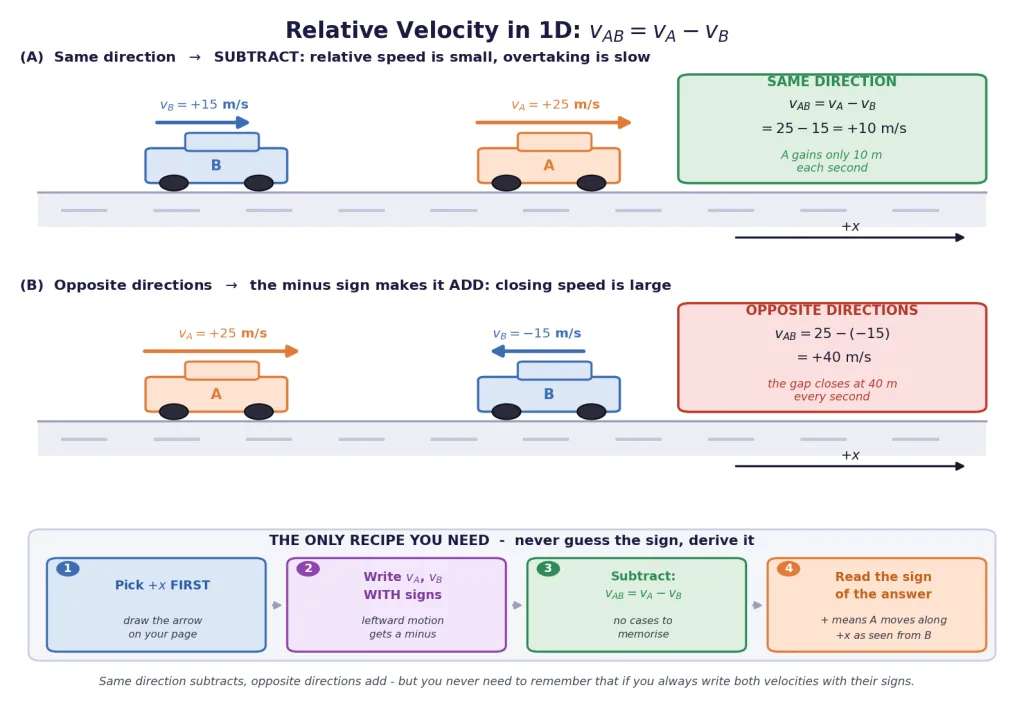
Same direction, opposite directions
Look at the figure. Everything follows from one subtraction, but it is worth seeing the two standard cases side by side:
| Case | Signs (with chosen rightwards) | What it feels like | |
|---|---|---|---|
| Same direction | , | m/s | small relative speed — overtaking is slow |
| Opposite directions | , | m/s | large relative speed — they close fast |
That is why overtaking a truck on a highway takes an uncomfortably long time while an oncoming truck is past you in a blink. Your speed relative to the truck you are passing may be only 10 m/s; relative to the oncoming one it is 40 m/s.
Key Point: In one dimension you never have to remember "same direction subtract, opposite direction add". Write both velocities with their signs and always subtract. The signs do the adding for you: .
The four-step recipe
- Choose the positive direction first and write it at the top of your rough work.
- Write and with signs. Anything moving the other way gets a minus.
- Subtract: .
- Read the sign of the answer. Positive means that, as seen from B, A moves along . Negative means A moves along . The magnitude is the relative speed.
[JEE Tip] Examiners love to hand you and ask for a direction, or to give the two speeds in different units — km/h for the vehicles, m/s for a bullet or a bird. Convert everything to one unit before step 2. Multiply km/h by to get m/s; multiply m/s by to go back.
Relative Position and Relative Acceleration
Velocity is not the only quantity that can be measured from a moving observer. The same subtraction works all the way up and down the chain.
Key Point (the three relative quantities): is the position of A relative to B — its magnitude is simply the separation between them. And these three are linked exactly as you would hope:
So the whole toolkit of Sections 2 to 4 — differentiate to go down, integrate to go up, and all three kinematic equations — can be applied directly to the relative quantities, provided you use relative values throughout:
This single idea turns a great many two-body problems into one-body problems.
The result that JEE and NEET love: free fall has zero relative acceleration
Take two objects moving under gravity alone. Both have the same acceleration, , whatever their mass, whatever their velocity, whichever way they are moving. Therefore
Key Point: Two bodies in free fall have zero relative acceleration. As seen from either one, the other moves with constant velocity — that is, in uniform motion. Their separation therefore changes at a steady rate, and the time for them to meet is just (initial separation) / (relative speed), no quadratic to solve.
Three standard consequences, each of which has appeared in an entrance paper:
- A stone dropped from a tower of height and a stone thrown up from the ground with speed (the launch speed, written elsewhere in this chapter) meet after . Relative velocity is , constant, so the gap closes at a steady . No appears in the answer at all.
- Two stones released from the same point one second apart separate at a constant rate, so their separation grows linearly with time. At the moment the second is released the first is already moving at , where is the delay; since the relative acceleration is zero, that relative velocity never changes afterwards. With s and m/s^2 the gap widens by a steady 10 m every second.
- Inside a freely falling lift, every dropped object hangs motionless — it has zero velocity and zero acceleration relative to the lift. That is weightlessness, and you will meet it properly in Chapter 5.
[JEE/NEET] The phrase to watch for is "as seen by" or "relative to" together with free fall. The moment you see it, write and treat the relative motion as uniform. What could have been two quadratics becomes one division.
The release trap: what velocity does the object start with?
This one is worth its own warning, because it is the most reliably missed idea in the topic.
Key Point: When an object is released (dropped, not thrown) from a moving carrier — a lift, a balloon, an aircraft, a moving train — its initial velocity in the ground frame equals the carrier's velocity at the instant of release. "Dropped" means dropped relative to the carrier, i.e. relative to the carrier is zero. It does not mean in the ground frame.
| Carrier at the moment of release | Ball's w.r.t. ground (up positive) | What happens next |
|---|---|---|
| Balloon rising at 5 m/s | m/s | the ball rises a little further, then falls |
| Lift descending at 5 m/s | m/s | the ball starts already moving down |
| Lift at rest | ordinary free fall from rest |
And a second-order subtlety that separates a good student from a very good one: what the ball inherits is the carrier's velocity, not its acceleration. Once released it is in free fall with regardless of what the carrier does next. If the lift is accelerating upward at the moment of release, the ball still leaves with the lift's velocity at that instant and then falls freely — and because the lift keeps accelerating away, the ball drops away from the lift faster than would suggest, since now .
Time to Meet, Time to Overtake
Almost every numerical in this section is one of two questions: when do they meet? or how long does the overtaking take? Both have the same one-line answer.
Key Point: If the relative velocity is constant (both bodies moving uniformly, or both in free fall), then This is just uniform motion, , applied in the relative frame — where one body sits still and the other does all the moving.
Three questions, then the answer
- What is the initial separation? Careful here — for point objects it is the gap between them, but for objects with length (trains, a car passing a lorry) it is the gap plus the lengths involved. More on this below.
- What is the relative velocity? Choose , write both velocities with signs, subtract.
- Is the gap actually closing? If and have the same sign, they are moving apart and will never meet.
Then divide. Two flavours you should be able to spot instantly:
| Set-up | Relative speed | Comment |
|---|---|---|
| Moving towards each other | gap closes quickly; this is the "closing speed" | |
| A chasing B in the same direction | only possible if A is faster; small numbers, long times |
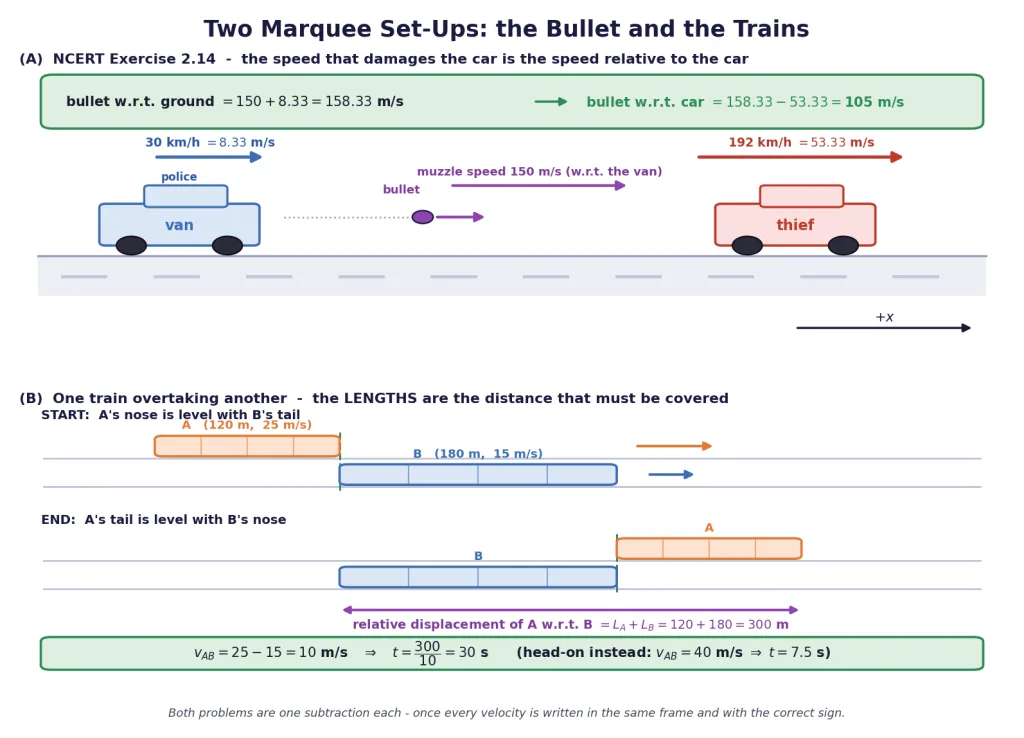
When lengths matter: one train overtaking another
Point objects meet when their positions coincide. Real trains do not: overtaking begins when the nose of the overtaking train A draws level with the tail of train B, and ends when the tail of A clears the nose of B. Between those two instants, A must gain its own length plus B's length on B.
Key Point: For one vehicle of length completely overtaking another of length , The same applies when they pass each other head-on — only changes, from to .
Panel (B) of the figure shows it. Train A (120 m, 25 m/s) overtaking train B (180 m, 15 m/s) must cover 300 m at a relative speed of 10 m/s, which takes 30 s. If the same two trains passed head-on instead, the relative speed would be 40 m/s and the crossing would be over in 7.5 s — four times faster, for exactly the same trains.
Two variants that use the same idea:
- A train passing a stationary observer or a pole: the relative displacement is just (the pole has no length), so .
- A train crossing a bridge or a platform of length : relative displacement is .
[NEET Important] These three cases — pole, platform, another train — account for nearly every "crossing" numerical ever set. Ask yourself only: what total length has to go past what?
When the relative velocity is not constant
If one of the bodies accelerates, changes and you cannot divide any more. Two safe routes:
- Relative route: use the kinematic equation in relative form, , and set for a meeting.
- Ground route: write and separately in the ground frame and solve . Slower, but almost impossible to get wrong.
A classic of this type: a car travelling at is a distance behind a slower car at and brakes with retardation . It just avoids a collision if the relative velocity falls to zero exactly as the gap closes, which by applied to the relative motion gives . Notice that only the relative speed appears — a 25 m/s car behind a 15 m/s car is in exactly the same danger as a 15 m/s car behind a 5 m/s one. Full chase problems where a body starts from rest and accelerates are taken up in the JEE Corner.
Two Objects on One Position-Time Graph
Section 5 taught you to read a single x-t graph: the slope at a point is the velocity, a straight line means uniform motion, a horizontal line means at rest. Draw two objects on the same axes and, with no new rules at all, the graph starts answering relative-motion questions.
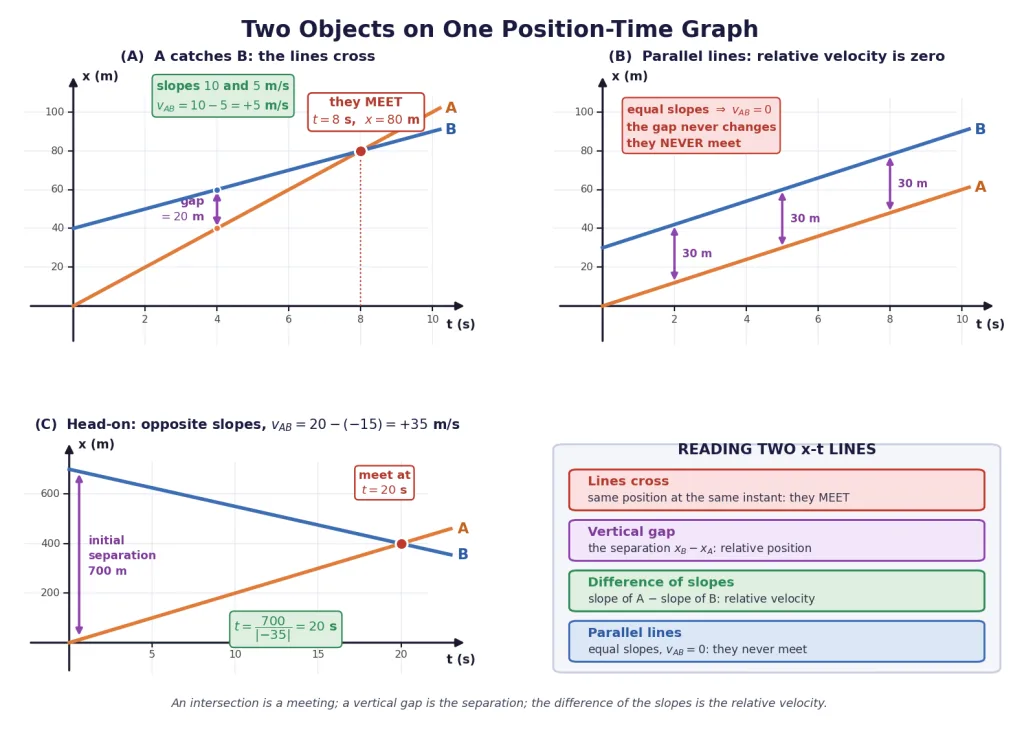
Key Point (reading a two-object x-t graph):
What you see What it means the two lines intersect at that instant both are at the same position — they meet, collide, or one overtakes the other the vertical gap between the lines at time the separation at that instant — the relative position the difference of the slopes the relative velocity the lines are parallel equal slopes, : constant separation, they never meet the lines diverge the gap is growing; they are moving apart
Three things follow immediately, and each is worth a mark somewhere.
The intersection is a meeting, not an overtaking on its own. The lines crossing tells you the positions were equal at that instant. Whether it counts as "overtaking" depends on which line was above before and after — and if the lines cross twice, the two objects met twice, so one of them must have reversed. The standard question that asks who lives closer to the school, who walks faster and who overtakes whom is exactly this reading exercise.
A steeper line always catches a shallower one — eventually. Two straight lines with different slopes must cross somewhere. If they do not cross for , the crossing was in the past. This is the graphical version of "if , the gap must reach zero at some time".
The vertical gap is a real distance you can measure. In panel (A), A starts 40 m behind B and gains 5 m each second; at s the gap has shrunk to 20 m, and at s it is zero — which is where the lines cross.
The same trick on a v-t graph
Draw the two velocities instead, and the reading changes but the idea does not:
- the vertical gap between the two v-t curves is the relative velocity ;
- the area between the two v-t curves is the relative displacement;
- the curves crossing means the velocities are equal at that instant — not that the objects meet. In a chase, that instant is when the gap stops shrinking and starts growing, so it is where the minimum separation occurs.
[JEE Tip] "Find the minimum distance between them" is answered at the instant , i.e. where the two v-t curves cross — never where the x-t curves cross.
Where this goes next
Everything in this section has been signed subtraction on a line: one axis, one sign, one number. That is the whole of relative velocity in one dimension.
Key Point: In 1D, relative velocity is nothing more than subtraction with signs. In two dimensions the definition is identical in form, , but the subtraction becomes vector subtraction — components, triangle law, angles. That is where the boat crossing a river at an angle, and the rain that makes you tilt your umbrella, are handled. You meet them in Chapter 3, Motion in a Plane.
So the formula you learn here does not get replaced later; it gets promoted.
Solved Examples
Example 1: The police van and the thief's car
A police van moving on a highway with a speed of 30 km/h fires a bullet at a thief's car speeding away in the same direction with a speed of 192 km/h. If the muzzle speed of the bullet is 150 m/s, with what speed does the bullet hit the thief's car? (Obtain the speed which is relevant for damaging the thief's car.)
Solution:
- Set the convention. Take the direction of motion of both vehicles as . All three motions are along this line.
- Convert everything to m/s (the muzzle speed is already in m/s, so bring the others across). Multiply km/h by :
- Read the muzzle speed correctly. 150 m/s is the speed of the bullet relative to the van (that is what "muzzle speed" means — it is measured by the gun). So m/s.
- Get the bullet's ground velocity. From , The van's motion gives the bullet a free head start.
- Now the question actually asked. The damage is done by the speed of the bullet relative to the car, because that is the speed at which it arrives at the car's bodywork:
Final Answer: The bullet hits the thief's car at 105 m/s.
Takeaway: Two subtractions and a unit conversion, and the only trap is the last step: the bracketed hint in the question exists because most students stop at 158.33 m/s. A bullet's ground speed damages nothing; the speed relative to the target does. Note also that the answer is exactly — the car outruns the van by 45 m/s, so it takes that much sting out of the bullet.
Example 2: Sign discipline, both ways round
Car A moves at 25 m/s and car B at 15 m/s along a straight road. Find and when (a) they move in the same direction, (b) they move in opposite directions, with A moving along in both cases.
Solution:
- Convention: is A's direction of motion throughout.
- (a) Same direction. Both velocities are positive: m/s, m/s.
- (b) Opposite directions. Now B moves along : m/s, m/s.
Final Answer: (a) m/s, m/s. (b) m/s, m/s.
Takeaway: In every case : same magnitude, opposite sign. And notice you never decided whether to add or subtract — the minus sign on in part (b) did that for you.
Example 3: Two cars approaching head-on
Two cars A and B are 700 m apart on a straight road, moving towards each other. A travels at 20 m/s and B at 15 m/s. (a) How long before they meet? (b) How far from A's starting point do they meet?
Solution:
- Convention: take from A towards B. Then m/s and, since B comes the other way, m/s. A starts at and B at m.
- Relative velocity of A with respect to B: Positive, and B lies in the direction from A, so the gap is closing. Good.
- Time to meet. In B's frame, B is at rest and A covers the whole 700 m at 35 m/s:
- Where they meet. Back in the ground frame, A has travelled (Check: B travelled m, and m. The two distances must add up to the original gap.)
Final Answer: They meet after 20 s, at 400 m from A's starting point.
Takeaway: "Closing speed" is just , and for head-on motion it is the sum of the speeds. Always finish with the check that the two distances add to the initial separation — it costs three seconds and catches sign errors.
Example 4: One train overtaking another, and then meeting it head-on
Train A is 120 m long and travels at 90 km/h. Train B is 180 m long and travels at 54 km/h. (a) If they move in the same direction on parallel tracks, how long does A take to overtake B completely? (b) How long would they take to cross each other if B were moving in the opposite direction instead?
Solution:
- Convert to m/s: m/s and m/s.
- Find the relative displacement required. Overtaking starts when A's nose is level with B's tail and ends when A's tail clears B's nose, so A must gain This is the same in both parts — the trains do not change length.
- (a) Same direction. With along the common direction, m/s and m/s:
- (b) Opposite directions. Now m/s:
Final Answer: (a) 30 s to overtake. (b) 7.5 s to cross head-on.
Takeaway: Same trains, same 300 m, but overtaking takes four times as long as crossing head-on — and the only thing that changed between the two parts was one minus sign. This is why overtaking on a two-lane highway is dangerous: you are alongside for tens of seconds, while anything coming the other way arrives in a few.
Example 5: A passenger times a passing train
A passenger sitting in a train moving at 20 m/s sees another train, 150 m long, going the opposite way on the next track. The second train takes 5 s to pass him completely. Find the speed of the second train.
Solution:
- Identify what "pass him" means. The passenger is a point; the train has length. So the relative displacement between the first instant (nose level with the passenger) and the last (tail level with the passenger) is exactly the train's own length, 150 m.
- Relative speed from the observation:
- Unpack it. Take as the passenger's direction of travel, so m/s and the other train has with . Then
Final Answer: The second train moves at 10 m/s, i.e. 36 km/h.
Takeaway: The observer's own speed is baked into what he sees. If the same passenger had been standing on the platform, the train would have taken 15 s to pass him — three times as long — for exactly the same train.
Example 6: The escalator
A moving escalator carries a standing man from the bottom to the top in 90 s. Walking up a stationary escalator takes the same man 60 s. (a) How long does he take if he walks up while the escalator is moving? (b) How long would he take to walk up if the escalator were running downwards at the same rate?
Solution:
- Choose a convenient measure. Let the length of the escalator be and take "up" as positive. Then Note carefully which frame each is measured in: the escalator's speed is with respect to the ground, and the man's walking speed is with respect to the escalator (the steps he is treading on).
- Combine to get the man's ground velocity. From ,
- (a) Time taken:
- (b) Escalator reversed. Now the escalator's velocity is , so
Final Answer: (a) 36 s walking with the escalator. (b) 180 s walking against it.
Takeaway: cancelled every time, so you never needed it. And the times do not average: 90 s and 60 s combine to 36 s going with, and to a punishing 180 s going against. Whenever two agencies move the same body, add their velocities — never their times.
Example 7: A man walking inside a moving train
A train moves due east at 20 m/s. A man inside walks at 1.5 m/s towards the rear of the train. (a) What is his velocity with respect to the ground? (b) Another train passes on the parallel track going due west at 15 m/s. What is the man's velocity relative to that train? (c) What is the first train's velocity relative to the second?
Solution:
- Convention: east is . Then m/s, and "towards the rear" means westwards, so m/s.
- (a) Ground velocity of the man. The walking speed is measured relative to the train, so He moves east at 18.5 m/s — still eastwards, just slightly slower than the train.
- (b) Relative to the second train, which has m/s:
- (c) Train 1 relative to train 2:
Final Answer: (a) 18.5 m/s east; (b) 33.5 m/s east; (c) 35 m/s east.
Takeaway: A speed quoted "inside the train" is a relative speed and must be added to the train's ground velocity before it can be used anywhere else. Notice how naturally the rearward walk becomes and then reduces his ground speed by exactly 1.5 m/s.
Example 8: The stone dropped from a rising balloon — the classic trap
A balloon is rising vertically at a steady 5 m/s. When it is 60 m above the ground, a stone is released from it. Taking m/s^2 and neglecting air resistance, find (a) the greatest height the stone reaches, (b) the time it takes to reach the ground, (c) its speed on landing, and (d) how far below the balloon it is when it lands.
Solution:
- Convention: upward positive, origin at the ground. At the instant of release the stone is at m.
- The trap, handled first. "Released" means released relative to the balloon, so its velocity relative to the balloon is zero — which means its velocity relative to the ground equals the balloon's: It is not zero. The stone goes up first.
- (a) Highest point. Using with :
- (b) Time to reach the ground. Using with : Take the positive root: s. (The root s is the fictitious earlier time at which a stone thrown from the ground would have been launched to follow this path.)
- (c) Landing speed: m/s, i.e. 35 m/s downward.
- (d) Distance below the balloon. The balloon keeps rising at a constant 5 m/s, so it is in uniform motion while the stone accelerates. Relative to the balloon, (Check in the ground frame: the balloon has climbed to m while the stone is at 0. Gap = 80 m.)
Final Answer: (a) 61.25 m above the ground; (b) 4 s; (c) 35 m/s downward; (d) 80 m below the balloon.
Takeaway: Two separate ideas earn the marks here. The stone inherits the balloon's velocity, so it rises 1.25 m before falling. And relative to the balloon it simply falls from rest with — which is why the tidy m works for part (d) even though neither body is at rest in the ground frame.
Example 9: Two stones, one dropped and one thrown up
From the top of a tower 100 m high a stone A is dropped. At the same instant a stone B is thrown vertically upward from the foot of the tower with a speed of 25 m/s. Take m/s^2. (a) When and (b) where do they meet? (c) Is B still rising when they meet?
Solution:
- Convention: upward positive, origin at the foot of the tower. Then m with , and with m/s. Both have m/s^2.
- Relative acceleration is zero — both are in free fall: So B moves at constant velocity as seen from A:
- (a) Time to meet. In A's frame, A is at rest and B closes the 100 m gap at a steady 25 m/s:
- (b) Where. In the ground frame, They meet 20 m above the ground.
- (c) Is B rising? Its velocity at s is m/s. Negative, so B is already on its way down. (It reached the top at s.)
Final Answer: They meet after 4 s, at 20 m above the ground, and B is falling by then.
Takeaway: Because the relative acceleration is zero, the meeting time is just — and never enters it. Change to the Moon's value and they would still meet after 4 s, just at a different height.
Example 10: Reading a meeting off the x-t graph
Two particles move along the same straight line. Particle A starts from the origin with velocity 10 m/s; particle B starts 40 m ahead of A and moves at 5 m/s in the same direction. (a) Write their position-time equations and find where and when A catches B. (b) What is the separation at s? (c) What would the graph look like if B also moved at 10 m/s?
Solution:
- Convention: along the common direction of motion, origin at A's start.
- (a) Catch-up. Two ways, same answer.
- Relative: m/s, initial separation 40 m, so s.
- Ground: s. Position: m.
- (b) Separation at s: Exactly half the original gap, because in the relative frame the gap shrinks uniformly at 5 m/s.
- (c) Equal speeds. Then the slopes are equal, the two lines are parallel, , and the 40 m gap stays 40 m forever. They never meet.
Final Answer: (a) They meet at s at m; (b) the gap is 20 m at s; (c) parallel lines, never meeting.
Takeaway: On an x-t graph, the intersection answers "when and where", the vertical gap answers "how far apart", and the difference of slopes answers "how fast is that gap changing". Three questions, one picture.
Example 11: The minimum braking needed to avoid a collision
Car A is travelling at 25 m/s, 100 m behind car B which is travelling at a steady 15 m/s in the same direction. The driver of A sees B and brakes. What is the least uniform retardation A must apply to avoid hitting B?
Solution:
- Convention: along the common direction. Relative to B,
- State the condition for a near miss. In B's frame, B stands still and A approaches at 10 m/s while decelerating. A just avoids the collision if its relative velocity falls to zero exactly as the 100 m gap closes. (If hits zero any earlier, A never reaches B; any later, A is still gaining when it arrives.)
- Apply to the relative motion. With B moving uniformly, :
- Sanity check in the ground frame. With m/s^2, A slows from 25 to 15 m/s in 20 s, covering m. B covers m. A gained exactly 100 m and their speeds are equal at that moment. They touch without impact.
Final Answer: A minimum retardation of 0.5 m/s^2.
Takeaway: Only the relative velocity appears in — the absolute speeds cancel out. And the collision condition is always "relative velocity reaches zero before the relative displacement is used up", which is the same statement as "the two v-t graphs cross before the x-t graphs do".
Example 12: Upstream, downstream and the average speed
A boat can travel at 10 km/h in still water. A river flows at 2 km/h. The boat goes 24 km downstream and returns to the starting point. Find (a) the time each way, (b) the total time, and (c) the average speed and the average velocity for the whole trip.
Solution:
- Convention: downstream is . "Speed in still water" means speed relative to the water, so km/h and km/h.
- Ground speeds:
- (a) Times:
- (b) Total time h.
- (c) Averages. The path length is km and the displacement is zero, so
Final Answer: (a) 2 h down, 3 h up; (b) 5 h in total; (c) average speed 9.6 km/h, average velocity zero.
Takeaway: The average speed is not the mean of 12 and 8 (which would be 10 km/h) — the boat spends longer on the slow leg, so the average is dragged below it. This is Section 1's distinction between average speed and average velocity, now dressed in relative-velocity clothing: a current that helps you one way and hinders you the other always costs you time overall.