
How to Use This Section
This is the last section of the chapter, and it is built for one job: to be read the night before the paper, and again in the queue outside the hall.
Nothing new is taught here. Every card below is a compression of something Sections 1 to 11 worked through properly, in the same notation and with the same worked numbers. So if a line here surprises you, that is not a line to memorise — it is a signal to go back and reread the section that owns it.
Six cards, one mistake checklist, one 60-second panic list. Screenshot the three figures.
Card 1 — The Nine Definitions, Side by Side
Key Point: An object is said to be in motion if its position changes with time. The position of the object is specified with reference to a conveniently chosen origin, and for motion in a straight line, position to the right of the origin is taken as positive and to the left as negative. That convention is a choice — but it must be made before any sign is assigned.
Every single quantity in this chapter is on this table. Learn the columns, not just the formulas: the sign column and the watch out column are where the marks actually live.
| Quantity | Symbol | Defining formula | SI unit | Signed? | Watch out |
|---|---|---|---|---|---|
| Position | coordinate on the chosen axis | m | Yes | Meaningless until you fix an origin and a positive direction | |
| Path length (distance) | total length of path actually traversed | m | No — never negative | Adds up every metre covered, reversals included; it never decreases | |
| Displacement | m | Yes | Depends only on the two end points; zero for any round trip | ||
| Average velocity | m/s | Yes | Belongs to an interval, not an instant; slope of a chord | ||
| Average speed | -- | m/s | No | Not the magnitude of ; and not the arithmetic mean of the leg speeds | |
| Instantaneous velocity | m/s | Yes | Slope of the tangent to the x-t graph. Differentiate first, substitute the instant last | ||
| Instantaneous speed | m/s | No | Exactly equal to — always, no exceptions | ||
| Average acceleration | m/s^2 | Yes | is a change in velocity, not in speed | ||
| Instantaneous acceleration | m/s^2 | Yes | Slope of the tangent to the v-t graph. Its sign alone tells you nothing about speeding up |
Dimensional formulas, because they get asked as one-markers: displacement , velocity and speed , acceleration . [Board Important] Write the zero power of mass in; it earns the mark.
The three relations that connect them
Key Point: The first two become equalities only when the object never reverses direction during the interval. The third is an equality always, because in a vanishing interval there is no room to turn around and nothing to cancel.
That second line is a guaranteed Board question.
The two-leg average speed, which is where the marks go missing
| Journey split into two legs | Average speed for the whole trip | Name |
|---|---|---|
| Equal distances at and | harmonic mean | |
| Equal times at and | arithmetic mean |
With 40 km/h and 60 km/h: equal distances give 48 km/h, equal times give 50 km/h. The equal-distance answer is always the smaller, because equal distances mean you spend longer on the slow leg. For equal distances, .
Uniform motion, and the three quick facts
An object is in uniform motion if it covers equal displacements in equal intervals of time, however small. Then is constant, , and .
- Its x-t graph is a straight line inclined to the time axis, whose slope is .
- Its v-t graph is a straight line parallel to the time axis.
- Average velocity over every interval equals the instantaneous velocity at every instant, and average speed equals average velocity exactly.
[NEET Important] Contrast that with uniformly accelerated motion, where the x-t graph is a parabola and the v-t graph is a straight line inclined to the time axis. That pair of sentences gets asked almost verbatim, and both halves are examined.
Card 2 — The Complete Kinematic Equation Set
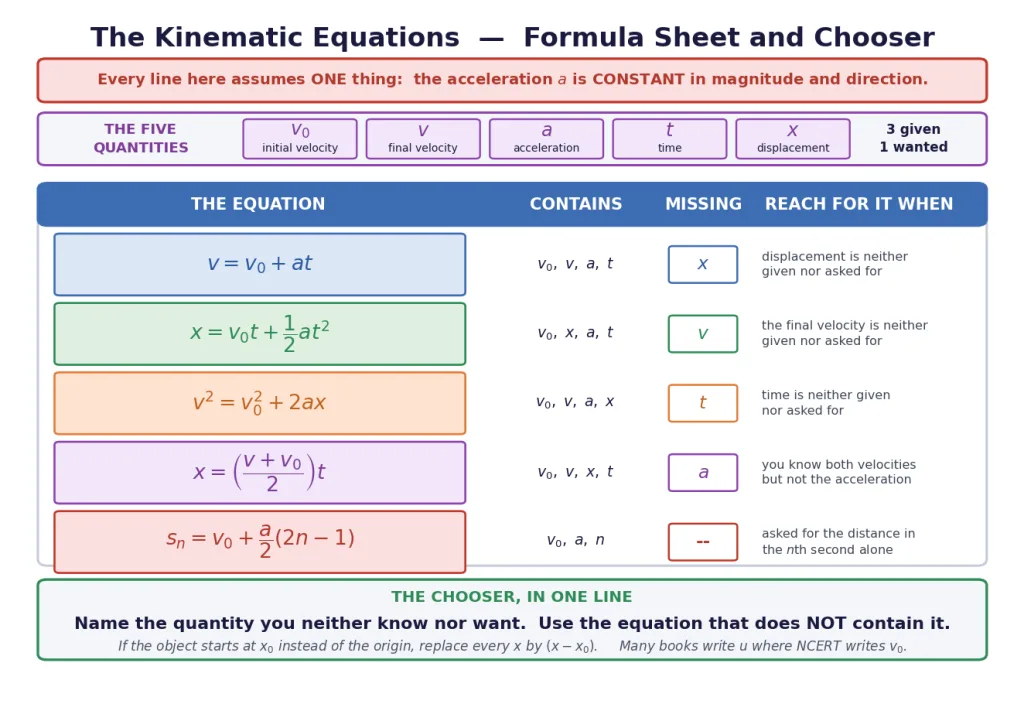
The five equations
Key Point: For rectilinear motion with constant acceleration, the five quantities , , , and are tied together by: The first three assume the position at is ; if the object starts at , replace every by .
The fourth is the same trapezium measured a second way, and it also says — the average velocity is the arithmetic mean of the initial and final velocities. The fifth gives the displacement in the th second alone, meaning the interval from to .
The chooser: which equation, in fifteen seconds
A well-posed problem hands you three of the five quantities and asks for a fourth. The fifth — the one that is neither given nor wanted — is the one to avoid.
Key Point: Name the quantity you neither know nor want. Use the equation that does not contain it. One substitution, one answer, no simultaneous equations.
| Equation | Contains | Missing | Reach for it when |
|---|---|---|---|
| displacement is neither given nor asked | |||
| the final velocity is neither given nor asked | |||
| time is neither given nor asked | |||
| you know both velocities but not | |||
| -- | asked for the distance in the th second alone |
Three drills, with the answers: from rest at 2 m/s^2, how far in 6 s? is the odd one out, so 36 m. At 20 m/s, stops in 200 m — find the retardation. is the odd one out, so m/s^2. Slows from 15 m/s to 5 m/s in 4 s — how far? is the odd one out, so 40 m.
And remember the hidden data: "starts from rest", "dropped", "released" all mean ; "comes to rest", "at the highest point" mean ; "uniform velocity" means ; "under gravity" means . Those phrases are numbers.
The loud reminder
Key Point: The definitions of instantaneous velocity and acceleration are exact and always correct. The kinematic equations are true only for motion in which the magnitude and the direction of the acceleration are constant during the course of the motion.
They are not laws of nature; they are the solutions of the differential equations of motion for the single special case constant. So a stone in free fall, a car with steady brakes, a trolley on a uniform slope are all fine. A car in city traffic, a bouncing ball, a particle with or are not — and plugging in there is simply wrong, not merely approximate. Card 6 shows what to do instead.
The same restriction kills the shortcut . Take over 0 to 4.0 s: the true displacement is 64 m so m/s, while m/s. Off by 50%.
Signs, and the two roots
Key Point: The origin and the positive direction are your choice, but you must fix them before assigning any signs. In the equations all quantities are algebraic — positive or negative — and the equations then work in every situation, provided every value goes in with its proper sign.
There is no separate formula for a body slowing down and no "downward" version of anything. There is one set of equations and the signs do the rest.
Because is quadratic in , you will often get two roots. A negative root describes where the object would have been before your clock started — reject it, and say in writing that you are rejecting it. Two positive roots are usually both real: the object passes the same height once going up and once coming down.
The nth second, in detail
It looks dimensionally wrong and is not: the interval is exactly 1 second, and that hidden factor fixes the units. Write the answer as "25 m", never "25 m/s" — the m/s version is a guaranteed lost mark. Three cautions: must be a whole number; is a displacement for that second, so it equals the distance only if the body does not reverse during that particular second; and setting gives Galileo's ratio , which needs and is false the moment the body starts with a velocity.
Card 3 — Free Fall and Vertical Motion: the Template
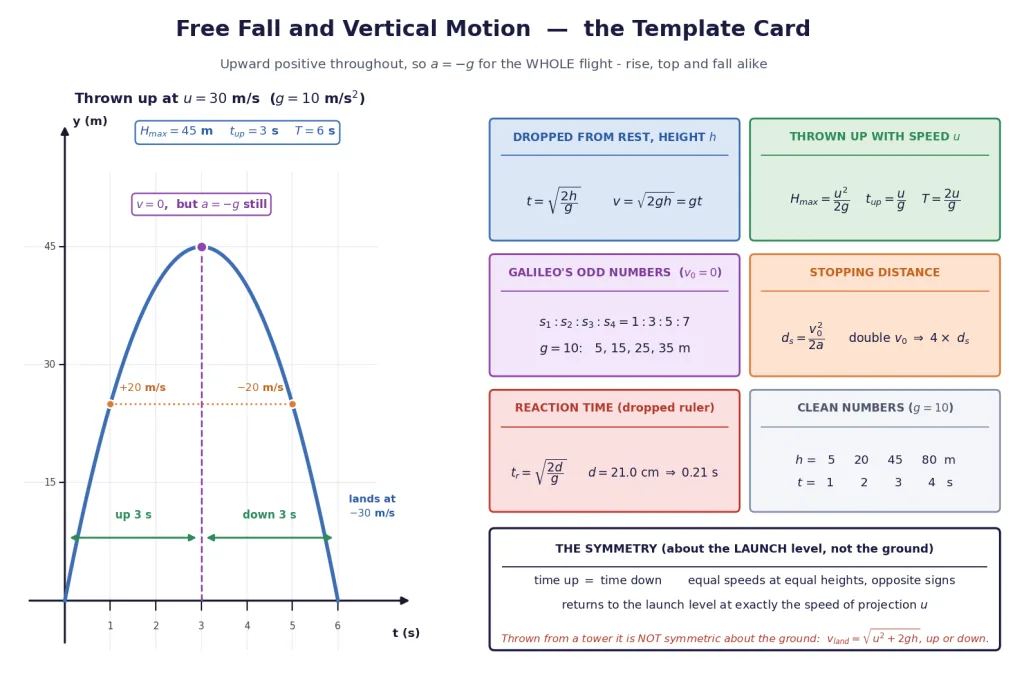
An object released near the Earth's surface with air resistance neglected is in free fall. Over distances small compared with the Earth's radius, is constant at 9.8 m/s^2 — so free fall is nothing but uniformly accelerated motion, and Card 2's equations apply unchanged. Take upward as positive throughout this card, so for the whole flight: rise, top and fall alike. And note what is missing from every formula below: the mass.
The results, as a template
| Situation | Result | Comes from |
|---|---|---|
| Dropped from rest through height | ||
| Speed on arrival | ||
| Thrown up at : time to the top | ||
| Thrown up at : maximum rise | ||
| Thrown up at : time back to launch level | ||
| Thrown up or down at from height | same speed either way |
Clean case to memorise: m/s with m/s^2 gives m, s, s. And for a drop: 5, 20, 45, 80 m give 1, 2, 3, 4 s respectively — the heights are the perfect squares.
The symmetry
Key Point: For flight between the same two levels, the time up equals the time down, and the object passes any given height with equal speeds going up and coming down (velocities equal in magnitude, opposite in sign). In particular it returns to the launch level with exactly the speed of projection.
Three consequences that get asked on their own:
- Over the whole flight the displacement is zero and the distance is , so the average velocity is zero while the average speed is .
- Doubling quadruples the height () but only doubles the time of flight ().
- At the top, but is still . That is the single most examined instant in the chapter.
Key Point (the trap): The symmetry is about the launch level, not the ground. Throw a ball up from a tower and the downward journey is longer than the upward one, and it lands faster than it left.
Galileo's law of odd numbers
Set in and the cancels out of the ratio:
Key Point: "The distances traversed, during equal intervals of time, by a body falling from rest, stand to one another in the same ratio as the odd numbers beginning with unity" — 1 : 3 : 5 : 7 : 9 : 11.
Equivalently, the positions at equal time steps go as the perfect squares 0, 1, 4, 9, 16, and the odd numbers are simply the gaps between consecutive squares. With m/s^2 the successive one-second falls are 5, 15, 25, 35 m, which is a set worth knowing on sight.
Stopping distance and reaction time
Braking from to rest, time is neither given nor wanted, so the chooser sends you to the third equation:
Key Point: Stopping distance goes as the square of the initial speed. Doubling the speed makes the stopping distance four times as long for the same deceleration.
Measured braking distances for one car — 10, 20, 34 and 50 m at 11, 15, 20 and 25 m/s — imply decelerations of about 6.1, 5.6, 5.9 and 6.3 m/s^2, near enough one constant value, exactly as the formula predicts. This is why halving a speed limit outside a school does not halve the braking distance; it quarters it.
Reaction time is the time to observe, think and act, before the brakes are even touched — and the vehicle covers metres in it. Measure your own by catching a dropped ruler through a distance : the ruler is in free fall from rest, so and
A measured cm with m/s^2 gives s. Typical human reaction times are 0.2 s to 0.3 s, and a car at 25 m/s covers about 5 m in that time with the brakes untouched.
Card 4 — The Graph Rules
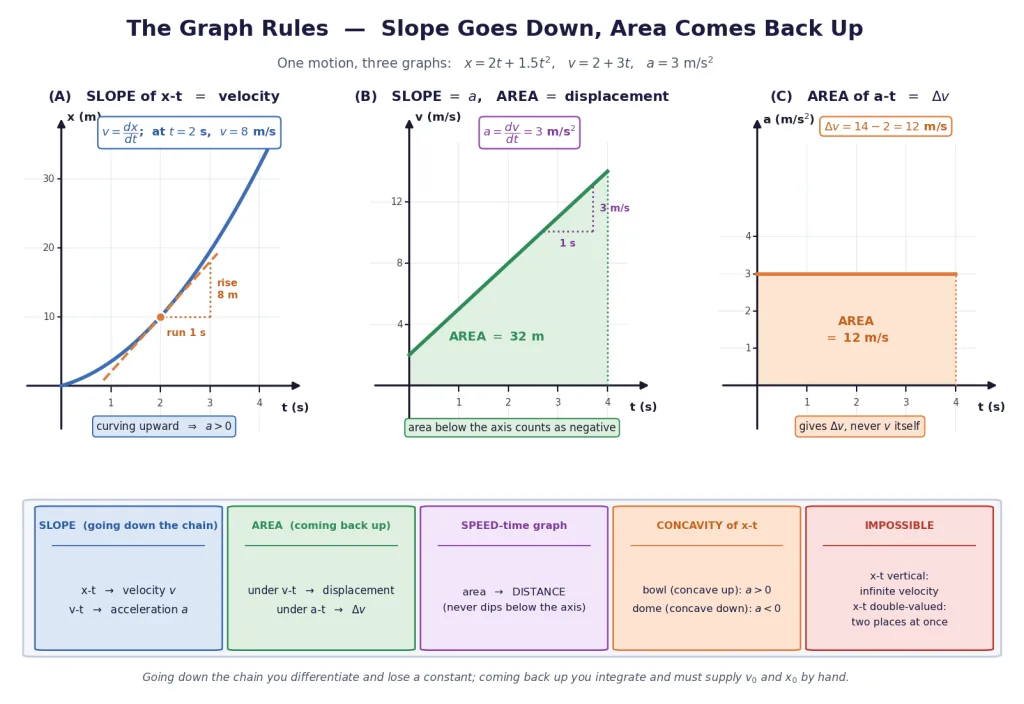
Half the exercise questions for this chapter are graph questions. Four rows answer essentially all of them.
Key Point (the master table):
Graph Its SLOPE gives you Its AREA with the time axis gives you position-time (x-t) velocity, nothing physically useful velocity-time (v-t) acceleration, displacement, acceleration-time (a-t) rate of change of (off syllabus) change in velocity, speed-time magnitude of acceleration distance travelled
Why an area can be a length: multiply the axis units. On a v-t graph, (m/s) times (s) is m. On an a-t graph, (m/s^2) times (s) is m/s. The units tell you what the area means, every time.
Signed areas, and the difference that is the mark
Areas below the time axis count as negative. Take : the area from 0 to 2 s is m and from 2 to 4 s is m, so the displacement is 0 while the distance is 16 m. Same picture, two answers, and the only difference is whether you attach the minus sign.
The area under a speed-time graph is the distance directly, because a speed-time graph never dips below the axis. Read the axis label before you start.
Down the chain by slopes, up the chain by areas
Key Point: Going down you differentiate and lose a constant. Coming back up you integrate and must put that constant back by hand. The area under a v-t graph gives the change in position, never the position; the area under an a-t graph gives , never .
What each shape means
| Shape | on x-t | on v-t | on a-t |
|---|---|---|---|
| horizontal line | at rest | uniform motion (at rest only if it lies on the axis) | uniform acceleration (uniform velocity only if on the axis) |
| straight sloping line | uniform velocity; steeper means faster | uniform acceleration | changing steadily — the kinematic equations do not apply |
| parabola | uniform acceleration | non-uniform acceleration | -- |
| crosses the time axis | passes the origin | reverses direction | acceleration changes sign |
| touches the time axis without crossing | reaches the origin and returns | momentarily at rest, no reversal | -- |
Concavity of the x-t graph is the acceleration: concave up (bowl) means , concave down (dome) means , straight means . Concavity has nothing to do with whether the curve is above or below the axis — a dome drawn entirely below the time axis still has .
Two more readings that are worth a mark each. On a v-t graph, the curve moving away from the time axis (in either direction) means speeding up; moving towards it means slowing down. And the particle is farthest from its start where the v-t curve crosses the axis, not where the v-t curve peaks — a peak in v-t is where it is fastest.
Why an x-t graph can never be vertical
Key Point: A vertical segment on an x-t graph means a finite change of position in zero time, which is an infinite velocity. No object does that. A very steep line is fine and just means "very fast"; a truly vertical one is impossible.
Its partner rule: an x-t graph can never be double-valued either, because a particle has exactly one position at each instant — that is the vertical-line test from your maths class. A v-t graph is also single-valued, but it may be drawn vertical as an idealisation (the instantaneous velocity reversal of a bouncing ball), because a jump in velocity is an idealisation of a very short collision, whereas a jump in position is not even that. And two more that cannot happen: a speed-time graph dipping below the axis, and a path-length-versus-time graph coming back down. You cannot un-travel a distance.
Finally, an honest footnote: in any realistic situation the graphs are smooth. Velocity and acceleration cannot change abruptly at an instant. The sharp kinks in the figures are idealisations drawn to keep the arithmetic clean.
Card 5 — Relative Velocity in One Dimension
This topic sits outside the rationalised syllabus body text — the chapter summary and the closing notes do not mention it — yet the standard police-van-and-thief problem cannot be solved without it and JEE Main and NEET ask it every year. Section 6 teaches it properly; here is the whole of it compressed.
The definition, and the two-way rule
Key Point: If A and B move along a line with velocities and measured in the same frame (normally the ground), then the velocity of A relative to B is Read the subscripts in order: the first is the object described, the second is the observer. So and are equal in magnitude and opposite in direction.
The same subtraction runs all the way up and down the chain:
which means the whole kinematic toolkit can be applied directly to the relative quantities: . That turns a great many two-body problems into one-body problems.
Same direction, opposite directions
Key Point: In one dimension you never have to remember "same direction subtract, opposite direction add". Write both velocities with their signs and always subtract. The signs do the adding for you.
| Case | With rightwards | What it feels like | |
|---|---|---|---|
| Same direction | , | m/s | small relative speed — overtaking is slow |
| Opposite directions | , | m/s | large relative speed — they close fast |
If the two are permanently at rest relative to each other, which is why you can hold a conversation across a lane at 80 km/h but not with a car coming the other way.
Time to meet, time to overtake
Key Point: When the relative velocity is constant, This is just applied in the relative frame, where one body sits still and the other does all the moving.
Two checks before you divide: is the gap actually closing (do and have opposite signs?), and does length matter? For point objects the separation is the plain gap. For vehicles with length, one train completely overtaking another must gain on it, so — a 120 m train at 25 m/s overtaking a 180 m train at 15 m/s needs s, while the same two passing head-on take s. A train passing a pole needs ; a train crossing a platform of length needs .
Zero relative acceleration in free fall
Two objects moving under gravity alone both have , so
Key Point: Two bodies in free fall have zero relative acceleration. As seen from either one, the other moves with constant velocity. Separation therefore changes at a steady rate, and no term ever appears in the relative motion.
Three standard consequences:
- A stone dropped from a tower of height and another thrown up from the foot at , released together, meet at — and does not appear in the answer. With m and m/s they meet after 3 s, 15 m above the ground. Always check the thrown body is still in the air: here s, and , so it is.
- Two stones released from the same point seconds apart separate at a constant rate , so the gap grows linearly, not quadratically. With s and m/s^2 it widens by a steady 10 m every second.
- Inside a freely falling lift every dropped object hangs motionless. That is weightlessness, and it belongs to Chapter 5.
[JEE Tip] The shortcut applies only while both bodies are in free flight. Before the second is launched, or after one lands, the relative acceleration is not zero.
The release trap, and the two-object graph
Key Point: An object released from a moving carrier — a lift, a balloon, an aircraft — starts with the carrier's velocity in the ground frame. "Dropped" means dropped relative to the carrier; it does not mean for the ground observer. A ball released from a balloon rising at 5 m/s starts at m/s and rises a little further before it falls.
What the ball inherits is the carrier's velocity, never its acceleration; once released it is in free fall with whatever the carrier does next.
On a two-object x-t graph: the lines intersecting means the objects are at the same position (they meet or one overtakes); the vertical gap is the separation ; the difference of the slopes is ; parallel lines mean and they never meet. On a two-object v-t graph the curves crossing means the velocities are equal — which is where the separation is maximum or minimum, and never where they meet.
Card 6 — The JEE Extension: When the Acceleration Is Not Constant
Everything on Cards 2 and 3 dies the moment changes. Boards rarely go here; JEE lives here. This card is Section 8 in one page, and NEET candidates can skip it without loss.
The three relations that never fail
These are definitions, not results, so no assumption about can break them:
That third form comes from the chain rule, , and it is the single most useful line in advanced 1D kinematics. Equivalently , or . Notice that is just this relation with pulled out of the integral because it was constant.
The three integration routes
Every variable-acceleration problem reduces to one question: what is a function of? Answer that and the route is fixed.
| You are given | Use | Integrate | You get |
|---|---|---|---|
| , then gives | |||
| directly, with no time in it | |||
| , want | as a function of , then invert | ||
| , want | as a function of , then invert |
Key Point: Use definite integrals with the limits written in — lower limits are the initial conditions, upper limits the general values. Half the marks lost in this topic go to a forgotten constant of integration. And read the question first: "how long until the speed halves" is a question, "how far before the speed halves" is a question, and the two answers are different numbers.
Linear drag versus quadratic drag
| (a straight line) | ||
| Stops in finite time? | No | No |
| Total distance | finite, | infinite, grows like |
| Units of | s | m |
Key Point (the one-line summary): Under the exponential sits in time and the distance is capped at . Under the exponential sits in position and the distance is never capped. "It never stops" and "it travels forever" are different statements — in the first case only the first one is true.
The restitution ladder
For a ball dropped from onto a floor with coefficient of restitution :
| Quantity | Result |
|---|---|
| Striking speed of the first impact | |
| Speed after bounces | |
| Height after bounces | |
| Fraction of kinetic energy kept per bounce | |
| Total distance travelled | |
| Total time |
[JEE Tip] Speeds carry ; heights carry — that is the single commonest slip in the topic. Infinitely many bounces, yet both totals are finite: the classic physical example of a convergent geometric series.
The chase results worth memorising
A bus passes a stationary car at a steady just as the car sets off from rest with constant acceleration . Then the car catches it at , having covered , and at that instant the car is doing exactly — twice the bus's speed, whatever the numbers. The gap is widest when the speeds are equal, at , and the maximum lead is .
For a car at a distance behind a car at , the minimum deceleration that just avoids a collision is
Only the relative speed appears, so cars at 100 and 90 m/s need exactly the same braking as cars at 20 and 10 m/s from the same gap. If the driver reacts for first, use the reduced gap .
Card 7 — The Twelve Mistakes That Cost the Most Marks
Every one of these was flagged somewhere in Sections 1 to 11. They are ordered roughly by how often they actually turn up in answer scripts.
1. Not fixing a sign convention before you start. The origin and the positive direction are your choice, but the choice must be made, written down, and then obeyed for the whole problem. "Taking upward as positive" at the top of your rough work is not a formality — it is the line that makes every sign in your answer markable. Switching halfway is the single most reliable way to get a sign wrong.
2. Reading the sign of as "speeding up" or "slowing down". It tells you nothing on its own. Compare the two signs: same signs, speeding up; opposite signs, slowing down. A freely falling stone with upward positive has and is gaining speed; a stone thrown up has that same and is losing speed. One value of , two opposite stories. And "deceleration" means the speed is falling, not that is negative.
3. Assuming zero velocity means zero acceleration. At the top of its flight a ball has and downward, unchanged. If the acceleration really did vanish there, the ball would hang in the air forever. Read it the other way too: does not imply — a car cruising at 60 km/h has plenty of velocity and no acceleration.
4. Confusing distance with displacement when the body reverses. The in every kinematic equation is displacement, never path length. The moment the velocity changes sign they part company. Split the journey at the instant , compute each part separately, then add magnitudes for distance and signed values for displacement. A body that goes out 24 m and comes back 12 m has travelled 36 m and been displaced 12 m, and a question asking for "the distance" wants 36.
5. Using the kinematic equations when the acceleration is not constant. and its two friends are the solutions for the single case constant. A particle with , or , or a ball in mid-bounce, breaks the assumption — and the equations are then wrong, not approximate. Symbols like , or inside the given acceleration are the signal to set up an integral (Card 6).
6. Using when the acceleration is not constant. The definition is always true; this particular value for it is not. With over 0 to 4.0 s the true average is 16 m/s while gives 24 m/s — off by 50%. The formula works because a straight v-t line has its average at its midpoint height; bend that line and the statement dies.
7. Taking the arithmetic mean of speeds for equal-DISTANCE legs. Equal distances give the harmonic mean ; equal times give the arithmetic mean . For 40 and 60 km/h that is 48 km/h against 50 km/h, and the examiner will have put both in the options. The equal-distance answer is always the smaller, because equal distances mean more time spent on the slow leg.
8. Forgetting to reject the unphysical root of a quadratic in . is a quadratic, so it hands you two roots. A negative root describes where the object would have been before your clock started — reject it, and write down that you are rejecting it. But do not over-reject: two positive roots are usually both real, because the object passes the same height once going up and once coming down, and the question decides which one it wants.
9. Forgetting that a body dropped from a moving carrier keeps the carrier's velocity. "Dropped" means dropped relative to the carrier. A ball released from a balloon rising at 5 m/s leaves with m/s in the ground frame and goes up a little further before falling; released from a lift descending at 5 m/s it starts at m/s. Setting in the ground frame is the most reliably missed idea in the relative-velocity topic. Note also that the ball inherits the carrier's velocity, never its acceleration.
10. Misreading the th-second formula as a velocity. is a distance in metres, not a speed — the interval is exactly 1 second and that hidden factor fixes the units. Write "25 m", never "25 m/s". Two related slips: is the ground covered between and , not the total distance in the first seconds; and the ratio 1 : 3 : 5 : 7 requires , so a question that quietly gives a non-zero and offers "1 : 3 : 5" as an option is fishing.
11. Forgetting that the th-second formula breaks if the body stops mid-interval. is a displacement for that second, and it is derived by subtracting two positions — so it silently assumes the body keeps moving the same way throughout. If the body comes to rest or reverses inside that particular second, the formula gives you a signed displacement that is not the distance, and if the body stopped for good part-way through, it is not even that: the equation carries on past the stop and reports motion that never happened. Find the stopping time first, and if it lands inside the th second, work that second out by hand.
12. Reading a chord when the question asked for a tangent — and other graph slips. Velocity at an instant is the slope of the tangent; the slope of a chord is the average over the interval, and they agree only for a straight-line graph. The rest of the graph checklist, each worth a mark: the height of an x-t curve says where the object is while its slope says which way it is going; a horizontal line on a v-t graph means cruising, not at rest; the area under a v-t graph is the change in position, so you need to get an actual position; areas below the axis are negative, which is exactly how displacement and distance come apart; and an x-t graph can never be vertical or double-valued.
Key Point: Two more that cost single marks: quoting an th-second answer or a stopping distance without a unit, and forgetting to convert km/h to m/s. Multiply km/h by : 36 km/h is 10 m/s, 54 is 15, 72 is 20, 90 is 25, 108 is 30.
The 60-Second Revision
You are in the queue outside the hall. This is the irreducible minimum.
Definitions. Displacement , signed, path-independent, zero for a round trip. Path length is a scalar and never decreases. ; average speed . Path length and average speed , with equality only if the motion never reverses; instantaneous speed always.
Calculus. , the slope of the tangent to the x-t graph. , the slope of the tangent to the v-t graph. Differentiate first, substitute the instant last.
Equations (constant only). ; ; ; ; . Replace by if it does not start at the origin. Choose the equation that omits the quantity you neither know nor want.
Vertical motion. , , , , , lands at from a height . Time up time down; equal speeds at equal heights; back at the launch level at exactly . At the top but . Galileo: 1 : 3 : 5 : 7 from rest, which is 5, 15, 25, 35 m with . Stopping distance , so double the speed and it is four times as far. Reaction time .
Graphs. Slope of x-t ; slope of v-t ; area under v-t displacement; area under speed-time distance; area under a-t . Concave up means , concave down means . Areas below the axis are negative. An x-t graph is never vertical and never double-valued.
Relative velocity. and ; write signs and always subtract. Time to meet separation / relative speed; add both lengths when the bodies have length. Two bodies in free fall have zero relative acceleration, so one sees the other move uniformly.
Signs. Fix the convention first. Same signs on and means speeding up; opposite means slowing down. The sign of alone decides nothing.
That is the whole chapter. Go and get the marks.