
Same Chapter. A Completely Different Clock.
Section 8 just took kinematics apart the JEE way — variable acceleration, three integration routes, retarding forces, restitution ladders. If you have read it, you already know far more physics than this section is going to ask of you.
So why a separate NEET Corner? Because NEET does not test the same skill.
JEE gives you a hard question and enough time to think. NEET gives you an easy question and almost no time at all. The Physics paper is 45 questions, and in a 180-minute exam split across three subjects those 45 questions deserve roughly 45 minutes. That is 60 seconds each — and mechanics, thermodynamics and electricity will eat far more than their fair share. So the two or three kinematics questions on the paper have to be finished in well under a minute each, correctly, so that you can bank the time for the questions that genuinely need it.
Key Point: NEET kinematics never leaves constant acceleration. No , no , no integrating . Everything on the paper from this chapter is a definition you recall, one equation you substitute into, a graph you recognise, or a format you have drilled.
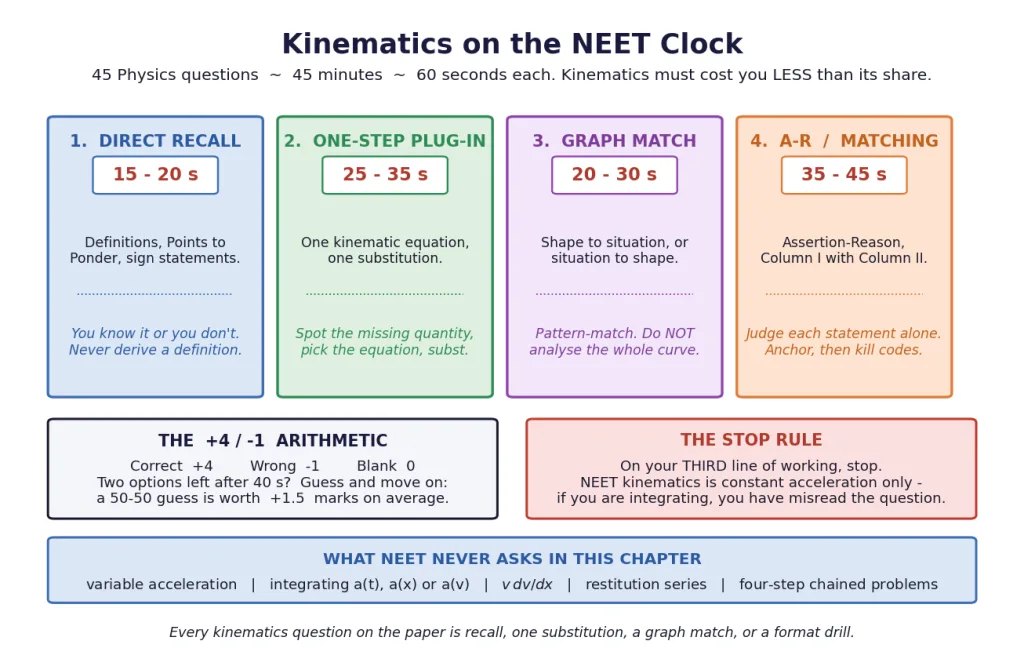
The four types, and what each should cost you
| Type | What it looks like | Your budget | The right instinct |
|---|---|---|---|
| 1. Direct recall | "The sign of acceleration tells us…" "Zero velocity implies…" "Area under a v-t graph gives…" | 15-20 s | You either know it or you don't. Never derive a definition. |
| 2. One-step plug-in | Free fall, a vertical throw, braking, distance in the th second | 25-35 s | Spot the missing quantity, pick the equation, substitute once. |
| 3. Graph match | Match an x-t or v-t shape to a situation, or the other way round | 20-30 s | Pattern-match the shape. Do not analyse the whole curve. |
| 4. Assertion-Reason / Column matching | Two NEET-only formats, both drilled below | 35-45 s | Judge each statement alone; anchor and kill codes. |
[Important] Here is a diagnostic worth internalising: if a kinematics question needs a third line of working, you have misread it. NEET will not ask you to chain four concepts. It gives you three of the five quantities and asks for a fourth.
The / arithmetic
Every right answer is 4 marks, every wrong one costs 1, and a blank is 0. So on a doubtful item the real question is not "can I get this?" but "can I get this in 40 seconds?" If two options survive your elimination and 40 seconds have gone, take the better of the two and move on — a 50-50 guess has an expected value of marks. What you must never do is spend three minutes rescuing one mark's worth of doubt.
What this section does and does not repeat
We will not re-derive the kinematic equations (Section 4 does that from the v-t graph and by calculus), re-teach the slope and area rules (Section 5), or rebuild relative velocity from scratch (Section 6). What you get here instead is the same material reorganised for recognition speed: the sentences NEET asks almost verbatim, the equation chooser turned into a timed reflex, a graph lookup that works in both directions, the standard set-ups pre-solved as templates, and the two NEET-only question formats drilled properly.
The One-Liners NEET Asks Almost Verbatim
This block is pure recall ammunition. Read it as flashcards, not as prose. Every item here has appeared as a complete question by itself, and the wording is kept close to the standard phrasing because that is how it gets asked.
The definitions, in the exact words
Key Point:
- Displacement is the change in position, . It is a vector, so in one dimension it carries a sign. Path length (distance) is the actual length of the path covered, is never negative, and is never less than the magnitude of the displacement.
- Average velocity . Average speed .
- Instantaneous velocity is the limit of the average velocity as the interval becomes infinitesimally small: . It is the slope of the tangent to the position-time graph at that instant.
- Average acceleration ; instantaneous acceleration , the slope of the tangent to the velocity-time graph.
- The area under the velocity-time curve between two instants equals the displacement in that interval.
Two more one-liners that get asked directly:
- The SI unit of acceleration is m/s^2 and its dimensional formula is .
- For uniform motion the x-t graph is a straight line inclined to the time axis and the v-t graph is a straight line parallel to it. For uniformly accelerated motion the x-t graph is a parabola and the v-t graph is a straight line inclined to the time axis.
[Important] This chapter writes for the initial velocity; most coaching material and many NEET papers write . They are the same quantity. Do not let the symbol slow you down.
Four Cautions — assertion-reason gold
Four short cautions are worth learning as sentences. Examiners mine them, because each is a single statement that is true, and each has an obvious-sounding opposite that is false. Learn all four as statements you could write out.
1. The origin and the positive direction of an axis are a matter of choice. You must fix that choice before you assign signs to displacement, velocity or acceleration. Nothing physical depends on the choice; only the signs do.
2. If a particle is speeding up, the acceleration is in the direction of the velocity; if it is slowing down, the acceleration is opposite to the velocity. This statement is independent of the choice of origin and axis — which is exactly why it is the reliable test.
3. The sign of the acceleration does not tell you whether the speed is increasing or decreasing. The sign depends on which direction you called positive. With upward positive, is negative; a falling body has negative acceleration and is speeding up, while a body thrown up has that same negative acceleration and is slowing down.
4. Zero velocity at an instant does not imply zero acceleration at that instant. A ball at the top of its flight has and downward, still.
Key Point: Read points 2 and 3 together, because together they are the whole trap. "Same sign as velocity" decides speeding up or slowing down. The sign of on its own decides nothing.
The always-true / never-true table
Speed comes from knowing which statements are safe. These are the ones NEET keeps testing.
| Statement | Verdict |
|---|---|
| Path length magnitude of displacement | Always true |
| Average speed magnitude of average velocity | Always true |
| Instantaneous speed magnitude of instantaneous velocity | Always true |
| Average speed magnitude of average velocity | Only if the motion never reverses |
| Zero velocity means zero acceleration | Never safe |
| Negative acceleration means slowing down | Never safe |
| Constant speed in a straight line means zero acceleration | True in 1D |
| A body with zero speed at an instant may have non-zero acceleration | True |
| An x-t graph can be a vertical line | Impossible (infinite velocity) |
| An x-t graph can be double-valued at one instant | Impossible (two positions at once) |
[Important] The most reused single distractor in the whole chapter is the pair "distance" and "displacement" swapped, closely followed by "average speed" and "average velocity" swapped. Before you compute anything, underline which of the two words the question actually used.
The Equation Chooser as a Five-Second Reflex
Section 4 built the chooser as a study aid and handed the drill to this section. Here it becomes a reflex, timed.
Every constant-acceleration problem is about five quantities: , , , and . A well-posed question gives you three and asks for a fourth. That leaves exactly one quantity that is neither given nor wanted — and that leftover quantity picks your equation for you.
Key Point: Find the quantity that is neither given nor asked for. Use the equation that does not contain it. One substitution, one answer, no simultaneous equations.
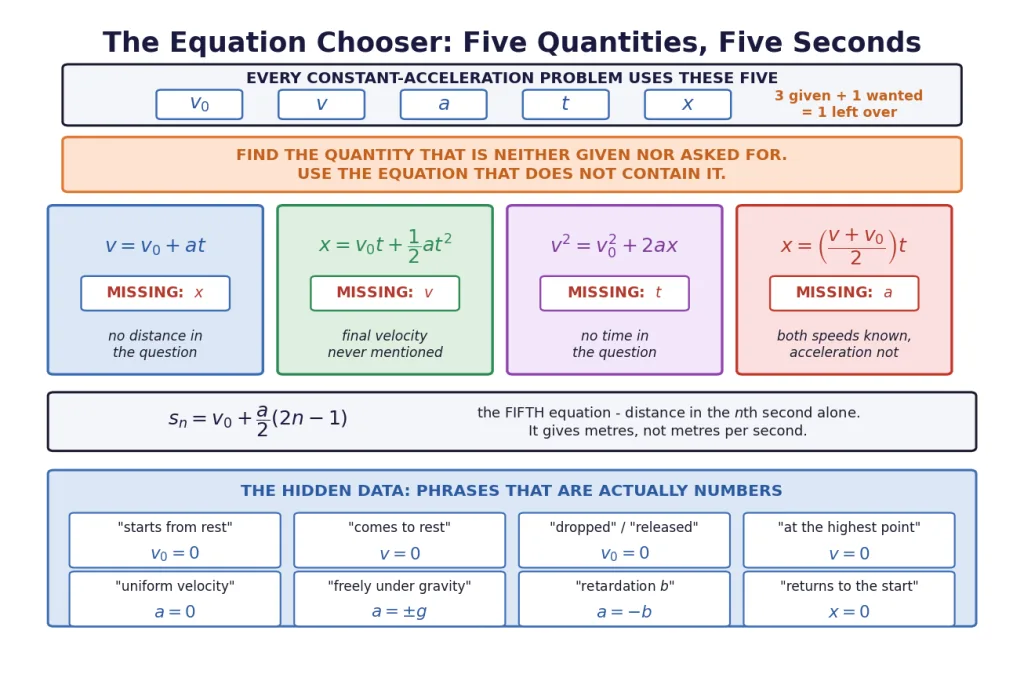
| Equation | Contains | Missing | Use when |
|---|---|---|---|
| no distance appears in the question | |||
| the final velocity is neither given nor asked | |||
| no time appears in the question | |||
| you know both velocities but not the acceleration | |||
| -- | asked for the distance in the th second alone |
The hidden data: phrases that are actually numbers
Half the students who say "there isn't enough information" have missed a phrase. These are data, not decoration.
| The words | The number |
|---|---|
| "starts from rest", "dropped", "released", "let fall" | |
| "comes to rest", "stops", "brought to a halt" | |
| "at the highest point" | |
| "moves with uniform velocity" | |
| "falls freely", "under gravity" | , and or 10 m/s^2 as the paper says |
| "retardation of 5 m/s^2" | m/s^2 |
| "returns to the point of projection" |
The drill — five items, five seconds each
Do not solve them yet. For each, name the missing quantity and the equation, out loud, before reading the answer.
| # | Question | Given | Wanted | Missing | Equation |
|---|---|---|---|---|---|
| 1 | A car starts from rest at 3 m/s^2. Its speed after 8 s? | ||||
| 2 | A scooter at 10 m/s stops uniformly in 5 s. Distance? | ||||
| 3 | A body at 6 m/s accelerates at 2 m/s^2 over 16 m. Final speed? | ||||
| 4 | A train at 25 m/s stops in 125 m. Retardation? | ||||
| 5 | From rest at 6 m/s^2, distance in the 4th second? | -- |
The answers, each one substitution: (1) 24 m/s, (2) 25 m, (3) 10 m/s, (4) 2.5 m/s^2, (5) 21 m. They are worked out at NEET pace in Example 2.
Two habits that save the most time
- Write the five symbols down and tick the three you are given. Then circle the one you want. The single symbol left unmarked is the one your equation must not contain.
- Convert km/h to m/s before anything else, by multiplying by . 36 km/h is 10 m/s, 54 km/h is 15 m/s, 72 km/h is 20 m/s, 90 km/h is 25 m/s, 108 km/h is 30 m/s. Learn those five conversions as facts; NEET reuses them constantly.
Key Point: looks dimensionally wrong and is not. It is a distance per one second of time, so the numerical value is in metres. And note it wants the th second, meaning the interval from to — not the first seconds.
Rapid Graph Recognition
A graph question on NEET is a pattern-match, not an analysis. You should never be computing slopes on a multiple-choice graph item; you should be recognising a shape you have already seen and reading off what it means.
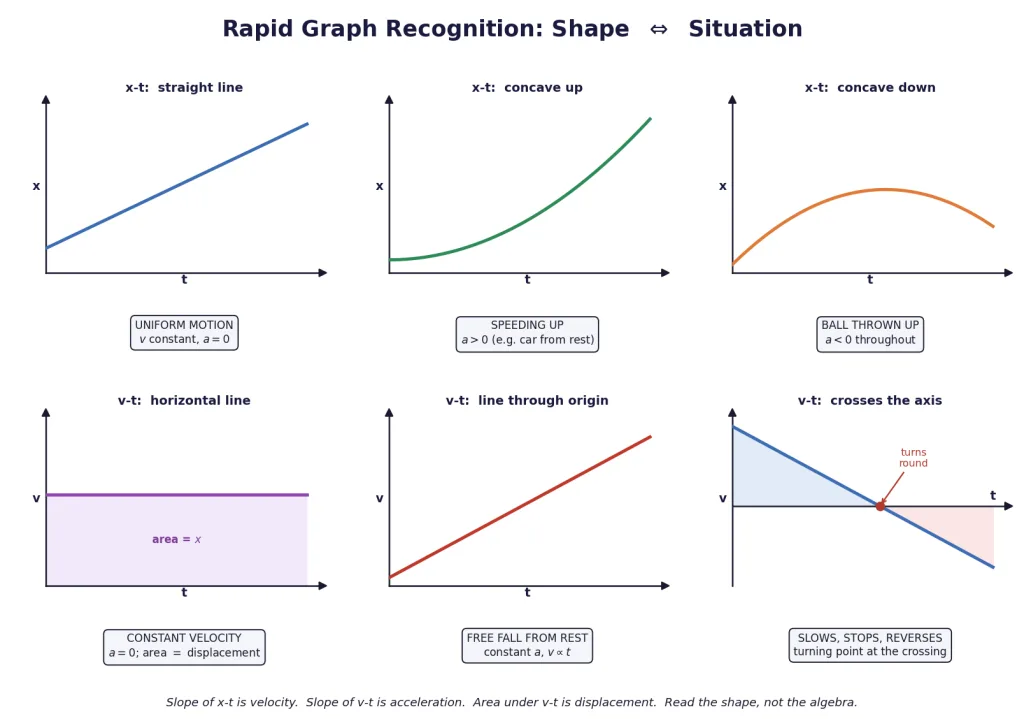
Shape to situation — the lookup you read left to right
| Graph | Shape | The motion |
|---|---|---|
| x-t | horizontal line | at rest |
| x-t | straight line, positive slope | uniform velocity, forward |
| x-t | straight line, negative slope | uniform velocity, backward |
| x-t | concave up (bowl) | acceleration positive |
| x-t | concave down (dome) | acceleration negative, e.g. a ball thrown up |
| x-t | parabola through a maximum | body goes out, stops, returns |
| v-t | horizontal line above the axis | constant velocity, |
| v-t | straight line through the origin, rising | starts from rest with constant (free fall) |
| v-t | straight line, negative slope, crossing the axis | slows, stops, reverses, speeds up backwards |
| v-t | straight line entirely below the axis, sloping down | moving backwards and speeding up |
| a-t | horizontal line | uniform acceleration |
| a-t | on the time axis | uniform velocity |
Situation to graph — the same lookup read right to left
| Situation | x-t | v-t | a-t |
|---|---|---|---|
| Body at rest | horizontal line | on the axis | on the axis |
| Uniform velocity | straight, sloping | horizontal | on the axis |
| Car starting from rest | concave-up parabola | straight line from the origin | horizontal line |
| Ball dropped from a height | concave-down curve (position falling) | straight line, steepening downward | horizontal at |
| Ball thrown vertically up and back | concave-down parabola | straight line crossing the axis | horizontal at |
| Car braking to a stop | curve flattening out | straight line falling to zero | horizontal, negative |
Key Point: For a ball thrown vertically upward the x-t graph is a parabola but the v-t graph is a straight line. Offering the parabola as the v-t graph is the single most successful distractor in this topic, because the picture in your head is the flight path.
The three questions that crack any curve
- Is it the ordinate that is positive, or the slope? "The particle is moving in the direction" is about the sign of ; "the particle is speeding up" is about and having the same sign. Different questions.
- Where does the curve cross the axis? On a v-t graph that crossing is where the body reverses — and therefore where it is farthest from its start. It is not where it is fastest.
- Is any area below the axis? If yes, displacement and distance differ. Displacement is the signed area; distance is the sum of the magnitudes.
The slope-and-area card, one line each
Key Point:
- slope of x-t velocity; slope of v-t acceleration
- area under v-t displacement; area under a-t change in velocity
- Going down the chain you differentiate (take slopes); going up you integrate (take areas).
- An area under a-t gives , not — you still need the starting velocity.
[Important] Two shapes are simply impossible and appear in every "which graph cannot represent this motion" question: an x-t graph that is vertical (infinite velocity) and any x-t or v-t graph that is double-valued at one instant (two positions, or two velocities, at the same time). Spotting those two kills most of the options before you think about physics at all.
The Clean-Number Templates
These set-ups account for most of the numerical kinematics NEET has ever asked. Each one has a standard answer that you should recall, not re-derive. The saving is real: 15 seconds against 60.
Throughout, take downward as the direction of and quote magnitudes; NEET papers use m/s^2 unless they say 9.8.
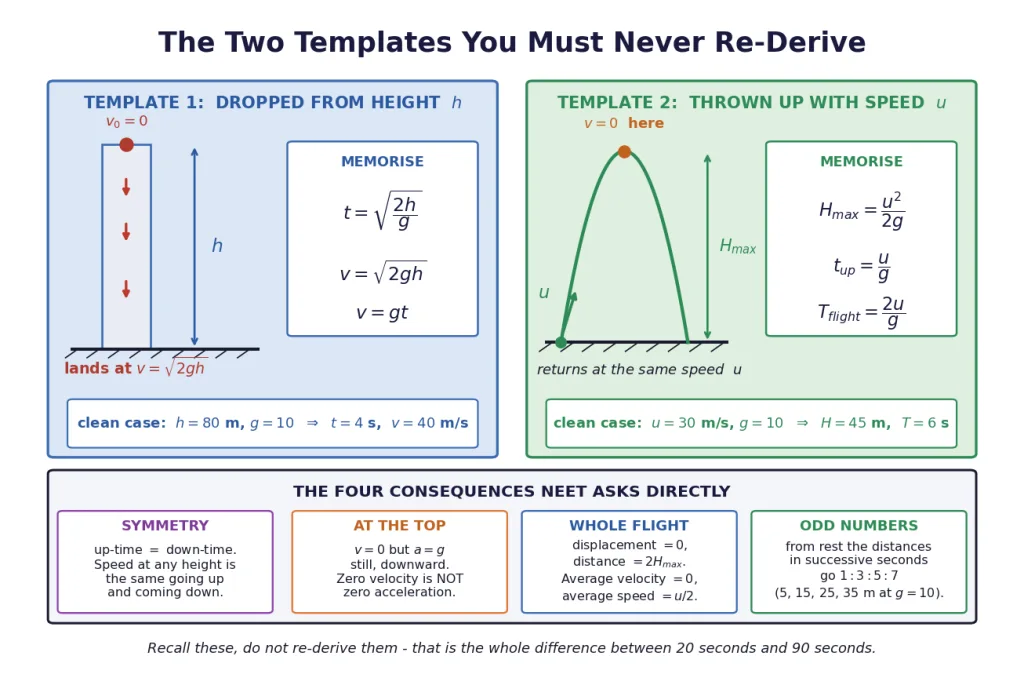
Template 1 — dropped from rest at height
Clean case: m with gives s and m/s. Also worth having: m gives 1 s, m gives 2 s, m gives 3 s and m gives 4 s. Notice the pattern in those heights, — they are the squares times 5, so the time of fall can be read off almost by inspection.
Template 2 — thrown vertically up with speed
and it comes back at the same speed with which it left.
Clean case: m/s with gives m, s, s.
Four consequences that are asked as questions in their own right:
- Symmetry. Time up equals time down, and the speed at any given height is the same going up as coming down.
- At the top, but downward still. (Caution 4 above.)
- Over the whole flight, displacement is zero and distance is , so the average velocity is zero and the average speed is .
- Doubling quadruples the height () but only doubles the time of flight ().
Template 3 — thrown up (or down) at from a height
Take upward positive, put the ground at , and solve . Two results are worth carrying:
The first is the one NEET likes: throw a stone up at or down at from the same roof and it lands at the same speed — the up-thrown one merely spends an extra seconds in the air, and it returns to the roof moving downward at exactly .
Clean case: m/s upward from a 120 m tower, : it lands after 6 s at 50 m/s. Thrown downward at 10 m/s instead, it lands after 4 s — at the same 50 m/s.
Template 4 — distance in the th second
For a body starting from rest the successive seconds cover distances in the ratio (Galileo's law of odd numbers). In free fall with that is metres — a set of numbers worth knowing on sight.
Template 5 — two bodies meeting under gravity
A stone dropped from a tower of height and another thrown up from the foot at , released at the same instant:
because the relative acceleration of two freely falling bodies is zero — in the frame of one, the other closes the gap at a constant . Then substitute that into either body's equation to find where they meet.
Clean case: m, m/s, : they meet after 3 s, at a height of 15 m above the ground. Always check the thrown body is still in the air: here s, and , so it is.
Template 6 — a car from rest overtaking a body moving uniformly
A vehicle moves at a steady ; at the instant it passes a stationary car, the car sets off from rest with constant acceleration . Then
Clean case: bus at 12 m/s, car at 4 m/s^2: caught after 6 s at 72 m, car then doing 24 m/s, and the bus's biggest lead was 18 m at s.
Key Point: Two of these results are general and get asked as pure theory: the catching car is always doing exactly twice the uniform speed at the moment it draws level, and the gap is widest when the two speeds are equal.
Assertion-Reason: The Format, Then the Drill
Here is a format a JEE-trained student has probably never practised, and NEET uses it every year. You are given two statements — an Assertion (A) and a Reason (R) — and asked how they relate.
The four option codes
Key Point:
(a) Both A and R are true, and R is the correct explanation of A.
(b) Both A and R are true, but R is NOT the correct explanation of A.
(c) A is true but R is false.
(d) A is false but R is true.(Some papers replace (d) with "both A and R are false". Read the instruction line once at the start of the paper, then never again.)
The three-step attack
The whole format collapses if you do this in order and refuse to shortcut it.
- Judge A on its own. Physically cover R with your finger. Is the assertion, as a standalone sentence, true? Decide before you have read a word of R — otherwise R's confident tone will talk you into agreeing with a false assertion.
- Judge R on its own. Is the reason a true statement of physics? Not "does it support A" — just, is it true?
- Only if both are true, ask the third question: does R actually supply the cause of A? Not "are they about the same topic" — does it explain it?
Steps 1 and 2 alone decide two of the four options. Step 3 only ever separates (a) from (b).
Why this chapter is a favourite for the format
Because those four cautions are true sentences whose plausible-sounding opposites are false. That is exactly the raw material an assertion-reason item needs. Expect these five to recur:
- zero velocity with non-zero acceleration (true)
- the sign of deciding speeding up or slowing down (false)
- acceleration along the velocity when speeding up (true, and axis-independent)
- distance versus displacement, and average speed versus average velocity
- the kinematic equations requiring constant acceleration (true)
The traps, in order of how often they work
- The true-but-irrelevant reason. R is a perfectly correct statement of physics with nothing to do with A. Both read as familiar and true, so the hand reaches for (a). The answer is (b). This is the commonest way marks are lost in this format.
- The over-general assertion. A contains the word "always" or "necessarily" and is therefore false, while R is the true general statement that shows why. That construction gives (d) almost every time.
- The swapped definition. A says "acceleration is the rate of change of speed" — which is not the definition; acceleration is the rate of change of velocity.
- The converse. R states the reverse implication of A: true sentence, wrong direction.
Drill: five items, decide before you read the verdict
1. A: A body thrown vertically upward has zero velocity at its highest point but a non-zero acceleration there. R: Gravity acts on the body throughout its flight, including at the highest point.
2. A: A negative acceleration always means that the body is slowing down. R: The sign of the acceleration depends on the choice of the positive direction of the axis.
3. A: If a particle is speeding up, its acceleration is in the direction of its velocity. R: The sign of the acceleration alone does not tell you whether the particle's speed is increasing or decreasing.
4. A: A particle can have zero speed at an instant and still have a non-zero acceleration at that instant. R: Acceleration is defined as the rate of change of speed.
5. A: The magnitude of the average velocity of a particle over an interval can never exceed its average speed over the same interval. R: The path length covered is always greater than or equal to the magnitude of the displacement.
| # | A | R | Does R explain A? | Answer |
|---|---|---|---|---|
| 1 | true | true | yes — gravity acting is precisely why at the top | (a) |
| 2 | false — with upward positive, a falling body has and speeds up | true | — | (d) |
| 3 | true | true | no — R is a true warning about signs, not the cause of A | (b) |
| 4 | true | false — acceleration is the rate of change of velocity | — | (c) |
| 5 | true | true | yes — dividing both sides of by gives A | (a) |
Item 3 is the trap in its purest form: both sentences come straight out of those four cautions, both are true, and they are about different things — one is a test you can apply, the other is a warning about a test you cannot. Item 2 is the "always" trap; the moment you see always or never in an assertion, hunt for the counterexample first.
[Important] When you genuinely cannot separate (a) from (b), pick (a) only if you can say out loud, in one sentence, why R causes A. If the best you can manage is "they are both true and both about acceleration", the answer is (b).
Column Matching, Elimination Habits, and the 45-Second Finish
Column matching: anchor, eliminate, confirm
Column I gives four items, Column II gives four or five, and the options are codes like "A-iii, B-i, C-iv, D-ii". The trap is built into the shape: it looks like four questions for the price of one, so students dutifully work out all four pairings and burn two minutes.
Key Point: You are not matching four items. You are eliminating four codes. One pairing you are certain of usually kills two or three of them outright.
- Find your anchor — the entry you are surest about, or the one that is structurally unique (the only time among lengths, the only one with a square root, the only "per second").
- Kill every code that contradicts it.
- Apply your second-surest pairing to whatever survives.
- Only if two codes still stand, check a third pairing. You will rarely get that far.
Worked demonstration.
| Column I | Column II |
|---|---|
| (A) Slope of the position-time graph | (i) change in velocity |
| (B) Slope of the velocity-time graph | (ii) displacement |
| (C) Area under the velocity-time graph | (iii) velocity |
| (D) Area under the acceleration-time graph | (iv) acceleration |
Codes: (1) A-iii, B-iv, C-ii, D-i (2) A-iv, B-iii, C-ii, D-i (3) A-iii, B-iv, C-i, D-ii (4) A-ii, B-iv, C-iii, D-i
The 20-second run. Anchor on A: the slope of an x-t graph is velocity, so A-iii. Codes (2) and (4) die at once. Between (1) and (3) the only difference is C and D: the area under a v-t graph is displacement, which is (ii), so C-ii. Code (3) dies. Answer: code (1) — and you never checked B or D at all.
[Important] Column II sometimes has five entries with one decoy that matches nothing; do not panic when an entry goes unused. And check the direction of the match — some papers put the formula in Column I and the quantity in Column II.
Killing options without solving
These four habits routinely turn a 90-second question into a 20-second one.
1. Kill by dimensions. An answer for a time must be built like or ; an answer for a height like or -free; an answer for a speed like or . If a question asks for the time of flight and an option reads , that option is a length. It is gone without a second's thought.
2. Kill by sign and direction. If a body is thrown up and you are asked for its velocity 5 s later with upward positive, the answer must be negative if 5 s is past the top. Any option that is positive when the body is clearly falling is dead.
3. Kill by limiting case. Take a formula-answer option and push it to an extreme:
| Push | What must happen |
|---|---|
| must collapse to | |
| every displacement must go to zero | |
| a formula for a body "starting from rest" must survive with deleted | |
| in a vertical throw | and must both go to zero |
An option that misbehaves in any of these limits is wrong, whatever the algebra says.
4. Kill by rough magnitude. With , a stone dropped for 3 s has fallen 45 m and is doing 30 m/s. If your working produced 450 m or 3 m/s, you have slipped a factor of 10 and the correct option is usually still visible in the list.
The 45-second checklist
- Classify in 3 seconds. Recall, one-step plug-in, graph match, or format drill?
- If recall: answer or move on. Never reason your way to a definition.
- If numeric: underline the given three, circle the wanted one, name the missing one, pick the equation. Convert km/h to m/s first.
- If a graph: name the shape, then read the meaning off the lookup. Do not compute slopes.
- If assertion-reason: judge A alone, then R alone, and only then the link.
- If column matching: anchor on the surest or structurally unique pairing and kill codes.
- At 45 seconds, stop. Two survivors and no clarity means guess between them and move on. The clock is worth more than the mark.
Key Point: Everything NEET asks from this chapter is one recall or one substitution. If you are on your third line of algebra, or you have started integrating, you have wandered into the Section 8 version of the question. Go back and read it again — NEET almost certainly asked something simpler.
Solved Examples
These are worked at NEET pace, and each one names the shortcut it uses — because the shortcut is the point, not the arithmetic. Take m/s^2 unless a question says otherwise.
Example 1: The rapid-recall round
Answer each in under 15 seconds. (i) A particle has zero velocity at an instant. What can you say about its acceleration then? (ii) A body has a negative acceleration. Is it speeding up or slowing down? (iii) What does the area under a velocity-time graph represent? (iv) What is the shape of the x-t graph for uniformly accelerated motion, and of the v-t graph? (v) Can the magnitude of the average velocity exceed the average speed? (vi) A ball is thrown up with speed and returns to the thrower. What are its average velocity and average speed over the whole flight?
Solution:
- (i) Nothing. Zero velocity does not imply zero acceleration — a ball at the top of its flight has and downward.
- (ii) You cannot tell. The sign of the acceleration depends on which direction you called positive. A body falling with upward positive has and is speeding up; a body thrown upward has the same and is slowing down. What decides it is whether has the same sign as .
- (iii) The displacement in that interval — the signed area, not the distance.
- (iv) The x-t graph is a parabola; the v-t graph is a straight line inclined to the time axis.
- (v) Never. Path length is always at least the magnitude of the displacement, so dividing both by the same gives average speed magnitude of average velocity.
- (vi) Displacement over the whole flight is zero, so the average velocity is zero. The distance is and the time is , so the average speed is .
Final Answer: (i) it can be anything, including non-zero (ii) undecidable from the sign alone (iii) displacement (iv) parabola, straight line (v) no (vi) zero and .
Takeaway: Not one of these needed a calculation. Six answers in the time a single plug-in question would take — that is what funds the rest of your paper.
Example 2: The equation chooser, five items at speed
Solve the five drill items from the notes, naming the missing quantity each time. (1) A car starts from rest with acceleration 3 m/s^2; its speed after 8 s. (2) A scooter moving at 10 m/s is brought uniformly to rest in 5 s; the distance covered. (3) A body moving at 6 m/s accelerates at 2 m/s^2 over 16 m; its final speed. (4) A train at 25 m/s stops in 125 m; the retardation. (5) A body starts from rest with acceleration 6 m/s^2; the distance covered in the 4th second.
Solution:
- (1) Given , , ; want ; is missing, so use :
- (2) Given , , ; want ; is missing, so use the mean-velocity form: (You could find m/s^2 first — that is two steps where one will do.)
- (3) Given , , ; want ; is missing, so use :
- (4) Given , , ; want ; is missing again: so the retardation is 2.5 m/s^2.
- (5) The th-second formula with , , :
Final Answer: (1) 24 m/s (2) 25 m (3) 10 m/s (4) 2.5 m/s^2 (5) 21 m.
Takeaway: Five questions, five single substitutions, no simultaneous equations anywhere. Every one of them was decided by naming the quantity that was neither given nor wanted. That naming step takes about two seconds and it is the whole method.
Example 3: The free-fall template, and the last second
A stone is dropped from rest from a height of 180 m above the ground. Take m/s^2. Find (a) the time it takes to reach the ground, (b) the speed with which it strikes the ground, (c) the distance it falls during the last second of its flight, and (d) the distance it falls in the first 2 s.
Solution:
- (a) Straight from the template, :
- (b) m/s. (Equivalently .)
- (c) The last second is the 6th second. Use the th-second formula with , , :
- (d) The first 2 s need the ordinary displacement equation, not the th-second one:
Final Answer: (a) 6 s (b) 60 m/s (c) 55 m (d) 20 m.
Takeaway: Parts (a) and (b) are recall, not calculation. And look at the contrast between (c) and (d): the stone covers just 20 m in its first two seconds but 55 m in the final second alone. That is what "the distance grows as " actually feels like, and it is why the th-second formula exists — computing 55 m as the difference of two displacements takes three times as long.
Example 4: The vertical throw, every question they can ask
A ball is thrown vertically upward with a speed of 30 m/s. Take m/s^2 and upward as positive. Find (a) the maximum height, (b) the total time of flight, (c) its velocity 4 s after being thrown, (d) the two instants at which it is 40 m above the ground, and (e) its average speed over the whole flight.
Solution:
- (a) and (b) are pure template.
- (c) One substitution into with m/s^2: The minus sign says it is moving downward at 10 m/s. It passed the top at s, so this is expected.
- (d) Set the height to 40 m. so s and s. Both roots are physical: the ball passes 40 m once on the way up and once on the way down. Note they are symmetric about the top at s.
- (e) Average speed. Total distance m in 6 s: The average velocity is zero, because the displacement is zero.
Final Answer: (a) 45 m (b) 6 s (c) 10 m/s downward (d) at 2 s and 4 s (e) 15 m/s, with average velocity zero.
Takeaway: Part (d) is where marks go. A quadratic in a vertical-throw problem usually has two positive roots and both mean something — up and down through the same height. Only reject a root when it is genuinely unphysical, such as a negative time. And part (e) is the classic pair: average speed , average velocity zero.
Example 5: Thrown up from a tower, and the symmetry that saves you
A stone is thrown vertically upward at 10 m/s from the top of a 120 m tower. Take m/s^2. Find (a) the total time until it hits the ground, (b) the speed with which it hits, (c) the greatest height it reaches above the ground, and (d) how the answers change if it is thrown vertically downward at 10 m/s instead.
Solution:
- Set up once. Upward positive, origin at the top of the tower, so the ground is at m, with m/s and m/s^2.
- (a) , so , i.e. Reject s: negative time is not physical.
- (b) m/s, so it strikes the ground at 50 m/s. The template gives it in one line:
- (c) It rises m above the tower, so the highest point is m above the ground.
- (d) Thrown downward at 10 m/s. Now m/s: gives , so s. And the landing speed is
Final Answer: (a) 6 s (b) 50 m/s (c) 125 m above the ground (d) 4 s, and the same landing speed of 50 m/s.
Takeaway: The landing speed does not care whether you threw the stone up or down — only the time does, and the difference is exactly s, the time the up-thrown stone spends going up and coming back to the roof. If a question offers you two different landing speeds for the two throws, both are wrong.
Example 6: Graph recognition, six in a row
Name the motion, or name the graph, as fast as you can. (i) An x-t graph is a straight line sloping downward. (ii) A v-t graph is a straight line through the origin, rising. (iii) A v-t graph is a straight line with negative slope that crosses the time axis at s. (iv) Sketch the shape of the v-t graph for a ball thrown vertically upward and caught again. (v) An a-t graph lies along the time axis. (vi) On the graph in (iii), where is the particle farthest from its starting point?
Solution:
- (i) Constant negative slope on an x-t graph means uniform velocity in the negative direction — the body moves backwards at a steady speed, with zero acceleration.
- (ii) Velocity proportional to time from zero means starts from rest with constant acceleration — the standard free-fall or car-from-rest signature.
- (iii) Constant negative slope means constant negative acceleration. The body slows, is momentarily at rest at s, then reverses and speeds up in the opposite direction.
- (iv) A straight line of constant negative slope crossing the time axis at the top of the flight — not a parabola. The x-t graph is the parabola; that is the swap examiners rely on.
- (v) throughout means uniform velocity. (It does not mean at rest — a body at rest also has , but so does any uniformly moving body.)
- (vi) At s, the instant the v-t line crosses the axis. Up to then the displacement has been accumulating in one direction; after it, the body comes back. The crossing is the farthest point, not the peak of the graph.
Final Answer: (i) uniform velocity, negative direction (ii) starts from rest, constant acceleration (iii) slows, stops at 4 s, reverses (iv) a straight line crossing the axis (v) uniform velocity (vi) at s.
Takeaway: Every one of these was answered by naming a shape, and none by computing a slope. Item (iv) is the one to burn in: the flight path is a parabola, the v-t graph is a straight line.
Example 7: Two stones meeting, with the relative-motion shortcut
A stone is dropped from the top of a 60 m tower at the same instant that a second stone is thrown vertically upward from the foot of the tower at 20 m/s. Take m/s^2. Find (a) when they meet, (b) the height above the ground at which they meet, and (c) the speed of each at that instant.
Solution:
- (a) Use the template. Both stones are in free fall, so their relative acceleration is zero and the gap closes at the constant relative speed of 20 m/s:
- Check it is legal. The thrown stone's time of flight is s, and , so it is still in the air. The dropped stone needs s to reach the ground, and , so it has not landed either. Good.
- (b) Substitute into either stone. For the thrown one, Cross-check with the dropped one: it has fallen m from 60 m, which is also 15 m above the ground. They agree.
- (c) Speeds at s. Dropped stone: m/s downward. Thrown stone: m/s, i.e. 10 m/s downward — it passed its own highest point at s and is on the way back down when they meet.
Final Answer: (a) after 3 s (b) 15 m above the ground (c) 30 m/s and 10 m/s, both downward.
Takeaway: The terms cancel because both bodies have the same acceleration, which is what turns this into a one-line division. And note part (c): they meet while both are moving downward. "They meet" never means "they are moving towards each other".
Example 8: The overtaking template
A bus is moving at a constant 12 m/s. At the instant it passes a stationary car, the car starts from rest with a constant acceleration of 4 m/s^2 in the same direction. Find (a) when the car draws level with the bus, (b) how far from the start that happens, (c) the car's speed at that moment, and (d) the greatest distance by which the bus leads before being caught.
Solution:
- Set up. Common origin, common , both moving in the direction:
- (a) Level means equal positions: , so , giving (the start, which we knew) or
- (b) m. Check with the car: m. Agreed.
- (c) m/s — exactly twice the bus's 12 m/s, as the template promises.
- (d) The lead is greatest when the speeds are equal, i.e. when , at s:
Final Answer: (a) after 6 s (b) 72 m from the start (c) 24 m/s (d) a maximum lead of 18 m, at s.
Takeaway: Two of these are general results you should quote rather than derive: the catching car is doing twice the uniform speed when it draws level, and the gap is widest when the speeds are equal. If the options contain 12 m/s and 24 m/s, the "twice" rule alone picks the answer in five seconds.
Example 9: Three assertion-reason items
For each pair choose: (a) both true, R explains A; (b) both true, R does not explain A; (c) A true, R false; (d) A false, R true.
(I) A: The three kinematic equations , and cannot be used for a body whose acceleration changes with time. R: These equations are derived on the assumption that the acceleration is constant in both magnitude and direction.
(II) A: The displacement of a body over an interval can be zero even though the distance it travels is not zero. R: Displacement depends only on the initial and final positions, whereas distance depends on the actual path followed.
(III) A: A body moving with a constant negative acceleration must eventually reverse its direction of motion. R: The velocity of a body under constant acceleration changes by equal amounts in equal intervals of time.
Solution:
- (I) Step 1 — is A true? Yes; the equations hold only for constant acceleration, and Section 8 shows exactly where the derivation breaks. Step 2 — is R true? Yes, that is the assumption used when was pulled out of the integration. Step 3 — does R explain A? Directly and causally. Answer (a).
- (II) Step 1 — is A true? Yes: a ball thrown up and caught again travels but returns to where it started. Step 2 — is R true? Yes, that is the definition of each. Step 3 — does R explain A? Yes; A is exactly what R implies. Answer (a).
- (III) Step 1 — is A true? Yes, and this one is worth pausing on. With constant and negative, falls without limit, so however large is, must cross zero and become negative. Step 2 — is R true? Yes; constant acceleration means equal changes in velocity in equal times. Step 3 — does R explain A? Yes: it is precisely because keeps dropping by the same amount every second that it must eventually go negative. Answer (a).
Final Answer: (I) (a), (II) (a), (III) (a).
Takeaway: Three (a)s in a row, deliberately — because students who have been told "the answer is usually (b)" start inventing reasons why R does not explain A. There is no pattern to exploit. Judge A, judge R, then test the causal link honestly, and let the answer be whatever it is.
Example 10: A column-matching question, run properly
Match Column I with Column II for a body moving in a straight line, and choose the correct code.
| Column I | Column II |
|---|---|
| (A) Time of flight of a body projected vertically up with speed | (i) |
| (B) Maximum height reached by that body | (ii) |
| (C) Time taken to fall from rest through a height | (iii) |
| (D) Speed on striking the ground when dropped from height | (iv) |
Codes: (1) A-ii, B-iii, C-i, D-iv (2) A-ii, B-iii, C-iv, D-i (3) A-iii, B-ii, C-iv, D-i (4) A-iv, B-iii, C-ii, D-i
Solution:
- Anchor structurally, not factually. Look at Column II first. Entries (i) and (iv) both contain a square root, but only (iv) has in the denominator under the root — so (iv) has units of time and (i) has units of speed. Entries (ii) and (iii) are the clean ones: is a time, is a length.
- Use the anchor. C asks for a time built from , and (iv) is the only time built from . So C-iv, which kills codes (1) and (4) immediately.
- Second pairing. D asks for a speed built from , and (i) is the only speed in the list. D-i, which is consistent with both survivors.
- Separate (2) from (3). They differ in A and B. A is a time, and of (ii) and (iii) only is a time. So A-ii, and code (3) dies.
Final Answer: Code (2) — A-ii, B-iii, C-iv, D-i.
Takeaway: Not one physical formula was recalled in that run. Every step was decided by asking "is this entry a time, a length or a speed?" Dimensional sorting is the fastest possible anchor in a matching question, and it works even on the day you cannot remember which way up goes.
Example 11: Finishing without solving
A body is projected vertically upward with speed from the ground, with the acceleration due to gravity. Four options are offered for the time it takes to reach its maximum height: (1) (2) (3) (4) Choose the answer without using any equation of motion.
Solution:
- Kill by dimensions. A time must come out in seconds. With in m/s and in m/s^2, the ratio has units s. But and have units m — those are lengths. Options (1) and (4) are dead on inspection.
- Separate the two survivors by a limiting case. Both (2) and (3) are times. But is the time for the whole flight, up and back; by symmetry the time to the top is half of that. So the time up must be the smaller of the two.
- Confirm with the numbers you already carry. For m/s and , the ball reaches the top at 3 s and lands at 6 s. Option (2) gives 3 s and option (3) gives 6 s.
Final Answer: Option (2), .
Takeaway: Half the options in a formula question can usually be removed by units alone, and the survivors are almost always separated by a symmetry or a limiting case. This is a 10-second question dressed up as a 60-second one — and note that option (1), , is there precisely because it is the answer to a different question (the maximum height).
Example 12: A 45-second finish with a direction reversal
A particle moving in a straight line at 18 m/s is subjected to a constant retardation of 3 m/s^2. Find, for the first 8 s, (a) its displacement, (b) the distance it travels, and (c) its average velocity and average speed. Take the initial direction as positive.
Solution:
- First, find whether it reverses. With , the particle stops at which is inside the 8 s interval. So it goes forward for 6 s and backward for 2 s, and the distance will exceed the displacement. Spotting this is the entire question.
- (a) Displacement over 8 s, in one substitution:
- (b) Distance — split at s. Forward leg: Backward leg, over the last 2 s, starting from rest and accelerating at 3 m/s^2 in the negative direction: (Check: m, the displacement. Consistent.)
- (c) The two averages over the 8 s:
Final Answer: (a) m (b) 60 m (c) 6 m/s and 7.5 m/s.
Takeaway: The equation always returns the displacement, never the distance. The moment a retardation problem's interval runs past , split it there and add the magnitudes by hand. Here the naive answer of 48 m for the distance will be sitting in the options, and so will 6 m/s against 7.5 m/s — the two averages differ for exactly the same reason.