
How Alcohols, Phenols and Ethers Is Asked
This chapter carries 10 printed marks: usually three 1-mark questions, one 2-mark question in Part B and one Part D question.
What to prepare, based on the last ten papers:
| Where | Asked more than once | Also asked |
|---|---|---|
| Part A (1 mark) | Cumene hydroperoxide with acid, aspirin from salicylic acid, comparing acidity or pK (3 times each); separating nitrophenols by steam distillation (twice) | Lucas test, benzylic and vinylic alcohols, bromination of phenol, Reimer–Tiemann, Williamson reagent, picric acid, glycerol |
| Part B (2 marks) | Lucas reagent; anisole with ethanoyl chloride; cumene to phenol (twice each) | Steam-volatile nitrophenol, Williamson synthesis, ethers with HI |
| Part D (5 marks) | Mechanism of dehydration of ethanol (4 times), three times with phenol + NaCrO/HSO and phenol + 3Br; hydration of ethene, Kolbe's reaction (twice each) | Ether formation at 413 K, aspirin, solubility of alcohols, pK of substituted phenols, cleavage of ethers by HI |
Classification and Physical Properties
| Type | Where the –OH is | Carbon's hybridisation | Example |
|---|---|---|---|
| Allylic alcohol | On the carbon next to C=C | sp | CH=CH–CHOH |
| Benzylic alcohol | On the carbon next to a benzene ring | sp | CHCHOH |
| Vinylic alcohol | On a carbon of C=C | sp | CH=CH–OH |
| Phenol | On a carbon of the benzene ring | sp | CHOH |
- Alcohols are hydroxyl derivatives of alkanes. Glycol (ethane-1,2-diol) has 2 OH groups; glycerol (propane-1,2,3-triol, CHO) has 3.
- Simple (symmetrical) ethers have the same group on both sides (methoxymethane, ethoxyethane). Mixed ethers have different groups (anisole, CHOCH).
- Boiling point rises with molar mass and falls with branching: propan-1-ol < butan-2-ol < butan-1-ol < pentan-1-ol.
- Solubility: alcohols dissolve in water much better than hydrocarbons of similar mass because their –OH forms hydrogen bonds with water.
Acidity: phenol is more acidic than alcohols, because the phenoxide ion is stabilised by resonance, while the alkoxide ion is not. Alcohols are even weaker acids than water.
- Electron-withdrawing groups (–NO) at ortho or para positions increase phenol's acidity. Electron-donating groups (–CH) decrease it.
- pK: o-nitrophenol 7.2, phenol 10.0, o-cresol 10.2, ethanol about 16. Lower pK means stronger acid, so acidity: o-nitrophenol > phenol > o-cresol > ethanol.
- p-Nitrophenol has the lowest pK and p-cresol the highest, among phenol, p-nitrophenol and p-cresol.
Nitrophenols: o-nitrophenol has an intramolecular hydrogen bond, so it is steam volatile. p-Nitrophenol forms intermolecular hydrogen bonds, so it isn't. That's how steam distillation separates them.
Preparations
Alcohols:
- Hydration of alkenes with dilute acid, following Markovnikov's rule.
- Reduction of aldehydes and ketones (NaBH, LiAlH, or H/Pd).
- LiAlH reduces carboxylic acids to primary alcohols in excellent yield.
- Grignard reagents with aldehydes and ketones.
Phenol from cumene (isopropylbenzene): air oxidises cumene to cumene hydroperoxide, which dilute acid splits into phenol and acetone.
Phenol is also made from chlorobenzene (NaOH at 623 K and 300 atm), from benzenesulphonic acid and from diazonium salts.
Ethers:
- Williamson synthesis: an alkyl halide reacts with a sodium alkoxide: . Use a primary alkyl halide; with a tertiary halide, elimination wins and you get an alkene.
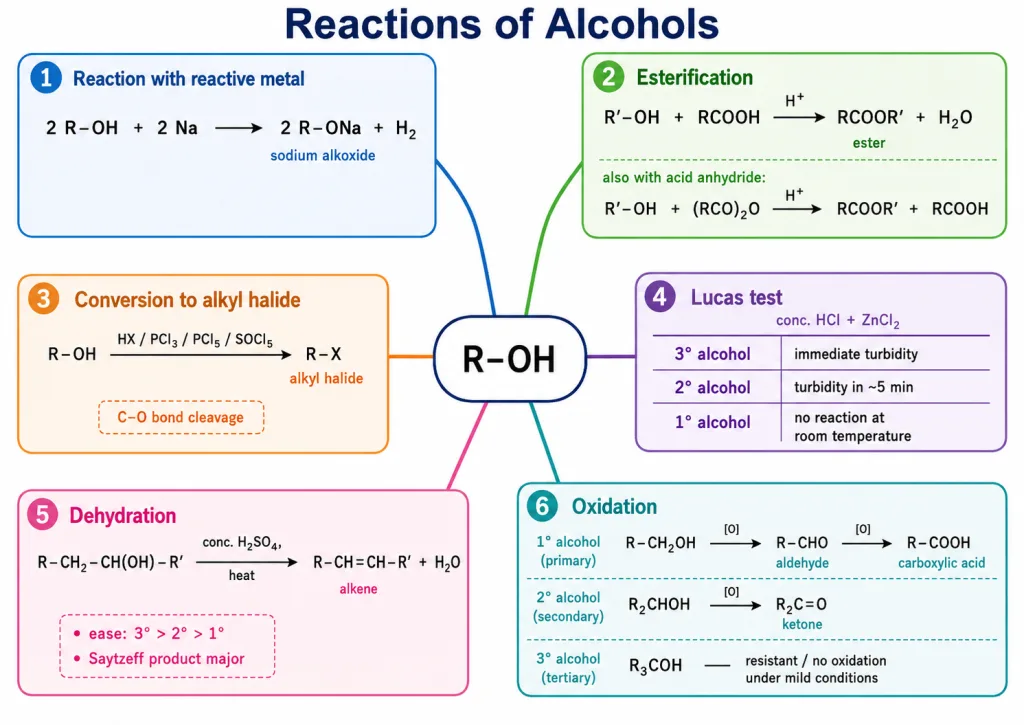
- Dehydration of alcohols: ethanol with conc. HSO at 413 K gives ethoxyethane; at 443 K it gives ethene.
The Three Acid-Catalysed Mechanisms
1. Dehydration of ethanol to ethene (conc. HSO, 443 K), asked four times:
- Step 1, protonation: (fast)
- Step 2, carbocation forms: (slow)
- Step 3, H is lost:
2. Hydration of ethene to ethanol (dilute acid):
- Step 1, the alkene is protonated by an electrophilic attack of HO, forming a carbocation:
- Step 2, water attacks the carbocation:
- Step 3, H is lost:
3. Ethanol to ethoxyethane (conc. HSO, 413 K):
- Step 1:
- Step 2, a second ethanol attacks (SN2):
- Step 3:
Tertiary alcohols dehydrate easily: 2-methylpropan-2-ol gives 2-methylpropene with 20% HPO at 358 K, and also when passed over heated copper at 573 K. Primary and secondary alcohols are oxidised by hot copper to aldehydes and ketones instead.
Reactions of Phenol and Ethers
| Reaction | Reagents | Product |
|---|---|---|
| Bromine water | 3Br (aq) | 2,4,6-tribromophenol (white precipitate) + 3HBr |
| Bromine in CS, low temperature | Br | o- and p-bromophenol. The –OH activates the ring so much that Br is polarised even without a Lewis acid |
| Dilute HNO, 298 K | o- and p-nitrophenol (separated by steam distillation) | |
| Conc. HNO | 2,4,6-trinitrophenol (picric acid) | |
| Kolbe reaction | Sodium phenoxide + CO (400 K, 4–7 atm), then H | Salicylic acid (2-hydroxybenzoic acid) |
| Reimer–Tiemann reaction | CHCl + aq. NaOH (340 K), then H | Salicylaldehyde |
| Oxidation | NaCrO + HSO | Benzoquinone |
| Zinc dust, heat | Benzene | |
| Aspirin | Salicylic acid + acetic anhydride | Acetylsalicylic acid (anti-inflammatory, antipyretic) |
Lucas test (conc. HCl + anhydrous ZnCl): tertiary alcohols give turbidity immediately, secondary within about five minutes, and primary not at room temperature. The cloudiness is the insoluble alkyl chloride.
Ether cleavage with HI:
- Two primary groups: the smaller one becomes the iodide (SN2).
- A tertiary group: it becomes the iodide (SN1).
- Anisole: the O–phenyl bond doesn't break.
Anisole in Friedel–Crafts reactions (anhydrous AlCl): the –OCH group directs to ortho and para, with para as the main product.
- With CHCOCl: 4-methoxyacetophenone (major) and 2-methoxyacetophenone.
- With CHCl: 1-methoxy-4-methylbenzene (major) and 1-methoxy-2-methylbenzene.
Solved Examples: Mechanisms
Question 1 (3 marks): Write the steps in the mechanism of acid-catalysed dehydration of ethanol to ethene.
Answer. The acid-catalysed dehydration of ethanol to ethene (at 443 K) takes place in three steps.
Step 1: Formation of protonated alcohol.
Step 2: Formation of carbocation by loss of a water molecule. This is the slow step.
Step 3: Formation of ethene by elimination of a proton.
Question 2 (2 marks): Complete the reactions: (i) phenol + NaCrO/HSO → ? (ii) phenol + 3Br → ? + 3HBr
Answer.
(i) Phenol is oxidised by chromic acid (NaCrO/HSO) to benzoquinone.
(ii) Phenol reacts with bromine water to give a white precipitate of 2,4,6-tribromophenol.
Question 3 (3 marks): Write the steps in the mechanism of acid-catalysed hydration of ethene to ethanol.
Answer. The acid-catalysed hydration of ethene to ethanol takes place in three steps.
Step 1: Protonation of ethene by electrophilic attack of HO to form a carbocation.
Step 2: Nucleophilic attack of water on the carbocation.
Step 3: Deprotonation to form ethanol.
Question 4 (3 marks): Write the three steps in the acid-catalysed dehydration of ethanol to ethoxyethane at 413 K.
Answer. At 413 K, ethanol forms ethoxyethane in three steps.
Step 1: Formation of protonated alcohol.
Step 2: Nucleophilic attack of a second ethanol molecule on the protonated alcohol, with loss of water (SN2).
Step 3: Loss of a proton to form ethoxyethane.
Solved Examples: Named Reactions and Preparations
Question 5 (2 marks): Explain the Kolbe reaction with an equation.
Answer. When sodium phenoxide is heated with carbon dioxide at 400 K and 4–7 atm pressure and the product is acidified, salicylic acid (2-hydroxybenzoic acid) is formed. This is called Kolbe's reaction.
Question 6 (2 marks): How is salicylaldehyde made from phenol?
Answer. Salicylaldehyde is made from phenol by the Reimer–Tiemann reaction. Phenol is heated with chloroform and aqueous sodium hydroxide at 340 K, and the product is acidified. A –CHO group is introduced at the ortho position of the ring, and salicylaldehyde (2-hydroxybenzaldehyde) is formed.
Question 7 (2 marks): How is isopropylbenzene converted into phenol? Write the equations.
Answer. Isopropylbenzene (cumene) is oxidised by air to cumene hydroperoxide.
Cumene hydroperoxide is then treated with dilute acid to give phenol and acetone.
Question 8 (2 marks): How do you prepare aspirin from salicylic acid?
Answer. Aspirin (acetylsalicylic acid) is prepared by the acetylation of salicylic acid with acetic anhydride in the presence of a little acid.
Question 9 (3 marks): Write the composition of Lucas reagent and explain how it distinguishes a primary alcohol from a tertiary alcohol.
Answer. Lucas reagent is a mixture of concentrated HCl and anhydrous ZnCl.
Alcohols react with Lucas reagent to form alkyl chlorides. The alkyl chlorides are insoluble, so the solution becomes turbid (cloudy).
- A tertiary alcohol gives turbidity immediately, because it forms a stable tertiary carbocation quickly.
- A primary alcohol gives no turbidity at room temperature. It reacts only on heating.
Question 10 (2 marks): Explain Williamson ether synthesis with the general equation.
Answer. When an alkyl halide is treated with a sodium alkoxide, an ether is formed. The alkoxide ion attacks the alkyl halide by the SN2 mechanism. This is called Williamson synthesis.
Example:
A primary alkyl halide should be used, because a tertiary alkyl halide gives an alkene by elimination.
Solved Examples: Ethers, Acidity and Properties
Question 11 (2 marks): Write the products formed when anisole reacts with ethanoyl chloride in the presence of anhydrous AlCl.
Answer. Anisole undergoes Friedel–Crafts acylation with ethanoyl chloride in the presence of anhydrous AlCl. Since the –OCH group is ortho and para directing, the products are 4-methoxyacetophenone (major) and 2-methoxyacetophenone (minor).
Question 12 (2 marks): Write the products when 2-methoxy-2-methylpropane reacts with HI.
Answer. The products are tert-butyl iodide (2-iodo-2-methylpropane) and methanol.
Here the reaction follows the SN1 mechanism, because the tertiary carbon forms a stable carbocation. So the iodide ion attaches to the tertiary carbon.
Question 13 (2 marks): Compound A (CHO) gives C and D with hot HI. D with conc. HSO at 413 K gives back A. Identify A and give its IUPAC name.
Answer. Heating an alcohol with conc. HSO at 413 K gives an ether, so D is an alcohol and A is the ether made from it. The ether CHO made from one alcohol is CHOCH.
A is diethyl ether, IUPAC name ethoxyethane. D is ethanol and C is iodoethane.
Question 14 (2 marks): A mixture of o- and p-nitrophenol is steam distilled. Which isomer is steam volatile? Why?
Answer. o-Nitrophenol is steam volatile.
In o-nitrophenol, the –OH and –NO groups are close together and form an intramolecular hydrogen bond, so its molecules are not held to each other. In p-nitrophenol, the molecules are held together by intermolecular hydrogen bonds, so it is much less volatile.
Question 15 (2 marks): Between p-nitrophenol and p-cresol, which has the higher pK and which the lower? Why?
Answer. p-Cresol has the higher pK (it is the weaker acid). The –CH group is electron releasing, so it destabilises the phenoxide ion.
p-Nitrophenol has the lower pK (it is the stronger acid). The –NO group is electron withdrawing, so it stabilises the phenoxide ion.
Question 16 (3 marks): Mention the hybridisation of the carbon to which –OH is attached in allylic alcohols, phenol and vinylic alcohols. Why are alcohols more soluble in water than hydrocarbons of similar mass?
Answer. Hybridisation of the carbon carrying –OH:
- Allylic alcohol: sp
- Phenol: sp
- Vinylic alcohol: sp
Alcohols are soluble in water because their –OH group forms hydrogen bonds with water molecules. Hydrocarbons cannot form hydrogen bonds with water, so they are insoluble.