
How Haloalkanes and Haloarenes Is Asked
This chapter carries 9 printed marks: usually two 1-mark questions, one 2-mark question in Part B and one Part D question.
What to prepare, based on the last ten papers:
| Where | Asked more than once | Also asked |
|---|---|---|
| Part A (1 mark) | Sandmeyer reagent; 2-bromobutane with alcoholic KOH; the anaesthetic, as a blank (twice each) | Product with AgCN, racemic mixture by SN1, melting points of dichlorobenzenes, Grignard reagent with water, Finkelstein reaction, freons, iodoform as an antiseptic |
| Part B (2 marks) | Fittig reaction; SN2 mechanism for chloromethane (twice each) | Wurtz, Swarts, Finkelstein, dehydrohalogenation, optical activity, freons |
| Part D (5 marks) | The same Finkelstein question, with dry acetone and racemic modification (twice); SN1 mechanism, SN2 mechanism, Fittig (twice each) | SN1 versus SN2, Wurtz, Wurtz–Fittig, Saytzeff's rule, reactivity of aryl halides, chirality, Grignard reagents, DDT |
Classification and Preparation
Types: in a geminal dihalide both halogens are on the same carbon (ethylidene chloride, CHCHCl); in a vicinal dihalide they are on neighbouring carbons (ethylene dichloride, ClCHCHCl). Allylic and benzylic halides have X on the carbon next to a C=C or a benzene ring.
From alcohols: R–OH with HCl + ZnCl, PCl, PCl or SOCl. Thionyl chloride is the best, because the other products (SO and HCl) are gases.
From alkenes: with HX (Markovnikov's rule), or with Br in CCl to give a vicinal dibromide. The reddish-brown colour of bromine disappears, which is the test for unsaturation.
Halogen exchange:
- Finkelstein: (X = Cl, Br). NaCl and NaBr don't dissolve in dry acetone, so they precipitate and push the reaction forward.
- Swarts: . AgF, HgF, CoF or SbF can be used to make alkyl fluorides.
Haloarenes:
- Electrophilic substitution: benzene with Cl and FeCl gives chlorobenzene.
- Sandmeyer reaction: benzene diazonium chloride with CuCl/HCl gives chlorobenzene, and with CuBr/HBr gives bromobenzene. Fluorobenzene can't be made this way; it needs HBF.
Physical properties: boiling point rises RF < RCl < RBr < RI and falls with branching. Among dichlorobenzenes, the para isomer melts highest because its symmetry lets it pack best in the crystal: p > o > m.
Nucleophilic Substitution: SN1 and SN2
Which product? KCN is ionic, so the carbon end attacks and you get an alkyl cyanide (nitrile). AgCN is covalent, so the nitrogen end attacks and you get an isocyanide. Similarly KNO gives an alkyl nitrite and AgNO a nitroalkane.
| SN2 | SN1 | |
|---|---|---|
| Steps | One, with a transition state | Two, through a carbocation |
| Order (kinetics) | Second: rate = k[RX][Nu] | First: rate = k[RX] |
| Configuration | Inversion | Racemisation (if the carbon is chiral) |
| Reactivity | CHX > 1° > 2° > 3° | 3° > 2° > 1° > CHX |
| Example | CHCl + OH → CHOH | (CH)CBr + OH → (CH)COH |
SN2 mechanism (chloromethane to methanol): OH attacks the carbon from the side opposite to Cl. In the transition state, the C–OH bond is half formed and the C–Cl bond half broken, with the three H atoms flat around the carbon. Cl leaves, and the configuration turns inside out.
SN1 mechanism (2-bromo-2-methylpropane to 2-methylpropan-2-ol):
- Slow step:
- Fast step:
The rate depends only on the alkyl halide, because only it takes part in the slow step.
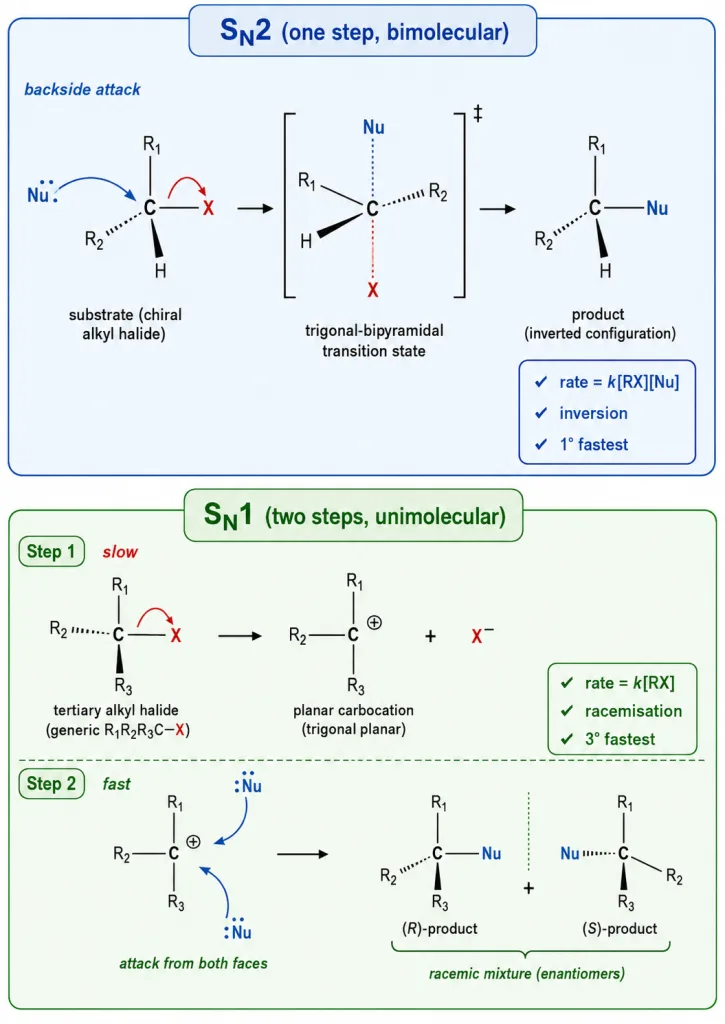
Optical activity: a molecule is optically active if it is chiral, meaning it can't be superimposed on its mirror image. The usual cause is a carbon bonded to four different groups (a stereocentre). Butan-2-ol has one stereocentre. Two such mirror images are enantiomers. A racemic mixture has equal amounts of both, so their rotations cancel and it is optically inactive. SN1 on a chiral halide such as 2-chlorobutane gives a racemic mixture, because the flat carbocation can be attacked from either side.
Elimination, Metals and Haloarene Reactions
Dehydrohalogenation: heating a haloalkane with alcoholic KOH removes HX and gives an alkene. Saytzeff's rule: the more substituted alkene (more alkyl groups on the double bond carbons) is the main product. 2-Bromobutane gives mainly but-2-ene (about 80%) and some but-1-ene. With a tertiary halide and a strong base, elimination wins: (CH)CBr with CHONa gives 2-methylpropene, not an ether.
Grignard reagent: . It is an organometallic compound (a carbon–metal bond). It reacts with anything that has an acidic hydrogen, even water, to give the hydrocarbon: . So both isopropyl and n-propyl magnesium bromide give propane with water.
Reactions with sodium:
- Wurtz:
- Fittig: (biphenyl)
- Wurtz–Fittig: (toluene)
Why aryl halides are less reactive towards nucleophilic substitution:
- Resonance gives the C–X bond partial double bond character, so it is harder to break.
- The carbon is sp hybridised, so the C–X bond is shorter and stronger than in haloalkanes.
- The phenyl cation that SN1 would need is very unstable.
- The electron-rich ring repels the incoming nucleophile.
They do react under harsh conditions: chlorobenzene with NaOH at 623 K and 300 atm, then acid, gives phenol. Nitro groups at ortho or para positions make this much easier. In electrophilic substitution, the halogen directs to the ortho and para positions.
Polyhalogen Compounds
| Compound | Use or fact |
|---|---|
| Dichloromethane, CHCl | Paint remover and solvent |
| Chloroform, CHCl | Once used as an anaesthetic in surgery; in air and light it forms poisonous phosgene, COCl, so it is kept in dark, full bottles |
| Iodoform, CHI | Used as an antiseptic; its action is due to the iodine it releases, not to iodoform itself |
| Carbon tetrachloride, CCl | Solvent; damages the ozone layer |
| Freons (CFCs) | Chlorofluorocarbons of methane and ethane, used in refrigerators and aerosols. Freon-12, CClF, is the most common in industry. They break down the ozone layer |
| DDT | p,p'-dichlorodiphenyltrichloroethane, an insecticide |
DDT: IUPAC name 1,1,1-trichloro-2,2-bis(4-chlorophenyl)ethane. Its use grew enormously after World War II because it was very effective against the mosquitoes that spread malaria and the lice that carry typhus. It is not easily broken down, so it builds up in animal fat and food chains.
Halogen compounds as medicines: chloroquine (malaria), chloramphenicol (antibiotic), halothane (anaesthetic).
Solved Examples: Named Reactions
Question 1 (2 marks): Explain the Wurtz reaction with an equation.
Answer. When an alkyl halide is treated with sodium in dry ether, two alkyl groups join to give an alkane with double the number of carbon atoms. This is called the Wurtz reaction.
Question 2 (2 marks): Explain the Fittig reaction with an example.
Answer. When an aryl halide is treated with sodium in dry ether, two aryl groups join together to give a diaryl compound. This is called the Fittig reaction.
The product is biphenyl.
Question 3 (2 marks): Explain the Wurtz–Fittig reaction for making toluene.
Answer. When a mixture of an alkyl halide and an aryl halide is treated with sodium in dry ether, an alkylarene is formed. This is called the Wurtz–Fittig reaction. Bromobenzene and bromomethane give toluene:
Question 4 (2 marks): Explain the Swarts reaction with an example.
Answer. When an alkyl chloride or alkyl bromide is heated with a metal fluoride such as AgF, HgF, CoF or SbF, an alkyl fluoride is formed. This is called the Swarts reaction.
Question 5 (2 marks): Explain dehydrohalogenation with an example, and state Saytzeff's rule.
Answer. When a haloalkane is heated with alcoholic KOH, a hydrogen atom from the β-carbon and the halogen atom from the α-carbon are removed, and an alkene is formed. This is called dehydrohalogenation.
Saytzeff's rule: in dehydrohalogenation, the preferred product is the alkene which has the greater number of alkyl groups attached to the doubly bonded carbon atoms.
(but-2-ene, about 80%) + (but-1-ene, about 20%)
Question 6 (1 mark): Why does KCN give an alkyl cyanide, while AgCN gives an isocyanide?
Answer. KCN is ionic, so the cyanide ion attacks through carbon and forms a C–C bond, giving an alkyl cyanide (R–CN). AgCN is mainly covalent, so only the lone pair on nitrogen is free to attack, and an isocyanide (R–NC) is formed.
Solved Examples: Mechanisms and Stereochemistry
Question 7 (3 marks): Write the SN2 mechanism for the conversion of chloromethane to methanol. Mention its order.
Answer. The conversion of chloromethane to methanol by OH takes place by the SN2 mechanism in one step.
The OH ion attacks the carbon atom from the side opposite to the chlorine atom. A transition state is formed in which the C–OH bond is partly formed and the C–Cl bond is partly broken. Then Cl leaves and methanol is formed with inversion of configuration.
Rate = k[CHCl][OH], so the reaction is second order.
Question 8 (3 marks): Write the SN1 mechanism for the hydrolysis of tertiary butyl bromide. On which reactant does the rate depend?
Answer. The hydrolysis of tertiary butyl bromide takes place by the SN1 mechanism in two steps.
Step 1 (slow): The C–Br bond breaks to form a carbocation.
Step 2 (fast): The hydroxide ion attacks the carbocation.
The rate depends only on the concentration of tertiary butyl bromide, because only it takes part in the slow step. Rate = k[(CH)CBr].
Question 9 (3 marks): Give the differences between SN1 and SN2 with respect to (i) order, (ii) configuration of the product and (iii) reactivity order of alkyl halides.
Answer.
| SN1 | SN2 | |
|---|---|---|
| (i) Order | First order reaction | Second order reaction |
| (ii) Configuration of product | Racemisation (a racemic mixture forms) | Inversion of configuration |
| (iii) Reactivity of alkyl halides | 3° > 2° > 1° | 1° > 2° > 3° |
Question 10 (2 marks): What are optically active compounds? Give the condition for a molecule to be optically active.
Answer. Compounds which rotate the plane of plane-polarised light are called optically active compounds.
Condition: the molecule must be chiral, that is, it must not be superimposable on its mirror image. Usually this means the molecule has a carbon atom attached to four different groups.
Question 11 (2 marks): What is a racemic mixture? How many stereocentres does butan-2-ol have?
Answer. A mixture containing equal amounts of the two enantiomers (d and l forms) of a compound is called a racemic mixture. It is optically inactive, because the rotation of one enantiomer cancels the rotation of the other.
Butan-2-ol has one stereocentre. It is C-2, which is attached to four different groups: H, OH, CH and CH.
Solved Examples: Haloarenes, Grignard and Polyhalogen Compounds
Question 12 (3 marks): Aryl halides are less reactive than alkyl halides towards nucleophilic substitution. Give three reasons.
Answer. Aryl halides are less reactive towards nucleophilic substitution because:
- Resonance effect: the lone pair of electrons on the halogen is in resonance with the benzene ring. So the C–X bond gets a partial double bond character and becomes difficult to break.
- sp hybridised carbon: in aryl halides, the carbon attached to the halogen is sp hybridised. So the C–X bond is shorter and stronger than in haloalkanes, where the carbon is sp hybridised.
- Instability of phenyl cation: the phenyl cation formed by the loss of the halide ion is not stabilised by resonance. So the SN1 mechanism is ruled out.
Question 13 (3 marks): What are organometallic compounds? Explain how a Grignard reagent reacts with water.
Answer. Compounds in which a carbon atom is directly bonded to a metal atom are called organometallic compounds. Example: Grignard reagent, R–Mg–X.
A Grignard reagent is prepared by reacting an alkyl halide with magnesium in dry ether:
Grignard reagents react with water to give hydrocarbons:
Example:
So Grignard reagents must be prepared and kept away from moisture.
Question 14 (3 marks): Write the IUPAC name of DDT. Why did its use increase so much after World War II?
Answer. The IUPAC name of DDT is 1,1,1-trichloro-2,2-bis(4-chlorophenyl)ethane.
Structure: one carbon carries a CCl group and a hydrogen atom, and is joined to two p-chlorophenyl (4-chlorophenyl) rings.
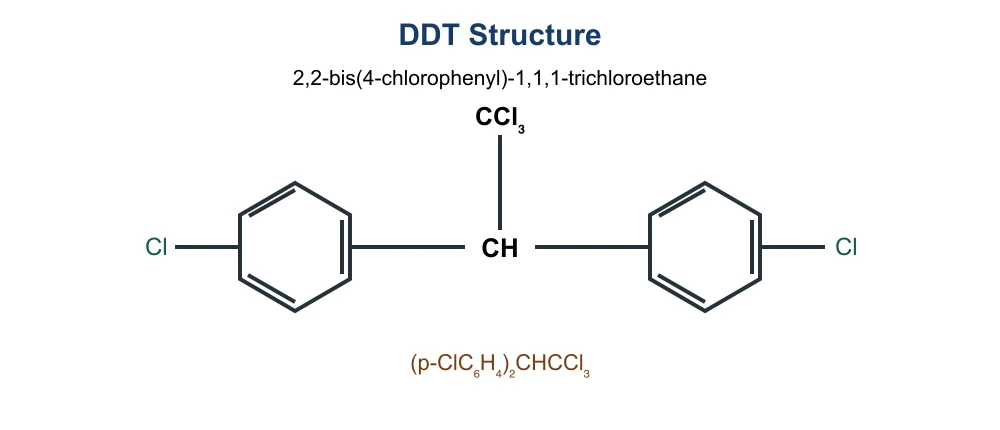
Its use increased greatly after World War II because it was very effective against the mosquitoes that spread malaria and the lice that carry typhus. Later it was found that DDT is not easily broken down, so it stays in the environment and builds up in food chains.
Question 15 (2 marks): What are freons? Give an example.
Answer. Freons are the chlorofluorocarbon compounds of methane and ethane. They are non-toxic, non-flammable and easily liquefiable gases, so they are used in refrigerators, air conditioners and aerosol sprays.
Example: freon-12, CClF.