
How Electrochemistry Is Asked
Electrochemistry carries 13 printed marks in every paper: one 1-mark question in Part A, two of the four group V questions in Part C and two of the six numericals in Part E.
What to prepare, based on the last ten papers:
| Where | Asked more than once | Also asked |
|---|---|---|
| Part A (1 mark) | The fuel cell used in the Apollo programme; electrolytes with the same A in | Products of electrolysis of aqueous NaCl, definition of emf, units, cell potential when a reaction is halved |
| Part C (3 marks) | H–O fuel cell and factors deciding the products of electrolysis (3 times each); standard hydrogen electrode with diagram, against graph (twice each) | Lead storage, mercury and Ni–Cd cells, corrosion, Daniell and galvanic cells, molar conductivity |
| Part E (numericals) | Nernst equation (4 times); log K from (3 times); from , mass deposited by electrolysis, Kohlrausch's law (twice each) | or of a weak acid, from resistance, hydrogen electrode at a given pH, volume of Cl, number of electrons |
Cells and Electrode Potentials
| Galvanic (voltaic) cell | Electrolytic cell |
|---|---|
| Chemical energy → electrical energy | Electrical energy → chemical change |
| Reaction is spontaneous | Reaction is driven by an outside source |
| Anode is negative, cathode positive | Anode is positive, cathode negative |
| Example: Daniell cell | Example: electrolysis of molten NaCl |
In both, oxidation happens at the anode and reduction at the cathode.
Daniell cell: , with = 1.10 V. Written as Zn(s) | Zn(aq) || Cu(aq) | Cu(s), with the anode on the left.
- Oxidation (anode):
- Reduction (cathode):
Cell emf is the difference between the electrode potentials of the two electrodes when no current is drawn through the cell.
Cell potential is an intensive property. Multiplying or dividing the cell reaction by a number does not change .
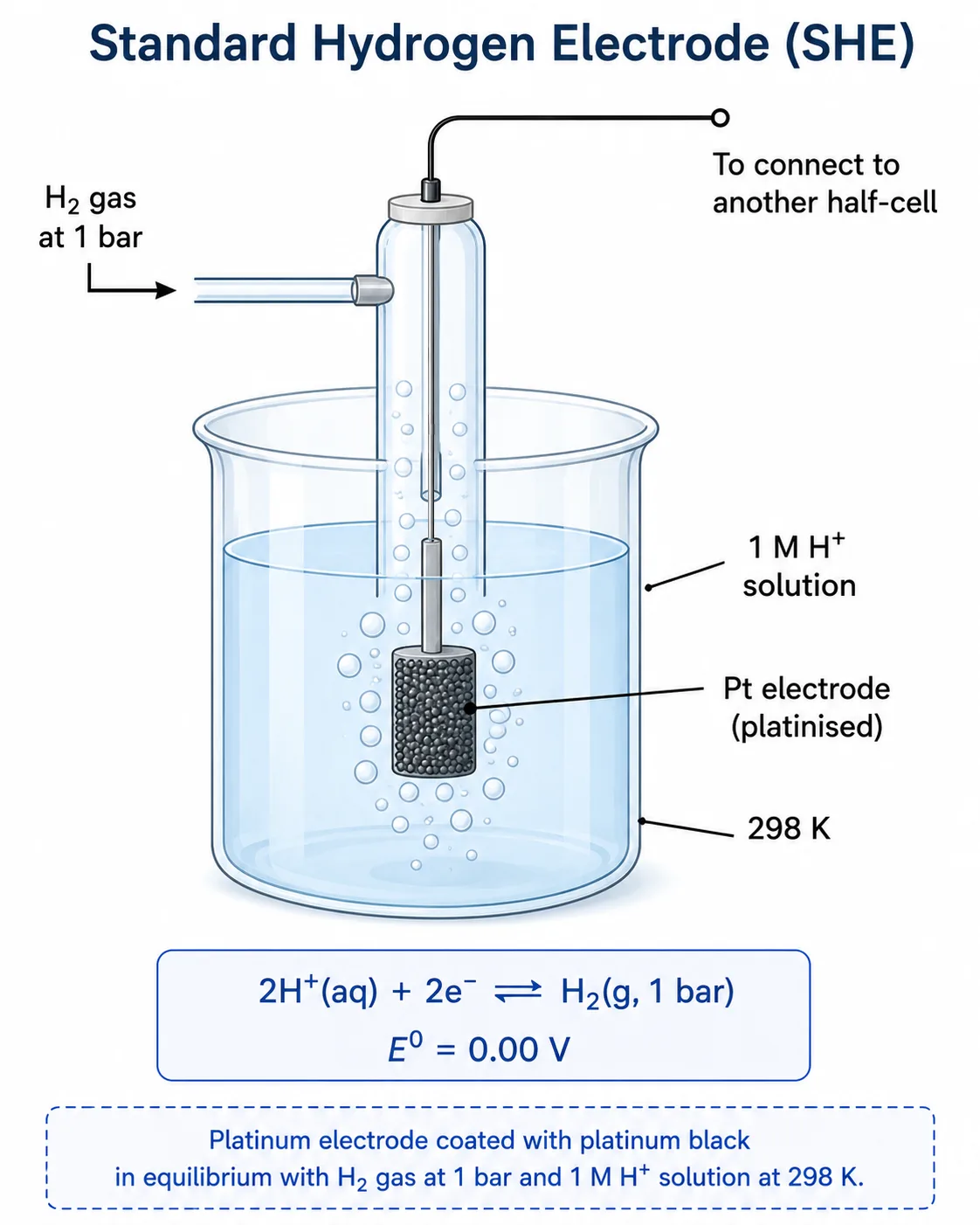
Standard hydrogen electrode (SHE): a platinum foil coated with platinum black, dipped in 1 M H solution, with pure H gas bubbled at 1 bar. Its potential is taken as 0.00 V at all temperatures.
- Representation: Pt(s) | H(g, 1 bar) | H(aq, 1 M)
- Half-cell reaction:
Inert electrodes such as platinum or gold take no part in the reaction; they only carry electrons. Example: the bromine electrode, Pt(s) | Br(aq) | Br(aq), with .
Nernst Equation, Gibbs Energy and K
For a cell reaction at 298 K:
Pure solids and liquids are left out of the log term. is the number of electrons transferred in the balanced equation.
Hydrogen electrode at any pH: for at 1 bar, . At pH 10 this gives −0.591 V.
Gibbs energy and the equilibrium constant:
A positive gives a negative and , so the reaction is spontaneous.
Keep the units straight: F = 96500 C mol, so comes out in J mol. Divide by 1000 for kJ mol.
Conductivity and Molar Conductivity
| Quantity | Formula | Unit |
|---|---|---|
| Resistance | ohm (Ω) | |
| Conductivity | S cm (SI: S m) | |
| Cell constant | cm | |
| Molar conductivity | S cm mol (SI: S m mol) | |
| Cell potential | – | V |
In , use in S cm and in mol L.
Molar conductivity is the conductivity of a solution that contains 1 mole of electrolyte, kept between two electrodes 1 cm apart with enough area to hold the whole solution.
Materials by conductivity: conductors (metals; also carbon black and graphite), semiconductors (silicon, doped silicon, gallium arsenide) and insulators (glass, ceramics).
Effect of dilution: conductivity decreases (fewer ions per cm), but molar conductivity increases.
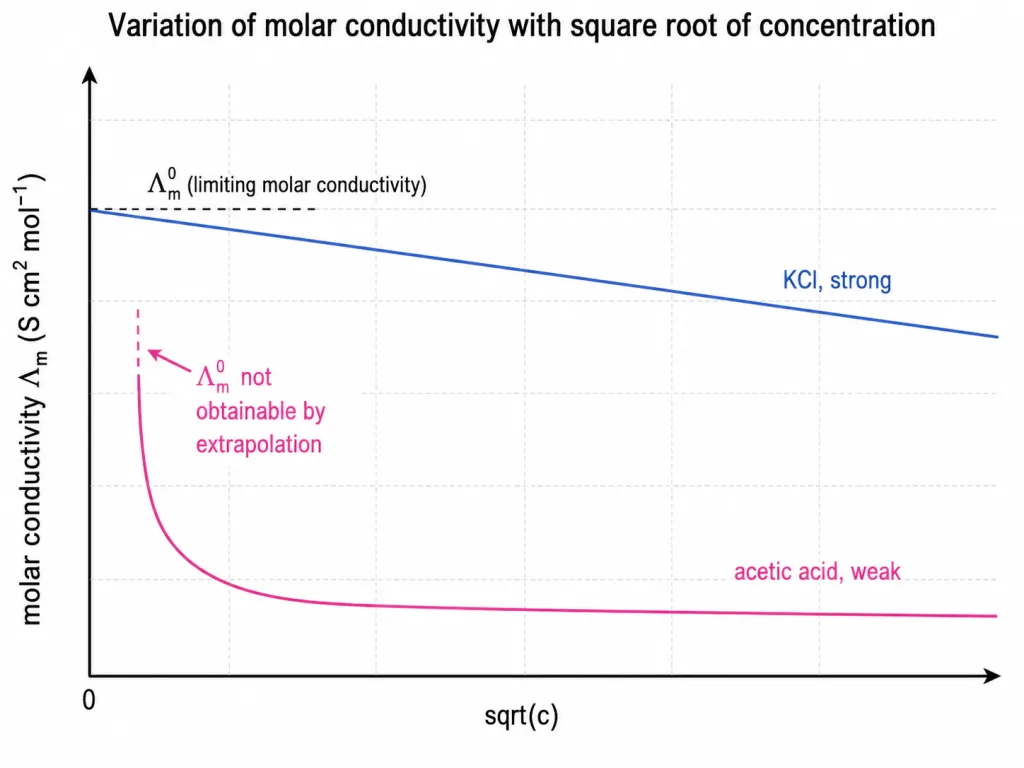
- Strong electrolytes (KCl, NaCl): rises slowly and in a straight line against : . Extending the line to gives .
- Weak electrolytes (acetic acid): rises steeply at low concentration because more molecules ionise. The curve can't be extended to zero, so is found by Kohlrausch's law.
- The constant A depends on the type of electrolyte: all 1-1 electrolytes (NaCl, KBr, NHCl) share one value, 2-2 electrolytes (MgSO) another.
Kohlrausch's law: the limiting molar conductivity of an electrolyte is the sum of the limiting molar conductivities of its cation and anion. For an electrolyte giving cations and anions:
Uses: of weak electrolytes, for example , and the degree of dissociation and dissociation constant of a weak acid:
Electrolysis and Faraday's Laws
Faraday's first law: the mass of a substance deposited or set free at an electrode is directly proportional to the quantity of electricity passed: , where .
Faraday's second law: when the same quantity of electricity passes through different electrolytes, the masses deposited are proportional to their equivalent masses.
1 F = 96500 C mol, the charge on 1 mole of electrons. Reducing 1 mol of M to M needs F. Oxidising 1 mol of FeO to FeO changes Fe to Fe, so it needs 1 F.
Factors that decide the products of electrolysis:
- The nature of the substance electrolysed (molten or aqueous).
- The type of electrodes (inert like Pt, or reactive like Cu).
- The standard electrode potentials of the competing oxidation and reduction reactions (and overpotential).
| Electrolysis of | Cathode | Anode |
|---|---|---|
| Molten NaCl | Na | Cl |
| Aqueous NaCl | H | Cl (NaOH stays in solution) |
| Aqueous CuSO with Cu electrodes | Cu deposits | Cu dissolves |
Batteries, Fuel Cells and Corrosion
Mercury cell (primary): anode is zinc–mercury amalgam, cathode is a paste of HgO and carbon, and the electrolyte is a paste of KOH and ZnO. It gives a steady 1.35 V.
- Anode:
- Cathode:
- Overall:
Lead storage battery (secondary, can be recharged): anode is lead, cathode is a lead grid packed with PbO, and the electrolyte is about 38% HSO. During discharge:
- Anode:
- Cathode:
- Overall:
Ni–Cd battery (secondary): anode is cadmium, cathode is Ni(OH). Overall:
H–O fuel cell (used in the Apollo programme): a fuel cell turns the energy of combustion of fuels like hydrogen and methane directly into electricity. H and O are bubbled through porous carbon electrodes into concentrated aqueous NaOH.
- Cathode:
- Anode:
- Overall:
Corrosion (rusting of iron): an electrochemical process. At an anodic spot, . At a cathodic spot, . Fe is then oxidised by air: , giving rust, FeO·xHO. It can be prevented by painting, by covering with a more active metal like zinc (galvanising), or by connecting a sacrificial metal such as Mg or Zn.
Solved Examples: Theory Answers
Question 1 (3 marks): Draw a labelled diagram of the standard hydrogen electrode, and write its representation and half-cell reaction.
Answer. The standard hydrogen electrode (SHE) consists of a platinum foil coated with platinum black, dipped in an acidic solution in which the concentration of H ions is 1 M. Pure hydrogen gas at 1 bar pressure is bubbled through the solution.
Diagram: draw a glass tube with H gas (1 bar) going in at the top, the platinum foil coated with platinum black at the bottom, dipped in 1 M H solution. Label all four parts.
Representation: Pt(s) | H(g, 1 bar) | H(aq, 1 M)
Half-cell reaction:
The standard electrode potential of the SHE is taken as zero, = 0.00 V, at all temperatures.
Question 2 (3 marks): Name the fuel cell used in the Apollo space programme. Write its anode and cathode reactions.
Answer. The fuel cell used in the Apollo space programme is the hydrogen–oxygen fuel cell.
Reaction at the anode:
Reaction at the cathode:
Question 3 (3 marks): What is a secondary cell? Write the reactions at the anode and cathode of a lead storage battery during discharge.
Answer. A secondary cell is a cell which can be recharged after use by passing current through it in the opposite direction, so that it can be used again and again. Example: lead storage battery.
Reactions during discharge:
At the anode:
At the cathode:
Question 4 (3 marks): Mention three factors that decide the products of electrolysis.
Answer. The products of electrolysis depend on:
- The physical state of the substance being electrolysed, that is, whether it is molten or in aqueous solution.
- The type of electrodes used, that is, whether they are inert (like platinum) or reactive (like copper).
- The standard electrode potentials of the different oxidising and reducing species present.
For example, electrolysis of molten NaCl gives sodium at the cathode, but electrolysis of aqueous NaCl gives H at the cathode, because water is reduced more easily than Na ions.
Question 5 (3 marks): Name the electrolyte used in the mercury cell. Write its anode and cathode reactions.
Answer. The electrolyte used in the mercury cell is a paste of KOH and ZnO.
Reaction at the anode:
Reaction at the cathode:
Question 6 (3 marks): Sketch against for KCl and acetic acid. For which electrolyte can be found from the graph?
Answer. Graph: plot on the y-axis and on the x-axis.
KCl is a strong electrolyte. Its decreases slowly and almost in a straight line as increases.
Acetic acid is a weak electrolyte. Its is low at higher concentrations but rises very steeply as the concentration approaches zero, giving a curve.
can be found from the graph only for KCl, by extending the straight line to zero concentration. For acetic acid the curve cannot be extended to , so its is found using Kohlrausch's law.
Question 7 (3 marks): When iron is left in moist air, it gets a reddish-brown coat. (a) Name the process. (b) Write the atmospheric oxidation reaction. (c) Give one method to prevent it.
Answer.
(a) The process is corrosion, that is, rusting of iron.
(b) Atmospheric oxidation:
(c) Rusting can be prevented by painting the surface of iron, or by coating it with zinc (galvanising).
Solved Examples: Numericals
Question 8 (3 marks): Calculate the emf of the cell at 298 K: , = 1.05 V.
Answer.
Given: = 1.05 V; [Ni] = 0.10 M; [Ag] = 0.001 M; n = 2
To find:
Formula:
Substitution:
Answer: emf of the cell = 0.902 V
Question 9 (3 marks): Calculate the potential of a hydrogen electrode in contact with a solution of pH 3.
Answer.
Given: pH = 3, so [H] = 10 M; pressure of H = 1 bar
To find: Electrode potential, E
Electrode reaction: , n = 1
Formula: (since = 0)
Substitution:
Answer: Potential of the hydrogen electrode = −0.177 V
Question 10 (3 marks): For , = 0.46 V. Calculate and log at 298 K.
Answer.
Given: = 0.46 V; n = 2; F = 96500 C mol
To find: and log
Formulae: and
Substitution:
J mol
Answer: = −88.78 kJ mol and log = 15.57 (so = 3.7 × 10)
Question 11 (3 marks): A column of 0.05 M NaOH has a cross-section area of 0.785 cm and a length of 50 cm. Its resistance is 5.55 × 10 Ω. Calculate its molar conductivity.
Answer.
Given: C = 0.05 mol L; A = 0.785 cm; l = 50 cm; R = 5.55 × 10 Ω
To find: Molar conductivity,
Formulae: Cell constant ; conductivity ;
Solution:
cm
S cm
Answer: Molar conductivity = 229.5 S cm mol
Question 12 (3 marks): Calculate of Cl from these values: = 106.0 S cm mol and = 258.6 S cm mol.
Answer.
Given: = 106.0 S cm mol; = 258.6 S cm mol
To find:
Formula (Kohlrausch's law):
Substitution: , so
Answer: = 76.3 S cm mol
Question 13 (3 marks): for CHCOONa, HCl and NaCl are 91.0, 425.9 and 126.4 S cm mol. Find for CHCOOH.
Answer.
Given: (CHCOONa) = 91.0, (HCl) = 425.9, (NaCl) = 126.4 S cm mol
To find: (CHCOOH)
Formula (Kohlrausch's law):
Substitution:
Answer: (CHCOOH) = 390.5 S cm mol
Question 14 (3 marks): The conductivity of 0.010 M acetic acid is 1.65 × 10 S cm. If is 390.5 S cm mol, calculate its degree of dissociation and dissociation constant.
Answer.
Given: C = 0.010 mol L; = 1.65 × 10 S cm; = 390.5 S cm mol
To find: Degree of dissociation, , and dissociation constant,
Formulae: ; ;
Solution:
S cm mol
Answer: = 0.0423 and = 1.86 × 10 mol L
Question 15 (3 marks): A current of 2.0 A is passed through CuSO solution for 30 minutes. What mass of copper is deposited? (Cu = 63.5 g mol, F = 96500 C mol)
Answer.
Given: I = 2.0 A; t = 30 min = 30 × 60 = 1800 s; molar mass of Cu = 63.5 g mol; F = 96500 C mol
To find: Mass of copper deposited, w
Reaction at the cathode: , so 2 × 96500 C deposit 63.5 g of copper.
Formula: Q = I × t and
Solution:
Q = 2.0 × 1800 = 3600 C
Answer: Mass of copper deposited = 1.18 g
Question 16 (3 marks): A current of 10 A is passed through molten NaCl for 1 hour. Calculate the volume of Cl set free at STP. (22.4 L mol at STP)
Answer.
Given: I = 10 A; t = 1 hour = 3600 s; F = 96500 C mol; molar volume at STP = 22.4 L mol
To find: Volume of Cl at STP
Reaction at the anode: , so 2 F (2 × 96500 C) give 1 mol of Cl.
Formula: Q = I × t
Solution:
Q = 10 × 3600 = 36000 C
Moles of Cl = = 0.1865 mol
Volume of Cl = 0.1865 × 22.4
Answer: Volume of Cl set free at STP = 4.18 L
Question 17 (3 marks): A current of 1.5 A flows through a wire for 10 minutes. How many electrons pass through it? (Charge on an electron = 1.602 × 10 C)
Answer.
Given: I = 1.5 A; t = 10 min = 600 s; charge on one electron = 1.602 × 10 C
To find: Number of electrons
Formula: Q = I × t, and number of electrons =
Solution:
Q = 1.5 × 600 = 900 C
Number of electrons =
Answer: Number of electrons = 5.62 × 10
Question 18 (1 mark): How much electricity, in faradays, is needed to oxidise 1 mol of FeO to FeO?
Answer. 1 F of electricity is needed. In FeO iron is +2 and in FeO it is +3, so each Fe loses one electron. 1 mol of FeO needs 1 mol of electrons, that is, 1 F.