
How Chemical Kinetics Is Asked
Chemical Kinetics carries 12 printed marks in every paper: usually one 1-mark question, one 2-mark question in Part B, one 3-mark theory question in group V and two of the six numericals in Part E.
What to prepare, based on the last ten papers:
| Where | Asked more than once | Also asked |
|---|---|---|
| Part A (1 mark) | None yet | Pseudo first order reactions, role of a catalyst, units of k and of rate, order and molecularity, rate law from data, the Arrhenius factor |
| Part B (2 marks) | Order versus molecularity; half-life | Effective collisions, drawbacks of collision theory, activated complex diagram |
| Part C (3 marks) | Integrated rate equation: zero order 4 times, first order 3 times | First order half-life, factors affecting rate |
| Part E (numericals) | from two temperatures (5 times); first order % completion and half-life (4 times); from a log k equation, k from NO data, average rate (twice each) | k at a new temperature, temperature for a given k, carbon-14 dating, fraction of molecules |
Rate, Rate Law, Order and Molecularity
For a reaction , divide each rate of change by its coefficient so they all give the same value:
Rate is measured in mol L s. For gas reactions, where concentration is shown as pressure, it is atm s.
Rate law: Rate = , found by experiment. The order is .
| Order | Unit of k |
|---|---|
| Zero | mol L s |
| First | s |
| Second | L mol s |
Order versus molecularity:
| Order | Molecularity |
|---|---|
| Found by experiment | A theoretical idea |
| Can be zero or a fraction | Always a whole number: 1, 2 or (rarely) 3 |
| Applies to the overall reaction | Applies only to an elementary step |
Molecularity above 3 is very unlikely, because more than three molecules rarely collide at the same moment.
Pseudo first order reactions look first order because one reactant is in large excess, so its concentration hardly changes. Examples: inversion of cane sugar and acid hydrolysis of ethyl acetate in water.
Finding the rate law from data: compare two experiments where only one concentration changes. If doubling [A] makes the rate four times, the order in A is 2. If making [B] four times makes the rate four times, the order in B is 1.
Factors that affect rate: concentration of reactants, temperature, presence of a catalyst, nature of the reactants and surface area.
Zero and First Order Reactions
| Zero order | First order | |
|---|---|---|
| Rate law | Rate = k | Rate = k[R] |
| Integrated form | ||
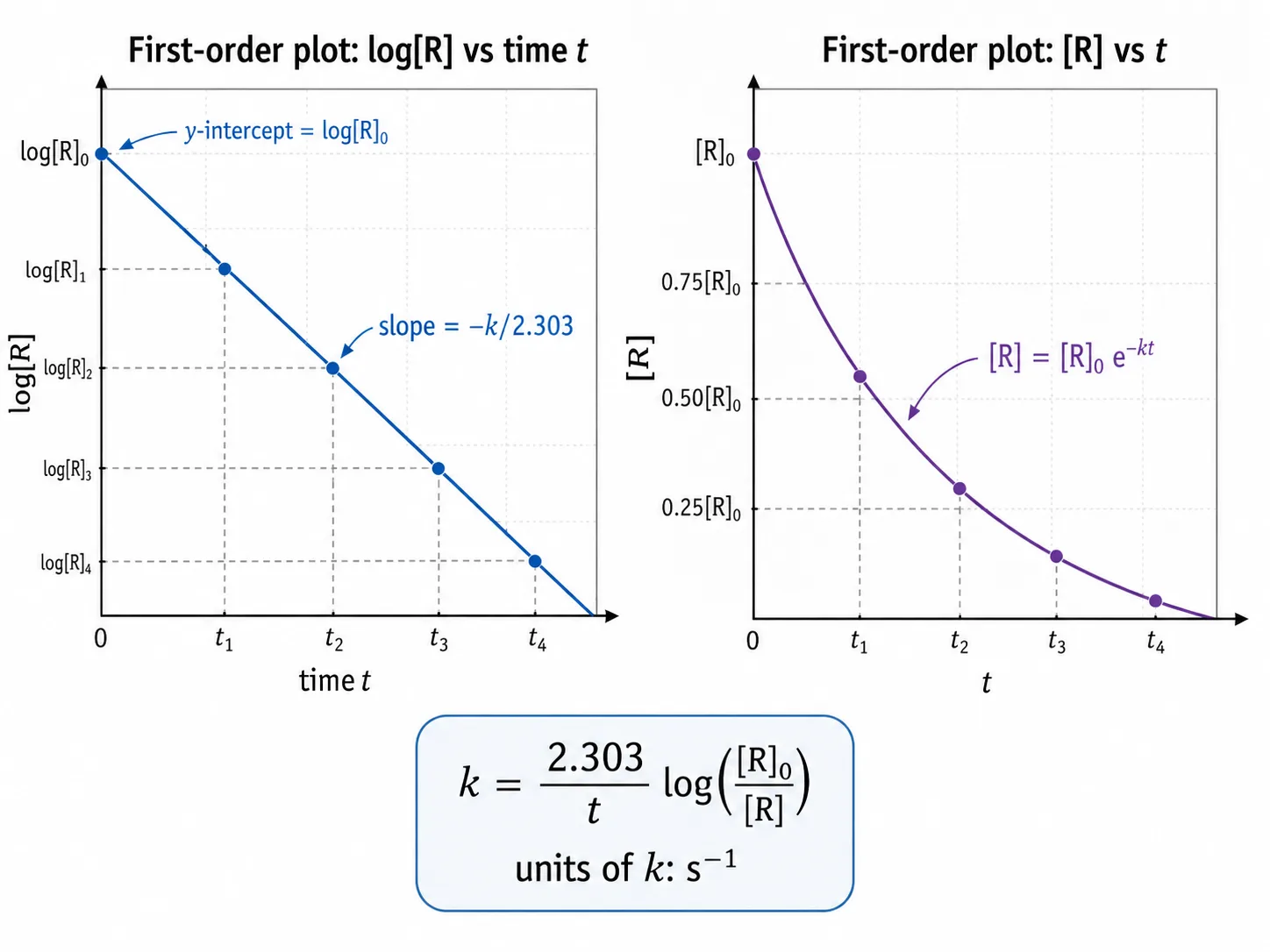
| Straight-line graph | [R] against t (slope = −k) | log [R] against t (slope = −k/2.303) |
| Half-life | ||
| Half-life depends on ? | Yes, directly | No |
| Examples | Decomposition of NH on hot platinum at high pressure; H + Cl in light | Radioactive decay; NO decomposition; hydrogenation of ethene |
Half-life () is the time in which the concentration of a reactant falls to half its starting value.
Shortcuts for first order reactions:
- 50% completion takes , 75% takes and 87.5% takes .
- For "x% completion", use and .
- Radioactive decay, including carbon-14 dating, is first order.
Temperature, Arrhenius Equation and Catalysts
For most reactions, a 10 K rise in temperature roughly doubles the rate.
Arrhenius equation:
- A is the Arrhenius factor, also called the frequency factor or pre-exponential factor.
- A plot of ln k against 1/T is a straight line with slope = −E/R. For log k against 1/T the slope is −E/2.303R.
- The fraction of molecules with energy equal to or more than E is .
Two temperatures:
Use R = 8.314 J K mol, so E comes out in J mol.
From a log k equation: if , compare with . Then K.
Activation energy is the extra energy reactant molecules must have, above their average energy, to form the activated complex, a short-lived arrangement at the top of the energy barrier.
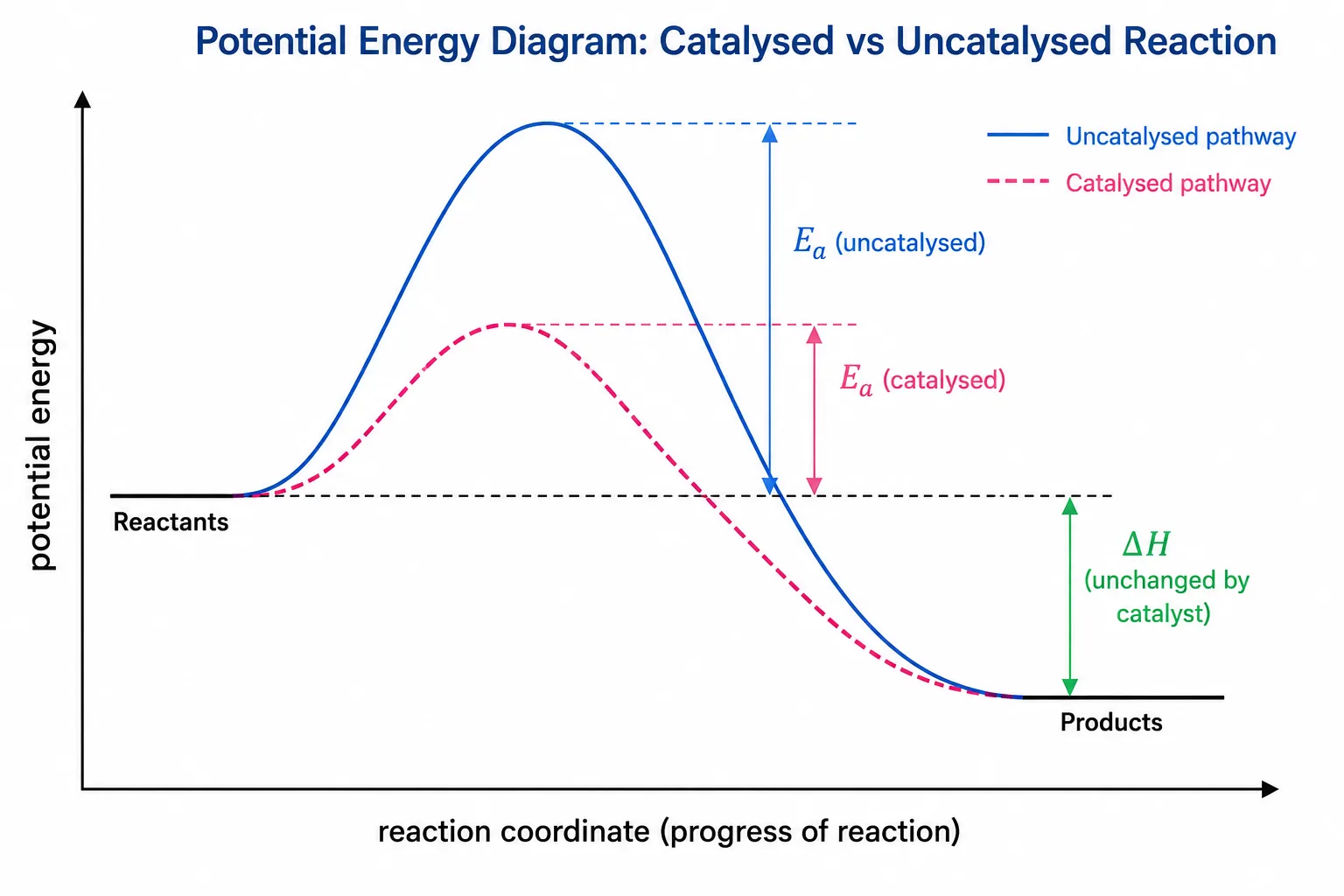
Catalysts provide another path with a lower activation energy, so more molecules can react. A catalyst speeds up the forward and backward reactions equally. It does not change , or the equilibrium constant.
Collision theory: molecules react only on collision. Collision frequency is the number of collisions per second per unit volume. A collision is effective only if the molecules have enough energy (at least the threshold energy) and the right orientation. Drawbacks: it treats atoms and molecules as hard spheres and ignores their structure.
Solved Examples: Theory Answers
Question 1 (2 marks): Write two differences between order and molecularity.
Answer.
| Order of reaction | Molecularity of reaction |
|---|---|
| It is the sum of the powers of the concentration terms in the rate law. It is found by experiment. | It is the number of reacting species taking part in an elementary step. It is a theoretical idea. |
| It can be zero or even a fraction. | It is always a whole number (1, 2 or 3); it can't be zero or a fraction. |
Question 2 (2 marks): What is the half-life of a reaction? Represent it symbolically.
Answer. The half-life of a reaction is the time taken for the concentration of a reactant to become half of its initial concentration.
It is represented as . For a first order reaction, .
Question 3 (3 marks): Derive the integrated rate equation for the rate constant of a zero order reaction.
Answer. Consider the zero order reaction R → P.
The rate of the reaction is
So,
Integrating both sides:
where I is the constant of integration. At , , so .
Putting in equation (1):
This is the integrated rate equation for a zero order reaction.
Question 4 (3 marks): Define half-life. Show that the half-life of a first order reaction does not depend on the starting concentration.
Answer. The half-life of a reaction is the time in which the concentration of a reactant becomes half of its initial concentration.
For a first order reaction,
At , . Substituting:
Since cancels out, the half-life of a first order reaction does not depend on the initial concentration of the reactant.
Question 5 (2 marks): What are the two conditions for an effective collision?
Answer. For a collision to be effective, that is, to lead to a reaction:
- The colliding molecules must have energy equal to or greater than the threshold energy.
- The colliding molecules must have the proper orientation, so that the old bonds can break and new bonds can form.
Question 6 (2 marks): Give two drawbacks of collision theory.
Answer. The drawbacks of collision theory are:
- It considers atoms and molecules to be hard spheres.
- It ignores their structural aspects, so a probability (steric) factor P has to be added separately.
Question 7 (2 marks): For , explain the role of the activated complex with a potential energy diagram.
Answer. Diagram: draw potential energy on the y-axis and reaction coordinate on the x-axis. The curve rises from the reactants (H + I) to a peak and then falls to the products (2HI). Mark the peak as the activated complex and the height from the reactants to the peak as .
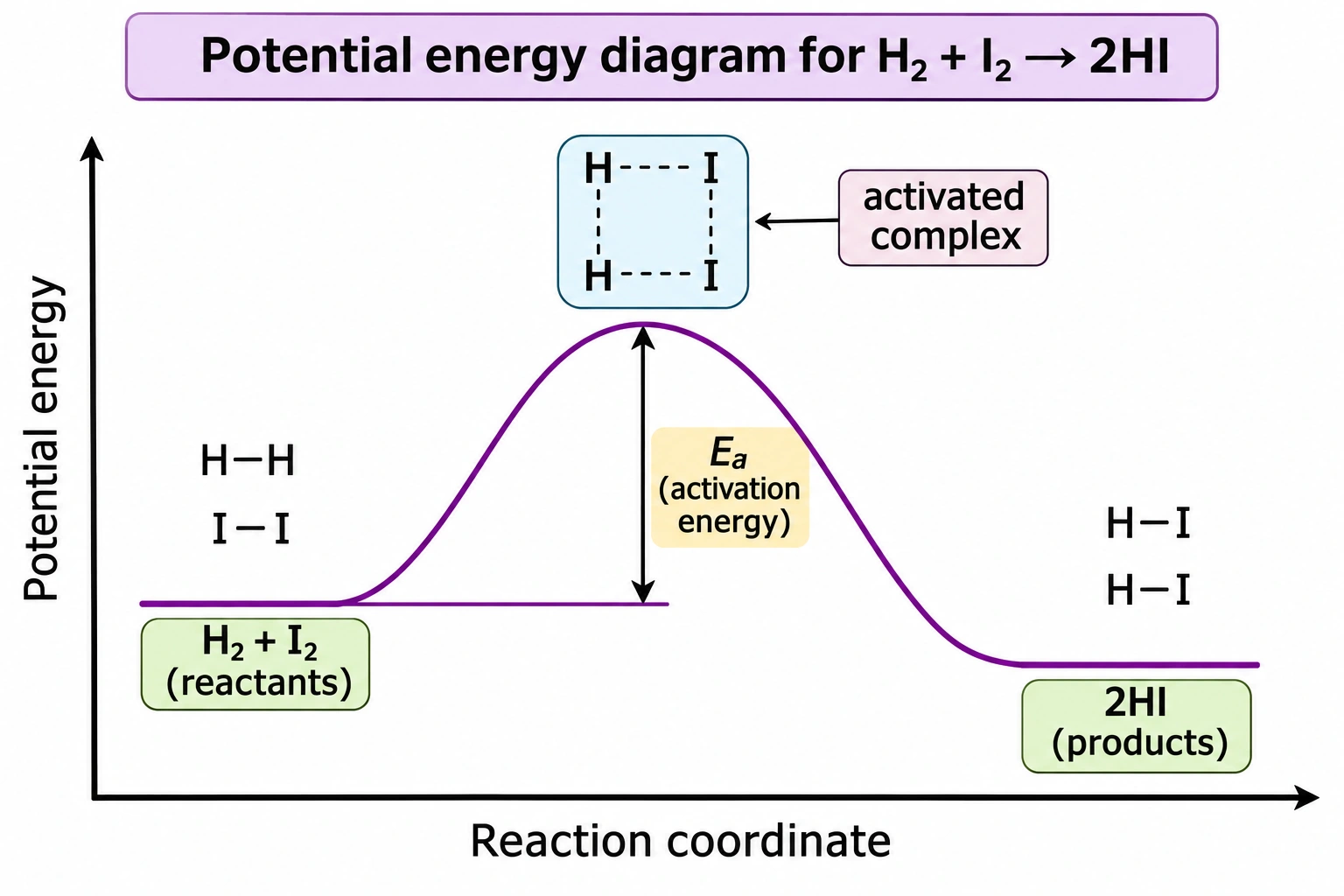
When H and I collide with enough energy, an unstable intermediate called the activated complex forms at the top of the curve. In it, the H–H and I–I bonds are partly broken and the two H–I bonds are partly formed. The activated complex then breaks up to give 2HI. The energy needed to form the activated complex is the activation energy.
Question 8 (1 mark): Write the rate of the reaction in terms of each reactant.
Answer.
Solved Examples: Numericals
Question 9 (3 marks): For , the concentration of A falls from 0.60 mol L to 0.45 mol L in 15 minutes. Calculate the rate of the reaction in mol L min and mol L s.
Answer.
Given: Initial [A] = 0.60 mol L; final [A] = 0.45 mol L; = 15 min
To find: Rate of the reaction
Formula:
Substitution:
Rate = 5.0 × 10 mol L min; in seconds, = 8.33 × 10 mol L s
Answer: Rate = 5.0 × 10 mol L min = 8.33 × 10 mol L s
Question 10 (3 marks): In a first order reaction, the concentration of the reactant falls from 0.80 M to 0.20 M in 30 minutes. Calculate k.
Answer.
Given: = 0.80 M; = 0.20 M; t = 30 min
To find: Rate constant, k
Formula:
Substitution:
Answer: Rate constant, k = 4.62 × 10 min
Question 11 (3 marks): A first order reaction is 20% complete in 15 minutes. Calculate its rate constant.
Answer.
Given: Taking = 100, after 20% reaction = 100 − 20 = 80; t = 15 min
To find: Rate constant, k
Formula:
Substitution:
Answer: Rate constant, k = 1.49 × 10 min
Question 12 (3 marks): A first order reaction has a half-life of 30 minutes. How long will it take for 40% of the reaction to be complete?
Answer.
Given: = 30 min; taking = 100, after 40% reaction = 60
To find: Time for 40% completion, t
Formulae: and
Solution:
min
, and
Answer: Time for 40% completion = 22.1 min
Question 13 (3 marks): The rate constant of a reaction becomes three times when the temperature rises from 300 K to 320 K. Calculate the activation energy. (R = 8.314 J K mol, log 3 = 0.4771)
Answer.
Given: = 3; = 300 K; = 320 K; R = 8.314 J K mol
To find: Activation energy,
Formula:
Substitution:
J mol
Answer: Activation energy, = 43.85 kJ mol
Question 14 (3 marks): The rate constant of a first order reaction is 1.0 × 10 s at 300 K, and E = 57.4 kJ mol. Calculate k at 310 K.
Answer.
Given: = 1.0 × 10 s; = 300 K; = 310 K; = 57.4 kJ mol = 57400 J mol; R = 8.314 J K mol
To find: Rate constant at 310 K,
Formula:
Substitution:
= antilog 0.3224 = 2.10, so = 2.10 × 1.0 × 10
Answer: Rate constant at 310 K = 2.10 × 10 s
Question 15 (3 marks): The rate constant of a reaction is given by . Calculate E. (R = 8.314 J K mol)
Answer.
Given: ; R = 8.314 J K mol
To find: Activation energy,
Formula (Arrhenius equation):
Comparing the two equations: K
Substitution: J mol
Answer: Activation energy, = 191.5 kJ mol
Question 16 (3 marks): For a reaction, E = 100 kJ mol at 500 K. What fraction of molecules has energy equal to or more than E?
Answer.
Given: = 100 kJ mol = 100000 J mol; T = 500 K; R = 8.314 J K mol
To find: Fraction of molecules, x
Formula: , so
Substitution:
x = antilog (−10.445)
Answer: Fraction of molecules = 3.59 × 10
Question 17 (3 marks): A piece of old wood has 40% of the carbon-14 found in living wood. Find its age. (Half-life of C-14 = 5730 years)
Answer.
Given: = 5730 years; taking = 100, = 40
To find: Age of the wood, t
Formulae: and
Solution:
year
, and
years
Answer: Age of the wood = about 7580 years