
How Solutions Is Asked
Solutions carries 12 printed marks in every paper: three 1-mark questions in Part A, one 3-mark theory question in Part C (group V) and two of the six numericals in Part E.
What to prepare, based on the last ten papers:
| Where | Asked more than once | Also asked |
|---|---|---|
| Part A (1 mark each) | Meaning of 10% (w/w) and of ; a pair showing positive deviation; for a non-electrolyte | Comparing colligative effects (glucose vs MgCl), Henry's law facts (scuba tanks, gases in cold water), osmosis, azeotropes |
| Part C (3 marks) | Ideal solutions | Ideal vs non-ideal, azeotropes, Henry's law, osmotic pressure for macromolecules, reverse osmosis |
| Part E (numericals) | Osmotic pressure (5 times); molar mass from , lowering of vapour pressure, two volatile liquids, Henry's law (twice each) | , mole fraction, isotonic solutions, graph-based problems |
Concentration Terms
| Term | Formula | Changes with temperature? |
|---|---|---|
| Mass percentage (w/w) | No | |
| Mass by volume percentage (w/v) | Yes | |
| Parts per million (ppm) | No (by mass) | |
| Mole fraction | No | |
| Molarity (M) | Yes | |
| Molality (m) | No |
Points that get asked:
- 10% (w/w) glucose means 10 g of glucose in 100 g of solution, that is, 10 g of glucose in 90 g of water.
- Mass by volume percentage is the unit commonly used in medicine and pharmacy.
- In a binary solution, . If , then .
- Molarity changes with temperature because volume expands or contracts with temperature. Molality and mole fraction use only masses and moles, so they don't change.
- The air in scuba divers' tanks is diluted with helium: about 11.7% helium, 56.2% nitrogen and 32.1% oxygen.
Henry's Law and the Solubility of Gases
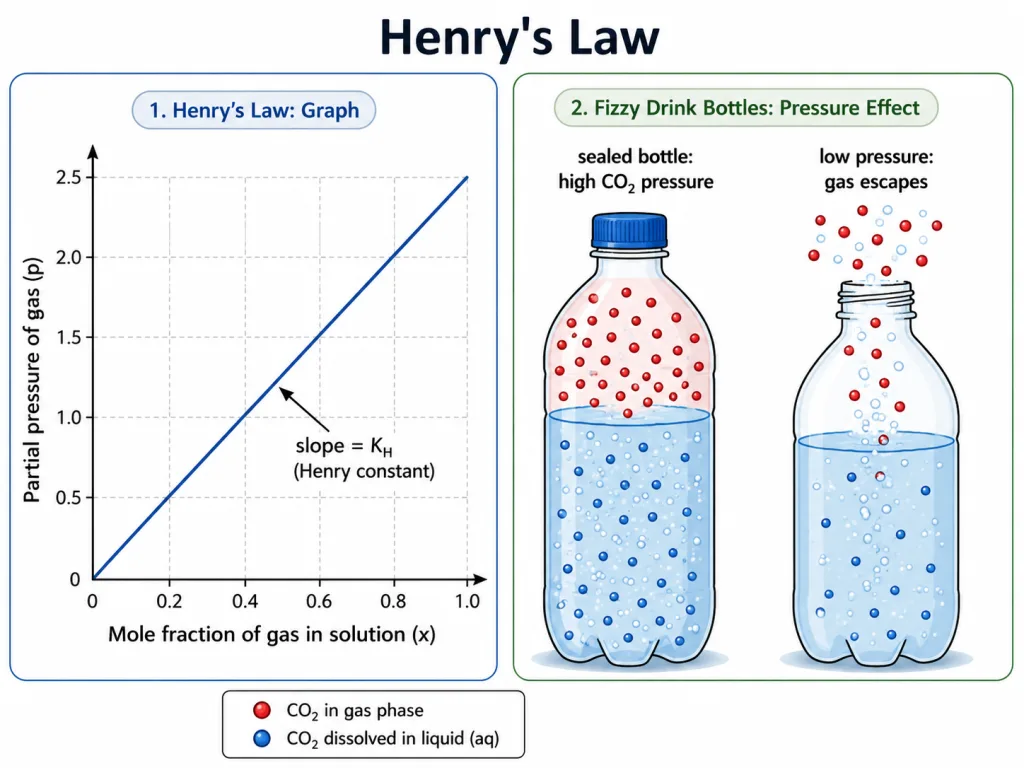
Henry's law: the partial pressure of a gas in the vapour phase is proportional to the mole fraction of the gas in the solution.
- At the same pressure and temperature, a higher means lower solubility.
- increases with temperature, so gases become less soluble as temperature rises. That's why cold water holds more dissolved oxygen than warm water.
- Pressure has no significant effect on the solubility of solids in liquids, because solids and liquids are almost incompressible.
Applications that come up: soda bottles are sealed under high CO pressure; scuba divers get "bends" when dissolved nitrogen comes out of the blood as bubbles, which is why helium is used to dilute the tank air; people at high altitude suffer anoxia because of low oxygen in the blood.
Raoult's Law, Ideal and Non-ideal Solutions
Raoult's law (volatile liquids): the partial vapour pressure of each component is proportional to its mole fraction.
The mole fraction of A in the vapour is .
For a non-volatile solute, only the solvent contributes vapour pressure, and the relative lowering equals the mole fraction of the solute:
| Feature | Ideal | Positive deviation | Negative deviation |
|---|---|---|---|
| A–B attraction compared with A–A and B–B | Same | Weaker | Stronger |
| Vapour pressure | As Raoult's law predicts | Higher | Lower |
| 0 | Positive (cools) | Negative (warms) | |
| 0 | Positive (volume increases) | Negative (volume decreases) | |
| Examples | n-hexane + n-heptane, bromoethane + chloroethane | ethanol + acetone, carbon disulphide + acetone | chloroform + acetone, nitric acid + water |
| Azeotrope formed | None | Minimum boiling | Maximum boiling |
Azeotropes are binary mixtures that have the same composition in the liquid and vapour phases and boil at a constant temperature, so they can't be separated by fractional distillation. Ethanol–water (about 95% ethanol) is a minimum boiling azeotrope. Nitric acid–water (68% nitric acid by mass, boiling at 393.5 K) is a maximum boiling azeotrope.
If 10 mL of A and 20 mL of B give 30.1 mL of solution, the volume has increased, so and the solution shows positive deviation.
More solute particles mean a lower vapour pressure. At the same temperature: pure water > 0.01 M sucrose > 0.1 M sucrose.
Colligative Properties and the van't Hoff Factor
Colligative properties depend only on the number of solute particles, not on what they are.
| Property | Formula | Molar mass of solute |
|---|---|---|
| Relative lowering of vapour pressure | ||
| Elevation of boiling point | ||
| Depression of freezing point | ||
| Osmotic pressure |
Here is the mass of solvent in grams. and depend only on the solvent, so doubling the molality doesn't change . For water, = 1.86 K kg mol and = 0.52 K kg mol.
Osmosis: solvent flows through a semipermeable membrane from the dilute (hypotonic) side to the concentrated (hypertonic) side. Applying a pressure larger than the osmotic pressure on the concentrated side pushes solvent the other way. That's reverse osmosis, used to desalinate sea water with a cellulose acetate membrane. Solutions with the same osmotic pressure at the same temperature are isotonic, so for non-electrolytes they have the same molarity.
Why the osmotic pressure method is used for proteins and polymers:
- It is measured at room temperature, so heat-sensitive biomolecules don't break down.
- It uses molarity instead of molality.
- Its value is large enough to measure even for very dilute solutions, which is all you can make with a macromolecule.
van't Hoff factor: . With , the formulas become , and .
| Solute | (complete dissociation) |
|---|---|
| Glucose, urea, sucrose (non-electrolytes) | 1 |
| KCl, NaCl | 2 |
| MgCl, CaCl, KSO | 3 |
| K[Fe(CN)] | 4 |
| Al(SO) | 5 |
| Ethanoic acid dimerising in benzene | about 0.5 |
At the same concentration, a bigger means a bigger , so a lower freezing point. A 0.01 M MgCl solution lowers the freezing point about three times as much as 0.01 M glucose.
Solved Examples: Theory Answers
Question 1 (2 marks): Molarity, molality and mole fraction are ways of expressing concentration. Which of these depend on temperature? Give the reason.
Answer. Molarity depends on temperature, but molality and mole fraction do not.
Reason: Molarity is the number of moles of solute in one litre of solution, so it depends on the volume of the solution. Volume changes with temperature (a liquid expands when heated), so molarity also changes. Molality and mole fraction are calculated only from masses and moles, and these do not change with temperature.
Question 2 (3 marks): What are ideal solutions? Write two characteristics.
Answer. Solutions which obey Raoult's law over the entire range of concentration are called ideal solutions.
Characteristics of an ideal solution:
- The enthalpy of mixing is zero, . No heat is absorbed or released when the components are mixed.
- The volume of mixing is zero, . The volume of the solution is equal to the sum of the volumes of the components.
In an ideal solution, the attractive forces between A and B molecules are the same as those between A–A and B–B molecules. Example: a solution of n-hexane and n-heptane.
Question 3 (3 marks): Define azeotropes. Which type is formed by solutions showing negative deviation from Raoult's law? Give an example.
Answer. Azeotropes are binary mixtures which have the same composition in the liquid phase and the vapour phase and boil at a constant temperature. So they cannot be separated by fractional distillation.
Solutions that show a large negative deviation from Raoult's law form maximum boiling azeotropes.
Example: a mixture of nitric acid and water containing about 68% nitric acid by mass. It boils at 393.5 K.
Question 4 (3 marks): Give three reasons why the osmotic pressure method is better than other colligative methods for finding the molar mass of macromolecules.
Answer. The osmotic pressure method is preferred for macromolecules like proteins and polymers because:
- Osmotic pressure is measured at room temperature. Biomolecules such as proteins are not stable at high temperature, so they are not damaged.
- The molarity of the solution is used instead of molality.
- Even for very dilute solutions, the osmotic pressure is large enough to be measured accurately. The elevation in boiling point or depression in freezing point of such dilute solutions would be too small to measure.
Question 5 (3 marks): Name the concentration term commonly used in medicine and pharmacy. Define it and write its formula.
Answer. The concentration term commonly used in medicine and pharmacy is mass by volume percentage (w/v).
Definition: Mass by volume percentage is the mass of solute in grams dissolved in 100 mL of the solution.
Formula:
For example, a 5% (w/v) glucose solution contains 5 g of glucose in 100 mL of solution.
Question 6 (3 marks): In a plant, pressure larger than the osmotic pressure is applied on sea water so that pure water passes through a membrane. (i) Name the process. (ii) Name one semipermeable membrane used. (iii) Give one use.
Answer.
(i) The process is reverse osmosis. When a pressure larger than the osmotic pressure is applied on the solution side, pure solvent flows from the solution into the pure solvent through the semipermeable membrane.
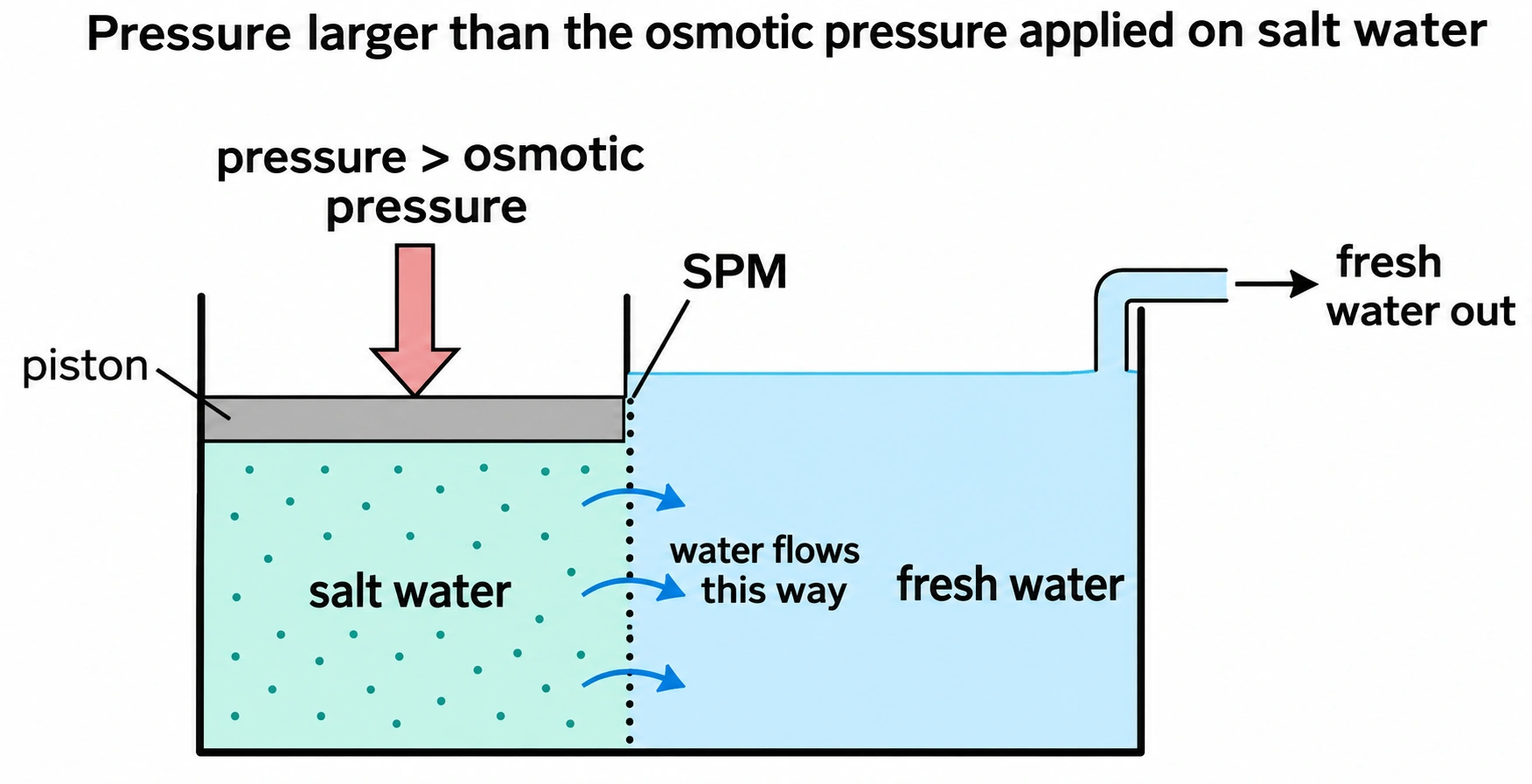
(ii) A film of cellulose acetate is used as the semipermeable membrane.
(iii) Reverse osmosis is used for the desalination of sea water, that is, to get pure drinking water from sea water.
Solved Examples: Concentration, Henry's Law and Raoult's Law
Question 7 (3 marks): Calculate the mole fraction of benzene and carbon tetrachloride in a solution of 15.6 g of benzene in 61.6 g of CCl. (CH = 78 g mol, CCl = 154 g mol)
Answer.
Given: Mass of benzene = 15.6 g, molar mass of benzene = 78 g mol; mass of CCl = 61.6 g, molar mass of CCl = 154 g mol
To find: Mole fraction of benzene and of CCl
Formula:
Solution:
Number of moles of benzene, mol
Number of moles of CCl, mol
Answer: Mole fraction of benzene = 0.333 and mole fraction of CCl = 0.667.
Question 8 (3 marks): Henry's law constant for O in water at 293 K is 34.86 kbar. Find the mole fraction of O in water when its partial pressure is 0.2 bar.
Answer.
Given: = 34.86 kbar = 34.86 × 10 bar = 34860 bar; partial pressure of O, p = 0.2 bar
To find: Mole fraction of O, x
Formula: , so
Substitution:
Answer: Mole fraction of O in water = 5.74 × 10
Tip: change kbar to bar before dividing, so that the units cancel.
Question 9 (3 marks): The solubility of a gas in water at STP is 0.10 mol kg. Calculate its Henry's law constant. (Pressure at STP = 0.987 bar)
Answer.
Given: 0.10 mol of gas dissolves in 1 kg (1000 g) of water; pressure p = 0.987 bar; molar mass of water = 18 g mol
To find: Henry's law constant,
Formula: , so
Solution:
Number of moles of water in 1 kg = = 55.56 mol
Mole fraction of the gas,
Answer: Henry's law constant, = 549 bar
Question 10 (3 marks): The vapour pressures of pure liquids A and B at 350 K are 400 and 600 mm Hg. Find the composition of the liquid mixture if the total vapour pressure is 520 mm Hg.
Answer.
Given: = 400 mm Hg, = 600 mm Hg, = 520 mm Hg
To find: Mole fractions and in the liquid
Formula (Raoult's law): , where
Substitution:
, so and
Answer: The liquid mixture contains 40 mol% of A and 60 mol% of B.
Solved Examples: Colligative Properties
Question 11 (3 marks): Calculate the osmotic pressure in pascals of a solution of 0.80 g of a polymer (molar mass 160000 g mol) in 400 mL of water at 27 °C. (R = 8.314 × 10 Pa L K mol)
Answer.
Given: Mass of polymer, = 0.80 g; molar mass, = 160000 g mol; volume, V = 400 mL = 0.400 L; T = 27 + 273 = 300 K; R = 8.314 × 10 Pa L K mol
To find: Osmotic pressure,
Formula:
Substitution:
Answer: Osmotic pressure = 31.2 Pa
Question 12 (3 marks): 1.50 g of a non-electrolyte dissolved in 60 g of benzene lowers its freezing point by 0.512 K. for benzene is 5.12 K kg mol. Find the molar mass of the solute.
Answer.
Given: Mass of solute, = 1.50 g; mass of benzene, = 60 g; = 0.512 K; = 5.12 K kg mol
To find: Molar mass of the solute,
Formula:
Substitution:
Answer: Molar mass of the solute = 250 g mol
Question 13 (3 marks): Benzene boils at 353.23 K. How much of a non-volatile solute (molar mass 128 g mol) must be added to 80 g of benzene so that it boils at 353.73 K? ( = 2.53 K kg mol)
Answer.
Given: Boiling point of benzene = 353.23 K; boiling point of solution = 353.73 K; = 128 g mol; = 80 g; = 2.53 K kg mol
To find: Mass of solute,
Elevation in boiling point, = 353.73 − 353.23 = 0.50 K
Formula: , so
Substitution:
Answer: Mass of solute to be added = 2.02 g
Question 14 (3 marks): The vapour pressure of water at 298 K is 23.8 mm Hg. Dissolving 5.0 g of a non-volatile solute in 90 g of water lowers the vapour pressure by 0.238 mm Hg. Find the molar mass of the solute.
Answer.
Given: = 23.8 mm Hg; lowering of vapour pressure, = 0.238 mm Hg; = 5.0 g; = 90 g; (water) = 18 g mol
To find: Molar mass of the solute,
Formula (for a dilute solution):
Substitution:
, so
Answer: Molar mass of the solute = 100 g mol
Question 15 (3 marks): What mass of a non-volatile solute (molar mass 60 g mol) should be dissolved in 156 g of benzene to lower its vapour pressure to 90%? (CH = 78 g mol)
Answer.
Given: = 156 g; = 78 g mol; = 60 g mol; vapour pressure of solution, p = 90% of = 0.90
To find: Mass of solute,
Relative lowering of vapour pressure = = 0.10
Formula (for a dilute solution):
Solution:
Number of moles of benzene, = 2.0 mol
Answer: Mass of solute needed = 12 g
Tip: if you use the exact form , you get = 0.222 mol and = 13.3 g. Board schemes have accepted either method, as long as the method is shown.
Question 16 (3 marks): A 3% (w/v) solution of urea is isotonic with a 9% (w/v) solution of a non-electrolyte X at the same temperature. Find the molar mass of X. (Urea = 60 g mol)
Answer.
Given: 3% (w/v) urea means 3 g of urea in 100 mL (0.1 L) of solution; 9% (w/v) X means 9 g of X in 100 mL (0.1 L) of solution; molar mass of urea = 60 g mol
To find: Molar mass of X,
Isotonic solutions have the same osmotic pressure. At the same temperature, , so isotonic solutions of non-electrolytes have the same molar concentration.
Formula: , that is,
Substitution: , so
Answer: Molar mass of X = 180 g mol
Question 17 (3 marks): 0.111 g of CaCl ( = 2.47, molar mass 111 g mol) is dissolved in water to make 1.0 L of solution at 27 °C. Calculate the osmotic pressure. (R = 0.0821 L atm K mol)
Answer.
Given: Mass of CaCl = 0.111 g; molar mass = 111 g mol; V = 1.0 L; T = 27 + 273 = 300 K; i = 2.47; R = 0.0821 L atm K mol
To find: Osmotic pressure,
Formula:
Solution:
Concentration, = 1.0 × 10 mol L
Answer: Osmotic pressure = 0.0608 atm
Question 18 (3 marks): 6.84 g of sucrose (molar mass 342 g mol) in 200 g of water freezes at −0.186 °C. Calculate for water.
Answer.
Given: = 6.84 g; = 342 g mol; = 200 g = 0.200 kg; freezing point of solution = −0.186 °C; freezing point of water = 0 °C
To find: of water
= 0 − (−0.186) = 0.186 °C = 0.186 K
Formula: , so
Solution:
Molality, = 0.10 mol kg
Answer: for water = 1.86 K kg mol