
How Aldehydes, Ketones and Carboxylic Acids Is Asked
This chapter carries 12 printed marks: usually two 1-mark questions and two of the six Part D questions, so it can supply half your Part D marks by itself.
What to prepare, based on the last ten papers:
| Where | Asked more than once | Also asked |
|---|---|---|
| Part A (1 mark) | Natural source of acetic acid; reagent to separate an aldehyde from a ketone; boiling point compared with acetone (twice each) | Clemmensen reagent, Cannizzaro products, Fehling's test, hydration of ethyne, acid strength, cyanohydrin formation |
| Part D (5 marks) | "Identify A, B, C" chains (8 papers), often starting from toluene or a Grignard reagent; Rosenmund, HVZ, aldol and iodoform (4 times each); Etard (3 times); Cannizzaro, Gattermann–Koch, Tollens' reagent (twice each) | Stephen, Wolff–Kishner and Clemmensen reductions, HCN addition mechanism, Fehling's solution, 2,4-DNP, Kolbe electrolysis, substituents and acidity, soda lime |
Preparing Aldehydes and Ketones
| Name | Reaction | Product |
|---|---|---|
| Rosenmund reduction | Acyl chloride + H, Pd–BaSO | Aldehyde: |
| Stephen reaction | Nitrile + SnCl/HCl, then HO | Aldehyde: RCN → RCH=NH → RCHO |
| Etard reaction | Toluene + chromyl chloride (CrOCl) in CS, then HO | Benzaldehyde |
| Gattermann–Koch | Benzene + CO + HCl, anhydrous AlCl/CuCl | Benzaldehyde |
| Friedel–Crafts acylation | Benzene + RCOCl, anhydrous AlCl | Aryl ketone, such as acetophenone |
| Dialkylcadmium | 2RCOCl + R'Cd | Ketone, RCOR' |
| Hydration of alkynes | dil. HSO + HgSO | Ethyne gives acetaldehyde; propyne gives acetone |
| Oxidation of alcohols | CrO (anhydrous) or PCC | Primary → aldehyde; secondary → ketone |
Example of the dialkylcadmium route:
Physical properties: aldehydes and ketones boil higher than hydrocarbons and ethers of similar mass (dipole–dipole attraction) but lower than alcohols (no hydrogen bonding between their molecules). So propan-1-ol boils after acetone. Lower aldehydes have sharp, pungent smells.
Naming: number from the CHO carbon. CHCH(Br)CHCHO is 3-bromobutanal.
Nucleophilic Addition and Tests
The C=O carbon is slightly positive, so nucleophiles attack it. Aldehydes react faster than ketones: they have less crowding and only one electron-donating alkyl group.
Addition of HCN (base catalysed):
- Step 1, the base makes the nucleophile:
- Step 2, CN attacks the carbonyl carbon, forming a tetrahedral alkoxide ion:
- Step 3, the alkoxide takes H to give the cyanohydrin:
| Reagent | What happens | Use |
|---|---|---|
| NaHSO | Crystalline bisulphite addition compound, split back by dilute acid or alkali | Separating and purifying aldehydes from mixtures |
| Ethylene glycol + dry HCl gas | Cyclic acetal or ketal | Protecting the C=O group |
| NHOH, NHNH, 2,4-DNP | Oxime, hydrazone, 2,4-dinitrophenylhydrazone (orange-red solid) | Identifying carbonyl compounds |
| Tollens' reagent, ammoniacal AgNO, [Ag(NH)] | Aldehydes give a silver mirror | Aldehydes only |
| Fehling's solution: A is CuSO; B is NaOH with sodium potassium tartrate (Rochelle salt) | Aliphatic aldehydes give a red-brown CuO precipitate | Aromatic aldehydes like benzaldehyde don't respond |
| NaOI (I + NaOH) | Iodoform test: yellow CHI | Compounds with CHCO– (methyl ketones, ethanal) |
Tollens' test:
Fehling's test:
Haloform reaction: . Ethanal gives iodoform; propanal doesn't, so this test tells them apart.
Acetone and benzaldehyde both react with NaHSO, phenylhydrazine and Grignard reagents, but neither reacts with Fehling's solution.
Reductions, Aldol and Cannizzaro
Reduction of C=O to CH:
- Clemmensen: zinc amalgam + concentrated HCl.
- Wolff–Kishner: hydrazine, then KOH in ethylene glycol on heating. Nitrogen gas is given off:
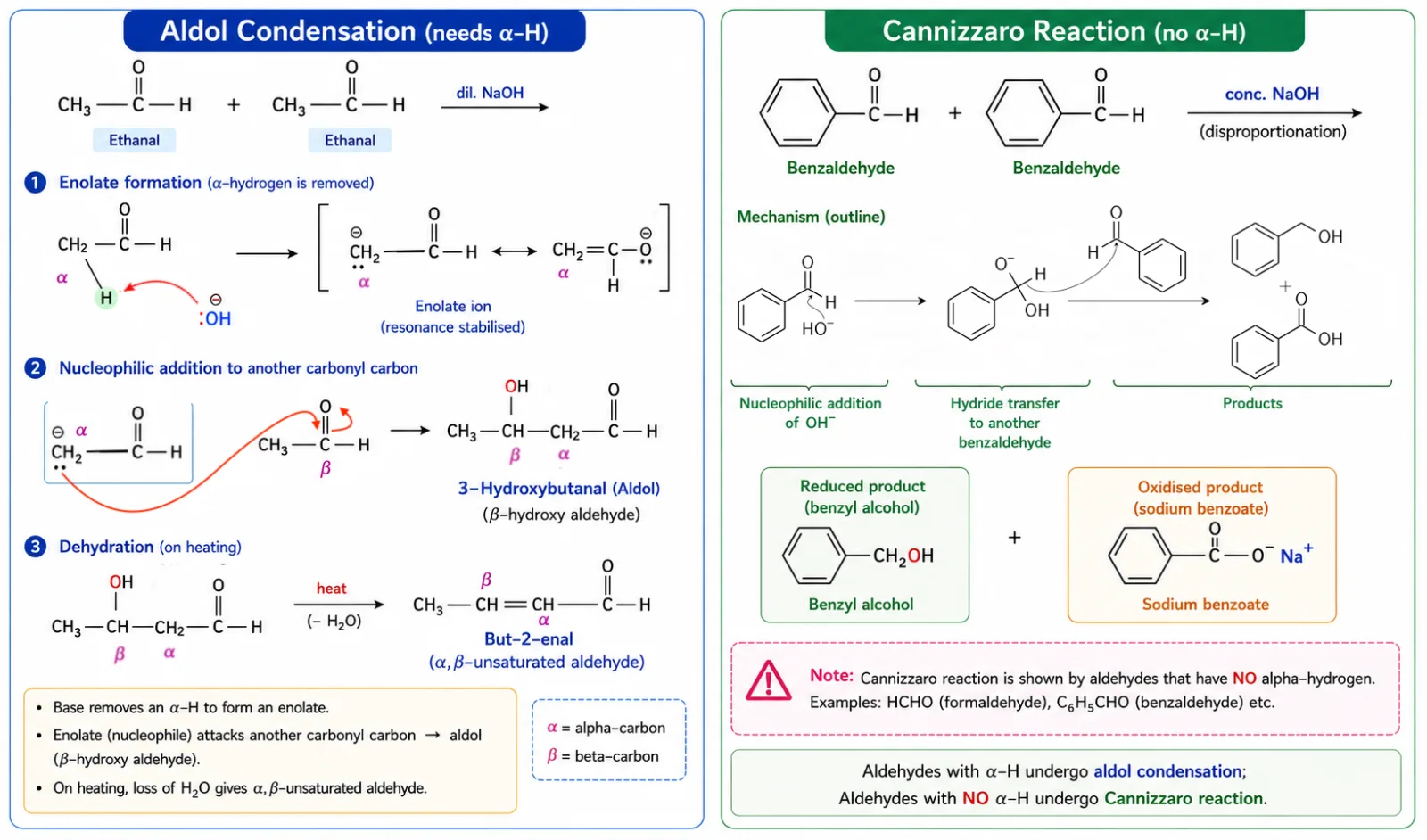
Aldol condensation needs an α-hydrogen. With dilute NaOH, two molecules join to give a β-hydroxy aldehyde or ketone, which loses water on heating:
The products are 3-hydroxybutanal (aldol) and but-2-enal. Acetone gives 4-hydroxy-4-methylpentan-2-one, which loses water to give 4-methylpent-3-en-2-one. Cross aldol uses two different carbonyl compounds and gives a mixture.
Cannizzaro reaction works for aldehydes without an α-hydrogen (HCHO, CHCHO). With concentrated alkali, one molecule is reduced to an alcohol and another oxidised to the salt of an acid:
| Compound | α-H? | Aldol? | Cannizzaro? |
|---|---|---|---|
| HCHO (methanal) | No | No | Yes |
| CHCHO (ethanal) | Yes | Yes | No |
| CHCHO | No | No | Yes |
| CHCHCHO | Yes | Yes | No |
Carboxylic Acids
Names and uses: acetic acid (ethanoic acid) comes naturally from vinegar. Oxalic acid is ethanedioic acid. Adipic acid (hexanedioic acid) is used to make nylon-6,6.
Preparation:
- Oxidation of primary alcohols and aldehydes.
- Side chain oxidation: toluene with alkaline KMnO, then acid, gives benzoic acid.
- Grignard + CO:
- Hydrolysis of nitriles, amides and anhydrides. Benzamide hydrolyses to benzoic acid; benzoic ethanoic anhydride gives benzoic acid and acetic acid.
- Cyclohexene with hot acidified KMnO gives hexanedioic (adipic) acid.
Acidity: a carboxylate ion is stabilised by resonance over two oxygen atoms, so carboxylic acids are stronger acids than phenol and alcohols. Electron-withdrawing groups (F, Cl, NO) increase acidity; electron-donating groups (alkyl) decrease it. The smaller the pK, the stronger the acid. So FCCOOH > FCHCOOH > CHCOOH > (CH)CHCOOH, and chloroacetic acid is stronger than acetic acid.
Reactions:
- HVZ reaction: an acid with an α-hydrogen reacts with Cl or Br and red phosphorus, then water, to give an α-haloacid.
- Decarboxylation: the sodium salt heated with soda lime (NaOH + CaO, 3:1) loses CO. Sodium benzoate gives benzene.
- Kolbe electrolysis: electrolysis of sodium acetate solution gives ethane at the anode.
- Amide formation:
- Ring substitution: –COOH directs to the meta position and deactivates the ring. Benzoic acid with conc. HNO + HSO gives m-nitrobenzoic acid. Aromatic acids don't undergo Friedel–Crafts reactions.
Solved Examples: Named Reactions
Question 1 (3 marks): Name the reactions: (i) RCOCl + H with Pd–BaSO → RCHO; (ii) benzene + RCOCl with anhydrous AlCl → CHCOR; (iii) RC=O with Zn–Hg and conc. HCl → RCH.
Answer.
(i) Rosenmund reduction
(ii) Friedel–Crafts acylation
(iii) Clemmensen reduction
Question 2 (3 marks): How is benzoyl chloride converted to benzaldehyde? Write the equation and name the reaction.
Answer. Benzoyl chloride is converted to benzaldehyde by hydrogenation in the presence of palladium on barium sulphate (Pd–BaSO). This reaction is called Rosenmund reduction.
BaSO partly poisons the palladium catalyst, so the aldehyde formed is not reduced further to an alcohol.
Question 3 (2 marks): Write the reaction for converting toluene to benzaldehyde with chromyl chloride. Name the reaction.
Answer. The reaction is called the Etard reaction. Chromyl chloride oxidises the methyl group of toluene to a chromium complex, which on hydrolysis gives benzaldehyde.
Question 4 (2 marks): How is benzene converted into benzaldehyde by the Gattermann–Koch reaction?
Answer. When benzene is treated with carbon monoxide and hydrogen chloride in the presence of anhydrous aluminium chloride (or cuprous chloride), benzaldehyde is formed. This is the Gattermann–Koch reaction.
Question 5 (2 marks): Explain the Stephen reaction.
Answer. In the Stephen reaction, a nitrile is reduced by stannous chloride in the presence of hydrochloric acid to an imine, which on hydrolysis gives the corresponding aldehyde.
Question 6 (2 marks): Write the Wolff–Kishner reduction of ethanal. Which gas is given off?
Answer. In Wolff–Kishner reduction, ethanal first reacts with hydrazine to form a hydrazone. The hydrazone is heated with KOH in ethylene glycol to give ethane. Nitrogen gas is given off.
Question 7 (2 marks): Explain the Hell–Volhard–Zelinsky reaction.
Answer. When a carboxylic acid having an α-hydrogen is treated with chlorine or bromine in the presence of a small amount of red phosphorus, and then with water, the α-hydrogen is replaced by the halogen. This is called the Hell–Volhard–Zelinsky (HVZ) reaction.
Solved Examples: Mechanism, Tests and Condensations
Question 8 (3 marks): Write the mechanism of addition of HCN to a carbonyl group in the presence of a base.
Answer. The addition of HCN to a carbonyl compound is a nucleophilic addition reaction. It takes place in three steps.
Step 1: The base generates the nucleophile, the cyanide ion.
Step 2: CN attacks the carbonyl carbon, and the π electrons of C=O move to oxygen, forming a tetrahedral alkoxide ion.
Step 3: The alkoxide ion takes a proton from water to form the cyanohydrin.
Question 9 (2 marks): What is the composition of Tollens' reagent? Write its reaction with an aldehyde.
Answer. Tollens' reagent is ammoniacal silver nitrate solution, which contains the [Ag(NH)] ion.
When an aldehyde is warmed with Tollens' reagent, the aldehyde is oxidised to a carboxylate ion and a bright silver mirror is formed.
Question 10 (3 marks): Name the reaction that tells ethanal and propanal apart. Write the reaction.
Answer. Ethanal and propanal can be distinguished by the iodoform test.
Ethanal has a CHCO– group, so when it is warmed with iodine and sodium hydroxide (sodium hypoiodite), it gives a yellow precipitate of iodoform. Propanal does not have a CHCO– group, so it does not give this test.
Question 11 (3 marks): Among acetaldehyde and benzaldehyde, which undergoes aldol condensation? Write the reaction.
Answer. Acetaldehyde undergoes aldol condensation, because it has α-hydrogen atoms. Benzaldehyde has no α-hydrogen, so it does not.
In the presence of dilute NaOH, two molecules of acetaldehyde combine to form an aldol, 3-hydroxybutanal. On heating, the aldol loses water to form but-2-enal.
Question 12 (2 marks): Among methanal and ethanal, which undergoes the Cannizzaro reaction? Give the reason.
Answer. Methanal undergoes the Cannizzaro reaction, because it has no α-hydrogen atom. Ethanal has α-hydrogen atoms, so with alkali it undergoes aldol condensation instead.
With concentrated alkali, one molecule of methanal is reduced to methanol and another is oxidised to formate.
Solved Examples: Acids and Conversion Chains
Question 13 (2 marks): Explain Kolbe electrolysis of sodium acetate.
Answer. When an aqueous solution of sodium acetate is electrolysed, the acetate ions lose CO at the anode, and the methyl radicals formed join together to give ethane. This is called Kolbe electrolysis.
Question 14 (2 marks): How do electron-withdrawing and electron-donating groups affect the acidity of carboxylic acids?
Answer. Electron-withdrawing groups like –Cl, –F and –NO pull electrons away from the carboxylate ion and stabilise it by spreading its negative charge. So they increase the acidity of carboxylic acids.
Electron-donating groups like –CH push electrons towards the carboxylate ion and destabilise it. So they decrease the acidity.
For example, ClCHCOOH is a stronger acid than CHCOOH.
Question 15 (5 marks): Compound A (CH) is heated with alkaline KMnO and acidified to give B (CHO), which turns blue litmus red. The sodium salt of B, heated with X, gives hydrocarbon C (molar mass 78 g mol). Identify A, B, C and X, and write the equations.
Answer.
A = toluene, CHCH
B = benzoic acid, CHCOOH (it is an acid, so it turns blue litmus red)
X = soda lime (NaOH + CaO)
C = benzene, CH (molar mass 78 g mol)
Equations:
Side chain oxidation of toluene:
Decarboxylation of sodium benzoate:
Question 16 (5 marks): CHMgBr reacts with CO, then HO, to give A. A with Cl/red P, then water, gives B. (a) Identify A and B. (b) Name the second reaction. (c) Why is B more acidic than A?
Answer.
(a) A = acetic acid (ethanoic acid), CHCOOH
B = chloroacetic acid (chloroethanoic acid), ClCHCOOH
(b) The second reaction is the Hell–Volhard–Zelinsky (HVZ) reaction.
(c) Chlorine is an electron-withdrawing group. It pulls electrons away from the carboxylate ion and stabilises it, so chloroacetic acid loses H more easily and is the stronger acid.
Question 17 (5 marks): Propyne (CH) adds water in the presence of HSO and HgSO to give A. A with sodium hypoiodite gives B and C. A heated with Ba(OH) gives D, which readily loses water. Identify A to D.
Answer.
A = acetone (propanone), CHCOCH
B and C = iodoform, CHI, and sodium acetate, CHCOONa (iodoform reaction)
D = 4-hydroxy-4-methylpentan-2-one, formed by aldol condensation of two acetone molecules. On losing water it gives 4-methylpent-3-en-2-one.