
How Coordination Compounds Is Asked
This chapter carries 11 printed marks: usually two 1-mark questions and three of the five group IV questions in Part C. Prepare it well and it can cover the whole of group IV on its own.
What to prepare, based on the last ten papers:
| Where | Asked more than once | Also asked |
|---|---|---|
| Part A (1 mark) | Linkage isomerism (3 times); homoleptic complexes, oxidation state of Ni in Ni(CO) (twice each) | Shape of Fe(CO), Werner's valencies from AgCl data, inner and outer orbital complexes, and , ambidentate and polydentate ligands |
| Part C (3 marks) | A VBT question in 8 of 10 papers ([Ni(CN)] 4 times, [Co(NH)] twice); Werner's postulates, Co(CO), CFT splitting diagram (3 times each); Mn(CO), cis and trans [MX(L–L)], fac and mer isomers, Werner's AgCl experiments (twice each) | [CoF], [NiCl], bonding in metal carbonyls, complexes of en, limitations of VBT |
Werner's Theory and Basic Terms
Werner's postulates:
- The metal in a coordination compound shows two kinds of valency: primary and secondary.
- Primary valencies are ionisable and are satisfied by negative ions. They correspond to the oxidation state.
- Secondary valencies are non-ionisable and are satisfied by neutral molecules or negative ions. Their number equals the coordination number, and it is fixed for a metal.
- Secondary valencies point in fixed directions in space, which gives the complex its shape.
AgNO test: only the chloride ions outside the square bracket (primary valency) are precipitated as AgCl.
| Formula as written | Moles of AgCl | Complex |
|---|---|---|
| CoCl·6NH | 3 | [Co(NH)]Cl |
| CoCl·5NH | 2 | [Co(NH)Cl]Cl |
| CoCl·4NH | 1 | [Co(NH)Cl]Cl (green trans and violet cis forms) |
Key terms:
- Ligand: an ion or molecule that donates a lone pair to the central metal.
- Denticity: unidentate (Cl, NH, HO), didentate (en, CO), polydentate (EDTA is hexadentate).
- Ambidentate ligand: can bind through two different atoms, for example NO (N or O) and SCN (S or N).
- Chelate: a ring formed when a di- or polydentate ligand binds through two or more atoms. Chelates are more stable, so oxalate gives more stable complexes than Cl, and [Fe(CO)] is more stable than [Fe(HO)].
- Homoleptic: only one kind of ligand, like [Co(NH)]Cl. Heteroleptic: more than one kind, like [Co(NH)Cl].
Complexes in daily life: haemoglobin (Fe), chlorophyll (Mg), vitamin B (Co), Wilkinson's catalyst (PhP)RhCl, EDTA for estimating hardness of water, cis-platin against cancer.
Naming Complexes
Name the cation first, then the anion. Inside the bracket: ligands in alphabetical order (prefixes like di-, tri- don't count), then the metal, then its oxidation state in Roman numerals. An anionic complex ends in -ate.
| Complex | Name |
|---|---|
| [Co(NH)]Cl | hexaamminecobalt(III) chloride |
| [Co(NH)Br]SO | pentaamminebromidocobalt(III) sulphate |
| [CoCl(en)] | dichloridobis(ethane-1,2-diamine)cobalt(III) ion |
| [Fe(en)Cl]Cl | dichloridobis(ethane-1,2-diamine)iron(III) chloride |
| K[Fe(CO)] | potassium trioxalatoferrate(III) |
| [Ni(CO)] | tetracarbonylnickel(0) |
| [Fe(CO)] | pentacarbonyliron(0) |
| [Co(CO)] | octacarbonyldicobalt(0) |
| [Mn(CO)] | decacarbonyldimanganese(0) |
To find the oxidation state, set the sum of charges equal to the charge on the complex. In [Fe(CO)]: , so , and three didentate ligands make the coordination number 6. In [Ni(CO)], CO is neutral, so Ni is 0.
Isomerism
| Type | What changes | Example |
|---|---|---|
| Linkage (structural) | Which atom of an ambidentate ligand binds | [Co(NH)(ONO)]Cl (red, through O) and [Co(NH)(NO)]Cl (yellow, through N) |
| Coordination (structural) | Ligands swap between cation and anion complexes | [Co(NH)][Cr(CN)] and [Cr(NH)][Co(CN)] |
| Ionisation (structural) | An ion swaps between inside and outside the bracket | [Co(NH)SO]Br and [Co(NH)Br]SO |
| Solvate (structural) | Water inside or outside the bracket | [Cr(HO)]Cl and [Cr(HO)Cl]Cl·HO |
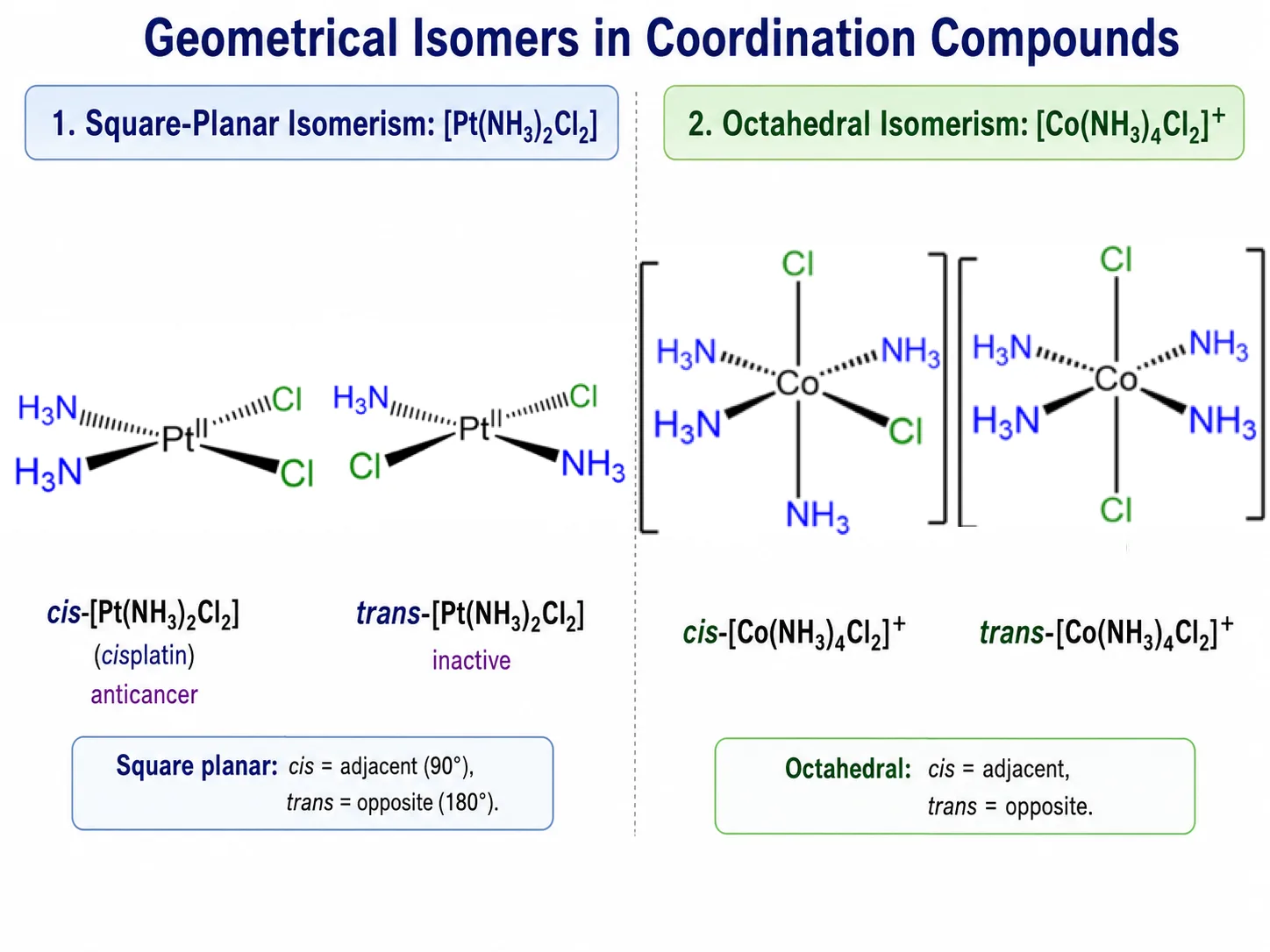
| Geometrical (stereo) | Arrangement in space | cis and trans; fac and mer |
| Optical (stereo) | Non-superimposable mirror images | [Co(en)] |
Geometrical isomerism is stereoisomerism, not structural.
Geometrical isomers you must be able to draw:
- [MAB] or [Co(NH)Cl] (octahedral): cis (two Cl at 90°) and trans (two Cl opposite each other).
- [MAB], such as Co(NH)(NO): fac, with the three identical ligands on one face, and mer, with them around a meridian. Coordination number 6, all ligands unidentate.
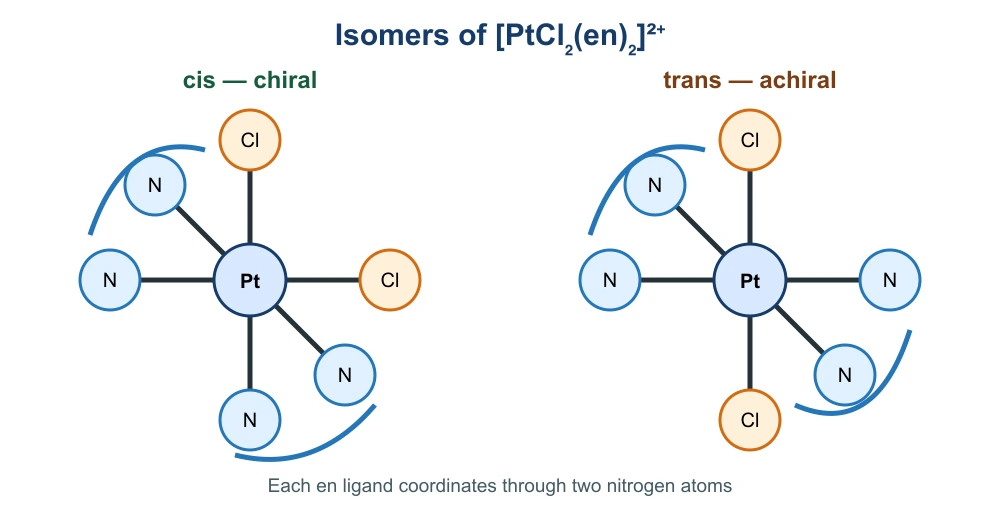
- [MX(L–L)], such as [CoCl(en)] or [PtCl(en)]: the cis form has no plane of symmetry, so it is optically active (chiral, two enantiomers). The trans form has a mirror plane, so it is optically inactive.
Valence Bond Theory
Steps for any VBT answer: write the metal ion's configuration, decide whether the ligand forces pairing (strong field: CN, CO, NH with Co, en) or not (weak field: F, Cl, HO), then pick the hybridisation, shape and magnetism.
| Complex | Metal ion | Ligand field | Hybridisation | Shape | Unpaired e | Magnetism |
|---|---|---|---|---|---|---|
| [Co(NH)] | Co, 3d | strong, pairs | dsp (inner orbital) | octahedral | 0 | diamagnetic |
| [CoF] | Co, 3d | weak, no pairing | spd (outer orbital) | octahedral | 4 | paramagnetic |
| [Ni(CN)] | Ni, 3d | strong, pairs | dsp | square planar | 0 | diamagnetic |
| [NiCl] | Ni, 3d | weak, no pairing | sp | tetrahedral | 2 | paramagnetic |
| [Ni(CO)] | Ni(0), 3d after 4s electrons pair into 3d | – | sp | tetrahedral | 0 | diamagnetic |
| [Mn(CN)] | Mn, 3d | strong | dsp (inner orbital) | octahedral | 2 | paramagnetic |
| [FeF] | Fe, 3d | weak | spd (outer orbital) | octahedral | 5 | paramagnetic |
Limitations of VBT: it rests on several assumptions; it doesn't explain magnetic data quantitatively; it doesn't explain the colour of complexes; it gives no quantitative idea of stability; it can't predict whether a 4-coordinate complex will be tetrahedral or square planar; and it doesn't separate weak and strong ligands.
Crystal Field Theory and Metal Carbonyls
Octahedral splitting: six ligands approaching along the axes push up the two orbitals that point at them. The five d orbitals split into a higher e set (d, d), raised by 0.6, and a lower t set (d, d, d), lowered by 0.4. In a tetrahedral field the order is reversed and the gap is smaller: .
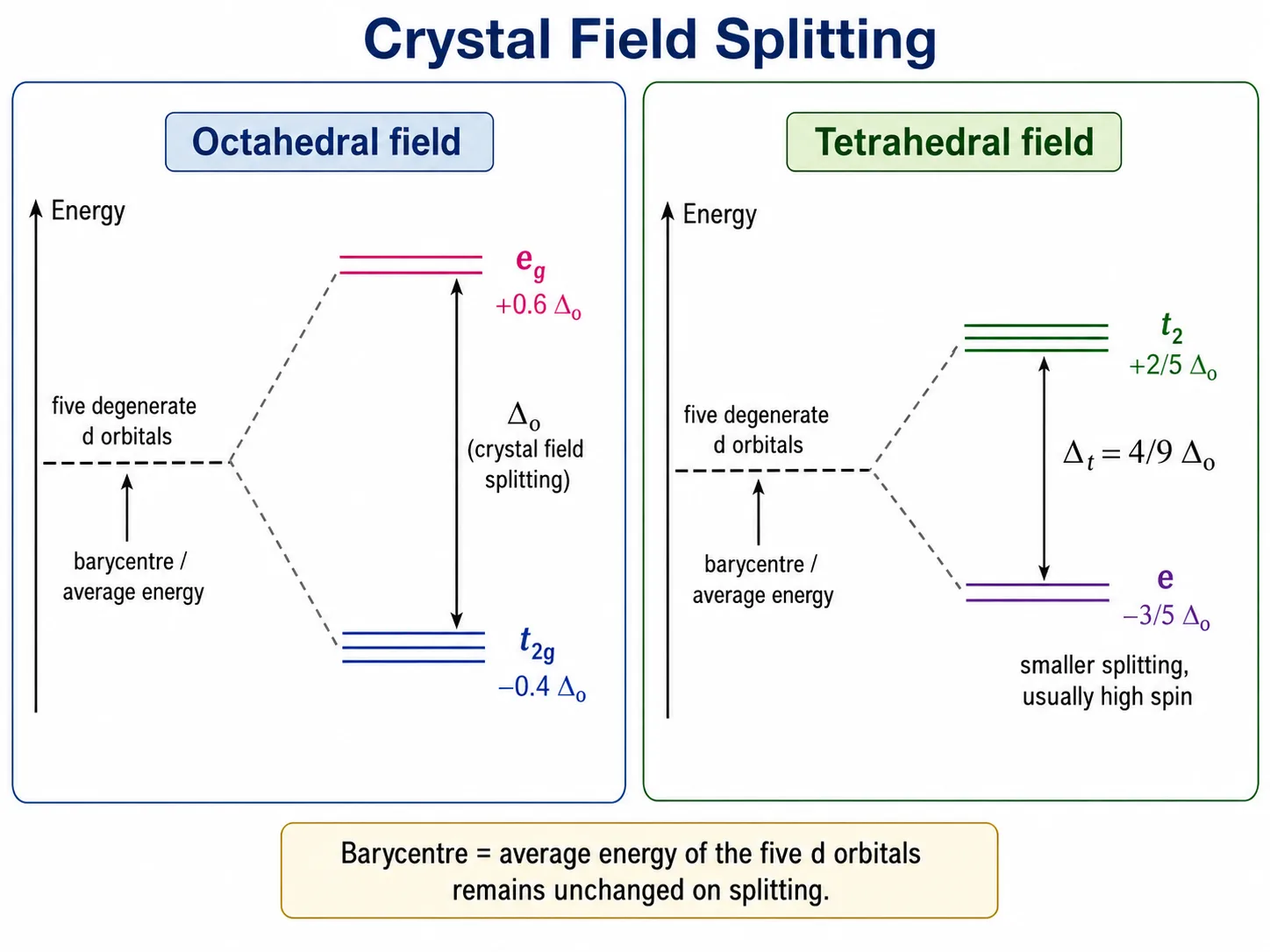
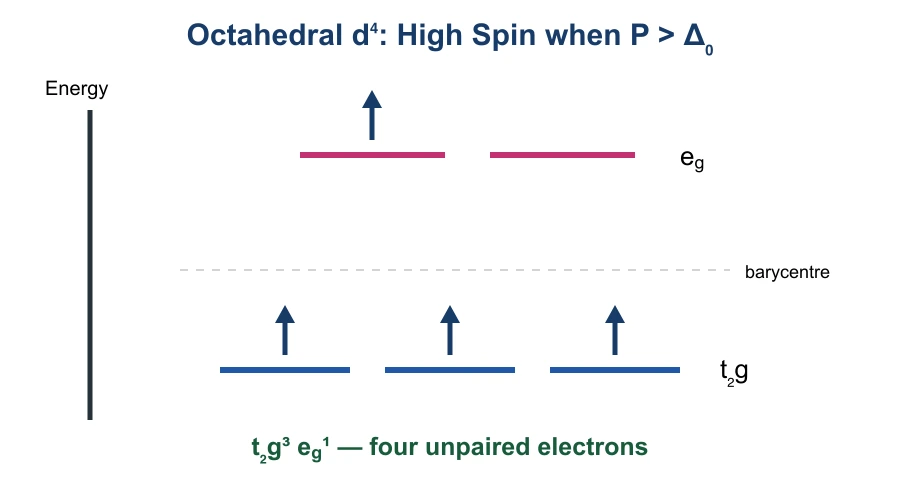
For d: the fourth electron either pairs up in t or goes up to e, depending on which costs less energy.
- If (weak field): t e, high spin.
- If (strong field): t e, low spin.
Spectrochemical series (weak to strong): I < Br < SCN < Cl < S < F < OH < CO < HO < NCS < EDTA < NH < en < CN < CO
Splitting also grows with the charge on the metal and from tetrahedral to octahedral. So the increasing order of splitting is [NiCl] < [CoF] < [Co(HO)] < [Co(CN)].
Colour: an electron jumps from t to e by absorbing visible light, and we see the complementary colour. [Ti(HO)] is violet for this reason.
Metal carbonyls:
| Carbonyl | Shape |
|---|---|
| [Ni(CO)] | tetrahedral |
| [Fe(CO)] | trigonal bipyramidal |
| [Cr(CO)] | octahedral |
| [Mn(CO)] | two square pyramidal Mn(CO) units joined by an Mn–Mn bond |
| [Co(CO)] | Co–Co bond with two bridging CO groups |
Bonding: the M–C σ bond forms when the lone pair on the carbon of CO is donated into an empty metal orbital. The M–C π bond forms when a filled metal d orbital gives electrons back into the empty antibonding π* orbital of CO. Each strengthens the other, so the bonding is called synergic.
Solved Examples: Werner's Theory and Naming
Question 1 (3 marks): State three postulates of Werner's theory.
Answer. The postulates of Werner's theory of coordination compounds are:
- In coordination compounds, the metal shows two types of valencies: primary valency and secondary valency.
- Primary valencies are ionisable and are satisfied by negative ions. They correspond to the oxidation state of the metal.
- Secondary valencies are non-ionisable and are satisfied by neutral molecules or negative ions. The secondary valency is equal to the coordination number, and these valencies are directed in space, which gives the complex its definite shape.
Question 2 (3 marks): CoCl·6NH gives 3 moles of AgCl with excess AgNO. Write its formula as a complex, its primary and secondary valencies, and its IUPAC name.
Answer. Since 3 moles of AgCl are formed, all three chloride ions are outside the coordination sphere.
Formula of the complex: [Co(NH)]Cl
Primary valency = 3 (the oxidation state of cobalt is +3). Secondary valency = 6 (six NH ligands).
IUPAC name: hexaamminecobalt(III) chloride
Question 3 (3 marks): CoCl·4NH gives 1 mole of AgCl with excess AgNO. Write the formula of the complex and draw its geometrical isomers.
Answer. Since only 1 mole of AgCl is formed, only one Cl is outside the coordination sphere. The formula of the complex is [Co(NH)Cl]Cl.
The complex is octahedral and shows two geometrical isomers:
- cis isomer: the two Cl ligands are on adjacent positions, at 90° to each other (violet).
- trans isomer: the two Cl ligands are on opposite positions, at 180° to each other (green).
Draw two octahedra: one with the two Cl next to each other (cis) and one with the two Cl opposite each other (trans), with NH at the other four positions.
Question 4 (3 marks): For [Fe(en)Cl]Cl: (a) what is the oxidation state of Fe? (b) What is the coordination number? (c) How many moles of AgNO react with one mole of the complex?
Answer.
(a) Let the oxidation state of Fe be x. en is neutral and each Cl is −1, and the complex ion has a charge of +1.
, so . The oxidation state of Fe is +3.
(b) en is a didentate ligand. Two en and two Cl give 2 × 2 + 2 = 6. The coordination number of Fe is 6.
(c) Only the one Cl outside the bracket is ionisable, so 1 mole of AgNO reacts with one mole of the complex.
Solved Examples: VBT and CFT
Question 5 (3 marks): Using VBT, explain the hybridisation, geometry and magnetic property of [Ni(CN)]. (Atomic number of Ni = 28)
Answer. In [Ni(CN)], nickel is in the +2 state. Ni is [Ar] 3d 4s, so Ni is [Ar] 3d with two unpaired electrons.
CN is a strong field ligand. It forces the two unpaired 3d electrons to pair up, leaving one 3d orbital empty. One 3d, one 4s and two 4p orbitals mix to form four dsp hybrid orbitals, which accept four electron pairs from four CN ions.
| 3d | 4s | 4p | |
|---|---|---|---|
| Ni ion | ↑↓ ↑↓ ↑↓ ↑ ↑ | [ ] | [ ] [ ] [ ] |
| In [Ni(CN)] | ↑↓ ↑↓ ↑↓ ↑↓ xx | xx | xx xx [ ] |
(xx = electron pair donated by CN)
- Hybridisation: dsp
- Geometry: square planar
- Magnetic property: no unpaired electrons, so it is diamagnetic
Question 6 (3 marks): Using VBT, explain the hybridisation, geometry and magnetic property of [CoF]. (Atomic number of Co = 27)
Answer. In [CoF], cobalt is in the +3 state. Co is [Ar] 3d 4s, so Co is [Ar] 3d with four unpaired electrons.
F is a weak field ligand, so the 3d electrons do not pair up. One 4s, three 4p and two 4d orbitals mix to form six spd hybrid orbitals, which accept six electron pairs from six F ions.
| 3d | 4s | 4p | 4d | |
|---|---|---|---|---|
| Co ion | ↑↓ ↑ ↑ ↑ ↑ | [ ] | [ ] [ ] [ ] | [ ] [ ] [ ] [ ] [ ] |
| In [CoF] | ↑↓ ↑ ↑ ↑ ↑ | xx | xx xx xx | xx xx [ ] [ ] [ ] |
(xx = electron pair donated by F)
- Hybridisation: spd (outer orbital, high spin complex)
- Geometry: octahedral
- Magnetic property: four unpaired electrons, so it is paramagnetic
Question 7 (3 marks): Using VBT, explain the hybridisation, geometry and magnetic property of [NiCl].
Answer. In [NiCl], nickel is in the +2 state, so Ni is [Ar] 3d with two unpaired electrons.
Cl is a weak field ligand, so the 3d electrons do not pair up. One 4s and three 4p orbitals mix to form four sp hybrid orbitals, which accept four electron pairs from four Cl ions.
| 3d | 4s | 4p | |
|---|---|---|---|
| Ni ion | ↑↓ ↑↓ ↑↓ ↑ ↑ | [ ] | [ ] [ ] [ ] |
| In [NiCl] | ↑↓ ↑↓ ↑↓ ↑ ↑ | xx | xx xx xx |
(xx = electron pair donated by Cl)
- Hybridisation: sp
- Geometry: tetrahedral
- Magnetic property: two unpaired electrons, so it is paramagnetic
Question 8 (3 marks): Draw the energy level diagram for the splitting of d orbitals in an octahedral field. Write the configuration of a d ion when .
Answer. In an octahedral field, the five degenerate d orbitals of the free metal ion split into two sets:
- a lower set of three orbitals, t (d, d, d), at −0.4
- a higher set of two orbitals, e (d, d), at +0.6
Diagram: draw the five d orbitals at one level, then show them splitting into the t set below and the e set above. Label the energy gap as .
When , the fourth electron goes into the e level instead of pairing up. So the configuration of the d ion is t e (high spin complex).
Question 9 (3 marks): Write three limitations of valence bond theory.
Answer. The limitations of valence bond theory are:
- It does not explain the colour of coordination compounds.
- It does not give a quantitative explanation of the magnetic data.
- It cannot exactly predict whether a 4-coordinate complex will be tetrahedral or square planar.
Solved Examples: Isomers and Carbonyls
Question 10 (3 marks): Write the geometrical isomers of [MX(L–L)], where X is unidentate and L–L is didentate. Which one is optically inactive?
Answer. The complex [MX(L–L)] is octahedral and shows two geometrical isomers:
- cis isomer: the two X ligands are on adjacent positions.
- trans isomer: the two X ligands are on opposite positions.
The trans isomer is optically inactive, because it has a plane of symmetry. The cis isomer has no plane of symmetry, so it exists as two optically active forms (d and l) that are mirror images of each other.
Question 11 (3 marks): A complex [MAB] (M is +3) shows geometrical isomerism. Predict the denticity of A and B and describe the two isomers.
Answer. Both A and B are unidentate ligands. The coordination number is 6, so the complex is octahedral.
It shows two geometrical isomers:
- Facial (fac) isomer: the three A ligands (and the three B ligands) occupy the corners of one triangular face of the octahedron.
- Meridional (mer) isomer: the three A ligands (and the three B ligands) lie around a meridian of the octahedron.
Example: [Co(NH)(NO)].
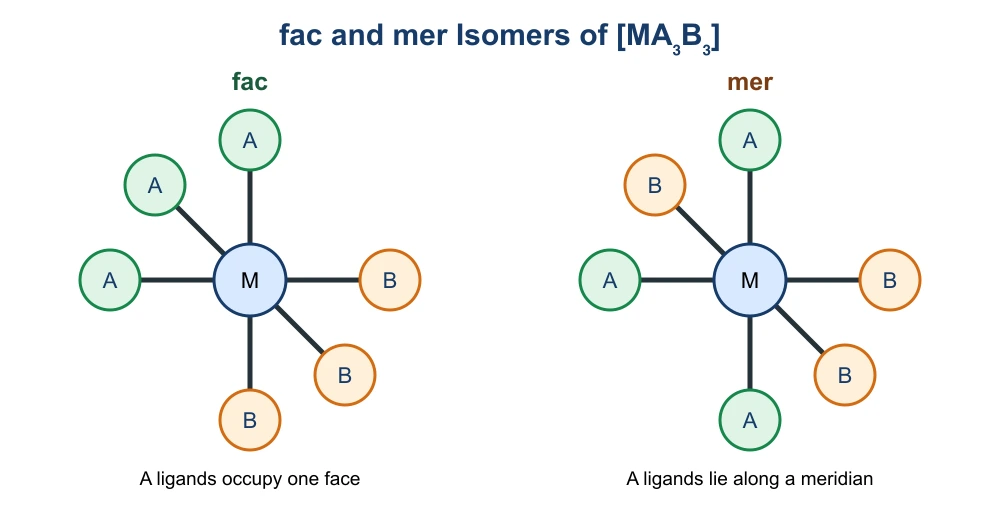
Question 12 (3 marks): Write the IUPAC name of [Co(NH)Br]SO and show the splitting of d orbitals of the metal ion according to CFT.
Answer. IUPAC name: pentaamminebromidocobalt(III) sulphate
Cobalt is in the +3 state, so Co is 3d. In this octahedral complex, the d orbitals split into a lower t set and a higher e set. NH is a strong field ligand, so all six electrons pair up in the t level.
Configuration: t e. There are no unpaired electrons, so the complex is diamagnetic.
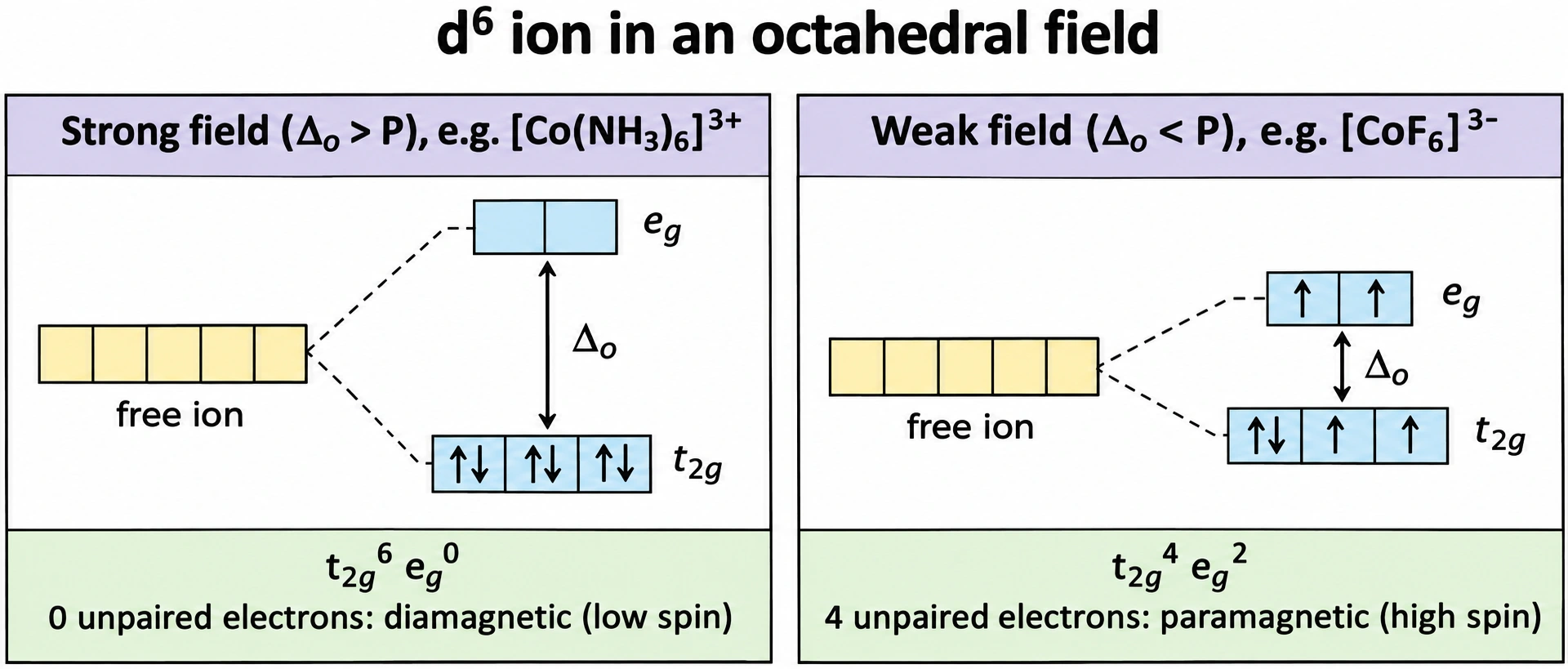
Question 13 (3 marks): Write the IUPAC name and structure of [Co(CO)]. How many bridging CO groups does it have?
Answer. IUPAC name: octacarbonyldicobalt(0)
Structure: the two cobalt atoms are joined by a Co–Co bond and by two bridging CO groups. Each cobalt atom also carries three terminal CO groups, so the total is 2 + 2 × 3 = 8 CO groups.
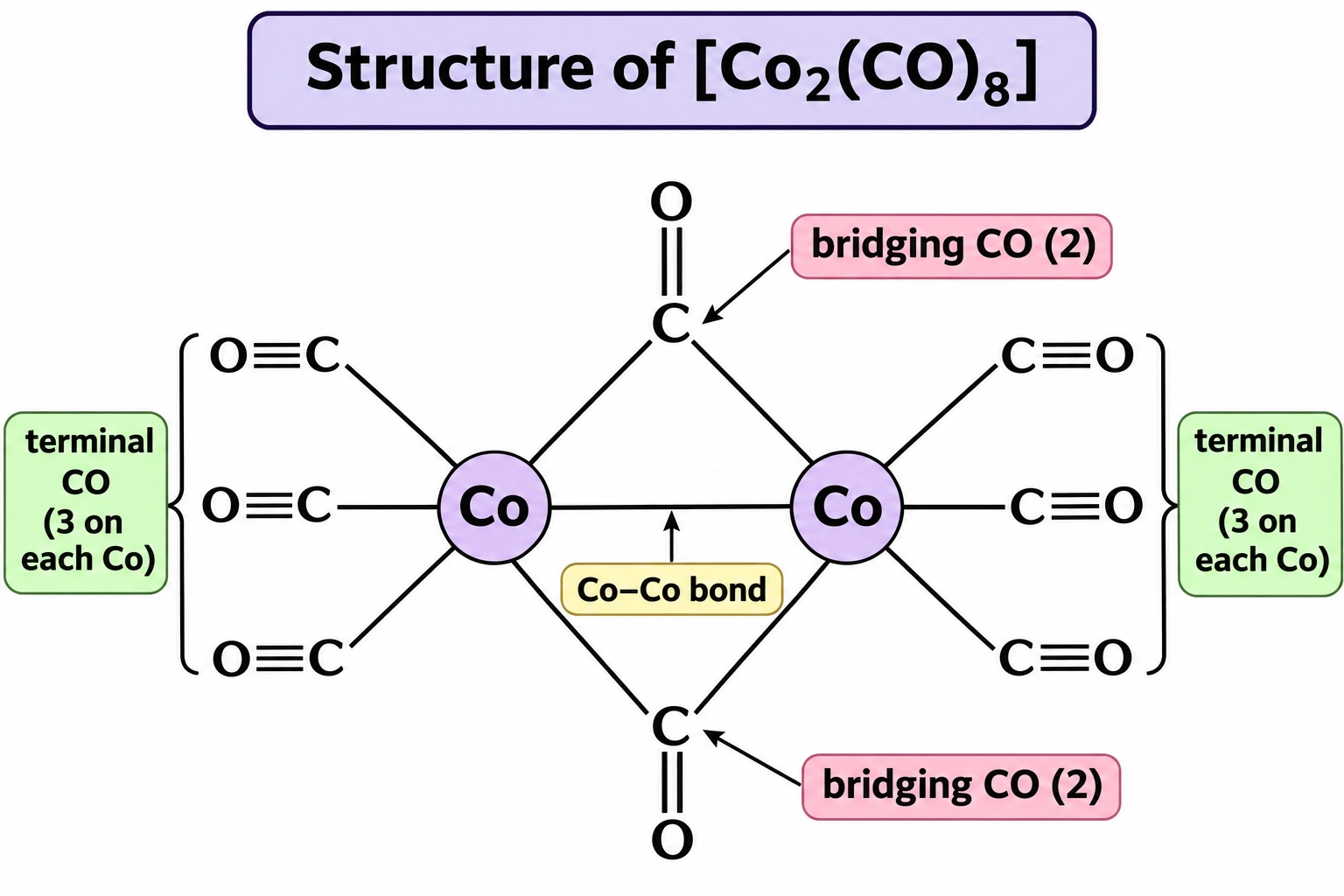
Question 14 (3 marks): How many square pyramidal units are present in decacarbonyldimanganese(0)? Write its molecular formula and describe its structure.
Answer. Molecular formula: [Mn(CO)]
It has two square pyramidal Mn(CO) units. The two units are joined by an Mn–Mn bond, and there are no bridging CO groups.
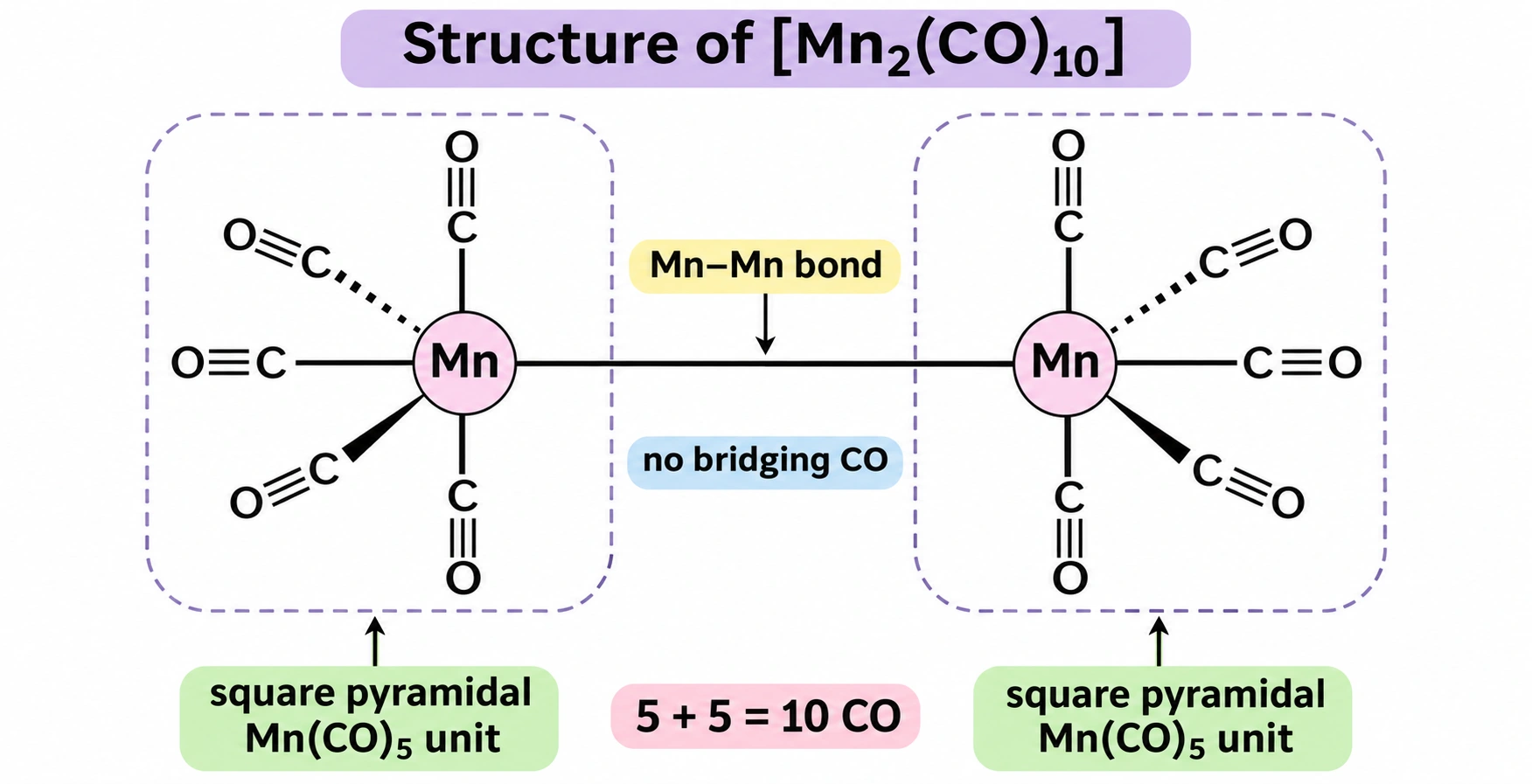
Question 15 (3 marks): Explain the M–C σ bond and M–C π bond in metal carbonyls.
Answer. The metal–carbon bond in metal carbonyls has both σ and π character.
- M–C σ bond: it is formed by the donation of the lone pair of electrons on the carbon of CO into a vacant orbital of the metal.
- M–C π bond: it is formed by the donation of a pair of electrons from a filled d orbital of the metal into the vacant antibonding π* orbital of CO.
The two bonds strengthen each other, which makes the metal–carbon bond strong. This is called synergic bonding.