
How d- and f-Block Elements Is Asked
This chapter carries 10 printed marks: usually two 1-mark questions, one 2-mark question in Part B and two of the five group IV questions in Part C. The only calculation is the spin-only magnetic moment.
What to prepare, based on the last ten papers:
| Where | Asked more than once | Also asked |
|---|---|---|
| Part A (1 mark) | Common oxidation state of element 21; catalysts matched with processes | KMnO statements and reactions, ions with [Ar]3d, oxidation states of lanthanoids and actinoids, the liquid metal, paramagnetism, Zr and Hf |
| Part B (2 marks) | What transition elements are; interstitial compounds | Lanthanoid contraction, separating lanthanoids, trends in ionisation and atomisation |
| Part C (3 marks) | KCrO from chromite ore (7 of 10 papers); lanthanoid contraction and its consequences (3 times); catalytic properties (twice) | KMnO from MnO, dichromate and permanganate with iodide, magnetic moment of Fe, reasons (Zn colourless, Ce), lanthanoids versus actinoids |
Transition Elements and Their Properties
Transition elements have an incompletely filled d subshell either in the atom or in their common oxidation states. Zn, Cd and Hg (full d in atom and ions) are not counted as transition elements. Example: iron, [Ar] 3d 4s.
Configurations to remember: Cr is [Ar] 3d 4s and Cu is [Ar] 3d 4s, because half-filled and completely filled d subshells are extra stable.
| Property | What to say | Example asked |
|---|---|---|
| Oxidation states | Variable, because 3d and 4s energies are close | Sc shows only +3; Mn reaches +7 |
| Ionisation enthalpy | Second IE is very high when it breaks a stable d or d | Highest second IE in 3d series: Cu |
| Enthalpy of atomisation | High, from strong metallic bonding by unpaired d electrons | Lowest in 3d series: Zn (no unpaired d electrons) |
| Electrode potential | Most values are negative | Only Cu is positive (+0.34 V), so Cu doesn't release H from dilute acids |
| Colour | d–d transition of an electron absorbs visible light | Zn, Sc, Ti (d or d) are colourless |
| Magnetism | Paramagnetism comes from unpaired electrons: BM | Fe (3d, n = 4): 4.90 BM |
| Oxides | Lower oxides are ionic and basic; higher ones are covalent and acidic | MnO is a covalent green oil |
- Scandium is the only 3d element that doesn't form a monoxide MO.
- Ions with the same configuration: Fe and Mn are both 3d.
- Ti, V and Cr are strong reducing agents and release hydrogen from dilute acids.
- Mercury is the metal that is liquid at room temperature.
Catalytic properties: transition metals and their compounds are good catalysts because they show variable oxidation states, can form complexes, and offer a surface where reactants are adsorbed.
| Catalyst | Process |
|---|---|
| VO | Contact process (oxidation of SO to SO) |
| Finely divided Fe | Haber process for NH |
| Ni | Hydrogenation of oils |
| PdCl | Wacker process (oxidation of ethyne to ethanal) |
| TiCl + Al(CH) (Ziegler catalyst) | Making polythene |
Interstitial compounds form when small atoms like H, C or N get trapped in the gaps of a metal lattice, for example TiC, MnN, FeH. They have higher melting points than the pure metal, are very hard, keep metallic conductivity and are chemically inert.
Alloys: UK "silver" coins are made of copper and nickel. Brass is copper with zinc; bronze is copper with tin.
Potassium Dichromate and Potassium Permanganate
KCrO from chromite ore (asked in 7 of the last 10 papers):
Chromate (yellow) and dichromate (orange) change into each other with pH. Dichromate oxidises iodide in acid:
KMnO from MnO: fuse MnO with KOH in air to get green potassium manganate, then oxidise it.
On heating to 513 K, KMnO gives off oxygen:
KMnO is a powerful oxidant. What it turns iodide into depends on the medium:
- Acidic: (iodine)
- Neutral or faintly alkaline: (iodate)
Mn is +7 in MnO (3d), so permanganate is diamagnetic. Its colour comes from charge transfer, not d–d transitions.
Lanthanoids and Actinoids
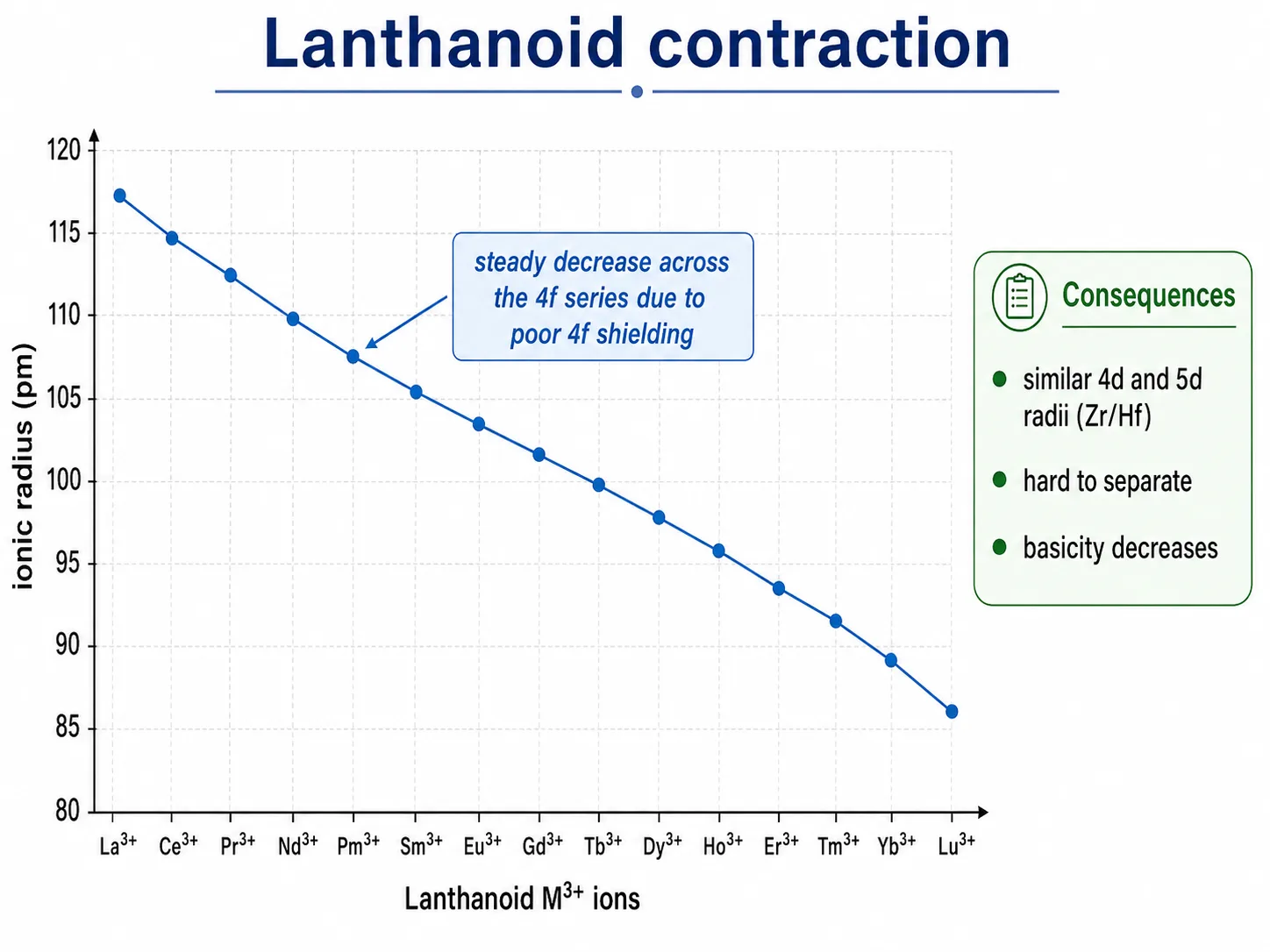
Lanthanoid contraction: the steady decrease in atomic and ionic radii from lanthanum to lutetium. It happens because 4f electrons shield each other poorly from the nucleus, so the growing nuclear charge pulls the electrons in.
Consequences:
- Zr and Hf have almost the same radius (160 and 159 pm), so the second and third transition series are very alike.
- Lanthanoids have very similar properties, so separating them is difficult.
- Basic strength of the hydroxides falls from La(OH) to Lu(OH).
Oxidation states: lanthanoids mostly show +3. Cerium also shows +4, because Ce gets the noble gas configuration (4f). Eu (4f) and Yb (4f) are other exceptions. La (4f) and Lu (4f) are colourless.
Chemistry of lanthanoids: the early members are quite reactive, like calcium; with increasing atomic number they behave more like aluminium. They burn in oxygen, , and on heating with carbon (2773 K) form the carbides LnC, LnC and LnC. Mischmetal (about 95% lanthanoid metal, 5% iron, traces of S, C, Ca and Al) is used in lighter flints and in Mg-based alloys for bullets. Mixed lanthanoid oxides are used as catalysts in petroleum cracking.
Actinoids generally show +3, but have a wider range of states. Maximum states: Th +4, Pa +5, U +6, Np and Pu +7, Lr +3. Studying actinoids is difficult because they are radioactive, many have short half-lives, and they are available only in tiny amounts.
| Lanthanoids | Actinoids |
|---|---|
| Mostly +3; few other states | Wider range of states, up to +7 |
| Mostly non-radioactive (except promethium) | All radioactive |
| Less tendency to form complexes | Greater tendency to form complexes |
| 4f electrons are filled | 5f electrons are filled |
| Smaller contraction | Larger contraction (5f shields even less) |
Solved Examples
Question 1 (2 marks): What are transition elements? Give an example.
Answer. Transition elements are the elements which have an incompletely filled d subshell either in their atoms or in their common oxidation states.
Example: iron (Fe), whose configuration is [Ar] 3d 4s.
Question 2 (2 marks): Write two characteristics of interstitial compounds.
Answer. Interstitial compounds are formed when small atoms like H, C or N are trapped in the gaps of a metal lattice. Two characteristics:
- They have higher melting points than the pure metals.
- They are very hard. Some borides are nearly as hard as diamond.
Also accepted: they keep metallic conductivity, and they are chemically inert.
Question 3 (3 marks): Write the balanced equations for the manufacture of potassium dichromate from chromite ore.
Answer. Potassium dichromate is made from chromite ore (FeCrO) in three steps.
Step 1: Chromite is fused with sodium carbonate in free access of air to form sodium chromate.
Step 2: The yellow sodium chromate solution is acidified to get orange sodium dichromate.
Step 3: Sodium dichromate is treated with potassium chloride to get potassium dichromate.
Question 4 (3 marks): Explain the preparation of potassium permanganate from MnO with balanced equations. Which gas is given off when KMnO is heated to 513 K?
Answer.
Step 1: MnO is fused with KOH in the presence of air to give green potassium manganate.
Step 2: Potassium manganate disproportionates in a neutral or acidic solution to give potassium permanganate.
On heating to 513 K, KMnO gives off oxygen gas.
Question 5 (3 marks): What is lanthanoid contraction? Mention two consequences.
Answer. Lanthanoid contraction is the steady decrease in the atomic and ionic radii of the lanthanoids from lanthanum to lutetium. It happens because the 4f electrons shield each other poorly from the nuclear charge.
Consequences:
- Zirconium and hafnium have almost the same atomic radius (160 pm and 159 pm), so their properties are very similar.
- The lanthanoids have very similar properties, so it is difficult to separate them from each other.
Question 6 (3 marks): Write three differences between lanthanoids and actinoids.
Answer.
| Lanthanoids | Actinoids |
|---|---|
| They mostly show +3 oxidation state; only a few show +2 and +4. | They show a wider range of oxidation states, up to +7. |
| Most of them are not radioactive (except promethium). | All of them are radioactive. |
| They have less tendency to form complexes. | They have a greater tendency to form complexes. |
Question 7 (2 marks): Calculate the spin-only magnetic moment of Fe. (Atomic number of Fe = 26)
Answer.
Given: Fe (Z = 26) is [Ar] 3d 4s, so Fe is [Ar] 3d. Six electrons in five d orbitals give 4 unpaired electrons (n = 4).
Formula: BM
Substitution:
Answer: Spin-only magnetic moment of Fe = 4.90 BM
Question 8 (3 marks): Give reasons. (a) Zn is colourless. (b) Cerium shows +4 oxidation state. (c) Zr and Hf have similar radii.
Answer.
(a) Zn has the configuration 3d. Its d subshell is completely filled, so no d–d transition is possible. It does not absorb visible light, so it is colourless.
(b) In the +4 state, cerium (Ce) gets the noble gas configuration 4f, which is very stable. So cerium shows +4 oxidation state.
(c) Because of lanthanoid contraction, the size of hafnium becomes almost the same as that of zirconium.
Question 9 (2 marks): Write balanced ionic equations for (i) dichromate with iodide in acid, and (ii) permanganate with iodide in neutral or faintly alkaline solution.
Answer.
(i) In acidic medium, dichromate oxidises iodide to iodine:
(ii) In neutral or faintly alkaline medium, permanganate oxidises iodide to iodate:
Question 10 (3 marks): Give two reasons for the catalytic property of transition elements. Name the catalyst used in the Wacker process.
Answer. Transition metals and their compounds act as good catalysts because:
- They show variable oxidation states, so they can easily take in and give out electrons.
- They can form complexes, and their surfaces can adsorb the reacting molecules.
The catalyst used in the Wacker process is PdCl.
Question 11 (3 marks): Among the 3d transition elements, name the element that (i) doesn't form a monoxide, (ii) has a positive , and (iii) is the base of the Ziegler catalyst used to make polythene.
Answer.
(i) Scandium does not form a monoxide.
(ii) Copper has a positive value.
(iii) Titanium: the Ziegler catalyst is TiCl with Al(CH).
Question 12 (2 marks): Write the formulas of the three carbides formed when lanthanoids are heated with carbon. Write the equation for their reaction with oxygen.
Answer. When lanthanoids are heated with carbon, they form the carbides LnC, LnC and LnC.
Lanthanoids burn in oxygen to form their oxides:
Question 13 (2 marks): Give reasons. (i) Separating lanthanoids is difficult. (ii) Studying actinoids is difficult.
Answer.
(i) Because of lanthanoid contraction, all the lanthanoids have very similar sizes and chemical properties. So it is difficult to separate them from each other.
(ii) Actinoids are radioactive, many of them have very short half-lives, and they are available only in very small amounts. So it is difficult to study them.