
How Amines Is Asked
Amines carries 7 printed marks: usually two 1-mark questions and one Part D question. It's the smallest chapter, but its Part D question is one of the most predictable.
What to prepare, based on the last ten papers:
| Where | Asked more than once | Also asked |
|---|---|---|
| Part A (1 mark) | Formula of Hinsberg's reagent; the para group that raises aniline's basicity; Gabriel synthesis, as a blank (twice each) | Order of basic strength, diazonium salt to benzene, coupling reactions, zwitter ion, Hofmann's reaction, carbylamine test, what Gabriel synthesis can't make |
| Part D (5 marks) | Carbylamine reaction and IUPAC names (3 times each); Gabriel synthesis, Hinsberg test, Hofmann bromamide reaction, coupling to p-aminoazobenzene, nitrobenzene to aniline (twice each) | Diazotisation, aniline to 4-bromoaniline, diazonium salt with HBF and KI, basic strength, nitration of aniline, why aniline doesn't undergo Friedel–Crafts |
Structure, Naming and Preparation
Structure: nitrogen in amines is sp hybridised with one lone pair, so amines are pyramidal. Trimethylamine's N is sp; dimethylamine's N has one lone pair.
IUPAC names: CHCHCHNH is propan-1-amine. (CH)N–CH is N,N-dimethylethanamine. CHNH is aniline (benzenamine).
| Method | Reaction | Note |
|---|---|---|
| Reduction of nitro compounds | CHNO with Fe + HCl (or Sn + HCl, or H/Pd) gives CHNH | Fe/HCl is preferred: the FeCl formed is hydrolysed and releases HCl, so only a little acid is needed |
| Ammonolysis | RX + NH gives RNH, then RNH, RN and finally RNX | Gives a mixture; the final product is a quaternary ammonium salt. A large excess of NH makes the primary amine the main product |
| Reduction of nitriles and amides | RCN or RCONH with LiAlH | Gives RCHNH |
| Gabriel phthalimide synthesis | Phthalimide + ethanolic KOH, then RX, then alkaline hydrolysis | Gives pure primary aliphatic amines only. Aniline can't be made, because aryl halides don't do nucleophilic substitution with the phthalimide anion |
| Hofmann bromamide degradation | The amine has one carbon less than the amide. So CHNH (CHN) comes from acetamide (CHNO) |
Gabriel synthesis of methylamine:
- Phthalimide + KOH (ethanolic) → potassium phthalimide + HO
- Potassium phthalimide + CHI → N-methylphthalimide + KI
- N-methylphthalimide + 2NaOH (aq) → CHNH + sodium phthalate
Basic Strength
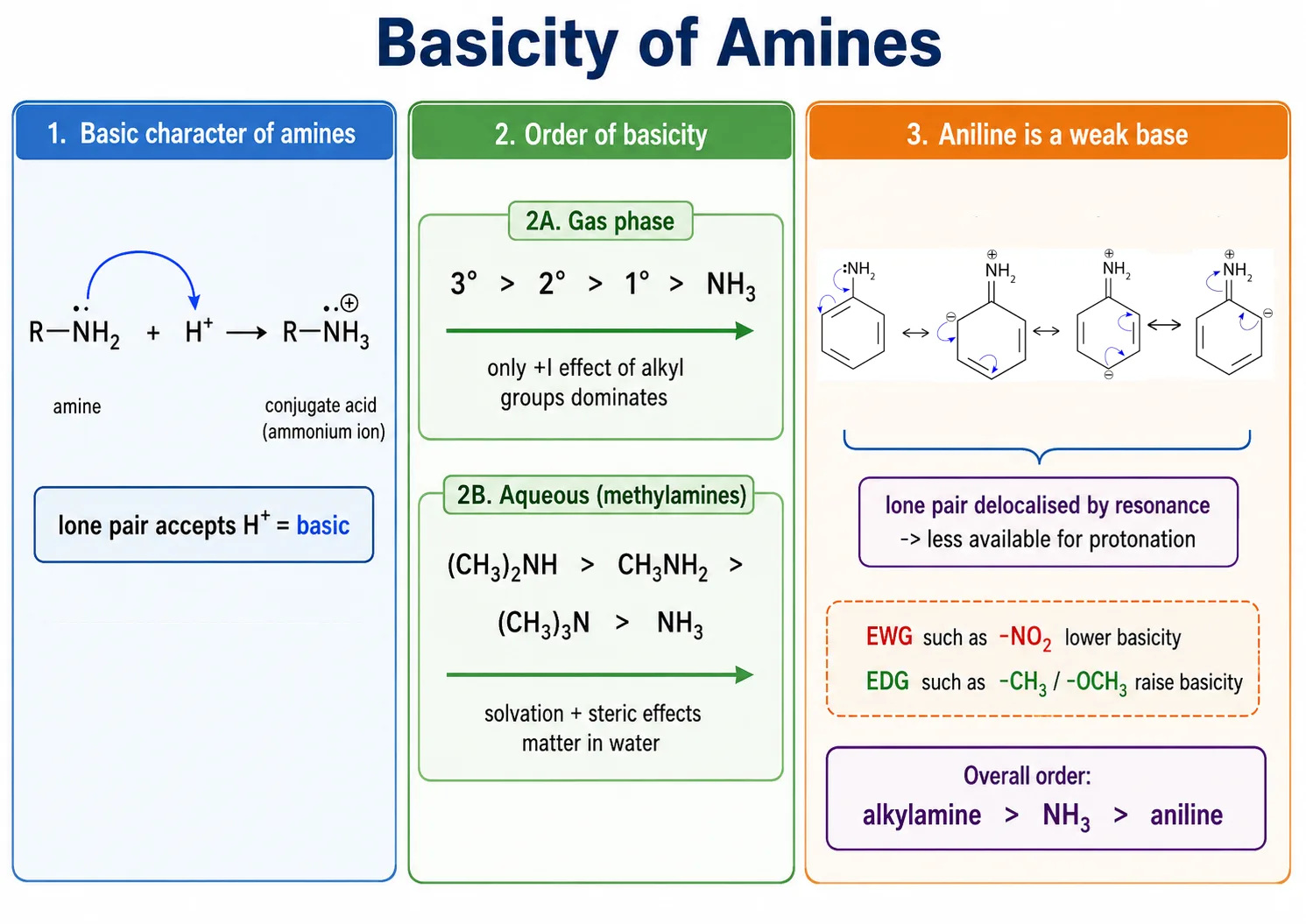
Amines are bases because the lone pair on nitrogen can take up a proton.
Factors that decide basic strength in water:
- Inductive effect: alkyl groups push electrons towards N and make the lone pair more available.
- Solvation: the substituted ammonium ion is stabilised by hydrogen bonding with water. More N–H bonds mean better solvation, so primary ammonium ions are stabilised most.
- Steric hindrance: bulky groups crowd the nitrogen and block both protonation and solvation.
Because these pull in different directions, the orders in water are:
- Methyl series: (CH)NH > CHNH > (CH)N > NH. Dimethylamine is the most basic.
- Ethyl series: (CH)NH > (CH)N > CHNH > NH.
Aryl amines are weaker bases than ammonia, because the lone pair on N is spread into the benzene ring by resonance. In aniline, an electron-donating group at the para position (–NH, –OCH, –CH) raises basicity; an electron-withdrawing group (–NO, –COOH, –Br) lowers it.
Tests and Reactions of Aniline
Carbylamine (isocyanide) test: only primary amines, aliphatic or aromatic, react. Heating with chloroform and alcoholic KOH gives an isocyanide with a foul smell.
Hinsberg test with benzenesulphonyl chloride, CHSOCl:
- Primary amine: gives N-alkylbenzenesulphonamide, which dissolves in alkali (its N–H is acidic).
- Secondary amine: gives N,N-dialkylbenzenesulphonamide, which doesn't dissolve in alkali (no H on N).
- Tertiary amine: doesn't react.
Electrophilic substitution of aniline: –NH strongly activates the ring and directs ortho and para.
- Bromine water gives 2,4,6-tribromoaniline (white precipitate) straight away. To get monobromoaniline, first acetylate the –NH to tone down its effect, then brominate, then hydrolyse.
- Nitration at 288 K with conc. HNO and HSO gives p-nitroaniline (51%), m-nitroaniline (47%) and o-nitroaniline (2%). The large meta share is because, in strong acid, aniline is protonated to the anilinium ion, which directs meta. Some aniline is also oxidised.
- Sulphonation: with conc. HSO, aniline forms anilinium hydrogensulphate, which on heating at 453–473 K gives sulphanilic acid. It exists as a zwitter ion.
- Friedel–Crafts reactions don't happen: aniline, a base, forms a salt with AlCl, a Lewis acid. The nitrogen then carries a positive charge and deactivates the ring.
Diazonium Salts
Diazotisation: aniline with NaNO and HCl at 273–278 K gives benzene diazonium chloride. It's used right away because it decomposes when warmed.
| Reagent | Product |
|---|---|
| CuCl/HCl or CuBr/HBr (Sandmeyer) | Chlorobenzene or bromobenzene |
| CuCN/KCN | Benzonitrile |
| KI | Iodobenzene + KCl + N |
| HBF, then heat | Benzene diazonium fluoroborate, then fluorobenzene + BF + N |
| Fluoroborate + NaNO, Cu, heat | Nitrobenzene |
| HPO + HO | Benzene |
| Warm water | Phenol |
Coupling reactions are electrophilic substitution: the diazonium ion attacks the para position of an activated ring.
- With phenol (in alkali): p-hydroxyazobenzene, orange.
- With aniline (mildly acidic): p-aminoazobenzene, yellow.
Solved Examples: Preparations and Tests
Question 1 (2 marks): Which class of amines gives the carbylamine reaction? Explain it with a general equation.
Answer. Only primary amines (both aliphatic and aromatic) give the carbylamine reaction.
When a primary amine is heated with chloroform and alcoholic potassium hydroxide, an isocyanide (carbylamine) is formed, which has a very bad smell. This reaction is used as a test for primary amines.
Question 2 (3 marks): Write the equations for preparing methylamine by Gabriel phthalimide synthesis.
Answer. In Gabriel phthalimide synthesis, methylamine is prepared in three steps.
Step 1: Phthalimide is treated with ethanolic potassium hydroxide to form potassium phthalimide.
Step 2: Potassium phthalimide is heated with methyl iodide to form N-methylphthalimide.
Step 3: N-methylphthalimide is hydrolysed with aqueous NaOH to give methylamine and sodium phthalate.
Question 3 (2 marks): How is methanamine prepared by Hofmann bromamide degradation? Write the equation.
Answer. When acetamide is heated with bromine and an aqueous solution of sodium hydroxide, methanamine is formed. The amine formed has one carbon atom less than the amide.
Question 4 (2 marks): How do you tell a primary amine from a secondary amine with Hinsberg's reagent?
Answer. Hinsberg's reagent is benzenesulphonyl chloride, CHSOCl.
A primary amine reacts with Hinsberg's reagent to form N-alkylbenzenesulphonamide. It has an acidic hydrogen on nitrogen, so it dissolves in alkali (KOH).
A secondary amine forms N,N-dialkylbenzenesulphonamide. It has no hydrogen on nitrogen, so it does not dissolve in alkali.
Question 5 (2 marks): How is aniline obtained from nitrobenzene? Which reducing agent is preferred, and why?
Answer. Aniline is obtained by reducing nitrobenzene with iron scrap and hydrochloric acid.
Fe/HCl is preferred because the FeCl formed gets hydrolysed and releases HCl again. So only a small amount of hydrochloric acid is needed.
Question 6 (3 marks): Mention three factors that decide the basic strength of alkyl amines in water.
Answer. The basic strength of alkyl amines in aqueous solution depends on:
- Inductive effect: alkyl groups are electron releasing. They push electrons towards nitrogen and increase the basic strength.
- Solvation effect: the ammonium ion formed is stabilised by hydrogen bonding with water. The more N–H bonds it has, the more it is stabilised.
- Steric hindrance: bulky alkyl groups crowd the nitrogen atom and decrease the basic strength.
Solved Examples: Aniline and Diazonium Salts
Question 7 (2 marks): Explain the conversion of aniline to benzene diazonium chloride with an equation.
Answer. When aniline is treated with sodium nitrite and hydrochloric acid at 273–278 K, benzene diazonium chloride is formed. This reaction is called diazotisation.
Question 8 (3 marks): Write the equations for converting aniline into 4-bromoaniline.
Answer. The –NH group of aniline is first protected by acetylation. Otherwise, bromine water gives 2,4,6-tribromoaniline.
Step 1, acetylation of aniline to acetanilide:
Step 2, bromination of acetanilide:
Step 3, hydrolysis to 4-bromoaniline:
Question 9 (3 marks): Write the products when aniline is nitrated at 288 K. Why is a large amount of the meta product formed?
Answer. Nitration of aniline at 288 K gives p-nitroaniline (51%), m-nitroaniline (47%) and o-nitroaniline (2%).
In the strongly acidic nitrating mixture, aniline gets protonated to form the anilinium ion, CHNH. The anilinium ion is electron withdrawing and meta directing. So a large amount of the meta product is formed.
Question 10 (2 marks): Name one electrophilic substitution reaction that aniline doesn't undergo. Justify.
Answer. Aniline does not undergo the Friedel–Crafts reaction (alkylation or acylation).
Reason: aniline is a base, so it forms a salt with AlCl, the Lewis acid used as the catalyst. The nitrogen then gets a positive charge, which deactivates the benzene ring.
Question 11 (2 marks): How do you convert benzene diazonium chloride to p-aminoazobenzene?
Answer. Benzene diazonium chloride is coupled with aniline in a mildly acidic medium. The diazonium ion attacks the para position of aniline, and p-aminoazobenzene, a yellow dye, is formed. This is called a coupling reaction.
Question 12 (2 marks): Complete: (i) CHNCl + HBF, then heat → ? + ? + N; (ii) the fluoroborate with NaNO/Cu, heat → ?
Answer.
(i) Benzene diazonium chloride first forms benzene diazonium fluoroborate with HBF. On heating, it decomposes to give fluorobenzene and BF along with N.
(ii) When the fluoroborate is heated with aqueous NaNO in the presence of copper, nitrobenzene is formed.
Question 13 (2 marks): Aniline is treated with NaNO + 2HCl at 273–278 K to give X. X with Y gives CHI + KCl + N. Identify X and Y.
Answer. X = benzene diazonium chloride, CHNCl
Y = potassium iodide, KI
Question 14 (1 mark): Write the IUPAC names of (i) CHCHCHNH and (ii) (CH)N–CH.
Answer. (i) Propan-1-amine (ii) N,N-Dimethylethanamine
Question 15 (1 mark): Which is more basic, an aryl amine or ammonia?
Answer. Ammonia is more basic. In aryl amines, the lone pair on nitrogen is delocalised into the benzene ring by resonance, so it is less available to accept a proton.