
How Biomolecules Is Asked
Biomolecules carries 9 printed marks: usually two 1-mark questions, one 2-mark question in Part B and one Part D question. Most of it is direct recall, so it's a reliable source of marks.
What to prepare, based on the last ten papers:
| Where | Asked more than once | Also asked |
|---|---|---|
| Part A (1 mark) | The vitamin from sunlight, fish and egg yolk (vitamin D); reducing sugars (twice each) | Vitamins and deficiency diseases, D/L configuration of amino acids, peptide linkages, enzymes, glycosidic and phosphodiester linkages, starch |
| Part B (2 marks) | Bases common to DNA and RNA; essential and non-essential amino acids (twice each) | Haworth structures, insulin, keratin and egg albumin, glucocorticoids |
| Part D (5 marks) | Haworth structure of maltose, lactose or sucrose (4 times); amino acids and glycine (4 times); glucose reactions (3 times); peptide linkage, fibrous versus globular proteins, the base found only in RNA, hormones (twice each) | Amylose and amylopectin, forces in protein structure, DNA backbone, vitamin deficiency |
Carbohydrates
Classification by hydrolysis:
- Monosaccharides can't be hydrolysed further: glucose (aldohexose), fructose (ketohexose).
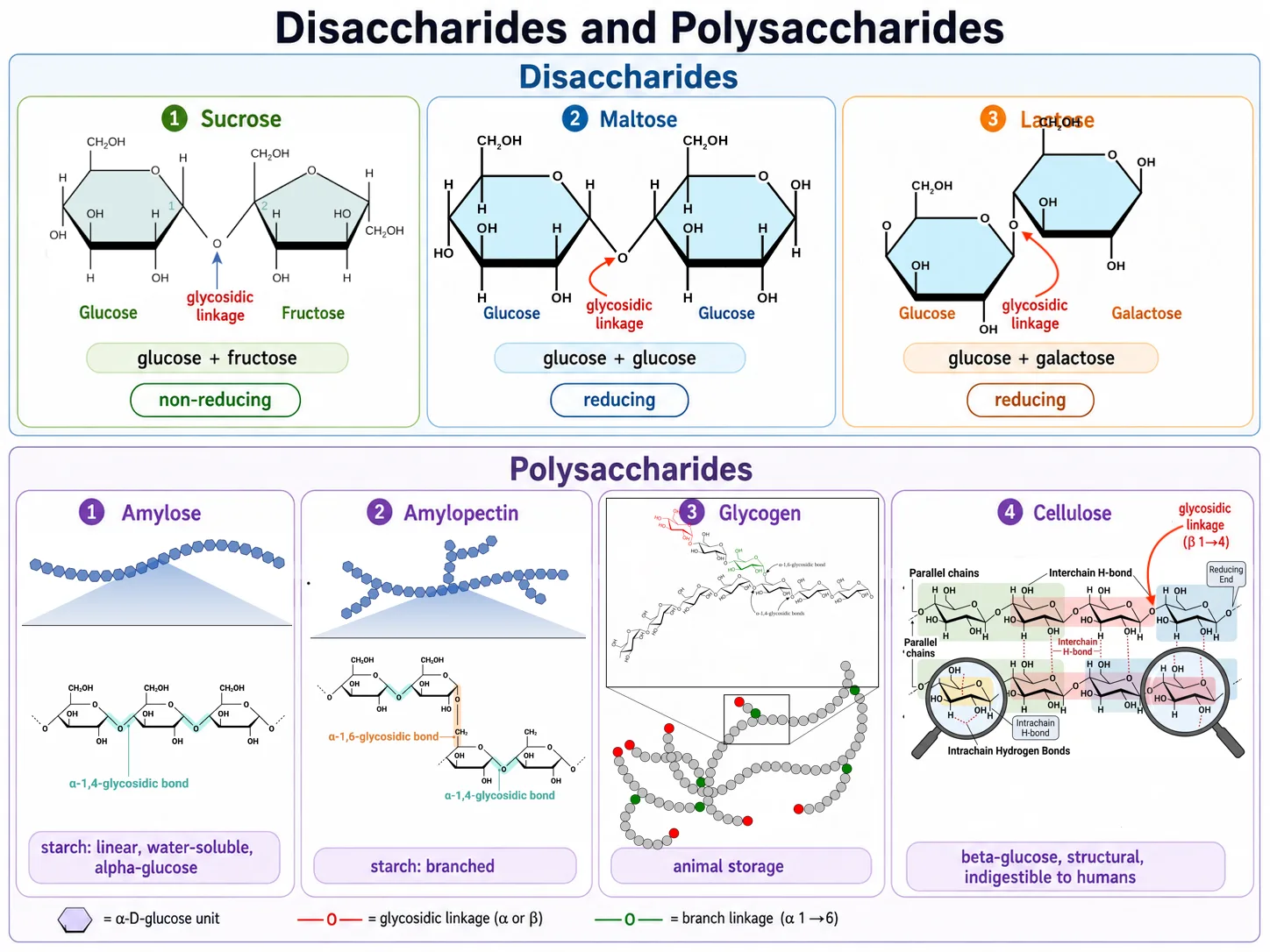
- Oligosaccharides give two to ten monosaccharide units: sucrose, maltose, lactose (disaccharides).
- Polysaccharides give many units: starch, cellulose, glycogen.
Reducing sugars reduce Fehling's solution and Tollens' reagent: all monosaccharides, maltose and lactose. Sucrose is non-reducing, because both of its anomeric carbons are tied up in the glycosidic bond.
Glucose from starch:
Reactions that reveal glucose's structure:
| Reagent | Product | What it shows |
|---|---|---|
| HI, prolonged heating | n-Hexane | Six carbons in a straight chain |
| NHOH or HCN | Oxime or cyanohydrin | A carbonyl group |
| Bromine water | Gluconic acid | The carbonyl is an aldehyde (mild oxidant; only –CHO is oxidised) |
| Acetic anhydride | Glucose pentaacetate | Five –OH groups |
| Nitric acid | Saccharic acid | A primary alcohol (–CHOH) group, oxidised along with –CHO |
Glucose also exists in cyclic forms, α and β (anomers), drawn as six-membered pyranose rings in Haworth structures.
Disaccharides:
| Sugar | Made of | Linkage | Reducing? |
|---|---|---|---|
| Sucrose | α-D-glucose + β-D-fructose | C1 of glucose to C2 of fructose | No |
| Maltose | Two α-D-glucose | C1 to C4 | Yes |
| Lactose (milk sugar) | β-D-galactose + β-D-glucose | C1 of galactose to C4 of glucose | Yes |
Units in disaccharides and polysaccharides are joined by glycosidic linkages, and these are the bonds broken on hydrolysis. Sucrose is dextrorotatory, but its hydrolysis gives a laevorotatory mixture, so the product is called invert sugar. The enzyme maltase hydrolyses maltose to glucose.
Polysaccharides:
- Starch = amylose (15–20%, water-soluble, an unbranched chain of α-D-glucose joined C1–C4) + amylopectin (80–85%, insoluble, branched, with C1–C4 links in the chain and C1–C6 links at the branches).
- Cellulose is a straight chain of β-D-glucose (C1–C4). It is the main component of plant cell walls and the most abundant organic substance in the plant kingdom.
- Glycogen ("animal starch") is stored in liver, muscles and brain.
Amino Acids, Proteins and Enzymes
Amino acids have an –NH and a –COOH group. In water they exist as zwitter ions, HN–CHR–COO.
- Essential amino acids can't be made by the body and must come from food: valine, leucine, isoleucine, lysine, phenylalanine and others.
- Non-essential amino acids are made by the body: glycine, alanine, glutamic acid and others.
- Glycine (HN–CH–COOH) is the only common α-amino acid that is optically inactive: its α-carbon carries two H atoms, so it isn't chiral.
- Most naturally occurring amino acids have the L-configuration.
Peptide linkage: the –CO–NH– bond formed when the –COOH of one amino acid joins the –NH of another, losing water. Glycylalanine is HN–CH–CO–NH–CH(CH)–COOH and has one peptide linkage. A tripeptide has three amino acids and two peptide linkages.
| Fibrous proteins | Globular proteins |
|---|---|
| Long, thread-like chains held side by side | Chains folded into a sphere |
| Insoluble in water | Soluble in water |
| Keratin (hair, wool, silk), myosin (muscle) | Insulin, albumins (egg albumin) |
Structure of proteins: primary (the sequence of amino acids), secondary (α-helix and β-pleated sheet, held by hydrogen bonds), tertiary (overall folding) and quaternary (several chains together). Secondary and tertiary structures are held by hydrogen bonds, disulphide linkages, van der Waals forces and electrostatic attractions. Denaturation (by heat or pH) destroys these, but leaves the primary structure.
Enzymes are biological catalysts, mostly globular proteins, that catalyse biochemical reactions in living systems.
Vitamins, Nucleic Acids and Hormones
Vitamins are needed in small amounts for normal growth. Most of them don't contain amino groups, despite the name.
- Fat-soluble vitamins (A, D, E, K) are stored in the liver and adipose (fat-storing) tissues.
- Water-soluble vitamins (B group, C) must be taken regularly, because they're excreted in urine. (B is the exception: it is stored in the liver.)
| Vitamin | Deficiency disease |
|---|---|
| A | Xerophthalmia, night blindness |
| B (thiamine) | Beri-beri |
| B (riboflavin) | Cheilosis |
| B (pyridoxine) | Convulsions |
| B | Pernicious anaemia |
| C (ascorbic acid) | Scurvy |
| D | Rickets (children), osteomalacia (adults); sources include sunlight, fish and egg yolk |
| E | Increased fragility of red blood cells |
| K | Increased blood clotting time |
Nucleic acids are long-chain polymers of nucleotides. A nucleotide is a base + a pentose sugar + a phosphate group. Nucleotides are joined by phosphodiester linkages between the 5' and 3' carbons of the sugars. The sugar–phosphate chain is the backbone of DNA.
| DNA | RNA | |
|---|---|---|
| Sugar | 2-deoxyribose | Ribose |
| Bases | A, G, C, T | A, G, C, U |
| Strands | Double helix | Single |
So adenine, guanine and cytosine are common to both; uracil is found only in RNA and thymine only in DNA.
Hormones are chemical messengers. They must be present in the right amounts: too little or too much upsets the body's balance and causes disorders.
- Insulin, a protein of 51 amino acids, is released quickly when blood glucose rises and brings it back down.
- Glucocorticoids control carbohydrate metabolism, modulate inflammatory reactions and are involved in responses to stress.
- Epinephrine and norepinephrine mediate responses to external stimuli.
Solved Examples: Carbohydrates
Question 1 (3 marks): Write the Haworth structure of maltose. Why is it a reducing sugar?
Answer. Maltose is made of two α-D-glucose units. C1 of the first glucose unit is joined to C4 of the second glucose unit by an α-glycosidic linkage (α-1,4 linkage).
Haworth structure: draw two six-membered rings, each with the ring oxygen at the top right. Join C1 of the first ring to C4 of the second ring through an oxygen bridge. Place the groups up or down as below:
| Carbon | First glucose unit | Second glucose unit |
|---|---|---|
| C1 | –O– link to C4 of the second unit (down, α) | OH down (α), free |
| C2 | OH down | OH down |
| C3 | OH up | OH up |
| C4 | OH down | –O– link from the first unit |
| C5 | CHOH up | CHOH up |
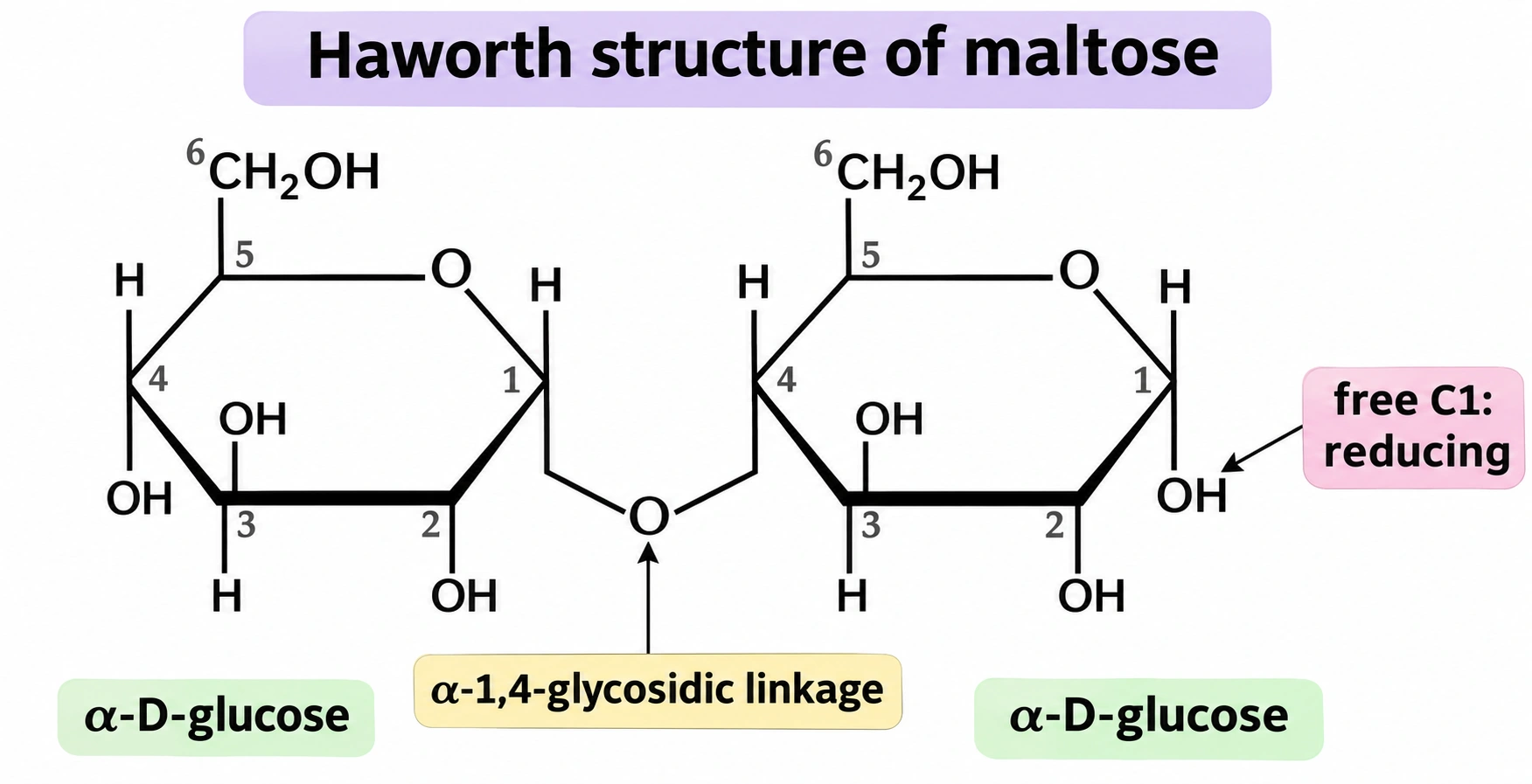
Maltose is a reducing sugar because C1 of the second glucose unit is free. That ring can open to give a free aldehyde group, which reduces Fehling's solution and Tollens' reagent.
Question 2 (2 marks): Name the two monosaccharides obtained when lactose is hydrolysed.
Answer. Hydrolysis of lactose gives β-D-galactose and β-D-glucose. In lactose, C1 of β-D-galactose is joined to C4 of β-D-glucose.
Question 3 (3 marks): Which disaccharide is called invert sugar? Explain why.
Answer. Sucrose is called invert sugar.
Sucrose is dextrorotatory (+66.5°). On hydrolysis, it gives equal amounts of D-(+)-glucose (+52.5°) and D-(−)-fructose (−92.4°).
Since the laevorotation of fructose is more than the dextrorotation of glucose, the mixture is laevorotatory. The sign of rotation changes (inverts) from dextro to laevo, so the product is called invert sugar.
Question 4 (2 marks): Write the reactions to show that glucose contains (i) five hydroxyl groups and (ii) an aldehyde group.
Answer.
(i) On acetylation with acetic anhydride, glucose forms glucose pentaacetate. This shows that glucose has five –OH groups.
(ii) On oxidation with bromine water (a mild oxidising agent), glucose gives gluconic acid, a six-carbon carboxylic acid. This shows that the carbonyl group in glucose is an aldehyde group.
Question 5 (2 marks): Which oxidising agent oxidises only the aldehyde group of glucose? Write the equation.
Answer. Bromine water oxidises only the aldehyde group of glucose and gives gluconic acid. The –CHOH group is not affected.
Note: nitric acid is a stronger oxidising agent and oxidises both ends to give saccharic acid.
Question 6 (2 marks): Illustrate the preparation of glucose from starch.
Answer. Glucose is prepared commercially by boiling starch with dilute HSO at 393 K under 2–3 atm pressure.
Question 7 (2 marks): Write two differences between amylose and amylopectin.
Answer.
| Amylose | Amylopectin |
|---|---|
| It is soluble in water. | It is insoluble in water. |
| It is a long unbranched chain with C1–C4 glycosidic linkages only. | It is a branched chain, with C1–C4 linkages in the chain and C1–C6 linkages at the branches. |
Also accepted: amylose is 15–20% of starch, amylopectin is 80–85%.
Solved Examples: Proteins, Nucleic Acids, Vitamins and Hormones
Question 8 (2 marks): What are non-essential amino acids? Name an optically inactive α-amino acid.
Answer. Amino acids which can be made in the body are called non-essential amino acids.
Glycine is optically inactive, because its α-carbon has two hydrogen atoms, so it is not chiral.
Question 9 (2 marks): What are essential amino acids? Give an example.
Answer. Amino acids which cannot be made in the body and must be obtained through the diet are called essential amino acids.
Example: valine (also leucine, lysine, phenylalanine).
Question 10 (2 marks): What is a peptide linkage? Write the structure of glycylalanine and the number of peptide linkages in it.
Answer. A peptide linkage is the amide (–CO–NH–) bond formed between the –COOH group of one amino acid and the –NH group of another amino acid, with the loss of a water molecule.
Structure of glycylalanine: HN–CH–CO–NH–CH(CH)–COOH
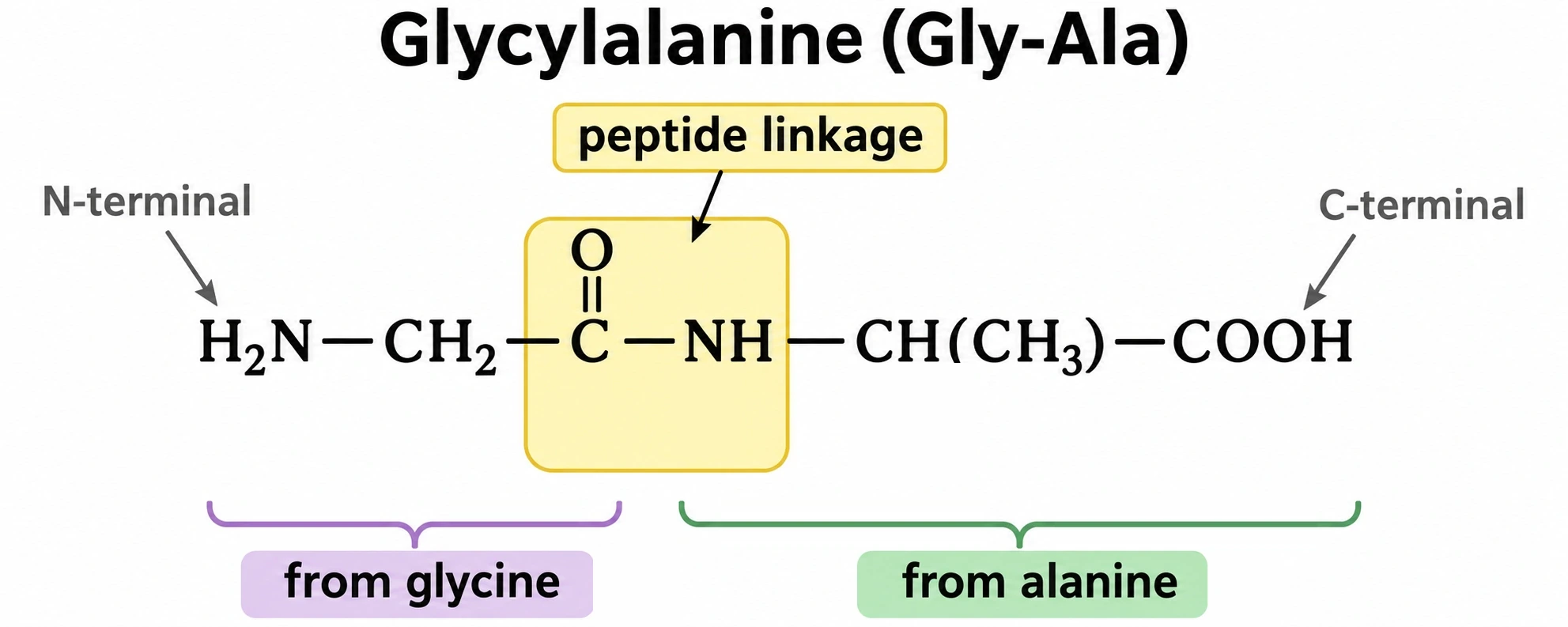
It has one peptide linkage.
Question 11 (2 marks): Name the proteins in hair and in egg albumin. How do they differ in solubility?
Answer. Hair contains keratin, a fibrous protein, which is insoluble in water.
Egg albumin is a globular protein, which is soluble in water.
Question 12 (2 marks): Mention two forces that stabilise the secondary and tertiary structures of proteins.
Answer. The forces that stabilise the secondary and tertiary structures of proteins are:
- Hydrogen bonds
- Disulphide linkages
Also accepted: van der Waals forces and electrostatic forces of attraction.
Question 13 (2 marks): List two nitrogenous bases common to DNA and RNA. Which base is in RNA but not DNA? What is the backbone of DNA?
Answer. Two nitrogenous bases common to DNA and RNA are adenine and guanine (cytosine is also common to both).
Uracil is present in RNA but not in DNA.
The backbone of DNA is made of alternating sugar (deoxyribose) and phosphate units.
Question 14 (2 marks): Name the hormone released quickly when blood glucose rises, and give the number of amino acids in it. Mention two functions of glucocorticoids.
Answer. The hormone is insulin, which contains 51 amino acids.
Functions of glucocorticoids:
- They control carbohydrate metabolism.
- They modulate inflammatory reactions and are involved in the body's reaction to stress.
Question 15 (2 marks): Name two fat-storing tissues where fat-soluble vitamins are stored. Which vitamin deficiency causes convulsions?
Answer. Fat-soluble vitamins are stored in the liver and in adipose (fat-storing) tissues.
Deficiency of vitamin B (pyridoxine) causes convulsions.