
Why Coordination Compounds Are Coloured
One of the most striking features of coordination compounds is their colour — the deep blue of , the violet of , the orange of dichromate. Crystal Field Theory explains it beautifully.
Recall that the d orbitals are split by . A d electron can absorb a photon of visible light whose energy exactly matches and jump from the lower set to the higher set — a d-d transition. The wavelength absorbed is removed from white light, and the colour we see is the complement of the absorbed colour.
Example: () absorbs in the green-yellow region (~500 nm) and so appears purple/violet (the complement).
For colour to appear, the ion must have a partially filled d subshell:
- ions (Sc, Ti) and ions (Zn, Cu) are colourless — no d-d transition is possible.
Colour Depends on the Ligand and Metal
Because the colour comes from , and depends on the ligand (spectrochemical series), changing the ligand changes the colour:
- is pale blue; adding ammonia gives , a much deeper blue — because NH is a stronger-field ligand (larger , absorbs different wavelength).
- (green) → (blue) → (violet), as the ligand field strengthens.
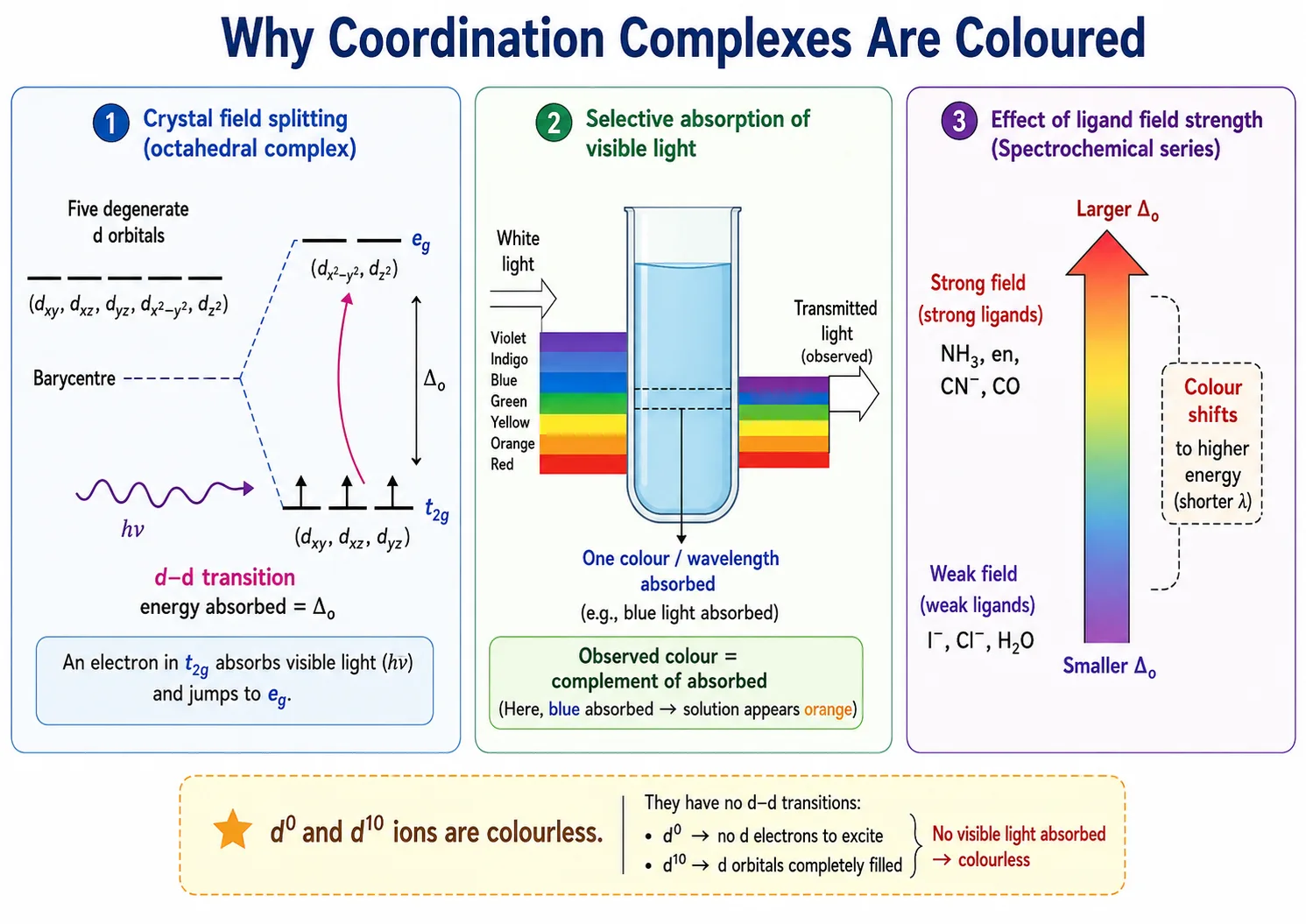
The colour also depends on the metal and its oxidation state. Removing all the ligands (or going to /) removes the colour.
[NEET Important] The colour of a complex arises from a d-d transition; its energy () and hence the colour are set by the ligand (spectrochemical series), the metal, and the oxidation state. A stronger-field ligand → larger → absorbs higher-energy (shorter-wavelength) light.
Limitations of Crystal Field Theory
CFT is a big improvement on VBT, but it is still a simplified model and has limitations:
- It treats the metal-ligand bond as purely electrostatic/ionic and ignores the covalent (orbital-overlap) character of the bond, which is significant in many complexes.
- It cannot satisfactorily explain why some ligands (like CN and CO) are strong field while others (like HO) are weak — the spectrochemical series is experimental, not predicted by CFT.
- It does not account for the relative strengths of metal-ligand bonds in a fundamental way.
These shortcomings are addressed by the more advanced Ligand Field / Molecular Orbital Theory (beyond this syllabus).
Key Point: CFT successfully explains colour, magnetism, and the high-spin/low-spin distinction using and the spectrochemical series — but it ignores covalency, which is its main limitation.
Solved Examples
Example 1: Origin of colour
Explain the origin of colour in .
Solution: Ti is . The single d electron absorbs visible light (~500 nm) and undergoes a d-d transition from to . The complement of the absorbed light makes the complex appear purple/violet.
Example 2: Why colourless
Why is colourless?
Solution: Zn is — the d subshell is completely filled, so no d-d transition is possible. With no absorption of visible light, the complex is colourless.
Example 3: Effect of ligand on colour
Why is a deeper blue than ?
Solution: NH is a stronger-field ligand than HO, so it produces a larger . The complex absorbs a different (higher-energy) wavelength, and its complementary colour is a deeper, more intense blue.
Example 4: Predict relative absorption
Two complexes of the same metal differ only in ligand: one has HO, the other CN. Which absorbs shorter-wavelength light?
Solution: CN is a stronger-field ligand → larger → absorbs higher-energy, shorter-wavelength light than the HO complex.
Example 5: d0 and d10 colourlessness
Why are both and ions colourless?
Solution: A ion has no d electron to excite, and a ion has a completely filled d set with no vacancy to receive an electron. In both cases no d-d transition is possible, so they are colourless.
Example 6: Colour change on ligand substitution
Anhydrous CuSO is white but hydrated CuSO is blue. Explain.
Solution: In anhydrous CuSO there are no water ligands to set up a crystal field. On hydration, water ligands surround Cu (), splitting the d orbitals and allowing a d-d transition that gives the blue colour.
Example 7: Limitation of CFT
State one limitation of crystal field theory.
Solution: CFT treats the metal-ligand bond as purely electrostatic and ignores the covalent character (orbital overlap) of the bond, which is significant in many real complexes.
Example 8: Spectrochemical prediction
Does CFT predict the spectrochemical series from first principles?
Solution: No. The order of the spectrochemical series is determined experimentally; CFT cannot derive it (e.g. it cannot explain from electrostatics alone why neutral CO is a stronger-field ligand than the anion F). This is a limitation of CFT.
Example 9: Colour and oxidation state
How can changing the oxidation state of the metal change the colour?
Solution: A different oxidation state means a different d-electron count and a different effective nuclear charge, which changes and the energy of the d-d transition — and therefore the absorbed wavelength and the observed colour.
Example 10: Identify the coloured ion
Among , and , which is coloured?
Solution: — V is (partially filled), so it undergoes a d-d transition and is coloured. Sc () and Zn () are colourless.