
What Is a Coordination Compound?
Some of the most important molecules in nature and industry are coordination compounds: haemoglobin (which carries oxygen), chlorophyll (which captures sunlight), vitamin B, and countless catalysts and pigments. In each, a central metal atom or ion is surrounded by a set of bound molecules or ions called ligands.
Coordination compound: a compound in which a central metal atom/ion is bonded to a fixed number of ligands by coordinate (dative) bonds, forming a coordination entity that retains its identity even in solution.
A classic example is . Here Co is the central ion, six NH molecules are ligands, and the whole unit stays intact in solution — only the three Cl outside the square brackets ionise.
Double salt vs complex: a double salt (e.g. Mohr's salt, FeSO(NH)SO@@GYANGHAR_MATH@@96HO) dissociates completely into all its ions in water. A complex (e.g. K[Fe(CN)]) does not give all ions — the complex ion [Fe(CN)] stays intact.
Werner's Theory
Alfred Werner (Nobel Prize, 1913) explained coordination compounds with a brilliant idea: metals have two kinds of valency.
- Primary valency (ionisable):
- Satisfied by negative ions (anions).
- Non-directional — does not fix geometry.
- Corresponds to the modern oxidation state of the metal.
- Secondary valency (non-ionisable):
- Satisfied by ligands (negative ions or neutral molecules).
- Directional — fixes the geometry of the complex.
- Corresponds to the modern coordination number.
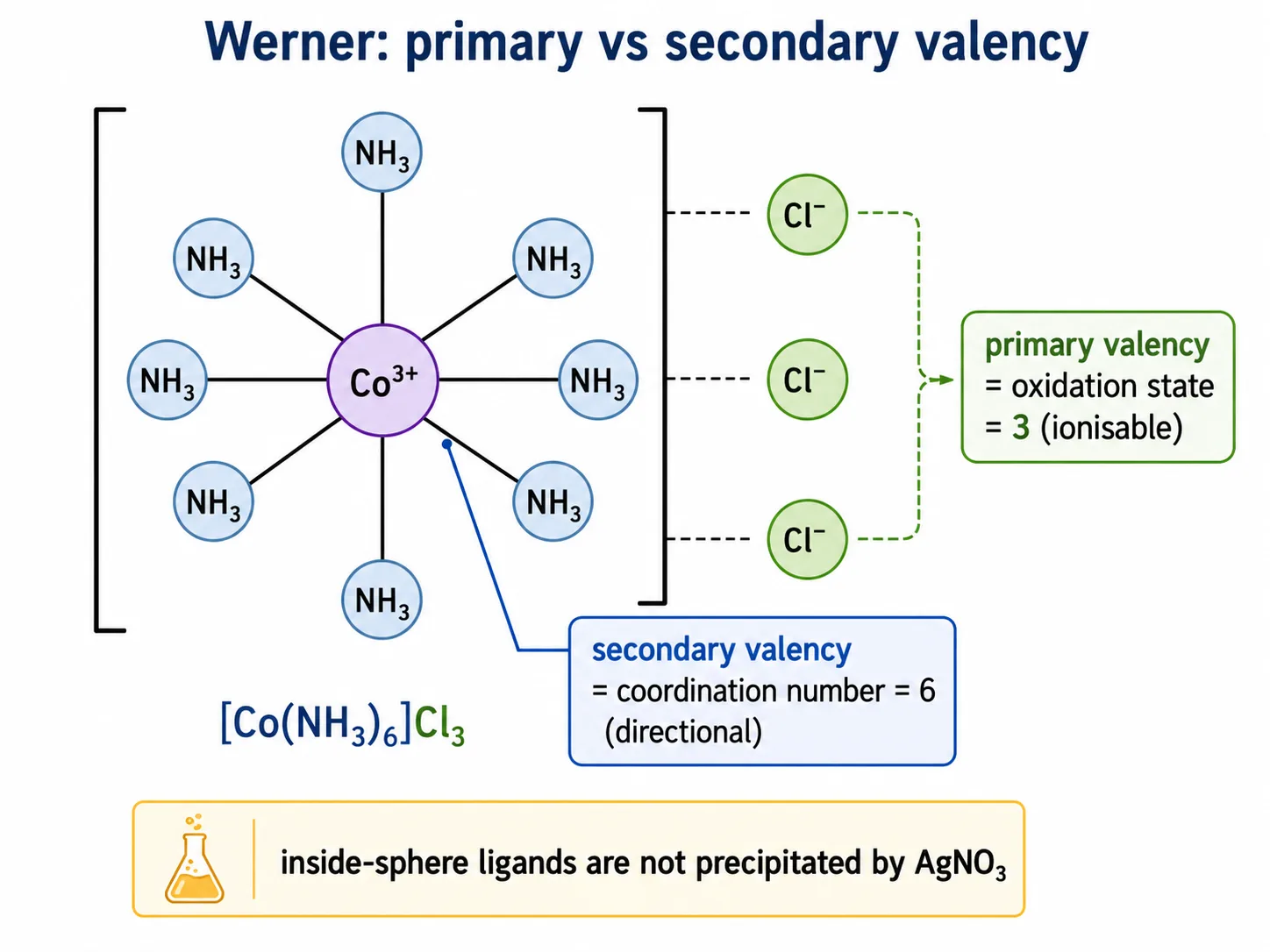
Worked logic: for CoClNH, all 3 Cl are precipitated by AgNO — so all three are primary (ionisable, outside the sphere), and the six NH are held by secondary valencies. The formula is .
How Werner Deduced Structures
Werner studied a series of cobalt-ammine chlorides and counted how many Cl ions precipitated with excess AgNO (only ionisable, outside-sphere chloride precipitates):
| Compound | Cl precipitated | Modern formula | Ions in solution |
|---|---|---|---|
| CoClNH | 3 | 4 | |
| CoClNH | 2 | 3 | |
| CoClNH | 1 | 2 |
A Cl inside the coordination sphere (bonded to Co) is not precipitated; only the outside (ionisable) Cl are.
[NEET Important] The number of ions a complex gives in solution (and hence its molar conductivity) reveals how many ions are outside the coordination sphere. gives 4 ions; gives only 2 — a classic exam discriminator.
Solved Examples
Example 1: Double salt vs complex
How does a double salt differ from a complex compound?
Solution: A double salt dissociates completely into all its constituent ions in water (e.g. Mohr's salt gives Fe, NH, SO). A complex retains its coordination entity in solution (e.g. K[Fe(CN)] gives K and the intact [Fe(CN)], not free Fe or CN).
Example 2: Primary and secondary valency
In Werner's theory, what do primary and secondary valencies correspond to today?
Solution: Primary valency = oxidation state (ionisable, satisfied by anions); secondary valency = coordination number (non-ionisable, directional, fixes geometry).
Example 3: Deduce the formula
CoClNH precipitates 2 mol of AgCl per mole with excess AgNO. Write its coordination formula.
Solution: 2 Cl are ionisable (outside), so 1 Cl is inside the sphere with the 5 NH. Formula: .
Example 4: Ions in solution
How many ions does give in solution?
Solution: It gives 4 ions: one cation and three Cl ions.
Example 5: Chloride inside the sphere
Why is the chloride in that is inside the brackets not precipitated by AgNO?
Solution: Chloride inside the coordination sphere is bonded to cobalt by a secondary (coordinate) valency and is non-ionisable, so it does not give free Cl ions and is not precipitated. Only the one outside (ionisable) Cl is precipitated.
Example 6: Directional valency
Which of Werner's valencies determines the geometry of the complex?
Solution: The secondary valency is directional and fixes the geometry (e.g. octahedral, square planar). Primary valency is non-directional.
Example 7: Count primary and secondary valencies
For , state the primary and secondary valencies of cobalt.
Solution: Primary valency = 3 (satisfied by 3 Cl, the +3 oxidation state). Secondary valency = 6 (six NH ligands, coordination number 6).
Example 8: Identify the complex ion
In K[Fe(CN)], what is the complex ion and what ionises off?
Solution: The complex ion is [Fe(CN)]; the three K ions ionise. The complex ion stays intact, so free CN is not released.
Example 9: AgCl from a complex
How many moles of AgCl will give with excess AgNO?
Solution: Only the one chloride outside the sphere is ionisable, so 1 mol of AgCl is precipitated. The two chlorides inside the sphere are not precipitated.
Example 10: Mohr's salt behaviour
When FeSO and (NH)SO are mixed in 1:1 ratio (Mohr's salt), what ions form in solution?
Solution: Mohr's salt is a double salt, so it dissociates completely into Fe, NH and SO ions (it gives the normal tests of Fe). It is not a complex.