
Stereoisomerism — Same Bonds, Different Shapes
Stereoisomers have the same atoms bonded to the same partners (same connectivity) but a different arrangement in space. There are two kinds: geometrical (cis-trans) and optical (mirror-image) isomerism.
Stereoisomerism in complexes depends on the geometry and the type of ligands. A complex with all identical ligands (homoleptic, e.g. ) shows no geometrical isomerism; you need two or more kinds of ligand (heteroleptic).
Geometrical (cis-trans) Isomerism
Geometrical isomers differ in the relative positions of ligands around the metal.
**Square planar (CN = 4), type : **
- cis — the two A ligands are adjacent (90° apart).
- trans — the two A ligands are opposite (180° apart).
- Classic example: cisplatin — the cis isomer is the anticancer drug; the trans isomer is inactive.
Octahedral (CN = 6):
- type shows cis (the two B ligands adjacent) and trans (the B ligands opposite). E.g. .
- type shows fac (3 alike on one triangular face) and mer (3 alike in a meridian).
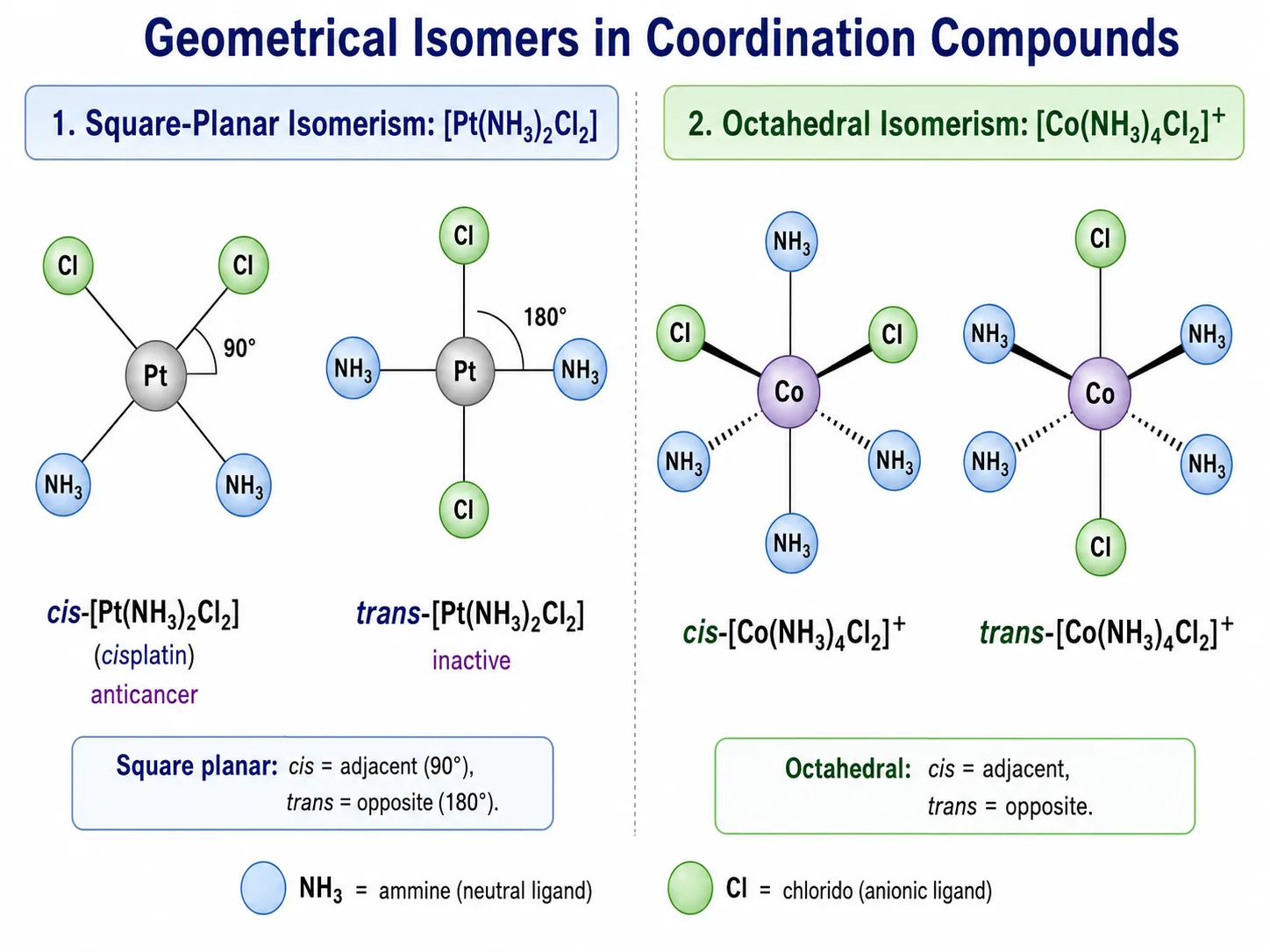
Key Point: Tetrahedral complexes do NOT show geometrical isomerism — all four positions are equivalent, so there is no cis/trans distinction.
Optical Isomerism (Chirality)
Optical isomers are non-superimposable mirror images of each other — like your left and right hands. They are called enantiomers; one rotates plane-polarised light clockwise (dextro, d or +) and the other anticlockwise (laevo, l or −).
Optical isomerism is common in octahedral complexes containing bidentate (chelate) ligands:
- — exists as two enantiomers (d and l forms). No plane of symmetry, so it is chiral.
- cis- is optically active (chiral); the trans isomer has a plane of symmetry and is not optically active.
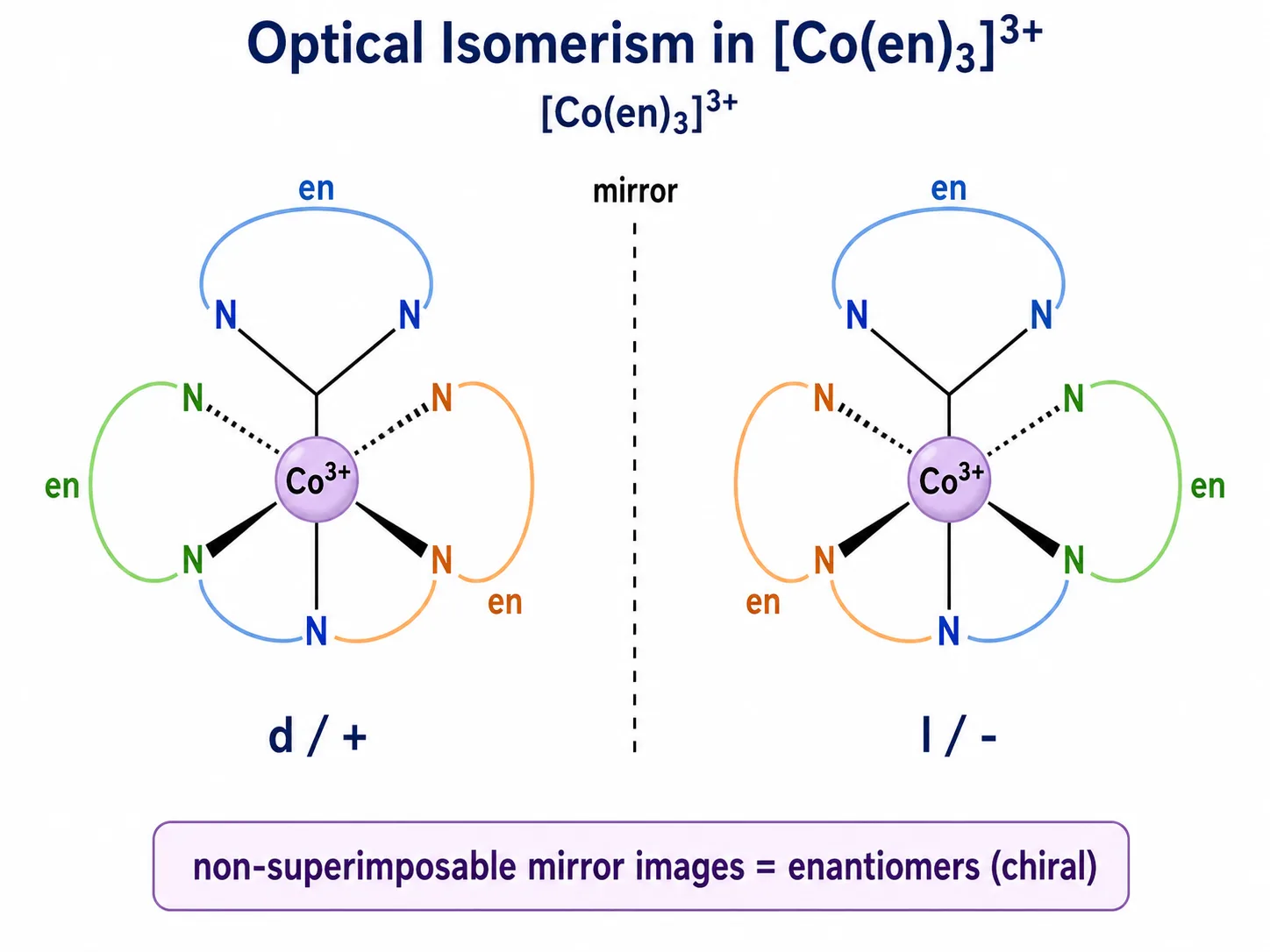
[NEET Important] A complex is optically active only if it has no plane of symmetry (no superimposable mirror image). The cis isomers of type are usually optically active; trans isomers usually are not (they have a symmetry plane).
Solved Examples
Example 1: cis and trans of cisplatin
Draw/describe the geometrical isomers of (square planar).
Solution: cis — the two Cl (and the two NH) are adjacent (90°); this is the anticancer drug cisplatin. trans — the two Cl are opposite (180°); biologically inactive.
Example 2: Why no geometric isomers in tetrahedral
Why does a tetrahedral complex show no geometrical isomerism?
Solution: In a tetrahedron, all four corner positions are equivalent — there is no distinct opposite position — so there is no cis/trans distinction.
Example 3: Geometric isomers of an octahedral complex
How many geometrical isomers does show?
Solution: Two — cis (the two Cl adjacent) and trans (the two Cl opposite).
Example 4: fac and mer
What are fac and mer isomers, and for what type do they occur?
Solution: They occur for octahedral complexes. fac (facial): the three identical ligands occupy one triangular face. mer (meridional): the three identical ligands lie in a plane (meridian) through the metal.
Example 5: Optical activity of [Co(en)3]3+
Why is optically active?
Solution: It has no plane of symmetry; its mirror image is non-superimposable, so it exists as two enantiomers (d and l) — it is chiral and optically active.
Example 6: cis vs trans optical activity
Which of cis- and trans- is optically active?
Solution: The cis isomer is optically active (no plane of symmetry, chiral). The trans isomer has a plane of symmetry, so it is not optically active.
Example 7: Define enantiomers
What are enantiomers?
Solution: Enantiomers are a pair of non-superimposable mirror-image stereoisomers. They rotate plane-polarised light by equal amounts in opposite directions (one +/dextro, the other −/laevo).
Example 8: Geometrical isomerism condition
What kind of ligand set is needed for a complex to show geometrical isomerism?
Solution: The complex must be heteroleptic (contain two or more different kinds of ligand) and have a geometry (square planar or octahedral) that allows distinct cis/trans arrangements.
Example 9: Identify optical isomerism
Does (square planar) show optical isomerism?
Solution: No. Square planar complexes generally have a plane of symmetry (the molecular plane), so they are usually not optically active. Optical isomerism is mainly seen in octahedral chelate complexes.
Example 10: Total stereoisomers
How many stereoisomers (geometrical + optical) does have?
Solution: Three in total: the trans isomer (1, optically inactive) plus the cis isomer, which exists as a pair of enantiomers (2). So 1 + 2 = 3 stereoisomers.