
Crystal Field Theory — A Better Model
Valence Bond Theory explains geometry and magnetism, but it struggles with colour and the detailed energetics. Crystal Field Theory (CFT) fills the gap. It is an electrostatic model: the metal-ligand bond is treated as a purely ionic/electrostatic attraction between the positive metal ion and the negative ligands (or the negative ends of dipolar ligands).
The key idea: in a free metal ion the five d orbitals are degenerate (same energy). When ligands approach, their negative fields repel the d electrons — but not equally, because the d orbitals point in different directions. This lifts the degeneracy and splits the d orbitals into groups of different energy. This splitting is what gives complexes their colour and magnetism.
Octahedral and Tetrahedral Splitting
Octahedral field: the six ligands approach along the x, y, z axes. The two d orbitals pointing along the axes ( and , the set) are repelled more (higher energy); the three pointing between the axes (, the set) are repelled less (lower energy).
The energy gap is the crystal field splitting energy, (also called 10 Dq).
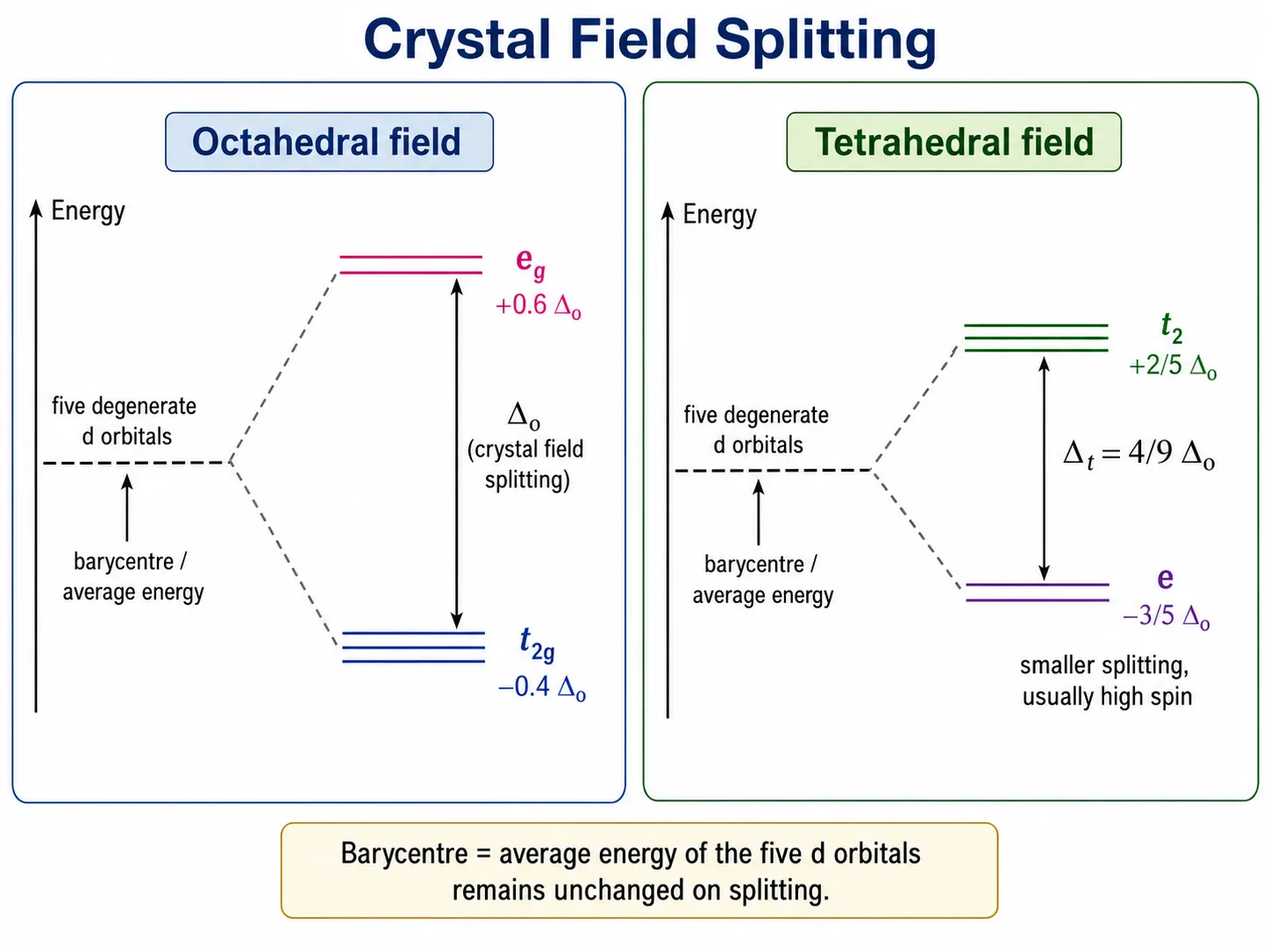
Tetrahedral field: the splitting is reversed and smaller. The set is lower and the set is higher, with
Because is so small, tetrahedral complexes are almost always high spin (no pairing).
The Spectrochemical Series and Spin State
How big is ? It depends mainly on the ligand. Arranging ligands by the splitting they cause gives the spectrochemical series (weak field → strong field):
- Weak-field ligands (small ): electrons spread out to avoid pairing → high spin.
- Strong-field ligands (large ): electrons pair in the lower set → low spin.
The deciding comparison is versus the pairing energy (P):
- If (weak field) → high spin (electrons go to rather than pair).
- If (strong field) → low spin (electrons pair in ).
The net stabilisation from preferentially filling lower orbitals is the Crystal Field Stabilisation Energy (CFSE):
[JEE Tip] For a - octahedral ion you must decide high vs low spin from the ligand. CN, CO, NH → low spin; HO, F, Cl → high spin. This decision drives the unpaired-electron count, magnetism and colour.
Solved Examples
Example 1: Octahedral d-orbital sets
Name the two sets of d orbitals in an octahedral crystal field and their relative energies.
Solution: The lower-energy set is () and the higher-energy set is (). The gap between them is .
Example 2: Tetrahedral splitting size
How does the tetrahedral splitting compare with the octahedral ?
Solution: — much smaller. Because of this small gap, tetrahedral complexes are almost always high spin.
Example 3: High spin vs low spin
For a octahedral ion, give the configuration in (a) a strong field and (b) a weak field.
Solution: (a) Strong field (low spin): all six pair in the lower set → → 0 unpaired. (b) Weak field (high spin): → 4 unpaired.
Example 4: Predict spin state from ligand
Is high spin or low spin?
Solution: Fe is . CN is a strong-field ligand (large ), so it is low spin: , 0 unpaired electrons (diamagnetic).
Example 5: Unpaired electrons in a weak-field complex
How many unpaired electrons does have?
Solution: Mn is . HO is weak field → high spin → → 5 unpaired electrons ( BM).
Example 6: CFSE of a d3 ion
Calculate the CFSE (in units of ) for an octahedral ion.
Solution: fills . CFSE .
Example 7: Spectrochemical order
Arrange Cl, HO, CN and NH in increasing field strength.
Solution: From the spectrochemical series: Cl < HO < NH < CN (weak to strong).
Example 8: Why tetrahedral is high spin
Why are tetrahedral complexes nearly always high spin?
Solution: Because is only — so small that it is almost always less than the pairing energy, so electrons prefer to occupy the upper orbitals singly rather than pair. Hence high spin.
Example 9: Strong vs weak field outcome
State the condition (in terms of and pairing energy P) for a complex to be low spin.
Solution: Low spin occurs when (strong field): the energy cost of pairing is less than the cost of promoting an electron to the set, so electrons pair in .
Example 10: CFSE of a low-spin d6 ion
Calculate the CFSE (in ) for a low-spin octahedral ion (ignore pairing energy).
Solution: Low-spin is . CFSE .