
The Vocabulary of Coordination Chemistry
To work with complexes you need their vocabulary. Let's define the key terms precisely.
- Central atom/ion: the metal atom or ion to which ligands are bonded (e.g. Co in ).
- Ligand: an ion or molecule that donates a lone pair to the metal (a Lewis base). The atom that actually donates is the donor atom.
- Coordination sphere: the central metal plus its ligands, written inside square brackets. Anything outside is the counter ion.
- Coordination number (CN): the number of donor atoms directly bonded to the metal — e.g. 6 in , 4 in .
- Coordination polyhedron: the spatial arrangement of donor atoms around the metal (octahedral, tetrahedral, square planar, etc.).
- Oxidation number of the metal: the charge it would have if all ligands were removed as their usual ions.
Classifying Ligands by Denticity
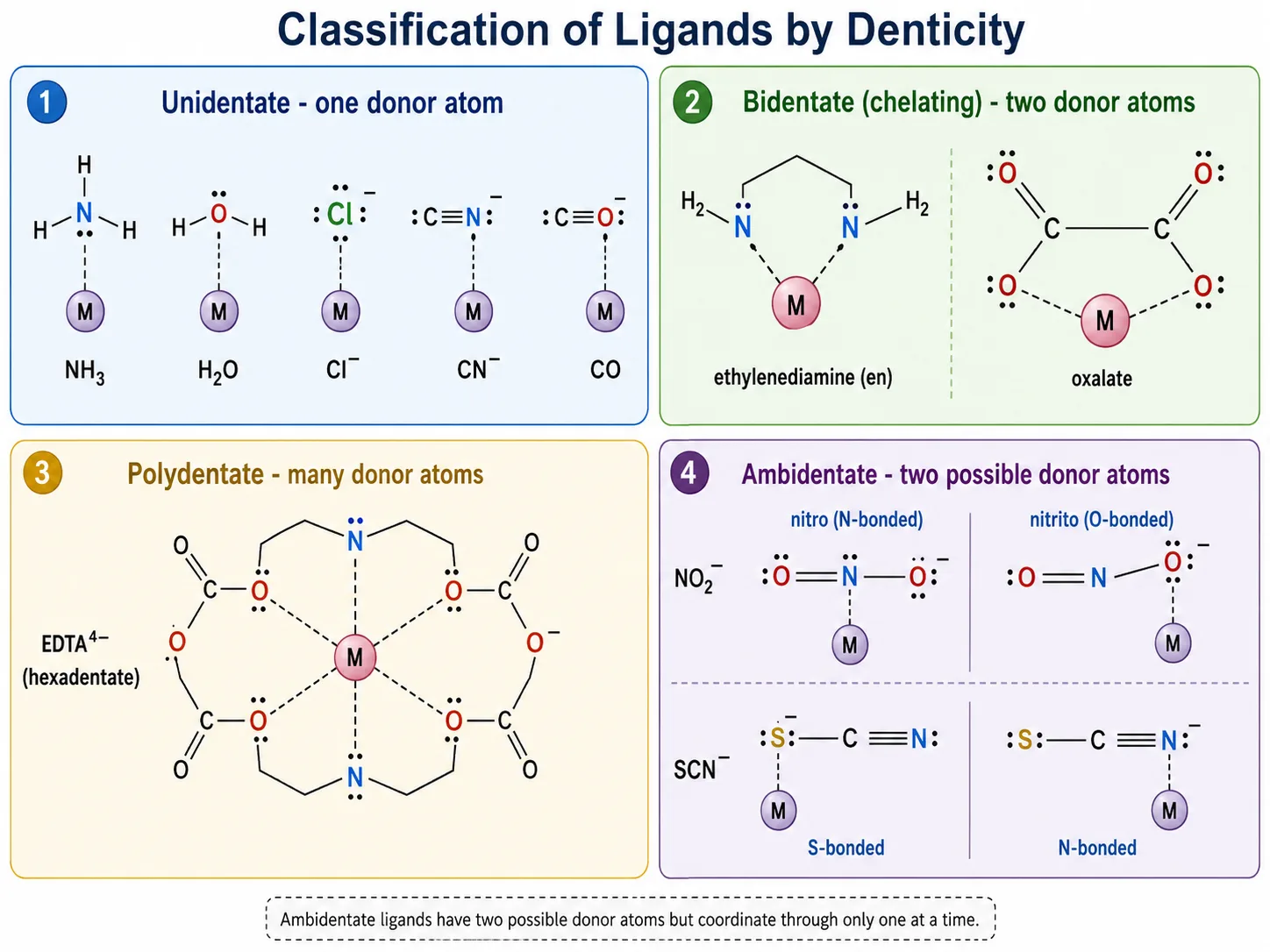
Ligands are classified by how many donor atoms they use to bind the metal — their denticity:
- Unidentate (monodentate): one donor atom. E.g. , , , , .
- Bidentate (didentate): two donor atoms. E.g. ethylenediamine (en), the oxalate ion (CO).
- Polydentate: several donor atoms. E.g. EDTA is hexadentate (binds through 6 donor atoms).
A ligand that binds through two or more donor atoms forming a ring with the metal is called a chelating ligand, and the ring complex is a chelate.
- Ambidentate ligand: can donate through either of two different atoms (but only one at a time). E.g. (through N as nitro, or O as nitrito) and (through S as thiocyanato, or N as isothiocyanato).
Coordination Number, Charge and Oxidation State
Three quantities you must be able to extract from any formula:
1. Coordination number = number of donor atoms bonded to the metal. Watch bidentate ligands! In , there are 3 en ligands but each is bidentate, so CN .
2. Charge on the complex ion = sum of the metal's oxidation state and the ligand charges.
3. Oxidation number of the metal = (charge on complex ion) (sum of ligand charges).
Worked example: In , the complex ion is (balancing 4 K). Six CN contribute . So Fe oxidation number . Coordination number .
[JEE Tip] For oxidation number: let the metal be , set sum of ligand charges charge on the complex ion, and solve. Always count the charge on the complex ion correctly from the counter ions.
Solved Examples
Example 1: Oxidation number of the metal
Find the oxidation number of cobalt in .
Solution: NH is neutral; the complex ion is (balancing 3 Cl). So Co , i.e. Co is +3.
Example 2: Coordination number with a bidentate ligand
Find the coordination number of cobalt in .
Solution: en (ethylenediamine) is bidentate, and there are 3 of them. CN .
Example 3: Oxidation number in an anionic complex
Find the oxidation number of iron in .
Solution: Complex ion is . Each CN is (total ). So . Iron is +2.
Example 4: Identify the ambidentate ligand
Which of NH, NO, en, CO is ambidentate, and why?
Solution: NO is ambidentate — it can bond through N (nitro, -NO) or through O (nitrito, -ONO). The others are not ambidentate.
Example 5: Denticity of EDTA
What is the denticity of the EDTA ligand?
Solution: EDTA is hexadentate — it binds the metal through six donor atoms (2 nitrogen and 4 oxygen), forming a very stable chelate.
Example 6: Coordination number of Ni in nickel carbonyl
State the coordination number of nickel in .
Solution: CO is unidentate and there are four of them, so the coordination number is 4.
Example 7: Charge on a complex ion
Find the charge on the complex ion in .
Solution: Three K balance the complex, so the complex ion has a charge of , i.e. .
Example 8: Oxidation number with charged ligands
Find the oxidation number of iron in (oxalate is ).
Solution: . Iron is +3. (Coordination number , since oxalate is bidentate.)
Example 9: Chelating ligand
What is a chelating ligand? Give an example.
Solution: A chelating ligand is a bidentate or polydentate ligand that binds the metal through two or more donor atoms forming a ring. Example: ethylenediamine (en) forms a five-membered ring with the metal.
Example 10: Counter ion
In , identify the coordination sphere and the counter ions.
Solution: The coordination sphere is (inside the brackets). The counter ions are the two Cl written outside the brackets.