
Valence Bond Theory of Complexes
How does the metal actually bond to its ligands? Valence Bond Theory (VBT) gives one answer: the metal ion makes a set of empty hybrid orbitals of definite geometry, and each ligand donates a lone pair into one of them, forming a coordinate bond.
The type of hybridisation determines the geometry:
| Coordination number | Hybridisation | Geometry |
|---|---|---|
| 4 | Tetrahedral | |
| 4 | Square planar | |
| 6 | Octahedral (outer orbital) | |
| 6 | Octahedral (inner orbital) |
Inner vs outer orbital: in the metal uses inner (n-1)d orbitals (inner-orbital complex); in it uses outer nd orbitals (outer-orbital complex). Which one forms depends on whether the ligand is strong-field or weak-field.
Inner vs Outer Orbital (Low Spin vs High Spin)
When a strong-field ligand approaches, it can cause pairing of the metal ion's d electrons, freeing inner d orbitals for hybridisation:
- Inner-orbital complex → fewer unpaired electrons → low spin → often diamagnetic or weakly paramagnetic.
When a weak-field ligand approaches, the d electrons usually remain unpaired, so the metal uses outer d orbitals for :
- Outer-orbital complex → more unpaired electrons → high spin → strongly paramagnetic.
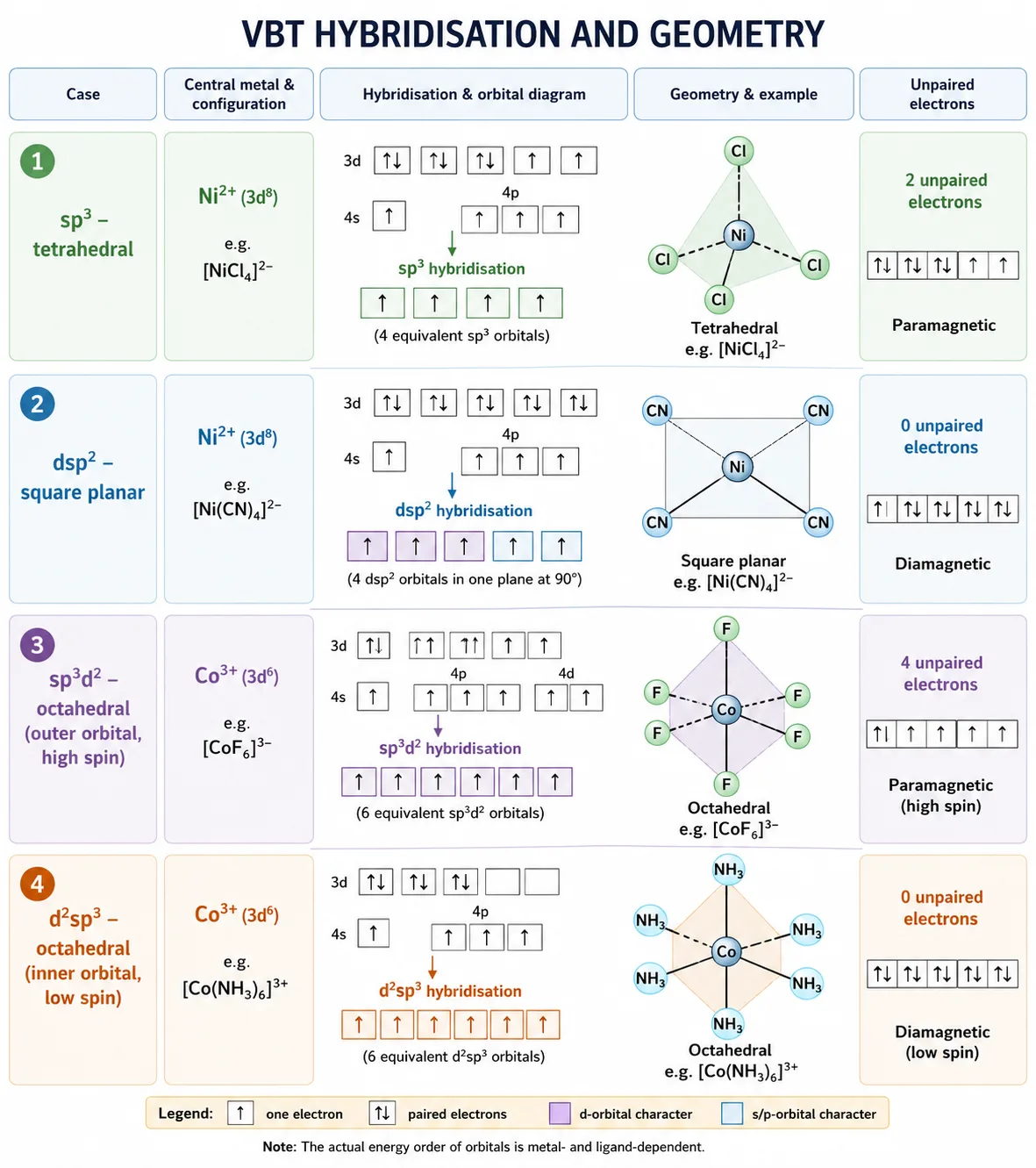
Worked example — : Co is . In the presence of NH, electrons pair in the lower-energy orbitals, leaving two inner d orbitals free for hybridisation. So the complex is octahedral, has 0 unpaired electrons, and is diamagnetic.
: Co () with weak F does not pair sufficiently, so it uses (outer orbital), has 4 unpaired electrons, and is paramagnetic.
Predicting Magnetic Moment with VBT
The spin-only magnetic moment ( BM) lets us test VBT predictions against experiment. Work through these standard cases:
| Complex | Metal ion (d) | Ligand | Hybridisation | Geometry | Unpaired | (BM) |
|---|---|---|---|---|---|---|
| Ni () | strong | tetrahedral | 0 | 0 (diamag.) | ||
| Ni () | weak | tetrahedral | 2 | 2.83 | ||
| Ni () | strong | square planar | 0 | 0 (diamag.) | ||
| Fe () | strong | octahedral | 1 | 1.73 | ||
| Fe () | weak | octahedral | 5 | 5.92 |
[JEE Tip] The pair (paramagnetic, tetrahedral) vs (diamagnetic, square planar) — same Ni () but different ligand strength — is the standard VBT comparison. Cl is weak (tetrahedral, 2 unpaired); CN is strong (square planar, 0 unpaired).
Example 1: Hybridisation of [Co(NH3)6]3+
Predict the hybridisation, geometry and magnetic nature of .
Solution: Co is . NH causes pairing of d electrons in the lower-energy orbitals, so two inner d orbitals are available for hybridisation. Therefore the complex is octahedral, has 0 unpaired electrons, and is diamagnetic (inner-orbital complex).
Example 2: [CoF6]3- vs [Co(NH3)6]3+
Why is paramagnetic while is diamagnetic, though both are Co?
Solution: F is a weak-field ligand, so pairing is not favoured; the complex uses (outer orbital), giving 4 unpaired electrons and paramagnetism. NH causes pairing to a greater extent, so the complex uses (inner orbital), has 0 unpaired electrons, and is diamagnetic.
Example 3: [NiCl4]2- vs [Ni(CN)4]2-
Both contain Ni (). Explain why is paramagnetic (tetrahedral) but is diamagnetic (square planar).
Solution: Cl is a weak-field ligand, so the complex remains (tetrahedral) with 2 unpaired electrons and is paramagnetic. CN is a strong-field ligand, so the d electrons pair and the complex becomes (square planar) with 0 unpaired electrons, making it diamagnetic.
Example 4: Magnetic moment of [NiCl4]2-
Calculate the spin-only magnetic moment of .
Solution: Ni () with weak Cl gives 2 unpaired electrons. So
Example 5: [Fe(CN)6]3- magnetic moment
Predict the hybridisation and spin-only moment of .
Solution: Fe is . CN is strong field, so pairing occurs and the complex uses (inner, octahedral). This leaves 1 unpaired electron. Therefore,
Example 6: [Fe(H2O)6]3+ magnetic moment
Predict the spin-only moment of .
Solution: Fe () with weak HO gives no pairing, so the complex is (outer), with 5 unpaired electrons. Thus which indicates a strongly paramagnetic complex.
Example 7: [Ni(CO)4] geometry
Predict the hybridisation, geometry and magnetism of .
Solution: In , nickel is in the 0 oxidation state and is treated as . CO is a strong-field ligand, and the complex uses hybridisation, giving a tetrahedral geometry with 0 unpaired electrons. Hence it is diamagnetic.
Example 8: Inner vs outer orbital
Distinguish inner-orbital and outer-orbital octahedral complexes.
Solution: Inner-orbital (): uses inner (n-1)d orbitals; formed more readily with strong-field ligands; low spin; fewer unpaired electrons. Outer-orbital (): uses outer nd orbitals; formed more readily with weak-field ligands; high spin; more unpaired electrons.
Example 9: Square planar from VBT
On the basis of VBT, explain why is square planar.
Solution: Ni is . The strong-field CN ligand causes pairing of the 8 d electrons, so one 3d orbital becomes available for hybridisation with 4s and 4p orbitals. This gives hybridisation and a square planar geometry with 0 unpaired electrons (diamagnetic).
Example 10: Predict unpaired electrons in [Pt(CN)4]2-
Predict the number of unpaired electrons in square planar .
Solution: Pt is . Strong CN gives a square planar complex with all d electrons paired, so there are 0 unpaired electrons and the complex is diamagnetic.