
Isomerism in Coordination Compounds
Isomers are compounds with the same molecular formula but different arrangements of atoms. Coordination compounds show a rich variety, divided into two broad families:
- Structural (constitutional) isomerism — different connectivity (atoms bonded to different partners). Covered in this section.
- Stereoisomerism — same connectivity but different spatial arrangement (geometric and optical). Covered next.
The four main types of structural isomerism are linkage, coordination, ionisation, and solvate (hydrate) isomerism.
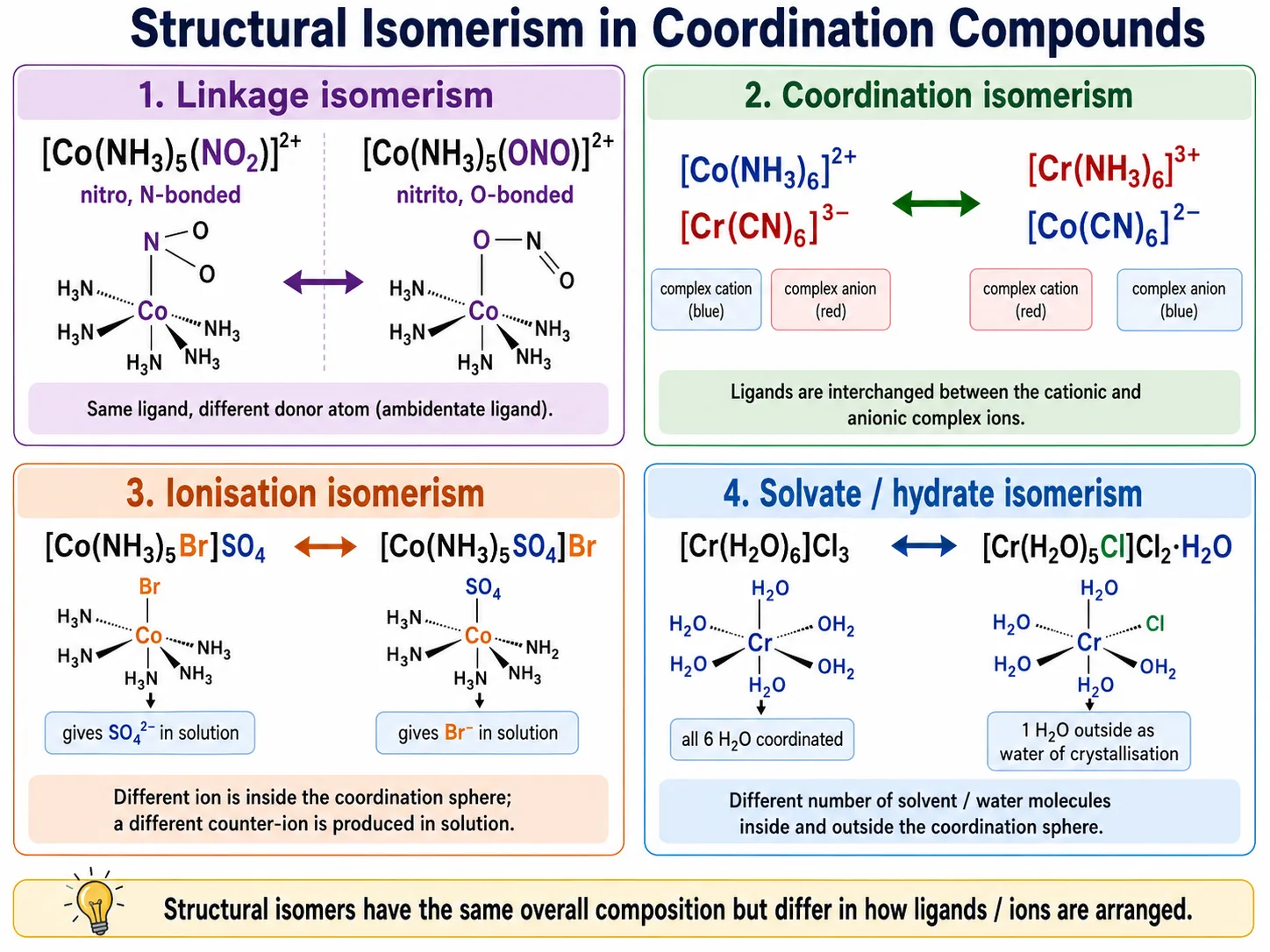
Linkage and Coordination Isomerism
Linkage isomerism arises when an ambidentate ligand can bind through either of two different donor atoms. The classic example is the nitrite ion,
- — bound through N (nitro, yellow).
- — bound through O (nitrito, red).
Other ambidentate ligands giving linkage isomers: SCN (S- vs N-bonded) and CN.
Coordination isomerism arises in a compound made of both a cationic and an anionic complex, when the ligands are interchanged between the two metal centres. Example:
The NH and CN ligands are swapped between the cobalt and chromium centres.
Ionisation and Solvate Isomerism
Ionisation isomerism arises when the counter ion and a ligand inside the sphere exchange places, giving different ions in solution. Example:
- — gives SO free in solution (Br is inside the sphere).
- — gives Br free in solution (SO is inside the sphere).
These can be distinguished by tests: the first gives a precipitate with BaCl (free sulphate); the second gives a precipitate with AgNO (free bromide).
Solvate (hydrate) isomerism arises when water is present inside vs outside the coordination sphere. The classic example is the three "isomers" of :
- (violet) — all 6 water inside; 3 Cl ionise.
- (blue-green) — 1 Cl inside; 2 Cl ionise.
- (green) — 2 Cl inside; 1 Cl ionises.
[JEE Tip] Ionisation and solvate isomers differ in the ions/molecules they release in solution, so they can be told apart by precipitation tests (BaCl for sulphate, AgNO for halide) — a favourite exam "give evidence" question.
Solved Examples
Example 1: Linkage isomers
Write the linkage isomers of .
Solution: The two isomers differ by the donor atom of the ambidentate NO:
- — N-bonded (nitro).
- — O-bonded (nitrito).
Example 2: Which isomerism for ambidentate ligands?
A complex contains the SCN ligand. Which type of structural isomerism can it show?
Solution: Linkage isomerism — SCN is ambidentate and can bond through S (thiocyanato) or N (isothiocyanato).
Example 3: Ionisation isomers
Give evidence that and are ionisation isomers.
Solution: They release different ions in solution:
- gives free SO → white precipitate with BaCl.
- gives free Br → pale yellow precipitate with AgNO.
The different precipitation tests prove they are ionisation isomers.
Example 4: Coordination isomerism
Write a coordination isomer of .
Solution: Interchange the ligands between the metal centres: .
Example 5: Solvate isomers
Write the three solvate (hydrate) isomers of .
Solution:
- (violet).
- (blue-green).
- (green).
They differ in how many water molecules and chlorides are inside vs outside the sphere.
Example 6: Distinguish hydrate isomers
How would you distinguish from ?
Solution: With excess AgNO, the first precipitates 3 mol AgCl (all 3 Cl ionisable), the second only 1 mol AgCl (only 1 Cl outside the sphere). The different amounts of AgCl distinguish them.
Example 7: Identify the isomerism
What type of isomerism is shown by and ?
Solution: Linkage isomerism — SCN binds through S in the first and through N in the second.
Example 8: Coordination isomerism requirement
What is required for a compound to show coordination isomerism?
Solution: It must contain both a complex cation and a complex anion (two coordination entities), between which ligands can be interchanged.
Example 9: Number of AgCl from a hydrate isomer
How many moles of AgCl does give with excess AgNO?
Solution: Two Cl are outside the sphere (ionisable), so it gives 2 mol AgCl. The one Cl inside the sphere is not precipitated.
Example 10: Test for ionisation isomer
A complex of formula gives a precipitate with BaCl but not with AgNO. Which isomer is it?
Solution: A precipitate with BaCl means free sulphate, so sulphate is the counter ion and bromide is inside the sphere: .