
The Whole Chapter in One Glance
Coordination compounds have a central metal bonded to ligands. Werner's primary/secondary valencies became oxidation state and coordination number. We name them by IUPAC rules, classify their isomerism, and explain bonding by VBT (hybridisation, inner/outer orbital) and CFT (d-orbital splitting, spectrochemical series, high/low spin, colour). Carbonyls bond synergically; chelates are extra-stable.
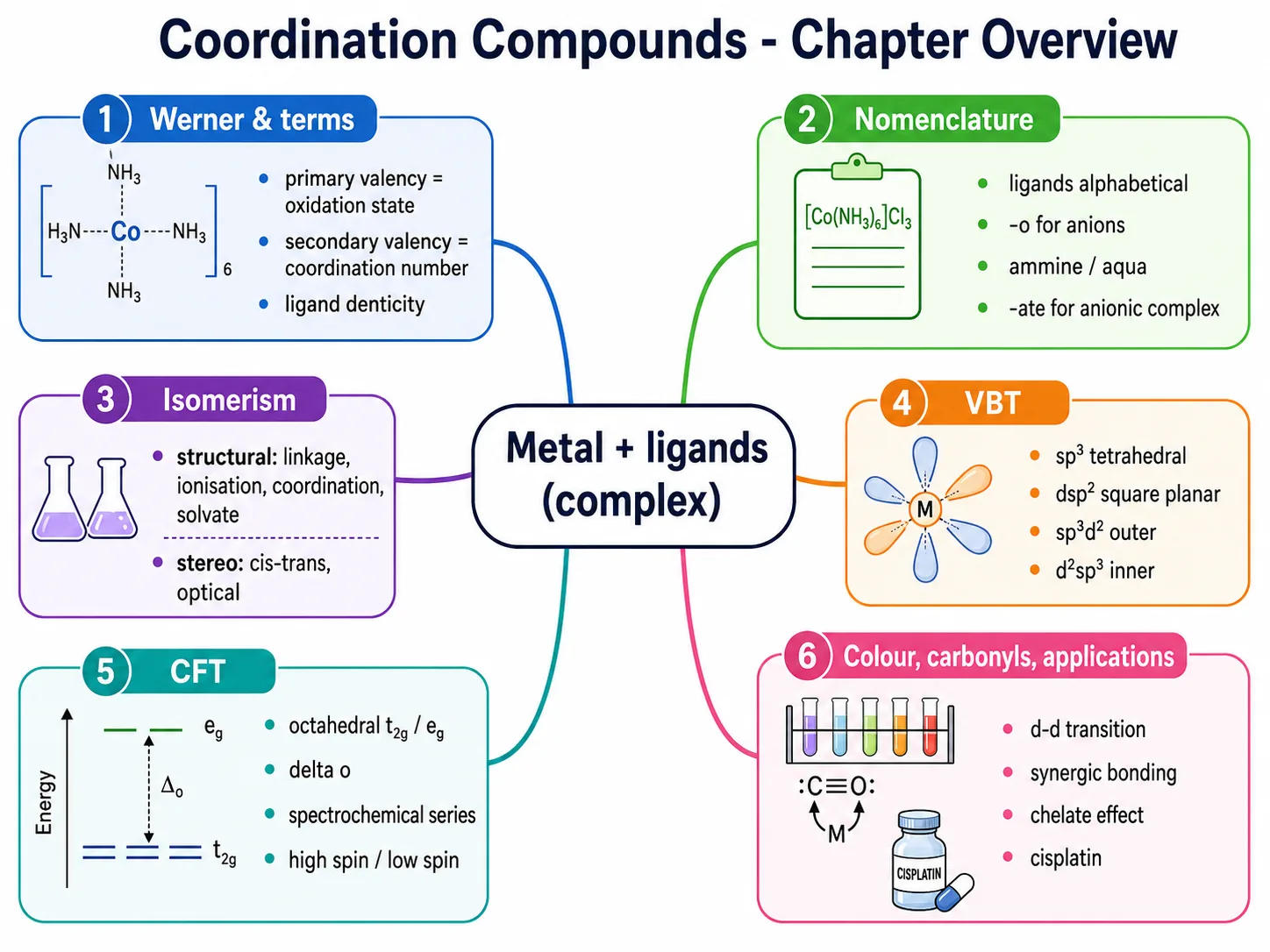
Slot every fact into one of these branches.
Master Facts Sheet
Werner: primary valency = oxidation state (ionisable); secondary valency = coordination number (directional).
Terms: ligand denticity - unidentate, bidentate (en, oxalate), hexadentate (EDTA), ambidentate (NO2-, SCN-).
Nomenclature: ligands first (alphabetical), -o for anionic ligands, aqua/ammine/carbonyl for neutral, oxidation state in Roman numerals, -ate for anionic complexes (ferrate, cuprate).
Isomerism: structural (linkage, coordination, ionisation, solvate) and stereo (geometrical cis-trans/fac-mer, optical enantiomers). Tetrahedral shows no geometrical isomerism.
VBT: tetrahedral; square planar; outer octahedral (high spin); inner octahedral (low spin). BM.
CFT: octahedral (-0.4) / (+0.6), gap ; tetrahedral (high spin). Strong field () -> low spin. Spectrochemical: I- < Cl- < H2O < NH3 < en < CN- < CO.
Colour: d-d transition; / colourless. Carbonyls: synergic ( + back-bond). Chelate effect: entropy-driven extra stability.
Quick Comparison Tables
VBT vs CFT
| Feature | VBT | CFT |
|---|---|---|
| Bond model | Covalent (hybrid orbitals) | Electrostatic (ionic) |
| Explains geometry | Yes | Yes |
| Explains colour | No | Yes |
| Inner/outer or high/low spin | Inner/outer orbital | High/low spin |
High spin vs Low spin (octahedral)
| Feature | High spin | Low spin |
|---|---|---|
| Ligand field | Weak | Strong |
| delta o vs P | delta o < P | delta o > P |
| Unpaired electrons | More | Fewer |
| Hybridisation (VBT) | sp3d2 (outer) | d2sp3 (inner) |
Last-Minute Memory Hooks
- Werner: primary = oxidation state, secondary = coordination number.
- Coordination number: count donor atoms - bidentate counts as 2 (e.g. [Co(en)3]3+ = 6).
- Naming: ligands alphabetical, ammine (two m's) for NH3, -ate for anionic complexes.
- Tetrahedral = no geometrical isomerism; cis chelate complexes are usually optically active.
- VBT geometries: sp3 -> tetrahedral, dsp2 -> square planar, sp3d2 -> octahedral (outer/high spin), d2sp3 -> octahedral (inner/low spin).
- The classic pair: [NiCl4]2- (tetrahedral, 2 unpaired, paramagnetic) vs [Ni(CN)4]2- (square planar, 0 unpaired, diamagnetic).
- CFT: strong field (CN-, CO, NH3) -> large delta o -> low spin; weak field (H2O, F-, Cl-) -> high spin.
- Colour = d-d transition; d0 and d10 are colourless. Stronger field -> larger delta o -> shorter-wavelength absorption.
- Chelate effect (entropy) makes en/EDTA complexes very stable. Carbonyl bonding is synergic.
One-line revision flow: Werner -> terms/ligands -> nomenclature -> isomerism (structural + stereo) -> VBT -> CFT (splitting, spectrochemical, spin) -> colour -> carbonyls/stability/applications.