
IUPAC Nomenclature — The Rules
Naming coordination compounds follows a precise set of IUPAC rules. Master these and you can name (almost) any complex.
1. Cation first, then anion — just like any salt.
2. Within the complex, name ligands first (alphabetically), then the metal.
3. Number of ligands: use di, tri, tetra… for simple ligands; use bis, tris, tetrakis… for ligands that already contain a numerical prefix or are complex (e.g. en, ethylenediamine → bis(ethylenediamine)).
4. Anionic ligands end in -o: chloride → chlorido (older: chloro), cyanide → cyanido (older: cyano), hydroxide → hydroxido, sulphate → sulfato, oxalate → oxalato.
5. Neutral ligands keep their name, with special names: HO → aqua, NH → ammine (two m's), CO → carbonyl, NO → nitrosyl.
More Naming Rules
6. Oxidation state of the metal is shown in Roman numerals in parentheses right after the metal name, with no space, e.g. cobalt(III).
7. If the complex ion is an anion, the metal name ends in -ate (often using the Latin stem):
- iron → ferrate, copper → cuprate, lead → plumbate, silver → argentate, tin → stannate, gold → aurate.
- e.g. → hexacyanidoferrate(II).
8. Ligand alphabetical order ignores the multiplying prefixes (di, tri…) — alphabetise by the ligand name itself (e.g. ammine before chlorido).
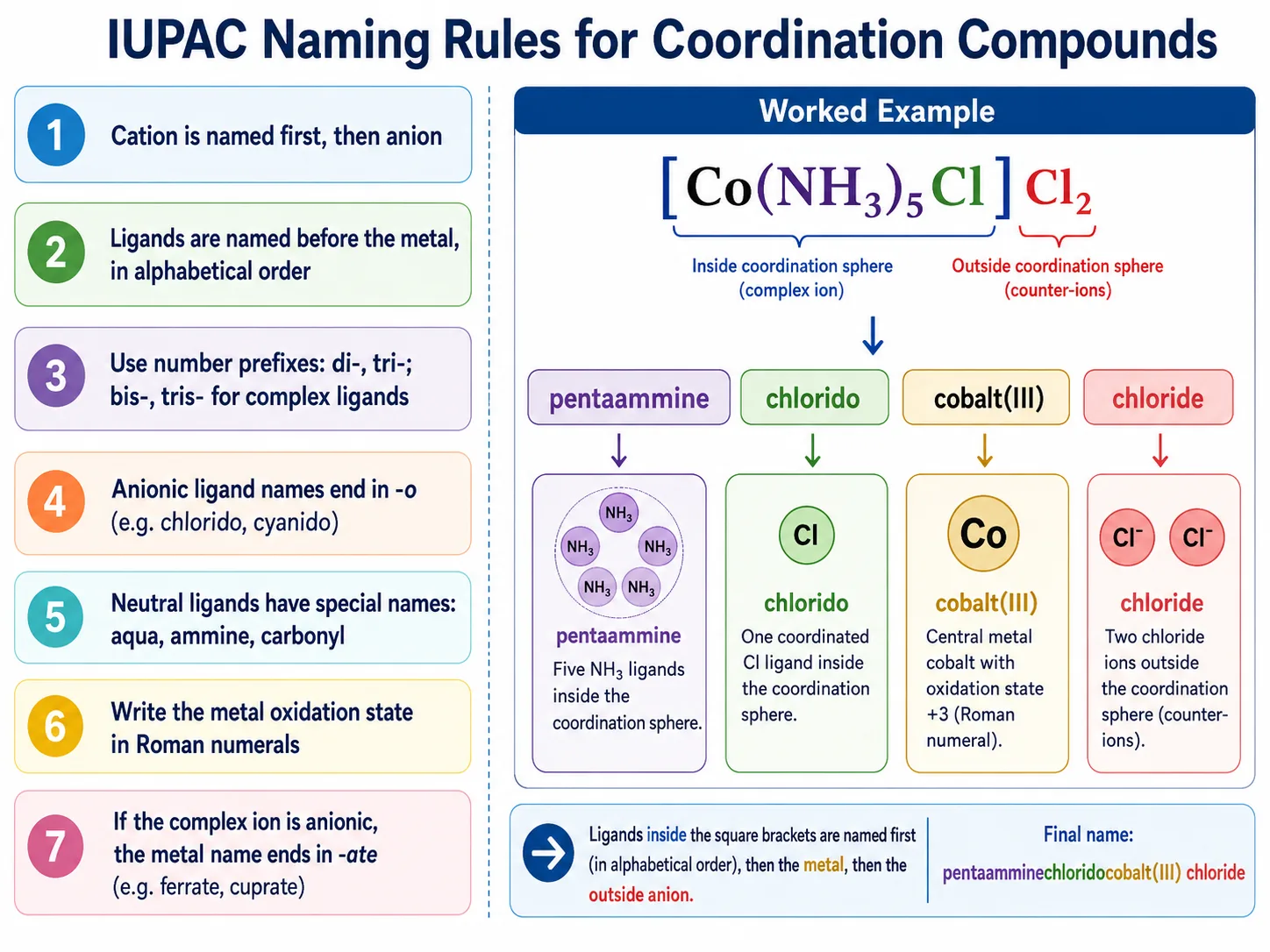
Worked example: → pentaamminechloridocobalt(III) chloride. (5 ammine + 1 chlorido ligands, cobalt(III), with chloride counter ions.)
Writing Formulas from Names
To go the other way (name → formula), use these conventions:
- The central metal is written first, then the ligands in alphabetical order (by symbol/name).
- The whole coordination entity is enclosed in square brackets, with the overall charge as a right superscript.
- Polyatomic ligands are enclosed in parentheses; abbreviations like en are written as such.
Worked examples:
- Potassium hexacyanidoferrate(III) → .
- Tetraamminecopper(II) sulphate → .
- Potassium tetrachloridoplatinate(II) → .
[NEET Important] Two spellings examiners check: ammine (two m's, for NH) versus amine (organic, one m), and -ate endings for anionic complexes (ferrate, cuprate, argentate). Getting these exactly right wins easy marks.
Solved Examples
Example 1: Name a cationic complex
Write the IUPAC name of .
Solution: Six ammine ligands, cobalt(III), chloride counter ion: hexaamminecobalt(III) chloride.
Example 2: Name an anionic complex
Write the IUPAC name of .
Solution: Six cyanido ligands, iron in an anionic complex (so ferrate), Fe is +2: potassium hexacyanidoferrate(II).
Example 3: Name with mixed ligands
Write the IUPAC name of .
Solution: Ligands alphabetical (ammine before chlorido): 5 ammine + 1 chlorido, cobalt(III): pentaamminechloridocobalt(III) chloride.
Example 4: Name with a bidentate ligand
Write the IUPAC name of .
Solution: en takes the bis/tris prefix: tris(ethylenediamine)cobalt(III) chloride.
Example 5: Formula from a name
Write the formula for potassium hexacyanidoferrate(III).
Solution: Fe(III) with 6 CN gives , balanced by 3 K: .
Example 6: Formula from a name (cationic)
Write the formula for tetraamminecopper(II) sulphate.
Solution: Cu(II) with 4 NH gives , balanced by SO: .
Example 7: Anionic metal stem
What is the metal name used for an anionic complex of (a) iron and (b) copper?
Solution: (a) Iron → ferrate; (b) copper → cuprate. The Latin stems are used with the -ate suffix for anionic complexes.
Example 8: Name a neutral complex
Write the IUPAC name of .
Solution: Four carbonyl ligands on neutral nickel (oxidation state 0): tetracarbonylnickel(0).
Example 9: Determine the oxidation state in a name
In sodium tetrachloridoaurate(III), what is the formula and the metal's oxidation state?
Solution: Au is +3 with four Cl → , balanced by Na: . Gold is in the +3 oxidation state (aurate = anionic gold).
Example 10: Ammine vs amine
Why is NH written as "ammine" (two m's) and not "amine" in complex names?
Solution: In coordination nomenclature, ammine (two m's) specifically denotes the NH ligand. "Amine" (one m) refers to organic amines. The double-m spelling avoids confusion and is the IUPAC-correct form.