
Bonding in Metal Carbonyls
Metal carbonyls are complexes in which carbon monoxide (CO) is the ligand, with the metal usually in a low (often zero) oxidation state — e.g. Ni(CO) (tetrahedral) and Fe(CO) (trigonal bipyramidal).
The metal-carbon bond in carbonyls is unusually strong because it is synergic (mutually reinforcing), made of two parts:
- (sigma) bond: the carbon lone pair of CO donates into an empty metal orbital (ligand → metal).
- (pi) back-bond: a filled metal d orbital donates electron density back into the empty antibonding orbital of CO (metal → ligand).
This synergic bonding — the two effects strengthen each other — makes carbonyls very stable.
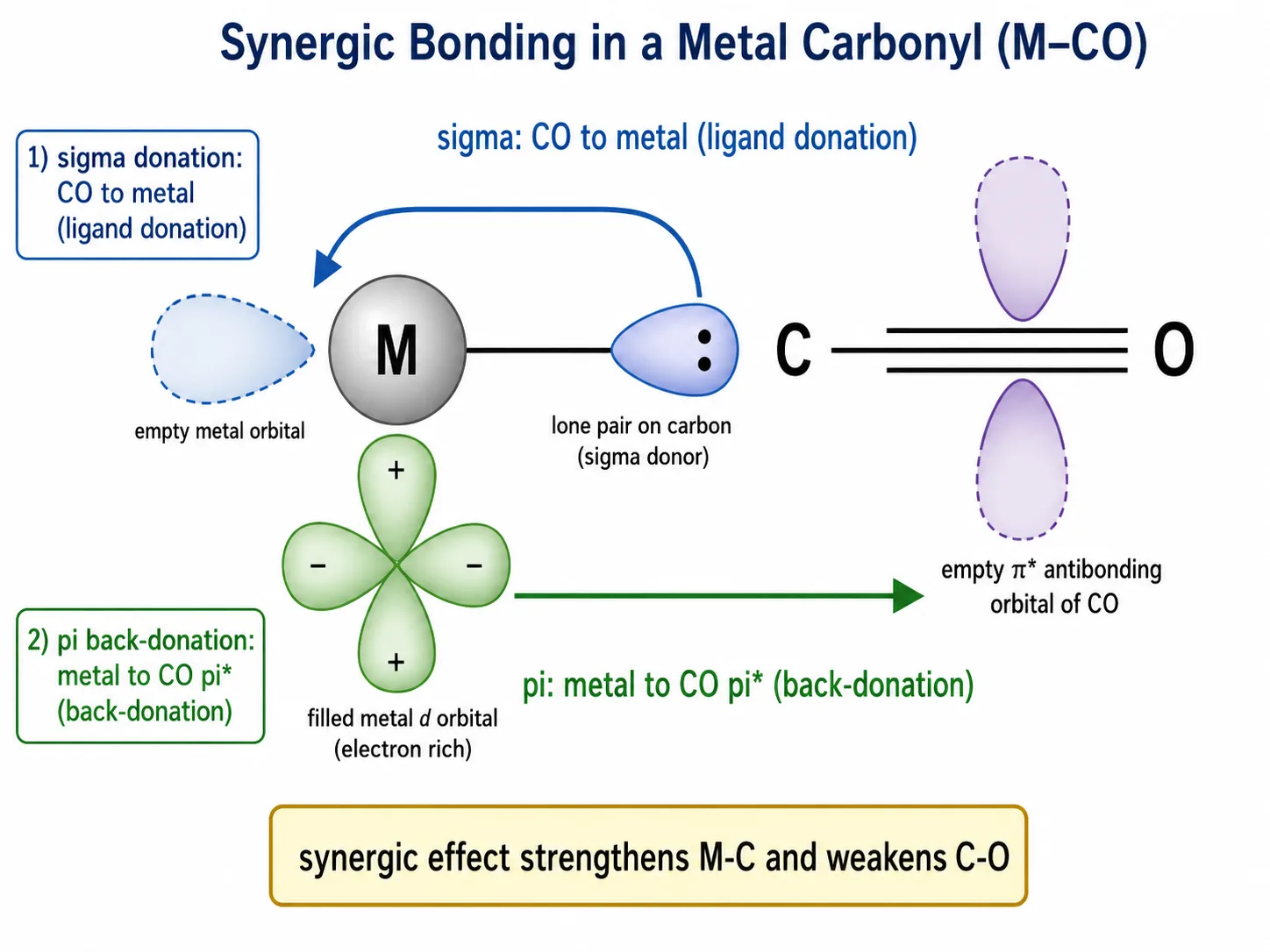
Key Point: The M-CO bond is synergic: CO donates a lone pair to the metal, and the metal donates d-electron density back into CO's orbital. More back-donation strengthens the M-C bond and weakens the C-O bond.
Stability of Complexes and the Chelate Effect
The stability of a complex in solution is measured by its stability (formation) constant, . A larger means a more stable complex (formation is favoured at equilibrium).
Factors that increase stability:
- Higher charge on the central metal ion.
- Smaller size of the metal ion.
- Stronger-field / more basic ligands.
- The chelate effect.
The chelate effect: complexes with chelating (polydentate) ligands are far more stable than comparable complexes with unidentate ligands. For example, is much more stable than , even though both have six Ni-N bonds.
Why? When a chelate ring forms, the number of free particles in solution effectively increases because one polydentate ligand replaces several unidentate ligands, so the reaction is favoured by a large positive entropy change. This entropy-driven extra stability is the chelate effect.
[JEE Tip] "Why is more stable than ?" — the chelate effect: the chelating en gives a favourable entropy increase.
Importance and Applications
Coordination compounds are everywhere — in biology, industry, analysis and medicine:
Biological:
- Haemoglobin — an iron complex that carries O in blood.
- Chlorophyll — a magnesium complex that captures light in photosynthesis.
- Vitamin B — a cobalt complex.
Analytical and industrial:
- EDTA complexometric titrations measure water hardness (Ca, Mg).
- Electroplating of silver and gold uses cyanide complexes for a smooth coat.
- Extraction of metals (e.g. silver and gold by cyanide leaching; nickel purification via Mond's process using Ni(CO)).
- Catalysis — Wilkinson's catalyst (hydrogenation), Ziegler-Natta (polymerisation).
Medicinal:
- cis-platin — an anticancer drug.
- Chelation therapy — EDTA and D-penicillamine remove toxic metals (Pb, Hg) from the body.
Key Point: From the oxygen in your blood to the drug that fights cancer, coordination compounds are central to life and technology. Their stability, colour and reactivity all trace back to the metal-ligand bonding studied in this chapter.
Solved Examples
Example 1: Synergic bonding
Explain the synergic bonding in metal carbonyls.
Solution: It has two mutually reinforcing parts: (1) a bond where the CO carbon lone pair donates into an empty metal orbital, and (2) a back-bond where filled metal d orbitals donate into CO's empty antibonding orbital. Each strengthens the other, giving a strong M-CO bond.
Example 2: Oxidation state in carbonyls
What is the oxidation state of nickel in Ni(CO)?
Solution: CO is a neutral ligand and the complex is neutral, so nickel is in the 0 oxidation state.
Example 3: The chelate effect
Why is more stable than ?
Solution: This is the chelate effect. en is a chelating (bidentate) ligand; replacing six unidentate NH with three chelating en ligands gives a favourable entropy increase that makes the chelate complex much more stable.
Example 4: Stability constant
What does a large stability constant () indicate?
Solution: A large indicates that the complex is very stable — its formation from the metal ion and ligands is strongly favoured at equilibrium.
Example 5: Effect of back-bonding on C-O
How does increased back-donation affect the C-O bond in a carbonyl?
Solution: More back-donation puts electron density into CO's antibonding orbital, which weakens the C-O bond (and strengthens the M-C bond). This is detectable as a lowering of the C-O stretching frequency.
Example 6: Biological complexes
Name the central metal in (a) haemoglobin, (b) chlorophyll, (c) vitamin B.
Solution: (a) Iron (Fe); (b) Magnesium (Mg); (c) Cobalt (Co).
Example 7: Factors affecting stability
List three factors that increase the stability of a complex.
Solution: (1) Higher charge on the metal ion; (2) smaller metal-ion size; (3) stronger-field/more basic ligands (and the chelate effect for polydentate ligands).
Example 8: Application of EDTA
Give one analytical application of EDTA as a ligand.
Solution: EDTA is used in complexometric titrations to estimate the hardness of water (the amount of Ca and Mg), forming very stable 1:1 chelate complexes with these ions.
Example 9: Mond's process
How is the metal carbonyl Ni(CO) used in metallurgy?
Solution: In Mond's process for purifying nickel, impure nickel reacts with CO to form volatile Ni(CO), which is then decomposed on heating to deposit pure nickel and release CO (recycled).
Example 10: Medicinal application
Name one medicinal application of coordination compounds.
Solution: cis-platin is used as an anticancer drug; and chelation therapy (e.g. EDTA, D-penicillamine) is used to remove toxic heavy metals (lead, mercury) from the body.