
Where the Exchange Happens, and by What Mechanism
Alveoli are the primary sites of exchange of gases. That is the sentence to memorise, but it is not the whole story - exchange of gases also occurs between blood and tissues. So there are two exchange sites in the body, one at each end of the circulation, and the same physics runs at both.
Oxygen and carbon dioxide are exchanged at these sites by simple diffusion, mainly based on pressure or concentration gradient.
Read that carefully. There is no pump, no carrier protein and no ATP anywhere in gas exchange. A gas simply moves from where its pressure is high to where its pressure is low. Every fact in this section is only an elaboration of that one idea.
The three factors that affect the rate of diffusion
The chapter names three, and they are asked as a set rather than one at a time.
- The pressure or concentration gradient - this is the main basis of the exchange, the one the chapter calls out with the word mainly.
- The solubility of the gases - a gas that dissolves better crosses a wet membrane faster.
- The thickness of the membranes involved in diffusion - the thinner the membrane, the faster the diffusion.
Learn them in that order and learn all three. A question that offers you "pressure gradient" alone as the complete answer is offering you one third of it.
[NEET Important] The examinable phrase is "simple diffusion, mainly based on pressure or concentration gradient". The distractors are always active transport and facilitated transport requiring ATP - both wrong, because gas exchange spends no energy at all. The second favourite trap is a "which of the following affects the rate of diffusion" item with solubility or membrane thickness quietly left out.
Partial Pressure and the Numbers of Table 14.1
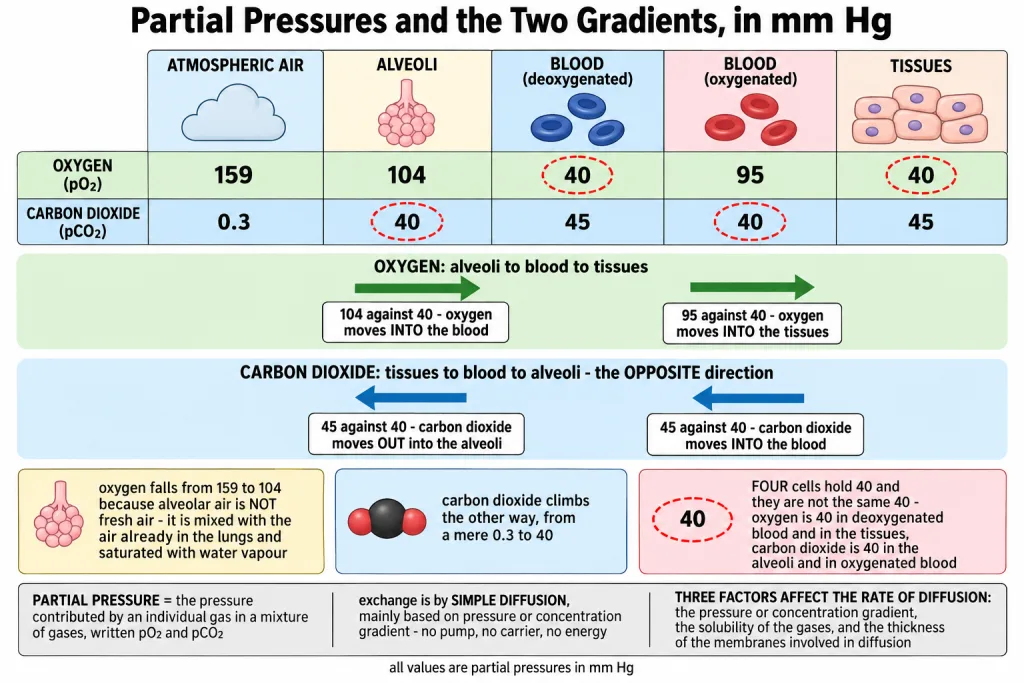
Pressure contributed by an individual gas in a mixture of gases is called partial pressure. Air is a mixture, so each gas in it presses with its own share of the total pressure, and it is that share which drives the gas across a membrane.
Partial pressure is represented as for oxygen and for carbon dioxide. Note the convention - a small italic p in front of the formula of the gas.
Now the table. This is the single most reproduced table in the chapter, and every one of its ten numbers gets asked.
| Respiratory gas | Atmospheric air | Alveoli | Blood (deoxygenated) | Blood (oxygenated) | Tissues |
|---|---|---|---|---|---|
| Oxygen | 159 | 104 | 40 | 95 | 40 |
| Carbon dioxide | 0.3 | 40 | 45 | 40 | 45 |
All values are partial pressures in mm Hg.
Now read the gradients straight off the table, because that is what the table is for.
- The data given in the table clearly indicates a concentration gradient for oxygen from alveoli to blood and from blood to tissues. Follow the oxygen row: 104 in the alveoli against 40 in deoxygenated blood, so oxygen moves into the blood; then 95 in oxygenated blood against 40 in the tissues, so oxygen moves into the tissues.
- Similarly, a gradient is present for carbon dioxide in the opposite direction, that is, from tissues to blood and from blood to alveoli. Follow the carbon dioxide row: 45 in the tissues against 40 in oxygenated blood, so carbon dioxide moves into the blood; then 45 in deoxygenated blood against 40 in the alveoli, so carbon dioxide moves out into the alveoli.
Two directions, one table. Oxygen always runs alveoli to blood to tissues; carbon dioxide always runs tissues to blood to alveoli.
One number deserves a second look. Oxygen falls from 159 in atmospheric air to 104 in the alveoli, because alveolar air is not fresh air - it is mixed with the air already in the lungs and saturated with water vapour. Carbon dioxide climbs the other way, from a mere 0.3 in atmospheric air to 40 in the alveoli.
[NEET Important] Learn the oxygen row as 159, 104, 40, 95, 40 and the carbon dioxide row as 0.3, 40, 45, 40, 45. The commonest errors are giving 95 where 104 is wanted (95 is oxygenated blood, 104 is the alveoli) and forgetting that atmospheric is 0.3 and not zero. Note too that oxygen has the same value, 40, in deoxygenated blood and in the tissues, and carbon dioxide has the same value, 40, in the alveoli and in oxygenated blood - a paper will use one of those repeats as a distractor.
Solubility, and the Three Layers of the Diffusion Membrane
Carbon dioxide has the easier journey
Look again at the carbon dioxide row. Its gradients are tiny - 45 against 40, a difference of only 5 mm Hg, where oxygen enjoys 104 against 40. Yet carbon dioxide gets out perfectly well. The reason is solubility.
The solubility of is 20-25 times higher than that of . Therefore the amount of carbon dioxide that can diffuse through the diffusion membrane per unit difference in partial pressure is much higher compared to that of oxygen.
So a small gradient is enough for carbon dioxide, while oxygen needs a large one. That single fact explains why the two rows of the table look so different in scale.
The diffusion membrane, layer by layer
The diffusion membrane is made up of three major layers:
- The thin squamous epithelium of the alveoli.
- The endothelium of the alveolar capillaries.
- The basement substance in between them - composed of a thin basement membrane supporting the squamous epithelium and the basement membrane surrounding the single layer endothelial cells of the capillaries.
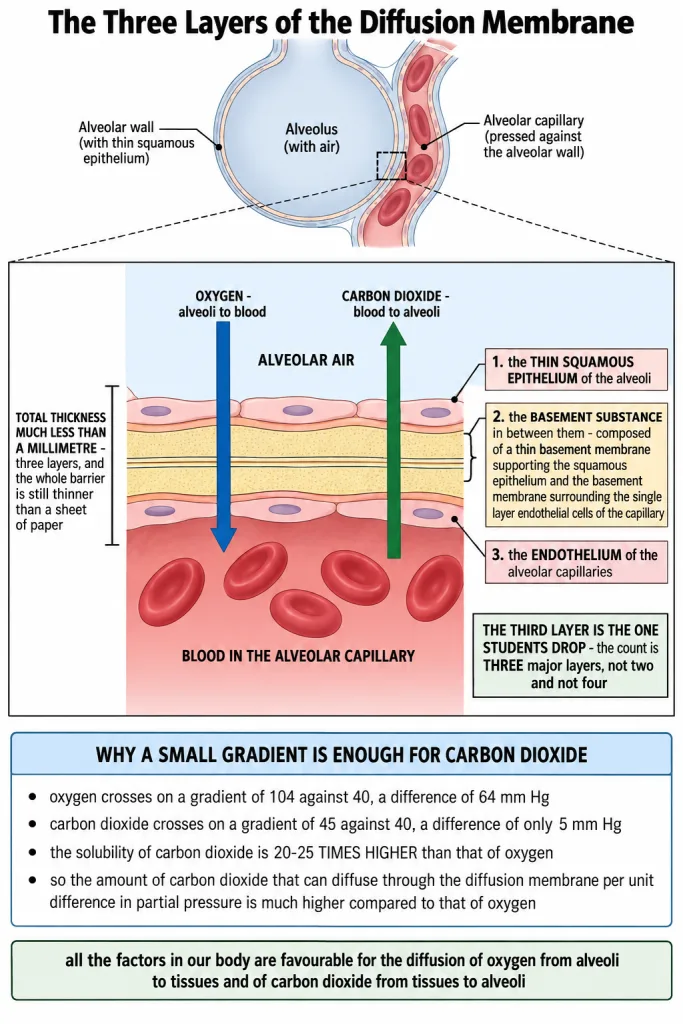
However, its total thickness is much less than a millimetre. Three layers sound like a lot until you see that figure - the whole barrier a gas has to cross is thinner than a sheet of paper, which is exactly why diffusion across it is fast enough to keep a person alive.
Therefore, all the factors in our body are favourable for the diffusion of oxygen from alveoli to tissues and of carbon dioxide from tissues to alveoli.
That is the chapter's own closing sentence on exchange, and it ties the three factors together: the gradients run the right way, carbon dioxide is highly soluble, and the membrane is extremely thin.
[NEET Important] Two counts and one comparison. Three major layers, not two and not four - and the third one, the basement substance, is the one students drop. Solubility of carbon dioxide is 20-25 times that of oxygen, and the distractors offered are usually 2-3 times and 70 times. The total thickness is much less than a millimetre - never quote it as one millimetre.
Quick Recap
- Alveoli are the primary sites of exchange of gases, and exchange also occurs between blood and tissues.
- Oxygen and carbon dioxide are exchanged at these sites by simple diffusion, mainly based on pressure or concentration gradient. No energy is spent.
- Three factors affect the rate of diffusion: the pressure or concentration gradient, the solubility of the gases, and the thickness of the membranes involved in diffusion.
- Partial pressure = the pressure contributed by an individual gas in a mixture of gases, written and .
- Partial pressures in mm Hg - oxygen: atmospheric air 159, alveoli 104, deoxygenated blood 40, oxygenated blood 95, tissues 40.
- Partial pressures in mm Hg - carbon dioxide: atmospheric air 0.3, alveoli 40, deoxygenated blood 45, oxygenated blood 40, tissues 45.
- Oxygen gradient: alveoli to blood, and blood to tissues.
- Carbon dioxide gradient: the opposite direction - tissues to blood, and blood to alveoli.
- The solubility of is 20-25 times higher than that of , so the amount of carbon dioxide that can diffuse per unit difference in partial pressure is much higher than that of oxygen.
- The diffusion membrane has three major layers: the thin squamous epithelium of the alveoli, the endothelium of the alveolar capillaries, and the basement substance in between them.
- Its total thickness is much less than a millimetre.
- All the factors in our body are favourable for the diffusion of oxygen from alveoli to tissues and of carbon dioxide from tissues to alveoli.
Solved Examples
Question 1
Q. Which are the primary sites of exchange of gases, and where else in the body does exchange occur?
Answer. The alveoli are the primary sites of exchange of gases. Exchange of gases also occurs between blood and tissues. Both sites work the same way, by diffusion down a partial pressure gradient.
Question 2
Q. By what mechanism are oxygen and carbon dioxide exchanged at these sites?
Answer. By simple diffusion, mainly based on pressure or concentration gradient. No carrier and no energy are involved - the gas simply moves from the higher partial pressure to the lower one.
Question 3
Q. Name the three factors that can affect the rate of diffusion of gases.
Answer.
- The pressure or concentration gradient, which is the main basis of the exchange.
- The solubility of the gases.
- The thickness of the membranes involved in diffusion.
All three are named in the chapter, and a complete answer needs all three.
Question 4
Q. Define partial pressure, and say how the partial pressures of the two respiratory gases are written.
Answer. Partial pressure is the pressure contributed by an individual gas in a mixture of gases. It is represented as for oxygen and for carbon dioxide.
Question 5
Q. Give the partial pressure of oxygen at all five places listed in the chapter's table.
Answer. In mm Hg: atmospheric air 159, alveoli 104, deoxygenated blood 40, oxygenated blood 95, tissues 40.
Question 6
Q. Give the partial pressure of carbon dioxide at those same five places.
Answer. In mm Hg: atmospheric air 0.3, alveoli 40, deoxygenated blood 45, oxygenated blood 40, tissues 45.
Question 7
Q. What will be the pO2 and pCO2 in the atmospheric air compared to those in the alveolar air? (i) pO2 lesser, pCO2 higher (ii) pO2 higher, pCO2 lesser (iii) pO2 higher, pCO2 higher (iv) pO2 lesser, pCO2 lesser This is one of the chapter-end exercises.
Answer. The correct option is (ii) - in atmospheric air the partial pressure of oxygen is higher and the partial pressure of carbon dioxide is lesser than in alveolar air.
The table settles it in two comparisons.
- Oxygen: 159 mm Hg in atmospheric air against 104 mm Hg in the alveoli, so atmospheric is higher.
- Carbon dioxide: 0.3 mm Hg in atmospheric air against 40 mm Hg in the alveoli, so atmospheric is lesser.
Why the others fail:
- (i) is wrong on both counts - it reverses each comparison.
- (iii) is wrong on carbon dioxide - atmospheric air has almost no carbon dioxide, 0.3 against 40.
- (iv) is wrong on oxygen - atmospheric air is the richest in oxygen at 159, not the poorest.
The reason behind the numbers is worth a line: alveolar air is not fresh air. It mixes with the air already in the lungs and is loaded with the carbon dioxide arriving from the blood, so its oxygen is diluted and its carbon dioxide is raised.
Question 8
Q. Read the direction of the oxygen gradient off the table.
Answer. There is a concentration gradient for oxygen from alveoli to blood and from blood to tissues. 104 in the alveoli against 40 in deoxygenated blood pushes oxygen into the blood, and 95 in oxygenated blood against 40 in the tissues pushes it on into the tissues.
Question 9
Q. Read the direction of the carbon dioxide gradient off the table.
Answer. The gradient for carbon dioxide runs in the opposite direction - from tissues to blood and from blood to alveoli. 45 in the tissues against 40 in oxygenated blood drives carbon dioxide into the blood, and 45 in deoxygenated blood against 40 in the alveoli drives it out into the alveolar air.
Question 10
Q. The carbon dioxide gradient is only about 5 mm Hg, far smaller than the oxygen gradient. Why is that enough?
Answer. Because of solubility. The solubility of carbon dioxide is 20-25 times higher than that of oxygen. Therefore the amount of carbon dioxide that can diffuse through the diffusion membrane per unit difference in partial pressure is much higher than that of oxygen. A small gradient carries a large amount of carbon dioxide, while oxygen needs a big gradient to move the same sort of quantity.
Question 11
Q. Name the three major layers of the diffusion membrane.
Answer.
- The thin squamous epithelium of the alveoli.
- The endothelium of the alveolar capillaries.
- The basement substance in between them, made of a thin basement membrane supporting the squamous epithelium and the basement membrane surrounding the single layer endothelial cells of the capillaries.
Question 12
Q. How thick is the diffusion membrane, and why does the figure matter?
Answer. Its total thickness is much less than a millimetre. It matters because the thickness of the membrane is one of the three factors affecting the rate of diffusion - the thinner the barrier, the faster a gas crosses it. Three layers still add up to less than a millimetre, which is why exchange across it is fast enough to supply the whole body.
Question 13
Q. Diffusion of gases occurs in the alveolar region only and not in the other parts of the respiratory system. Why? This is one of the chapter-end exercises.
Answer. Because only the alveoli have the structure that diffusion needs, and the rest of the tract does not.
What the alveoli have:
- A thin squamous epithelium, one flat cell thick.
- A dense network of capillaries pressed right against that epithelium.
- Together these give a diffusion membrane of three layers - the squamous epithelium of the alveoli, the endothelium of the alveolar capillaries and the basement substance in between - whose total thickness is much less than a millimetre.
What the rest of the tract has instead:
- The conducting part runs from the nostrils to the terminal bronchioles. Its walls are thick and are supported by cartilage - incomplete cartilaginous rings in the trachea and bronchi - and there is no capillary bed in contact with the lumen.
- A gas would have to cross a thick, cartilage-supported wall to reach blood that is not there, so no useful diffusion can occur.
So the two parts have two different jobs. The conducting part transports the air and clears, humidifies and warms it; the alveoli, the exchange part, do the actual diffusion of oxygen and carbon dioxide.
Question 14
Q. Oxygen reaches the alveoli at only 104 mm Hg although the air outside is at 159 mm Hg. Does this loss stop exchange?
Answer. No. What matters for diffusion is the gradient across the diffusion membrane, not the value in the atmosphere. Alveolar oxygen at 104 mm Hg still faces deoxygenated blood at 40 mm Hg, and that difference of 64 mm Hg is a strong gradient into the blood. The fall from 159 to 104 happens because alveolar air is mixed with the air already in the lungs and is saturated with water vapour.
Question 15
Q. Summarise, in the chapter's own words, why gas exchange works so well in our body.
Answer. All the factors in our body are favourable for the diffusion of oxygen from alveoli to tissues and of carbon dioxide from tissues to alveoli. In detail: the partial pressure gradients run the right way for both gases, carbon dioxide is 20-25 times more soluble than oxygen, and the diffusion membrane, though made of three layers, is much less than a millimetre thick.