
Same Syllabus. A Different Exam.
The Solved Examples section worked this chapter the way a written paper does - trace the air, explain the mechanism, define the capacity. NEET does not ask you to explain anything here. It names one number, one structure or one direction, gives four options, and you have about half a minute.
The marking is +4 for a correct answer and -1 for a wrong one. In a written answer, saying vital capacity is "roughly four and a half litres" earns the mark. Here, 1100 mL where the answer is 1200 mL is worth -1, which is five marks behind someone who skipped it.
This is the second most number-dense chapter of the year, after respiration in plants - and again that is good news. The numbers do not change, there are about twenty-five of them, and nothing has to be derived except five sums. Learn the numbers, the addresses and the directions, and most of the chapter answers itself.
Where students lose marks is the negatives and the one-word swaps - normal against forcible, alveoli against blood, medulla against pons. Both get their own block below.
The Four Shapes This Chapter Is Asked In
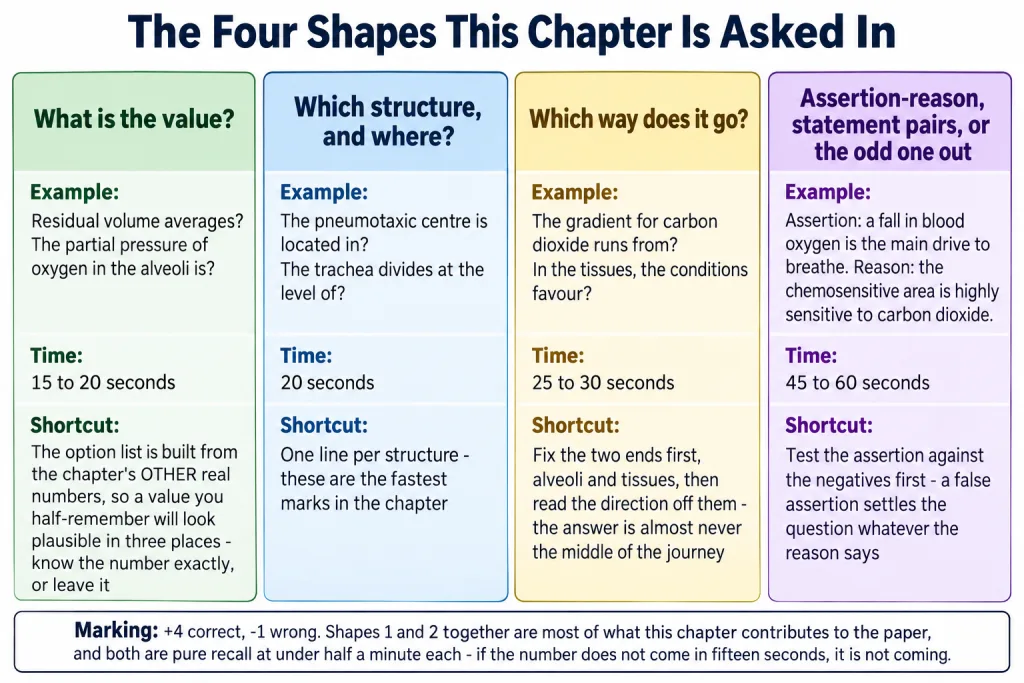
Shape 1 - What is the value? "Residual volume averages?" "The partial pressure of oxygen in the alveoli is?" Budget 15 to 20 seconds. The shortcut: the option list is built from the chapter's OTHER real numbers, so a value you half-remember will look plausible in three places. Know the number exactly, or leave it.
Shape 2 - Which structure, and where? "The pneumotaxic centre is located in?" "The trachea divides at the level of?" Budget 20 seconds. The shortcut: one line per structure, and the address table below is that list. These are the fastest marks in the chapter.
Shape 3 - Which way does it go? "The gradient for carbon dioxide runs from?" "In the tissues, the conditions favour?" Budget 25 to 30 seconds. The shortcut: fix the two ends first - alveoli and tissues - then read the direction off them. Everything in this chapter moves between those two places, and the answer is almost never the middle of the journey.
Shape 4 - Assertion-reason, statement pairs, or the odd one out. "Assertion: a fall in blood oxygen is the main drive to breathe. Reason: the chemosensitive area is highly sensitive to carbon dioxide." Budget 45 to 60 seconds. The shortcut: test the assertion against the negatives block first. Half of this chapter's assertion-reason items are built on a statement the chapter explicitly denies, and a false assertion settles the question whatever the reason says.
[NEET Important] Shapes 1 and 2 together are most of what this chapter contributes to the paper, and both are pure recall at under half a minute each. Do not spend a minute on a value question. If the number does not come in fifteen seconds, it is not coming.
Every Number in the Chapter
Learn these as a block, because the wrong options are drawn from this same block.
The four volumes
| Volume | What it is | Value |
|---|---|---|
| Tidal Volume (TV) | inspired or expired during a normal respiration | approximately 500 mL |
| Inspiratory Reserve Volume (IRV) | extra volume on a forcible inspiration | 2500 to 3000 mL |
| Expiratory Reserve Volume (ERV) | extra volume on a forcible expiration | 1000 to 1100 mL |
| Residual Volume (RV) | remains even after a forcible expiration | 1100 to 1200 mL |
The five capacities - all of them sums
- IC = TV + IRV - inspired after a normal expiration
- EC = TV + ERV - expired after a normal inspiration
- FRC = ERV + RV - remains after a normal expiration
- VC = ERV + TV + IRV - the maximum in one breath, either direction
- TLC = RV + ERV + TV + IRV, that is VC + RV
The partial pressures, in mm Hg
| Gas | Atmospheric air | Alveoli | Deoxygenated blood | Oxygenated blood | Tissues |
|---|---|---|---|---|---|
| oxygen | 159 | 104 | 40 | 95 | 40 |
| carbon dioxide | 0.3 | 40 | 45 | 40 | 45 |
Four cells in that table hold 40, and they are not the same 40. Oxygen is 40 in deoxygenated blood and 40 in the tissues; carbon dioxide is 40 in the alveoli and 40 in oxygenated blood. A question that gives you "40 mm Hg" and asks what it is has four right answers and is really asking which gas and which site - read the stem twice.
The rest of the numbers
- Breathing rate: 12-16 times per minute, moving 6000 to 8000 mL of air per minute.
- The solubility of carbon dioxide is 20-25 times higher than that of oxygen.
- The diffusion membrane has 3 layers and a total thickness much less than a millimetre.
- Oxygen transport: 97 per cent by RBCs, 3 per cent dissolved in plasma.
- Each haemoglobin molecule carries a maximum of 4 molecules of oxygen.
- Carbon dioxide transport: 20-25 per cent as carbamino-haemoglobin, 70 per cent as bicarbonate, about 7 per cent dissolved in plasma.
- 100 mL of oxygenated blood delivers about 5 mL of oxygen to the tissues.
- 100 mL of deoxygenated blood delivers about 4 mL of carbon dioxide to the alveoli.
- The trachea divides at the level of the 5th thoracic vertebra.
One Structure, One Line
Every Shape 2 question is one row of this table.
| Structure | Its one line |
|---|---|
| Larynx | the cartilaginous sound box - helps in sound production |
| Epiglottis | thin elastic cartilaginous flap covering the glottis during swallowing |
| Cartilaginous rings | incomplete, supporting trachea, bronchi and initial bronchioles |
| Terminal bronchiole | the last structure of the conducting part |
| Alveoli | the primary sites of exchange of gases |
| Pleural fluid | reduces friction on the lung surface |
| Diaphragm | contracts on inspiration; antero-posterior axis |
| External intercostals | contract on inspiration; dorso-ventral axis |
| Spirometer | estimates respiratory volumes for clinical assessment of pulmonary function |
| Diffusion membrane | squamous epithelium of alveoli + endothelium of alveolar capillaries + basement substance |
| Haemoglobin | red, iron-containing pigment in the RBC; binds oxygen reversibly |
| Carbonic anhydrase | in the RBC in high concentration; drives the reaction in both directions |
| Respiratory rhythm centre | in the medulla; primarily responsible for regulation |
| Pneumotaxic centre | in the pons; moderates the rhythm centre by reducing the duration of inspiration |
| Chemosensitive area | adjacent to the rhythm centre; sensitive to carbon dioxide and hydrogen ions |
| Aortic arch and carotid artery | receptors for carbon dioxide and hydrogen ion changes |
| Asthma | wheezing, from inflammation of bronchi and bronchioles |
| Emphysema | alveolar walls damaged, respiratory surface decreased; cigarette smoking |
| Occupational disorder | dust from grinding or stone-breaking leading to fibrosis |
[NEET Important] Two rows in that table are swapped more often than anything else in the chapter. Larynx is the box, epiglottis is the lid. Medulla holds the rhythm centre, pons holds the pneumotaxic centre. If you fix only two facts from this section, fix those.
The Negatives, and the Pairs That Get Swapped
The negatives
These are the sentences with a "not" in them, and they are where the -1 marks come from.
- No diffusion of gases happens anywhere in the conducting part - only in the alveoli and their ducts. The conducting part only transports, clears, humidifies and warms.
- Residual volume cannot be measured with a spirometer, because that air never leaves the lungs.
- The role of oxygen in the regulation of respiratory rhythm is quite insignificant. Carbon dioxide and hydrogen ions drive breathing, not falling oxygen. This is the single most counter-intuitive line in the chapter and it is asked constantly.
- Normal expiration is passive. It happens by relaxation of the diaphragm and intercostals, not by any muscle contracting.
- The percentage of oxygen in the air does not fall with altitude - the partial pressure does. A man on a hill is breathing air that is still about one-fifth oxygen.
- Insect blood plays no part in oxygen transport - the tracheoles deliver air to the tissue directly.
- The cartilaginous rings are incomplete, not closed circles.
- We cannot directly alter the pulmonary volume - the lung has no muscle of its own and is moved by the thoracic chamber around it.
The pairs
| If the question says | The answer is | The trap option is |
|---|---|---|
| remains after a normal expiration | FRC = ERV + RV | RV, which is after a forcible expiration |
| inspired after a normal expiration | IC = TV + IRV | EC, which is expired after a normal inspiration |
| the maximum in one breath | VC | TLC, which adds RV on top |
| the rhythm centre | medulla | pons, which holds the pneumotaxic centre |
| increases the antero-posterior axis | diaphragm | external intercostals, which act on the dorso-ventral axis |
| 100 mL of oxygenated blood delivers | 5 mL of oxygen | 4 mL, which is the carbon dioxide figure |
| 70 per cent | carbon dioxide as bicarbonate | 97 per cent, which is oxygen carried by RBCs |
| conditions favouring dissociation of oxygen | the tissues - low , high , high , higher temperature | the alveoli, where every one of those four is the other way |
[NEET Important] The word "normal" or "forcible" in a volume question is the question. Nothing else in the stem matters until you have decided which one it says.
Solved Examples at NEET Pace
Each item names the shortcut it uses, because the shortcut is the thing worth carrying into the exam hall.
Question 1
Q. What is the volume of air that remains in the lungs after a normal expiration?
Answer. The Functional Residual Capacity, FRC = ERV + RV. Shortcut: normal expiration means a capacity, forcible expiration means residual volume. Reading "normal" and answering RV is the commonest single error in this chapter.
Question 2
Q. Vital capacity includes which volumes?
Answer. ERV + TV + IRV. Shortcut: vital capacity is everything you can move, so it is total lung capacity minus the one volume you cannot move - RV.
Question 3
Q. The partial pressure of oxygen in the alveoli is 104 mm Hg. What is it in oxygenated blood?
Answer. 95 mm Hg. Shortcut: blood leaving the alveoli never quite reaches alveolar , so the oxygenated-blood figure is always the slightly lower one of that pair.
Question 4
Q. Which gas has the steeper partial-pressure gradient in absolute terms at the alveolus, and which diffuses faster?
Answer. Oxygen has the bigger gradient - 104 against 40, a difference of 64 - while carbon dioxide crosses on a gradient of only 5, from 45 to 40. Carbon dioxide still moves in the quantity required because its solubility is 20-25 times higher. Shortcut: gradient favours oxygen, solubility rescues carbon dioxide.
Question 5
Q. Name the three layers of the diffusion membrane.
Answer. The thin squamous epithelium of the alveoli, the endothelium of the alveolar capillaries, and the basement substance in between. Shortcut: alveolar wall, capillary wall, and the layer between them - and the whole thing is much less than a millimetre thick.
Question 6
Q. What percentage of oxygen is carried dissolved in plasma?
Answer. 3 per cent, the other 97 per cent being carried by the RBCs. Shortcut: for oxygen the RBC does almost everything; for carbon dioxide it does not.
Question 7
Q. How many molecules of oxygen can one haemoglobin molecule carry?
Answer. A maximum of four. Shortcut: four haem groups, four oxygens - and it is also the reason the dissociation curve is sigmoid.
Question 8
Q. In the tissues, are the conditions favourable for formation or for dissociation of oxyhaemoglobin?
Answer. Dissociation. The tissues have low , high , high hydrogen ion concentration and higher temperature, and all four favour unloading. Shortcut: learn the four conditions once for the alveoli and flip every one of them for the tissues.
Question 9
Q. Seventy per cent of carbon dioxide travels in which form?
Answer. As bicarbonate. Shortcut: the three carbon dioxide figures run 70, then 20-25, then 7 - bicarbonate, carbamino-haemoglobin, dissolved plasma - in that order of size.
Question 10
Q. Which enzyme handles the bicarbonate route, where does it sit, and in which direction does it work?
Answer. Carbonic anhydrase, in very high concentration in the RBCs with minute quantities in the plasma, and it facilitates the reaction in both directions. Shortcut: the same enzyme traps carbon dioxide at the tissue and releases it at the alveolus - the direction is set by , not by a second enzyme.
Question 11
Q. Which brain region holds the respiratory rhythm centre, and which holds the pneumotaxic centre?
Answer. Rhythm centre in the medulla; pneumotaxic centre in the pons. Shortcut: rhythm and medulla are the two words that go together - the pons only moderates, by reducing the duration of inspiration.
Question 12
Q. A question claims that a fall in blood oxygen is the main stimulus for increased breathing. True or false?
Answer. False. The role of oxygen in the regulation of respiratory rhythm is quite insignificant. The chemosensitive area and the aortic and carotid receptors respond to carbon dioxide and hydrogen ions. Shortcut: whenever oxygen is offered as the driver of breathing rate, it is wrong.
Question 13
Q. Which disorder damages the alveolar walls, and what is its major cause?
Answer. Emphysema, a chronic disorder in which alveolar walls are damaged so the respiratory surface is decreased; one major cause is cigarette smoking. Shortcut: asthma is airways and wheezing, emphysema is alveoli and surface area, occupational disorders are dust and fibrosis.
Question 14
Q. Which axis of the thoracic chamber does the diaphragm act on, and which do the external intercostals act on?
Answer. The diaphragm increases the antero-posterior axis; the external intercostals lift the ribs and sternum and increase the dorso-ventral axis. Shortcut: the diaphragm is the floor, so it works front to back; the ribs are the walls, so they work back to front and out.
A Drill Before You Move On
Decide each one before you read the verdict. Aim for 20 to 25 seconds per question.
- Residual volume can be measured directly with a spirometer. - False. That air never leaves the lungs.
- Tidal volume is approximately 500 mL. - True.
- The partial pressure of oxygen in atmospheric air is 104 mm Hg. - False. That is the alveolar figure. Atmospheric is 159.
- Carbon dioxide is about 20-25 times more soluble than oxygen. - True.
- The pneumotaxic centre lies in the medulla. - False. Pons. The rhythm centre is in the medulla.
- Normal expiration requires contraction of the internal intercostal muscles. - False. Normal expiration is passive relaxation.
- Seventy per cent of carbon dioxide is carried as carbamino-haemoglobin. - False. 70 per cent is bicarbonate; carbamino-haemoglobin is 20-25 per cent.
- Diffusion of gases occurs only in the alveoli and their ducts. - True.
- At high altitude the air contains a smaller percentage of oxygen. - False. The partial pressure falls; the percentage does not.
- The trachea divides into primary bronchi at the 5th thoracic vertebra. - True.