
Why an Animal Has to Breathe at All
Oxygen is utilised by organisms to indirectly break down simple molecules like glucose, amino acids and fatty acids to derive energy for their activities. Carbon dioxide, which is harmful, is also released during these catabolic reactions.
So the cell has a standing problem in two directions at once. Oxygen has to be continuously provided to the cells, and the carbon dioxide the cells produce has to be released out.
The process of exchange of oxygen from the atmosphere with the carbon dioxide produced by the cells is called breathing, commonly known as respiration.
Read that definition against the one from the respiration chapter, because the two are different things sharing one word. Cellular respiration is the enzyme-controlled breakdown of glucose inside the cell. Breathing is only the exchange of gases with the atmosphere. Breathing supplies the oxygen that cellular respiration then spends.
[NEET Important] The word "indirectly" is in the sentence for a reason. Oxygen does not attack glucose directly - it acts at the end of the electron transport system. A question that says oxygen "directly oxidises glucose" is testing that word.
Respiratory Organs Change with Habitat and Level of Organisation
Mechanisms of breathing vary among different groups of animals depending mainly on their habitats and levels of organisation.
That single sentence sets up the whole comparison, and the comparison is a favourite matching question.
| Animal group | Respiratory surface | The name of the respiration |
|---|---|---|
| Lower invertebrates - sponges, coelenterates, flatworms | simple diffusion over the entire body surface | - |
| Earthworms | moist cuticle | cutaneous |
| Insects | a network of tubes - tracheal tubes carrying atmospheric air within the body | tracheal |
| Most aquatic arthropods and molluscs | gills, special vascularised structures | branchial respiration |
| Terrestrial forms | lungs, vascularised bags | pulmonary respiration |
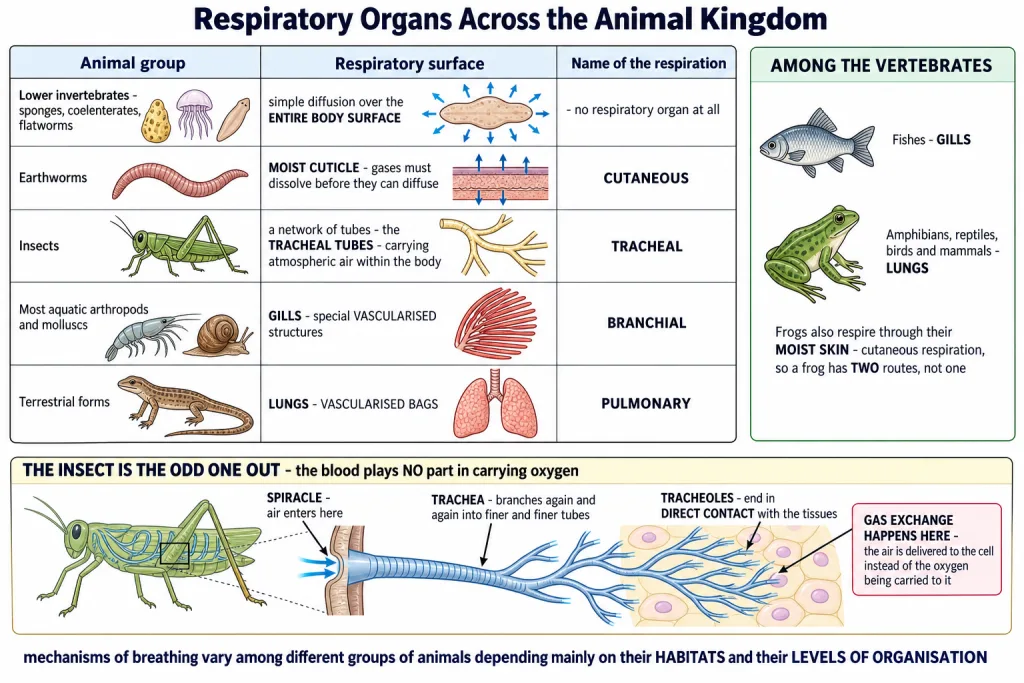
Among the vertebrates the split is simple. Fishes use gills. Amphibians, reptiles, birds and mammals respire through lungs. And amphibians like frogs can respire through their moist skin as well - cutaneous respiration.
Notice which words the source attaches to which group. Gills are "special vascularised structures"; lungs are "vascularised bags". Both are vascularised - that is the point of a respiratory organ - and an option that calls gills non-vascular is wrong on the definition.
[NEET Important] Learn the four "-al" names as a set: cutaneous, tracheal, branchial, pulmonary. They are asked as a matching column more often than they are asked one at a time. And remember a frog has two respiratory routes, not one - lungs and moist skin - which is exactly the kind of two-part answer that carries the mark.
The Insect Is the Odd One Out
The insect tracheal system is worth a paragraph of its own, because it is the one respiratory design in the list where the blood plays no part in carrying oxygen.
- Air enters through openings in the body wall called spiracles.
- It travels along the tracheae, the network of tubes the chapter names, which branch again and again into finer and finer tubes.
- The finest branches, the tracheoles, end in direct contact with the tissues.
- Gas exchange happens right there, at the tracheoles, between the air in the tube and the tissue cell.
So in an insect the air is delivered to the cell instead of the oxygen being carried to it. That is why insect blood does not need a respiratory pigment, and it is why this system suits a small animal but could not supply a large one.
[NEET Important] "What is the site of gaseous exchange in an insect?" is one of the chapter-end exercises, and the answer NEET wants is the tracheoles - the fine terminal branches of the tracheal system, in direct contact with the tissues - reached through spiracles. Answering only "the tracheal tubes" gets you most of the way; naming the tracheoles gets you all of it.
Quick Recap
- Oxygen is used to indirectly break down glucose, amino acids and fatty acids to derive energy; carbon dioxide, which is harmful, is released in the same catabolic reactions.
- Breathing = the exchange of oxygen from the atmosphere with the carbon dioxide produced by the cells, and it is commonly called respiration.
- Mechanisms of breathing vary with habitat and level of organisation.
- Sponges, coelenterates and flatworms - simple diffusion over the entire body surface.
- Earthworms - moist cuticle.
- Insects - a network of tracheal tubes; air enters by spiracles and exchange happens at the tracheoles, in direct contact with the tissues.
- Most aquatic arthropods and molluscs - gills, that is branchial respiration.
- Terrestrial forms - lungs, vascularised bags, that is pulmonary respiration.
- Fishes use gills; amphibians, reptiles, birds and mammals use lungs; frogs also use their moist skin - cutaneous respiration.
Solved Examples
Question 1
Q. What is breathing, in the chapter's own words?
Answer. The process of exchange of oxygen from the atmosphere with the carbon dioxide produced by the cells. It is commonly known as respiration.
Question 2
Q. Why must oxygen be supplied continuously and carbon dioxide removed continuously?
Answer. Because oxygen is used to indirectly break down glucose, amino acids and fatty acids to derive energy, and carbon dioxide, which is harmful, is released during those same catabolic reactions. Both processes run all the time, so both the supply and the removal must be continuous.
Question 3
Q. What decides which respiratory organ an animal has?
Answer. Its habitat and its level of organisation. The chapter names both, and both are needed for the mark.
Question 4
Q. How do sponges, coelenterates and flatworms exchange gases?
Answer. By simple diffusion over their entire body surface. They have no respiratory organ at all.
Question 5
Q. Name the respiratory surface of an earthworm.
Answer. The moist cuticle, which is cutaneous respiration. The moisture matters - gases must dissolve before they can diffuse.
Question 6
Q. What is the site of gaseous exchange in an insect? This is one of the chapter-end exercises.
Answer. The tracheoles, which are the finest terminal branches of the tracheal system.
- Air enters through the spiracles, openings in the body wall.
- It passes into the tracheae, the network of tubes that transports atmospheric air within the body.
- These branch repeatedly into tracheoles, which end in direct contact with the tissues, and the exchange of gases takes place there.
Because the air is delivered right to the tissue, the insect's blood plays no part in transporting oxygen.
Question 7
Q. Which animals use gills, and what is that kind of respiration called?
Answer. Most aquatic arthropods and molluscs, and among vertebrates the fishes. Gills are special vascularised structures, and the process is branchial respiration.
Question 8
Q. What is pulmonary respiration, and which animals use it?
Answer. Respiration through lungs, which are vascularised bags used by terrestrial forms. Among vertebrates, amphibians, reptiles, birds and mammals respire through lungs.
Question 9
Q. A frog is said to have two respiratory routes. Name them.
Answer. Lungs - pulmonary respiration, and the moist skin - cutaneous respiration. Amphibians can use either.
Question 10
Q. Both gills and lungs are described in one word that explains why they work. What is it?
Answer. Vascularised. Gills are special vascularised structures and lungs are vascularised bags. A respiratory surface is useless without a blood supply pressed close against it.
Question 11
Q. How does breathing differ from cellular respiration?
Answer. Breathing is the exchange of gases with the atmosphere - taking oxygen in and giving carbon dioxide out. Cellular respiration is the enzyme-controlled breakdown of glucose inside the cell that actually releases the energy. Breathing supplies the oxygen that cellular respiration spends.
Question 12
Q. Why would a tracheal system not work for an animal the size of a dog?
Answer. Because the tracheoles deliver air directly to each tissue by diffusion along a tube, and diffusion over a long distance is far too slow. The system works only while every tissue stays close to the body surface, which is why it is found in small animals like insects and why large animals need blood carrying a respiratory pigment instead.