
The Three Routes Carbon Dioxide Takes
Carbon dioxide leaves the tissues by three separate routes, and the chapter gives a percentage for each. These three figures are the most frequently asked numbers in the whole of gas transport.
| Route | How the carbon dioxide travels | Share |
|---|---|---|
| Bound to haemoglobin in the RBCs | as carbamino-haemoglobin | nearly 20-25 per cent |
| As bicarbonate | carried in the blood after the carbonic anhydrase reaction | 70 per cent |
| Dissolved in the plasma | simply in solution | about 7 per cent |
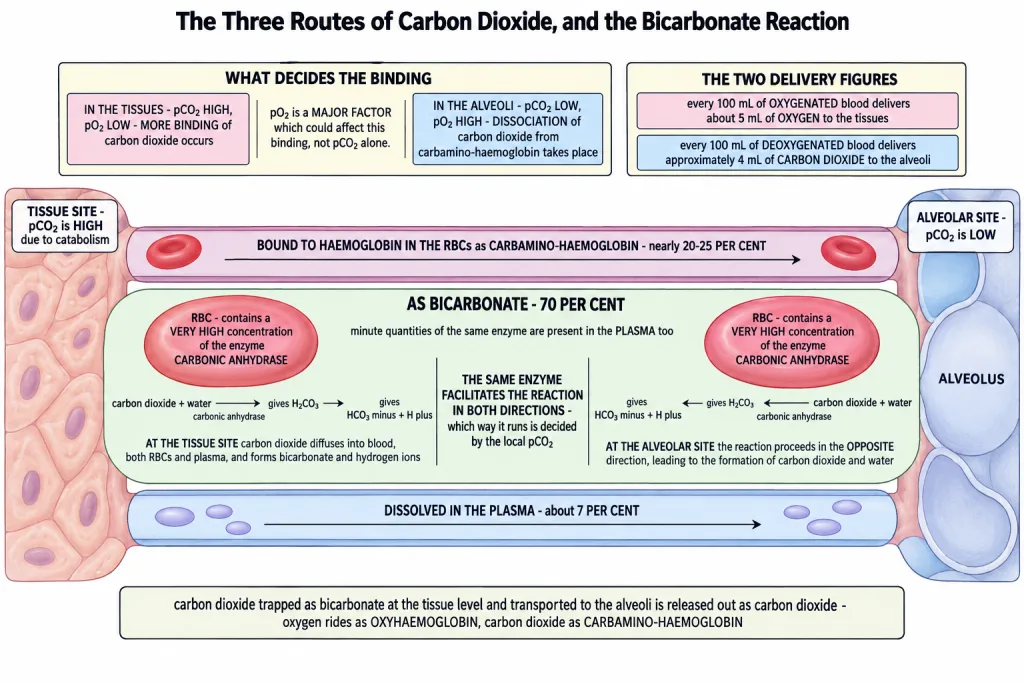
Learn the figures exactly as printed, ranges and all. You will notice that 20-25 plus 70 plus 7 does not come to exactly 100 - one of them is a range and another is prefixed with "about", so the printed set is a set of approximations. Reproduce them as printed anyway, because that is the form in which they are asked.
Compare the shape of this list with the oxygen list. Oxygen: 97 per cent by RBCs, 3 per cent dissolved. Carbon dioxide: 20-25 per cent by RBCs, 70 per cent as bicarbonate, 7 per cent dissolved. The bulk of oxygen rides on haemoglobin; the bulk of carbon dioxide rides as bicarbonate.
[NEET Important] The single most asked fact here is that 70 per cent of carbon dioxide is carried as bicarbonate, and the distractor set is drawn from the neighbouring figures - 7 per cent, 20-25 per cent, and 97 per cent borrowed from oxygen. Do not swap 7 with 70.
Carbamino-haemoglobin, and Why Both Partial Pressures Matter
Carbon dioxide is carried by haemoglobin as carbamino-haemoglobin, about 20-25 per cent of the total.
Notice that haemoglobin carries both gases, but at different sites and under different names - oxygen as oxyhaemoglobin, carbon dioxide as carbamino-haemoglobin.
This binding is related to the partial pressure of carbon dioxide, . That much is obvious. What is less obvious, and what gets asked, is the second factor.
The partial pressure of oxygen, , is a major factor which could affect this binding.
So the loading of carbon dioxide depends on both partial pressures at once, and the two places in the body set them in opposite ways.
| Where | What happens | ||
|---|---|---|---|
| In the tissues | high | low | more binding of carbon dioxide occurs |
| In the alveoli | low | high | dissociation of carbon dioxide from carbamino-haemoglobin takes place |
In the chapter's own words: when is high and is low, as in the tissues, more binding of carbon dioxide occurs; whereas when is low and is high, as in the alveoli, dissociation of carbon dioxide from carbamino-haemoglobin takes place.
That is, carbon dioxide which is bound to haemoglobin from the tissues is delivered at the alveoli.
Put the two gases side by side and the symmetry is complete. At the tissues haemoglobin drops oxygen and picks up carbon dioxide; at the alveoli it drops carbon dioxide and picks up oxygen. One molecule, two cargoes, two opposite stations.
[NEET Important] A question will give you only and expect you to remember that is also a major factor in carbamino-haemoglobin formation. Both are needed for the full mark. And keep the names apart - oxyhaemoglobin carries oxygen, carbamino-haemoglobin carries carbon dioxide; swapping them is the standard trap.
Carbonic Anhydrase and the Bicarbonate Route
Seventy per cent of the carbon dioxide travels as bicarbonate, and one enzyme makes that possible.
RBCs contain a very high concentration of the enzyme carbonic anhydrase, and minute quantities of the same are present in the plasma too.
Read the two halves of that sentence. Very high concentration in the RBCs, minute quantities in the plasma - the RBC is where the work is done, but the enzyme is not absent from the plasma.
This enzyme facilitates the following reaction in both directions.
Both directions is the crucial phrase. The same enzyme, in the same red cell, runs the reaction one way in the tissues and the other way in the lungs - and which way it runs is decided entirely by the local .
At the tissue site
At the tissue site, where the partial pressure of carbon dioxide is high due to catabolism, carbon dioxide diffuses into blood (RBCs and plasma) and forms and .
The words "due to catabolism" explain the high - the tissue is breaking down food molecules and releasing carbon dioxide all the time, so its stays at 45 mm Hg against 40 mm Hg in the arriving blood.
At the alveolar site
At the alveolar site, where is low, the reaction proceeds in the opposite direction, leading to the formation of carbon dioxide and water.
Thus, carbon dioxide trapped as bicarbonate at the tissue level and transported to the alveoli is released out as carbon dioxide.
That is the whole bicarbonate story in one sentence. Trapped at the tissues, carried as bicarbonate, released as carbon dioxide at the alveoli - the gas is disguised for the journey and undisguised on arrival.
The amount delivered
Every 100 mL of deoxygenated blood delivers approximately 4 mL of carbon dioxide to the alveoli.
[NEET Important] Two delivery figures, and they are offered as each other's distractors. 100 mL of oxygenated blood delivers about 5 mL of oxygen to the tissues. 100 mL of deoxygenated blood delivers about 4 mL of carbon dioxide to the alveoli. Oxygen 5, carbon dioxide 4 - tie each number to its blood, oxygenated for oxygen and deoxygenated for carbon dioxide, and the pair stops being confusable. Remember also that carbonic anhydrase works in both directions and that it is present in very high concentration in RBCs and in minute quantities in plasma.
Quick Recap
- Carbon dioxide travels by three routes: nearly 20-25 per cent transported by RBCs as carbamino-haemoglobin, 70 per cent carried as bicarbonate, and about 7 per cent in a dissolved state through the plasma.
- Reproduce those figures as printed, even though they do not total exactly 100.
- Carbon dioxide is carried by haemoglobin as carbamino-haemoglobin, about 20-25 per cent.
- This binding is related to the partial pressure of carbon dioxide, and is a major factor which could affect this binding.
- When is high and is low, as in the tissues, more binding of carbon dioxide occurs.
- When is low and is high, as in the alveoli, dissociation of carbon dioxide from carbamino-haemoglobin takes place.
- Carbon dioxide bound to haemoglobin from the tissues is delivered at the alveoli.
- RBCs contain a very high concentration of the enzyme carbonic anhydrase, and minute quantities of the same are present in the plasma too.
- The enzyme facilitates the reaction in both directions: .
- At the tissue site, where is high due to catabolism, carbon dioxide diffuses into blood (RBCs and plasma) and forms bicarbonate and hydrogen ions.
- At the alveolar site, where is low, the reaction proceeds in the opposite direction, forming carbon dioxide and water.
- Carbon dioxide trapped as bicarbonate at the tissue level and transported to the alveoli is released out as carbon dioxide.
- Every 100 mL of deoxygenated blood delivers approximately 4 mL of carbon dioxide to the alveoli, against 5 mL of oxygen delivered by every 100 mL of oxygenated blood.
Solved Examples
Question 1
Q. Name the three routes by which carbon dioxide is transported, with their percentages.
Answer.
- Nearly 20-25 per cent is transported by RBCs, as carbamino-haemoglobin.
- 70 per cent is carried as bicarbonate.
- About 7 per cent is carried in a dissolved state through the plasma.
Question 2
Q. What are the major transport mechanisms for carbon dioxide? Explain. This is one of the chapter-end exercises.
Answer. Carbon dioxide is transported in the blood by three mechanisms.
- Bound to haemoglobin as carbamino-haemoglobin - nearly 20-25 per cent.
Carbon dioxide is carried by haemoglobin as carbamino-haemoglobin. This binding is related to the partial pressure of carbon dioxide, and the partial pressure of oxygen is a major factor which could affect this binding.
- When is high and is low, as in the tissues, more binding of carbon dioxide occurs.
- When is low and is high, as in the alveoli, dissociation of carbon dioxide from carbamino-haemoglobin takes place.
- So carbon dioxide bound to haemoglobin at the tissues is delivered at the alveoli.
- As bicarbonate - 70 per cent, the largest share.
RBCs contain a very high concentration of the enzyme carbonic anhydrase, and minute quantities of the same are present in the plasma too. The enzyme facilitates the following reaction in both directions.
- At the tissue site, where the partial pressure of carbon dioxide is high due to catabolism, carbon dioxide diffuses into blood (RBCs and plasma) and forms bicarbonate and hydrogen ions.
- At the alveolar site, where is low, the reaction proceeds in the opposite direction, leading to the formation of carbon dioxide and water.
- Thus carbon dioxide trapped as bicarbonate at the tissue level and transported to the alveoli is released out as carbon dioxide.
- Dissolved in the plasma - about 7 per cent.
A small fraction simply dissolves in the plasma and travels in solution, helped by the fact that carbon dioxide is 20-25 times more soluble than oxygen.
The result of all three together: every 100 mL of deoxygenated blood delivers approximately 4 mL of carbon dioxide to the alveoli.
Question 3
Q. In what form does haemoglobin carry carbon dioxide, and how much of the total does that account for?
Answer. As carbamino-haemoglobin, and it accounts for about 20-25 per cent of the carbon dioxide transported.
Question 4
Q. Which two partial pressures affect the binding of carbon dioxide with haemoglobin?
Answer. The binding is related to the partial pressure of carbon dioxide, and the partial pressure of oxygen is a major factor which could affect this binding. Both and matter, and an answer that names only the first is incomplete.
Question 5
Q. Under what conditions does more binding of carbon dioxide to haemoglobin occur?
Answer. When is high and is low, which is the situation in the tissues.
Question 6
Q. Under what conditions does carbon dioxide dissociate from carbamino-haemoglobin?
Answer. When is low and is high, which is the situation in the alveoli. So the carbon dioxide bound at the tissues is delivered at the alveoli.
Question 7
Q. Name the enzyme responsible for the bicarbonate route, and say where it is found.
Answer. Carbonic anhydrase. RBCs contain a very high concentration of it, and minute quantities of the same are present in the plasma too.
Question 8
Q. Write the reaction that carbonic anhydrase catalyses, and say which way it runs.
Answer. The enzyme facilitates the reaction in both directions.
Which direction it actually takes at any moment is decided by the local partial pressure of carbon dioxide - forward at the tissues, backward at the alveoli.
Question 9
Q. What happens at the tissue site, and why is the partial pressure of carbon dioxide high there?
Answer. At the tissue site the partial pressure of carbon dioxide is high due to catabolism - the cells are constantly breaking down food molecules and releasing carbon dioxide. Carbon dioxide therefore diffuses into blood, into both the RBCs and the plasma, and forms bicarbonate and hydrogen ions.
Question 10
Q. What happens at the alveolar site?
Answer. At the alveolar site the partial pressure of carbon dioxide is low, so the reaction proceeds in the opposite direction, leading to the formation of carbon dioxide and water. The carbon dioxide trapped as bicarbonate at the tissue level and transported to the alveoli is released out as carbon dioxide.
Question 11
Q. How much carbon dioxide does 100 mL of deoxygenated blood deliver to the alveoli?
Answer. Approximately 4 mL of carbon dioxide.
Question 12
Q. State the two delivery figures of the chapter together, and say which belongs to which.
Answer. Every 100 mL of oxygenated blood delivers about 5 mL of oxygen to the tissues. Every 100 mL of deoxygenated blood delivers approximately 4 mL of carbon dioxide to the alveoli. Oxygen goes with 5 and with oxygenated blood; carbon dioxide goes with 4 and with deoxygenated blood.
Question 13
Q. The three carbon dioxide percentages do not add up to exactly 100. How should they be quoted?
Answer. Exactly as printed: nearly 20-25 per cent by RBCs, 70 per cent as bicarbonate and about 7 per cent dissolved in plasma. One of them is given as a range and another is prefixed with "about", so the set is a set of approximations rather than an exact division. Quote the printed figures, because those are the figures the question paper will use.
Question 14
Q. Haemoglobin carries both gases. How does it manage two opposite jobs at two places?
Answer. Because the same conditions that suit one gas suit the release of the other.
- At the tissues: low and high - oxygen dissociates from oxyhaemoglobin and more carbon dioxide binds as carbamino-haemoglobin.
- At the alveoli: high and low - oxyhaemoglobin forms and carbon dioxide dissociates from carbamino-haemoglobin.
One molecule, two cargoes, loaded and unloaded at opposite ends of the circulation.